

Photograph by Getty Images
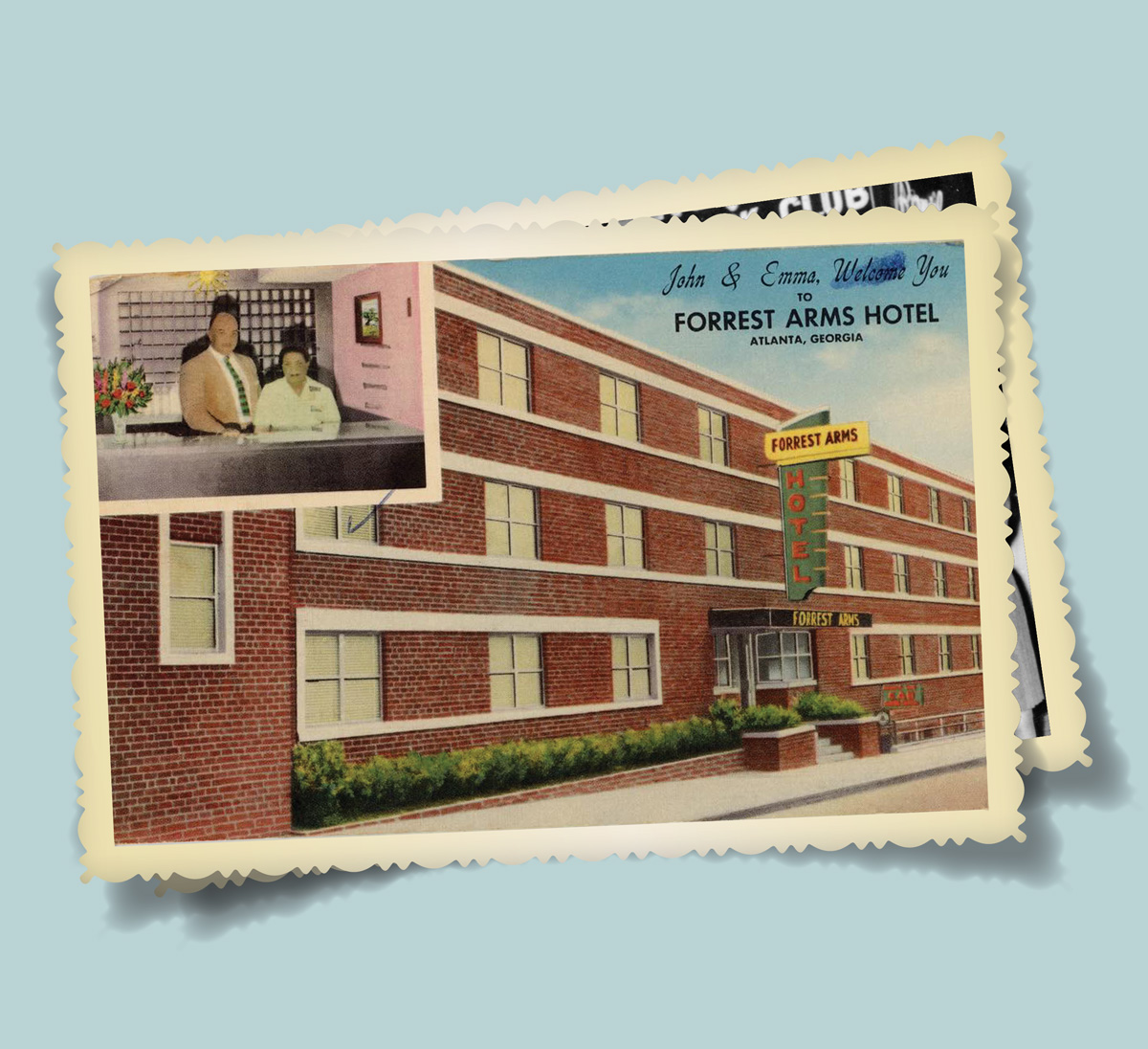
If you walk east on Ralph McGill Boulevard from Piedmont Avenue in the Old Fourth Ward, you won’t see any evidence that the Forrest Arms Hotel ever existed. There’s no trace of the building, a three-story, U-shaped red-brick construction that, between 1955 and 1965, hosted pretty much every prominent Black entertainer who passed through Atlanta. Over its decade-long existence, guests included Louis Armstrong, Ray Charles, James Brown, and Sam Cooke, as well as many well-known Black athletes and civil rights leaders.
“It was an entertainer’s paradise,” says William Bell, the 85-year-old Grammy-winning soul singer and songwriter. In 1961, Bell, fresh off his first single, was hired to play with Dionne Warwick at the famed Royal Peacock Club on nearby Auburn Avenue. Bell booked a room at the Forrest Arms for the first time. “Before integration, we could only stay at certain hotels,” he says. “The Forrest Arms was the in place for Black acts in Atlanta.”
Today, it’s been almost entirely forgotten. The property where the Forrest Arms stood is now Georgia Power’s corporate headquarters, a handful of anonymous-looking office buildings. Search online or in old newspapers, and you’ll find only scattered references to the hotel. Even rummaging through tax records turns up little.
“Not many people from that era are still alive,” says Bell.

Photograph courtesy of the Ross Ingram Collection at the Kenan Research Center at the Atlanta History Center
The story of Forrest Arms, with its brief dazzle and ultimate disappearance, was shaped by the same forces that have continuously transformed the city at large, rendering whole blocks unrecognizable from one decade to the next.
In its day, the hotel sat at the corner of Butler Street and Forrest Avenue. The latter, named for Nathan Bedford Forrest—a Confederate general and the first Grand Wizard of the Ku Klux Klan—was rechristened in 1980 in honor of former Atlanta Constitution editor Ralph McGill.
Meanwhile, the stretch of Butler Street where the hotel’s front doors opened was erased from maps a few years after the hotel was razed. Both were casualties of a so-called urban renewal project in which the city razed the historic Black community of Buttermilk Bottom to build the Atlanta Civic Center, a sprawling performance and conference venue that shuttered for good in 2014.
Although the Forrest Arms’ footprint has faded from view, for a decade in the late ’50s and early ’60s, it was a hub of Black cultural life in the city. “Everybody who worked the Royal Peacock stayed at the Forrest Arms,” recalls Bettye LaVette, a Detroit-based R&B singer who first visited the hotel in 1963 while on the road with Bell, Otis Redding, and Solomon Burke. Before the Civil Rights Act of 1964 outlawed segregation, the Forrest Arms was one of a few places in Atlanta where Black travelers could not only get a room but also meet and conduct business.
“There was a lot I couldn’t do in Georgia at that time,” says LaVette. “One of the first things my mother told me when I went on those first tours through the South was ‘Don’t you be trying to talk to those White people, and don’t be looking in their faces.’”
It was LaVette who first told me about the Forrest Arms, in 2020, when I was interviewing her for the New York Times and she found out I lived in Atlanta. The hotel wasn’t particularly luxurious, she recalled, but the camaraderie and community made an impression on her. Segregation had created an uneven playing field, but it also carved out uniquely Black spaces like the Forrest Arms. Lavette recalled a hotel full of musicians—not only those passing through town, but also some who lived there for long stretches, among them Etta James, Hank Ballard, and Jimmy Reed.

Photograph courtesy of Associated Press
When I started researching the place, I tried to track down another of those full-time residents, Odell “Gorgeous” George, a singer, emcee, tailor, and valet for many entertainers, who several people told me was a big part of the Forrest Arms story. “He knew absolutely everybody,” says LaVette. But when I connected with his daughter, she told me he’d been very ill battling dementia and was no longer able to do interviews.
This is the reality of uncovering history from this era. There aren’t many around who still remember, and time is running out. At one point in my research, I reached out to Jerry Butler of The Impressions. The following day, he died. As LaVette puts it, “So many of us are gone. We seem to die off in clumps.”
From the recollections I could gather, the Forrest Arms was a communal kind of place. Musicians would habitually stay up late, hanging out in hotel rooms and the courtyard—playing music together, partying, or talking. “There was always something to do,” says Bell. “I ran into Ike and Tina Turner, Jerry Butler and The Impressions, Gladys Knight and the Pips, all the Motown acts. That’s how we got to know each other.”
Bell worked closely with Gorgeous George for years. “He had a room on the bottom floor there, and his roommate for a while was Jimi Hendrix,” says Bell. According to an interview he gave to Rolling Stone, George helped a prefame Hendrix secure a gig in Little Richard’s band.
Legendary trombonist Fred Wesley, a cornerstone of James Brown’s band and later Parliament-Funkadelic, first visited the hotel in 1963 as part of Ike and Tina’s band. “I learned a lot at the Forrest Arms,” says Wesley. “It was very important to me as a young guy who’d just gotten on the road.” Wesley met Hank Ballard at the hotel, where he jammed with Ballard’s group, the Midnighters. Afterwards, they invited him to join; he quit Ike and Tina’s group on the spot. “That’s where I made that transition.”
This sort of cross-pollination between musicians from all over the country helped shape the direction of R&B, soul, and rock ‘n’ roll through the ’50s, ’60s, and beyond. “It was an exciting time,” says Bell. “All of us were just getting our careers started.”

Photograph courtesy of Don Paulsen/Michael Ochs Archives/Getty Images
The Forrest Arms was managed by John Eddie Jefferson and his wife, Emma—“They were mom and pops to us,” says Bell—but was owned by a White real-estate developer named Pat Kimbrough. He died in 1967, but his son, Bud Kimbrough, has clear memories of working at the hotel as a teenager.
“My dad didn’t want anyone to know that a White man owned it. He just wanted to stay out of the limelight and make the money,” says Kimbrough. “That’s why they hired Johnnie Jefferson. Everyone thought Johnnie owned the hotel.”
The neighborhood around Forrest Arms, Buttermilk Bottom, was almost entirely Black and had been neglected by the city for decades. Despite unpaved streets, a lack of electricity, and frequent flooding, the area was bustling with commercial activity. Wesley recalls a restaurant near the hotel, Ford and Mae’s, that “had great butterbeans and rice for 50 cents a bowl.”
In 1964, the city began solidifying plans to build the Civic Center. Using eminent domain laws and federal urban renewal grants, the city displaced thousands of Black residents and bulldozed C.W. Hill Elementary School. The city paid the Kimbroughs $1 million in exchange for closing the Forrest Arms in 1965—a lucky break, says Bud Kimbrough, because under the new Civil Rights Act, the hotel’s Black customer base now had many more options across the city. “It was a godsend,” he says. “Everybody would’ve gone to the White hotels after integration.”
But for the rest of the neighborhood, things were never the same again. “The Forrest Arms was like our Ritz-Carlton,” says Lucius Gantt, who lived a few blocks away. He’d been a student at C.W. Hill Elementary and was a teenager when the hotel was leveled.
“It wasn’t just a hotel. It was a gathering place,” says Gantt. He had friends who’d go there to shine shoes, sell fruit, or spot celebrities. “The whole area around it, you had Black entrepreneurs: restaurants, taxicabs, dry cleaners, bakery, the neighborhood bar. It was a thriving place. That’s all gone now.”
After the hotel closed, Jefferson, the Forrest Arms’ manager, worked to open his own motel. By the end of 1968, he’d put a down payment on a parcel of land nearby and secured financing from a local bank. A succession of stories in the Atlanta Journal and the Atlanta Constitution—one by Ralph McGill himself—trumpeted the deal, with one calling it “a new breakthrough for Black capitalism through the use of White-controlled money.” It doesn’t appear the new motel ever opened: According to a 1971 city directory, Jefferson was working as the manager of Hood’s Service Station on Edgewood Avenue. He died in 1984.
It’s a sadly fitting coda to the Forrest Arms’ story. The hotel’s legacy as an anchor for a flourishing Black community during a tumultuous era and an important incubator of a wildly creative cultural moment lives on in the memories of the few still around who experienced it—but virtually nowhere else. “It was a happening place and a special time,” says Bell. “But it’s something that gets lost in history, unless someone writes it down.”
This article appears in our July 2025 issue.