


Illustration by Sébastien Thibault
On a Sunday morning in September outside a coffee shop in Alpharetta, a dozen volunteers are gathered, most of them women, filling out name tags and sipping on lattes. They are preparing to knock on doors for Debra Shigley, a Democrat battling Republican Jason Dickerson in a runoff race for a Georgia State Senate seat. (Shigley ultimately lost the race to Dickerson, 61 percent to 39 percent.)
Among the volunteers is Barbara Peters, a recently retired Dahlonega resident and first-time canvasser. Peters admits she would much rather be having brunch with friends or relaxing at home on the weekend, but she’d made the 40-mile drive to support Shigley because of her terror at the current state of the nation.
“I’ve never been highly political, but I’m becoming political because I feel like we’re in danger,” says Peters, the daughter of a Jewish refugee who immigrated to the United States in the 1930s. Shigley doesn’t represent Peters’s district, but she joined her campaign because Peters believes that getting involved in local and regional elections is the best avenue through which citizens can have their voices heard.
In Georgia, suburban women are becoming a dominant political force. They are getting involved in local and state races, writing postcards, canvassing, and participating in phone banks—and, increasingly, they are running for office themselves. In 2016, women represented 24 percent of the seats in Georgia’s General Assembly, but today they represent 34 percent, according to figures compiled by the Center for American Women and Politics.
Around metro Atlanta, suburban women’s political engagement has been key to shifting Georgia further to the left. After decades of Republican domination, Democrats have made substantial gains in Atlanta’s suburbs in the past three presidential elections. Since 2017, suburban women have helped flip 17 seats in the Georgia General Assembly from red to blue, according to Georgia WIN (Women in Numbers) List, a political action committee that supports pro-choice candidates.
“We focus on reproductive freedom, but our women are also strong advocates for public education, healthcare, and gun safety,” says Executive Director Melita Easters. She notes that many of the women whom Georgia WIN List has helped to elect are mothers of young children, whose perspective, she argues, is crucial to shaping policies on childcare, schools, and healthcare access.
“We really have made an effort to recruit and make sure that we always have women with young children in the legislature,” Easters says, “because they bring the perspective to the table where the decisions are made and the budgets are crafted.”
For decades, Georgia’s suburbs, such as Cobb, Gwinnett, and North Fulton counties, were Republican strongholds. Cobb County was once represented in the U.S. House by Republican Newt Gingrich, a former Speaker of the House and a staunch conservative. But shifting demographics in these areas has changed the political map and opened up opportunities for Democrats.
“In the last 20 years, Georgia has become more competitive because of migration patterns,” says Andra Gillespie, a political science professor at Emory University. She points to a reverse migration of African Americans returning to the South, rising Latino and Asian American populations, and an influx of young professionals to metro Atlanta.
That growth has made suburban areas more racially diverse, more economically varied, and, crucially, more politically contested. The Sixth Congressional District—the seat long held by Gingrich—is a prime example of how voters have shifted toward blue. In 2017, Democrat Jon Ossoff narrowly lost to Republican Karen Handel in a special election. But a year later, Democrat Lucy McBath flipped the seat blue, reflecting the changing constituency of the area.
“These are the places where women are knocking on doors, running for office, and reshaping political life,” Gillespie says.

Photograph courtesy of Georgia Postcard Project

Photograph courtesy of Georgia Postcard Project
For busy suburban women—juggling kids, jobs, and other activities—volunteer opportunities like the Georgia Postcard Project offer an easy way to get involved. Tricia Gephardt launched the organization in 2019 as a hobby, but when Covid-19 pandemic lockdowns kept people from traditional door-to-door canvassing a year later, the initiative exploded into a statewide effort, even garnering interest from out-of-state volunteers. Ahead of the January 2021 senate runoff, the group helped distribute half a million postcards.
“It gave women, especially new moms stuck at home, a way to connect and feel empowered,” Gephardt says, noting that 89 percent of the postcard project’s volunteers today are women. “They would put their kids down for bed at night, and they would write postcards, and that was the way they could feel connected to a bigger group.”
Social media has also provided a platform to amplify women’s voices. Milton resident and former media literacy advocate Lindsay DeFranco went viral earlier this year when she recorded Congressman Rich McCormick being confronted by constituents at a town hall as they challenged his stances including a recent comment dismissing the importance of free school lunches. That clip garnered more than 6 million views, inspiring DeFranco to consider a bid for office herself.
“That really got me thinking: If this guy can be a politician, why can’t I do it?” she says. “The imposter syndrome evaporated out of my body.” Now, DeFranco is running for a seat on the Fulton County school board.
Cherokee County resident Gail Petrakos believes grassroots movements lay the groundwork for effecting change at higher levels of government.
“We can’t start at the top. When you build a house, you start at the foundation,” Petrakos says. A former Republican who now backs Democrats, Petrakos didn’t begin as a political organizer, but in recent years, she has taken up postcard writing and phone banking and has even participated in protests. Her activism is fueled both by policy concerns, such as childcare and affordable housing, and by disillusionment with what she sees as the Republican Party’s drift toward extremism.
“I’m doing this for my children and future grandchildren,” she explains. “I want them to experience democracy and all the rights I had.”
But left-leaning women are not the only ones summoning their peers to get boots on the ground. Conservative women, too, have been reasserting their presence after losing ground in recent elections.
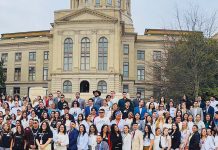
Women Lead Right, a Republican grassroots group, launched in February 2022 at the Georgia State Capitol with a mission to bring back suburban women who had drifted from the GOP in the Trump era.

Photograph courtesy of Women Lead Right
“Our focus will be the formerly reliable Republican female voter, who elected not to engage in Republican primaries after 2016. We must win these women back,” says Leah Aldridge, former GOP state senate candidate, in a press release posted on the organization’s website when its Atlanta campaign first launched.
Just as Georgia WIN List provides training to pro-choice candidates, Women Lead Right offers resources to conservative women to run for office, noting that while Georgia ranks 22nd in female legislative representation, most of those women are Democrats. The training program aims to empower Republicans to close that gap.
Former Smyrna City Council member and state representative Teri Anulewicz believes the influence of suburban women is only growing. “We can be angry about what’s happening in Washington, but we can also do something about how our police department works, how our schools are run, or how much we pay for utilities,” she says. “That’s where suburban women are stepping in.”
One such local race that’s drawn interest this year is for a seat on the state’s Public Service Commission—“one of the most important offices that you’ve never heard of,” says City of Atlanta Chief Sustainability Officer Chandra Farley. She moderated a September panel on behalf of the nonpartisan League of Women Voters to demystify the commission’s impact on energy infrastructure. The panel drew more than 100 virtual attendees—an impressive audience for a relatively obscure race.
Anulewicz notes that these are the very elections that suburban women are most well suited to influence, as they often manage paying the bills for their households. “I’ve seen it recently, just in my own neighborhood,” she explains. “A lot of mothers being like, ‘Why is [the electric bill] so high?’ and realizing, ‘Oh, it’s because the PSC has allowed Georgia Power to continue to raise rates.”
Georgia’s suburban women will likely play a key role in the year to come. The state will have an open governor’s race in 2026, alongside a high-profile U.S. Senate election; dozens of state legislative seats will also be up for grabs. Regardless of their political affiliation, suburban women are increasingly stepping into civic participation, making their voices heard even as partisan rancor discourages some from taking a stand.
“Suburban women are multitaskers by nature,” Petrakos says. “We’re mothers, workers, caregivers. We don’t have time for excuses. We just get involved.”
This article appears in our November 2025 issue.