


 In 1994, when East Cobb resident and ardent soccer fan Mike Holmes was 14, the FIFA World Cup took place in the United States—but in a very different landscape. The soccer culture we now see in America was in its infancy, with no internet or social media for the interested. Soccer was mostly a curiosity in Holmes’s galaxy, but he became intrigued after getting a poster of the World Cup bracket (a la March Madness) and putting it on his bedroom wall in his childhood home in New Jersey.
He filled in the bracket throughout the tournament and wrote the scores for every match. On the Fourth of July, Holmes persuaded his family to forgo hot dogs and fireworks and instead host a watch party for the Round of 16 match between the United States and Brazil. The U.S. lost 1–0, but Holmes was hooked anyway.
“I was all in,” he says. “I wanted everything: the jerseys, stuffed mascots, sticker books.” Holmes’s family moved to Atlanta that fall, and more than 30 years later, the World Cup returns to the United States this summer, with Holmes’s adopted home among the host cities.
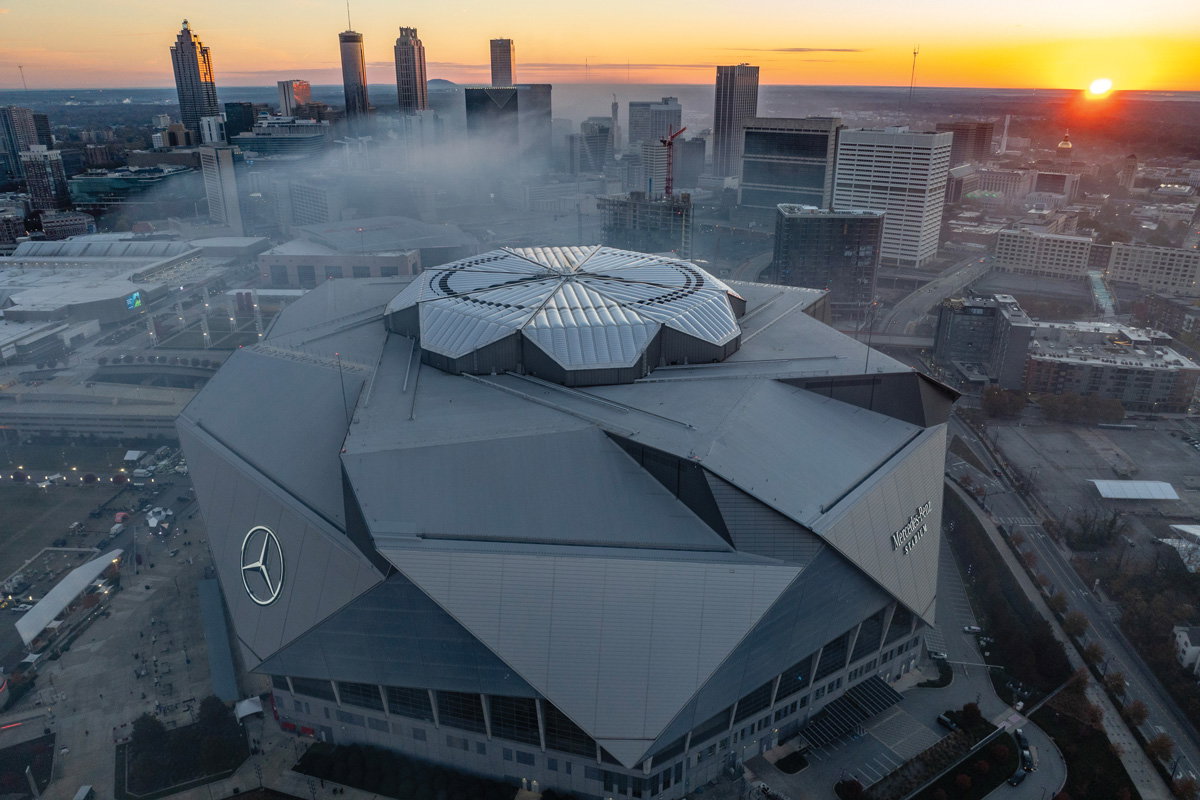
The World Cup still offers a chance to fall in love with soccer and engage in something global. The United States hosts the 2026 edition alongside Canada and Mexico; in total, 48 countries will compete. Atlanta will host eight matches, starting with a group stage match June 15 and ending with a semifinal July 15.
Winning the World Cup is considered the most significant international achievement in sports, and it’s easy to see why. The Olympics celebrates individual greatness but comprises dozens of events that require different skills. In the incorrectly named World Series, only teams from North America compete. The World Cup, meanwhile, is focused on a single sport—soccer—and almost every country has a chance to contend.
To get to this year’s World Cup, 206 nations from every continent (except Antarctica) played nearly three years of qualifying matches, pitting tiny nations such as Andorra (population 83,000, similar to Johns Creek) against soccer behemoths such as England. The nation that wins this summer truly represents a world champion.
The city already sees 1.3 million annual international visitors on average. Those coming for the World Cup should add at least 500,000 more. FIFA leaders and Atlanta stakeholders have likened hosting the eight matches to hosting eight Super Bowls. An economic impact study commissioned in July 2024 by the Metro Atlanta Chamber of Commerce estimates the World Cup will generate $503.2 million for the state. Then there’s viewership: 325 million people around the globe tuned in for the 2022 World Cup semifinal—that’s more than double the Super Bowl. The 2022 final drew 1.5 billion eyeballs, or 10 Super Bowls.

Courtesy of Mercedes-Benz Stadium
“I think the World Cup is important to our city because this is another opportunity for us to ascend to the international stage,” says William Pate, president of the Atlanta Convention and Visitors Bureau. “The more we can stay on the radar screen, the more we have . . . the opportunity to really show the city off through the broadcast. We think there’s an opportunity to whet people’s appetite to come to Atlanta for leisure travel.”
Pate says this type of exposure could lure international business to Atlanta as well: “When you have an opportunity to have an event of this magnitude, with this many international viewers watching, I’m sure we’ll take full advantage of that.”
This summer’s World Cup matches will constitute another thread (or eight) in Atlanta’s rich soccer-culture tapestry. In 1968, the city’s first professional sports title went to the Atlanta Chiefs, who won the North American Soccer League championship. Of course, there’s now Atlanta United, which lifted the MLS Cup in 2018 and, since its founding in 2017, has led the league in fan attendance at Mercedes-Benz Stadium every season except for the pandemic-shortened 2020 season. Mercedes-Benz will also host a National Women’s Soccer League team starting in 2028. And this summer, the United States Soccer Federation’s new headquarters will open in Fayette County.
This summer’s World Cup will bring the sport full circle for Holmes. He now has a 13-year-old son who he hopes will fall as hard for soccer as he did in 1994.
“There’s just something different about cheering on the USA in the World Cup,” Holmes says. “Baseball, football are all great sports, but when it comes to the international stage, soccer is still the biggest thing by far.”
Atlanta Schedule
MONDAY, JUNE 15
12 p.m. ET
Spain vs. Cabo Verde
(Group H)
THURSDAY, JUNE 18
12 p.m. ET
South Africa vs. Czech Republic
(Group A)
SUNDAY, JUNE 21
12 p.m. ET
Spain vs. Saudi Arabia
(Group H)
WEDNESDAY, JUNE 24
6 p.m. ET
Morocco vs. Haiti
(Group C)
SATRUDAY, JUNE 27
7:30 p.m. ET
Uzbekistan vs. Democratic Republic of the Congo
(Group K)
WEDNESDAY, JULY 1
Round of 32
TUESDAY, JULY 7
Round of 16
WEDNESDAY, JULY 15
Semifinal
This article appears in our June 2026 issue.