
Home 2025

Archives

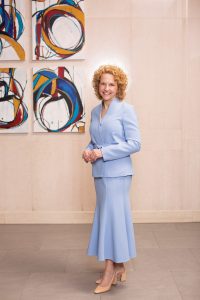
Lisa Anders

If a TV show or movie was filmed in Gwinnett County, Lisa Anders can quickly name the location on screen. For example, the Gwinnett County Jail makes an appearance in Ozark, the Netflix drama starring Jason Bateman. “It’s kind of amazing because you realize how much effort and skill it takes to turn almost nothing into anything,” says Anders, executive director of Explore Gwinnett. “We’ve had the Gas South District used as an airport, and no one knew the difference on TV.”

Now in her 29th year at Gwinnett’s official destination marketing organization, Anders has helped shape Georgia’s largest county into a major player in the film industry, an undertaking the state tasked her with a decade ago. Since then, the Gwinnett’s Film Office has grown substantially, earning official film commission status in 2024, and becoming involved in everything from locations assistance and permitting to partnerships.
Hit shows such as Stranger Things and Tulsa King are among the productions filmed in the county, but the value goes beyond seeing stars. “It aligns with everything we do because not only is it bringing that economic development into Gwinnett, but it’s also bringing film crews into our hotels on a very regular basis,” says Anders. The influx of crews also benefits local restaurants, and there are other ancillary revenue streams like tours of on-screen locations.

Beyond film, Anders helps locals fall in love with their own county. Initiatives like Burger Week, in which chefs around the county make a signature burger for $10, and Artober, a month-long fete of arts and culture events, encourage residents to explore beyond their bubbles. “There’s so much opportunity because we’ve got so many cities, and they’ve got so many different personalities,” says Anders. And when people come for conventions, the locals know where to send them, turning everyday residents into ambassadors for Gwinnett.”
– LIA PICARD

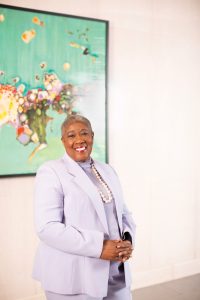
Terri Block

Terri Block doesn’t just talk about change; she makes it happen. For 25 years, she’s led social-impact initiatives that ensure Atlanta’s small businesses and charitable foundations thrive. As Atlanta market executive for Bank of America, she has directed millions in local grants, mobilized employees to contribute more than 300,000 volunteer hours, and championed partnerships creating lasting stability and growth across the metro area. “We can’t solve all our communities’ problems, but I am proud of how our team has helped make a difference,” Block says. However, for her, this work is more than just a professional mission—it’s deeply personal.

Raised in a single-parent home with her mother and grandmother, Block experienced the effects of financial insecurity throughout her life. “I know firsthand the challenges that come with finding affordable housing, understanding credit, and securing a good-paying job,” she says. “These are not abstract policy discussions; they are real, everyday barriers that determine whether families can thrive or remain in a cycle of financial insecurity.” Her personal experience fuels her commitment to expand access to affordable housing, workforce training, and small-business development in Atlanta.

Through partnerships with organizations such as Atlanta Land Trust, Enterprise Community Partners, CareerRise, and the United Way, she is working to bridge opportunity gaps to build a stronger, more inclusive Atlanta. Under Block’s leadership, Bank of America has distributed over $40 million in local grants since 2018. She cochaired a fundraising campaign with Sweet Auburn Works that exceeded its $6 million goal and spearheaded a collaboration with the Grove Park Foundation, leading Bank of America to invest over $2.7 million for revitalization projects in the northwest Atlanta neighborhood.

With an unwavering commitment to philanthropy, Block is helping to shape a future where all Atlantans have access to opportunities that foster economic stability. “In metro Atlanta, where affordability and economic disparities continue to grow, these focus areas are crucial in shaping a more equitable and sustainable future,” she says.
– TYRA DOUYON

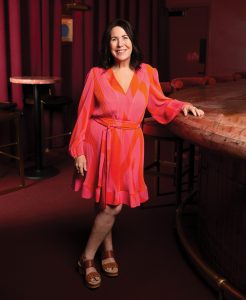
Leigh Burns

Over the years, the Fox Theatre, founded in 1929, has made a name for itself as the home of world-class programming. Pull the curtain back, however, and there’s even more to the institution. It is a steward of historic preservation and arts programming throughout the state—an effort led by Leigh Burns.

Burns is the director of community partnerships for Fox Gives, which has awarded $4.2 million in grants to 61 historical theaters since 2008. The funds go towards preserving the venues as historical landmarks, which in turn boost local economies. In 2022, the nonprofit arts and culture sector generated $1.3 million in economic activity alone. “The Fox wants to pay forward its success, and we saw a need for technical assistance through rehabilitation for theaters throughout Georgia,” says Burns. “We offer that, plus professional development, education, and grants.”

Theatres such as the Plaza Theatre in Poncey-Highland, downtown’s Theatrical Outfit, the Morton Theatre in Athens, and the Piedmont Grand Opera House in Macon have received help from Fox Gives. “We’ve made efforts to invest in theaters that not only want to provide the best experience, but also help diversify programming and education and recapture their audience,” says Burns.

Her approach to partnerships is creative, combining education, preservation, and empowerment through community-driven engagement. Two such programs are Fox in Box, an interactive school program about preservation available in English and Spanish; and All-Access Pass, which provides hands-on technical experience to high schoolers. Burns has been instrumental in reaching nearly 70,000 students across 200 schools.

It’s important groundwork to keep Georgia’s theaters running and the arts top of mind. “We want people to find a sense of identity locally,” Burns says. “We love for them to come to the Fox, but we also champion the preservation of these smaller theaters. We think it’s important that audiences, especially kids, learn that personal connection and have a sense of ownership in their community.”
– LAUREN FINNEY HARDEN

Laura Emiko Soltis

Laura Emiko Soltis’ sense of justice developed early. As a teenager in rural Minnesota, she tended the cornfields with other working-class kids while Latinx migrant workers handled soybeans. “We would even eat lunch separately, and I remember wishing I could speak with them,” she recalls.

In her international relations classes at UGA, Soltis started to think critically about her experience and eventually joined the Student Farmworker Alliance to work with the Coalition of Immokalee Workers, a worker-based human rights organization. “While I obtained my PhD from Emory University, I received my political education from Mexican, Maya, and Haitian migrant workers in the tomato fields of South Florida,” Soltis says. “They taught me that change requires both consciousness and commitment.”

Both qualities are key to Soltis’ work at Freedom University, a modern-day freedom school for undocumented students banned from equal access to higher education in Georgia. Soltis first joined as a volunteer staff member in 2013, but in June 2014, the school closed when the founding faculty left. Just three months later, Soltis reopened it with a human rights framework whose objective is to restore dignity to students. “We began fighting back—empowering students to assert their human rights and leading campaigns to create their own pathways to higher education,” she says.

Human rights may be the cornerstone of the university, but Soltis emphasizes that collective action is the true path to change. To this end, she invited key participants like Atlanta Civil Rights activist Lonnie C. King Jr. to strategize with students. “These individuals desegregated the same public universities in the early ’60s that are now banning undocumented students,” Soltis says.

While her pupils may speak different languages and have different immigration statuses, they are all part of a community. “The best part of my day is hearing their laughter and knowing that despite the bigotry they experience, from nearly every corner of society and every level of government, they find so much joy when they are together.” – TESS MALONE

Kim Menefee

Kim Menefee, executive director for the Cumberland Community Improvement District (CCID), brings together commercial investors, government officials, and other stakeholders who have an interest in improving the area, primarily through transportation and infrastructure projects. The first of its kind in the state, the CCID has invested $180 million since its founding in 1988, creating $20 billion in economic impact in Cobb County.

Menefee has been at the helm since 2019, overseeing improvement projects such as the Cumberland Sweep, a three-mile path that will connect the district through walking and biking lanes and a self-driving shuttle system; and the New Day Palisades rehabilitation project at Paces Mill, which will build a visitor information center, provide safety updates and better river access, and rethink river runoff. “The Cumberland CID leverages our [commercial property owner taxpayer] funds to build out projects that focus on creating greater access, connectivity, and character within our area,” she says.

One such project is the Akers Mill ramp, which granted 100,000 daily commuters more direct access to Cumberland when it debuted this past spring. Menefee oversaw the teams responsible for landscaping, lighting, and maintenance in the district, the 12th and final access point within the toll system on I-75.

Menefee is also in charge of One Cumberland, the nonprofit arm of the CCID. Created in 2023, it aims to improve quality of life for the district’s 88,000 workers, 31,000 residents, and millions of visitors through safety measures and community events. “I’m proud of the character we’ve created in the district and the improved quality-of-life measures,” she says.
While the instant gratification of seeing the district’s projects come to fruition is satisfying, Menefee is most interested in long-term impact. “Everything we build brings generational improvements. We’re seeing how past benefits have made a difference in this community,” she says. – LAUREN FINNEY HARDEN

Guiomar Obregón

When Guiomar Obregón cofounded and stepped into the role of president of the Georgia Hispanic Construction Association (GHCA) in 2012, she had a specific plan in mind. “I knew what Hispanic contractors needed because I recognized what was lacking,” she says. Much of that knowledge came from her experience as CEO of Precision 2000 Inc. (P2K), the construction company she founded with her husband, Carlos Sánchez, nearly three decades ago. “Small contractors needed education and training opportunities,” she says. “They needed to know how to get bonded, develop banking relationships, get loans, read and write contracts, and manage their accounting.”

Fortunately, Obregón had years of experience to tap into. Born in Boston and raised in Colombia by parents who were both civil engineers, she was naturally drawn to the field. She earned a civil engineering degree from the Colombian School of Engineering and a master’s degree in civil engineering from Georgia Tech—the latter of which emboldened her to consider entrepreneurship. Following the construction boom spurred by the 1996 Olympic Games in Atlanta, Obregón and Sánchez, also an engineer, launched their own firm focusing on infrastructure projects for clients such as the city of Atlanta, the Georgia Department of Transportation, and Hartsfield-Jackson Atlanta International Airport. During the Covid-19 pandemic, P2K even found a way to begin producing its own concrete despite shortages. “You have to see the opportunities in the challenges,” Obregón says.

That innovative mindset is something Obregón wants to share with future generations of engineers and construction professionals. It’s why she not only helped form the Latinas in Construction subgroup for the GHCA, but also launched the P2K Scholarship Program at Georgia Tech, which helps women and Hispanics become civil engineers. “Education is a game changer,” she says. “We want future employees to see that what we do is really important.” – AMY MEADOWS

Eslene Richmond-Shockley

In 2001, businesswoman Eslene Richmond-Shockley set out on a new path. “I was trying to get back into corporate America, but I felt a call from God to feed and clothe the people in my community,’” she says. With a meager fund of $25, Richmond-Shockley endeavored to organize a food drive for seniors in her Poole Creek community. She rented a warehouse off Browns Mill Road for three months for $1 and got to work. “Word got around that I would be helping for Christmas, and people reached out to ask if they could be on the list to get food,” she says. “We were able to get them the groceries they needed for a good holiday.”

Twenty-four years later, Richmond-Shockley runs Caring for Others to provide aid to her community—all from that original warehouse (and a few more she’s acquired since). In 2024, Caring for Others served almost half a million individuals. With 10 full-time employees, plus corporate sponsors, the organization does everything from running the South Atlanta Food Bank to providing clothing and housewares for hurricane survivors. Richmond-Shockley knows personally how easily losing everything can lead to poverty. “I lived it growing up in Guyana,” she says. “It’s easy to do the work when I’ve experienced it myself.”

The ultimate goal of Caring for Others isn’t just to put a meal on the table, but to eradicate poverty—in Atlanta and beyond. Each year, Caring for Others hosts the International Poverty Forum to gather international leaders to address the issue of global poverty. Even as Richmond-Shockley’s work has received recognition from the Biden Administration, it’s still the individual community members that mean the most to her. “One time I went to my CVS, and this cashier stopped me,” she recalls. “They said ‘I have to give you a hug because you started my life over again by giving me new furniture after Katrina.'”– TESS MALONE

Denise Starling

Women Making a Mark honoree Denise Starling

For Denise Starling, being on the move is a strategy, not just a statement. As executive director of Livable Buckhead for over two decades, she has been at the forefront of transforming the district into a more eco-conscious, connected community. In this role, she facilitates the transportation, sustainability, and workforce housing initiatives that will reshape Buckhead’s future while staying true to one guiding principle: innovate or die. “Innovation isn’t just about chasing big ideas; it’s about solving real problems in smarter ways,” she says.

Starling’s journey began in 1999 when she realized Buckhead’s traffic and air-quality issues weren’t just daily inconveniences, but barriers to a thriving community. She wanted to do more than simply reduce the amount of time people spent in traffic. That epiphany led to the creation of Livable Buckhead, which has since developed major projects such as PATH400, a greenway designed to connect neighborhoods and provide a safe route for bikers. She also established the Buc, Atlanta’s first micro-transit service, which has reduced 7.4 tons of carbon emissions and eliminated over 15,000 vehicle trips since 2022.

Transit isn’t Starling’s only focus. She also tackles workforce housing affordability, an often-overlooked piece of the transportation puzzle. “Every single day, 92 percent of Buckhead residents leave to work elsewhere, while 92 percent of the workforce commutes in from outside the area,” Starling says. To address this disparity, in 2011 she launched Live.Work.Buckhead, an initiative providing rent subsidies to help workers live closer to their jobs. Starling’s leadership also extends to sustainable development; her team encourages developers to use lower-carbon materials in new Class-A properties, helping to reduce the district’s emissions.

Looking ahead, Starling envisions a fully connected PATH400 with the Atlanta BeltLine, expanded transit options around the city, more green spaces, and policies that prioritize walkability. “Our work has grown significantly, but our core values have remained the same,” she says. “We must be committed to inspiring innovation, change, and a sense of community.” – TYRA DOUYON

Dean Crowe

Women Making a Mark honoree Dean Crowe.

Dean Crowe studied journalism in college and began her career working in the banking industry—running a research foundation wasn’t part of her plan. In 2005, however, a pivotal moment inspired Crowe to found Rally Foundation, a nonprofit that funds pediatric cancer research, and she hasn’t looked back.

It started when her son’s baseball teammate, William, was diagnosed with brain cancer in the early 2000s. After he relapsed, Crowe visited him and his parents at the hospital and asked what they really needed. His mother challenged Crowe to raise money for childhood cancer— not just brain cancer but all forms of childhood cancer, including leukemias, lymphomas, and central nervous system tumors. Crowe realized how underfunded the field is, and she was all in. “Some of the larger organizations really only focused on adult cancers, so it became evident that there was a need,” she says.

Getting people to “rally” for Rally was easy. “I knew that people would want to help, even if they didn’t necessarily know a child with childhood cancer,” Crowe says. “When you see the pictures and hear the stories, you want to get involved.” In the ensuing years, Rally has raised more than $40 million, funded peer-reviewed studies around the country, and expanded with offices in Nashville, Pensacola, and Salt Lake City.

“There are kids alive today because of Rally assisted research,” Crowe says. “We see ourselves as philanthropic seed investors in the next great discovery.” Working in childhood cancer research brings the “highest of the highs and the lowest of the lows,” Crowe admits. But the families Rally supports keep her motivated. She keeps in touch with all of them. “They become part of your life and they become your friends,” Crowe says. “You want them to know that you love and care about them.”
– LIA PICARD

Cynthia Curry

Women Making a Mark honoree Cynthia Curry

Nature has always been fundamental to Cynthia Curry’s life. Although her family moved across the Southeast when she was a kid, mountain hikes were a constant that continued even when she attended UGA. “For years, I slept in the woods most every weekend a year into my young adulthood,” she says. Even as she made a name for herself working in tech, preserving nature through sustainability and community remained a focus. Now it’s her fulltime role as senior director of cleantech ecosystem expansion with the Metro Atlanta Chamber.

Curry is a connector, bringing in technologies designed to reduce environmental impact across 29 counties in the metro area. “My role is that of an ecosystem builder that shows communities how they can leverage technology for good,” she says. “Atlanta understands what cleantech is now and how it can help us reach the future we want and create jobs.”

One of Curry’s main roles is to help break down silos between industry, corporate, civic, and educational stakeholders so everyone can be involved with helping build a better Georgia. “Collaboration is Atlanta’s superpower,” she says. “A lot of my work is to help forge partnerships.” This can be as simple as creating educational social hours for the cleantech industry or as difficult as convincing a company that Georgia is the right place for their business. When South Korea’s electric battery company, SK On, came to the region, Curry introduced them to the right people and companies—from utility providers to
economic developers—to ensure business went smoothly. She was also pivotal in bringing Qcells, a solar panel company, to Dalton.

Curry has helped put Georgia on the cleantech map: The state is a leader in clean energy job creation with 43,000 new roles since 2022. And Curry isn’t stopping there. “Five years from now, I want Atlanta to set an example of how cleantech can inspire equity,” she says. “It’s a wonderful way to create jobs and a better world for future generations.”
– TESS MALONE

Follow Us

69,386FansLike
144,836FollowersFollow
493,480FollowersFollow

NEWSLETTERS