


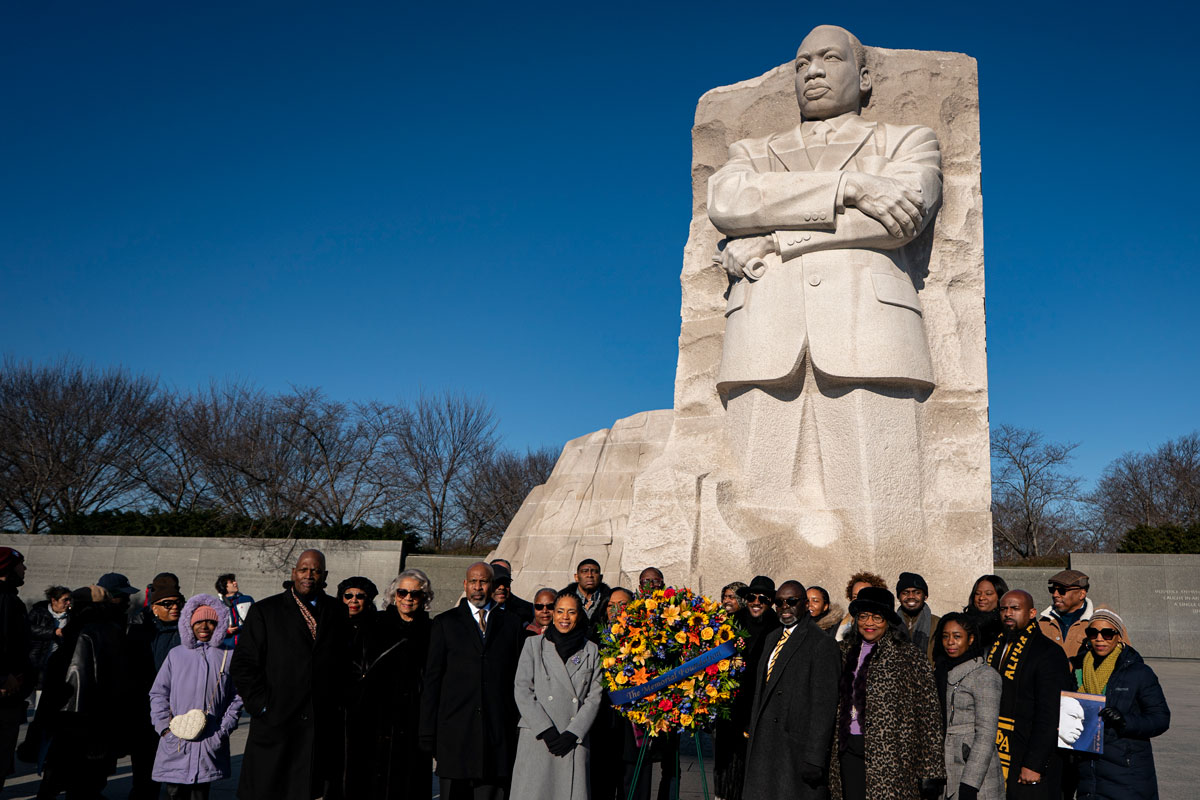
Photograph by Al Drago/Getty Images
I was shocked by many things when I moved to Rhode Island in 1988 to work at the Providence Journal. “Big hair” (aka “helmet hair”) was the fashion rage for women, a style that required enough hair spray to be a walking hazard to the ozone layer. The local accent was harsh and shrill and muted the letter r in words. The city of Warwick, for example, was pronounced “Waw-wick.” But nothing shocked me more than when I learned Rhode Island had yet to observe the Dr. Martin Luther King Jr. holiday, which was federalized in 1983, with official observance beginning in 1986. In the middle of the liberal bastion of New England, how could that even be possible? It was first observed in Georgia in 1986, thankfully replacing Confederate Memorial Day as an official holiday.
On MLK Day that year, I was assigned to go to a high school in the northern suburbs and write a story about a history teacher who always devoted the holiday to teaching about the civil rights movement. To his 16-year-old students, the ’60s were ancient history, and he wanted to make sure they understood the historical context and why it was still relevant to their lives.
Afterward, we chatted, and I told him about my experiences growing up in the Deep South during the movement. “Can you come back tomorrow and speak to my class?” he said. “They need to hear this.”
The next day, I stood before the class, acutely aware there was not a single Black face in the classroom. I had not been in an all-White classroom since the fourth grade. I started with a question: “How many of you have friends who are Black?” Not a single person raised their hand.
It took me a moment to recalibrate my thoughts—I had not expected that response. I’m from the South, and it’s hard to imagine growing up without Black people around and not having friends of color.
I was seven when my dad integrated the hometown Little League baseball team he coached. After a single player broke the color line that year, half the roster was Black the following season. During a time when there were still separate public water fountains, my teammates and I were drinking from the same plastic water jug during games. Most of them began to regularly come to my house for pickup basketball games. That experience taught me the value of knowing people as individuals rather than embracing stereotypes.
My dad was my elementary school principal when the school system integrated at the beginning of my year in fifth grade. There was one Black kid in my homeroom, Alfred. We became friends and he was quickly accepted by the other kids. Not so much by their parents. When we drew names for Christmas gifts, I drew Alfred’s name and he drew mine. Looking back, I think that might have been arranged to give my dad one less headache from White parents who objected to buying a Christmas gift for a Black kid.
Having those experiences as a kid expanded my world. I saw different perspectives, different ways of looking at things. And it was unsettling to see a de facto segregated high-school class not 30 years removed from the civil rights movement. Those kids wouldn’t have the benefit of interacting with different races and different cultures.
In this issue, we mark the 40th anniversary of the King holiday. The values it celebrates and marks are just as relevant today as they were during the ’60s.
My message to those students was that relationships matter. It’s how we embrace our commonalities and how we bridge divides. I grew to love living in Rhode Island, and though our cultures were different, I made long-lasting friendships there. Forty years after the holiday began, its power lies not only in remembrance, but also in the reminder that equality is built one relationship at a time.
As King said in one of my favorite quotes, “The good neighbor looks beyond the external accidents and discerns those inner qualities that make all men human and, therefore, brothers.”
This article appears in our January 2026 issue.