


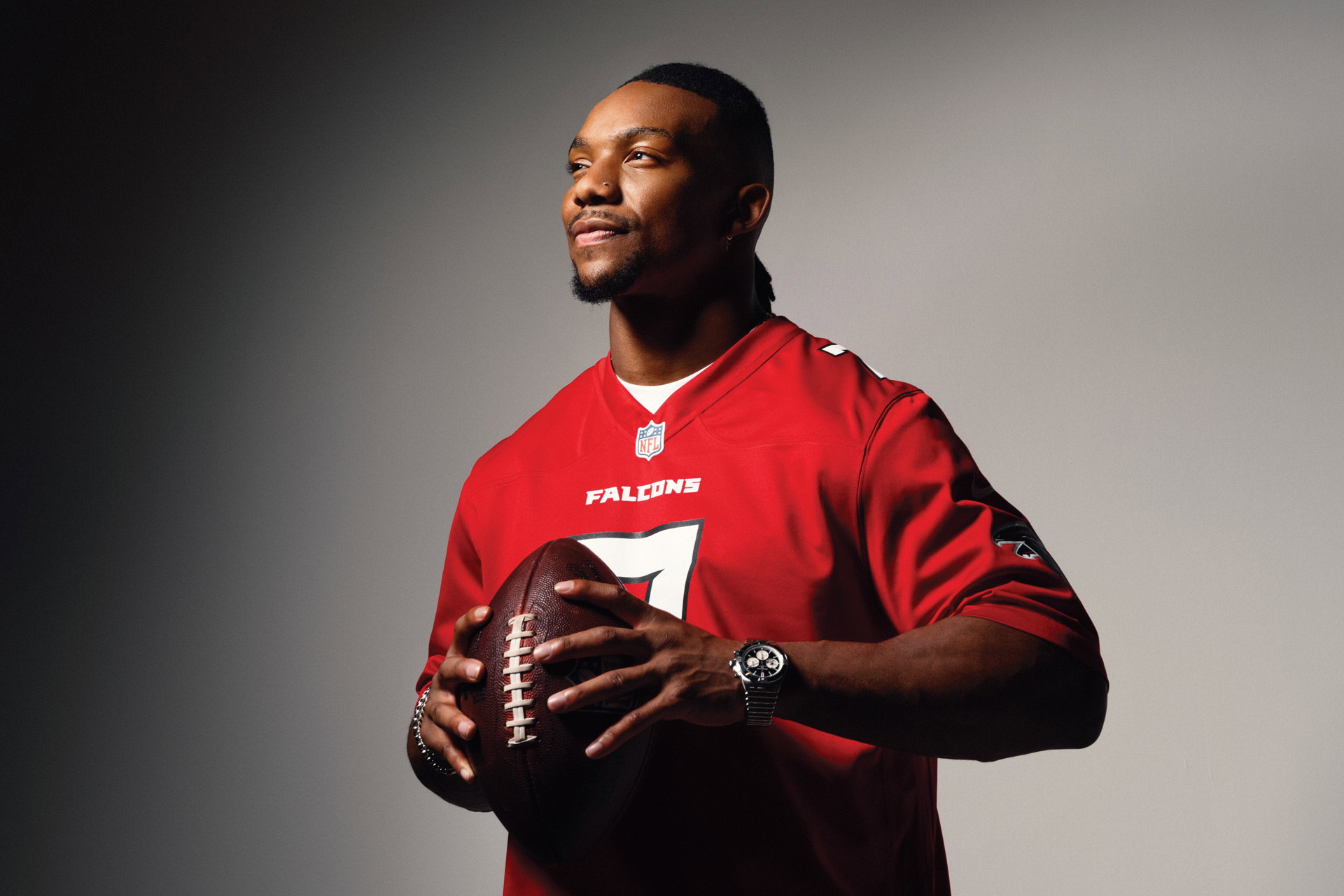
Monday night, mid-October, serial contender Buffalo in the house. Road-tripping Bills fans rolled in by the busload to fill swaths of seats inside sold-out Mercedes-Benz Stadium, complicating Atlanta’s home-field advantage. Yet the 2025 season was still young enough that even habitually defeatist Falcons fans showed up in droves and sounded, after seven straight losing seasons, strangely optimistic. In a unified display of ATL-ism, it seemed like every one of them—except, I think, me—spit out Jeezy’s halftime-show rhymes with full-throated, phone-wagging gusto.
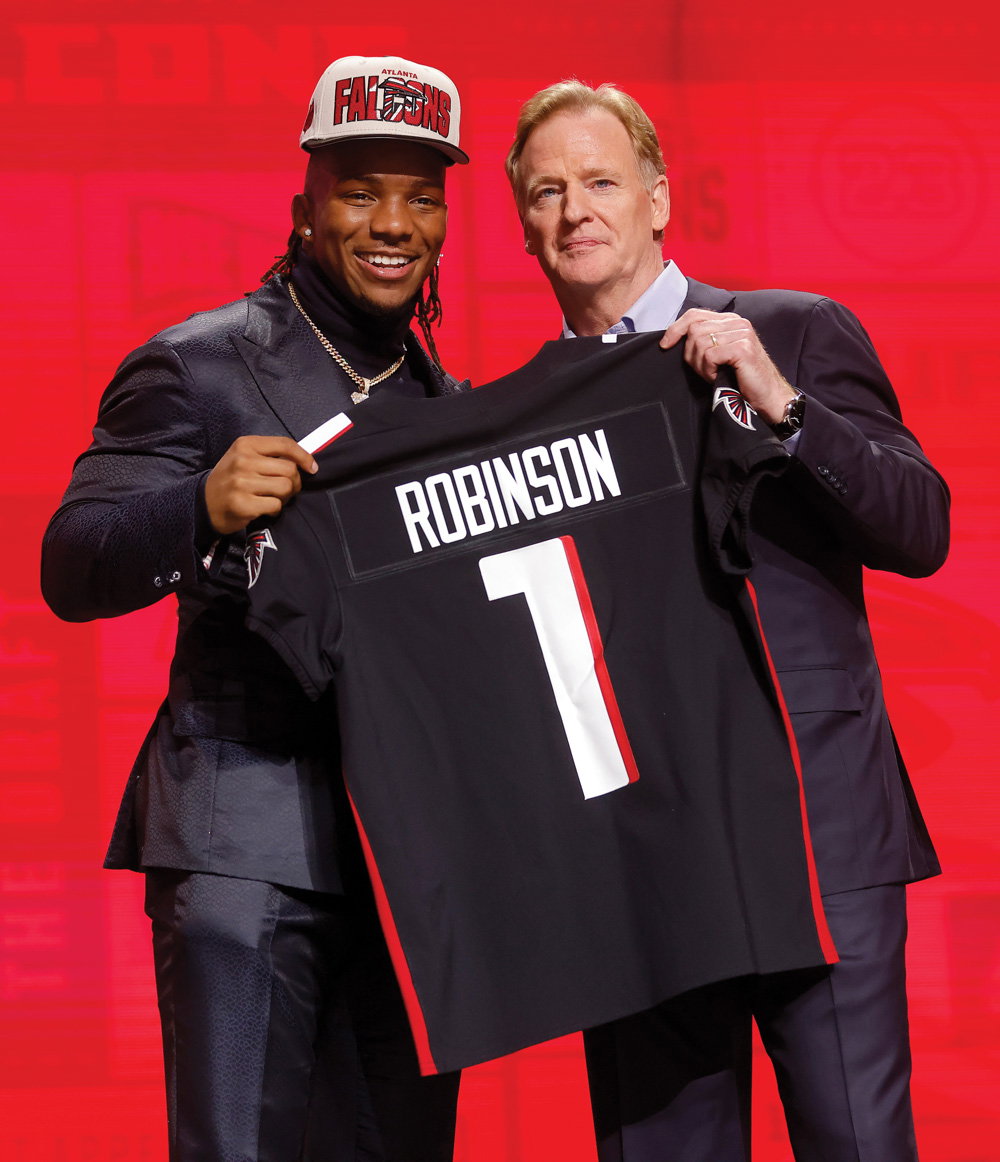
Our optimism centered on one dude: Bijan Robinson. The Falcons’ top draft pick two years earlier, he’d already become, in a league loaded with eye-popping athleticism, a thing to see. It wasn’t just his impressive stats, which placed him among the NFL’s top running backs. When you watched Robinson, you expected to see something . . . else. Something more. Something you couldn’t believe you just saw.
Photograph by Todd Kirkland/Getty Images
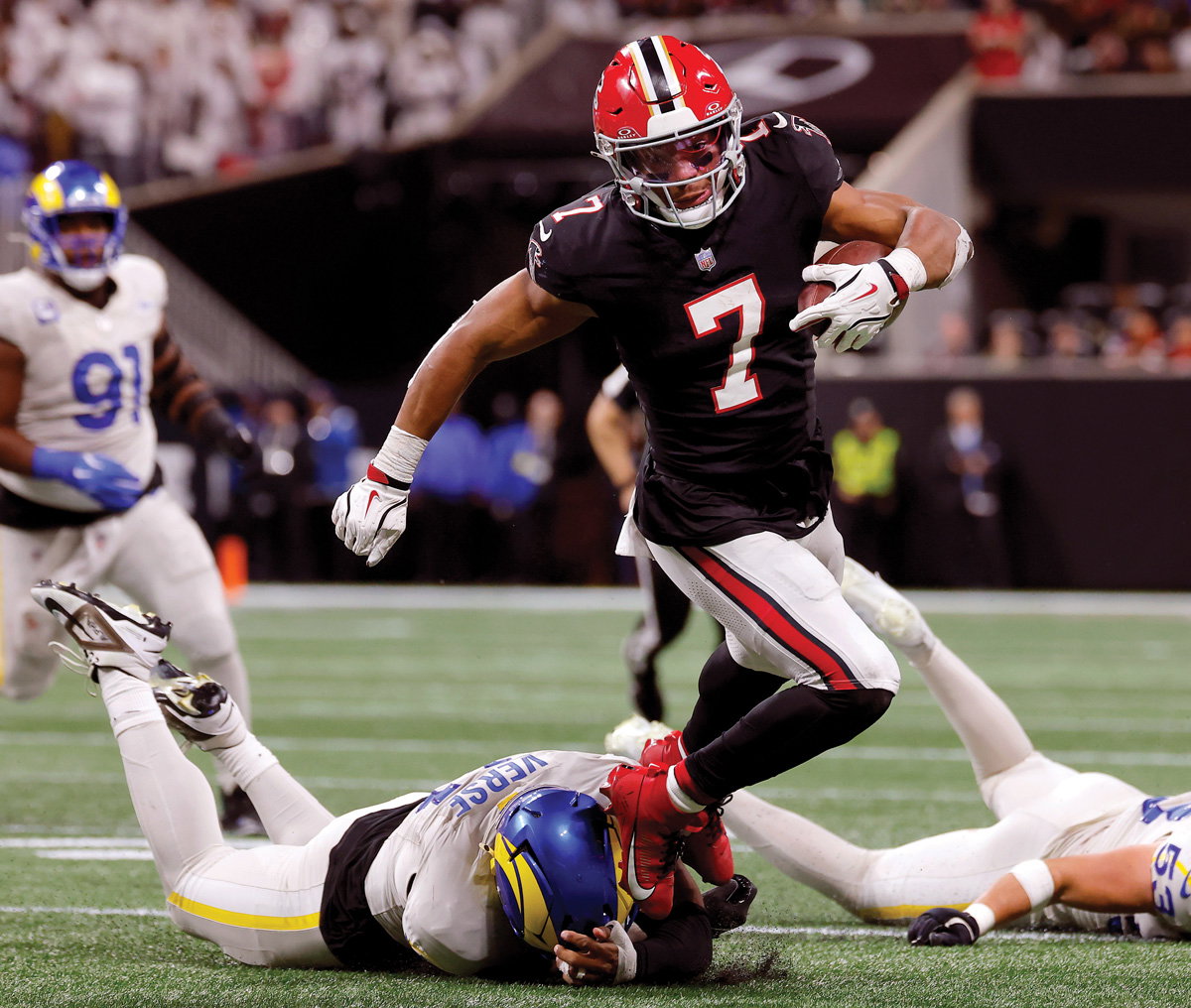
This night’s nobody-but-Bijan moment unfolded on the Falcons’ own 19-yard line. Struggling quarterback Michael Penix Jr. did the wisest thing a struggling quarterback could do and handed Robinson the ball. It was an unfussy play that looked as basic as Psst, kid, run this across the street and don’t get caught.
That’s what Robinson did. He slipped through a narrow gap on the line’s right side that his blockers widened into a virtual throughway. He then sprinted upfield and toward the sideline, leaving everybody—blockers, tacklers, officials—behind. At midfield, however, a determined Bills defensive back appeared to have a bead on him, charging at Robinson full speed before leaving his feet to wrap both arms around the running back’s torso.
That’s when Robinson did the something I couldn’t quite believe I saw. With the defender draping him, Robinson just . . . kept running, his feet inches from stepping out of bounds. Ball tucked in his right arm, he then brushed the would-be tackler aside with the slightest wave of his left wrist—not a stiff-arm, not a shoulder shake, but a move you’ve probably used yourself to shoo an old dog from the dinner table. The Bills defender slid down Robinson’s thighs, then his knees, then his cleats. Robinson barely broke stride. The defender finally fell away, discarded, likely questioning his self-worth.
From my angle, peering down the same sideline, it looked as if the defender’s arms had gone right through the 5-foot-11, 215-pound Robinson, as if they were grabbing at air or a ghost or a daydream. Former columnist for The Athletic and The Atlanta Journal-Constitution Jeff Schultz mused to me later, “It’s almost like there’s two Bijans: There’s the one with the ball, and there’s a hologram. And the defender is tackling the hologram.”
Robinson finished his 81-yard bolt alone in the end zone, where he raised one finger roofward and flipped the ball into the stands. He’d gain another 157 yards that game, keying the Falcons’ upset victory and further stoking the hometown fans’ hopes. But the touchdown also gave us something to remember, to post, to hold on to when the good times went south, as they’ve done too often for the Falcons. Case in point: Following the big win, Atlanta lost seven of its next eight games, ensuring yet another losing season.
But this night was about hope and miracles, and the shoulders they rested on. In the locker room afterward, receiver Drake London, the Falcons’ other elite playmaker, tried to explain what he’d witnessed. “There are some people who are just born to be a certain athlete,” he said. “Like you have certain people who are born to be basketball players, such as LeBron [James]. You have people who are born to be football players, like they have the perfect body shape for it.”
London then applied his curator’s eye to what makes Robinson special. He may not know exactly what that is, but he knows it when he sees it. Game recognizes game.
“[Bijan] goes out there,” London pronounced, “and it’s like art.”
• • •
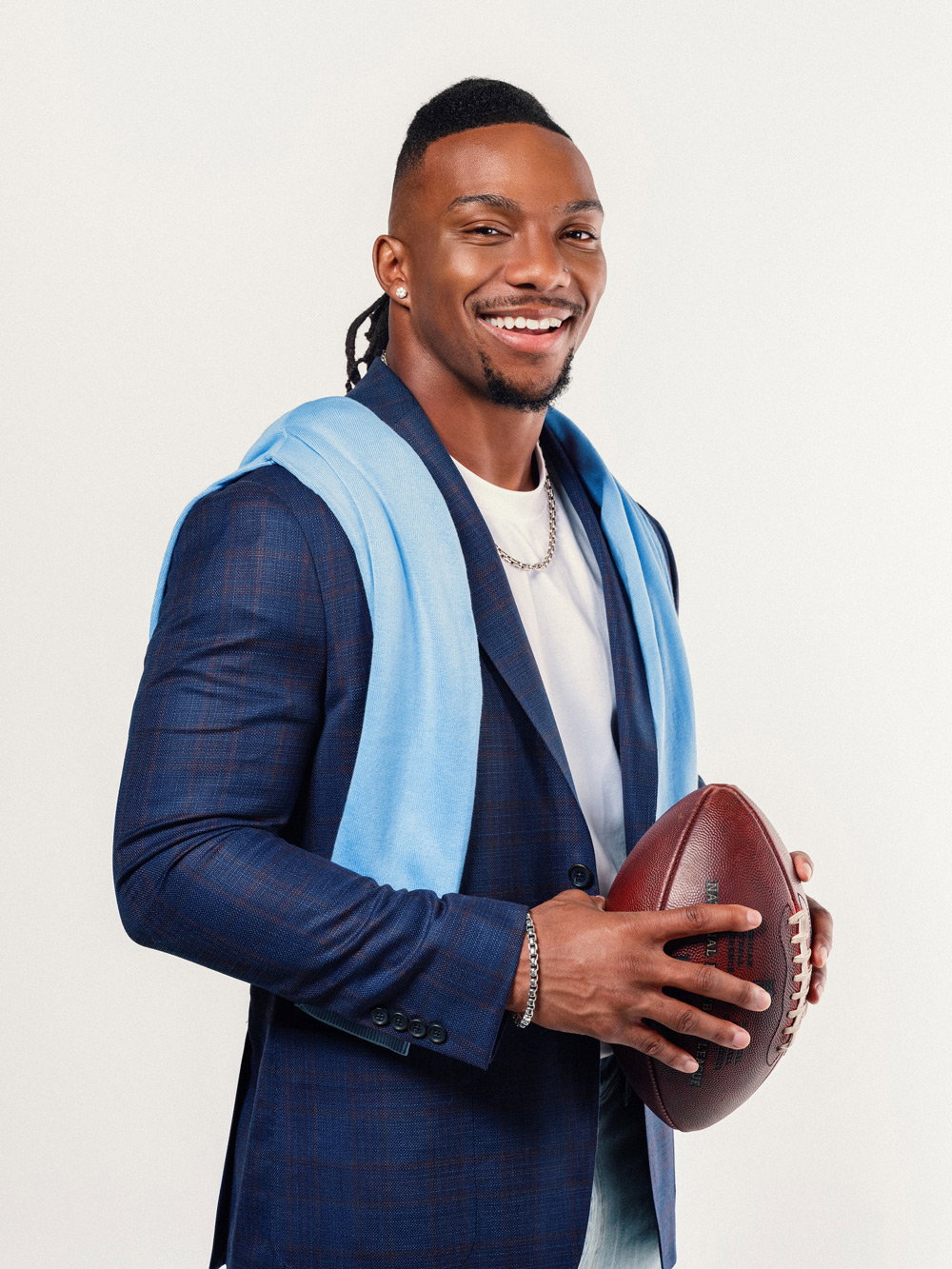
Photograph by Alex Martinez, styling by Fatiyha Johnson, grooming by Danielle Mitchell
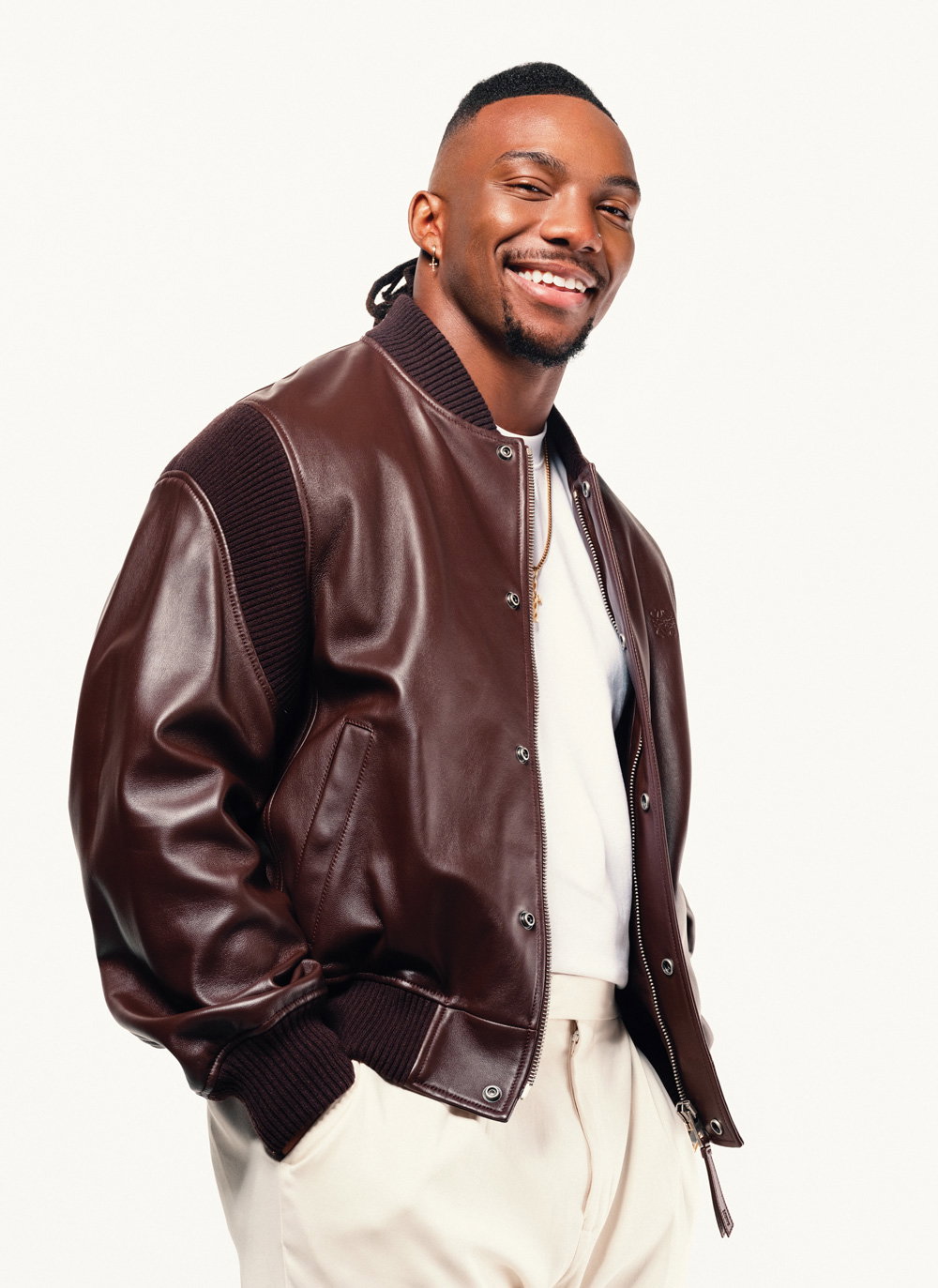
Atlanta has seen its share of great athletes. But only a handful have possessed an athleticism so elite, with a style so singular, that they could be counted on to do what seems impossible, night after night. These players have eclipsed the game and entered the realm of something, as London put it, like art.
Three come right to mind: Dominique Wilkins, Michael Vick, and Julio Jones. As a Hawk, Wilkins specialized in whirling, almost criminally vicious dunks that earned him a nickname that speaks for itself: the Human Highlight Film. Vick’s breakneck, ad-libbed elusiveness was so unlike anything a quarterback had ever flashed that he became, before his well-documented troubles began, football’s reigning cheat code. Julio Jones’s acrobatics, combined with his brute physicality and world-class sprinter’s speed, made the receiver a likely first-ballot Hall of Famer.
Now there’s Robinson, only 24 years old and already dropping jaws. Will he be the newest face chiseled into Atlanta’s swaggy Mount Rushmore?
Photograph by David Eulitt/Getty Images
“It’s crazy you say that,” Robinson says when I roll out my conceit about this select group. We’re sitting inside an airy conference room at the Falcons compound in Flowery Branch, where summer minicamp recently ended. “I talked to Dominique at a [Hawks] game, and he said the exact same thing. He said, ‘You bring the swag like the city is used to. You’re a part of that now.’ He was like, ‘Just embrace it and do right by it, and they will do everything for you. Just keep being yourself.’”
I call Human Highlight to elaborate.
“I love watching this guy play,” Wilkins says. “I mean, if there’s a guy who can carry that torch, he’s the guy. I’m hoping he continues on this road and becomes that next iconic player in this city.”
Robinson goes about his business off the field about as artfully as he does on it. Placed back-to-back, his endorsement deals—including his own condiment, Bijan Mustardson—might stretch the length of a football field. He supports a string of charities. Young clubbers went wild when he guest deejayed at District, Atlanta’s electronic dance-music hot spot.
Arthur Blank, who signed checks for Vick and Jones, tells me of Robinson, “As an owner, you’re always proud when you have a player with that kind of talent, but you’re even prouder when they represent your organization the way Bijan does.”
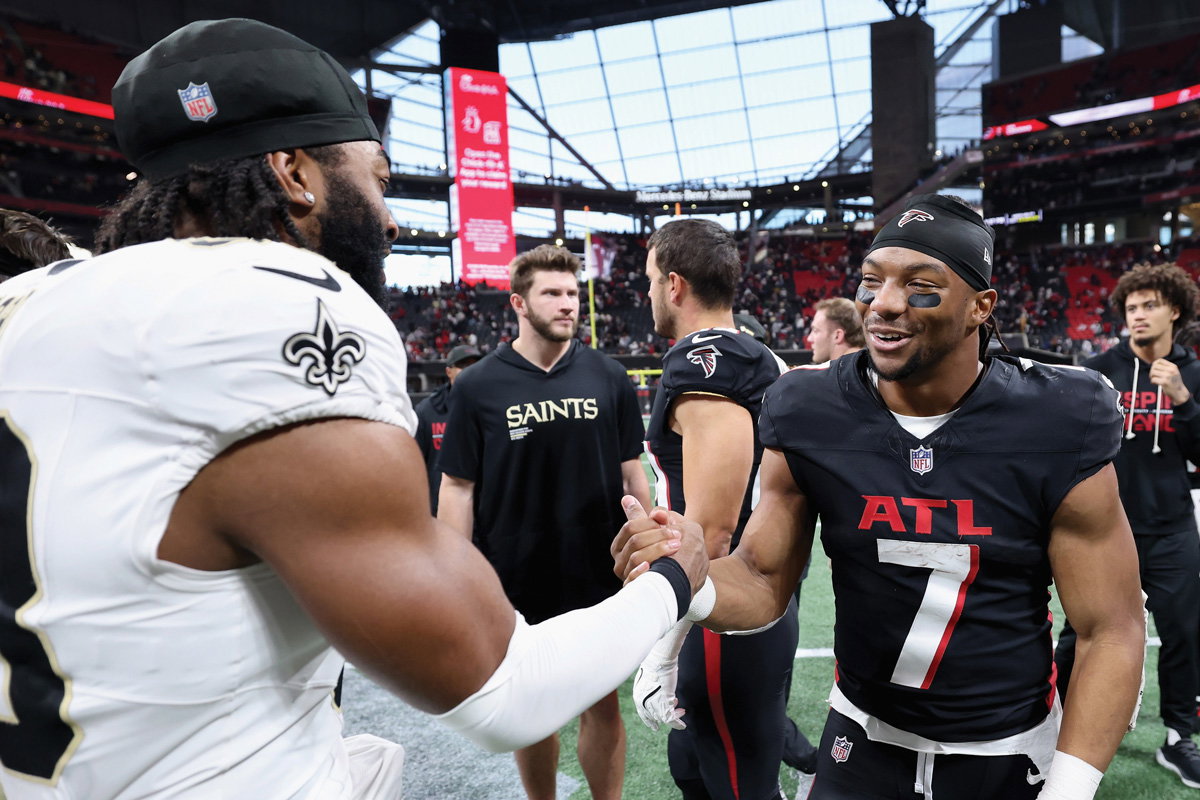
Photograph by Kevin C. Cox/Getty Images
Robinson presents as humble, upbeat, engaged. He’s quick to give the glory. He says the right things without sounding overprogrammed. “He’s got this ridiculous charisma and knows about being a star when he’s out in public,” says Atlanta sports radio host Steak Shapiro. “He’s built to be a star.”
Still, there’s one box Robinson hasn’t checked. Doing so is as much in the Falcons’ hands as it is in Robinson’s. But if it goes unmarked for too long, it could become an asterisk attached to an otherwise transcendent career.
“All that’s missing,” Shapiro says, “is playoff games and playoff moments.”
• • •
Robinson wasn’t born with a football in his hands. It just seems like it. He toted one to his first haircut; snuck one into church, where his grandparents admonished him; cradled one while sprinting down grocery-store aisles, heading straight at people’s carts until, last second, he spun around them.
“I still do it to this day,” he says, laughing at how he feints and stutter-steps to avoid invisible defenders when he walks past blind corners inside his house.
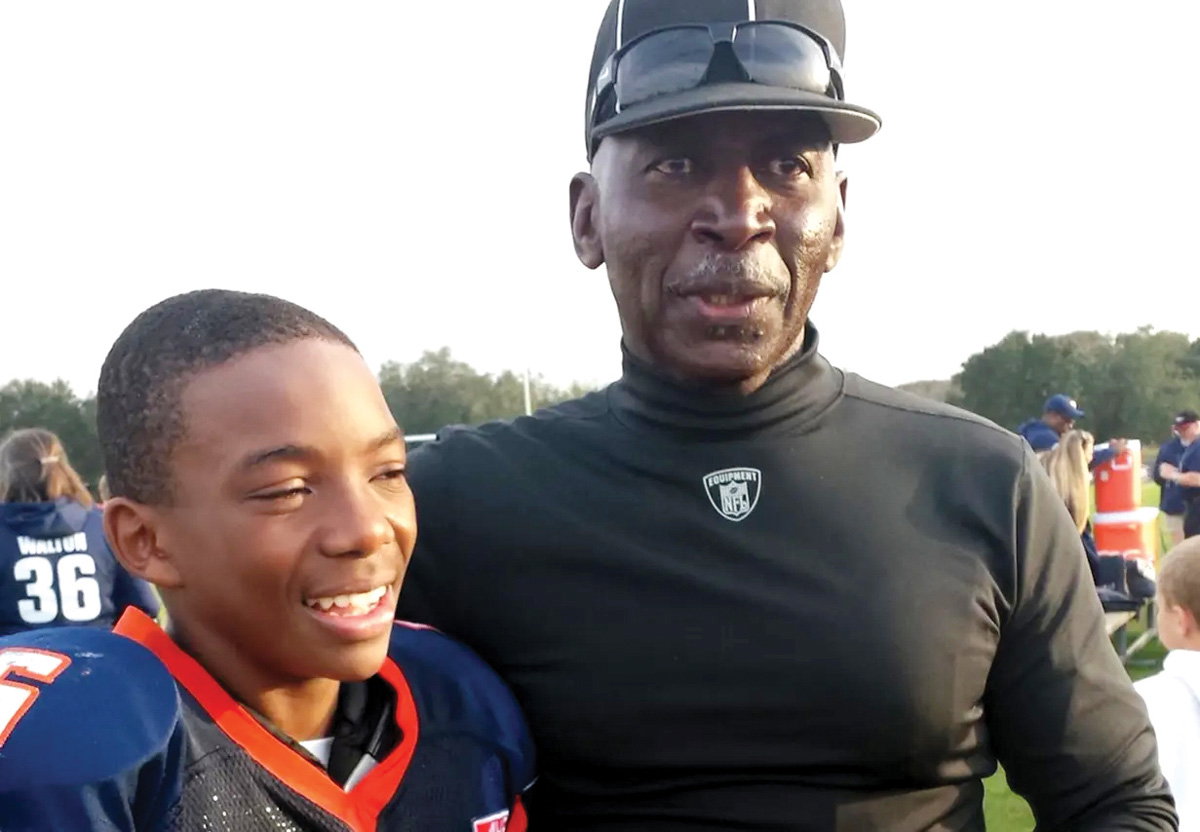
Courtesy of Terri Robinson
His earliest influence was his maternal grandfather, Cleo Robinson, a former college football player and longtime Pac-10 Conference field official. (His great-uncle, Paul Robinson, played professionally for six seasons.) Robinson’s mother became pregnant with him while attending junior college, and she and Bijan eventually moved into her parents’ house in Tucson, Arizona. Robinson says of Cleo, “He became my dad.”
When Cleo brought home programs from games he officiated, young Bijan cut out players’ photos and attached their faces to his collection of mini plastic football helmets. He’d arrange them in formations and play out imaginary games in his head.
“I just visualized everything on the field,” he says. “So when I started playing tackle football when I was seven, I was already seeing things on the field. I could see the levels open up.”
Seated beside his grandfather while he watched film of Pac-10 teams, Bijan became captivated by Reggie Bush, University of Southern California’s Heisman Trophy–winning running back. He watched Bush’s film obsessively, often falling asleep to it after his mother put it on when he went to bed.
“I was doing those same moves to all these other kids, even going to the park and doing all this stuff,” he says. “And all these kids are like, ‘Whoa!’ Like they haven’t really seen that before.”
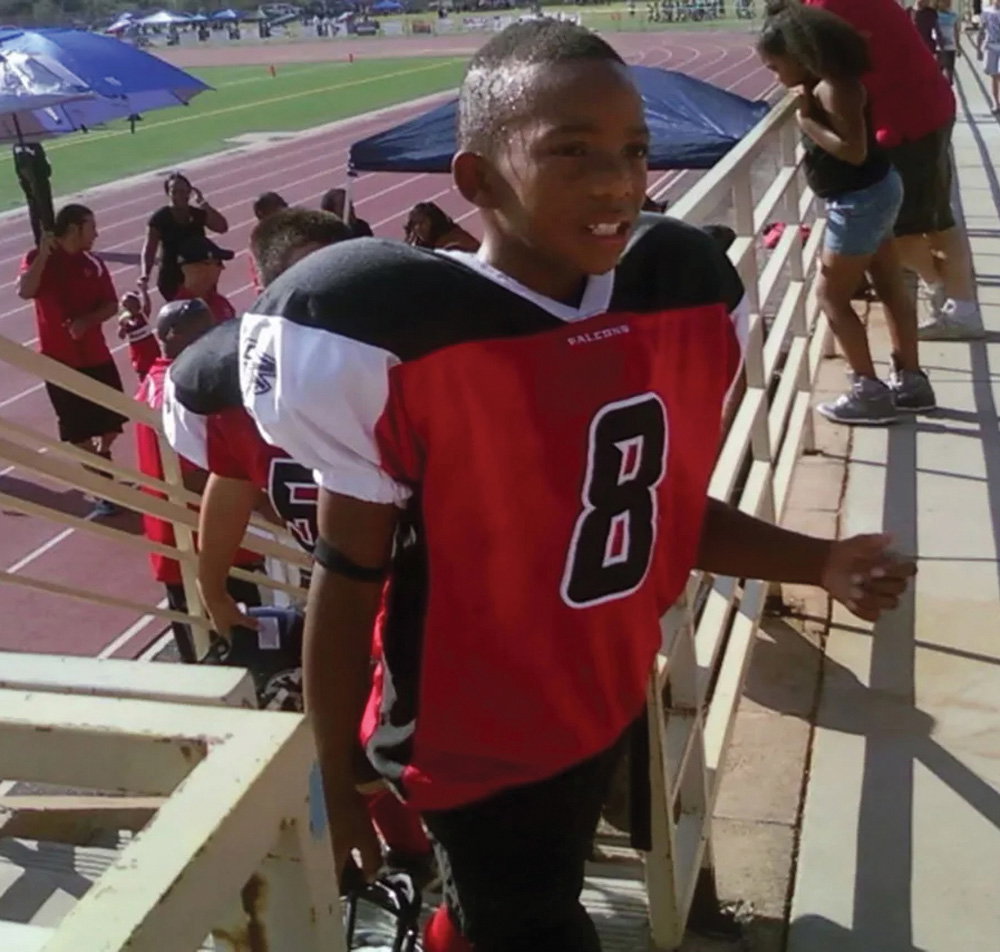
Courtesy of Terri Robinson
Off the field, Robinson imitated his grandfather. “Every room he walks in lights up because he makes everybody smile,” Robinson says. “He used to do cool things for my grandma. He’d tell me, ‘Watch this,’ and he’d open the door for her. Little things like that. He taught me to be respectful to everybody.”
By middle school, Robinson had mapped his future’s throughline. His grandmother Geraldine gave him sticky notes to write down his life goals and put by his bedroom door. First thing Robinson wrote, in bold letters: NFL. He also wrote Best player in college, First round draft pick, and Give God all the glory. His grandmother revisited the list after his sophomore year of high school, when Robinson was rated the nation’s top back in his class. Staring at it, she told him, “This thing could actually be something.”
• • •
Starting in the fall of 2020, Robinson played three seasons at the University of Texas. Coaches promised to feature him as a dual-threat running back, both to exploit his pass-catching ability and to cut down on the volume of punishing rushes. It took him a minute to adjust to college ball’s speed during his freshman season. But by early December 2020, in the biting cold at Kansas State University, he had his Matrix moment, the quiet, hyperaware flow state that elite athletes often talk about reaching. The game suddenly transfigured into something like three-dimensional chess, with Robinson seeing three and four moves ahead.
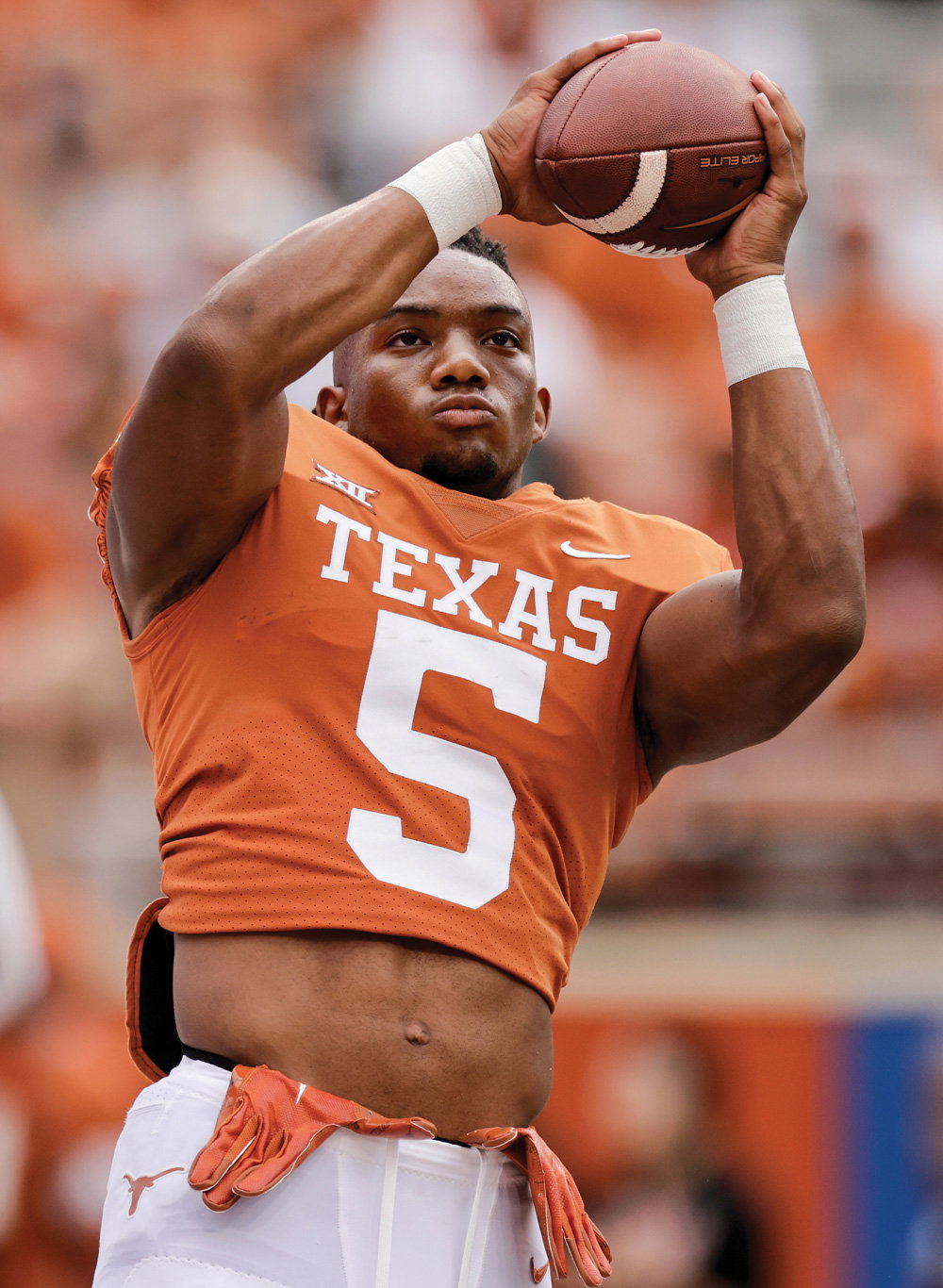
Photograph by Tim Warner/Getty Images
He was unstoppable. He ran the ball only nine times but averaged an almost-unheard-of nearly 20 yards a carry. He also caught three passes for 51 more yards. “I saw everything slow down,” he remembers. “I saw where I had to cut, the angles, everything. It was one of those moments where you know life started to change.”
Life changed big-time the next summer, the first year that college athletes could be paid through NIL deals. After signing with chicken franchise Raising Cane’s, he inked deals with a queue of others. The highest profile: Lamborghini.
“Now there’s a trend of all these colleges having the Lamborghinis, all these crazy cars,” says Robinson, not quite smirking. “I think I started that.”
Yet while Georgia Bulldogs quarterback Carson Beck took a ton of grief when he tooled around Athens in his NIL Lamborghini, Robinson’s outgoing personality and easy embrace of business—he has spoken twice about NIL and branding at Austin’s SXSW festival—shielded him from most criticism. During his last two years at Texas, Robinson reportedly collected $1.6 to $2 million.
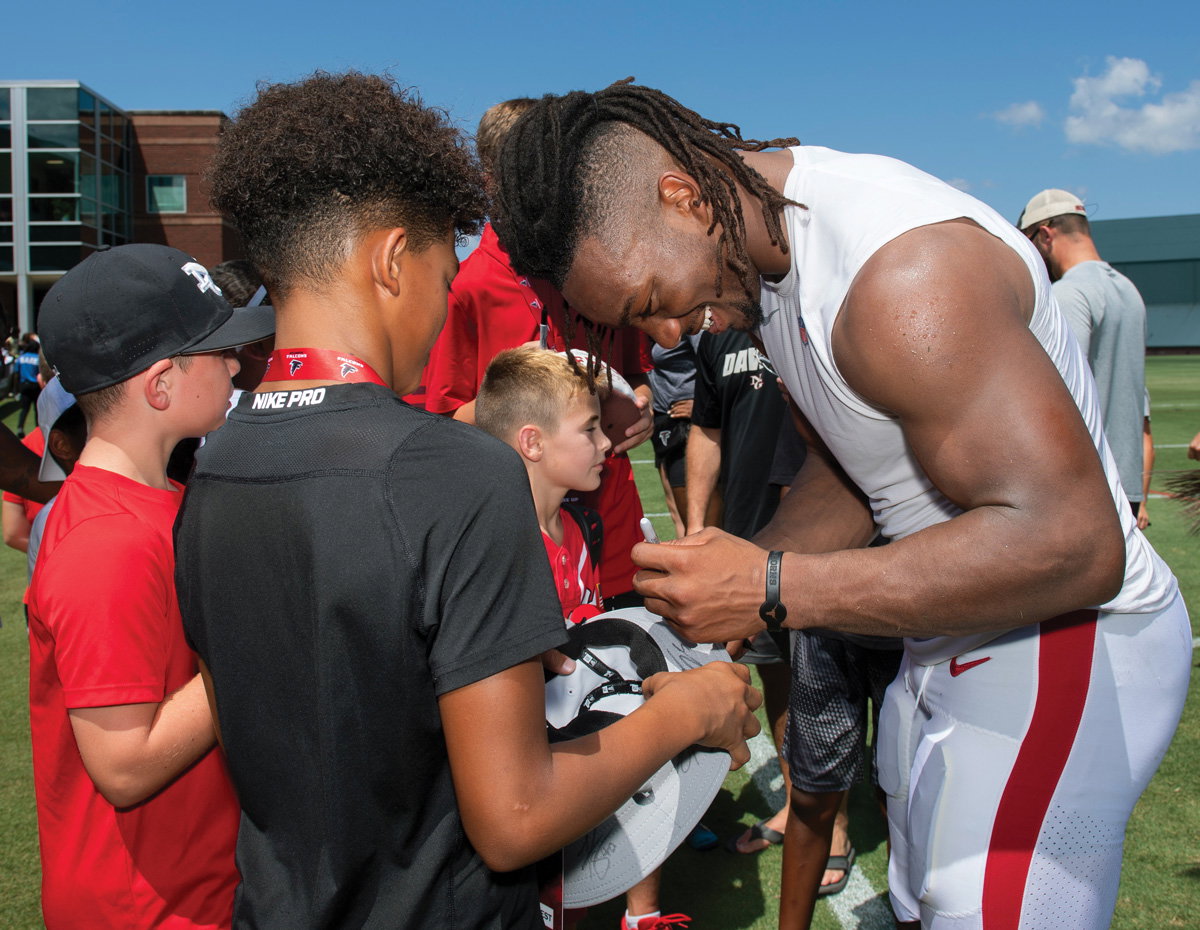
Photograph by Shanna Lockwood/Atlanta Falcons
“He created a brand the minute he came in here: How he acts, how he treats people, how he moves,” then Texas Longhorns running backs coach Tashard Choice said of Robinson at the time. “People want to attach themselves because of who he is.”
Robinson approached the blizzard of deals the same way he navigated swarming defenses. “I was like, God, just let it all slow down,” he says. “I didn’t expect NIL to come in my college career. It was all happening so fast. The email, social media, just everything was growing so fast. I’m having conversations with financial advisers.”
It finally slowed—his Matrix moment arrived on the business side—when he realized his most effective strategy was being himself.
“I just used my personality,” he says. “I enjoyed it.”
• • •
Robinson’s first two seasons with the Falcons were good—for most backs. He gained a lot of yards, but there were few big, breakaway runs. The longest was 38 yards.
He stuck to the process he’d followed as a kid. Before the 2025 season, he devoutly studied film of other elite backs, including Hall of Famers Barry Sanders and LaDainian Tomlinson. He also broke down tape of athletes in other sports, anatomizing the footwork of basketball players like all-star guard Kyrie Irving. He spent a month that summer in Los Angeles training with the San Francisco 49ers’ Christian McCaffrey, the prototype dual-threat running back renowned for his fierce, high-tech workouts.
The two swapped trade secrets, fueled their competitiveness, and concentrated on recovery. They climbed into a space-capsule–like chamber called Stratosphere ATC and simulated training at 18,000 feet.
It paid off. Last season, Robinson led the NFL in combined rushing and receiving yards—edging out second-place McCaffrey.
Big plays became expected. He topped his 81-yard touchdown run against Buffalo with a 93-yarder against the Los Angeles Rams. He sliced and slashed and dipped and sluiced across the turf like a slalom skier; one TV analyst said watching Robinson’s seemingly effortless deceits was “like watching liquid run.” His physics-defying jump cuts became mythic, leaving three, four, five defenders waving at him like parents bidding their kids goodbye at preschool as he juked past them untouched.
“He’s doing things in the NFL you don’t normally see,” says Jake Matthews, the Falcons’ 13-year offensive lineman, who has seen plenty. “It’s uncommon [to outperform so many defenders]. Guys in this league are really good.”
Yet Robinson says his motivation remains as profoundly elemental as the first time he brought a football to the park in Tucson. “I hate getting tackled,” he says. “So I’m trying to embarrass defenders any way I can. [I’m] trying to score literally every play.”
Robinson’s feats have gone viral, especially those filmed by the Falcons’ Roof Cam, an overhead shot that makes his pinballing runs look like a video game. His grandmother has sent him clips posted on Instagram.
Now, other backs study him.
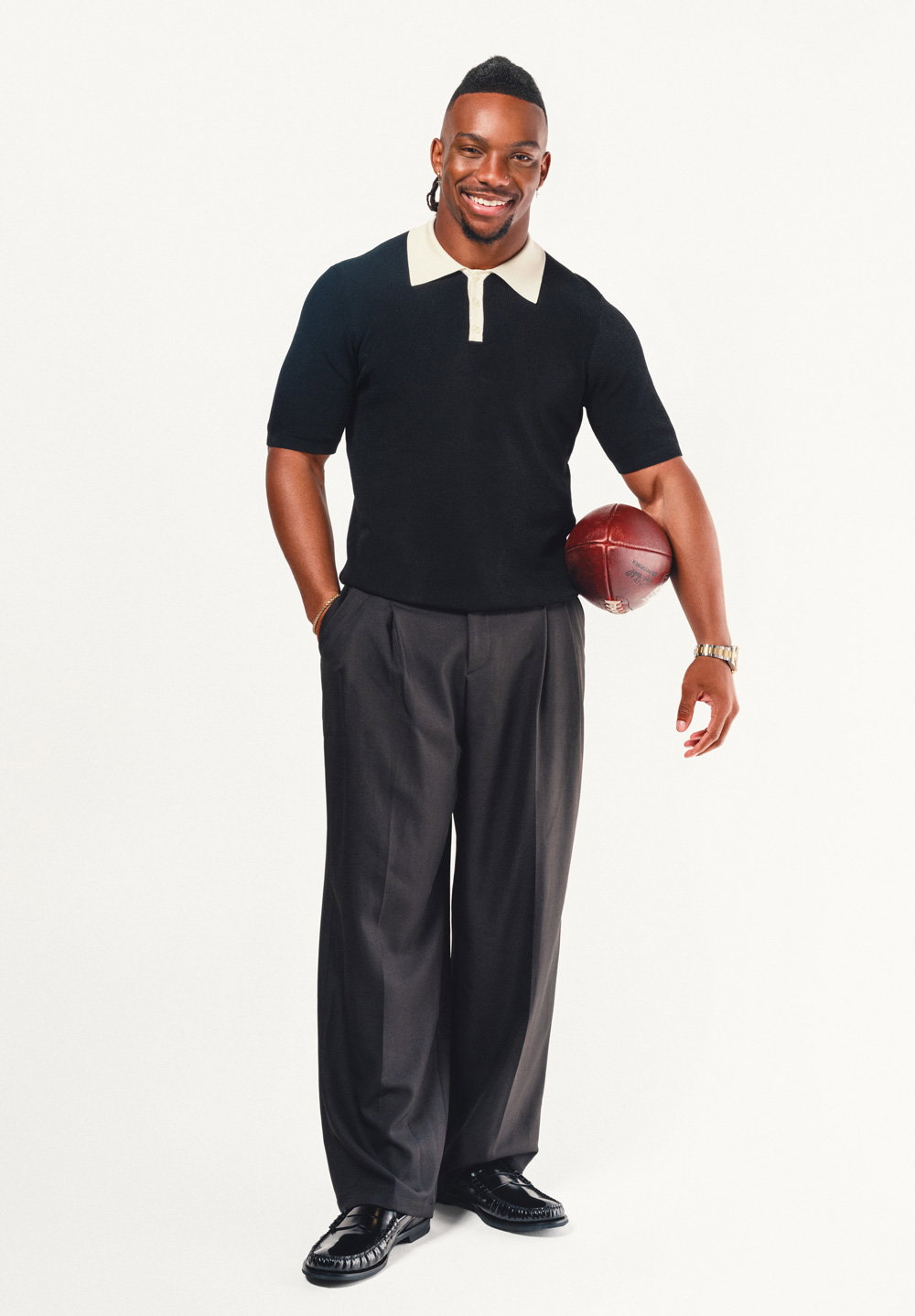
Photograph by Alex Martinez, styling by Fatiyha Johnson, grooming by Danielle Mitchell
“There’s nobody that’s able to cut like Bijan,” the Philadelphia Eagles’ Saquan Barkley, then the league’s highest-paid back, conceded last year. (Robinson’s new $66.75 million contract tops Barkley’s.) “His vision, his agility, and he can catch the ball, too—it’s fixing to get scary for a lot of people as he continues to figure it out.”
The question we’re left with now: Can the Falcons figure it out? Can they become the team a player like Robinson deserves? Can they provide playoff moments? While 2025 was a breakout year for him, the next five or six seasons could be legacy defining.
“For a franchise trying to take the next step, having a player who can tilt the field like [Bijan] matters—not just for production, but for confidence, identity, and the standard you’re trying to establish,” says Matt Ryan, the former record-setting Falcons quarterback who’s now the team’s president of football. “He’s the kind of foundational player you can grow around . . . As he continues to mature as a leader, he will only make the players around him better.”
To that end, Robinson spent this summer dissecting film of Seattle Seahawks wide receiver Cooper Kupp, a former Super Bowl MVP who’s envied for his surgically precise routes and tactical smarts. I ask Robinson if that means he’ll have new tricks up his sleeve this season.
He cracks his billion-watt smile. Then he deals me an open-ended answer that leaves whatever moves he might be plotting up to our imaginations.
“We’ll see . . .”


This article appears in our September 2026 issue.