



Photograph by Meg Buscema
Each time a door clangs shut behind us, my heart races a little faster. We’ve taken off our shoes, belts, and jewelry to get through security, handed over our IDs, and left phones and laptops in the car.
We’re winding our way through a forest of fences topped with concertina wire that surround a series of bland, beige buildings. I try to open one of the doors, forgetting for a moment that we must get buzzed through each one.
Walking beside me is Winfield Ward Murray, a member of the Morehouse College faculty who drives more than an hour south every Friday night through rush-hour traffic to this building in the Burruss Correctional Training Center outside Forsyth. The medium security state prison is home to 800 male inmates, from juvenile offenders to old men, and it’s where Murray teaches a weekly class about the U.S. Constitution and race and law.
He has asked me to speak to his class about my book, A Devil Went Down to Georgia: Race, Power, Privilege, and the Murder of Lita McClinton. Murray uses the case—in which a White husband orchestrated the murder of his Black wife in Buckhead in 1987—in his law classes at Morehouse, and my publisher has donated copies to Murray’s incarcerated students.
Being inside a prison is new to me. As another heavy metal gate closes and rattles my nerves, I harden a little, preparing for a heavy experience. Though Murray has told me about some of his students—how one wrote a symphony, another several books—I envision cold, hard, scary men. I can’t help it; this is my vision of prisoners in prison. People can be mean and scary, and the scariest, meanest of all people are in prison.
As we walk into the room, a big space that looks like a converted cafeteria, the men whoop and holler and surround us, joyful to see their professor and his guest, the author of the book they just read.
“I haven’t read a book in 10 years,” one man tells me. “But I stayed up late and read a hundred pages of your book. A hundred pages!” Several of them hug Murray and nervously shake my hand and thank me for coming. It’s not what I’m expecting at all. I’m overwhelmed with emotion, and it hits me: Their days are filled with hypervigilance, monotony, and small ideas. This two-hour class with Murray is an opportunity to escape and live in the juiciness of Big Ideas.
After the celebration of our arrival, Murray’s 13 students (a diverse group of Black, White, and Hispanic inmates) arrange three long tables into a U-shape. Murray sets down his books on a small table at the top of the U, so that everyone is facing him. Behind Murray, a bank of vending machines hums so loudly that I strain to hear. Also behind Murray, at a table beside the Coke machine, an older Black man named Boudreau sits off by himself. (Editor’s note: The names of inmates have been changed for this story.) I find out later he has been in prison so long—41 years—that he gets to informally audit the class, which means he comes—or doesn’t—as he pleases. A heavy door clangs when the prison staff periodically passes through. The idea is that Murray will teach for an hour, then we’ll switch places, and I’ll lead a discussion about my book.
I find a seat next to a Black man wearing a white knit cap named Miles, who slides me a thoughtful handwritten list of two dozen questions he’s eager to ask about my writing process. He tells me he read my book over the phone with his girlfriend every day until they finished it. He is a writer himself, he says, having self-published several books from behind prison walls.
On my other side is Jamal, a Black man with face and neck tattoos who barely looks old enough to order a beer. His hands shake a little as he fiddles with his pens and highlighters, and he shyly says hello. It strikes me that, like me, he’s also nervous.
All the men wear the same uniform of white pants with a navy stripe down the side, and white shirts with blue collars. The only thing that distinguishes their clothing is that each of them wears a different style of sneakers.
As everyone settles, Murray hands out a couple of books he’s bought or pulled off his own bookshelves to give to the men. This is clearly a weekly ritual that generates excitement: Who’s getting a book today? He gives Kent, a Black guy in his 50s, a book about the business of beekeeping. To Miles, the writer beside me, he gives a book about how to start a podcast. For next time, Jamal requests a copy of Bryan Stevenson’s Just Mercy: A Story of Justice and Redemption. Cory, a White man, wants a dictionary: He’s hungry to learn more words.
Today’s class is about the history of voting rights in the United States. Some of the students have taken the Louisiana Literacy Test, which was given to people registering to vote as a means to suppress Black voters before it was outlawed in 1963. Jamal has a copy and slides it over to me. The test is loaded with arbitrary questions intentionally worded to be confusing; it once gave White registrars great leeway in determining who qualified to vote.
The Voting Rights Act of 1965 was the first step in prohibiting this kind of racial discrimination in voting, Murray tells the class. “Think about how much effort went into not letting people vote,” he says.
Every man is leaning in, pens poised. There are no distractions, obviously no phones, and no one yawns. “I never thought about any of this stuff before,” says Kevin, a White man in his early 20s. “Now, it’s changed the way I think about everything.”
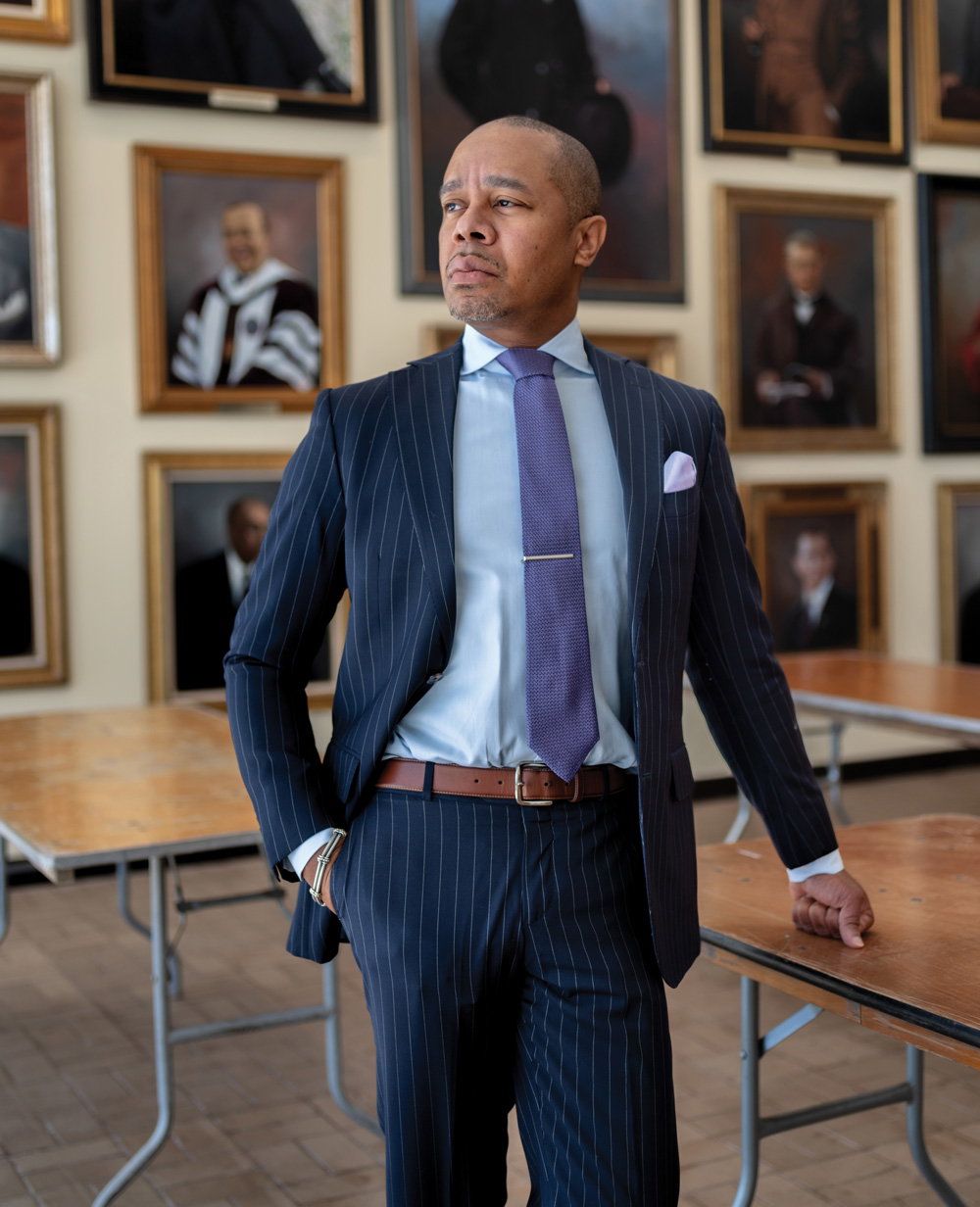
Murray meanders around the inside of the U, making eye contact with each of the men. Always impeccably dressed in a three-piece suit and shiny shoes, he offers his students—whether they’re at Morehouse College or in a Georgia prison—a new model of masculinity and power. He doesn’t bully, condescend, or overpower; he simply commands the room.
It’s clear that a couple of the students haven’t completed the reading—chapter two from The Voting Rights War: The NAACP and the Ongoing Struggle for Justice, by Gloria J. Browne-Marshall.
Murray gently but firmly chides them. “When I ask you to read something,” he says, “I expect you to read it.”
The men who didn’t finish the reading nod and apologize. They know how fortunate they are to be here—that there’s a long line of prisoners wanting to be here too. These men have been hand-selected to take this class based on a mix of criteria, including their interest, the warden’s discretion, and the expectation that, despite some serving life sentences, they will be discharged within a couple years, due to parole or early release. These college-accredited classes are meant to inspire critical thinking and prepare the inmates for life on the outside while giving them valuable credits toward an associate’s or bachelor’s degree.
“The most difficult thing about teaching in prison is that a lot of these guys have not had the best experience with education,” says Murray. Many prisoners have struggled with extreme poverty and lacked the basics: parental support, healthy food, school supplies, transportation, guidance. Some were told they were stupid or damaged or unworthy. Others dropped out of school and turned to crime because they couldn’t see another way out.
“So, the first hurdle you must get over is building trust by showing them that you’re going to teach them,” says Murray. “They need to see that this classroom is a safe place. Once you reach that plateau, once you have their trust, that’s when the class really takes flight.”
■ ■ ■
Photograph by Johnathon Kelso
In addition to teaching at Morehouse, Murray is a federal immigration judge, who spends his days working his way through an inherited backlog of cases. He grew up with his parents in East Point and spent a lot of time with his grandmother in Collier Heights. His father is an Atlanta obstetrician-gynecologist who gave financial support to help found the Morehouse School of Medicine. A Morehouse alum, Murray is the fourth generation in his family to graduate from an Atlanta University Center school.
He went to law school at Howard University before completing a master’s in law at George Washington University. He’s worked as an Atlanta city prosecutor and was the deputy chief of staff to Mayor Keisha Lance Bottoms. He leads a nationally ranked moot court team: Under his leadership, Morehouse was the first of the HBCUs—historically Black colleges and universities—to win a national championship in 2015; earlier this year, Morehouse came in third out of 560 teams. He also actively participates in Leadership Atlanta, one of the country’s oldest community leadership organizations.
Murray is here as part of a partnership between Morehouse, the Andrew Young Center’s Higher Education in Prisons program, and Common Good Atlanta, a nonprofit that provides inmates with access to higher education. The nonprofit, which gives students college-level credits in literature, writing, history, art, science, math, and philosophy, was cofounded by Sarah Higinbotham, an associate professor at Emory University’s Oxford College.
At the height of the recession in 2008, Higinbotham was a 39-year-old getting her PhD in literature. As she delved into the depths of Shakespeare and Milton, she felt an overwhelming tug to share what she was learning. “I was extremely and acutely aware of what I was doing with my time, which was absorbing 150 years of beauty and wisdom and philosophy of the English Renaissance,” she says. “One thing I could think to do was to make the material I was learning accessible to people who had historically not had access to that kind of world.”
The idea to teach in prisons was inspired by Higinbotham’s uncle, a Vietnam veteran who was later incarcerated in another state. She was a new mother at the time, trying to balance life, and never got the chance to visit him in prison. Shortly after his release, he passed away. “He died without knowing that I was trying to get to see him,” she says.
She knew people in prisons often feel forgotten, so she began writing to wardens, asking if she could bring the literature she loved into prisons. When Phillips State Prison in Gwinnett County accepted her offer to teach a writing course, the class filled within minutes of being announced. “I was just going to do it for one semester,” she says. “That was 16 years ago.”
Today, faculty from five Georgia colleges and universities have partnered with Common Good to teach classes in 37 subjects in Georgia’s prisons.
The idea of educating prisoners has historically been a controversial one. Some people view prisoner education as being “soft on crime” while others, like Higinbotham and Murray, believe it a humane and essential path to reentry.
“Clearly we have a problem with mass incarceration,” Murray says, pointing out that the United States locks up more people per capita than any other nation in the world. Most prisoners are nonviolent offenders who will eventually be released and return to the general population.
According to the Prison Policy Initiative, currently 1.9 million people are incarcerated across the country. In Georgia, the incarceration rate is 881 per 100,000 residents, far exceeding the national average and surpassing that of any independent democratic nation. There are currently 95,000 people locked up in Georgia.
The national recidivism rate is 76.6 percent, according to a Bureau of Justice Statistics study; a whopping three-quarters of prisoners will be rearrested within five years of release. But when incarcerated people can pursue even a little education in prison, the recidivism rate plummets.
A recent report in the American Journal of Criminal Justice found that when inmates participate in a prison education program, their odds of recidivism decrease by 19 percent. For those who take college-level courses, the odds of recidivism decrease by 45 percent.
“If we are really trying to stop crime, if we’re really trying to make communities safer and to restore people, then prison education is what we need to be doing,” says Murray. Educated prisoners are less likely to repeat offend and more likely to find jobs, make higher incomes, and save taxpayer money. “There’s this narrative that you have to be tough on crime, and that tough on crime means longer sentences, but that doesn’t work. It also costs more.”
■ ■ ■
When I look around the room, I count: Of the 13 students, six are Black, three are Hispanic, and four are White. This is not reflective of the prison population. In these classes, Murray says, they aim for a diverse cross section of ages and races because what they’re after is diversity of thought—to foster more rounded conversations. If the class did reflect the prison population, most of the students would be Black.
Despite comprising 31 percent of the state’s population, Black Georgians make up almost 60 percent of the incarcerated population. Black people are 2.7 times more likely to be imprisoned compared to their White neighbors.
Murray says he found working as a prosecutor challenging because it often meant incarcerating a never-ending line of Black men. He believes prisons are necessary but also advocates for equitable sentencing and restorative justice programs that help offenders learn accountability, build confidence, and believe they can be contributing, law-abiding members of society.
“These men come into prison, and they really don’t know what to look forward to,” Murray says. “What I try to tell them is that no matter what age they are or how much time they’re serving, they’re still alive. Whether you’re in prison or not, you still have the ability to exercise your voice. You still have something to give.”
Murray believes that Morehouse, the only school in the country devoted to the education of Black men specifically, is uniquely positioned to serve Black inmates. “The best way for imprisoned Black men to get their lives back on track is by giving them the benefit of education,” he says. “What better institution to do that than one that is mission-driven to educate Black men?”
Dr. Kipton Jensen, a professor of philosophy at Morehouse and director of the Higher Education in Prisons program, agrees. “I feel like it’s a tender reminder about the core mission of HBCUs: to give a foothold to individuals who have been maligned by society,” Jensen says. “Providing education to prisoners is pushing the envelope to the next frontier of those who are most disenfranchised.”
To date, 23 members of the Morehouse faculty have taught in the prisons, often accompanied by student ambassadors who get to see firsthand how incarceration affects lives. Jensen says the eyes of everyone who teaches or visits the prisons are opened in a profound way. “Something about teaching inside [prison] made me come alive,” he says, and in true professor fashion offers a quote from philosopher Howard Thurman: Don’t ask what the world needs. Ask what makes you come alive and go do it. Because what the world needs is people who have come alive. “There’s something really beautiful about watching other people come alive,” he says.
■ ■ ■
When it’s my turn at the front of the class, my nervousness has dissipated. There’s something about being in this place that makes it easy to drop pretenses.
Murray frames the discussion to get us started. He says that Lita, the victim at the center of my book was, like him, a child of Atlanta. She was brutally murdered days after her 35th birthday, and it took nearly 20 years for anyone to be convicted of her murder.
“After reading your book, I felt like I actually knew her,” says John, a Black man in his mid-50s. We talk about the book for a while, but I find myself more interested in learning about them, so I ask them to go around the room and introduce themselves, tell me who they are.
In his 41 years of incarceration, Boudreau tells me, he has transferred prisons more times than he can remember, seen a fellow inmate shivved to death, repented and anguished over the singular event that landed him here, and written a memoir. I do the math: He got locked up in 1984, at the age of 25. He’s now 66. He hopes to get out so he can hug his elderly father one last time before he dies.
Jordan, a White man with thick-rimmed glasses and a tidy haircut, stays quiet for most of the class. When it’s his turn to speak, he tells us he grew up in chaos and extreme poverty, in which he could choose to go hungry with a mother who struggled with substance abuse or stay with his father, who beat him ruthlessly. He committed a crime when he was 15, and he’s about to turn 24. He’s grown from a child to a man . . . mostly in prison.
I ask if anyone wants to tell me how these college-level classes have changed them. Every single man throws up his hand. Javier, a Hispanic man in his late 20s, says he didn’t speak for the first five years he was incarcerated, but because of these classes, he’s been able to find his voice. John echoes this sentiment. “The shame of prison makes you quiet,” he says, but through the encouragement of Murray and other faculty, he’s learned “my voice matters.”
Sheldon, a Black man in his 20s, says he grew up ostracized as “a queer Black kid from Henry County.” He says this class has helped him see that his life doesn’t need to be determined by other people’s prejudices.
At the end of the class, Murray asks me to sign books for his students, and I get a quiet moment with each of them. Miles wants to learn more about publishing. Jamal, the tattooed young man, asks me to sign his book to his mother. When it’s Jordan’s turn, I ask him if he’s afraid to get out, having missed nearly a decade of his formative years. He thinks for a moment before responding. “I used to not want to get out because I felt like I had nothing to live for,” he says quietly. “But now I do.”
Boudreau hands me a sticky note with the name of his memoir. Even after more than four decades of incarceration, he finds hope. He nods in Murray’s direction and says, “I didn’t think it was possible, but the elixir of human kindness—it does exist.”
■ ■ ■
We all drive by jails and prisons all the time; usually they are sprawling complexes on cheap land in rural areas. Eyesores, mostly. Cages for some of the most heinous criminals, sure, but the majority of the people behind bars are nonviolent offenders, incarcerated for drug possession, theft, and other nonviolent crimes. Almost a quarter of them haven’t even been convicted yet; they are unable to afford bail, so they sit in jails, often for years, awaiting trials or sentencing. It’s easy when you drive past to forget that inside those walls are fathers and mothers, brothers and sisters, sons and daughters.
Over the course of the two hours at Burruss, I’ve learned a little about the men around the table. I don’t know what they did to get in here, and I don’t ask; I would not want to be judged by the worst mistakes I’ve made either. Of course, on the other side of every crime are people whose lives have been shattered by perpetrators of crime. Can these two things be true—that people can commit unforgivable crimes and still be deserving of empathy, education, and the opportunity to break out of the prison cycle?
Murray tells me about Rashawn, one of his former students who has been moved to a transition house, the last step before he’s released from prison, where he’s been since he was a teenager. Rashawn is now in his mid-30s, and although he’s about 15 years younger than Murray, they went to the same high school—Frederick Douglass High in northwest Atlanta. Unlike Murray, Rashawn grew up in the projects, a place he calls “eerily similar to prison.” When he was just 10 years old, with a mother and a sister addicted to crack cocaine, he became the provider for his family, including his sister’s two babies. Starving and desperate, he began selling drugs to buy diapers and groceries. As a teen, he got arrested and sent to prison.
“He never had a chance to be a kid,” says Murray, reflecting on how they were two distinct tales of the same city—both Black, one privileged, one not. “He’s one of the smartest people I’ve ever met.” During his time at Burruss, Rashawn earned six transferable college-level credits. He gave the commencement address for the Common Good Atlanta class of 2022. In it, he said:
I know that you think you know a few things about me. Know “my type.”
But you don’t.
You can’t.
Maybe because you don’t want to know. Or maybe you don’t care enough to know.
I would never have dreamed to have a year in my life where I read, digested, and discussed Shakespeare, Jay-Z, Brown v. Board of Education, Plato, and Van Gogh all in one year.
I know you didn’t know that I was more than a Black man who is in prison. It’s not your fault you didn’t know.
■ ■ ■
Photograph by Meg Buscema
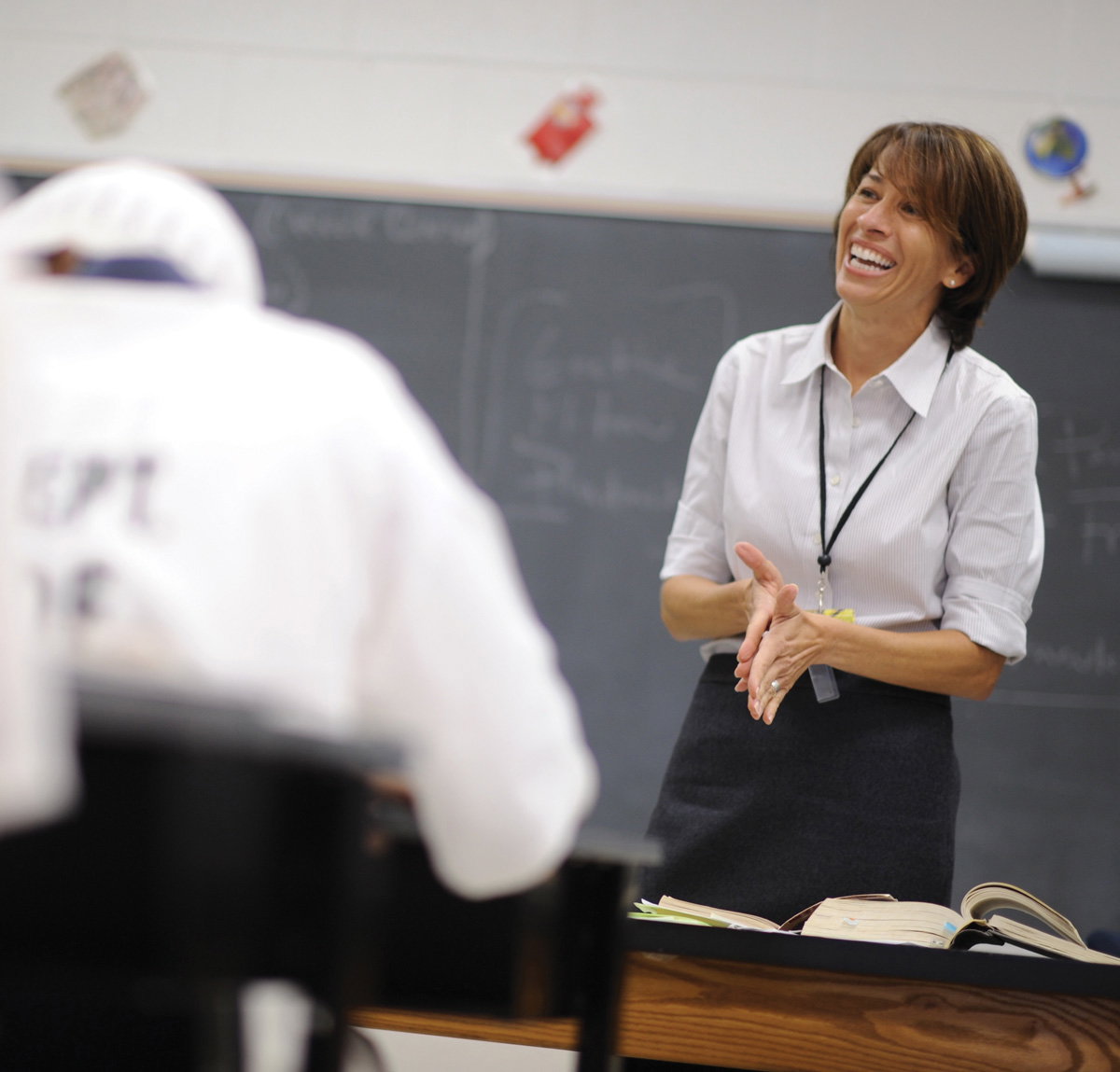
Sarah Higinbotham has made hundreds of trips to prisons and jails over the past 16 years and has never lost the joy of teaching incarcerated students. She spends a lot of her time supporting alumni—the hundreds of former prisoners who took Common Good–affiliated classes and are now back in the community. Sometimes she helps them get a driver’s license or find a place to live. She and her husband host holiday meals at their home, where alumni get together and play disc golf or sit around a bonfire. She helps coordinate cooking classes, concerts, and support groups. “With me, and with each other, they don’t have to pretend like they never went to prison,” she says.
She makes it a point to connect with people where they’re at, not just where they’ve been. “It is a shift in perception that people who have served time in prison are somehow less worthy of our community,” says Higinbotham, reflecting on why she and cofounder Bill Taft named their organization Common Good. “I do not approach what we’re doing as rehabilitation, but as an issue of human rights.”
Photograph by Ben Rollins
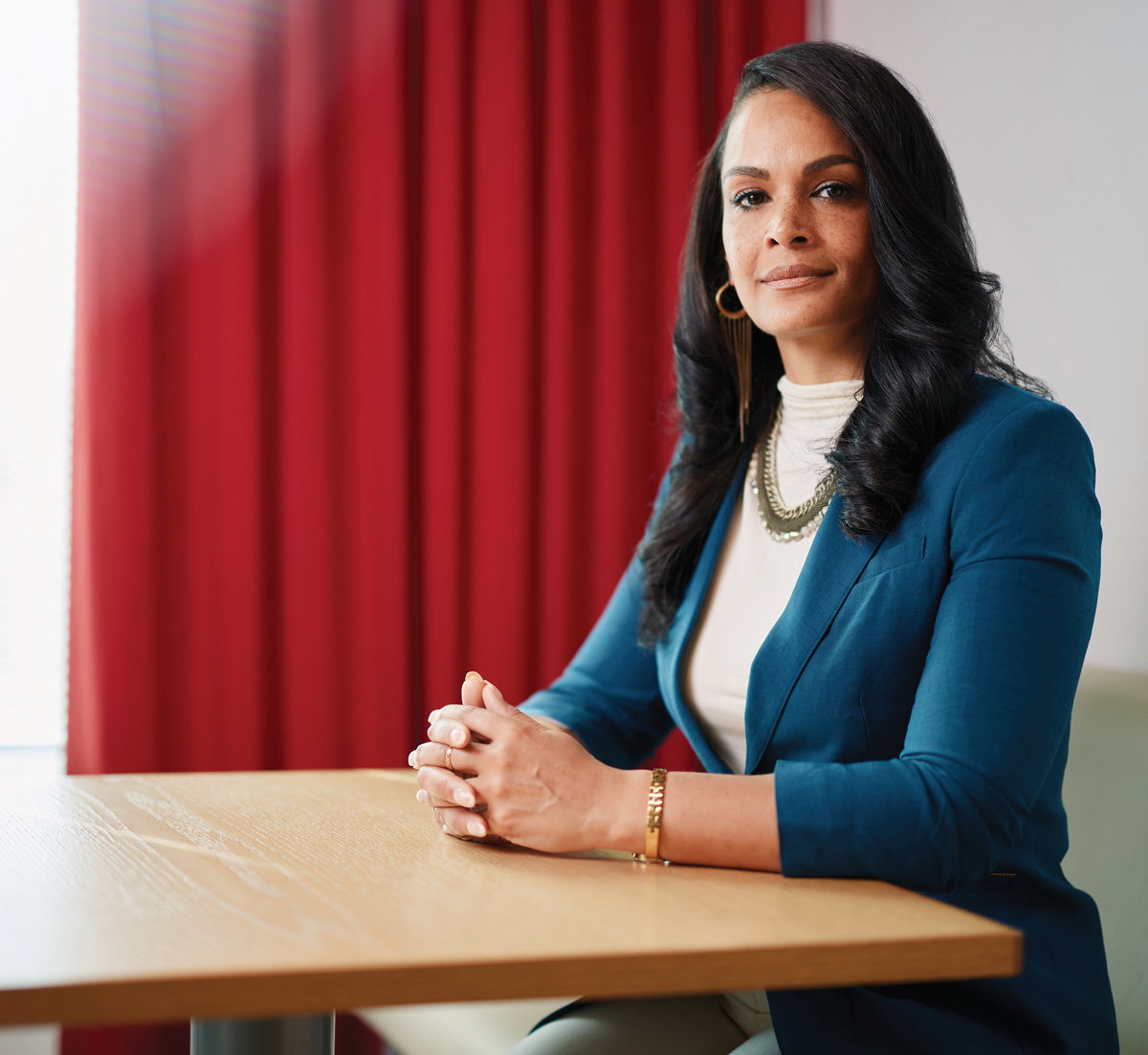
Tiffany Kirk, the executive director of Common Good Atlanta, says there’s plenty of professors who believe in the value of teaching in prisons. “We have a waitlist of faculty and no shortage of facilities that want us inside,” she says, but the nonprofit needs money. As head of the organization, she actively engages with community members and private foundations to raise funds to expand the number of classes they can offer inmates. Kirk, who also teaches financial literacy at the Metro Reentry Facility in DeKalb County, says teaching in prisons is like going to church. “It’s that spiritual.”
As we leave Burruss, there’s a palpable buzz in the room, a feeling that something important has taken place. We share handshakes, hugs. It’s dark outside, lights now illuminating the walkway and glinting off the concertina wire atop the high fences. Murray and I are quiet as we clang out through the maze of gates, knowing we get to go home to family, friends. We can drive anywhere, buy a burger or a beer, sleep on comfortable mattresses, cook eggs for breakfast. I feel a lump in my throat, a little speechless.
“I know,” says Murray, without me saying anything.
We get back to the car, check our phones, and drive away in silence. I watch in the side mirror as the prison shrinks and fades into the darkness. I think about Thurman’s quote, about coming alive. I look over at Murray, shoulder-checking as he pulls onto I-75. Despite the long day, I feel wildly alive.
This article appears in our June 2025 issue.