


Courtesy of AECOM
Calvin Lockwood remembers the downtown Atlanta of 1993 as a vastly different place. That’s when he bought a former dry goods and furniture store constructed in 1910 in Castleberry Hill, next to what is No Mas! Cantina today, to build his photography studio, art gallery, and trendy loft. Almost nobody lived in the historic neighborhood at the time, and Lockwood forked over $135,000 for his new home. That bought more than 20,000 square feet.
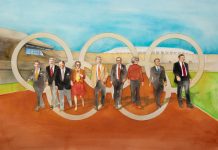
The downtown of three decades ago was dotted with bulldozers, construction cranes, and other traits of a development frenzy for the Olympic Games. As in 1996, sections of the city’s oldest blocks today are busy preparing to welcome the World Cup with record-breaking injections of public and private investment. It all rings familiar to Lockwood, who volunteered at Atlanta’s Games in 1996. “We would come home and drive through what was a rundown warehouse district that they bulldozed to build [Centennial Olympic Park],” Lockwood recalls. “That was quite an amazing transformation.”
As with the Olympics, the local legacy of the World Cup will be shaped by what the city and some of its largest development firms are constructing right now—additions to downtown’s landscape, much of it previously vacant, that will remain long after this summer.
What’s arguably the Olympics’ most lasting infrastructural legacy, Centennial Olympic Park, had been a “multiblock eyesore” in the middle of downtown until Billy Payne, chief executive officer of the Atlanta Committee for the Olympic Games, had an idea. Now, that $75 million greenspace investment, funded entirely by private donations, will host the epicenter of World Cup fan hoopla this summer. Relics of the Games (see Summerhill’s Olympic Cauldron) and more functional additions, such as the Centennial Place mixed-income apartments, still echo the global impact the event had on the city. Likewise, the World Cup–era big kahunas are Centennial Yards (formerly downtown’s barren Gulch) and the 16-acre restoration and revitalization flurry that is Atlanta Ventures’ South Downtown, where an array of restaurants, offices, and retail is bound for formerly moribund blocks. Both are titanic undertakings.

Photograph by Getty Images
In other ways, the Olympics and the 2026 FIFA World Cup—two seismic events, coincidentally 30 years apart—will have differing impacts on the city’s built environment. The scattered Olympics saw a purpose-built stadium rise, public housing (such as Techwood Homes, which had 1,100 residents) cleared for athlete villages, and sporting venues sprout from Jonesboro (beach volleyball facilities) to Stone Mountain (tennis arena) and Conyers (equestrian park and mountain biking venue). In recent years, hundreds of millions of dollars’ worth of development has been more centralized around downtown—a lot of it with a hard deadline of June, when World Cup matches begin.
Atlanta Downtown Inc. (formerly Central Atlanta Progress and other agencies) counts three new hotels—with nearly 600 rooms and 18,000 square feet of retail space total—spurred in part by the World Cup’s economic promise. The Mitchell apartment tower brought more than 300 luxury units and retail overlooking Mercedes-Benz Stadium at Centennial Yards, and the National Center for Civil and Human Rights recently tacked on 24,000 square feet of exhibition and events space. Another key addition, according to the downtown agency, is CNN Center’s rebirth as The Center, with some 200,000 square feet of renovated retail—and the city’s largest bar.
Less splashy downtown additions include 500 completed rapid-housing units designed to help Atlanta’s homeless get off the street and stabilized. Amanda Rhein, the city’s chief housing officer, says roughly 58 developments with affordable housing components on publicly owned land are in progress now—double the number of a few years ago.
“We can really build on all the work that was done in preparation for the 1996 Olympics to build a significant amount of residential units downtown, including conversions of office buildings,” Rhein says. “People might be hesitant to move downtown because they see it doesn’t have the amenities they want in a neighborhood, but it’s hard to get the amenities without having that residential population and those demand drivers.”
A.J. Robinson, Atlanta Downtown Inc.’s longtime president who is stepping down in 2026, had a bird’s-eye view of Olympics preparations downtown in the 1990s, and he says the pre–World Cup vibe and buzz is comparable. “These kinds of things are a way for people in the metro area and Georgia to kind of rediscover downtown,” Robinson says. “It’s going to be interesting to see.”
Another contingent, of course, will be international visitors (more than 500,000 are expected to visit Atlanta for the event), many of them, by all indications, with deep pockets.
“Every week that goes by, people are asking, Hey, so-and-so’s going to need a place for a month during the World Cup. Can you help them?” says Lucas Carter, a Coldwell Banker luxury real-estate agent who is considered a downtown expert. “Do I think it’s going to change our life entirely? Absolutely not. But the nice thing is, the more things that happen like this, and the more that developers put multibillions of dollars into our little world down here, things can’t help but change, boosting property value and perception of the neighborhood.”
This article appears in our June 2026 issue.