


Courtesy of Six Flags Over Georgia
I’ve always been intrigued by worlds outside my own. As a kid, I was enamored with how worlds were created, spending my free time reading books and children’s magazines and playing video games—anything I could get my hands on, anything that had a world I could explore. But despite all this engagement with books and television, there were very few places where I could experience, in person, anything close to a new world.
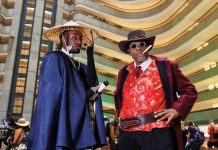
Six Flags Over Georgia was the first place that felt to me as if I were walking into a world unlike my own. A place where I could get lost in a story—the closest I could get to a living, breathing, walking, talking real-life fantasy. Other kids had Renaissance fairs, comic festivals, or LARPing [live action role-play] events. For me, it was Six Flags.
Six Flags Over Georgia, just west of the city out I-20, has held a special place in the hearts of Atlantans for decades. Before Six Flags Over Georgia opened in 1967—the franchise’s second park after the inaugural Six Flags Over Texas—summertime entertainment was relegated mostly to the amusements at Lakewood Fairgrounds, as well as traveling fairs and music, theater, and circus performances.
Six Flags quickly became the go-to destination for thrill-seeking Atlantans, especially because of its highly rated roller coasters. Over the decades, the park has established itself as a place where visitors of all ages can tune out their daily problems for a day of fun. (Mostly unproblematic fun: In the past few years, Six Flags has quietly addressed some early missteps—for instance, renaming Monster Plantation to Monster Mansion.)
For children, it’s an early introduction to the world of theme parks; for teenagers, it’s a transitional space before full independence from their parents. For young adults, it’s a place to go back to for memories of years past or to celebrate milestones. And for parents and caregivers, it’s a way to entertain the kids and break up the day-to-day monotony of childcare.
For me, Six Flags has always been where I go to be reminded of my childhood and make memories with friends in adulthood. What I like about Six Flags is that it’s constantly changing, but the core remains the same—something I can’t say about the city of Atlanta.
Six Flags is a time capsule: The rides may change, but the park’s layout, design, and map have stayed consistent. The Cyclone—formerly the Georgia Cyclone, now the Twisted Cyclone—is still the first roller coaster you hit when you enter the park; the Great American Scream Machine has been around since my parents were dating. The Monster Mansion is still where first kisses happen, while Thunder River still offers cool relief on a hot Georgia day.
The Ninja—er, now the Blue Hawk—is giving teens their first introduction to the impact of g-force, and that steep uphill trek from the Gotham City area into the main park still haunts kids and their beleaguered parents. Meanwhile, my personal childhood favorite, the Dahlonega Mine Train, continues to delight the kid in me.
Six Flags is one of the few places in the whole metro area where I can look back and compare all the experiences I’ve had there at various stages of my life and with various people in my life. It’s where my dad took me for my birthday as a kid and, hopefully, one day, where I will take my own kids.
Once a year, I pilgrimage to Six Flags Over Georgia, that place that built me, with new eyes. I guess that makes me a Six Flags adult; I wouldn’t have it any other way.
This article appears in our July 2025 issue.