



Photograph by Audra Melton
When Beth Hyland first shopped around the script for her play Fires, Ohio, multiple theater companies told her it was unproducible. There wasn’t a problem with the dialogue or the plot; the script, humorous and gripping, had already won both the Kennedy Center’s Paula Vogel Award in Playwriting and the Mark Twain Prize for Comic Playwriting. The setting itself was the issue: a two-story house in an Ohio town, surrounded by a raging wildfire.
Hyland, who has an MFA in playwriting from UC San Diego, spent seven years developing the play, an adaptation of Anton Chekhov’s Uncle Vanya. She workshopped it at readings throughout the country to catch the eye of theater producers. Finally, Fires, Ohio won this year’s prestigious Alliance/Kendeda National Graduate Playwriting Competition, an annual award from Alliance Theatre that turns a student playwright’s work into a professional production. The world premiere of Fires, Ohio runs from February 25 to March 22; before that, dozens of Alliance Theatre company artists, from designers and costumers to sound and lighting engineers, worked for months to realize the play onstage.
“I can’t believe it, because I know this play is a huge challenge to actually make happen in front of an audience,” Hyland says. “I also know that it will blow people’s minds.”
Alliance Theatre established the Kendeda prize in 2004 to bring original work and world premieres to Atlanta. Over the course of its 22-year history, the prize has launched the careers of writers who go on to Broadway or the big screen: One notable prize winner was Tarell Alvin McCraney’s In Moonlight Black Boys Look Blue, later adapted into the film Moonlight, which won the 2017 Academy Award for Best Picture.
The spark for Fires, Ohio was rooted in anger. Hyland had read Uncle Vanya as an undergraduate at Kenyon College and seen it live during a semester abroad in Russia. She wrote her first lines just after watching that production of the play, which is a living-room drama set in rural Russia that follows the emotional upheavals of a caretaker of a rural estate and his niece Sonya, alongside their complicated guests.

Photograph by Audra Melton
“I was frustrated on behalf of Sonya and wanted to give her character more of a voice than she has in the original,” Hyland says. “She’s such a complicated character who has to endure suffering and isn’t allowed to advocate for herself.”
Fires, Ohio takes place in the 21st century in a small fictional Ohio town, which Hyland based on the rural areas that surround Kenyon. Sonya is a 23-year-old still living at home with her father—a college professor—her brother, and her father’s second wife. Wildfires in neighboring Kentucky are encroaching on the small town, keeping everyone stuck inside, when they get a visit from climate journalist Erin, a friend for whom Sonya may or may not have feelings.
“Literal smoke is trapping them inside,” says Hyland. “It’s also figuratively clouding judgments and forcing all of these emotional, interpersonal issues and desires to a boiling point.”
For its world premiere, Fires, Ohio features an all-local cast under the direction of Marissa Wolf, artistic director of Portland Center Stage in Oregon, who had previously workshopped the script with Hyland during a new-play festival in 2024. The set and costume designer is Lex Liang, who has regularly taken on original works with the Alliance since 2010.
Several months before the show opened, Liang began tackling the first of several logistical hurdles that the production demanded: designing a set that would fit a two-story house on the Hertz stage. The problem was not only one of scale—the stage allows for a 15-foot clearance—but also one of dynamism, because the house must move with the story as action occurs in multiple rooms. “It was a challenge to design a container that must appear spacious and safe but also transition to dangerous and unsafe with the environment around it,” he says. “The house also has to accommodate a lovely surprise at the end in a way that’s . . . legal.”
Once Liang had designed the set, his visions came to life at the Alliance Theatre Scene Shop, which is in Atlanta’s English Avenue neighborhood. There, three technical directors lead a staff of carpenters, welders, and craftspeople to build a season’s worth of sets and props.
Welder Chris Seifert created a metal framework for a set-sized two-story house. Seifert is looking forward to seeing the team’s complicated handiwork come to life onstage. “I don’t usually see the shows, but I’m definitely interested to see a house I helped build on the Hertz,” he says.
Photograph by Audra Melton
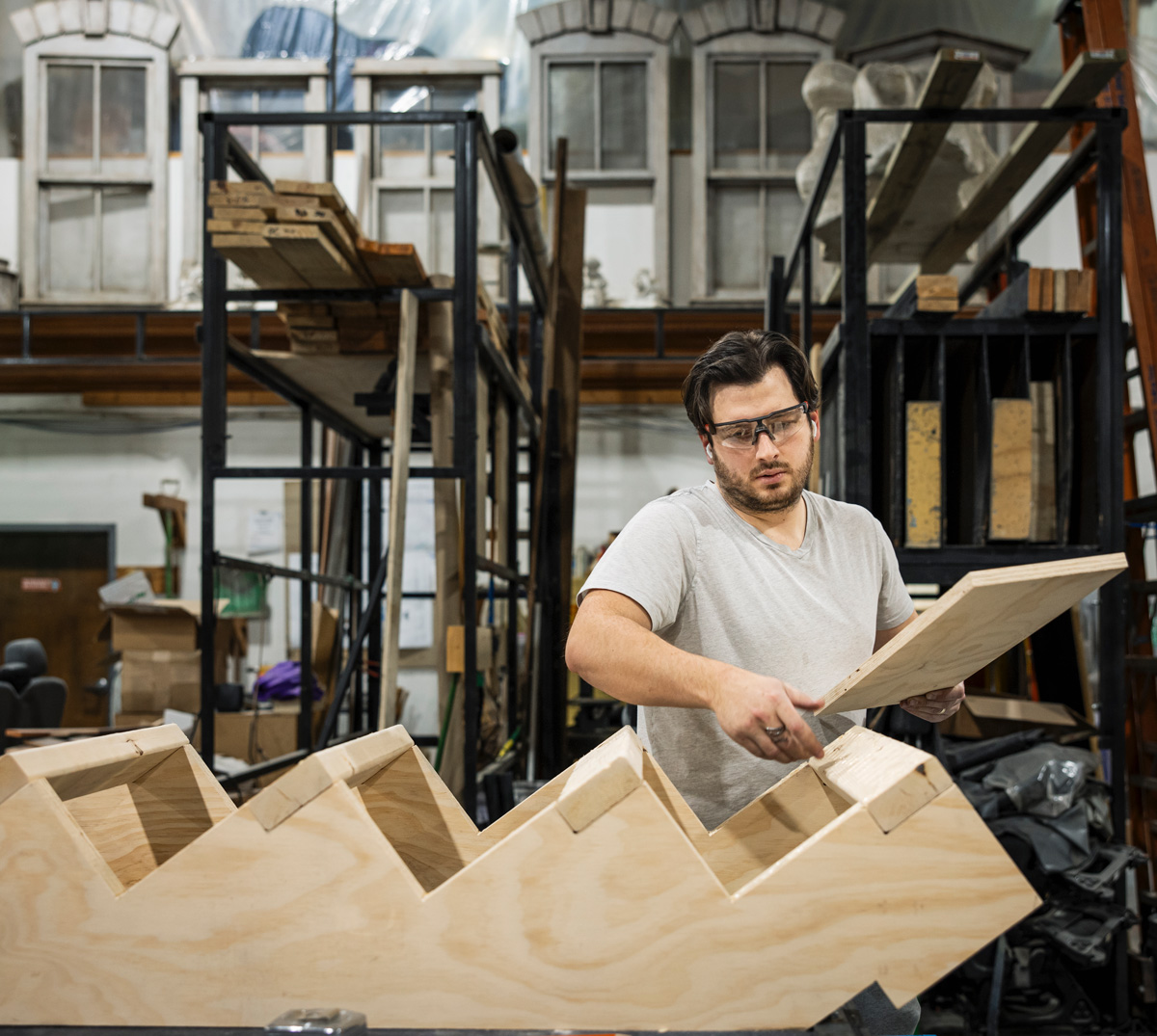
A two-story house also needs a sturdy set of stairs. Rebecca Lovett and Spencer Antoci sanded and curved plywood to give the stairs dimension. With the props team, Antoci also built light-box windows that incorporate lighting in the show. “Fires is ambitious, and our job is to make things look real, and that’s part of the show,” says Antoci. “What design is trying to do may not look realistic six inches away, but if you back up five or 10 feet, you’ll think, Whoa, that set is on fire.”
Lead carpenter Marlon Wilson worked on building the house’s walls and attaching a fabric to them for special effects. He built several walls with different configurations in the scene shop to find just the right angle for Liang’s vision. “With an original, it’s fun to be part of the decisions of how things will look,” Wilson says. “And Fires should be one of the most eye-catching we have done in a while.” Like Seifert, he rarely sees the shows he builds in person but intends to watch Fires, Ohio live.
Joining them in the audience will be Hyland, Liang, and Wolf, who have worked to bring about what was once deemed unproducible onstage. “I don’t want to give everything away, but I’m excited to see how our visions come together to build towards the end,” says Liang. “So you are just going to have to see the damn show for yourself.”
This article appears in our March 2026 issue.