


Courtesy of the Atlanta History Center
In October 1926, the Atlanta Historical Society’s founding officers gathered at the Atlanta Athletic Club downtown to formalize their organization. Tommie Dora Baker, elected librarian, offered to store donated artifacts at the city’s Carnegie Library office where she worked, because the fledgling organization had no office space. Adjourning for dinner, the group heard from University of Georgia professor E. Merton Coulter, who admonished them that history should be revered “as a record, not a play-horse.”
Bolstered by $5 annual dues—$100 for a lifetime membership (about $1,800 today)—the group brainstormed grand plans: citywide markers, a booklet, and first-person accounts from older residents, the Atlanta Constitution reported. Thirty Atlantans were named founding curators.
A century later, the group has evolved into the not-for-profit Atlanta History Center, which occupies 33 acres in Buckhead, houses 61,000 artifacts, and is buoyed by multimillion-dollar endowments. To celebrate its centennial—which coincides with the nation’s 250th birthday—the center will unveil six ambitious new exhibitions.
Debuting this month is More Perfect Union, a centerpiece exhibition that explores Atlanta’s role in the Civil War. It squarely addresses the contradictions between the slave economy at the war’s root and the founding principles of freedom and equality celebrated during this year’s semiquincentennial.

Photograph by Lynsey Weatherspoon
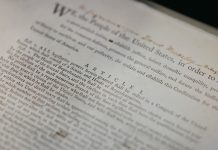
“When we read ‘We the People,’ well, who exactly is included in that?” says Gordon Jones, the center’s senior military historian. Jones curated both Turning Point, the center’s Civil War exhibition that debuted in 1996, and More Perfect Union.
“We have a long history of enslavement, race, freedom—and conflicts between those things were part of the leading up to the Civil War and then leading back out of it again,” he says. “This is a good time for us to be talking about that in the country.”
Jones says he began thinking about this larger, nuanced, and contextual exhibition as soon as Turning Point opened 30 years ago. That exhibition focused on military operations; the new one puts the war into context. This includes artifacts that demonstrate the brutality of slavery (such as shackles from the Middle Passage) and the impact of the slave economy (rice, indigo, cotton). It addresses the agency Black Americans had in gaining freedom—a central artifact is a flag of the U.S. 127th Colored Infantry—and the role of abolitionists, including John Brown, whose handwritten letter is featured.
A focus on firsthand accounts makes More Perfect Union accessible, says Atlanta History Center President and CEO Sheffield Hale: “As my dad used to say, ‘down where the goats can get at it.’” Through artifacts, text, and multimedia, the exhibit explains a very complex chapter of history. “We try to talk in ways that are measured, factually based, and without hyperbole,” Hale says. “We try to focus on the facts. We bring the receipts. We have footnotes.”
The exhibition also addresses the postwar Reconstruction period, including the ways White supremacy came to shape views of the conflict and its aftermath. “What are the myths about Reconstruction that we deal with, not only here, but at the Margaret Mitchell House, or Margaret Mitchell herself had?” Hale says. “I will tell you her idea of Reconstruction was very, very consistent with what the academic one was at that period of time. But it was bonkers.” The exhibition contrasts Mitchell’s “Lost Cause” take on the war with the more historically accurate one written by her contemporary W.E.B. Du Bois. Hale says the exhibition will let people learn “there’s another story than the one that they may have heard, the general story that’s been out there for many decades.”

Courtesy of the Atlanta History Center

Courtesy of the Atlanta History Center

Courtesy of the Atlanta History Center
Against today’s backdrop of polarized politics and federal efforts to clamp down on diversity in national parks and museums, the History Center’s staff members say they value their independence as a private organization and stress that the timing is right to talk more openly and critically about the Civil War’s role in the nation’s overall history.
“We are now presenting this visual, immersive experience that will situate a real, personal point of view in the run-up to the war and then the war itself,” says Pola Changnon, the History Center’s chief content officer. “It’s more accessible when you see firsthand quotes and letters of people who are going through this time writing to loved ones on the battlefield, and you hear from the folks on the battlefield writing to their spouses, mothers. It’s heartbreaking, no matter what side of the war you’re on.”
Over the past three decades, the History Center has amassed one of the world’s largest Civil War collections, and many items from that collection will be shown for the first time. One item Jones says is particularly resonant is an original copy of Frederick Douglass’s speech that has become famously known as “What to the slave, is the Fourth of July?” That is paired with a recording of an actor reading the speech. “When you stand under that, and you hear him putting it out there, this is the contradiction. This date, what does this mean? It means nothing to me. It is an insult to me. To be able to put that front and center . . . it’s pretty powerful stuff,” Jones says.
“One of the other things we’re doing is not only placing the American Civil War in the arc of America, the course of American history, but also in the course of world history,” he says. “Think about what would have happened in the world had a slave republic survived and prospered in North America.”
At this century mark, Hale says what matters more than ever is the items amassed in the center’s archives, which blossomed from the stash Tommie Dora Baker began gathering 100 years ago. “Particularly in this world of AI that we have now,” he says, “being able to show that you have the actual document, not something that has been transformed somehow magically into something else, that’s increasingly important.”
This article appears in our July 2026 issue.