

Photograph by Matthew Doyle of Doyle | Goodrowe
When a friend told me to meet them on the Upper Westside, I thought they were giving me an Atlanta-specific riddle to solve. In my seven years in the city, I had never seen that name on a map or heard any native—or transplant, for that matter—mention it.
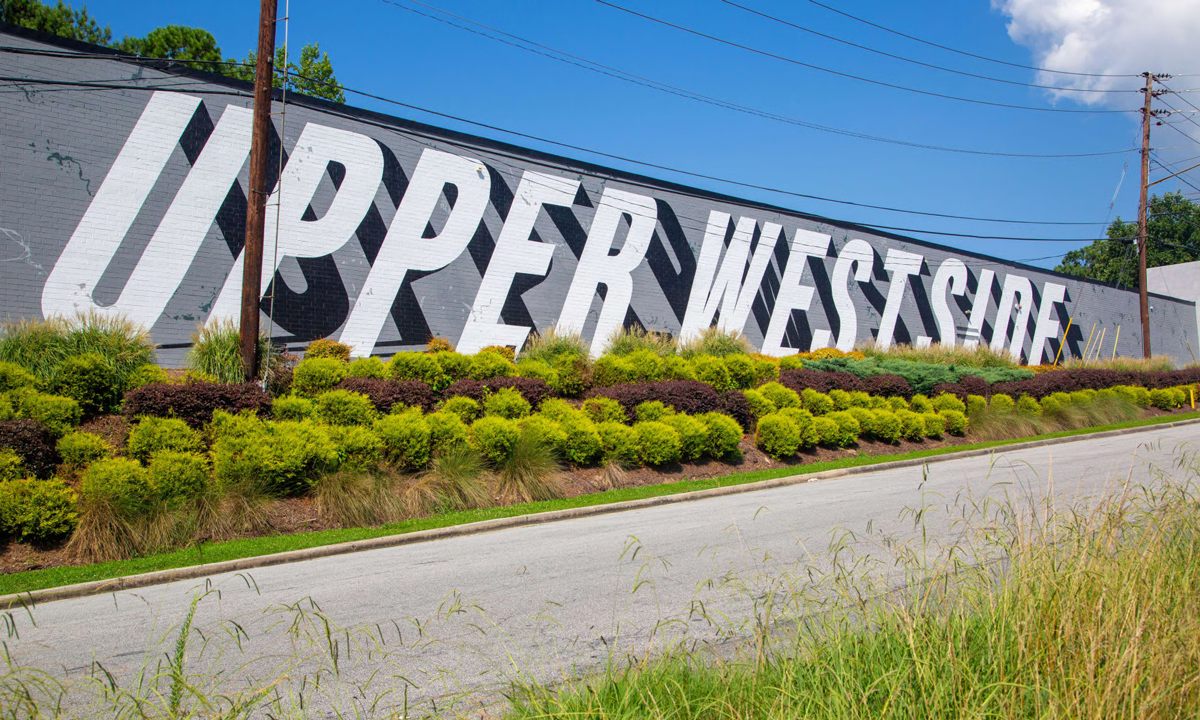
This year marks the 10th anniversary of the Upper Westside, or at least of the Community Improvement District (CID) tasked with developing its local infrastructure, which coined the name in 2016. It seemed an apt time to ask the titular question. In short: Yes, the Upper Westside is a real place, but the name has yet to stick for a reason.
To venture into this maze, one must first understand that neighborhood names in Atlanta can ebb and flow with the development wind. Midtown, for instance, was called “Uptown” in the 1950s and ’60s (including a short stint as “Uptowne”) before earning its current name in 1972. In the 21st century, names are a defining feature of developing neighborhoods, from those that have gained prominence—South Downtown, West Midtown—to those that have flopped, such as East Midtown, East Downtown, or the aspirational Uptown, this time in the Lindbergh/Morosgo area.
The term Upper Westside popped up in the early 2000s among neighbors. “When I moved to the area in 2008, it was already in place just by word of mouth,” says Dustin Hillis, Atlanta City Councilman of District Nine, which encompasses much of northwest Atlanta. “That original title pertained to Whittier Mill Village, Riverside, and Bolton.”
The CID was first established in 2016 to connect the neighborhoods within the northern Westside, but it didn’t include the neighborhoods Hillis noted. Originally, the district was named the Howell Mill CID and centered around the Howell Mill Road and Marietta Street corridors. “We quickly expanded from there to six neighborhoods, so we landed on the Upper Westside shortly after,” says Elizabeth Hollister, executive director of the now Upper Westside CID, which comprises Blandtown, Berkeley Park, Channing Valley, Howell Station, Marietta Street Artery, and Underwood Hills.
The Upper Westside CID’s mission is to connect the area in name and in practice, a tall order in a territory divided by industrial lots and lacking human infrastructure. Simple improvements include new sidewalks on Howell Mill Road and cycle tracks on Brady Avenue as well as big projects such as the Woodall Rail Trail. The CID has also created new signage for the individual neighborhoods. “We aren’t trying to replace any names before us,” Hollister says. “But we want you to know that you’re in a general place, the Upper Westside.”
Developers, though, have used the name for new mixed-use projects, often ignoring neighborhood or CID boundaries. A quick Google search shows such developments as Luna Upper Westside in Bolton, or The Collective Upper West Side in Whittier Mill Village.
This is what King Williams, a journalist and Atlanta native, lamented when he took up the Upper Westside question in 2019 op-eds for SaportaReport. “The story mostly came from general annoyance,” he says. “Developers were saying, We bought here. We live here now. And we’re going to call it this. And people online latched onto this newness like nothing existed here before.”
Today, Williams says that he doesn’t use the term Upper Westside often. He believes it has yet to stick because of its moving boundaries and disconnected neighborhoods. “It’s difficult to tell what a place is if it feels like a loose real-estate concept,” he says. “No one can experience an apartment and think, This is the Upper Westside. If we are going to use the name, Atlanta should say, This is on the map, while still specifying the neighborhoods in it.”
Upper Westside may be real, but like much of Atlanta, it’s a place still in progress.
This article appears in our March 2026 issue.