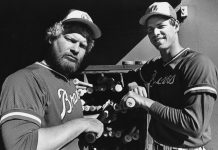



Lee Walburn—one of the twin titans in the history of Atlanta magazine, along with founding editor-in-chief Jim Townsend—had a simple mantra for what made a magazine speak to readers: “Make ’em laugh, make ’em cry, make ’em smarter.”
He was editor-in-chief of the magazine for 15 years, longer than anyone else in the publication’s 65-year history. Under his guidance, Atlanta magazine received more than 200 journalism awards—and a few of those bore my byline. I am certain that every award I received while at the magazine was due to Lee’s masterful and incisive editing.
He could see gaps in a story that no one else could. “It’s a good story, but you buried the lede,” he told me more than once. Another Lee axiom proved essential to my editing and writing career: “Just because it’s interesting doesn’t mean it’s part of the story you’re telling.”
Lee nurtured and edited some of the greatest Southern literary voices of his generation: Pat Conroy, Lewis Grizzard, Pulitzer Prize winner Susan Faludi, two-time National Magazine Award winner Tom Junod. His friend, Terry Kay, had an idea for a story about his father and a white dog that showed up after his mother’s death. Lee pushed him to write it, and it turned into a bestselling book and then a film that earned Hume Cronyn an Emmy Award as Outstanding Lead Actor in 1994.
Roswell Lee Walburn passed away April 9 after battling a long illness. He was 89. He is survived by his beloved wife, Jackie, and their three children: Shannon, Steve, and David. A memorial service will be held in Rome at 1 p.m. on May 9 at the Pleasant Valley North Baptist Church.
He was born in LaGrange into humble beginnings. His parents were “lintheads,” cotton mill workers, and he carried that with pride. We shared that heritage in common—my grandparents did their time in the same mills. We also both matriculated at West Georgia College (he transferred to LaGrange College as a junior) and we each started our journalism careers at our hometown papers before going to work for The Macon Telegraph.
In 1960, Lee moved to The Atlanta Journal to cover the Atlanta Crackers minor league baseball team. Five years later, he was hired by the Atlanta Braves as their first public relations director. He relished telling the story of how he hit the first home run in Atlanta Stadium during a staff batting practice shortly before the inaugural season began.
He published a Braves yearbook sold at games that was full of feature stories, player profiles, and career statistics. That was how he first touched my life. The debut yearbook in 1966 included a profile of Braves pitching coach Whitlow Wyatt, who happened to live a few blocks from me. “Buchanan, Ga., doesn’t take up a lot of this green earth, but what it does, it covers in a peaceful, unpretentious way,” the story began. I was seven years old when I read that and I was mesmerized by the poetry of the language. It was the seed that made me want to become a writer.
The byline was Lee Walburn.
After a stint owning a public relations firm, he returned to the Atlanta Journal-Constitution in 1980 to become the editor of its Sunday magazine Atlanta Weekly. That magazine published my first-ever freelance story—all three paragraphs of it.
In 1987, he became editor-in-chief of Atlanta magazine and transformed a sleepy city magazine into a literary force. He not only had an eye for great magazine story ideas, he recognized and then nurtured writing talent.
He was vigilant in protecting the magazine’s editorial integrity. When Atlanta magazine was sold early in his tenure to American Express, an executive came down to meet him and Lee found himself in something of a job interview. When the questions got too personal for his taste, he stood up and ended the meeting. “Let me tell you something,” he famously said. “I’m not wealthy. But I’ve got enough kiss-my-ass money set aside that I don’t have to take any more of your questions.”
A few years after that, when I decided I wanted to graduate from newspapers to magazine writing, I sent story ideas to Lee. When he responded, he went into embarrassing detail about how the magazine had already published every idea I submitted. Then came the second paragraph: “The good news is I like your writing. Keep sending in ideas and we’ll see if we can’t get you an assignment.”
I was there for seven-and-a-half years of his 15-year tenure; first as a freelance writer, then senior editor, and finally as his executive editor. Some of our best story ideas were born over lunches of cornbread and buttermilk at the Silver Grill on Monroe Drive. He would host staff retreats at his farm home in Armuchee in northwest Georgia, and some of us stayed overnight in the office/guest house that he called “The Nut Hut.”
He was more than a boss; he became a father figure. He could be tough, but he inspired through positive feedback and encouragement. He was kind, he was compassionate, and he was demanding. He brought out the best in his editors and his writers. He loved beautiful writing the way some men love beautiful women. I walked into his office one afternoon and was shocked to find him weeping. He held up a manuscript: “Have you read this?” he asked. “It’s magnificent.”
Lee liked to brag that he’d never missed a deadline, and he chafed whenever a writer took their deadline as a suggestion rather than a tangible thing. When I turned in a story on disgraced mayor Bill Campbell that was 2,000 words too long and stretched the definition of a deadline, he sent the following note: “The Bill Campbell piece is so good I will be devastated if it is not a finalist for a National Magazine Award. It is so good that I am pleading with [our copy editor] not to have you shot for being so f***ing late with it. Worthy of The New Yorker in my opinion.”
Nearly every person on his staffs would have gone to the wall for him. We didn’t just work for Lee, we loved him. I’ve never had another boss like him.
The writers and editors he nurtured are Lee Walburn’s legacy. We carry his imprint with us, his philosophies and his truths. Atlanta magazine is also his legacy. Jim Townsend is the father of Atlanta; Lee raised it into adulthood. Townsend is Babe Ruth to Lee’s Hank Aaron. He carried forward what Townsend built, then he elevated it and made it his own.
The soul of Atlanta magazine may be Jim Townsend. But the heart of Atlanta beat within Lee Walburn.