


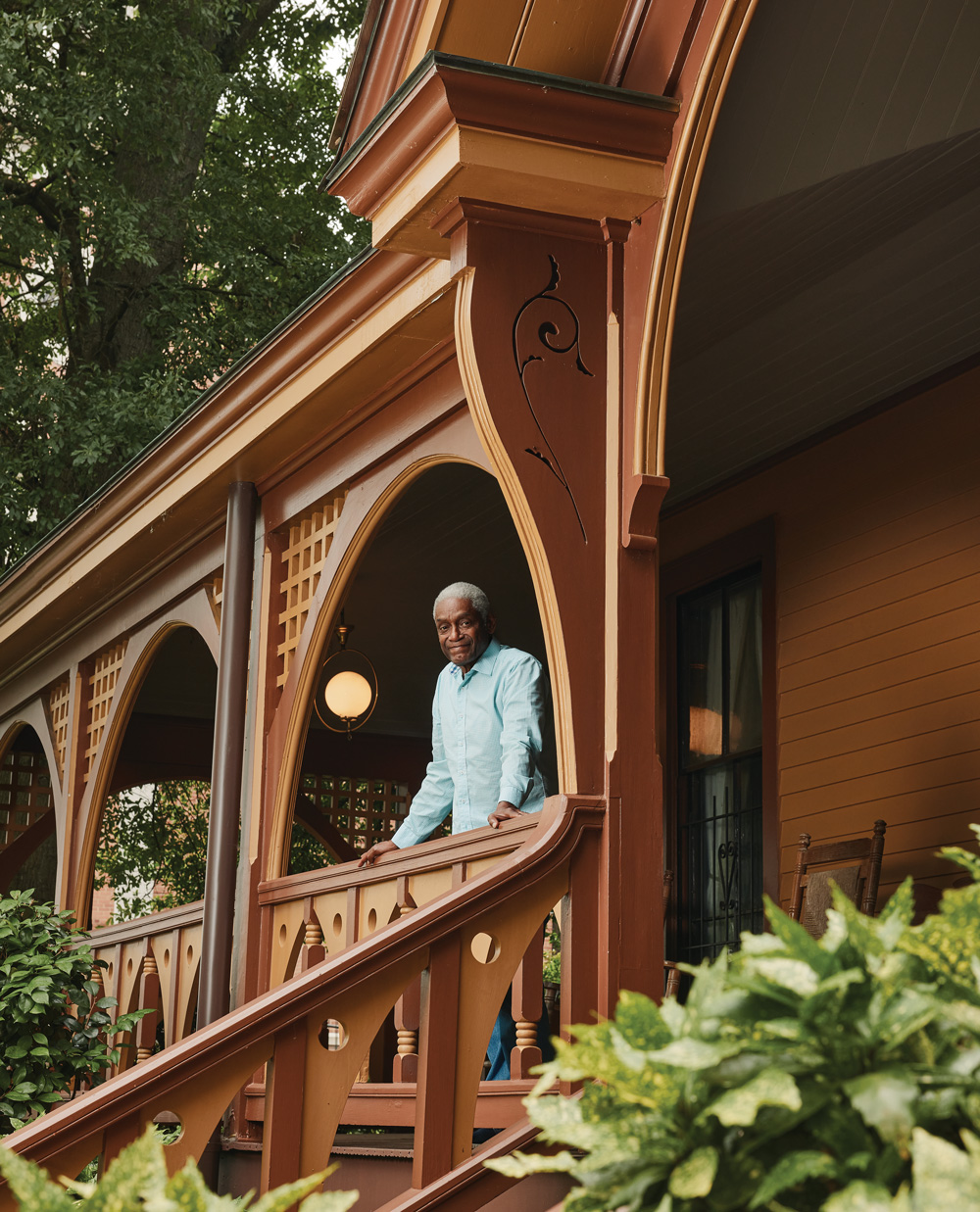
Photograph by Ben Rollins
A good front porch is personal but not entirely private. Carla Jeffries started using hers as a last resort to calm her baby. It was 2015, and she and her husband had recently moved to Inman Park; their front porch quickly became the place to take their son out of the house when he was restless. As so often happens on a porch, Jeffries, with a baby in her arms, began to meet her neighbors.
“The baby was like an open invite: One person after another stopped and asked about him,” she says. “But I loved it because it was passive socialization, and eventually it got our family involved in our community.”
Through the people she met, Jeffries joined the neighborhood association and later served as editor of The Advocator, the Inman Park newsletter. Sixteen years later, she is a regular at the neighborhood’s official monthly Porch Party (hosted by a rotating cast of residents) to meet neighbors beyond her block and catch up with friends who were once strangers on her porch.
Similar to any Southern city, Atlanta has piles of porches for hanging out. But look closely, and the threshold serves as an entryway into the city’s culture and history. Aesthetically, front porches reflect Atlanta’s architectural eras: Think pre–Civil War classical columns, ornate Victorian portals of the late 19th century, and 20th-century overhanging Craftsman roofs. Socially, they are quiet participants in Atlanta’s most significant moments. Take, for example, the porches where groups critical to the civil rights movement, such as the Student Nonviolent Coordinating Committee, met in Sweet Auburn in the 1960s. The “outdoor living room” is so synonymous with that neighborhood, a new mixed-use apartment development built on Auburn Avenue was named The Front Porch (with balconies).
As Atlanta grows more dense, front porches may seem nostalgic. City code doesn’t require a porch, and amid rapid development, new apartment buildings often substitute in rooftops, balconies, or nothing at all. Yet, throughout Atlanta, front porches have become more desirable for both old and new homes. The stats back that up: In 2024, the National Association of Home Builders reported that 67.2 percent of new homes were built with porches, up from 42 percent when reporting began in 1994. In the Southeast, that 2024 percentage jumps to 79 percent.
To find out why, “it’s only right to start with the oldest porch in Atlanta,” says David Mitchell, executive director of the Atlanta Preservation Center, as he stands on the 1854 porch of the Lemuel Pratt Grant Mansion in Grant Park, now the center’s home. According to Mitchell, this is where the Grant family watched the city burn following the Civil War’s Battle of Atlanta. The porch is elevated several feet from the ground and still presides over the neighborhood. “This space is big and open, so it’s not only breezy but also meant to be used, almost like a faux room,” Mitchell says.
In the early South, raised porches were a necessary shelter from the summer’s heat and humidity. And like most places with shade, people were attracted to them as social spaces. Even after the advent of air-conditioning, Mitchell says porches remained a key part of single-family home construction in Atlanta. “People just needed a place to spill out, to smoke that cigarette, to be out in nature,” he says.
According to Mitchell, the late 20th century saw less front-porch construction, with more attention going to the backyard. “The porch’s biggest threat now isn’t air-conditioning. It’s how private our lives are. Today, we’d rather be on our phones than sit on the porch and talk to that weird neighbor with the three-legged dog about the weather.”
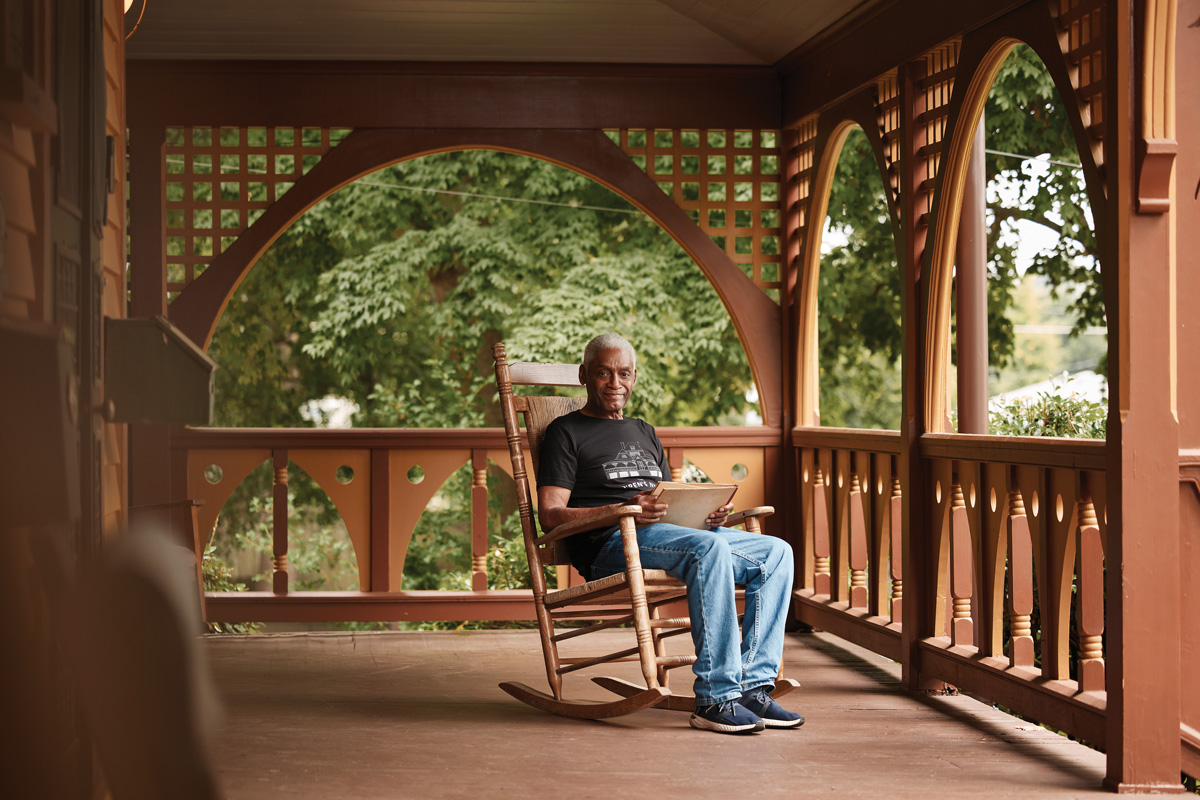
In the West End, Robert Thompson has seen renewed interest in porch sitting in his own community. He moved to the neighborhood in 1990, and after retiring from film production in 2011, he started a tour company, Insight Cultural Tourism, that focuses on the West End’s cultural history. (On his tours, Thompson makes regular stops at the porches of legacy residents, who speak to the groups about the neighborhood’s character.)
The West End also has a tradition of porch parties, which Thompson says became more formal during the pandemic. Porches were a natural buffer for social distancing while still allowing neighbors to congregate outside. “The porch party was a way for us to meet one another, and people wanted that connection then,” he says. “Attendance has grown and is usually very mixed, and this welcome diversity gathered in an intimate setting makes the community feel really special.”
Photograph by Monique Davidson
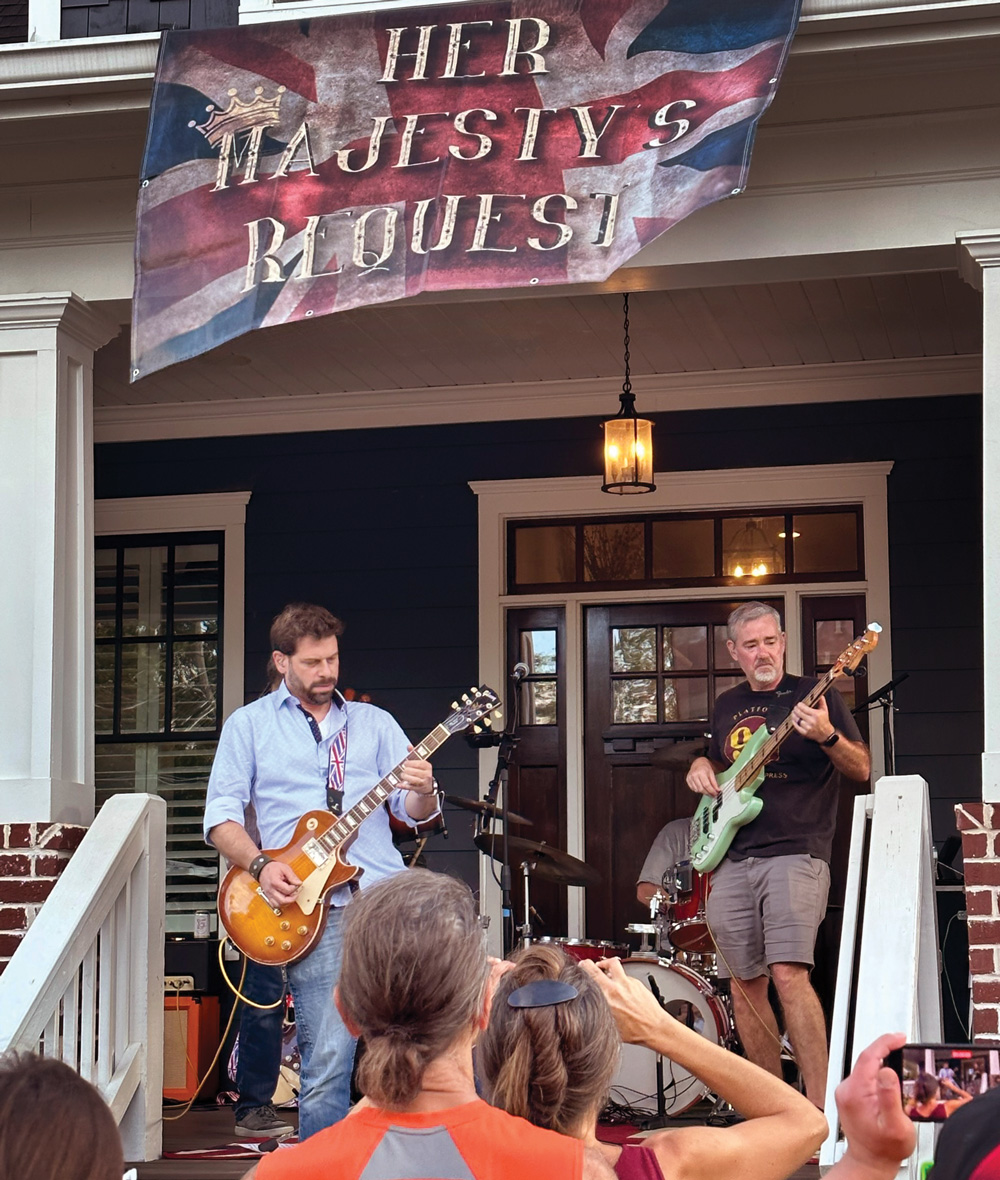
Porch parties like the ones in the West End and Inman Park have become common among Atlanta’s neighborhood associations. Some have adopted their own symbols to display on signs hanging on each porch, such as the Grant Park sunburst or the East Atlanta Village dragon. Increasingly popular are “porchfests,” held in Oakhurst, Virginia-Highland, and elsewhere, which transform the front of homes into stages for live music.
This porch renaissance is reflected in Atlanta home building as well. Pam Sessions has built homes around Atlanta since 1985 with her husband, Don Donnelly, and their company Hedgewood Homes. They began to focus their efforts in town after the recession, and even though appraisers often don’t count the porch toward the total square footage, Sessions says that requests for them (as well as patios, perches, and rooftops) have increased, especially since 2020.
“I think the pandemic only heightened everyone’s want for a place outdoors where you could socialize,” Sessions says. “We now consider the porch in our design just as important as the living room.”
Photograph by Ben Rollins
Home builders can also make porches more usable, adding kitchen elements for outdoor dining or a fireplace for the winter. “We’ve recently been installing sliding-glass walls into homes so they could open up completely to the front porch,” Sessions says. “It’s brought neighborliness back to design, because people are hungry for a space for real-life experiences, even if that’s just waving or seeing someone walking by.”
In Inman Park, the monthly porch parties take that “real-life” porch experience and concentrate it. As many as 40 people of all ages and demographics can be found spilling out into the front yard or inside the house. The only requirement for entry is that you arrive with something to eat or drink.
Jeffries brings her son, now 11, to the porch parties. Since her own porch’s first use as a baby refuge, it has lived several lives: as extra storage space for kid stuff, a place for her son to be loud with friends, and even as the backdrop for a firepit where neighbors often gather.
“It’s become our own third space,” Jeffries says. “You don’t realize it, but once you need it, a porch becomes the most valuable part of your home.”
This article appears in our August 2026 issue.