

Photograph courtesy of Whitespace Gallery
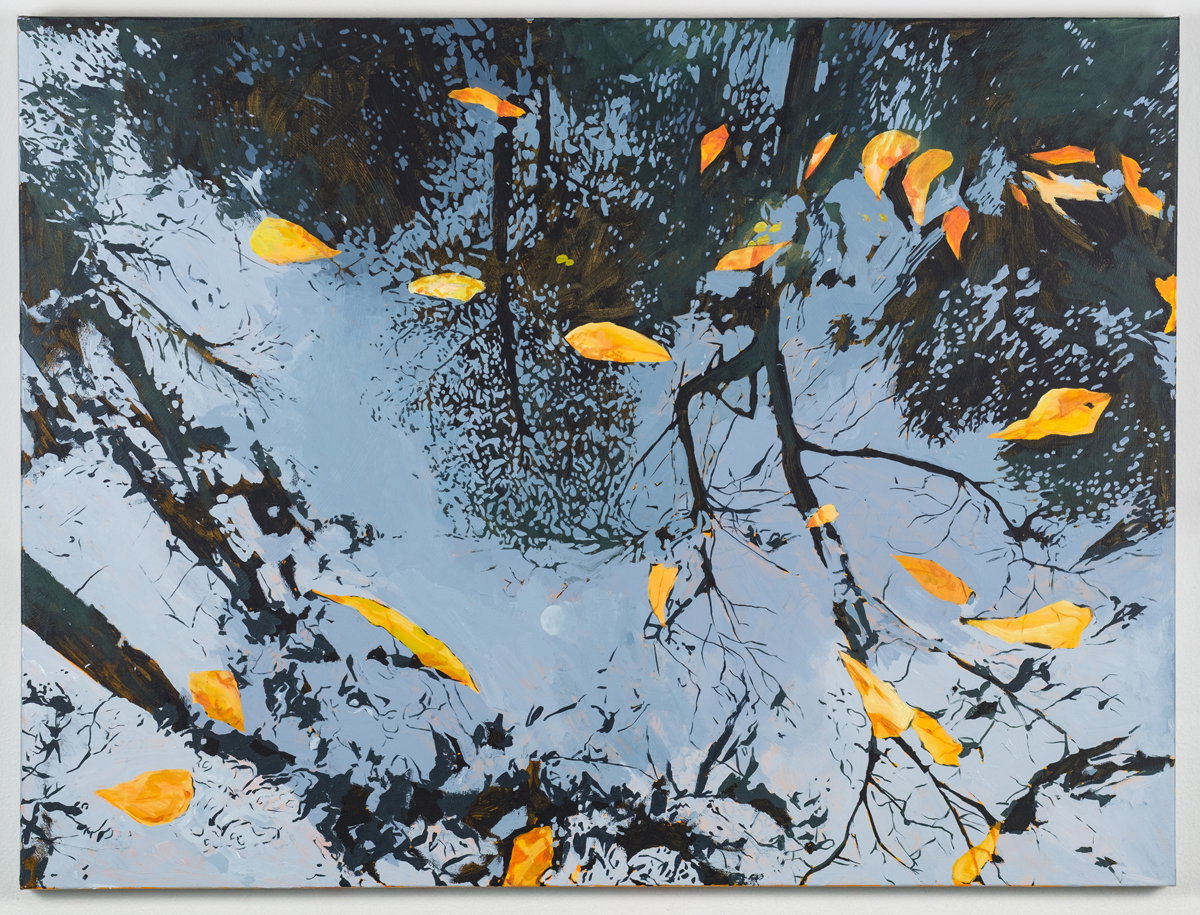
The night before an ice storm is set to plunge metro Atlanta into frigid temperatures, Whitespace Gallery in Inman Park is crackling with warmth and energy. Inside the Victorian carriage house-turned-contemporary gallery, attendees admire ethereal paintings made with smoke, undulating tree roots of latex and bark, and other works by more than a dozen artists hailing from Atlanta, New Orleans, and beyond.
Boundary Layers, a new exhibition curated by Atlanta-based artist Heather Bird Harris, brings together 15 artists to explore how life survives, adapts, and transforms itself under rapid, intense change.
It’s a question Harris has grappled with in both her artistic practice and her personal life for years—one that followed her here all the way from New Orleans, where she lived until natural disaster forced her to seek stability in Atlanta in 2022. Surviving Hurricane Ida while caring for her children and her community compelled Harris to reckon not only with the bleak realities of climate catastrophe, but with how few tools she’d been given for understanding how to carry on through it.
As an educator attuned to history and justice, an artist whose work confronts climate change, and a mother grappling with the existential weight of shepherding new life through a warming world, Harris says she often looks to the living world for guidance. Boundary Layers, on view through March 6, asks painters, sculptors, weavers, ceramicists, and more to do the same, asking not what survival might look like, but how it happens: how life can reveal, and sometimes rewrite, its own rules for survival. Below, we talked with Harris to learn more about the exhibition.
You mentioned that the idea for this exhibition has been in the works for a while.
Yes. It’s related to my own practice, in that this is what I’m doing in isolation in my studio, working really intimately with natural material, almost for the purpose of learning lessons from them: What is life doing? How does life respond to different conditions, and what strategies can I take from that? And I think the power in curation is that it just expands that to multiple perspectives and opens up more possibilities. But it’s the same root question: how does life respond to stressful conditions and rapid change?
It’s a timely question.
I don’t know what other question there is. And it’s not just an art practice, it’s a mothering question, it’s a teaching question . . . I’m just increasingly aware of how little I was taught to be able to navigate this now. So finding new methodologies and epistemologies for ways of understanding has been really helpful to me.

Photograph courtesy of Whitespace Gallery
Can you share an example of a work in the show that explores this question?
One of the artists, Hannah Chalew, has a sculpture that’s made out of found materials from where she lives in New Orleans, and one of those things is a log she found with resurrection fern on it. Essentially, part of its strategy for surviving is dying and being able to resuscitate itself. What does it mean for the resurrection fern to be able to “die” and come back to life when it’s opportune? These are all different strategies organisms have used to be able to grow, and that’s what life does, and we’re part of that. Life creates the conditions conducive to life. That’s part of that biomimetic understanding that’s helping to fuel my practice and this exhibition.
Has your work always been climate focused?
I’ve always been climate-focused in that I’ve always been really history-focused. My work has always been focused on social justice issues. And then my work after college was rooted in history because I was a history educator in New Orleans. I wrote anti-racist history curriculum for schools in New Orleans and the South more broadly. I was starting to come back to my art practice [at that time], and that’s what I was thinking about: how is the history here held by the land and the water and the materials that make up [a place like] New Orleans? That’s the source of my work more broadly. And also it really is the focus of this exhibition too.
The show features 15 artists; how did you find them?
These are artists who I had previous relationships with in one way or another. It really is relational. And it’s also shared concern. Shared concern, and deep admiration for their practices, and all of the ways that they embody it. These are not artists who sit alone in a studio and work individually; they have a very expansive practice. They collaborate, they teach, a lot of them write, a lot of them curate. It’s expansive and uncontained. I think at the core of all their practices is really deep learning, and deep feeling and expression, through really close material practices. They’re doing really experimental and new things, and thinking about these questions through new materials.

Photograph courtesy of Whitespace Gallery
Can you tell me about some of them and how their work fits in this exhibition?
When we started doing studio visits for this exhibition, Michelle Laxalt had just finished a series of ceramic vessels that touched on grief. She works a lot with these bodily forms that aren’t representational, they’re not figurative, but they remind you of something. It looks like it could be a body, whether it’s human or more-than-human. For this series, her question was, what does a body or a vessel look like after life has left it? And her newer work, the work that’s in the show, was really a reaction to that grief cycle that she was in: they look like seed pods. Dormant, potentially, but with the capacity to grow.
Part of her process is working with earthenware and Lizella clay, and wood-firing in a wood kiln. And she was telling me that each of these kilns that she’s used across the country act differently because they’re fed different types of wood, from the trees of that region. And the trees are taking in the minerals and the soil. So each one is very specific to its bioregionalism. And within the kiln, the wood turns into carbon and smoke, and though she doesn’t put a glaze on the outside of these particular pieces, it looks like they’re glazed because they’re touched and kissed with smoke. Some of them on the outside look like bark, and that’s not something she manipulated or did. It looks, to me, like the rematerialization of the wood itself. And that’s how it forms itself when it settles. So the work is really a byproduct of that natural process, of what happens physically when wood changes states of matter back into carbon.
I think that’s a really good example of that root question, which is, how does life move and adapt and transform? Fire can be a violent and destructive force, but it’s also life-giving, and part of this natural cycle. So I think there are many opportunities within the artists’ work to reframe how we think about the laws that govern life.
Boundary Layers is about exploring how life grows in the margins. What is it about these kinds of spaces that interest you?
It wasn’t necessarily an interest in the spaces, but more that these spaces exist. Thinking of the visual characteristics of how life organizes itself versus how humans have learned to organize themselves. When artists are working with natural materials, in a way that their materials are really guiding them, you start to see a lot more form that mimics nature as opposed to the built infrastructure. So why is there that visual difference? Why do we see contrast when this is really a system we’re a part of, too?
I think that also connects to the process-oriented aspect of the work in the show. All the artists are really led by their materials in a way that’s collaborative, and not controlling. That has a big part to do with what ends up being the visual formation of the work. And it makes sense that they’re also people who really understand relationships, and connection, and are thoughtful in their materials. It’s not really a means of control. It’s working with, instead of over, or as a means to an end.

Photograph courtesy of Whitespace Gallery
Do you want to talk about how motherhood has played a role in this for you?
That’s what I mean by “life.” You can just put my kids there, to replace that [word]. There’s so much to know that we don’t, and I want to learn it for myself in order to pass it down, but I also want to model that learning. and curiosity, and questioning is a big part of that. What else don’t we know? What else is there?
Some of the materials the artists are working with have really different timescales. The timescales of the materials help to put our relative briefness into perspective. Capitalism is just an idea that’s not that old. And, fun fact, it arose during the last climate disruption, which was the Little Ice Age. Climate disruption makes room for new ideas, and we are in that space right now, and there’s no better time to put artists at the forefront to say, Here’s a different idea, because this one did not work.
So to go back to motherhood, that’s the importance of learning, the zoom-out. And just trying to question and understand what else is there. The tools we’ve been given are not going to be sufficient. In order to learn what to actually do and how to actually survive this. Life knows what to do. We’re just tapped out, and we need to tap back in.
I think it was [climate scientist] Kate Marvel who said something along the lines of, We know what is going to happen but what we don’t know is how to feel. In terms of the point of the show, it’s both knowledge, and feeling. Their expression in their work is both. And I think it’s an invitation to people to be able to do both as well. To be able to move through with more tools and more understanding. We need outlets for this because it’s really, really hard, and we don’t really have the language for it yet, and if we just bottle it up and pretend like we’re all okay, we’re not doing our community a service. We need to be able to feel our way through it authentically. You need to have authentic outlets of, this is what it feels like to live through this, and I think all the artists model that really well.