


Courtesy of Kevin Blackwell / Amphibian Foundation
Mark Mandica has spent the past few months sweating about the fate of the thousand-odd amphibians under his care: frogs, toads, salamanders, and even some snakes and other reptiles. With a bushy gray beard, a ponytail, and glasses, Mark is not some hippie frog version of the Tiger King. He’s the cofounder and executive director of Amphibian Foundation—the only independent, non-zoo affiliated amphibian conservation organization with a brick-and-mortar facility in the entire nation.
Since its foundation in 2016, Amphibian Foundation had operated out of the Blue Heron Nature Preserve in Buckhead. But it faced an uncertain future earlier this year when the City of Atlanta condemned the building, leaving Mark and his cofounder and wife, Crystal Mandica, scrambling for a new headquarters. But the abrupt eviction turned into an extraordinary opportunity: This fall, Amphibian Foundation moved to Decatur and became a public facility for the first time. There, the community can learn about the organization’s conservation efforts and interact with amphibians and reptiles. “This is a huge opportunity for us to share our work with Atlanta,” Mark says.
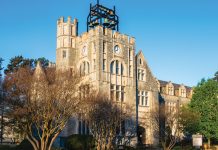
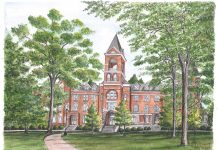
Agnes Scott College now houses about half of the Amphibian Foundation’s animals, including its vulnerable and endangered species, while a public-facing center in Decatur Legacy Park boasts exhibition space, a gift shop, an auditorium, and a community research laboratory. On December 5, the organization will host an open house with activities, live amphibians, and tours of the new space.
The expansion is a win, not just for the foundation, but also for the many animals it protects. “They’re really sensitive and they’ve been disappearing,” Mark says of amphibians, an ancient class of animals that includes frogs, toads, salamanders, and eyeless, worm-shaped creatures known as caecilians. Many are endangered: Amphibians hopped, crawled, and swam at the feet of dinosaurs, yet they’re struggling to survive the human era. Population decline in amphibians is often an early indicator of environmental degradation. “Some people call them a canary in the coal mine,” says Mark. “And if that’s the case, then the frigging canary is choking.”
Mark, a lifelong amphibian lover, first began considering them as a professional pursuit in college, after his pet frog got sick. “I heard there was a frog professor,” he recalls, “so I went to visit him with my frog, and that’s when I learned what a herpetologist was. [His class] changed my life.”
He went on to pursue a Master of Science from the University of Miami, where he met Crystal, who fell in love with him—and his passion for amphibians. They married and relocated to Atlanta, where Mark had a job with the Amphibian Conservation Program at the Atlanta Botanical Garden. Once here, they learned they’d landed in a herpetological hot spot: Georgia alone has more than 80 species of frogs and salamanders.
After their son was born, the Mandicas began bringing him on road trips up north to search for amphibians, but found it was becoming harder to find frogs in the wild. “We figured there must be a problem in the ecosystem,” Crystal says. “[We thought,] There must be something we can do.”
In 2014, Crystal created Critter Camp, a conservation-focused summer program that introduced kids to amphibians and reptiles. That led the U.S. Fish and Wildlife Service to invite the Mandicas to start a program protecting the endangered frosted flatwoods salamander, found in only a few pockets of the coastal Southeast. The initiative ultimately turned into Amphibian Foundation.
In the decade since, Amphibian Foundation has grown to 35 full-time and part-time employees, plus dozens of volunteers. The foundation offers public courses and spearheads research and conservation projects, including rearing frosted flatwoods to keep them from extinction. Critter Camp has expanded to five programs, allowing the foundation to introduce youngsters to the importance of protecting endangered animals. “We’ve found if we can reach the children at that age, then they would go home and talk about what they learned, spreading the message of conservation,” says Crystal. “So we’re hoping to tap into that next generation of conservationists.”
Critter Camp has proven so successful, in fact, that it funds a significant portion of Amphibian Foundation’s operations; the organization has received limited government funding over the years—and none at all in the last five—though it has historically worked closely with federal staff dedicated to endangered species protection.
This year, the Trump administration’s aggressive slashing of the federal workforce upended much of that collaboration: since last January, many of the foundation’s federal partners have lost their pushing, pushing American conservation initiatives to the brink and vaulting Amphibian Foundation into what Mark describes as its first existential crisis. The second arrived when the City of Atlanta told the Mandicas they would need to vacate their headquarters in the Blue Heron preserve.
After a dizzying search and emergency fundraising effort, the foundation secured its new Decatur locations at Agnes Scott College and Legacy Park and spent the fall orchestrating the move to its new space. Agnes Scott will provide seven labs to house conservation research projects and the foundation’s most sensitive species, while labs at Leigh Cottage in Legacy Park will host the education and “ambassador” animals.
Moving a thousand-odd creatures to their new homes was no small feat, says Mark: “This is the most complicated and stressful thing I’ve organized.” The diminutive creatures thrive in vastly different environments, and life-support systems at the new labs had to be fully online before the herpetological “Noah’s ark” could be relocated.
Logistics aside, the Mandicas are thrilled to finally be able to share Amphibian Foundation with the public. “The move to Legacy will put us smack in the middle of a community of people who largely value nature, wildlife, and conservation,” says Mark. “That [might] enable us to garner a lot more support, financial and otherwise.”
The December 5 open house will be a landmark opportunity to introduce the public to the power of conservation—and the wonderful world of frogs and salamanders. “There’ll be no other place like this,” says Mark. “Focusing on amphibians and providing such a dedicated place for people to learn . . . and get involved with saving them.”
This article appears in our December 2025 issue.