

Home 2009

Archives

Style Insiders: Runway Projects

LEONA

Two and a half years ago, Lauren Leonard turned down a handful of New York design jobs to launch a women’s clothing line from her parents’ Tuscaloosa home. Today, the twenty-five-year-old lives and works in a Buckhead loft and hopes to round out a list of sixty-plus boutique clients with a department store chain. Leonard declined a turn on TV’s Project Runway three times to focus on her company. Leonard also custom designs bridesmaid dresses and, for college-town clients, game-day dresses. “I was trying to tap into a market that New York designers don’t get and don’t want to get. Dresses to football games in school colors? They would never stoop to that level,” she laughs. “But I will!” Leona is available locally at Tulipano, 2140 Peachtree Road, 404-351-3220, tulipanoboutique.com, and at shop.leonacollection.com.

SHREE MONI

Shari Gray had a fetish for footwear out of her price range, so she developed a line of avant-garde but accessible shoes, priced between $150 and $300 and sold at boutiques around the country. “I take pictures of art. I go and pick weird things off the ground and go, ‘This would be kind of cool on a shoe,’” says Gray, who travels between Atlanta, New York, and China, where her shoes are manufactured. Her spring collection featured playful, Parisian-themed designs, and her fall collection features crushed-leather knee-high boots and a sleek ankle boot in cobalt-blue suede. Find Shree Moni at Seven, 2140 Peachtree Road, 404-367-5333, and at the SoShoelite Shoe Lounge, 240 North Highland Avenue, Suite C-1, 404-525-2103, thesoshoelite.com.


UCCÉ

You can’t accuse Uche Ude of not aiming high. “I hope to go farther than Chanel,” says the Nigerian-born designer, a former accountant for British Petroleum. When her women’s wear line, Uccé, debuted in August with a runway show at the St. Regis, it was the culmination of a lifelong obsession with fashion—from childhood doodles to design courses at SCAD. With tailored suits, dresses, and sportswear, Uccé is geared toward the sophisticated career woman, though it shines in the playful details—exposed zippers, asymmetrical lines, coquettish ruffles. Ude, who for now works out of her Dunwoody home, plans to add accessories and a men’s line. “We’re thinking big. This is just the beginning,” she says. Visit ucce.com for a list of retail locations.

Photographs by Joe Martinez

Style Insider: Kathleen Plate

0

Most people see a bottled beverage for what’s inside—flavor, texture, the promise of a buzz. Kathleen Plate has a different take. Beer bottles, she’ll tell you, are made from a soft glass; their shape is often imperfect. Champagne bottles are hard, built to withstand the pressure of carbonation. Coke bottles just have this sparkle—“almost effervescent, like the product.” Plate, who founded Smart Glass Jewelry seventeen years ago, has long incorporated glass in her designs, but the bottles are a more recent obsession.

A whiz with a soldering iron, Plate built her company around a line of stained glass jewelry encased in sterling silver. But in 2006, for a special commission from Coke, she bought her first band saw. She cut the embossed logos out of old bottles, then fashioned them into earrings and pendants. Coke loved it. Plate loved the saw. She kept on cutting through the bottle scraps, aquamarine rings rolling off like cucumber slices. Then, with the bravado of an inventor, she bought a kiln. “It took me three times to find the right temperature,” she recalls of her initial attempts to fire the rings. “The first one didn’t melt, the second one I just disintegrated into nothing, and the third one was the sweet spot.”

The sweet spot indeed. That was two and a half years ago, when the demand for eco-friendly goods was surging. Her new jewelry line, which she would augment with the greens and golds and cobalts of other beverage bottles, particularly struck a chord in L.A., where a laundry list of stars—Katherine Heigl, Sienna Miller, Leighton Meester, Amy Smart—would wear it. Smart Glass was included in the official 2008 Sundance Film Festival gift bag, and the story is that Isabella Rossellini and Sharon Stone had a playful squabble over who got which necklace.

Today, Plate is the owner of two massive Diamond Laser 7000 band saws. She oversees a staff of four in a Candler Park studio she calls “a cross between a quilting bee and a sweatshop.” They continue to make jewelry but have begun tackling large-scale projects: wall installations, chandeliers, a series of glass dresses that went down the runway at L.A. Fashion Week. In June, Plate held her first art show at Atlanta’s Emily Amy Gallery, and it was filled with friends and clients who’d supported her work in all its stages. “There were many, many years where I felt like I was chained to the workbench,” Plate says of the endeavor. “It’s fun for me to be an artist again.” smartglassjewelry.com

Photograph by Jamey Guy

One-on-One: Jason Wu

The breakthrough designer (remember Michelle Obama’s inaugural ball gown?) appears at this month’s Jeffrey Fashion Cares fundraiser. He chats about stepping out in the South.

Have you gotten used to being an honored guest? I’m never used to it. I’ m very low key, I like to entertain at home, I’m that type of a guy. My company’s just three years old, so I’m experiencing a lot for the first time. And we’re just really fortunate to be growing during an economy like this.
We’re lucky, but also because of that we work harder than we would ever
work, because it’s the only way.

What are your hours like? Crazy hours. It used to be, a month before Fashion Week we’d work overtime, but now every day is Fashion Week. There’s
so much going on all the time that my staff—we’re always there.

I guess you really need to love what you’re doing. It’s the only way to do it. When I went to Parsons [The New School for Design], one of
the first things I was told was if you don’t love fashion you need to
get out. It’s a very glamorous industry, but most of all it takes hard work and dedication. Five percent of it is glamorous. The other
ninety-five percent is hard work and just like incessant—I struggle
over a bead or [if it’s] a shade off on the fabric.

You’ve pointed to illustrations of fairy tales as the inspiration for your latest collection, and you design for a line of dolls. Are you drawn to elements of child’s play? I think fashion can be only so serious. One of the dresses [in the
fall 2009 collection] had a print that featured little vignettes of
fairy tale drawings. It was a mature-looking dress, but up close there
was a whimsical element about it. I think you’ve got to have fun with
fashion. I think the second you take anything too seriously, it’s not
fun anymore.

Having worked on designing dolls since I was sixteen, that gave me a
lot of experience in having attention to detail and just general work
experience—knowing what to do and what not to do when you’re operating
a business. Those things really helped me when I started my business
three years ago.

Wow. When I was sixteen I was lifeguarding.
I was a ski patrol before that. I was in Connecticut and that was all I did.

How did you make the leap into fashion? Well I was not a great ski patrol [laughs]. It was certain I was
not going to be doing that for a living. But I was artistic ever since
I was five. That was one of the reasons my mom moved me here—because I
wasn’t going to have the opportunities I had here in Taiwan, where I’m
from originally. Especially in the eighties, Taiwan was less open to
the idea of boys being in the arts. Most of my cousins and friends
ended up in business. That was the norm. My mom saw that early on—that
I was really artistic and obsessed with dresses, and she thought it
would be best for me to move here.

Does your mom ever give you feedback on your designs?
She gives me her input. She’s got great taste. My dad, though,
really has a lot of input into what I do because he’s a businessman,
and a really great one at that. He’s helped me a lot. Being a designer
in a self-owned company, you are operating a serious business on top of
being a creative person. It’s not just drawing and painting and draping
fabric all day. It’s about keeping the company afloat and letting it
grow and grow under these crazy circumstances. My dad has been really
great about giving me monthly advice on how to make it work. So I have
extraordinary parents.

Jeffrey is your exclusive retailer in Atlanta. How did that relationship come about?
It’s a strategy we felt strongly about—that as a young collection we can’t be readily accessible. I think the definition of luxury has somewhat been lost in the last few years. I think as a society we thought luxury just meant something that was really expensive, when in my opinion it means something that’s unique, special, timeless, and rare. That’s my approach to making clothes—to make only the best and to sell in places we really believe in. And so Jeffrey in Atlanta was the obvious choice.

I imagine your designs—polished, feminine, modern—are a big hit in the South. We had a tremendous response [last season at Jeffrey]. I think I understand the ladies here and I think they understand my aesthetic. You know what else I’ve discovered that the store manager at Jeffrey introduced me to? Chick-fil-A. It’s my favorite! So I’m a Southern boy at heart.

Jason Wu photo courtesy of C&M Media

Beauty School: Five Facials Under $50

Fabu Face Spa
Photograph by Caroline Kilgore

Rejuvenate Spa’s Minifacial, $20 (Wednesdays only, cash only) The spa caters to Downtown workers on the go, and on hump-day you can snag this treatment (normally $50) for a song. It includes a cleanse, steam, exfoliation, a mask, and hydration with all-organic products. The esthetician even taught our tester how to make similar concoctions at home. 303 Peachtree Center Avenue, Suite AL-112, 404-577-4877, rejuvenatespas.com

Float Spa’s Minifacial, $35 ($21 for members) This tidy, earthy spot in Inman Park bills itself as “the affordable spa experience.” The minifacial saw us cleansed, exfoliated, masked, and moisturized with products by local line Silky Smooth Urban Oasis, and we emerged softer, cleaner, and—in a welcome twist—fit for public appearance. 240 North Highland Avenue, Suite F, 404-228-4423, floatforvalue.com

Fabu Face Spa’s Men’s Fitness Facial, $45
Inside a cozy, pale blue treatment room, our tester received a daily cleanser from the Jack Black product line, a papaya- and pumpkin-enzyme exfoliating mask of Fabu’s own invention, a carrot vitamin mask, herbal toner, and Jack Black SPF 20 moisturizer—plus plenty of hot towels and gentle massages. Bliss. 335 West Ponce de Leon Avenue, Suite E, Decatur, 404-377-6363, fabufacespa.com

Jazmin Spa’s Hydra Flash Facial, $45 The regimen features a precleanse, cleanse, exfoliation, and colloidal mask using only Dermalogica products. By the end we felt so warm and tingly we didn’t want to move. The best endorsement? Getting an unsolicited compliment on our complexion later in the day. Three intown locations, including 506 Moreland Avenue, Suite B, 404-521-3002, jazminspa.com

Invigo Spa’s Minifacial, $45
(15 percent discount for members) Our experience consisted of a cleanse, enzyme peeling cream, a high-frequency wand to zap bacteria, and a gel mask, plus intermittent hand, shoulder, and head massages. We loved the crisp, citrusy scent of the Pevonia Botanica skin care line as well as the smooth morning-after results. 2550 Sandy Plains Road, Suite 125, Marietta, 678-905-7377, invigodayspa.com

Hot Shop: Seed Factory

Seed Factory, a new children’s store on the westside, is a parent’s fantasy of what a child’s playroom could look like—sun-filled, many-colored, with everything in its place. Toys, trucks, and Dr. Seuss mingle with papier-mâché dolls and fabric birdhouses. T-shirts and cargo shorts hang next to gauzy tutus and jeweled babouches. Tree branches with tissue-paper cherry blossoms provide an earthy centerpiece.

The 4,000-square-foot space in the White Provision development backs up to a view of Westside Urban Market, where sister store Sprout—catering to infants and toddlers—resides. Owner Rachel Baba opened Sprout in 2002, and its steady success prompted her to extend the concept to older children. “Every year as our families [at Sprout] grew up, there would be a wave that would say, ‘When are you going to do a store for older kids?’ I think they came to trust our sensibility,” she says. At Seed Factory, that sensibility encompasses safe, simple toys (wooden checkerboards, old-fashioned bike bells), classic books (Harold and the Purple Crayon, The Secret Garden), and high-quality fabrics (popular clothing lines include Petit Bateau and Kit + Lili). Baba gravitates toward designs that feature flowers or cars rather than cheeky slogans or Nike swooshes. “We try and approach everything from the kid’s point of view,” she says.

Where Baba really shines is her ability to arrange kid-friendly merchandise in an adult-friendly package. Meaning, quite simply, the store is gorgeous. Baba received her MFA in painting from New York’s Pratt Institute, but a thriving side job designing window displays diverted her career plans. When she returned to her native Atlanta in 2000, she landed a job arranging tabletop displays at Anne Quatrano’s Star Provisions, and Quatrano eventually backed her when she opened Sprout. Now, with her second enterprise, Baba has room to incorporate a pet project: a 1,000-square-foot activity room where she hosts arts and crafts classes, story time, and even yoga sessions. The classes are for kids; parents are welcome to stick around. Says Baba, “One of the things that’s so strong about Sprout is that we have a real community, we get to know the families. We want the same thing here.”

VITAL STATISTICS

ADDRESS/PHONE 1170 Howell Mill Road, 404-355-2043

HOURS Monday–Saturday, 10 a.m.–6 p.m.

TAG LINE Children’s apparel, books, and toys with a classic bent, for kids ages two through twelve. Clothing ranges from $30 to $80.

Photo by Caroline Kilgore

Hot Shop: Lila

If clothing stores were beverages, Lila would be an ice-cold glass of lemonade. Sunny in decor and disposition, with prices that will make you say “ahhh,” this newcomer on North Highland has a simple goal. “I wanted to bridge the gap between people who shop in high-end stores and people who are stuck at Target,” says owner Salima Manji, a Montreal native. “If you just want to look cute on a cheese day and spend less than a hundred bucks, you can get a full outfit.”

Save a handful of “investment pieces” (AG Jeans, Hobo bags, a Hale Bob screen-printed dress last seen on Salma Hayek), most of Lila’s offerings stay comfortably below that mark. You’ll find lots of clean lines and solid colors—a navy capelet by Piko 1988, jersey dresses in edible-looking hues by Color Me Red—along with more whimsical items, including a retro print dress by Collective Concepts and an embroidered ivory sundress by Minuet. The jewelry selection includes delicate gold-dipped creations by Top Shelf as well as wood pieces of Manji’s own design. Handbag favorites include Shiraleah vegan leather bags (priced around $60) and leather messenger bags by The Sak that fold over to become clutches. At less than $30, TokyoMilk perfumes are pretty enough to top any vanity, and they smell good, too.

Manji cites Inman Park’s walkability as one of its chief appeals, and Lila pulls in its share of passersby—women on their way back from kickboxing, or perhaps drawn by the “Beck disco floor” mural on the back wall. “I wanted people to drive by and be like, ‘What the hell is that?’” Manji says of the yellow, green, and blue blocks that preside over the store. The motif, inspired by a Beck music video, extends to the price-tag art, the cube-shaped seats, and the swinging square dressing room doors. Manji cautions: The doors are very swingy. Also: She might be tempted to play stylist and throw another outfit over the door, or offer feedback if you’re willing to model. It’s a boutique, after all, where personal service reigns and shopping often consists of spirited debate and adventurous assembly. If you’re not into that, there’s always Target. 

VITAL STATISTICS

Address/Phone: 240 North Highland Avenue, C-2, 404-584-5452

Hours: Tuesday–Friday noon–7 p.m.; Saturday 11 a.m.–8 p.m.; Sunday noon–6 p.m.

Tag Line: The look is minimalist meets whimsical. Soft jersey dresses for day, tailored jackets for work, and festive jewelry for night are available for less than $100. Denim lines include AG, Miss Me, Level 99, and Anoname.

Photo by Lauren Rubinstein

Style Insiders: Get Married

While it’s fitting that a husband-and-wife team would start a television show called Get Married,
it wasn’t sentiment that prompted Stacie and Dave Francombe to carve
their niche. The CNN alums chose an industry with perpetually high
revenues ($50 billion annually), saw a glut of reality shows therein
but few informational shows, and in three years have turned a local,
Sunday-only broadcast hosted by Q100’s Jenn Hobby into a
five-day-a-week Lifetime program hosted by lifestyle guru Colin Cowie.

The
family business has grown alongside the family unit. Stacie, a former
sports producer, launched her own production company in 1999; Dave
joined her when their first child was born. They added a small staff to
the company, another child to the brood, and by the time they started
their own TV show in 2006 (called Get Married Atlanta in its
first incarnation), they were on to their third kid. “We had a big
launch party at the Fox Theatre and I was nine months pregnant.
Everybody was thinking I was going to deliver at the party,” Stacie
recalls.

Deliver she did. The Get Married platform—a
wedding “infotainment” show that spotlights vendors and interviews
experts, plus a companion website filled with photo galleries and
planning tools—was such a success locally that the Francombes went
national a year later. After a brief stint on the WE network, they
found a home with Lifetime and a host in celebrity party planner David
Tutera. To accommodate the five-day-a-week time slot, the staff
ballooned in size and traded up in digs; in January they moved into an
18,000-square-foot space off Chamblee Tucker Road. It has a green room
and dressing rooms and plenty of breathing room, and now, in the new
season, it has world-famous event designer Colin Cowie.

When
Tutera joined “the dark side” of reality TV, Stacie began scheming to
bring on Cowie, who has worked with the likes of Oprah and Tom Cruise
and whose books she’d worshipped as a bride-to-be. One day she slipped
out to her car and put in the call; a week later she was in New York
hashing out a contract. Now, every weekday morning at 7:30, Cowie and
his cohost, former Bachelorette DeAnna Pappas, dispense
advice on topics such as trimming the budget, choosing linens, and
keeping Bridezilla at bay. Says Cowie, “Normal females become abnormal
the moment that engagement ring goes on their finger. Why? Because most
young brides went to college to study a thousand different subjects,
but very few think, ‘Fresh out of college, I’m going to plan the single
biggest production of my entire life.’ That’s why I enjoy doing this
show.”

ONLINE EXTRA: BUDGET-FRIENDLY TIPS FROM COLIN COWIE

We asked Colin Cowie for the best ways to produce an elegant wedding on a tight budget. Some of his ideas:

There’s
no one single area in a budget. It’s really about going around and
trimming everywhere and being a little bit frugal wherever you can.
Your guest list is the one that counts the most.

DJs [instead of a band] are a big one. Today’s DJs are tomorrow’s rock stars.

Have a Thursday night reception.

Instead
of serving French champagne, have a martini bar. Your guests will have
a wonderful, memorable time; they don’t know what you didn’t serve.

There’s no such thing as too many candles—votive candles, pillar candles, tapered candles.

Take
small vases and pack them abundantly with flowers and disperse them
with bowls of fruit. You can make a very, very rich and abundant look.

Use single flowers in a simple color. It’s much more focused; it’s much more modern.

My
other favorite flower in the whole world that nobody ever tends to use
is the carnation. If you use that flower on its own and use a lot of
it, you get to create a wonderful impact. It’s really an ugly flower
when they mix it on the corner stand with two pieces of baby’s breath
and three odd roses, and it looks like something that should be outside
the funeral gate.

The trend now is cleaner lines, a lot of
simplicity, but then again a lot of attention to detail—for instance a
bead that’s stitched to the back of a napkin.

Serving dinner
family-style is kind of fun, too, because I think there’s a lot less
formality taking place at weddings and a lot more personality showing
through, and I think it’s more about the experience. If we could just
get people to understand—it’s not about impressing people, it’s about
making them feel comfortable and making them feel welcome. When you can
do that, you’ll have a much, much better wedding.

How To: Look Great for Less

Spring has sprung, but last year’s warm-weather wardrobe is on life
support. Trouble is, so is your bank account. No worries, according to
some Atlanta style experts, who swear that buying on a budget—or even
not buying at all—can refresh your look quickly.

Start by going
shopping in your closet. “Invite two of your most fashionable friends
over and do a complete wardrobe purge,” says Cecile Blanco, owner of
the personal shopping service Style Me Now. “It can be painful, but you
should only have things in your closet that you love and that look good
on you.” Throw out or donate anything that is out of style, pilled,
damaged, or worst of all, doesn’t fit. Be ruthless, regardless of
label. Says Blanco, “You can wear a $3,000 Dolce & Gabbana dress
and look bad because it fits poorly, but a well-fitted, fifty-buck
dress from H&M can make you look like a million dollars.” After the
clean-out, have your friends help you mix and match the remaining
pieces, and assess whether any “maybes” are worth a trip to the tailor
for revival (hint: the fabric better be high quality and the
mending/altering minimal).

If you discover you’re lacking in
wardrobe staples, jot down what you need and where you plan to invest.
Next, you’ll need to hit the stores for a few trend purchases. “You can
be set for a season if you buy one or two up-to-date pieces,” says Mara
Maddox, spokeswoman for Bloomingdale’s Lenox and Perimeter, who notes
that this spring you’ll get mileage out of a striped or “preppy” tee,
bangle bracelets, a loose “boyfriend” jacket, or a bold statement
necklace. And you don’t have to spend a lot—reigning supreme for style
at bargain prices are chains such as H&M, Forever 21, Zara, and
Target, as well as local boutiques such as Sage, where most items are
under $100 (sageclothing.com), and 1*FIVE*0, where everything is under
$150 (150atlanta.com). Also, learn what designer brands fit you well
and gain access to sample sales through members-only sites like
gilt.com. But remember: A discount price does not always a bargain
make. One year, Dafina Nya Memberr, co-owner of Sunny’s Hair and Wigs
boutique in Buckhead, decided to ban herself from buying anything on
sale because she realized she had a closet full of “cheapie” purchases
that were in reality all junk. “Now I am the anti-impulsive shopper. If
I’m standing in line, I ask myself, ‘Do I really need this? What will
this go with?’ and talk myself out of a [so-so] purchase.”

Finally,
even if your budget is tight, embrace the look-great-for-less power of
grooming. “A [well-groomed] woman in jeans and a T-shirt looks better
than someone who has fancy clothes but has roots showing, chipped
nails, and bushy eyebrows!” says Blanco. Prioritize, rather than
eliminate, your beauty rituals. Shannon Kitchens, the busy owner of
Sage and mom to a toddler, gets her hair colored every eight weeks and
“desperately needs” her biweekly massages, but she’s ditched the salon
mani-pedis. “I do my own now.”

When to Spend More
Despite
all these frugality tips, insiders say when it comes to wardrobe,
sometimes it is worth it to spend. It all comes down to a concept
called “cost per wear,” says stylist Blanco. Say you buy a little
spring dress for $300, but you’re likely to wear it only a few
occasions. The cost each time you wear it—up to $100—is quite high.
“But if you buy a nice jacket that you’ll wear to the office a couple
times a week for the next six months, that’s a very low cost per
wear—great for the budget,” says Blanco. Timeless pieces that work
throughout the year are even better long-term buys. Here are six
wardrobe staples that deserve a big chunk of your shopping budget.

1. Designer jeans
—You
can never go wrong with a great pair of jeans. Go for a straight leg if
you are petite (under 5 foot 4) and a boot-cut if you’re taller. Once
you find a brand that works well, there are deals to be had: Kitchens
gets her True Religions at an Off 5th outlet near her home for half the
price of a denim boutique. “They might technically be last season, but
they still fit the same!”

2. Black suit
—Look
for something with a little stretch in a versatile, high-quality fabric
such as lightweight wool. Don’t balk at spending $500 or more; it’s
worth it considering you can use it year-round for the next few years.
Wear a $500 suit once a week for a year and that cost-per-wear figure
gets down to $10.

3. Sheath dress
—As
fashionable today as when Audrey Hepburn wore them, and flattering to
most body types. Modernize a chic navy version with a thick belt,
flip-flops on the weekend, or a cardigan for work, says Maddox.

4. Trench coat
—Perfect for transitional weather and most of Atlanta’s mild winter. Look for something in a neutral color.

5. Cashmere
—Always
classic and luxe, a well-cut cashmere sweater or wrap yields instant
polish; works in both cool and warm temperatures; and nowadays can
often be found at modest prices. Stock up on rich colors like eggplant,
navy, and chocolate—which will pair nicely with spring brights and
carry you into fall and winter.

6. Crisp white shirt
—Look for something with a little give and special details like darting.

Hot Shop: EcoEmporium

0

It’s not by chance that EcoEmporium, the new earth-friendly boutique in
West Midtown, looks familiar. Owners Carol and Bruce Held hired the
designers behind mall chain Anthropologie to create a calming space
with antique display cases and simple art. Only instead of bohemian
wares, the Helds’ “bazaar of sorts” provides a step-by-step guide to
decreasing your ecological footprint.

Carol, who has a
background in banking and interior design, adopted a green lifestyle
after discovering she was allergic to her husband’s office furniture,
which was sealed with formaldehyde glue. After researching products
such as detergents, dishware, toys, and towels, she decided Atlanta
needed a one-stop shop for everything organic, nontoxic, fairly traded,
repurposed, and recycled. And Brickworks, a renovated warehouse turned
shopping center, was the ideal location.

Catering to home, baby,
and pet, many of EcoEmporium’s goods are made from organic cotton or
bamboo. Check out the Bambu flatware, plates, and bowls, which can be
easily washed and reused; there’s even supersoft loungewear and wedding invitations
made from the woody stems. Kids’ tees with slogans such as “I recycled
my juice box today” and “I didn’t take a bath to save water today” are
hot items. Other whimsical offerings include jewelry made from soda
bottles, bullet casings, bicycle chains, and cut-up credit cards; and
purses constructed from magazines, gum wrappers, recycled felt, and
rubber reclaimed from tractor-trailer inner tubes. The two biggest
sellers, though, are utilitarian staples: diapers and mattresses. The
gDiapers starter kit comes with two pairs of washable cotton pants and
ten flushable refills for $28. For around $3,000, you can get a
queen-size Savvy Rest mattress made from natural rubber, organic
cotton, and pure wool (it repels dust mites!).

The Helds and
their official greeter, Krissie, a rescued border collie mix, hope to
franchise in the future. They also plan to host community classes on
such topics as how to set up your own organic baby nursery.

Vital Statistics:


Address:
1000 Marietta Street, Suite 114

Phone: 404-875-5224

Website: theecoemporium.com

Hours:  Monday–Saturday 10 a.m.–7 p.m.

Bargain buys:
Inexpensive
finds include reusable glass straws for $5.99 and a four-pack of SKOY
kitchen cloths for $8.95. (Using just one of these bio­degradable
cloths can save fifteen rolls of paper towels.)

Photo by Deborah Whitlaw Llewellyn

Hot Shop: Grey Parrot Gallery

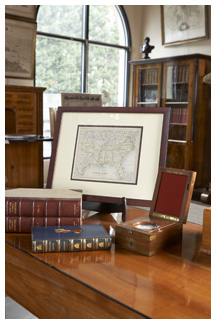
Alex Branch removes a slightly browned piece of paper from its plastic

sheath. “Hold it in your hands,” he says. And in an eerie,
pull-back-the-veil sort of moment, the remarkably legible script of
Lilyann Williams comes to life:

I am a woman that in the
year 1787 was taken a prisoner by the Creek Indians in your state and
my husband afterwards died. I was pregnant when taken, and while a
prisoner brought forth a female child—and in May 1795 I was brought
into Savanah and exchanged for, but the Indians refused to give up my
child, which is now near twelve years old—and now being informed that .
. . there is a way . . . to get her from [the] Savages . . . I humbly
petition your Excelency to . . . take such steps as to you may seem
mete. [1799, letter to Georgia Governor James Jackson]

After
more than a decade of amassing historical documents, maps, and rare
books, Branch, founder of real estate investment firm Branch
Properties, signed on managing curator Kenneth Hosley to help transfer
his treasures to a Buckhead shop. A professed cartophile, Branch is
fascinated by the shifting shapes of land over centuries. “A map gives
you so much more feel than reading a history book,” he says, pointing
to a 1625 map that depicts California as an island. “It’s the extent of
what they knew at the time.” Bibliophiles will enjoy browsing through
benchmark titles of American literature, all first editions, rare
printings, or signed—Gone with the Wind, Atlas Shrugged, To Kill a
Mockingbird
, In Cold Blood, an edition of Alice in Wonderland signed
and illustrated by Salvador Dali.

When appraising an item,
Branch explains, you look for three things: authenticity, condition,
and rarity—which is why a 1925 first printing of The Great Gatsby might
be worth $5,000, but its fragile dust jacket would be “a steal” at
$90,000. Similarly, his pristine Audubon turkey, once the much-handled
first page of an “elephant folio,” is worth about $165,000. One might
think it foolhardy to make such an acquisition in a poor economy, but
there’s security in wrapping one’s money around a book or seeing it
mounted in a frame. “It may become a little less liquid,” Branch says,
“but it’s not affected by the price of gasoline.”

Vital Statistics

Address/phone: 2300 Peachtree Road, A-101, 404-352-2990

Website: greyparrotgallery.com

Bargain bin: Early-twentieth-century city maps and signed, first-edition contemporary novels may cost as little as $15.

Photo by Amy Herr

Follow Us

69,386FansLike
144,836FollowersFollow
493,480FollowersFollow

NEWSLETTERS