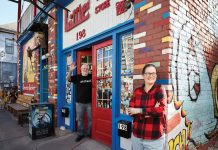



Courtesy of Cabbagetown Initiative
On November 7, when Cabbagetown welcomes 30,000 people to Chomp & Stomp—its neighborhood chili and bluegrass festival—Jacob Elsas will be there working the volunteer tent, where Chomp & Stomp helpers can rest and grab a bite to eat. The team calls it “the Worker’s Village,” which makes Elsas’s position there a bit ironic: His great-great-grandfather, also named Jacob Elsas, founded the cotton mill and much of the surrounding worker’s village that came to be known as Cabbagetown. “I’ll be handing out company scrip for all the hard work they’re doing,” jokes Elsas.
Elsas grew up in Druid Hills, not Cabbagetown; his family, which launched the Fulton Bag & Cotton Mills in 1881, was bought out of the company in the 1950s. Elsas’s father, a doctor, often brought his son on his visits to the neighborhood, where he worked with a community organization that supported Cabbagetowners in the difficult decades after the mill closed in 1981. “There were people in my family who saw [the poverty of] Cabbagetown as a blight to the family name,” Elsas says, “but my dad saw it as kind of our responsibility to participate and see what we could do to help people out.”
Bordered by the railway, Oakland Cemetery, and its colossal mill, Cabbagetown developed a culture that was distinct in Atlanta, shaped largely by mill-worker families who hailed from the North Georgia Appalachian mountains. They had brought with them home-cooking traditions, folk craft skills, and instruments, particularly the fiddles and banjos that form the backbone of American roots music.
Those Appalachian customs inspired Chomp & Stomp, which locals run as a fundraiser for Cabbagetown Park and other public spaces. “Chomp & Stomp was founded in that bedrock story of people coming from the mountains to [work in] the cotton mill,” says John Dirga, longtime Cabbagetown resident and festival director. “It’s not just about helping the community mow the lawn. We’re also trying to honor the people who used to live here.”
One such honored resident is the late folk musician Joyce Brookshire, whose namesake Joyce Brookshire Memorial Amphitheatre is currently under construction in Cabbagetown Park. Born in the North Georgia mountains and raised in a mill-working Cabbagetown family, she often sang of the community’s nostalgia for Appalachia. “She translated the life that a lot of people here lived through that lens [of music],” Dirga says.
Jacob Elsas (the younger) fell in love with eclectic Cabbagetown, and in 2012, he bought a loft apartment in The Stacks, the renovated mill building his great-great-grandfather built. He lives there with his wife, Nina, with whom he cofounded the Patch Works Art & History Center, dedicated to preserving Cabbagetown’s stories. “I didn’t get into this because of the family name. I didn’t even tell people who I was for a long time,” Elsas says. “I just shared this desire to keep the history alive.”
This article appears in our November 2026 issue.