

Home 1974

Archives

Coming: Mr. 715

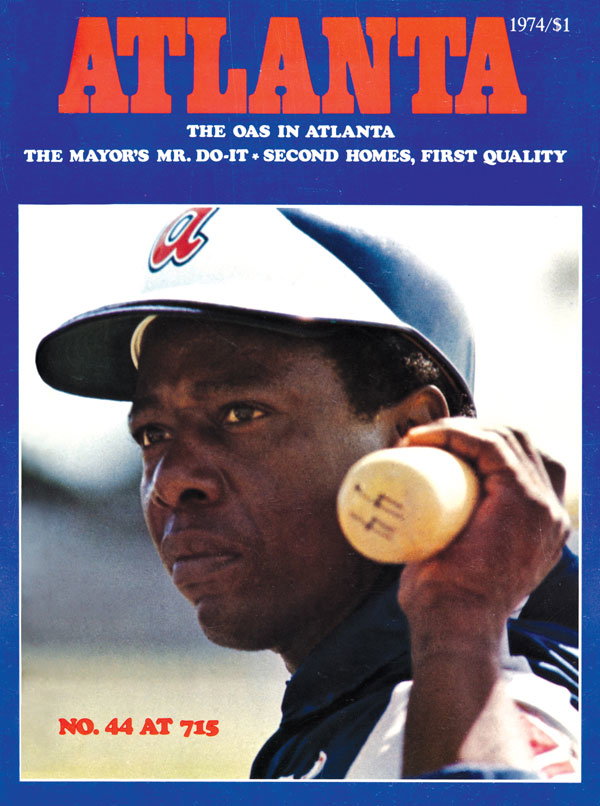
This article originally appeared in our April 1974 issue.

He is almost always just Hank. He is recognized wherever he goes and people want to touch him, get his autograph and pose for pictures with him.

He was 20 when he began these sojourns, swatting No. 1 in 1954, when Eisenhower was President. Hank is supposed to have said then that this first trip around the League was like riding through a beautiful park and getting paid for it.

Of all those playgrounds, only Wrigley Field in Chicago still is used for baseball; everywhere else, he is older than any piece of baseball turf. All has changed save him. Only one player still is performing in the major leagues who was there when he arrived. Seven managers are younger than he. In his first Spring he played the Dodgers in Brooklyn; in his golden Summer, and now with the turning of his leaves, they are in Los Angeles.

Before the Atlanta Braves ever played one game, Hank Aaron already had hit more home runs than all but a half-dozen players then in the Hall of Fame. By now, he has stolen more bases than Rabbit Maranville, hit for more bases than either Babe Ruth or Georgia’s Ty Cobb, caught more fly balls than Tris Speaker, scored more runs than Honus Wagner, and driven in more than Ted Williams.

This is the season—probably the month—when Aaron, at 40, takes a moon walk above one of the most hallowed individual records in American sport, the 714 home runs hit by George Herman Ruth. Only in the last year or two has Aaron attracted the national attention his exploits have merited for years. His statistical accomplishments are so vast and continuous that putting them into perspective is like trying to remember numbers of passing freight cars.

He has gone to the plate more than 11,000 times, hit for more than 6,000 total bases and collected more than 500 doubles. As impressive as all those accomplishments are, the big number is 715. His relentless pursuit of that treasure has made Aaron the single most conspicuous figure in American sports.

The enormousness of it has closed in fast on Aaron, on and off the field. As the climax approached at the end of last season, he was walked increasingly because opposing pitchers frankly feared him. Opposition infields overshifted, trying to force him to hit to right field. Aaron ignored them and took the overhead route; in baseball vernacular, he “went for the pump.” Aaron wants everybody to come in with their hard stuff. When pitchers get shifty, trying to nip the outside corner, he disapproves but adjusts accordingly, grumbling all the while about pitchers who “want to fool everybody.” Aaron prefers the problem of hitting against a man such as the New York Mets’ Tom Seaver.

“A man like Seaver, he says, ‘All right big guy, here it is. Pschoo!’ Why hold on to the ball? Why sneak it in? That’s not what the good dudes do—Gibson . . . Seaver. ‘Here’s the heat,’ they say. ‘Here, you want me? Pschoo!'”

Some baseball aficionados cite such comment as evidence of the massive pressure on Aaron. They also observe the number of times Aaron stepped out of the batter’s box last season, how tightly he seems to grip his bat, the way he questions umpires about strikes. But when Babe Ruth is chasing you, people see things they never noticed before. And, yes, it is a matter of Ruth chasing Aaron, the old legends dogging Aaron’s steps, wraiths in pinstripes hounding him.

Always one to read and answer fan mail, Aaron realizes that while most letter writers are pulling for him, a disturbing number do not want him to hit 715. For some who bode him ill, the reason is that Ruth is a colussus in their pantheon. For others, Aaron’s color is sufficient to denigrate his quest. Letters that begin “Dear Nigger,” and go downhill from there, say far more about the mind of parts of the nation than they do about Aaron. “It bothers me,” he says. “I have seen a President shot and his brother shot. The man who murdered Dr. Martin Luther King is in jail, but that isn’t doing Dr. King much good is it? I have four children and I have to be concerned about their welfare.”

Yet Aaron seems to thrive on pressure: it has made him all the more steadfast in his Olympian ambition.

Perhaps this helps explain why the pressure hasn’t seemed to take a noticeable physical toll. Aaron’s wiry, superbly conditioned body shows only the faintest signs of wear. A consummate and deliberate craftsman, he is the same Aaron players have held in awe for years. An accomplished outfielder with keen baseball savvy, Aaron is said never to have made a mental error like throwing to the wrong base. His quick wrists (at eight inches around, they are bigger than Muhammad Ali’s) still snap the bat with sizzling speed, and he hits what are known in baseball’s dugouts as “frozen ropes.” At 190 pounds, Aaron is only 10 pounds heavier than when he broke into the big leagues 20 years ago with Milwaukee. He is the most steady player in a sport that demands consistency of its genuine heroes.

His record in this respect is scintillating. Only twice has he failed to hit at least .280; once was in 1966, when the Braves moved from Milwaukee to Atlanta. His average that year fell to .279, but with 44 home runs and 127 runs batted in, nobody could complain that his hitting was inadequate. Because of his consistency and high performance in so many categories, even an average season for him produces eye-opening statistics. Despite his ability, longevity, consistency and willingness to play, even when injured, the national fame accorded Mickey Mantle, Willie Mays and Stan Musial wasn’t granted Aaron until last year. Perhaps it was because he did not play in New York, and thereby missed the glow of glory that flooded Mickey and Willie, or that he did not come into the Big City and rip the fence in Ebbets Field as Stan did. Being in Milwaukee and Atlanta did not help Aaron’s publicity value, but all of that has changed. Still, Aaron is somewhat resentful. He remarked plaintively in a recent interview with CBS-TV’s Heywood Hale Broun that “I wish all this fame had come earlier. I’m 40 years old now, and I gotta pace myself . . . can’t go as fast as I once did.”

Being the first ballplayer outside New York or Los Angeles to make it to the media vitals has not been easy for Aaron, a flesh-and-blood Everyman who has demonstrated that a hero need not be mythic. He prefers a subdued lifestyle free of curiosity-seekers and paparazzi; his wardrobe is fastidious, not flashy; he drives a 1973 Chevrolet. As one friend reports, “Hank’s idea of a big night out is dinner at a Polynesian restaurant.”

Hank Aaron 1973
Hank Aaron talks during a press conference before filming “The Flip Wilson Show” on October 15, 1973.

Photograph by by Michael Ochs Archives/Getty Images

In the last six months, Aaron has made TV appearances with Merv Griffin, Flip Wilson and Dinah Shore. Last year he appeared on the covers of publications as disparate as Newsweek and Jet. Now his likeness will proliferate like posters when the circus is due. More recently, he popped up on the sports, business, and entertainment pages, and his wedding last Fall put him on the society pages. Three books on Aaron were scheduled for March and April release, and another will be rushed into print as soon as he cracks 715. Another book on Aaron may be written by George Plimpton. (In August, 1968, Atlanta magazine already pictured Aaron on its cover: that issue featured an extract from a book written by Atlanta Journal sports editor Furman Bisher.)

At the outset of this year, a barnstorming, banquet-circuit tour took Aaron to Chicago, Boston, New Hampshire, Milwaukee, and New York—not to mention celebrations honoring him in Atlanta, and his birthplace, Mobile. While in Los Angeles, Aaron was offered a part in a movie which is to costar Harry Belafonte and Sidney Poitier.

“I was to play a bartender,” Aaron said. “They gave me about a page of lines to learn, and I was to serve a few drinks, but I turned it down. It would have been fun, but I just don’t want to make another trip to the West Coast. That’s a different world out there . . . they’re too fast. I don’t want any part of it.”

Hank’s business manager, Berle Adams, is determined to “get an organizational structure around Hank that we can work with and try to control.” While Aaron is not a great one for getting to business meetings on time, he has filmed a series of Brut commercials, plugged Lifebuoy soap and Oh Henry chocolate bars, and signed a pact with the Magnavox Corp. calling for payment of $1 million over a five-year period.

The Magnavox pact calls for Aaron to engage in promotional activities, including his own TV specials. At a New York press conference detailing his Magnavox contract, Aaron said he not only was signing his exclusive services but also the balls, bats, uniforms and other memorabilia associated with his career.

“Each ball, each bat, even the uniform Hank uses, will become our possession,” Alfred di Scipio, a Magnavox official, told the New York assemblage. “They will be carried around the country for people to touch so they can feel a part of this legendary event.” Aaron’s Magnavox contract allows his commitments to other companies until their expiration, when his promotional activities fall under the sole direction Magnavox.

Aaron has become much more than a baseball superstar. He eclipses the sports page and is, in the lexicon of Hollywood, a singular merchandising phenomenon. The home of Lt. Gov. Lester Maddox, Dr. Martin Luther King Jr., Margaret Mitchell and Ralph McGill has put him on a pedestal. The Atlanta Chamber of Commerce and the City of Atlanta initiated a massive “Atlanta Salutes Hank Aaron” celebration which encompasses a citywide Aaron billboard campaign, an Aaron Scholarship Fund administered by the Metropolitan Foundation of Atlanta, and other salutes such as street and school names, and a bust of Hank to be placed at Atlanta Stadium.

At the recent “Atlanta Salutes Hank Aaron Dinner” Gov. Jimmy Carter read a proclamation citing Aaron as an honorary Admiral in the Georgia Navy. Mayor Maynard Jackson awarded him a sterling silver medal, Atlanta’s second highest honor for public service. Explaining why it was not the City’s highest honor, a gold medal, Hizzoner quipped: “I’m saving that one until he breaks the record.” Braves’ announcer Ernie Johnson, observing that a player must wait five years after terminating his playing career to be eligible for the Hall of Fame, commented: “Special dispensations have been granted in special cases in the past, and if Hank Aaron has to wait five years, it’s injustice!”

There is something serenely beautiful in the way Aaron is being honored in Atlanta—a way no black athlete could have been feted as little as 20 years ago. Aaron, while keenly aware of it, takes it in stride: His overall cool throughout the adulation has bordered on the comatose. Now and then he reflects on the magnitude of these tributes: “I have always thought the way I could do the most for my race was through excelling in my conduct on and off the field as a player. Now, because of the position I’m in, I hope I can inspire a few kids to be a success in life. The problems we have in Atlanta are no different than anywhere else: I want to break Ruth’s record as an example to children, especially black children.”

Ivan Allen Jr., mayor of Atlanta when the Braves moved from Milwaukee in 1966, offers this perspective on Aaron: “There was a lot of subtle apprehension about how the South’s first major league sports franchise and its black players would go over. Hank played a major role in smoothing the transition and confirming the end of segregation in the South through his thoughtful consideration and cooperative attitude with everyone, and his exemplary conduct. He taught us how to do it. The first time he knocked one over that left-field fence here, everyone forgot his color.”

Five years ago, the thought that Aaron would be as much a fixture of American culture as Coca-Cola would have been preposterous. The conventional wisdom around the big leagues then was that Ruth’s record not only was untouchable but inviolable, and anyone who thought otherwise obviously had taken leave of his senses. Aaron in less halcyon days remarked: “People keep wondering if I’ll be around long enough to break Babe Ruth’s home run record. I really don’t know. I do know that I will not hang on just for the sake of hanging on—picking up 12 one year and maybe 20 the next and jumping from club to club. I have too much respect for the game of baseball to do that just to chase someone’s record.”

This is the gist of the Aaron legend: immense self-respect. It’s also a kind of class which Aaron attains simply by being himself, a man who would like to pare life to certain essentials but finds it hard. Aaron is first and foremost a baseball player (“The only thing I really know is baseball”) and all the Hollywoodish packaging and grooming cannot obscure that fact. For all his business deals, for all the largesse he has raked in, Aaron seems somewhat uncomfortable about the whole business.

His off-season schedule kicked off at 8 a.m. daily and usually stretched nonstop to midnight: TV commercials, speaking engagements, and discussions with civic leaders—in town one day, out the next. Trying to rap with Aaron during the off-season was a hit-and-run proposition—five minutes here, 10 there, and catch me if you can. The irony is that the acclaim denied him through much of his career now threatens to overwhelm Aaron. In defense, he has developed stock answers for the stock questions he hears every day. His pursuit of the Babe also has become a wish for solitude. Aaron couldn’t wait to get to Spring training this year: “It’s gonna be like a vacation,” he said.

Baseball: That’s where Aaron’s roots are. There he takes his ease; there is his domain. One recalls Braves third baseman Darrell Evans teasing a sartorially resplendent Aaron prior to the Atlanta Salutes Hank Aaron Dinner: “Hey, ‘Supe’”—( short for Superstar)—”how come ya got ‘that fancy jacket on? Whaddya doin’— gettin’ married again?” Hank grinned, but you felt he wanted to take off the damned tuxedo, pick up a bat and start limbering up right there in the Marriott’s Grand Ballroom.

Braves owner Bill Bartholomay once said of him: “One of the few right things I might have done in Milwaukee was to get to know Aaron right away. My admiration for him goes beyond description. He’s Mr. Brave.”

Aaron must admire records because he has created so many of them; yet, for all of the scuffled hysteria over his chase of the Babe, Aaron observes: “To be frank, it is not as important to me as to baseball. The only thing I ever thought about was to be as good as I could. I never thought about being the greatest ballplayer or anything; just to be as good as I could.”

A friend has noted that “for all the commercials, endorsements and business connections, he’ll never be a ‘Broadway Hank.’ The thing about Hank is that he’s really simplified. Simplified. He doesn’t complicate anything. Thoreau would have loved the guy.” So when Commissioner of Baseball Bowie Kuhn failed to congratulate Aaron on his 700th home run, and issued an edict warning pitchers not to “groove” Nos. 714 and 715 for Aaron, it was construed as scandalous. Some pitchers had made some offhand remarks about “groovin’ the biggies,” but only Kuhn took the talk seriously.

Other so-called experts on baseball have referred to the architecture of Atlanta Stadium as the real reason Aaron’s about to overtake Ruth. While it is a park without any wind factor, and because of the altitude of Atlanta, the ball rockets over the wall as if launched from Cape Kennedy. One look at this park and you want to pick up a bat. To suggest, as many have, that this is the principal reason why Aaron has pulled even with the Babe smacks of errant folly.

Such minutiae and petty slights, coupled with the Hall of Fame’s lack of enthusiasm for Aaron mementoes, are an understandable source of annoyance to Aaron, although he will not be caught badmouthing Kuhn or the Hall of Fame. “I like to let the record book speak for itself.”

In the last game of the 1973 season, 40,517 turned out at Atlanta Stadium on a rainy Sept. 30 to see if Aaron could finish off the Babe. Each time Aaron came to bat, there it was, louder still: noise, enthusiasm, recognition. In his first three times at bat that day Hank hit three singles. When he popped up in has last at-bat in 1973, the din was enormous. All Aaron had done for his year’s work, at the age of 39, was slam 40 home runs, hit .301, and knock in 96 runs.

When Hank Aaron paused on his way to the dugout that day, it was beyond any mere note of excitement; it was with absolute authority. The only baseball player before Jackie Robinson, Willie Mays and Aaron who played with the kind of zest and gusto referred to as “black style” was Enos Slaughter.

There was the echo of the tone of one of William Faulkner’s characters who said, standing at the wagon: “Them that’s going, get in the goddam wagon. Them that ain’t, get out of the goddam way.”

Aaron’s in the front wagon.

This article originally appeared in our April 1974 issue.

S.C.L.C.: What’s Happened to the Dream


This article originally appeared in our April 1972 issue.

On a Memphis motel balcony four years ago this month, a 30.06 slug tore the life from Dr. Martin Luther King Jr. His colleague and intimate friend, the Rev. Ralph David Abernathy, was standing inches behind him when the bullet struck.

“I got down over him and I patted his cheek until I got his attention,” Abernathy recalled days ago. “I know talked. His lips quivered, and his eyes said to me, ‘Don’t you let me down, Ralph.’ It was like an inner voice.”

Abernathy succeeded King as president of the Southern Christian Leadership Conference (SCLC), that loose confederation of towering egos and simple folk who want justice which served as the vehicle for King’s movement. But many were convinced that SCLC’s fuel was King’s charisma, and without him, it would falter.

They could make a good case.

The mellifluous, urgent baritone solo of Martin Luther King has been supplanted by a cacophony of militant rhetoric in America. SCLC, the one-time vanguard of the black American revolution, is in the back seat to the headline potential of Huey Newton and Angela Davis.

SCLC has moved from mule train to Whisperjet, from frequent street marches to sedate board rooms. Around SCLC’s yellow-brick headquarters on Atlanta’s Auburn Avenue, the symbolic denim of revolution yielded to double-breasted suits and mod accoutrements. Many faces familiar in King’s day have vanished. So has much of the drama.

“Used to be, if there was trouble somewhere, everybody in the place would pick up and go,” said the Rev. Andrew Young, one-time King lieutenant and now the conservatively dressed director of Atlanta’s Community Relations Commission. “We’d have maybe two people to answer the phone. Everybody else would go march.”

And march and march and march … in Southern towns like Selma and Grenada, towns that never had made a Northern headline; in better known cities like Montgomery and Birmingham, which soon took on new symbolism … places that were never the same after SCLC had mounted a campaign.

Today, SCLC rarely commits all its resources to a single issue. Instead of a hundred or more workers in the field, there are only a dozen. Its 48 other staffers—most of them in Atlanta—have desk jobs to perform and phones to answer.

Has Abernathy failed King’s admonition not to “let me down”? Is SCLC a walking cadaver?

“The times have changed,” King’s jowly successor intoned slowly, his booted feet propped on a thick, monogrammed attache case by his desk. “We were having problems prior to Dr. King’s assassination. Had he lived, he would have changed with the times, too.

He would have been saying ‘right on’ and ‘power to the people’ just like the rest of us.”

(One staffer confided that King had decided just before his death to let his close-cropped hair grow to moderate Afro length.)

“During Dr. King’s lifetime,” Abernathy added, “we dealt with the obvious, overt forms of segregation. Now we are faced with more subtle forms. Sure, we have the right to eat downtown and stay in a hotel. But do we have the right to hold the job to earn the money to pay the hotel bill? We earned the right to schools, but do we have quality education? There once was a time when we could expose evil through mass demonstrations. But demonstrations alone will not solve our problems. We have to have jobs, income, control of our communities.

“The philosophy of our organization is still the same: militant nonviolence. But the strategy has changed.”

Even if the more sophisticated challenges of jobs and political power were amenable to mass confrontation tactics, it is doubtful that such demonstrations would command the headlines that they did before.

The Rev. Hosea Williams, a firebrand SCLC organizer whose mere presence in a small Southern town sets old-line white leaders boiling, summarized it: “Unless you go out and get you a gun and shoot at some white folks—you can’t just talk about it, you got to shoot at someone now—you don’t make the press. But if you go out and do some hard work like we did in Sandersville, or Columbus, or all over Alabama right now, the press doesn’t write about that—things that would have made front-page stories 10 years ago.”

The last time an old-style campaign got both headlines and results was in 1969, when SCLC joined with union organizers in a 113-day strike to help poorly paid Charleston, S.C., hospital workers win collective bargaining rights. SCLC—including King’s widow, Coretta Scott King—defied state and local police to march and kneel in prayer in the middle of the street. And Abernathy, in best Old Movement fashion, spent 21 days fasting in Charleston jail.

It’s not that SCLC’s reduced cadre of field workers aren’t still manning the trenches in civil rights backwaters. It’s just that their work rarely is treated as news. Few newspaper readers, for example, may realize that:

  • Last August, a black man was found, bludgeoned to death, in the trunk of a state patrol car in Ayden, N.C. The patrolman driver was transferred to another part of the state, but not prosecuted. SCLC field worker Golden Frinks led ensuing protests; he and 175 rural blacks were arrested in two days of marching, in one instance having to dodge a police car which charged into the line of march.
  • A black girl, 19, was killed last September when a white man drove his car into a civil rights march which protested the firing of black teachers in Butler, Ala. Though charged with murder, the white driver was released the same day on a small bond. Abernathy and some 300 local blacks went to jail for two days in the ensuing protests, while SCLC Board Chairman man Joe Lowery negotiated a nondiscriminatory hiring agreement with the Butler, Ala., power structure.
  • SCLC spent about $200,000 of its $900,000 budget in 1971 on a little publicized “War on Repression,” which included welfare marches in Nevada and Wall Street, and a mule train march in Washington on Moratorium Day, in conjunction with other peace groups.
  • It backed a march in Daytona Beach, Fla., to protest the low pay of domestic workers there.
  • SCLC helped Sandersville, Ga., blacks win a majority on the city council last November, and in the 1970 elections was instrumental in the election of black governments in Greene County, Ala., and Hancock County, Ga.

These events were noted by occasional reporters, but outside the immediate localities (and sometimes even there) the stories rated no better than inside-page coverage. Gone were the battalions of TV cameramen who filmed the clubbing of voting-rights marchers on Edmund Pettus Bridge in Selma, or the fire-hosing and police dog attacks on public accommodations petitioners in Birmingham.

With SCLC’s lower public profile has come a lower budget.

SCLC raises its money strictly through private donations. It owns what is considered the best mailing list of liberals in the country: some 200,000 names, mostly of whites. It steadfastly resists efforts of other organizations to buy the list, but it recently tested the potency of the list by mailing an appeal for Angela Davis’ defense. In three months’ time, it brought $47,000. The postage cost alone, however, was formidable.

It has shied away from federal grants and foundations.

“They always have string attached,” Andrew Young explained, “like no political activity.” SCLC donors must be especially devoted because their contributions are not tax-deductible.

In the times of the Selma March (1965); the March on Washington, when King delivered his “I have a dream” speech at the Lincoln Memorial (1963); and of King’s assassination (1968), SCLC’s receipts soared to $2 million each year (non-taxed). Last year’s $900,000 income, although less than half those peaks, hardly suggests a moribund organization.

Shifted emphasis of goals, less dramatic tactics, and lower levels of publicity also have wrought internal changes. Of necessity, the lower budget brought staff reductions. (Not that SCLC pay ever was lavish. Example: The Rev. James Orange, a burly, highly effective field worker who looks utterly at home in dungarees, after nearly 10 tough years in the Movement, recently received a raise to $6,500 a year—plus, presumably, free soul food almost anywhere he goes.)

Many volunteers and some of the old staff are gone because the old glamor is. New recruits and those who remain have accommodated to the new rhythms.

Dorothy Cotton, who has been at SCLC so long she “can’t even remember my life before the Movement,” summarized it: “The hectic days of living and working with Dr. King—wow! It was exciting, beautiful, moving. But it was also killing. You just can’t live at that pitch constantly. One year you can run down the street shouting ‘Freedom now!’ But after a few years, you’ve got to put some flesh on that skeleton. I guess this leads to a more coat-and-tie approach.”

Young, always a coat-and-tie man, left day-to-day work with SCLC first to run for Congress and later to plant his roots more solidly in Atlanta soil with the Community Relations Commission. He remains a member of the SCLC board.

Coretta King also is a board member, and occasionally makes appearances for SCLC causes, but her general absence from the scene continually inspires reports that she and Abernathy are at odds. Both deeply resent these allegations.

A more accurate reading is that Mrs. King is occupied—even preoccupied—with raising her four school-age children, and seeking funds for the Martin Luther King Memorial Center, an ambitious four-block complex of research, meeting and museum facilities planned in the neighborhood of Ebenezer Baptist Church, where King was co-pastor with his father. These commitments, plus a protective secretary, make her almost inaccessible to reporters. (Even after three weeks’ attempts to reach her for this article, she was “not available.”)

“Dr. King used to say we had a team of wild horses,” recalled Tom Offenburger, a white journalist who left U.S. News & World Report to answer King’s clarion. “They could go off on their own thing, but then he could pull it all together again.”

Most of the “wild horses” have left the corral, and gradually—often subtly—SCLC is becoming Abernathy’s organization.

The Rev. James Bevel drifted out of SCLC and was heard from most recently urging a Gov. George Wallace-Rep. Shirley Chisholm ticket.

The Rev. T. Y. Rogers died in an automobile accident.

The Rev. Jesse Jackson, often cited as Abernathy’s most potent rival, resigned a few months ago in a much celebrated flap when Abernathy and the SCLC board attempted to curb Jackson’s near autonomy in the organization’s Chicago operation. The handsome, dynamic young Chicago minister promptly established his own black rights organization, PUSH (People United to Save Humanity).

Hosea Williams, most flamboyant and controversial of all the “horses,” was bypassed last spring when young Stoney Cooks, who has less seniority, was named executive director. Williams was placed on leave of absence, made a trip around the world (with funds raised from churches), and returned to write a book. Although Williams was never especially noted for his piety, Abernathy recently ordained his as a minister. Despite their differences, Williams rejects any criticism of Abernathy’s leadership:

“You must be kidding! Abernathy is the most unsung hero in the movement. Dr. King never made a decision that he didn’t consult Ralph David Abernathy. And if Ralph said no, you could bet your bottom dollar that was a dead idea.

“Ralph is not as intellectual as Dr. King, but he’s no dumb man. Everybody knows the guts Ralph’s got. And they know Ralph cannot be bought out. Ralph is able to relate better to the masses than Dr. King was. Dr. King tried. He’d put on some old boots and go down to the pool hall and shoot pool. And they’d accept him a little bit. But as soon as he’d open his mouth—there was something about that man—they’d back away and want to put him on a pedestal. And you’d see ’em looking at him, just wanting to touch him. He was something particular.

“Ralph’s different. Ralph couldn’t do that if he wanted to. There ain’t a bum in the streets won’t say, ‘Hey, Abernathy,’ and throw his arm around Ralph. But that’s the type leader we need today. Black people have developed to the point today that they no longer need a leader they can look up at. They need one they can look at!”

UnKingly though Abernathy admittedly is, and fragmented as the black rights movement is into militants, moderates and separatists, a recent Lou Harris survey showed that black Americans rank Abernathy their most respected leader—a position once held by his friend and predecessor, King.

And as much as some externals have changed, SCLC retains some of its original essences. It is still more a force than an organization, more an idea than a bureaucracy. Mail may still go unanswered, phone calls unreturned, timeclocks unpunched, appointments tardy or unkept.

The slightly shabby headquarters of the Movement that helped change America remains in that focus of black Atlanta, “sweet Auburn,” a soul stew of churches, high-booted prostitutes, “Jesus Saves” neon, billiard parlors, old men in a barber shop, pushers in rakish hats, soul-food lunchrooms, and the prestigious, black-owned Atlanta Life Insurance Company.

It is appropriate that SCLC is there, in the Prince Hall Free & Accepted Masons Building, rather than in the other focus, the West Side, with its Atlanta University complex and $50,000 homes, for SCLC’s strength remains with the poor and troubled.

“You can’t get too poor, and your house can’t be too run down for SCLC,” remarked Thomas Gilmore, whom SCLC helped elect the first black sheriff of Greene County, Ala. (Black officeholders in the Old South have risen in number from about 100 in 1965 to 873 today. Many received SCLC assistance.)

“SCLC is at its very tops out in the Perry Counties, Choctaw Counties, Wilcox Counties,” said a long-time U.S. Justice Department official, a close observer of the civil rights struggle for more than a decade. “They’re the best out in the field working with the regular folks as community organizers.”

“I’ve got 30 people who can ‘turn on’ any county in the South,” claimed Stoney Cooks. “We are the organization that can turn people on. (State Rep.) Julian Bond ain’t got nobody but himself, his wife and children.”

This ability to talk the language of the people not only influences the kinds of projects SCLC undertakes, but also carves a niche distinct from other civil rights organizations and from labor unions.

In a few rural backwaters, where the Civil Rights Act of 1964 and the Voting Rights Act of 1965 still encounter bitter-end resistance, SCLC projects resemble those of the old days. But increasingly, they are economic and political. Hosea Williams summed it up:

“We’ve got to get the movement out of the streets and into the banks, the chambers of commerce, the college classrooms. We’ve got to stop running to the white community. We’ve got to develop our community. We’ve got to change the slums from a dungeon of shame to a haven of beauty. And then, hell, the white folks’ll be trying to move into our neighborhood.”

SCLC’s major program theme this year is “Politics ’72.” It includes voter registration drives, now rolling at Atlanta University, in parts of North Carolina and Mississippi, and in the Alabama Black Belt. It will support sympathetic candidates in key congressional districts around the country (notably Georgia’s Fifth District, where Atlanta’s Andrew Young will be taking his second shot at the seat).

Abernathy probably will lead a delegation of demonstrators to the Democratic National Convention in July in Miami Beach to apply public pressure to black delegates. SCLC played an important role in organizing black students who elected Shirley Chisholm delegates at the Fifth District Democratic Convention last month.

A formidable propaganda apparatus undergirds SCLC’s politicking. Hundreds of thousands of leaflets, flyers and posters will be distributed to explain voter registration. (One sample, affixed to a wall in the SCLC lobby: “This house is 100% registered to vote. Is yours?”)

SCLC also distributes a half-hour taped radio program to more than 150 black radio stations each week. Called “Martin Luther King Speaks,” it is aimed at devout blacks for whom the Promised Land and the struggle for equal rights are one and the same. Programs often include King’s voice. “Luckily, we taped every speech he made,” Offenburger sighed.

In the area of citizen education and government—as contrasted with politics—SCLC also operates workshops through a tax-exempt Southern Christian Leadership Foundation, which spent $300,000 last year (one-third as much as SCLC’s entire budget but not part of it).

The recession of the late Sixties and early Seventies has handicapped SCLC’s efforts to upgrade jobs for blacks. The organization has been most effective in protest situations such as the Charleston hospital workers’ strike. In 1970, when 500 black and white steelworkers struck in Georgetown, S.C., SCLC helped coordinate their protests into a successful strike. Currently, two SCLC field workers in Birmingham are girding for a re-run of Charleston: More than 2,000 employes from three hospitals already have signed pledge cards asking for collective bargaining.

The National Association for the Advancement of Colored People (NAACP) has been involved in voter education and politics far longer than SCLC. The Urban League has more seniority in solving employment problems. And labor unions would seem on the surface to have enough experience in union organizing to get along without SCLC’s help.

Has SCLC then become a fifth wheel, a drain on the diminished resources of black-rights causes?

If SCLC has a raison d’etre, it lies not in staking out exclusive projects, but in its special ability to talk to and “turn on” poor blacks. NAACP, no slouch at such organization, is more oriented to litigation. Urban League tends to operate more through established channels of power.

As for union support, Abernathy said: “We can get into these hospitals very easy. We speak the people’s language, and they believe in us. They’ve never been in a union before. Once they are organized, they choose the union; we don’t. Soul power and union power are a winning combination.”

“The black American is in the church,” Hosea Williams added. “His whole being is in the church.” Anent his own new preaching role, he explained: “You got to go where the people are before you can take them where they ought to be.”

SCLC’s fate is directly related to the faith it can instill in its constituency. Can that faith survive without the charisma of King? Without the drama and headlines of monumental, all-troops confrontations?”

Four years should be long enough for some sort of answer. Abernathy has found his.

In the first months after King’s assassination, he recalled, trying to operate SCLC was “kind of like being a widower, being the father and the mother to the movement. We had always been together, even in jail.

“The thing I miss most, now I don’t have anybody to laugh with.”

Abernathy lived long in King’s shadow, though he says that people who attempt to compare him with King “are not sincere supporters of the Movement.”

The turning point for Abernathy was a religious experience.

“When ‘d leave the office late at night, I used to walk up to the (King) tomb and listen for his voice. But the tomb never said anything. One night last year I got home from a staff meeting about four in the morning. We had had terrible disagreements, and I didn’t know what to do.

“I looked at Dr. King’s picture in my hallway, and I said, ‘Martin, I’ve done everything I know how. What can I do?’ You may not believe this, but I know he talked to me . . . an inner voice. He said, ‘Ralph, don’t look to me. I don’t have the answer. Look to the Cross.’

“I got back in my car—and drove down to my church and sat in a pew for about an hour. The Cross is always illuminated. Finally, I realized I would no longer find the answers in Martin Luther King. He was a great spirit. He lived. But the answers must come from Christianity.”

Follow Us

69,386FansLike
144,836FollowersFollow
493,480FollowersFollow

NEWSLETTERS