


Photograph by Growl
This story is part of Atlanta magazine’s Streets Issue—a block-by-block exploration of our city and the stories it tells. Find the entire package here.
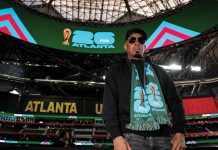
In January 2020, Killer Mike visited his alma mater, Frederick Douglass High School, to make the case for parking spaces. A new co-owner of Bankhead Seafood—alongside fellow rapper T.I.—Mike introduced himself at a meeting of the area’s neighborhood planning unit as a Collier Heights native who lives farther west on Donald Lee Hollowell Parkway. He knew firsthand how tricky visiting the restaurant could be. “We knew that fish was so darn good it blocked traffic on Fridays,” he said, to chuckles. Until it closed in 2018, parking was so scarce at Bankhead Seafood—a Hollowell staple since the time the street was called Bankhead Highway—that customers would drop each other off to wait in a line that often ran out the door.
So, Killer Mike asked that NPU-J approve a proposal to expand the restaurant into a grassy lot behind it and increase parking from 12 spaces to 22. Residents in attendance tried to envision the addition for themselves: How might traffic affect the school across the street? Or the homes nearby? When NPU chairs motioned to delay the vote, due to confusion over whether the new owners would pursue a liquor license, Mike pleaded with the crowd: “I’m trying to make sure that my grandmother, my mother, and my aunts have someplace nice to go to that’s a five-minute drive from them. For whatever power and politics we play on a local level, I beg of you: Don’t defer this.” He noted that, just an hour earlier, NPU-J had approved an alcohol license for Chevron Food Mart. “I’m going to ask you to vote in favor for us so we can bring Bankhead back to the glory that she deserves,” he said.
Killer Mike and T.I.’s goal seems simple: to build on Bankhead Seafood’s 50-year legacy. Yet they have been subject to concerns over how the community, and its shrinking Black population, will benefit from its reopening. Recently, the area has become a hotbed of gentrification, drawing new residents and real estate speculation galvanized by the BeltLine-linked Westside Park, a planned Microsoft campus, and a 19-acre mixed-use development called Echo Street West. Because of those concerns (and a pandemic), the new owners have had to delay the reopening from spring 2021 to a date yet to be determined.
Krystal Tyler-Peterson, the broker who oversaw the purchase, gets it. “The demographics are shifting in the area. And there were a lot of various wants and desires, which is pretty inherent in neighborhood-focused developments. Bankhead Seafood was such a pillar in the neighborhood,” she says.
For five decades, as fast food chains came and went, Bankhead Seafood served $5 seafood boxes that could feed an entire family. Boxes came with two hush puppies each—and two only, as immortalized in Goodie Mob’s “Soul Food”: “And Miss Lady acting like we in jail / Says she ain’t got no extra hush puppies to sell.” Melody Thurston was a rare exception to that rule. When Bankhead Seafood was behind the old West Fulton High School, before it moved to Donald Lee Hollowell Parkway, Thurston’s father ran an insurance company in the same plaza. She said Bankhead Seafood founder Helen Brown Harden would sneak her extra hush puppies.
“She’d always tell me, Don’t tell anybody, because she would never sell them to anybody else like that,” Thurston says. She can still remember how those hush puppies tasted: “It reminded you of home cooking. That’s how it tasted to me, like a lot of love was put into it.”
Genia Billingsley—an old friend of Thurston’s (and a contributor to this issue)—has attended Grove Park Neighborhood Association meetings for four years and began serving as a board member in January. She remembers that, when Harden closed Bankhead Seafood because of her declining health—a decision that took her more than a year to make—residents reacted in stages of grief: “denial, shock, and then, finally, acceptance.”
As Harden was preparing to close her doors, though, T.I. was launching his Buy Back the Block initiative to revitalize Atlanta’s west side—his old stomping grounds—as a developer. Over the course of a year, starting in 2018, T.I., Killer Mike, and other partners acquired Bankhead Seafood’s building, trademark, and recipes. They envisioned the restaurant as “one of the core flagship developments that was supposed to kick off the initiative,” Tyler-Peterson says.
But Bankhead Seafood’s new owners also wanted to expand on Harden’s vision for the restaurant, with a liquor license, a second story, outdoor dining—and, yes, more parking. They drafted plans with architecture firm TaC Studios and, after surveying residents, revamped the menu to include “healthier options,” Tyler-Peterson says—steamed, grilled, and vegan items, in addition to Bankhead Seafood’s trademark fried fillets. (When asked at that NPU meeting whether the same residents would be able to enjoy the new space, Mike said yes—but the price for a box of fish will increase from $5 to $8.)
Billingsley has seen fellow community members debate whether to grant building permits to Bankhead Seafood. Between neighborhood meetings, and conversations outside them, she noticed a divide. “People who have been around, like me, see this as, Ms. Helen’s restaurant is reopening. We want this in the community,” Billingsley says. “But newer folks say, We’re not sure that we want rappers’ restaurants. What’s the noise going to be like? What’s the parking going to be like? Is it going to be like [T.I.]’s Trap Music Museum?”
Tyler-Peterson noticed, too. “We went through multiple rounds of community meetings,” she says. “You have legacy residents who are excited about Bankhead Seafood and want to see [it] open its doors again. But we also have a lot of incoming residents—which we love—who didn’t necessarily understand the culture.”
Conversations like these are why, ahead of its January 2020 meeting, NPU-J had Bankhead Seafood sign a community benefits agreement, a new practice for the planning unit. “It’s a memorandum of understanding saying, You’re in this community, you will benefit from this community. What will you bring to or give back to the community for being here?”
Billingsley says. Ultimately, between the agreement and Mike’s impassioned plea, NPU-J approved its parking lot request for Atlanta City Council review. “We were literally ready to submit our plans into permitting,” Tyler-Peterson says. But before they could, Mayor Keisha Lance Bottoms placed a moratorium on construction near Westside Park in efforts to slow gentrification. She then extended the moratorium through spring 2021—when Bankhead Seafood was slated to reopen.
Tyler-Peterson hesitates to give a new reopening date, though she anticipates construction could begin in August. Last December, after operating Bankhead Seafood as a food truck for most of 2021, the owners submitted a new building permit application. (They’d waited until they were approved for a tax allocation district grant to supplement the $3 million cost of construction.) Doing so required a letter of recommendation from NPU-J. In exchange, they signed a “good neighbor agreement” and agreed to sponsor community events, hire locals, and consult with Grove Park Neighborhood Association on traffic, public safety, and parking.
Measures like these aren’t exclusive to Bankhead Seafood. Residents hope to have Microsoft sign a CBA ahead of its anticipated 90-acre campus. This may include an “antidisplacement fund,” Billingsley says. Explicit terms like these can help residents retain some control over the future of their neighborhood.
Bankhead Seafood may be under new ownership, but these kinds of measures have helped residents like Billingsley move toward acceptance. “There’s been differences about the methods,” she says. “But the neighborhood agrees. We want to see it go forward.”
This article appears in our August 2022 issue.