


Photograph by Kristen Nelson
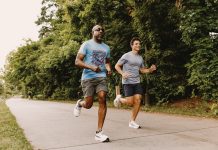
The summit of Pine Mountain in Cartersville isn’t dramatic. Trees at the top were felled to make a view. The twisting and rooty trail up is short and punishing: more than 600 feet packed into one mile with green walls of pine trees on either side. Even in the shade, a hot and humid Georgia day bakes between the walls. On Saturdays, mostly mountain bikers navigate the trail’s turns. Also working up the trail is a man drenched in sweat running and giving fist bumps to the bikers as he passes them by, like he’s the one on two wheels.
Most Saturdays, Hans Troyer, a professional trail ultrarunner, does loops of Pine Mountain. In four hours, he will cover 25 miles and climb 6,300 feet, summiting 11 times. In 2025 alone, he ran nearly 5,000 miles and climbed over 400,000 vertical feet. His consistent training here has led Hans to burst onto the ultramarathon scene, competing at the front of the most competitive races on U.S. soil.
An ultramarathon is any race longer than a marathon’s 26.2 miles, often on a trail that can range from 50-kilometers to hundreds of miles. Most U.S. professionals live in California or Colorado, where mountains are an everpresent playground. But Hans grew up in the suburbs of Atlanta, and his ultrarunning obsession took hold in a camper in the Georgia woods.
Raised in Newnan, Hans got the nickname “destroyer” as a kid, not only for the rhyme to his last name but also his recklessness. When he and his family rode dirt bikes in the backyard, Hans didn’t worry about finesse or form. “My brother always did things more calculated, while I just went for the risk,” he says. “I wasn’t really putting much thought into what I was doing.”
Hans went to Trinity Christian School for high school, where he met his now-wife Grace on the track and field team. Augusta University was the only college that offered Hans a running scholarship out of school, so he took it.
“When he showed up at Augusta, he had actual wide, starry eyes,” says Kai Brickey, his teammate and sophomore and junior-year roommate at Augusta and now a videographer for Hans. They make regular videos on YouTube of Hans’s training and races that have amassed millions of views.
Hans initially struggled with the disciplined structure of college running. “He had injuries early in college that came from dirt biking that really messed with him,” Brickey says. “I think he realized that if he had to commit to really do something with running.”
Hans bought into the rigidity of college training as an upperclassman, and regularly asked his coach for extra miles that he could add on after practices. His focus paid off: He placed highly at regional cross-country meets and thrived especially on hilly courses. Grace and Hans eloped and married in 2021, and both graduated from Augusta.
Back in Newnan, Hans found himself adrift in the summer of 2023 after graduating. “I was working at Fleet Feet, and it felt like I was standing still,” Hans says. “So, I started running, a lot.”
That meant several 120-mile weeks in a row, all in a hot and humid Georgia summer. Hans found he could handle the volume, and his interest in ultramarathons peaked after finishing a 50-mile run around his parents’ property. From the suggestion of a friend, he signed up for the Bandera 100-kilometer race in January 2024 in Texas. He won in dominant fashion; second place was over one hour behind.
Six months after graduating, Hans returned to Augusta to get his master’s degree in kinesiology and moved into a small camper on his friend’s property. “Once I was in the camper, I was all in,” he says. “I’m studying exercise, running twice a day, reading books on training, and listening to running podcasts constantly.”

Photograph by Kristen Nelson
In February, he ran Black Canyon 100K, where he daringly shot into the solo lead in front of dozens of pros. His risk proved almost fatal. After the race, Hans underwent rhabdomyolysis, a medical condition brought on by dehydration where damaged muscle tissue breaks down and can lead to kidney damage. He was in the hospital for 12 days. “He told me that he was scared that this might kill him down the road,” Grace says. “As much as I wanted to tell him to stop, I knew running is what he loved to do.”
His return was slow, and his life continued forward. He finished his degree in the spring of 2025 and moved from the camper into a house with Grace in Cartersville. There, Grace can commute into Atlanta for a job with Asics, and Hans has access to more trails, such as Pine Mountain, even if not at high altitude. “I know I’m at a disadvantage to people who live in more mountainous places, but living in Georgia has made me want it more and work so much harder,” Hans says. “Another benefit is that it’s so hot and humid here, so I’m ready for the heat.”
In 2025, Hans’s running career skyrocketed. At Canyons 100K in April, he placed second and ran 15 minutes under the previous course record. That result earned him a Golden Ticket to run Western States, the oldest 100-mile race in the world and one of the most prestigious. There, Hans had an imperfect race of 16 hours and finished eighth. He capped off his 2025 with a dominating win at the JFK 50 Mile, one of the most historic ultras in the U.S. In 2026, he plans to return to Western States—and to Black Canyon, where his body fell apart two years ago.
“Sometimes people ask me if there are loose screws in Hans’s brain to be doing this, and I used to say maybe a few.” Grace says. “But now my answer is that there are screws entirely missing. He’s pushing his limits to go further, faster, longer.”
Back at Pine Mountain, when Hans reaches the tree-cut summit, he likes to sit on a rock and draw in a deep breath to look at the view. “For that moment at the top, I think, These are the times,” he says. “Each time I grind up a mountain, I’m exploring myself and what I can do.” Hans appreciates this for two seconds, and with an exhale, bounds down the trail to do it all again.
This article appears in our January 2026 issue.