

Photograph by David Walter Banks
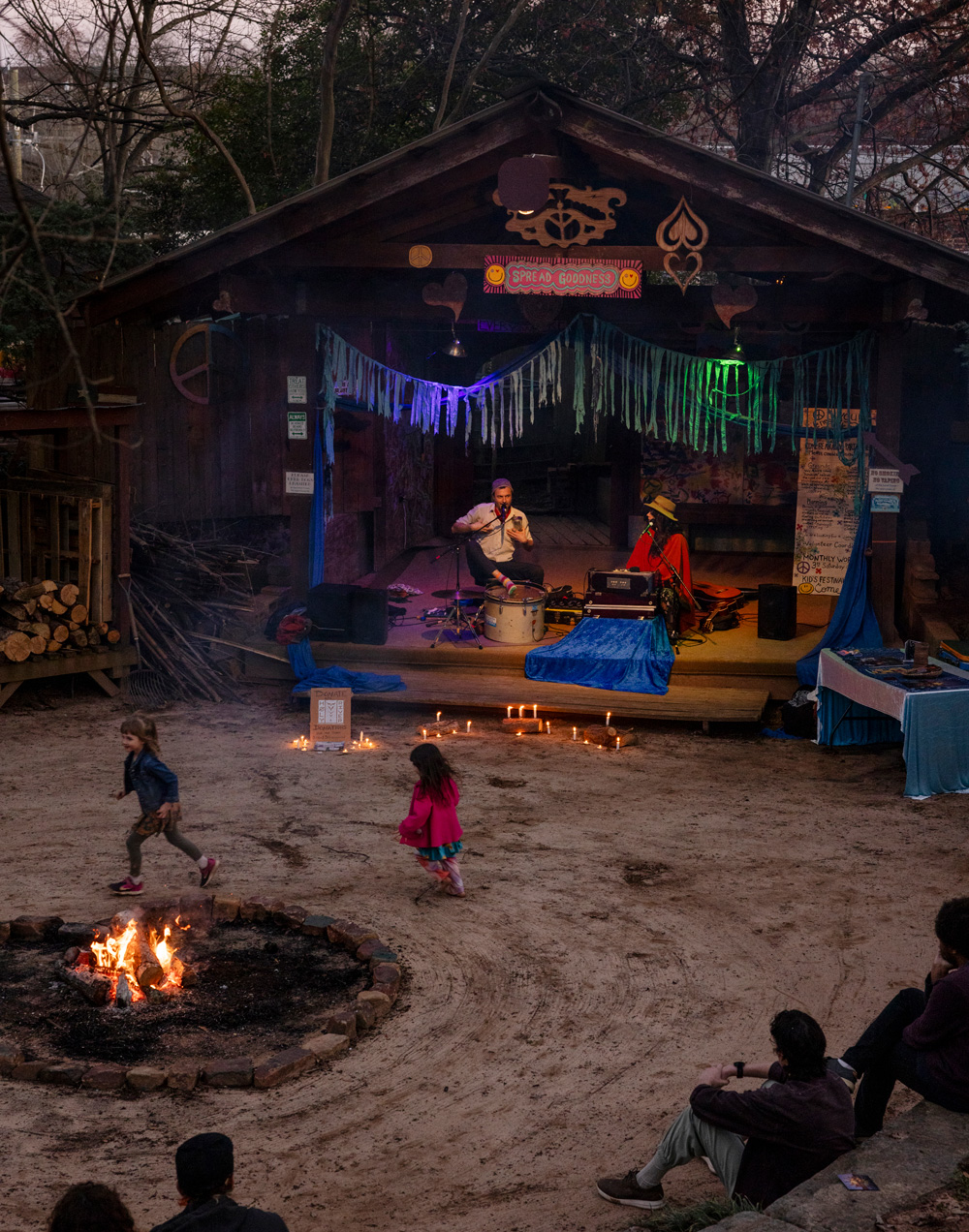
On the first Saturday evening of every month, a motley crew of hippies and curious neighbors assembles at the Lake Claire Community Land Trust to bang on drums before a fire. Look beyond the drummers scattered across makeshift amphitheater seats and spot a woman spinning an incandescent Hula-Hoop so fast that the colors blur into a rainbow. Behind her, a shirtless man dances around the fire pit, flinging his arms and legs into the firelight. As the drums settle into a rhythm, like a heart beating in the middle of Atlanta, a man with a cigarette dangling from his mouth plays with fire, whipping around ropes with fiery balls attached to the ends.
This is the Lake Claire Community Land Trust: a pocket of nature, ritual, and community nestled in its namesake neighborhood on the east side of Atlanta. Purchased from MARTA by a group of residents for $26,500 in 1986, the land trust, a now one-and-a-half-acre lot, has sprouted into an urban garden, community space, and performance venue that anyone can visit. But it faces an uncertain future—not because of developers or legal threats, but because the people who built it are aging, and the next generation has yet to step in.
The land trust emerged from a dream shared by a handful of Lake Claire neighbors to purchase an unused piece of MARTA land overrun by kudzu and trash. The original founders intended to preserve the property from development and use it as a community greenspace. After buying the land, the group immediately incorporated it and received 501(c)(3) status in 2008 to operate as a nonprofit. Though it looks like a public park, it remains privately owned and governed by a five-member volunteer board of trustees.
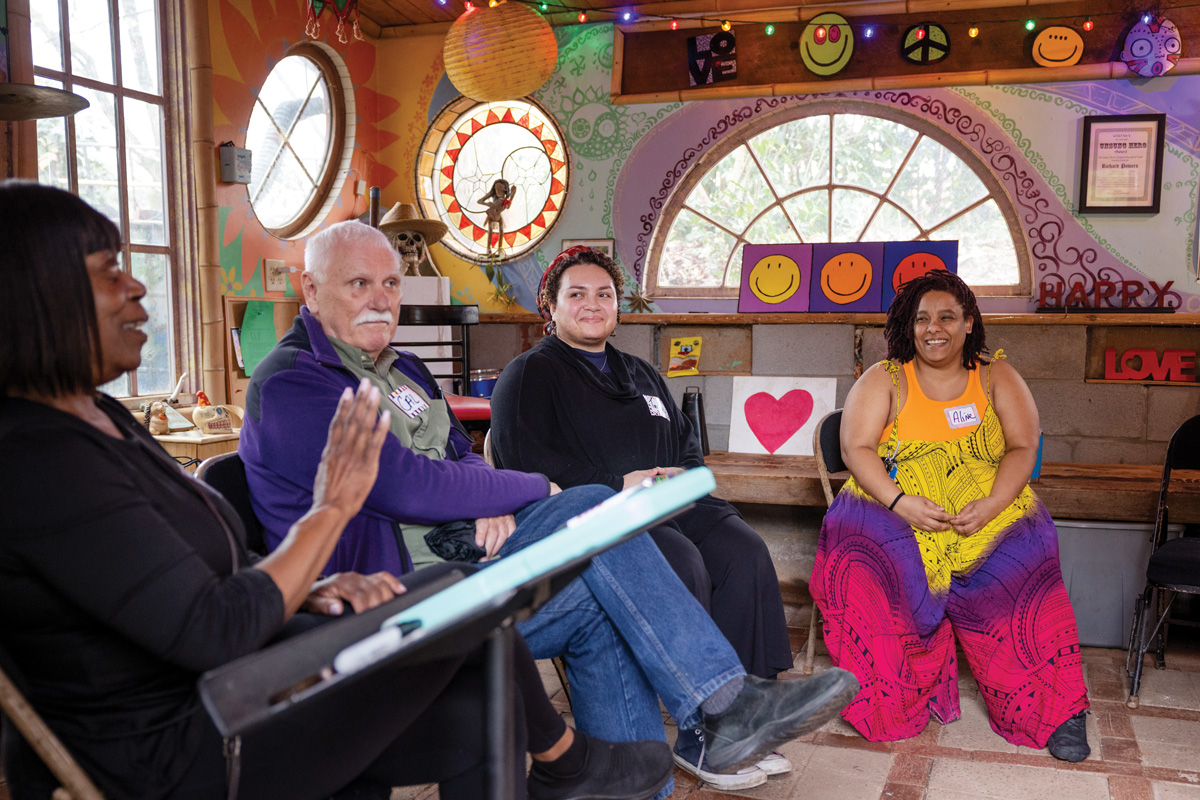
Some community members have built cabins on the land; others live nearby in homes on Nelms and Arizona avenues and donate to the trust, volunteer, or attend events. There’s no formal membership, dues, or buy-in process—just a shared understanding that the place survives through community effort. “I hope it exists forever,” says Diana Powers, whose parents were founders and raised her on the land trust. “But there’s part of me that’s really afraid it won’t.”
On the surface, the trust looks like a success story: something green and thriving in a city fragmented by megahighways and hemmed in by development. Powers’s parents, Richard and Joanna, and a handful of founding neighbors built the trust, literally from the ground up. They cleared a mess of kudzu from the lot, bulldozed it flat, and erected a dozen structures that dot the property: a sweat lodge, a tiny home, a gazebo, and a pen for Big Lou, the late emu who lived on the land for three decades.
Photograph by David Walter Banks
From the beginning, the founding families aspired to blend community and nature. They hosted weekend work parties and regular potlucks, with a devotion to land stewardship and strong neighbor relationships. “Atlanta is a city of neighborhoods, and everyone identifies with their neighborhood,” says Miriam Herbers, one of the original founders. “The land trust really created my little world.”
Herbers, a nurse, and her husband, union lawyer Mark Sanger, moved to the Lake Claire neighborhood in the early ’80s. They quickly befriended the Powers family and Charlie Pope, a Lockheed Martin mechanic turned Berkeley bohemian turned MARTA employee. Back when getting volunteers was easy, most of the Lake Claire neighborhood (which measures less than a square mile in its entirety) was involved in the land trust. “Back then, neighbors were inspired to contribute,” Pope, a founding trustee, says. “I think people, with how Atlanta has grown and the stress in their lives, don’t live as locally as they used to.”
The neighbors began hosting drum circles early in 1991, and they were so big and disruptive that they had to impose an 11 p.m. curfew. They also gathered for weekly jam sessions in which a group of folk musicians crooned to attendees in front of a campfire.
When the land trust needed money, the founders planned fundraising events, like the Peace and Love Springfest, which began in 1986, and the Jerry Jam (an annual event that kicked off in 2009 in honor of Jerry Garcia, obviously). To cover a property tax bill before they gained nonprofit status, the members built and sold wooden Adirondack chairs. For extra cash, they turned the land trust into a makeshift campground where visitors could stay for a small fee during the 1996 Olympics. They also ensured it would be around for future generations; in 2012, the land trust founders set up a conservation easement to permanently protect the land.
That status gives the property immunity from developers eyeing the now-affluent Lake Claire neighborhood, which boasts an average $819,300 home value. The land trust is the only undeveloped property on DeKalb Avenue. “It’s an inspiration because nobody gave up on it,” Powers says. “People have come and gone, but the underlying theme is dedication.”
Photograph by David Walter Banks
Today, the vision for who will preserve the land trust is murky. Of the original trustees, few survive, and fewer remain involved. Mark Sanger passed away in 2003 and Richard Powers in 2023. Pope quit the board of trustees about a decade ago and moved off the land, retreating into the 10-by-18-foot tiny home he constructed next to the property. Pope is less concerned about the longevity of the place, claiming he doesn’t “think so much in generations.”
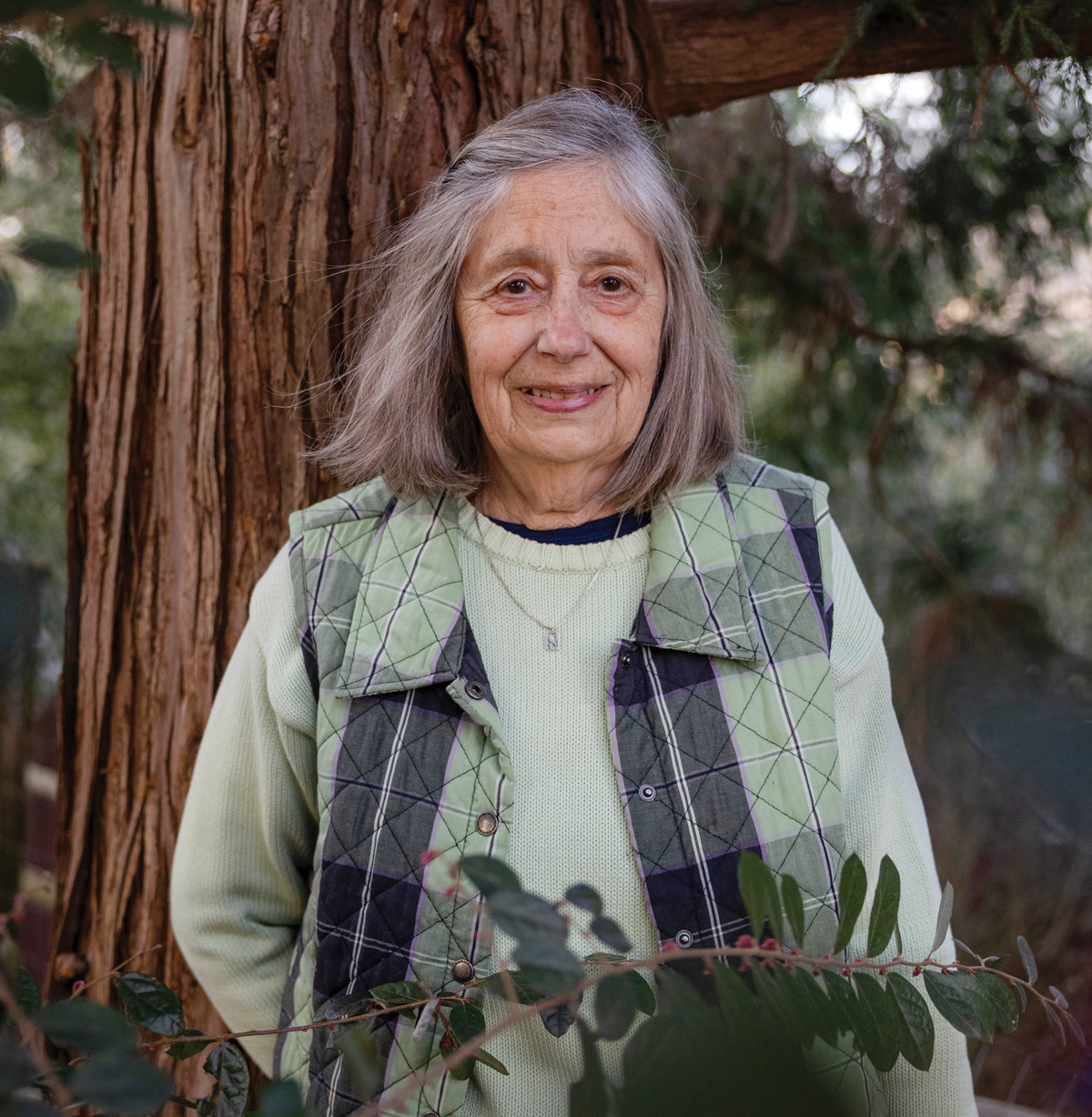
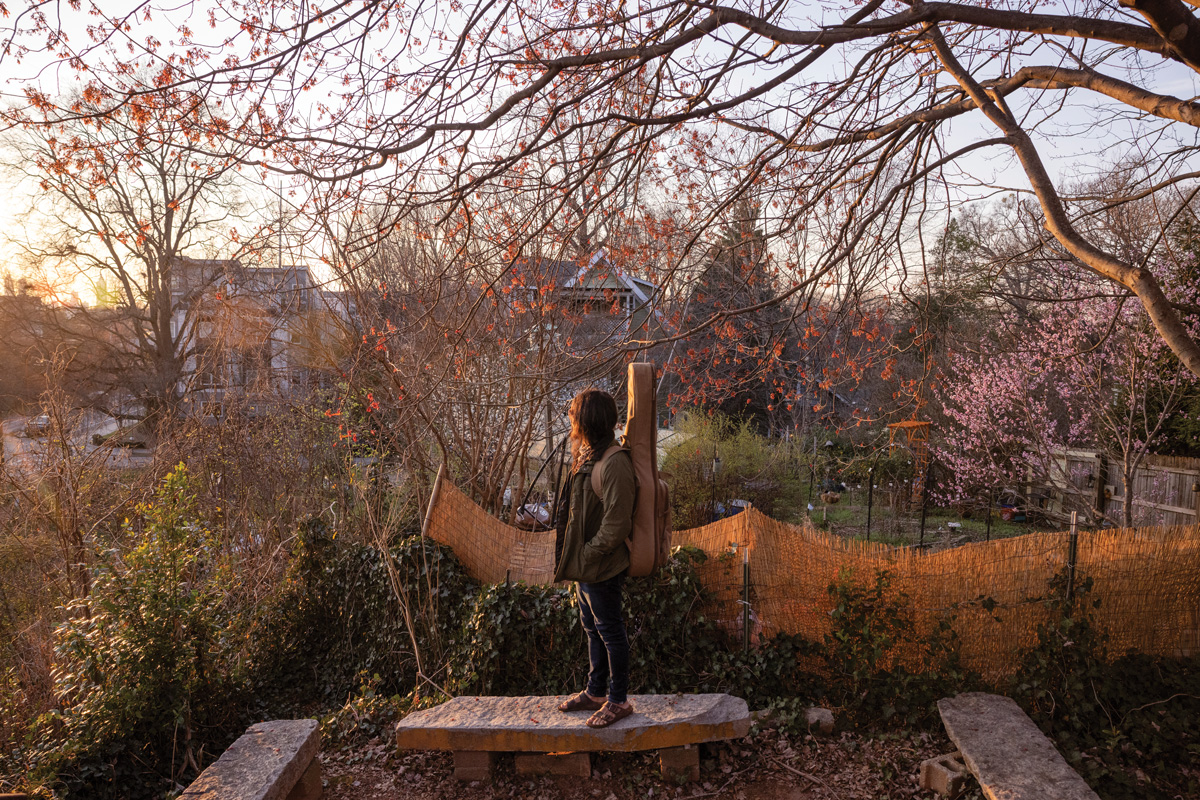
Not everyone shares his nonchalance. “The founders and the people who first made the space are passing away,” says Powers, who recently joined the board of trustees. At 31, she’s the youngest member by 40 years, but she’s settled in New Orleans, where she’s established a career doing nonprofit work. “We’re still trying to find the young people who can come and make it their own.”
Herbers and Bernard Spenle, a French immigrant who moved to Lake Claire decades ago, continue to lead the trust. Herbers chairs the board of trustees, and Spenle maintains the infrastructure, building new structures and repairing old ones. But both are upwards of 70 and have tended the land for decades. “I will never walk away from the land trust,” Herbers says. “I’ve been here since 1987, but I am tired of making decisions.”
Spenle echoes her. “I feel like I want to step back. I’ve been repairing all these things,” he says. “Like, yeah, I put a new floor on a porch, and it looks great. But at some point, I’ll be gone.”
Herbers wishes Powers could move back and breathe new life into the place. “She’s got great ideas,” Herbers says. “She’s got the energy.”
Beyond Powers, few have stepped up. Herbers’s daughters live in the area, and one of them serves on the board, but they are busy with jobs and child-rearing responsibilities. And while the wider neighborhood of Lake Claire visits the preserve, most residents don’t donate or participate in cleanup days. “Everybody knows about the land trust,” Herbers says. “But they don’t do anything to help it flourish.”
Photograph by David Walter Banks
Martin Mueller is a neighborhood dad not involved in the land trust. Initially, he hadn’t distinguished it as a community greenspace when he passed it on DeKalb Avenue. “We didn’t really know what it was,” he says. “My wife found it just zooming out on Google Maps, really.” They see it as a place to take their kids to enjoy the nature rather than a community to join.
And while the land itself is protected by conservation status, without new stewards, it risks becoming another abandoned corner of the city overgrown with kudzu. “Eventually, all of us will be gone,” Spenle says. “And if nobody takes over, it may become an area where people come for drug deals.”
The hope is that a fresh wave of Atlantans stumbles upon the land trust and experiences what Spenle describes as an “experiment in community living.” Until then, Herbers and Powers will continue to manage, organize, and maintain it. There’s a community workday planned for May 16, as well as the regularly scheduled drum circles and open mic nights. “It’s been and will continue to be a great place to dream,” Pope says.
The echoes of those first drum circles are still here 40 years later. Now, somebody just has to listen.
This article appears in our May 2026 issue.