

Courtesy of the Kenan Research Center at the Atlanta History Center, Boyd Lewis Collection
To be in Tom Houck’s presence was to be in the presence of the city itself. He was Atlanta’s institutional knowledge personified. He knew the city so well, he coordinated traffic flow for Martin Luther King Jr.’s 1968 funeral. Surprisingly, he was a transplant.
The Boston native landed in his adopted city as a teenager in 1966 after getting expelled from his Jacksonville, Florida high school for taking part in a 1965 march in Selma organized in response to Bloody Sunday. He arrived in Atlanta to help with the Southern Christian Leadership Conference voter registration efforts and ended up becoming Dr. Martin Luther King Jr.’s driver, routinely taking King’s children Yolanda, Martin III, Dexter, and Bernice to Spring Street Elementary. His starting pay: $15 a week.
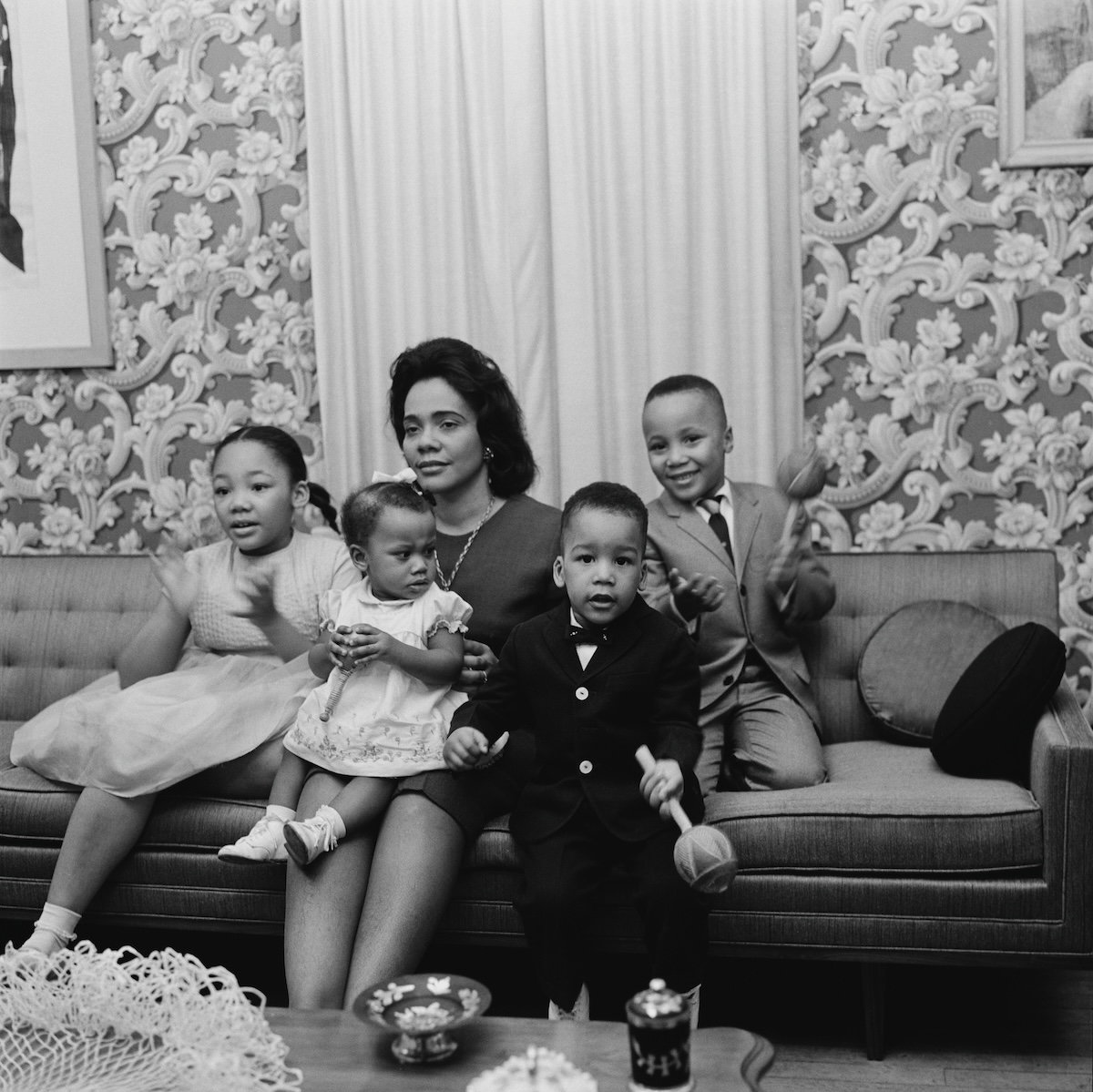
Photo by Michael Ochs Archives/Getty Images
The lifelong civil rights activist, politico, WGST-AM and WAGA-TV Georgia Gang media personality died October 22 at age 79 in Atlanta, following complications from pneumonia.
Houck’s final professional endeavor, the city’s popular Civil Rights Tours, started in 2015. The tours were a series of three-hour bus outings to Atlanta’s most historic civil rights locations narrated in person by Houck himself with videos by movement icons, including Andrew Young, John Lewis, and Julian Bond. The tours became Houck’s passion project.
“These places are not included in any Atlanta tour guide,” Houck once explained to Atlanta. “I thought, ‘Why not do this, and do it with the stories of the people who lived it?’ I want this to be a view of Atlanta that’s never been seen before, an experience that puts Atlanta on the map as the citadel of the civil rights movement.”
And who better to organize a tour of the King family home in Vine City, Dr. King’s parents’ final resting place at South-View Cemetery in southwest Atlanta, and the old SCLC headquarters on Auburn Avenue than a civil rights activist who knew each of those spaces from personal experience?
Before opening the Civil Rights Tours to the public, Houck provided Atlanta with a personally chauffeured and narrated preview. Standing in front of Dr. King’s final residence, a midcentury red brick house at 234 Sunset Avenue, Houck told stories with his trademark rapid-fire cadence and gravelly rumble. Memories flooded back to him, including the first time he met with King. It was 1966. While Houck was waiting for a lift in front of SCLC headquarters on Auburn Avenue, MLK spotted him. At that time, Houck was a shaggy-haired 19-year-old. MLK offered him a lift and lunch at home.
As he told the tale, Houck could still remember the spread Coretta Scott King put out a half century earlier: “Fried chicken, ham, greens, coleslaw, squash, cornbread and sweet tea,” Houck says smiling between snaps of gum.
At lunch, Mrs. King lamented the family’s need for a driver. Houck jumped at the opportunity. For the next nine months, between SCLC voter registration efforts, he drove MLK to the airport, the kids to school, and Mrs. King to her many appointments. His toughest assignment, both logistically and emotionally, was coordinating the traffic flow for King’s 1968 funeral in Atlanta.
As the civil rights figures he worked beside became the city’s new political leaders, beginning with Andrew Young’s 1972 election to Congress and Maynard Jackson’s historic mayoral win in 1973, Houck’s deep civic and political connections helped him transition into to a career as a media pundit and columnist, including as a regular contributor to Atlanta magazine from 1979 to 1981.
His inaugural column, Tom Houck’s Tattler, was published in the February 1979 issue. The piece opened with a bang: “If abortions were common 44 years ago, would Jimmy Carter be President of the United States?” Houck then went on to reveal the salacious details in an unpublished memoir being shopped by Helen Rafshoon, the 75-year-old mother of Gerald Rafshoon, the then White House communications director and longtime Carter political aide. Mrs. Rafshoon had let Houck thumb through the manuscript detailing her difficult marriage and, yes, her unsuccessful search for a doctor in the 1930s to perform an abortion when she was pregnant with Gerald.
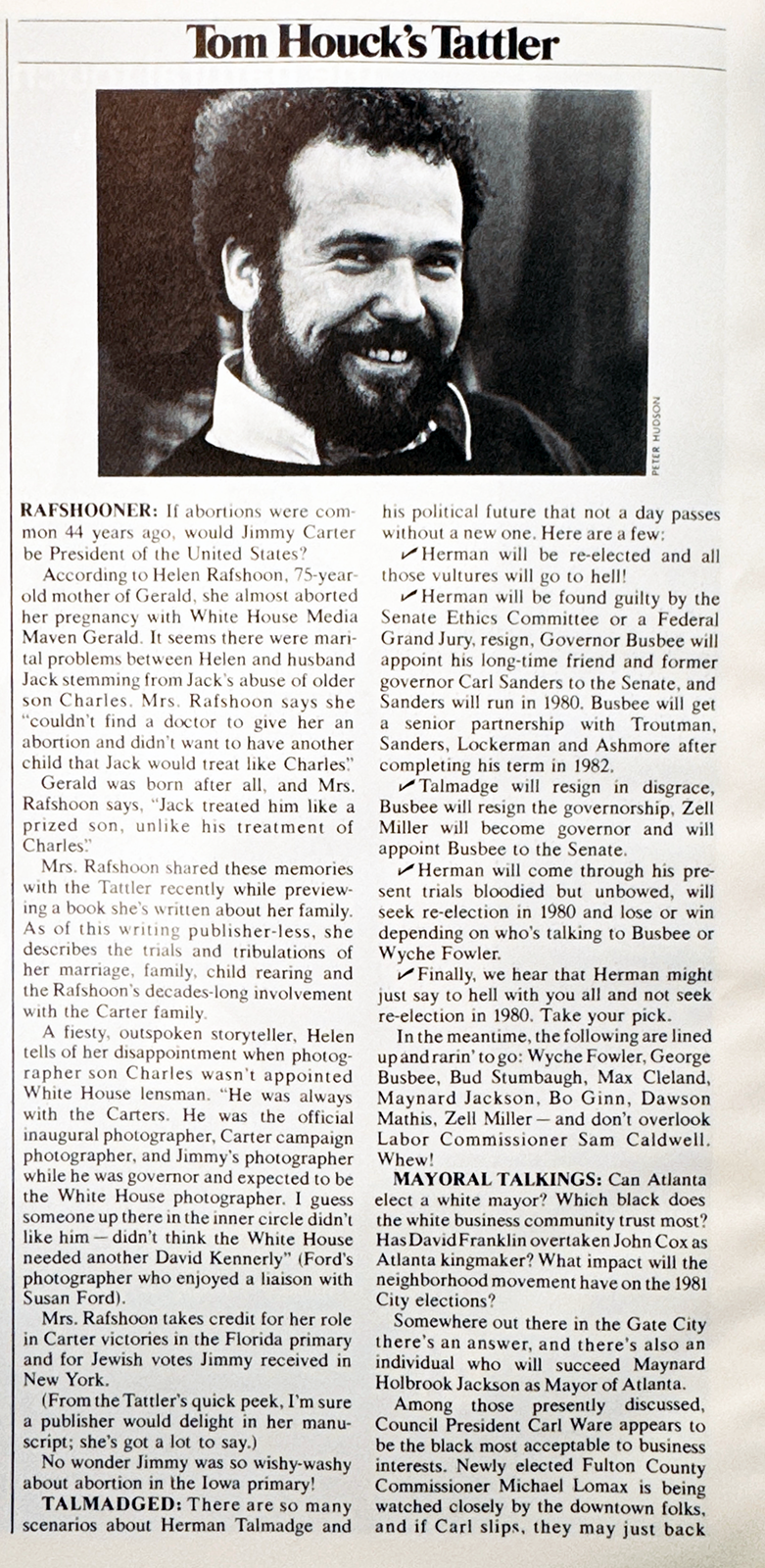
Reaction in Washington, DC to the bombshell in Houck’s first Atlanta Tattler column was swift. In a subsequent column, Houck told Atlanta readers after hearing about The Tattler column, Gerald had immediately placed “an embargo” on his mother’s manuscript, instructed her “not to return phone calls to reporters” and “to take a vacation.”
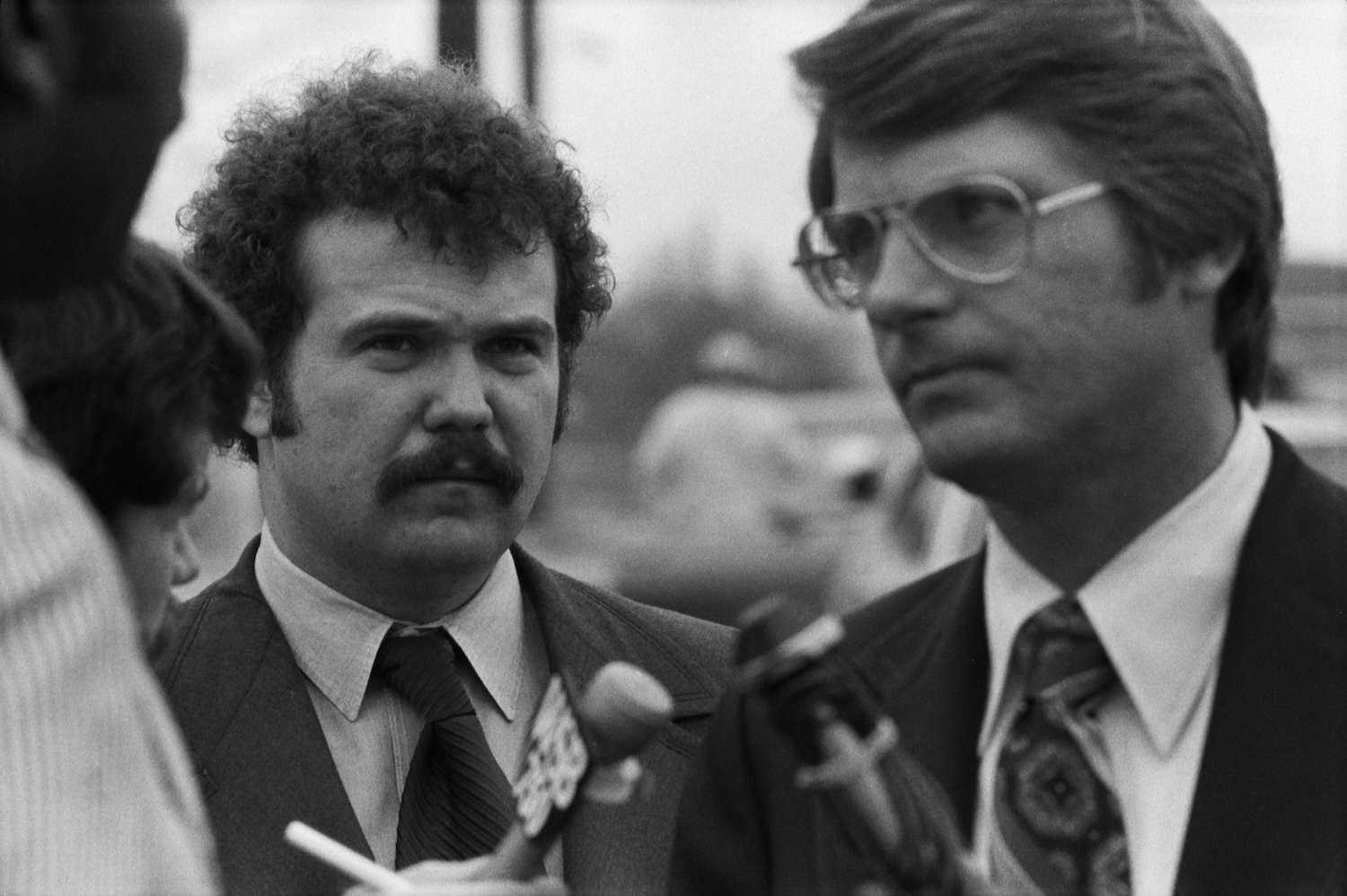
In Tom Houck’s Tattler, the columnist also came to the defense of his former employer Coretta Scott King and the King family after a series of stories by WABE reporter Boyd Lewis alleged financial mismanagement at the King Center, specifically a grant check from the Center to the Martin Luther King Jr. Foundation mailed to Mrs. King’s home address. Houck reported Mrs. King did not draw a salary from the Center and that the check had been issued to pay the salaries of her staff.
“The funds were sent to her home address because her office was located in its basement,” explained Houck. The columnist went on to observe: “Lewis did perform a valuable service in making the Center aware that recipients of public funds must make public reports. Dr. King was too much a public man for his heirs to expect to have secrets.”
Among Houck’s other Tattler scoops for Atlanta:
- Director of Rich’s Cooking School and future public television cooking icon Nathalie Dupree was not being paid for her contributions to WAGA-TV’s then-successfully syndicated PM Magazine. When he called the station to inquire why, PM Magazine’s producer told Houck, “It’s none of your damn business.”
- Atlanta writer Paul Hemphill’s baseball novel Long Gone would be adapted into a movie (In 1987, Long Gone became a critically acclaimed HBO film that introduced the world to actors William Petersen, Virginia Madsen and Dermot Mulroney). Houck’s fellow Atlanta contributor wasn’t exactly worried about being seduced by the trappings of Hollywood, quipping to Houck, “If I make 250 grand, it works out to about 25 grand over the last ten years. The only change I’ll make is to purchase a few satin sheets.”
- Former Carter administration United Nations ambassador Andrew Young would return to Atlanta and run for mayor, quoting a political insider saying, “As long as Andy keeps a voting address in southwest Atlanta, the Mayor’s job is his for the asking.” Still, Young hedged his bets, telling Houck, “I’m making no current plans to seek political office. However, I wouldn’t think being Mayor of Atlanta was a lesser job or demeaning to the role or stature of my former position. After all, Atlanta wants to be recognized as an international city.” Young would go on to serve two successful terms as mayor and become an integral force in bringing the Centennial Summer Olympics to Atlanta in 1996.
Occasionally, Houck’s media musings didn’t pan out. No, WSB-TV Action News anchor Monica Kaufman never departed the city for a rumored new gig in Washington, DC. And AJC scribe Lewis Grizzard never left for a sunnier perch in Miami. But sometimes, Houck’s political prognostications proved prescient. In a 1979 column, Houck publicly warned his friend John Lewis to “take a poll” before running against incumbent Wyche Fowler for Georgia’s 5th Congressional District. Having lost against Fowler during a special election runoff in 1977, Lewis ultimately heeded the advice. He would successfully run for the seat in 1986, where he would remain, until his death in 2020.
By the start of 1981, with his successful Tom Houck’s Notepad segments now airing six times daily on news/talk WGST AM, the columnist’s work for Atlanta evolved with a focus on what he did best—using his decades of political and civil rights connections to report on Georgia’s evolving political scene. His subsequent Political Sphere column would run monthly from January 1980 to the Fall of 1981. Before departing, perhaps to devote more time to his burgeoning broadcast career, Houck used his final monthly dispatch for Atlanta to handicap the 1981 Atlanta City Council race. As the guy who moved to Atlanta in 1966 to help organize Black voter registration efforts in the aftermath of the Civil Rights Act, Houck predicted: “The guessing here is that the new council will be younger, blacker but, by and large, more receptive toward working with the new mayor [Andrew Young]. With a new mayor and perhaps a majority of Council members who will work for good government, the old days of doing business as usual may disappear. Thank heaven for elections.”
This past week, as word of his passing spread across the city via phone calls, texts, and social media posts, longtime friends, civil rights leaders, and his fellow adopted Atlantans likewise thanked heaven for Tom Houck.