


Home 2015

Archives

One Square Mile: Salvage Hunter Auto Parts, Austell

0
Salvage Hunter Auto Parts
Photograph by Dustin Chambers

Salvage Hunter Auto Parts | Austell | 21 miles northwest of Atlanta

In this open-air market by the Silver Comet Trail, every item has a tale of calamity or violence or catastrophic malfunction. Maybe the transmission failed, or the front end crumpled, or blood spilled on the passenger seat. Maybe the airbag inflated, the windshield going translucent from shock, or maybe a young woman drew white hearts on the windows—along with the date, 3/31/15, and such proclamations as It’s My Birthday! and I’m Feelin’ 22!!—just before the engine died, and her teal-green Ford Escort LX joined a thousand other metal cadavers here in automotive purgatory. The reluctant proprietor is 55-year-old Pat Williamson (above), who’s spent half his life watching humans run the narrow spectrum between thrift and desperation. His customers wander the yard, looking for replacement doors, fuel lines, anything to keep that old Honda Accord running. He understands how thin their margins are, how a fragile economy depends on cheap used parts, and yet he can’t help wishing he could walk away. Some customers bring in crying children; others, occasionally, offer to pay with drugs. One flung an alternator over the wall and went to retrieve it and found a police officer who’d seen the whole thing. Amid rotting banana peels and old cans of Dr Pepper, the customers find small treasures that previous owners left behind. Finders keepers, if they catch the boss in a good mood. Running a junkyard is hard work—cold in winter, hot in summer, the forklifts always breaking down, the ground sparkling with broken glass. Williamson has sold the parts of nearly 27,000 vehicles in the past 20 years, but there’s one deal he can never seem to close. “Success to me,” he says, “is the day somebody buys my business.”

This article originally appeared in our July 2015 issue.
American Legion Fayette County Post 105

0
American Legion Fayette County Post 105
Photograph by Dustin Chambers

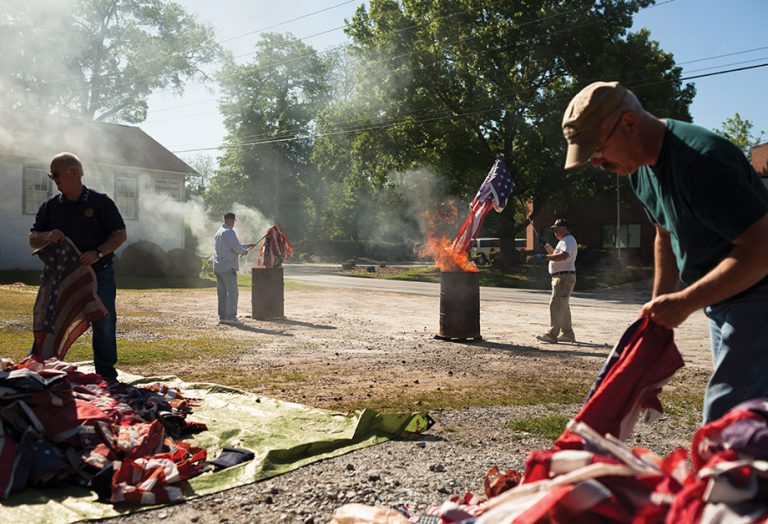
The military veterans of Post 105 had spent their best years doing hazardous jobs on behalf of their country, and now, on a windy blue morning, they did one more. A somber tune played on a portable stereo. Someone said a prayer. Then they lit the fires. Nearly 700 worn-out American flags had accumulated at their headquarters, deposited by various local patriots, and it was time for the quarterly cremation. “Hey, don’t burn the flag,” a passing driver said, not unreasonably, because once in a while the sacred resembles the profane. “It’s not burning,” said Robert Ladd, 74, a former lieutenant colonel in the Army. “It’s retiring.” The men retired the flags in four 55-gallon drums that emitted noxious black smoke and spilled black liquid on the gravel. Some members had stayed home to avoid the fumes of melting nylon. “Don’t breathe that smoke, gentlemen,” Ladd advised the troops. “Get upwind!” Larry Newsome, a former Air Force engine mechanic, recalled the time a confused bystander saw the flames of flag retirement reflected in the windows of the fire department across the street. “So he called the fire department and said, ‘I guess you know your fire department’s on fire.’” But it was only the flags, melting, smoking, disintegrating, rendered to the fire by the men who pledged their allegiance and carried them around the world and brought them home to cover their brothers’ coffins. “We’re kind of putting these flags to their eternal rest,” said David Niebes, former post commander, as smoke rose toward the clear blue sky.

This article originally appeared in our June 2015 issue. 

One Square Mile: Lockheed Martin Aeronautics, Marietta

Lockheed Martin Aeronautics
Photograph by Dustin Chambers

Lockheed Martin Aeronautics | Marietta | 17 miles northwest of Atlanta

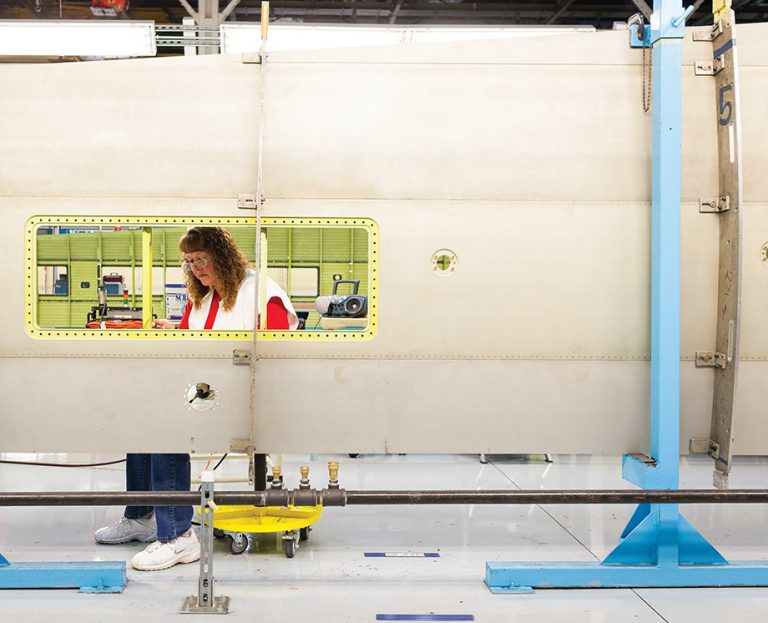
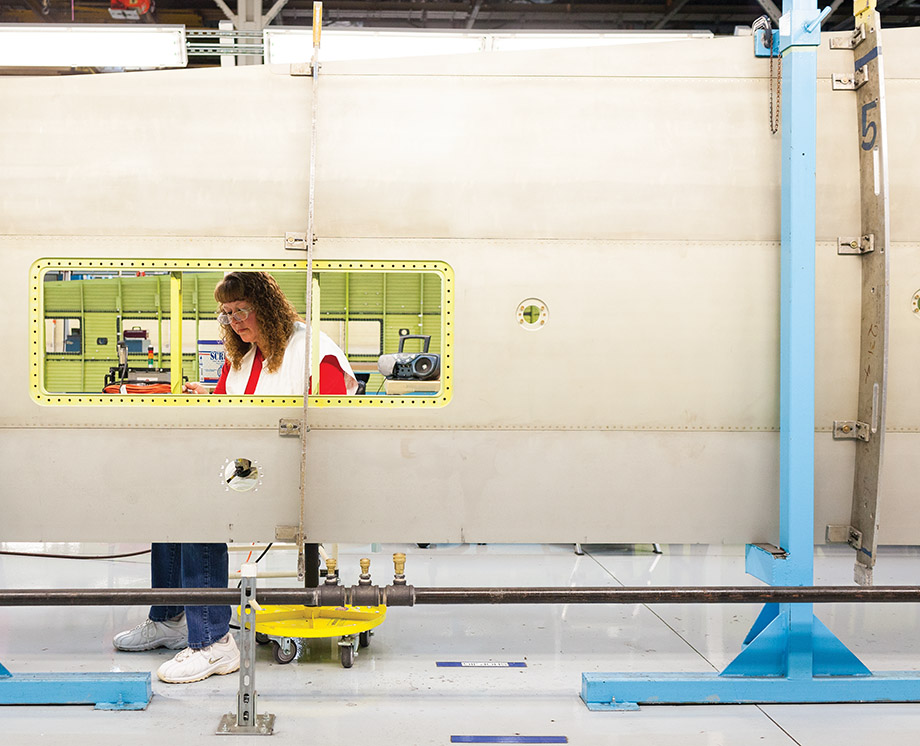
They build airplanes here, and the noise is terrific: a general whirring and whining, a clatter of rivet guns. Seated before the upper wing panel of a C-130J Super Hercules, Valerie Branch plays her own part in the cacophony. Country music spills from her battered radio as she applies chemical sealant to the dome nuts that hold the wing together. The sealant gun makes a soft hiss. Time passes in the changeless artificial light of the oldest continuously operating military production line in history. Branch’s grandmother worked here, decades ago, on the B-29 Superfortress, the bomber that won World War II. Branch’s father worked here for 31 years. Now here is Valerie Branch, a 49-year-old senior mechanic, wiping away excess sealant with a paintbrush. The avionics have changed, but today’s C-130 military transport planes look much the same as the ones that first came off this line in 1955. They bring soldiers to war and bring them home. They carry supplies for disaster relief. Whenever Branch sees a C-130 on television or on a test flight outside the plant, she thinks, I was there. I built that. She is four hours into a nine-hour shift. The sealant gun hisses. The work is easy after 11 years, not mindless but nearly automatic, and so she can sit here and still go somewhere else in her mind: often the same place, West Point Lake, near the Alabama line, in a boat with her twin sister, Vanessa, and sandwiches in the cooler, and the sun rising through the fog, and the shallows full of bass, and somewhere in the world a C-130 roars through the sky, but not here on the lake in the morning, where you can barely hear a sound.

This article originally appeared in our May 2015 issue.

One Square Mile: The Shepherd’s Inn

0
Photograph by Dustin Chambers

The Shepherd’s Inn | Atlanta Mission, Downtown

Between night and day, between Centennial Olympic Park and the county jail, Jimmy Rivas is praying. He and his coworkers have agreed to spend one year within these walls, recovering from alcohol or other drugs. In five minutes, they will serve breakfast. The workers have been here since 4 a.m., cooking sausage and biscuits and oatmeal for roughly 230 people who slept here last night. Standing to Jimmy’s left is a man in an orange shirt. A moment ago, he stirred the oatmeal in a large vat with the joy of a child playing in a sandbox. The man in orange is 50 years old. He used to do cocaine back when he played the drums in a rock band. He drank a lot, beat people up, fell into ditches, passed out on the floor. They told him he was one arrest from doing hard time, so he came here and played drums in the chapel band and whipped up the oatmeal and said, “Manna from heaven! Manna from heaven!” Jimmy Rivas is still praying. He is not so free with his story as the man in orange, but in a moment, while chopping vegetables, he’ll say, “Just working hard to change me. Change my life. Better direction.” Frost covers the ground outside. In the dining room through the high windows, you can see the yellow ring of lights on the Westin Peachtree Plaza above a luminous billboard for Crown Royal whiskey. “Amen,” Jimmy says, and the metal window rolls open, and the hungry men collect their breakfast, plates clattering on the sill, and the man in orange is drinking something from a paper cup—a kale smoothie, as it turns out—and he says, “I’m pretty grateful to be here.”

This article originally appeared in our April 2015 issue.

One Square Mile: Kingston, Georgia

0
Photograph by Dustin Chambers

Kingston, Georgia | 55 miles northwest of Atlanta

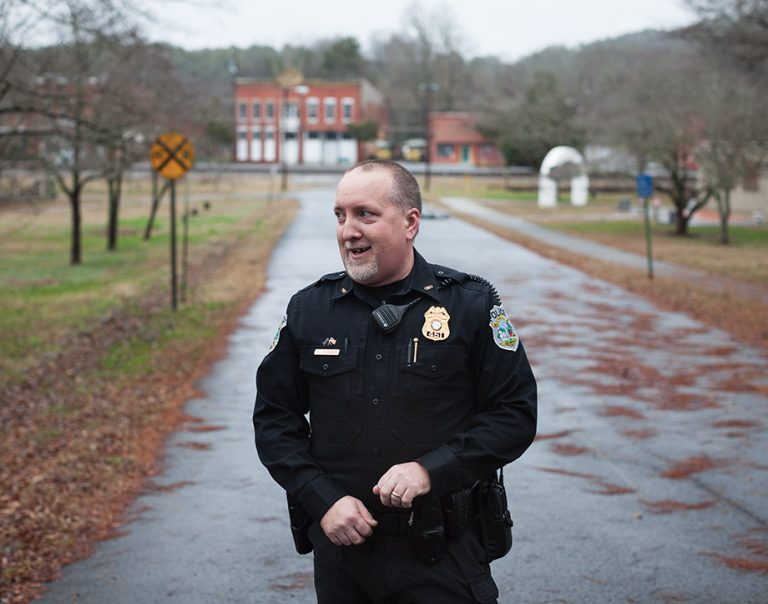
The police chief has several guns, including a 12-gauge shotgun and a semiautomatic rifle, but he almost never puts them to use. “This is the modern Mayberry,” says T.J. Sosebee, the only full-time officer in Kingston, population 646, a hidden Bartow County village on a narrow plain between Cartersville and Rome. The chief’s job was vacant for most of last fall, leaving the town with no police department, and in the ensuing anarchy, someone kicked in the doors of the restrooms by the baseball field. Sosebee started work in early December, and the rest of 2014 passed without serious incident. A woman called 911 because her father was choking on a peanut butter sandwich, but the man fell down and dislodged the obstruction before Sosebee arrived. He caught a woman driving 72 in a 40 zone. He did not catch the thief who made off with two large bottles of Coke from Dollar General, but he was pretty sure he knew who it was. There was no need for a SWAT raid. He walked around town, Tic Tacs rattling softly in his pocket, waving to men in pickup trucks. Around Christmastime, he got a call about stolen electricity. A man had his power cut off, so he plugged an extension cord into a neighbor’s outlet to keep the heater going. He was sorry. Sosebee could have arrested him, but he wrote a citation instead. On New Year’s Eve, he cruised the streets and found people worshiping in churches and drinking peacefully in the town’s only bar. Around 9:30 p.m. on Reynolds Bridge Road, a man hit a deer. The man and his truck were all right, but the chief looked down at that 45-pound doe and knew she was suffering. The chief has many responsibilities, some prescribed by law, others simply understood. He took aim with his pistol and pulled the trigger.

This article originally appeared in our March 2015 issue.

One Square Mile: Hunter Park Community Center

0
Photograph by Dustin Chambers

Hunter Park Community Center | Douglasville | 24 miles west of Atlanta

Angelica Blackwell was seven on the night of the dance, old enough to know about looking good. She wanted the red stockings—not the black—and red bows in her hair, with the puffs done just right. And because this was a mother-daughter dance, and because daughters of a certain age hold themselves responsible for their mothers’ appearance, she had to inspect her mother’s dress. “Mommy,” she had been known to say, “maybe you should consider something else.” About 30 daughters and their mothers stood on the floor of a rented ballroom on a cold Friday night and danced to John Legend and celebrated nature’s most complex parent-child relationship. “Your mother is a guide and a protector,” said guest speaker Chaunnie Dodds, a senior at Alpharetta High School. “Savor every moment.” But this was easier said than done. Event co-organizer Alana Gillespie and her 14-year-old daughter, Milan, had been clashing lately—over the dishes, homework, and so on—which made it all the more surprising when Milan took the microphone for an unscheduled announcement. “I just wanted to recognize my mom,” she said, voice cracking. “I just wanted to say sorry to her.” Then DJ Muzic Warfare cranked the tunes back up, and Alana took Milan in her arms, and a moment later Alana was in the hallway, tears in her eyes, fanning herself with a tissue. “Unexpected,” she said, because 14-year-old girls are never wrong. Back on the floor, in a room scented with perfume, Angelica looked up at her mother, Lynita Mitchell-Blackwell. For a moment, everything was simple. Lynita wore hoop earrings and a green sleeveless dress and open-toed gold shoes. They had all passed inspection. “Mommy,” Angelica said, “this is perfect.”

This article originally appeared in our February 2015 issue.

One Square Mile: Stone Mountain Park Carillon

0
Photograph by Dustin Chambers

Stone Mountain Park Carillon | Stone Mountain, GA | 18 miles east of Atlanta

Here is the office on a Sunday afternoon in her 40th year at the machine. The music runs from her fingers to the circuitry in a dark room below her feet and then under the ground and down the hill and up the amplifying tower at the water’s edge, 380 feet away. This journey takes less than a second. “I’m pushing 8,000 watts,” Mabel Florence says. “That’s a lot for an old lady.” She will not say how old. But she will share the secret of her unfailing attendance as the official carillonneur of Stone Mountain Park: “If you’re sick, take about five aspirin and a good shot of Scotch.” The massive electronic carillon was a gift to the state from Coca-Cola after its appearance at the 1964 World’s Fair in New York. Now she plays the bells every weekend: twice on Saturdays, three times on Sundays, the sound ringing out across the park. Today she opens the console room and looks at the only two people in the small amphitheater outside and asks them whether they want to hear love songs or Christmas songs. They say love songs. She plays “Let Me Call You Sweetheart,” and the man pulls the woman close. They walk away during “Ave Maria,” replaced by two more lovers during “O Holy Night.” There are no words for the way she plays that song on those bells on this damp gray afternoon with the leaves red and yellow and the man and the woman standing there in wonderment. Then they go, and the amphitheater is empty once again, and Mabel Florence plays on. She does not intend to retire anytime soon. This is a powerful machine, perhaps a dangerous one, and she will choose her apprentice carefully. “I’m gonna find an engineer and teach ’em to play,” she says, “rather than find an organist and electrocute ’em.”

This article originally appeared in our January 2015 issue. 

One Square Mile: Mid-Georgia Livestock Market

0
Photograph by Dustin Chambers

Mid-Georgia Livestock Market | Jackson, GA | 49 miles southeast of Atlanta
They sell beef by the pound, even when it still has hooves and a beating heart. The auctioneer wears a white Stetson hat and speaks the numbers in a glorious monotone. He is very fast, very efficient. The cow walks off the scale and through the first gate and the auctioneer calls out the bids in his numerical shorthand and the cow prances and kicks up some wood chips and maybe it moos or leaves a warm souvenir and the bidding ends and the second gate opens and there goes the cow, off to the feedlot if it’s young, the slaughterhouse if it’s old, and then the next one walks in. It all takes barely 15 seconds. There are 375 cattle to buy and sell this Wednesday afternoon at the Mid–Georgia Livestock Market in Jackson, and the bidders will pay dearly. Supply is down. Demand is up. Beef prices are near an all-time high. The man in the big chair at the edge of the railing pays $1,875 for a pregnant cow weighing 1,565 pounds. He is Luke Weaver, a 71-year-old retired insurance agent, and he will tend the calf and one day bring it here to sell. The special chair belonged to a previous auctioneer who retired but kept coming back to watch the auctions. Now the old auctioneer has passed on, but his chair is free to whoever sits there first. Today it belongs to the man they call Mr. Luke. There is less competition than before. Mr. Luke remembers the auctions of 30 years ago. They could be wild, full of double-dealing and intrigue, and instead of three hours they might last 12. Now the buyers represent large industrial concerns, and the local sellers are dwindling. “Too many houses,” Mr. Luke says. “Too many people sold their farms.”

One Square Mile, our new photo column, profiles places located one square mile from metro Atlanta’s 8,376. This article originally appeared in our December 2014 issue.

Follow Us

69,386FansLike
144,836FollowersFollow
493,480FollowersFollow

NEWSLETTERS