
Home 2016

Archives

One Square Mile: The 12-year-old Atlanta fencer

0616_onesqmile_oneuseonly

Atlanta Fencer’s Club | East Point | 6 miles south of Atlanta
Ryan Droutman is taking a breather. The 12-year-old fencer sits sweating in a red plastic lawn chair, mask tucked beneath his arm, foil lying across his lap, as he referees a bout between two classmates, one of whom is old enough to be his grandfather. “Annnnnd . . . fence,” says Ryan, suppressing a cough. His hacking is soon drowned out by the thud of tennis shoes on the hollow wooden floor and the clack of steel blades as the two masked combatants advance. Ryan glances over at his father, pacing the periphery, lost in his work on a laptop he’s balancing against his chest. The son knows his dad could pull the plug at any moment. When Ryan woke up this morning, he said that his cold was bad enough to warrant a sick day—until his father reminded him of the strict “no class today, no fencing practice tonight” policy. So Ryan went to school. He’d always dreamed of being a knight, and when horseback riding didn’t quite fulfill the fantasy, his dad signed him up for fencing lessons just before his ninth birthday. “I love the strategic thinking,” says Ryan. “It’s like physical chess.” Ryan competes in weekend tournaments around the country and is currently ranked 69th in the U.S. 12-and-under age group. He has the respect of his elders in this room, one of whom, a software engineer twice his age, challenges the preteen to a bout. Ryan eagerly puts on his black-mesh mask. He gets into position, spreads his feet, and raises his foil en garde. Ryan is instantly the aggressor, lunging forward, feinting right, parrying his opponent’s retreating stab, and scoring a hit on the elder’s shoulder. “Yeah!” says Ryan, releasing a quick burst of coughing, which he tries to stifle through the rest of the victory. “Best two out of three?” says the opponent. “Nope,” says Ryan’s father, keys out, ready to take his son home.

This article originally appeared in our June 2016 issue.

One Square Mile: Bingo Night at American Legion Post 7

American Legion Post 7American Legion Post 7 | Gainesville | 58 miles northeast of Atlanta
No one else sits at Betty Toney’s table. It’s not that she needs all that space. The 73-year-old retired hospital clerk takes up just a quarter of the rectangular surface, where she’s arranged her $27 book of Bingo sheets, her multicolored daubers, and her dinner—egg salad sandwich, plain potato chips, Dr Pepper with ice in a Styrofoam cup, and two M&M’s chocolate chip cookies. And Betty’s not alone because she’s superstitious, like Grace, who would cover the adjoining table with dozens of laminated four-leaf clovers from her yard every Thursday night for 30-some years. She died at 102. And it’s not that Betty is unpopular. She was born and raised in Gainesville and has been a Bingo Night regular since the first number was called back in 1981. No, everyone knows that the three empty chairs are in honor of Betty’s older sisters. Reba introduced her baby sis to the game. For two decades the Toney sisters played four or five times a week—girls’ nights out—starting on Monday at the Cleveland American Legion, Tuesdays in Cumming, Thursdays here, Fridays in Dawsonville, then Saturdays back in Cumming or up in Cherokee, North Carolina, at a hall that boasted a $35,000 blackout jackpot. None of the women ever struck it rich, but they were competitive, especially with each other. Reba died in 2002. Frances followed five years later. Betty and Emma Verlene played on for a decade, until Emma passed in 2014 at age 88. Betty never married, never had kids. On a fixed income, she’s cut back her Bingo to three nights a week. She plays 21 cards at a time. The next ping-pong ball is sucked from the Bingo King Autotronic machine. “O-65,” says the caller. Betty daubs the square with Emma Verlene’s old purple dauber. “Bingo!” she cries. She puts down the marker and places her palms on the table.

This article originally appeared in our May 2016 issue.

One Square Mile: Visit a Mosque Day at Duluth’s Madina Institute

Madina Institute DuluthMadina Institute | Duluth | 24 miles northeast of Atlanta
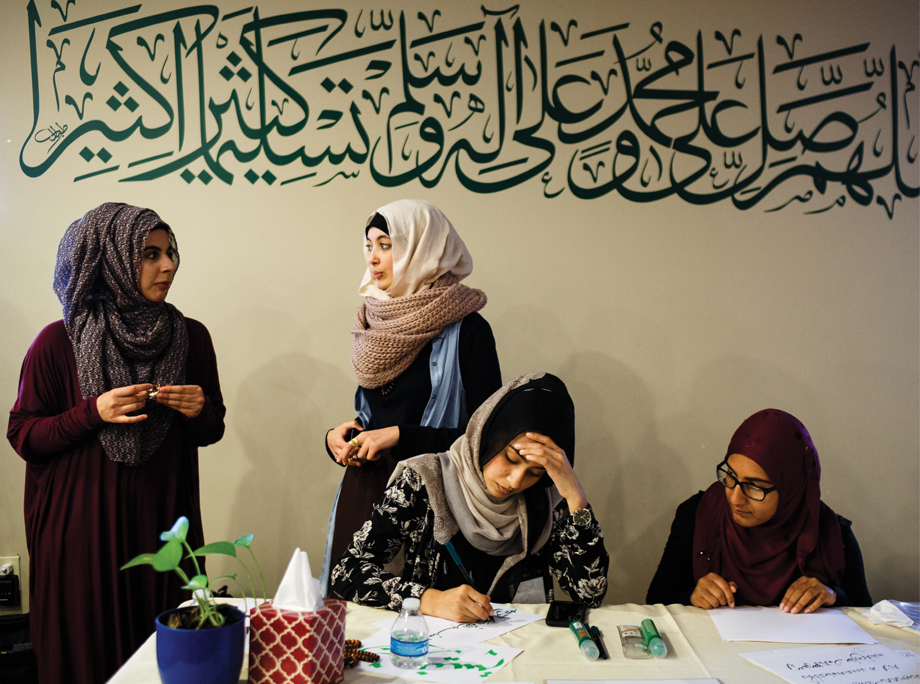
It’s cold outside on Visit a Mosque Day. Men wear thobes and parkas, while women wear coats and abayas. Shoes are placed in cubbies outside the door. Inside, it’s warm and delicious-smelling. Umber Hanief, a program director at Gwinnett Technical College, has brought food for newcomers, who have traveled from Buckhead, Decatur, and places between. Prompted by the attacks in Paris and California and the anti-Islam furor that followed, the Atlanta Muslim community organized the event with the support of 16 local mosques. “Originally,” Hanief says, “we were just gonna get packaged things. We thought, People won’t want buffet-style. Then a couple people in our group told us that their friends at the churches are expecting ethnic foods. So we’re like, Oh no! What do we do? The hummus was easy, so we made that; it’s becoming very popular in America. A lot of people know about samosas—deep-fried, everyone likes that. The biryani we weren’t expecting. We were afraid some things would be a little spicy.” Nearby, Ethan Rubenstein digs in. “My favorite is the baklava!” says the 12-year-old from Johns Creek. His aunt, Leanne Rubenstein, who is executive director of a nonprofit called Compassionate Atlanta, tries on a hijab. Ethan gets his name written in Islamic calligraphy at a nearby table staffed by two Muslim women. “He’s very open-minded,” Rubenstein says. “He knows a lot, reads a lot. I hope that together we can educate our friends and family about what Islam is all about. I think there’s a lot of misinformation and Islamophobia. Hearing things like, ‘Muslims shouldn’t come into the country,’ this has happened to the Jewish people!” A man walks up to a microphone: “It’s just poetry,” he says to the crowd of white and brown faces, as two young Muslim men prepare to recite ancient songs of peace in English and Arabic. “Please don’t be alarmed.”

This article originally appeared in our April 2016 issue.

One Square Mile: Feather, Fin, and Fur Taxidermy Studio

0
Feather, Fin, and Fur Taxidermy Studio
Photograph by Dustin Chambers

Feather, Fin, and Fur Taxidermy Studio | Loganville | 37 miles east of Atlanta

Beth Johnson believes that every life has a story. Among the nails, pins, knives, and other tools scattered about her workbench lies the colorful, limp-necked carcass of a parrot. Johnson doesn’t know the bird’s name, but she knows that it was a beloved pet for 22 years, that it died of natural causes, and according to the hand-written and blood-smudged ticket, the bereaved owner wants Johnson to give the animal in death what it rarely took in life—flight. That’s Johnson’s job, as she sees it. To, in a way, honor the creature’s existence. She knows that some people think taxidermy is inhumane or at the very least revolting. With the former, Johnson respectfully disagrees; with the latter . . . well . . . she admits it’s not for the squeamish. Today, as her coworker cleans deer skins with a paring knife, giving the air a sweet, gamey tinge, Johnson slices open the bird’s bright yellow belly, inserts a foam-and-wire form, and stitches birdy back up, skillfully concealing the seam beneath the feathers, which she preens with large tweezers. She began learning the craft 26 years ago when, as a fed-up schoolteacher, she answered a “help wanted” sign in the Lithonia yard of what she later learned was a taxidermist. There she practiced skinning and stuffing what seemed like every creature that once walked, crawled, swam, or flew. She also learned to be a storyteller. “Anyone can hang a deer head on the wall,” she says. She prides herself on researching an animal’s habitat and staging wildlife scenes. Her showroom is a library of vignettes, including a timber wolf leaping over a barbed-wire fence and a bear cub pawing at a beehive, complete with insect exoskeletons dotting the mammal’s snout. Of course, she’ll mount antlers and hog heads for hunters who just want a trophy. She also does pet cremations. But some clients, like this parrot’s owner, want something more. And so Johnson lovingly fluffs the bright blue tail feathers and spreads its lifeless wings.

One Square Mile: Freddy Cole and Sweet Auburn’s evolution

0
Freddy Cole
Photograph by Melissa Golden

Sweet Auburn

Freddy Cole sits at a table in a back corner of Sweet Auburn Seafood restaurant. The linens are crisp, the decor modern: shimmering tile, high-backed benches, cream-padded walls—all unmarked by smoke or time. This place is a welcome sign of slow resurgence in this historic part of town. When Cole first moved here from New York in 1972, he’d hear live jazz blasting from doorways and windows up and down Auburn Avenue. Cole himself often played piano across the street at the old Royal Peacock, which once hosted Dizzy Gillespie, Bessie Smith, and Louis Armstrong. By then the Connector had already split the neighborhood in two, and people had begun to flee, leaving crime and blight and abandoned storefronts behind. As it did in black communities in cities all over the U.S., the music stopped. Cole played on. The baby brother of Nat “King” kept recording, was nominated for three Grammys, hit the road and hasn’t stopped. Two weeks ago, he was playing in Japan, where they’re wild for American jazz. He returned to a country and a city that is starting to reclaim its birthright. “Black communities are coming back,” he says. “They have self-esteem, and they’re starting to realize that jazz music is black music.” Tonight the restaurant is packed with patrons, black and white, dressed up to mark the business’s one-year anniversary. Cole is celebrating, too: Tomorrow he will turn 84. As evening falls and light fades from the plate-glass windows, Cole’s grandson arrives to escort him to the front of the room. As he passes, each table stops him to say hello, to ask for a photograph. By the time he settles into the seat at the Steinway, his voice is hoarse from all the greetings. But when he pulls the microphone to his lips, a bell-clear baritone rings through the stilled audience. His fingers glide across the keys, tapping out standards: “A Lovely Way to Spend an Evening,” “Long, Long Ago,” “I Remember You.” I remember you/You’re the one who made my dreams come true . . . A sound, a person, and a place out of time, yet somehow of the moment.

This article originally appeared in our January 2016 issue.

One Square Mile: Falconry near Mason Mill Park

0
Mason Mill Park
Photograph by Dustin Chambers

Near Mason Mill Park | 8 miles East of Atlanta
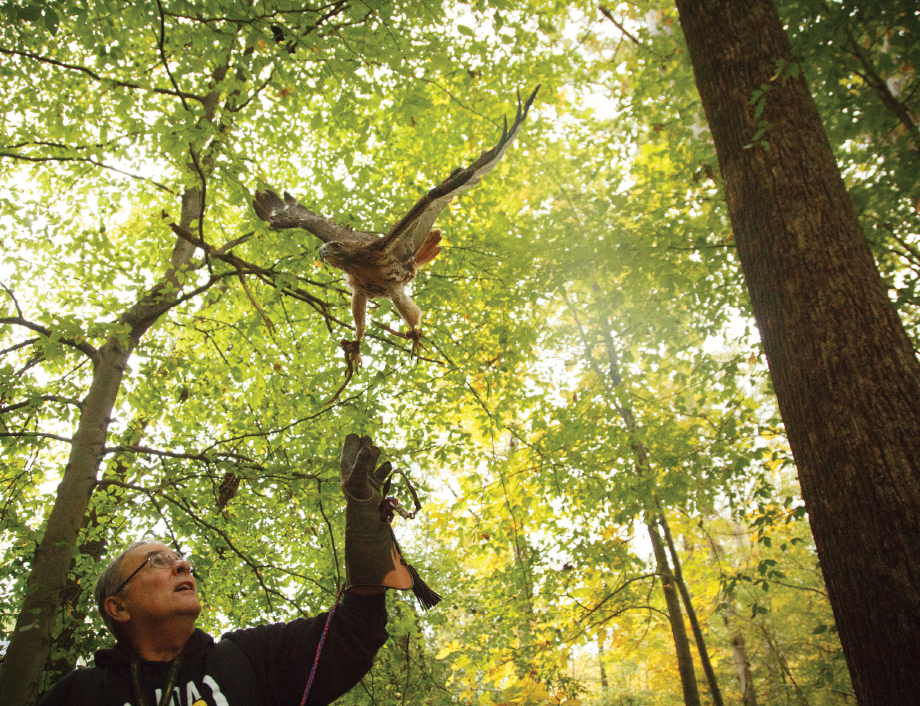
“Bird up!” yells Greg Ames across the wooded hill, silent but for the faint wash of distant traffic, as a red-tailed hawk springs from his leather-gloved wrist. The brass bells strapped to the animal’s legs jingle with each wing flap until she finds a perch on a barren limb some 50 feet up. Her name is Bird No. 7. “You start naming your birds and you start to think they like you,” says Ames. “That’s when you get hurt.” Ames points to an eight-year-old talon scar on the temple behind his right eye, which he got when he was handling his first hawk, Barney, and forgot to remove the leather glove before scratching his head. The birds eat from the glove while being trained. And from their perspective, the relationship with the hawker is all about food. That’s why the year-old raptor streaks from branch to branch, following Ames as he and his fellow hawker, Bill Mixon, try to rustle up some prey—a squirrel, a mouse—from the undergrowth. The sexagenarians shuffle their feet among the dead leaves. They pull marbles from their shoulder bags to sling-shot at lofty squirrels’ nests. Then they move to the next tree, bells tailing them from above, a dance that has been occurring between man and bird for more than 4,000 years. While falconry—as this form of hunting, even with hawks, is known—remains popular in the Middle East and in the U.K., Ames and Mixon are two of only 4,000 licensed falconers in the U.S., around 175 in Georgia. Suddenly No. 7 streaks from the air and crashes upon a brush pile. “She’s got something!” shouts Ames. But by the time the two converge to help No. 7 unclench her talons, they find nothing there. In the distance, a squirrel chirps out something like a warning to the neighborhood, and all is still again except for the bells returning to the treetops and two friends, not the least bit dismayed, walking together through the woods.

This article originally appeared in our December 2015 issue.

One Square Mile: Newton County Superior Court

0
Judge Horace J Johnson Jr.
Photograph by Dustin Chambers

Covington |36 miles| Southeast of Atlanta
Judge Horace J. Johnson Jr. sits behind a desk covered with case files, in the shadow of a 12-foot wall lined with law books thick as bricks. A mountain of words. He prepared yesterday for the civil docket he’ll preside over today: divorces, separations, child custody issues. “The law is about inclusion,” he says. “And inclusion is more than just words.” Forty-nine years ago, at Ficquett Elementary, less than two blocks from here, Johnson became one of the first black students to be integrated into Newton County schools. He remembers walking out of the building behind a row of state troopers, an unwitting symbol against a scrum of protesters. Later Johnson would leave, first to Emory University, then to University of Georgia, where he got his law degree. After three years in private practice in Atlanta, he noticed there were no black lawyers practicing back in Newton County. Seventeen years defending neighbors under his Covington shingle earned Johnson the respect of both former governor Roy Barnes, who put Johnson on the Alcovy Circuit bench in 2002, and the electorate that has kept him there since. Now Johnson rides the rural circuit between Covington and Monroe, the Walton County seat just north. Wielding the gavel in the community he grew up in is a mixed bag. He’s locked up people he’s known all his life, and he has bumped into grateful friends who have made good on a second chance. But more than the sentences he issues, Johnson believes he is a symbol from the bench. “If there’s a person who looks like them,” he says, “folks might feel like the system is open to them.” Back in his chambers, Johnson stands and slips on the black robe. He strides out, through the long hallway, up a few steps to a narrow doorway at the back of Courtroom 3. As Johnson enters the room, the white-haired bailiff calls out to the gallery of citizens, black and white, “All rise.”

 This article originally appeared in our November 2015 issue.

One Square Mile: Dixie Speedway

0
Photograph by Dustin Chambers

Dixie Speedway| Woodstock| 31 Miles Northwest of Atlanta
In the pits, 73-year-old Nancy Roland, poker visor down and a Marlboro Light dangling from her lips, pushes an ice scraper across the hood of the race car, sweeping off chunks of orange clay. Thirteen-year-old Will Roland steps out from behind the trailer, zipping up his black-and-red fire suit. He slips on his helmet and climbs behind the wheel of the number 22 Roland Tire Crate Late Model. The engine roars to life—400 horsepower rattling 2,300 pounds of car and 95 pounds of driver. Mark Roland, Will’s father and crew chief, leans in to shout a few words of advice before sending his son onto the oval alongside men twice and even three times his age. Will raced quarter midgets—essentially souped up go-karts—from age five, but this is his first full year in late model, on the dirt where speeds approach 100 miles per hour. As the cars rev their engines for the qualifier, the PA booms: Wheel to wheel. Hub to hub. Doorpost to doorpost. Here we go! Will pulls away early, but he falters on the penultimate lap, coming in loose and high to turn two, leaving an opening for the surging number 87 to attempt a pass. The two cars come within inches of contact as they accelerate into the straightaway. Will holds him off, barely. Pacing at the fence, Nancy pulls a fresh cigarette from her red fanny pack. She remembers the wreck at Rome that retired her son, Will’s father. That nightmare recedes as her grandson takes the checkered flag. “He won! He won!” Back in the pits, Will removes his helmet and climbs out of the car, stepping over the glittering decal for Roland Tire, the family business back in Jasper that is his birthright should his NASCAR dreams fail to materialize. He needs to tell his dad that the track is getting slick and that they might want to attach the spoiler to the car before the next race. But not before getting a congratulatory kiss from his biggest fan.

This article originally appeared in our October 2015 issue.

One Square Mile: Frolona Farm

0
PHOTOGRAPH BY DUSTIN CHAMBERS
Photograph by Dustin Chambers

Frolona Farm | Franklin |65 miles southwest of Atlanta
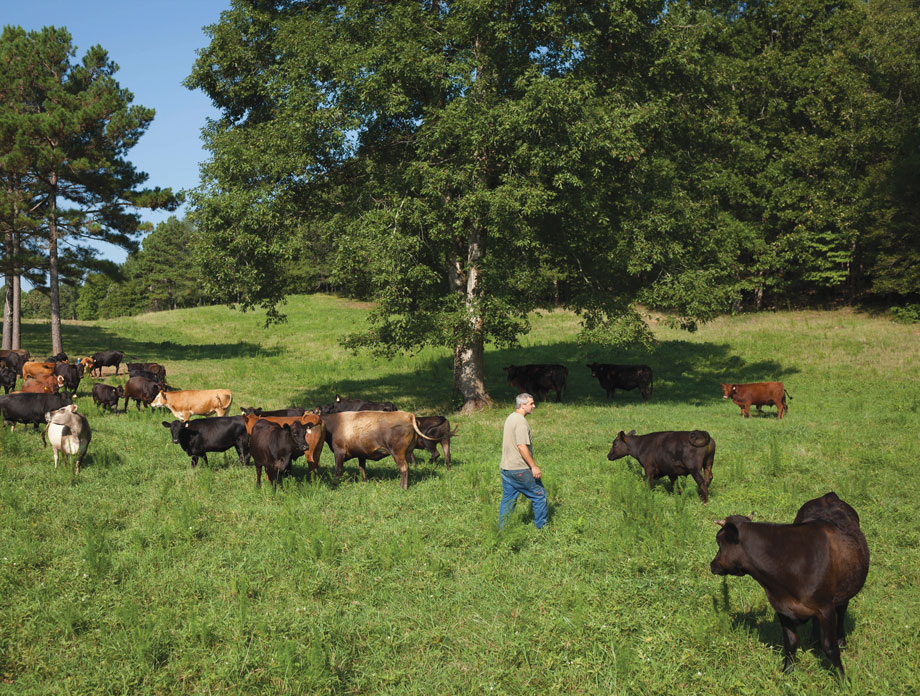
Josh Davis is a farmer. His life is moving things from place to place: Hay from field to barn. Feed from barn to pasture. Cattle and hogs from pasture to slaughter to CSA or wholesale. This morning his maroon Dodge Ram crunches up the steep gravel drive, carrying his 15-month-old daughter, Ona—bleary blue eyes, tousled blonde hair, and one orange moccasin missing from a plump foot—to the remote white clapboard farmhouse with the tin roof where his sister waits to babysit. His wife is out of town on business, leaving Davis to tend to the livestock and the land. Davis’s great-great-great-grandfather, a subsistence farmer, won claim to this clay in the Creek Land Lottery in the 1830s. His descendants built the house in 1890. Davis’s childhood bedroom was upstairs, with a picture window overlooking 1,500 verdant acres specked with timber, pigs, and cows. All he saw back then was emptiness. “I left immediately after high school with no intention of ever coming back,” he says. He fled to college, got an M.A. in philosophy from the University of Louisville, but became disillusioned with academia. Got a marketing job that he lost in the Great Recession, and reluctantly came home in 2009. He found local markets hungry for grass-fed beef and pasture-raised pork. He discovered a tether he didn’t realize was there. “There’s something about being here and working this land,” he says, walking among the herd of cows who’ve come lowing for food. “Besides, if it’s not me, no one else will do this.” As soon as Ona is old enough, she’ll be bouncing beside him in the farm truck, bounding over this red earth, calling pigs and feeding cattle. “I don’t see how she couldn’t get a love for this place,” he says, knowing full well that when the time comes, she’ll move wherever she wants.

This article originally appeared in our September 2015 issue.

One Square Mile: Jungle Paradise

0
Jungle Paradise
Photograph by Dustin Chambers

Jungle Paradise | Dawsonville | 56 miles north of Atlanta

This is her favorite time of day, her favorite time of year, when the new flowers blossom for the first time. No one has seen daylilies like these before, not even their caretaker, Suzanne Franklin, who walks through the garden with the pride of a mother and the wonder of a child. “Oh my gosh,” she says. “This is a pretty one. Look at that baby!” But the admiration soon turns to cold-eyed appraisal. Franklin is running a business, after all. She breeds her hybrid lilies with particular goals in mind, and only the most successful experiments go to her crossing bed for further propagation. They could sell for more than $100 each. The others are removed from the gene pool and given away. She wants to see large blossoms, ruffled edges, high bud count, resistance to cold, a glorious contrast of colors. And if the flower is somehow exceptional, she just might give it a name. There is an art to naming a lily. Other hybridizers try to be funny, suggestive, subversive, or perhaps romantic, but Franklin has her own priorities. Several years ago, in the car on the way to Florida, she asked her husband and sons for help with a backlog of more than 250 nameless varieties. “I want it to be something that glorifies God,” she said. So were born His Tenderness, His Resurrection, His Sacrifice, His White Horse, His Sparkling Glory, His Sunshine, and many other tributes to divinity. And even though Franklin loves all her flowers, she must also be their judge. Now, she stops to examine a lily of dusty complexion: not quite burgundy, no ruffle, no etched eye, no treasured flecks of gold on the petals. “This is not a pretty one,” she says, “so it goes away.” She moves on to a seven-inch red blossom with white edges and ruffles. Too many ruffles. Franklin pauses, considering its fate. “I don’t care,” she finally says. “I’m keeping it.”

This article originally appeared in our August 2015 issue.

Follow Us

69,386FansLike
144,836FollowersFollow
493,480FollowersFollow

NEWSLETTERS