


Courtesy Winston-Salem
Lexington and Concord, Boston and Philadelphia, the Delaware River and Valley Forge. When we reflect on the birth of the nation, these are the places that naturally come to mind. But as we celebrate the 250th anniversary of the signing of the Declaration of Independence and America’s beginning, we want to give the South its due. Travelers will find America’s Revolutionary history preserved in four cities that played crucial roles in the early development of our nation: Williamsburg, Virginia; Charleston, South Carolina; Salem, North Carolina; and New Orleans, Louisiana.
• • •
Courtesy Visit Williamsburg
Liberty Takes Root
Williamsburg, Virginia, proved a fertile ground for the seeds of a new nation
It’s not a stretch to say that without Williamsburg, Virginia, the United States may not have become a nation. The colonial city, positioned on the Virginia Peninsula between the James and York rivers, was a hotbed of revolutionary thought in the late 18th century. There, along the cobblestone streets, Patriots and Founding Fathers Thomas Jefferson, George Washington, and Patrick Henry—all native Virginians—met to discuss what could be, if the 13 colonies broke free of British rule. In 1773, Jefferson and Henry, along with Francis Lightfoot Lee and Dabney Carr, met to develop the intercolonial Committees of Correspondence, establishing shadow governments and resistance networks around the would-be nation.
Courtesy Visit Williamsburg
As the capital of Virginia from 1699 to 1780, Williamsburg was a linchpin for the American Revolution, serving as an epicenter of social, political, and military planning, as well as a hub for fiery debates. On May 15, 1776, it hosted the vote that moved Congress to officially declare independence on July 4 in Philadelphia. Neighboring hamlet Yorktown became the site of the war’s final major showdown, and the place where General Washington negotiated an unconditional surrender from General Lord Charles Cornwallis on October 19, 1781.
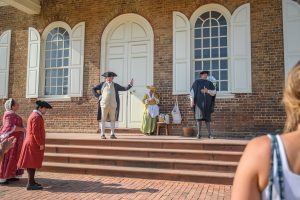
Today, the southeastern Virginia city offers plenty of opportunities to walk in those transformative footsteps. Along Duke of Gloucester Street, Colonial Williamsburg’s main corridor, visitors can engage with costumed interpreters—including the Founding Fathers themselves—who share well-researched historical insights into the city’s Revolutionary past. Travelers can take part in a worship service at Bruton Parish Episcopal Church, established in 1684; reserve one of the 11 cozy rooms at the restored Market Square Tavern, built in 1749 (and patronized by Thomas Jefferson); marvel at the intimacy of the reconstructed Raleigh Tavern’s Apollo Room, a frequent rendezvous point for Henry, Jefferson, and other firebrands; and enjoy some of Washington’s favorite dishes, such as Virginia peanut soup and baked fish at the King’s Arms Tavern, a lodging house established in 1772. More than 300 restored or reconstructed buildings make up this colonial capital, including 89 original to the 1700s, plus more than 30 historically accurate gardens.

Courtesy Visit Williamsburg
Beyond the main thoroughfare, Revolutionary history comes alive around town. The Art Museums of Colonial Williamsburg feature beautifully displayed pieces of decorative and folk art as well as antiques from the colonial period. Those on a Revolutionary War pilgrimage should seek out the nearly 9-foot-tall, circa-1780 portrait of Washington, painted by the era’s preeminent portraitist, Charles Willson Peale. Visitors hoping to see the work that goes into uncovering and preserving our nation’s history up close will want to check out the newly opened Colin G. and Nancy N. Campbell Archaeology Center, which is part museum and part working laboratory. Admission is free, and guests are invited to engage in hands-on activities in this state-of-the-art space designed to house a staggering 60 million-plus artifacts excavated over the past century, from ceramics and silver spoons to wig curlers. For a more contemporary commemoration of America’s 250th birthday, head to the Colonial Williamsburg Regional Visitor Center to see the Great American Birthday Quilt. Led by artist Steve Prince, the project invited thousands of individuals, community groups, and artists from around the nation to contribute hand-stitched squares to create the massive quilt that measures 500 feet long and five feet wide.
The spirit of forward-thinking change is still alive and well in Williamsburg, one of the cradles of the United States, and still home to William & Mary, a public research university founded in 1693 (U.S. presidents Thomas Jefferson, James Monroe, and John Tyler were graduates). Just this spring, an enthusiastic young man pulled a red wagon festooned with American flags, as he collected signatures to petition to change the official tourism slogan from “Virginia is for Lovers” to “Virginia is the Birthplace of America.” He passionately explained to passersby that the state is where the United States was born and raised, and that Virginians deserve a slogan reflecting that historical gravitas. It’s easy to envision a similar zeal two and a half centuries ago when revolutionary thinkers walked these streets. –Jennifer Bradley Franklin
The Critical Port in the Revolutionary Storm
Charleston, South Carolina, the wealthiest city in the colonies, was the ultimate prize for both sides
At the dawn of the Revolutionary War, Charleston was a bustling port city with a thriving plantation economy dependent on the labor of enslaved people, who made up half its population. Then known as Charles Town, named after King Charles II, it was the wealthiest city in the colonies as well as one of the largest. This prosperity made it a prime target for the British army.
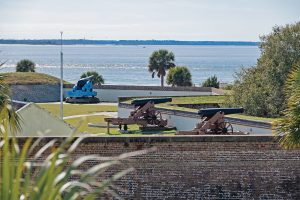
The first major attempt by the Redcoats to seize Charleston took place during the Battle of Sullivan’s Island, beginning on June 28, 1776. The campaign proved to be significant: It was one of the first decisive victories by the Continental Army, earning the island its nickname “the Obstinate Daughter.” The unique construction of Fort Sullivan, later renamed Fort Moultrie in honor of the battle’s triumphant commander Colonel William Moultrie, helped keep it secure. Made from sand and spongy palmetto logs, it was able to withstand the British cannon fire, absorbing the impact rather than shattering. (So celebrated was this feat that the palmetto tree has enjoyed pride of place on the South Carolina state flag ever since.)

Courtesy Visit Charleston
This victory ensured the city remained a Patriot stronghold up until the 1780 Siege of Charleston, the biggest Patriot defeat of the Revolutionary War. Five thousand soldiers were captured, and Charleston fell to the British, becoming its army’s southern headquarters. The clever and unexpected use of guerrilla warfare strategies by Patriot officers Nathanael Greene and Francis Marion, aka the Swamp Fox, ultimately drove out the British, who evacuated in December 1782.
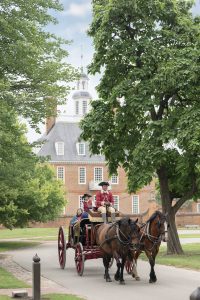
From the cobblestone streets to the colonial homes to the clip-clop of horse-drawn carriages, Charleston hums with centuries of history; the past is always very much alive. But for a deeper dive into the history of the Revolutionary War, book a guided war-themed walk with Bulldog Tours—or opt to visit a handful of significant sites at your own pace.
Courtesy Explore Charleston
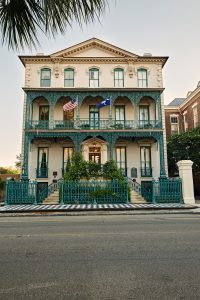
Many pivotal figures in our nation’s founding lived in Charleston at this time, including a handful of Declaration signers and Constitution drafters whose homes allow visits. Built in 1772, the Georgian-style Heyward-Washington House was the home of signer Thomas Heyward Jr. The property features the only colonial-era kitchen open to the public and an esteemed collection of Charleston-made furniture, including the spectacular Holmes Bookcase—considered one of America’s cabinetmaking masterpieces. John Rutledge, South Carolina’s first governor, served a crucial role as chairman of the five-person drafting committee for the Constitution. Today his private home is an inn where you can bed down under the same roof where he pored over what would become our nation’s supreme law—as well as dine where George Washington breakfasted during his 1791 visit. A short drive northwest of the city center and set alongside the Ashley River, verdant and sprawling Middleton Place was home to Declaration signer Arthur Middleton and his family. The nearly 300-year-old plantation features America’s oldest landscaped gardens and shares generations of stories, including those of enslaved laborers as well as Continental Congress members.
For an up-close look at the fortifications that withstood British assault during the Battle of Sullivan’s Island, head to Fort Moultrie in Charleston Harbor, where you can check out reproduction cannons and take in panoramic views of Fort Sumter across the water. More military history can be found at the Powder Magazine, South Carolina’s oldest public building, constructed in 1713, that stored gunpowder during the Revolution. A few blocks away, the Old Exchange and Provost Dungeon, built in 1771, offers a look at the dark (literally) underbelly of the war with its cellar dungeon, where the Redcoats housed military and political prisoners, including Declaration signers Middleton, Heyward, and Edward Rutledge. Upstairs at the Exchange, a self-guided tour reveals the building was also used to host South Carolina leaders as they debated and ratified the U.S. Constitution.
Courtesy Explore Charleston
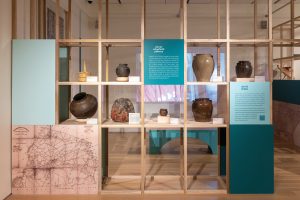
Once free from British occupation, Charleston flourished—but at the expense of thousands of Africans brought in bondage. Charleston’s International African American Museum, located at the docks where nearly half of the country’s enslaved peoples disembarked, shines a spotlight on the complex and paradoxical history of colonists fighting for freedom while suppressing the liberties of the laborers who built their wealth. In addition to important contextual displays, the museum houses artifacts from the colonial era, the Revolutionary War, and the antebellum period, such as handmade earthenware, a freedman’s badge, and shackles from the Middle Passage. With an economy and way of life so reliant on enslaved laborers, it’s no surprise that Charleston became the cradle of secession in 1860, leading efforts to divide the nation and ignite the Civil War with the Battle of Fort Sumter. –Emma Hunt

From Ambivalence to Embrace
Salem, North Carolina, maintained neutrality until war’s end—then quickly integrated into America
In the deep, forested backcountry of the American colonies, removed from the patriotic fervor along the coast, the Revolution was often greeted with ambivalence. Many settlers valued their personal independence above all and simply wanted to be left alone. This was doubly the case in Salem, North Carolina, founded in 1766 by Moravians, a German-speaking Protestant sect established in Bohemia (today the Czech Republic) that held fast to the principle of pacifism.

Courteys Visit Winston-Salem
Like other religious groups, such as the Puritans and Quakers, the Moravians had fled persecution in the Old World and established communities in Pennsylvania and North Carolina. Their aim was political and economic self-sufficiency, which allowed them the freedom to practice their religion and the opportunity to raise money for the church.
At the time of the Revolution, Salem was a bustling town, the most prosperous in the North Carolina backwoods. As such, it was valuable to British and Patriot forces alike. In the hope of being regarded as neutral, the Moravians committed themselves to helping anyone in need. If an army were moving through, soldiers would be fed and housed, but their presence in the town was certainly unwanted. Understandably, this noncommittal stance bred antipathy from both sides, as well as suspicion by their neighbors outside the community. Still, the North Carolina legislature supported their exemption from bearing arms and honored the title to their land throughout the war. Salem—the very name of which means “peace”—stood.
Courtesy Winston-Salem
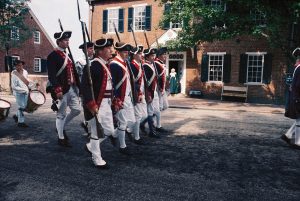
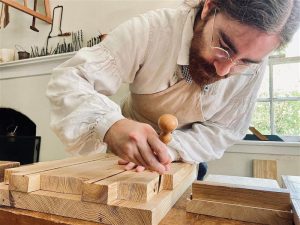
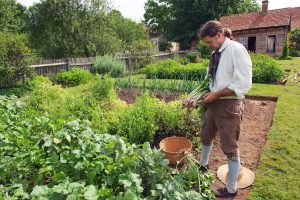
Visitors to Winston-Salem (as the city has been known since the merger of the towns in 1913) will discover the historic village of Old Salem wonderfully intact and buzzing with activity. Craftspersons and historic interpreters in period dress stroll the brick and stone sidewalks, tend heirloom gardens, and ply their trades—weaving, baking, leather tanning—in many of the nearly 100 restored structures on the 100-acre site. To delve more deeply into Revolutionary-era Salem—and hear the stories of how the Moravians responded to the war—visits to three of its oldest structures are a must. Begin at the Single Brothers’ House. Constructed in 1769 to provide housing for unmarried Moravian men, it also served as the community’s trade school and today showcases demonstrations of the skills learned there. A couple of blocks south stands the tavern, which has been transformed into a museum that tells the story of the town’s connections to the larger world, as well as the visit of President George Washington, who stayed here during his 1791 tour of the Southern states. Just up the street, the Miksch House affords a glimpse of domestic life in this family home built in 1771.
While visiting Old Salem Museums & Gardens, stop in at MESDA, the Museum of Early Southern Decorative Arts, to view a varied collection of artifacts—from household items to artworks—that further illuminate the experience of the Revolution. For a still deeper dive, book a vault tour of the Moravian Archives, which houses a wealth of period books, maps, letters, and manuscripts, as well as a first edition of “The Star-Spangled Banner.”

Courtesy Visit Winston-Salem
A short drive north of Old Salem lies Bethabara, the Moravians’ original settlement in North Carolina. Established in 1753, it had become a thriving community before the church established a new civic and administrative center in Salem. By the time of the Revolution, it had become a relatively sleepy village, and today little remains of the town. However, guided tours of the archaeological ruins and presentations by interpreters speak to Bethabara’s wartime role as a hub of military activity, a place soldiers on both sides of the conflict sought food and shelter, particularly after the 1780 Battle of Kings Mountain, a Patriot victory that served as a turning point of the war in the Southern colonies.
Courtesy Visit Winston-Salem
As a community dedicated to religious freedom, Salem’s contribution to this core American tenet is obvious. However, the Moravians also demonstrated a very real commitment to the pursuit of happiness, as the church’s unofficial motto makes clear: “In essentials, unity; in nonessentials, liberty; in all things, love.”
Salem’s gifts to a young nation were also specific and concrete. The town welcomed America’s first educational institution for women, Salem College, in 1772, and witnessed the composition of the nation’s first classical score in 1789. But perhaps most notably, in 1783 (two months before the signing of the Treaty of Paris, which ended the war and established the new country) Salem hosted the first documented Fourth of July celebration in America—which is reenacted in grand fashion annually on Salem Square. –Kevin Benefield
Foreign Capital, Indispensable Ally
The port city of New Orleans was vital to America’s founding—even if it wasn’t technically American
At the time of the American Revolution, New Orleans was governed by Spain, having been ceded by the French in the aftermath of the French and Indian War. (Echoing its centuries-long feud with England, France gave the territory to Spain rather than deliver it to the British.) With its well-planned city center, thanks to its French founding in 1718, New Orleans was a multiracial, multiethnic metropolis, bustling with 4,000 residents, making it larger than many cities in the British colonies.
As the Revolutionary War was fought, New Orleans supported the 13 rebelling colonies, both as an ally of France—and, by extension, Spain—and as a source of supplies. In early 1777, for example, munitions were shipped to New Orleans from Spain and then smuggled northward to aid the Revolution, while gunpowder was brought in from Mexico. Notable fighters included members of New Orleans’s free Black militia, which sent troops to support the American cause. Their numbers included Noel Carriere—born into slavery in New Orleans in 1745—who was decorated as a war hero for his post as a commander in the militia and his role in battles fought by Spain in support of the rebelling colonies.
Courtesy New Orleans & Co.
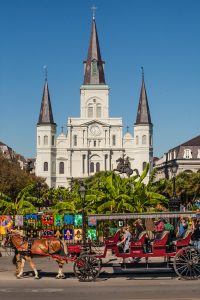
When visiting New Orleans during this semiquincentennial year, a must-stop is the immersive exhibition American Revolution, which will be at the Historic New Orleans Collection through January 2027. Created by the French firm Histovery, the interactive exhibit covers key events of the nation’s founding and also includes local history, including the campaign of Spanish governor Bernardo de Gálvez, who led volunteer forces comprising Indigenous peoples, Acadians, and the free Black militia and captured four British forts, in Baton Rouge, Natchez, Mobile, and Pensacola. Dive deeper into the governor’s story with Gálvez and Louisiana in the American Revolution at the Cabildo, part of Louisiana State Museums, which uses personal accounts, artifacts, and stories to chronicle the diverse forces from New Orleans that aided in the Revolution. You’ll also get a sense of the city’s time as Nueva Orleans, during your visit to the historic structure on Jackson Square. The Cabildo served as the seat of Spanish government and was the place where the Louisiana Purchase was signed in 1803, making Louisiana part of the United States.

Courtesy Historic New Orleans Collection
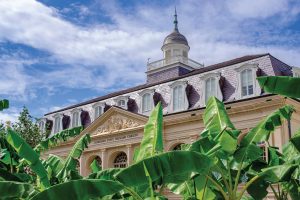
To live and breathe history outside a museum’s walls, there is no better opportunity than strolling the streets of historic New Orleans. The 66-block grid of streets and squares along the Mississippi River was engineered by the French, who established La Nouvelle-Orleans in 1718. (The city’s history as a European colony pre-dates some of the original 13 colonies.) Its planned streets and squares can still be followed. Step into buildings such as St. Louis Cathedral, originally erected in 1724, and look at its murals and collection of religious art, or sip a cocktail at Lafitte’s Blacksmith Shop Bar, which occupies a 1770s building purported to have belonged to the swashbuckling blockade runner Jean Lafitte.

Courtesy New Orleans & Co.
New Orleans history traces the watery paths and passes from Lake Pontchartrain to its harbor on the Mississippi. Walking the waterfront today is an excellent way to absorb the city’s influence in the life of our country, and Goldring Woldenberg Riverfront Park, which opened this spring, offers acres of greenspace and trails along the river still traveled by ships from around the world. After all, it’s the city’s role as an international port, an entry point for peoples and ideas, as well as goods, that contributed to its ethnic diversity and cultural richness—and it’s those treasures that represent perhaps the city’s greatest legacy to a young nation. –Rebecca Burns
This article appears in the Summer 2026 issue of Southbound.