A smartphone, a tasty beer, and a drum concert by a musician with a prosthetic arm: All brought to you by . . . science. To explain the how and why of these phenomena and many others—and to demonstrate how science connects to everyday life—Atlanta Science Festival was launched last year. It culminated with a free daylong expo attended by 16,000. The next fest is scheduled for spring 2015.
Give them a chance and kids love opera. Really. Capitol City Opera stages performances for as many as 20,000 students at dozens of schools every year. The shows include tyke-friendly entertainment such as Hansel and Gretel and Green Eggs and Ham. Woven amid the songs and colorful costumes are lessons about self-acceptance, responsibility, and history.
Students who want to join Kinnis Gosha’s computing lab at Morehouse College can’t just work on their own projects; they must agree to be ambassadors for science and technology on campus and in the community. The Culturally Relevant Computing Lab is believed to be the only facility of its kind that exclusively targets black male undergraduates.
You don’t need to be a Rockefeller to fund the arts. Founded by photographer Neda Abghari in 2011, the Creatives Project underwrites emerging artists and provides children with arts enrichment missing from schools. TCP gives artists two-year fellowships culminating with exhibitions. In exchange, the artists participate in community education projects, such as helping students at Perkerson Elementary School design and paint a mural or Old Fourth Ward youngsters document their community through photos and video.
Fear is what Aylin Aeshaea most remembers about her early childhood in Baghdad. She was afraid to leave her house except to go to school—and even school wasn’t safe from bombs and gunfire.
Today school is the joyous center of Aylin’s life because she is a Fugee. “It’s different from other schools; it’s fun,” says Aylin, fourteen, of the Fugees Academy in Clarkston, where she improves her English, struggles with math, plays soccer, and blends with refugee children from around the world. Like Aylin, many of her classmates fled war-torn countries and lived in refugee camps before coming to America. Fugees Academy provides a transition between their old lives there and their new ones here.
The academy’s origins are rooted in happenstance. A decade ago, Luma Mufleh got lost while driving through Clarkston and came upon a group of barefoot refugee kids playing soccer on an empty asphalt lot, with rocks as goal posts. Mufleh decided to organize a soccer program with better equipment and grassy fields for practice. But soccer became more than a game for the Jordanian-born Mufleh and her players. They formed a team, the Fugees (short for “refugees”), that became a bridge across cultures—a safe place for the kids to heal, grow up, and adapt to American life.
Mufleh offered tutoring and helped her players keep up with their schoolwork. Then one day she realized one player, a sixth-grader who had been making mostly Bs in public school for four years, couldn’t read. In 2007, she pulled six students together and hired a teacher.
The next year, she doubled the number of students. Then doubled it again. Meanwhile, the Fugees attracted national attention. New York Times reporter Warren St. John chronicled a season as these plucky players and their dedicated coach struggled to find a practice field in Clarkston. His front-page story and subsequent book made Mufleh and her team a cause celebre, prompting television interviews, an option for movie rights, and a stream of donations.
It would have been easy to stick with soccer and to coach the team to championships. But instead, Mufleh expanded the scholastic portion of her program, using the media attention to grow the Fugees Academy to educate both boys and girls in grades six through twelve. Today the academy enrolls about 100 students from more than twenty countries. Soccer remains central; a soccer tryout is part of the admissions process. That said, natural athletic ability isn’t important, insists Mufleh. But perseverance is. Twenty-one former students are in college, and three are college graduates. The school is accredited by the Southern Association of Colleges and Schools and the Southern Association of Independent Schools.
“Being refugees, at times, can be very isolating,” Mufleh says. “Finding a group of kids who has your back at all times is a good way to create an educational model.”
Even with dozens of volunteers, it costs about $14,000 per student to cover schooling, meals, soccer uniforms, summer academic camp, and other expenses. There is no tuition; the cost is covered through donations. Mufleh has obtained property and plans to build a campus in Clarkston. For now, however, the school meets in a cramped space at the Clarkston United Methodist Church and plays soccer at Armistead Field.
Like many refugee children, Aylin had fallen behind in her schoolwork. At the Fugees Academy, with classes of about fourteen students, she is slowly catching up. “Our coach, Luma, she tells us to not give up, to keep trying it,” Aylin says. “She’s the best.”
With girls under siege in many countries, it’s not surprising that some refugee girls come to America with gaps in learning—and limited literacy even in their own languages. The Global Village Project in Decatur addresses the problem one girl at a time, with an intensive middle school program for refugees who were denied schooling or whose education was interrupted by violence. This fall, Global Village will enroll thirty-eight girls, tuition-free, and mentor about forty others in high school or other programs. Seven grads are now in college.
As riders roll into the Midtown MARTA station, they can check an app for real-time updates on connections. OneBusAway—which tracks trains, buses, and Tech shuttles—is one of several apps developed through Midtown Buzz, a partnership between the university and the Midtown Alliance business association. The goal of Buzz is to engage residents, businesses, and students in developing community-focused smartphone apps. CycleAtlanta, another Buzz app, records bicycle trips and enables cyclists to share street conditions with city planners.
“We want people who are in Midtown to talk about the things they need,” says Shannon Powell, executive vice president and chief operating officer of the Midtown Alliance. “All of this is centered around how do we leverage Georgia Tech as a world-class university and connect the community back to them?”
Laurie Dean Baird, managing director of Midtown Buzz and executive in residence for media and entertainment for Tech’s Institute for People and Technology, says teams host workshops to showcase tools and help participants develop and find resources for grants. One idea being discussed is a “mobile beacon” that provides information on landmarks. You might, for instance, get an alert with an interesting fact about the Margaret Mitchell House as you walk past the structure at the corner of Tenth and Peachtree.
“This is an evolution,” says Baird. “It can be a bigger story than Midtown. But Midtown is our home, and we really wanted to experiment with what it means to be in a city that’s connected.”
When you’re changing or rocking hat newborn, it’s key to be chatty too. Talk with Me Baby, an initiative compromised of several local agencies and lets by the Marcus Autism Center, trains nurses to encourage new moms and moms-to-be to speak to their babies. Talking helps babies develop language skills and gets them on the road to reading. (See related project at the Rollins Center) The program, which received a $1.5 million grant from the United Way, initially targets at-risk parents.
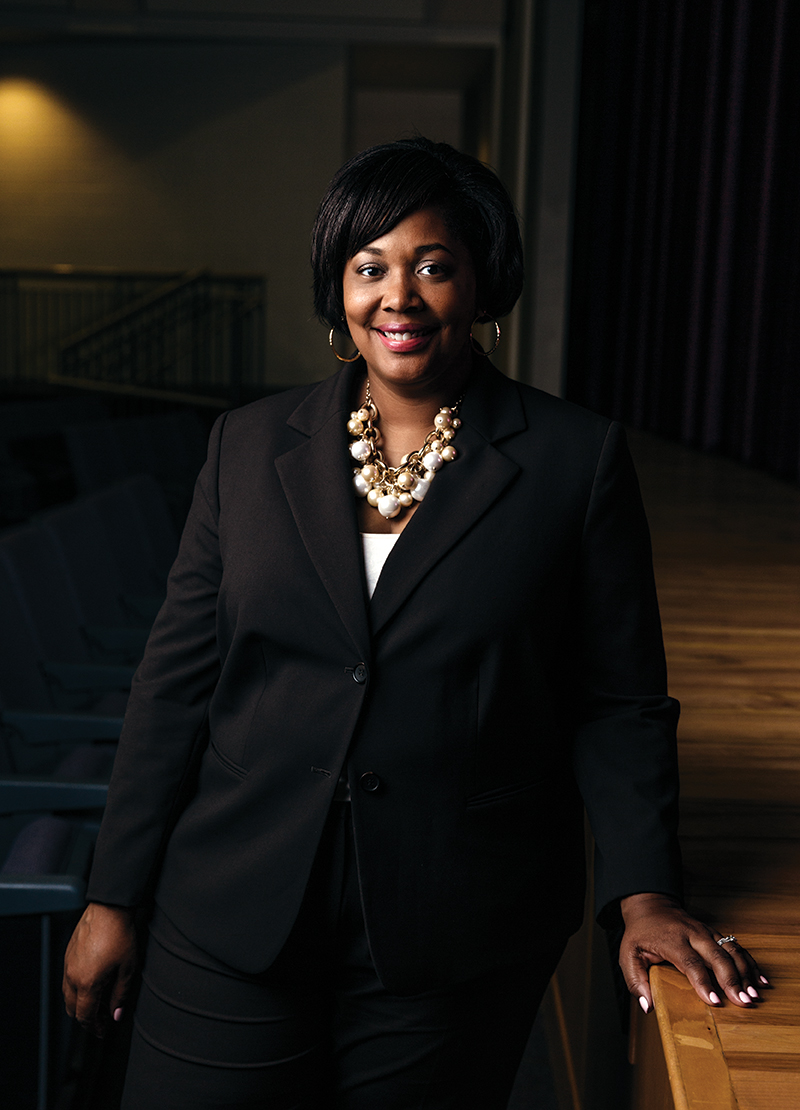
When she became principal, Termerion McCrary Lakes focused on all the things that her new school had: athletic programs, a team in the International Science Fair, a JROTC program, and a school-wide focus on STEM—science, technology, engineering, and math—coursework.
But at the end of her first year helming the Coretta Scott King Young Women’s Leadership Academy’s high school, Lakes realized that what mattered most was something the school did not have: boys. “We remove the idea that ‘my behavior has to be dictated by the presence of a boy,’” she says. “What we see is an increase in calculated risk taking. We see confidence to speak up.”
When boys are absent, “we see confidence to speak up,” says Principal Termerion McCrary Lakes
Photograph by Ben Rollins
The school—awkwardly shortened to CSKYWLA and pronounced “cee-skee-wah-la”—was founded in 2007 as the only all-girls unit of Atlanta Public Schools. What began as a small middle school in a temporary facility has expanded to a full grade-six-through-twelve program on a dedicated campus. The first seniors graduated from CSKYWLA this past spring, and every single one was accepted to college; 2014 valedictorian Jamaya Powell will be attending Syracuse University this fall with a full scholarship.
The school’s attendance zone draws primarily from 30318, a zip code with some of the highest crime and poverty rates in the city of Atlanta. One hundred percent of its students qualify for free or reduced lunch, and 98 percent are black. “For these girls, we are a light in the community,” says Lakes. “We are a place that is trying really hard to get it right for them.”
Lakes, an APS grad herself and former principal of South Atlanta School of Health and Medical Science, took over CSKYWLA in 2011. Coming from a coed school, Lakes was surprised by the girls’ eagerness and willingness to try in the classroom, particularly in math and science.
“Driving around this neighborhood, you see dilapidated structures, check-cashing establishments, and liquor stores,” says Lakes. “You don’t realize something amazing is happening. We are training future scientists, or as we call them, STEMinists.”
All 290 students are enrolled in a STEM pathway, choosing between emphases in biotechnology, research, and development; energy systems; and web and digital design. CSKYWLA students conduct research at Georgia Tech, place at the state science fair, and break stereotypes about women of color in the sciences.
All classes—from math to English—are based around discussion and debate because girls are, as Lakes puts it, “definitely, absolutely social creatures.”
Outside the classroom, the all-girl community helps to tear down barriers between students, teachers, and administrators. “We are just here to love on these girls,” says Lakes. “One of the things that is critical to a girl’s self-confidence is feeling like you see me, like I matter.” For example, CSKYWLA changed the phone message that goes home when a student is absent by adding, “I miss you. We miss you when you aren’t here.” And the teachers make sure someone seeks students out when they return to school to acknowledge that they are back. These small efforts are bolstered by the big endeavors the school undertakes, like the parent center: a place where volunteer “moms” make sure girls are prepared for the day ahead, providing practical support such as a washer and dryer, a closet full of toiletries, and even a shower.
“We do have kids that are homeless or other situations where they can’t come to school as prepared as other students,” says Lakes. “We remove barriers that prevent those girls from being successful at school. [The volunteers] help them get ready for the day, then they go on to class and no one has to know.
“For some of these girls, the school has to become the family. The school is a larger share of the support system than for others.”
Lakes knows not all students are going to win science fairs. “You start where the kid is, and you go from there,” she says. “If you came here and you were belligerent, and you didn’t want to try—give us a month. You’ll be wanting a hug; you’ll be smiling. That might not be a math score, but that’s something. I hope the legacy of this place is that we loved girls. We literally loved these girls.”
As unemployment surged during the Great Recession, Marietta-based MUST Ministries responded with nuts-and-bolts job training. MUST is the only nonprofit of its type to have alliances with OSHA and the National Safety Council for certification for specialized jobs like forklift operation. Through a partnership with the UGA Extension, MUST provides ServSafe food handling certification; restaurants are required to have at least one ServSafe-
certified staffer on every shift. When some grads still didn’t land jobs, MUST uncovered a practical concern: Workplaces require safety shoes that can cost $70 and up, cash someone who’s unemployed won’t have. So MUST removed that hurdle, too, with mobile visits from uniform supplier Cintas. After MUST began to supply footwear—steel-toed or composite for OSHA, nonskid for ServSafe—placement increased from around 60 percent to 77 percent.