Home 2014

Archives

Savannah: The downtown renaissance that SCAD built

Savannah boasts a rich conglomeration of talented, tattoo-bedecked art students; driven professionals; and the good ol’ boys (and girls) whose families have been around since General Oglethorpe settled here in the 1730s. Now vibrant and energetic, the Hostess City had become sleepy and rundown by 1978, when Savannah College of Art and Design was founded. The art school sparked a resurgence in downtown Savannah, repurposing both mansions and abandoned strip malls into academic halls and dorms. Now many of the local businesses downtown tie their success back to SCAD.

In Savannah, you can window-shop under a delicate canopy of Spanish moss between classes, or get your reading done before a pickup soccer game at Forsyth Park. Every fall, rub elbows with the city’s elite and national celebrities at SCAD’s Savannah Film Festival while you grab a to-go cup for your mint julep. Or check out Tybee Island, a beach town freckled with sea salt–coated, wind-worn cottages—it’s only a twenty-five-minute drive from downtown. ­

Coffee shop for studying
Gallery Espresso
Decorated with well-worn armchairs and big wooden tables, the cafe is adjacent to Chippewa Square (where Forrest Gump was shot) and is an ideal place to work solo or tackle a group project. 234 Bull Street, 912-233-5348

Coffee shop for coffee
Foxy Loxy
Find quality coffee, comfy couches, and half-price wine bottles and s’mores around the fire pit on Saturday nights. Also: kolaches. 1919 Bull Street, 912-401-0543

Brunch
B. Matthew’s Eatery
It can be a destination for both fancy spring brunch or just some post-partying scrambled eggs and bacon. 325 East Bay Street, 912-233-1319

Dinner—when your parents pay
The Olde Pink House
Tucked next to the historic Planters Inn, this is a local special-occasion favorite and a draw for out-of-towners. 23 Abercorn Street, 912-232-4286

Dinner—when you’re paying
Moon River Brewing Company
The name Moon River may remind you of Savannah native Johnny Mercer’s beloved Breakfast at Tiffany’s theme, but owners Eugene Beeco and John Pinkerton based the name on fire and water elements. Regardless, it has great food—and it’s the only bar in town that brews its own beer. 21 West Bay Street, 912-447-0943

Campus dive bar
Pinkie Master’s Lounge
Nothing good ever happens after 2 a.m. Unless you somehow end up at Pinkie Master’s—then you know it’s been a great night. 318 Drayton Street, 912-238-0447

Savannah must-do
Sixth Sense Savannah Ghost Tours
Savannah’s considered to be one of the most haunted cities in America. Take the late-night tour to find out why. 404 Abercorn Street, 912-292-0960

Essential place to take friends when they come to visit
The Lucas Theatre and Leopold’s Ice Cream
Catch an old movie at the posh and painstakingly restored Lucas, then pop around the corner for a cone of homemade rum bisque or butter pecan. 32 Abercorn Street, 912-525-5040; 212 East Broughton Street, 912-234-4442

Milledgeville: Hang out on Georgia College’s front yard

Truth is, most of downtown Milledgeville is on a few blocks off the main drag, West Hancock Street. There are the antebellum houses straight out of a Flannery O’Connor story, the grass carpet rolled out as Georgia College’s front lawn, the bars and restaurants lining the street, and the Gothic Revival spires of Georgia Military College in the distance. That’s about it, though. The town winks out a few miles off West Hancock in any direction.

The city’s charm isn’t really found in what’s there, but in what people do with it. Students use Georgia College’s front campus like their front yard, throwing Frisbees, studying in hammocks, lounging in the sun between classes with picnics, books, or laptops. The downtown bars and restaurants host pairings of students and professors at lunchtime, crowds of thirsty late-night patrons, and the swarms of visitors who pour onto the street when open-container laws are suspended during the annual music festival, Deep Roots (conveniently scheduled on Georgia College’s Family Day). And, as many seniors who came with plans to transfer after a semester or two could tell you, those stately houses with their wide front porches looking out over West Hancock become homes for far longer.

Where to find the best …

Coffee shop for studying
Starbucks at U.S. 441 and Roberson Mill Road
It may not be unique, but the store is far enough away from campus that you won’t be distracted by classmates wandering in. 2400 North Columbia Street, 478-454-4040

Coffee shop for coffee
Blackbird Coffee
With beans roasted in-house, this is where you go for coffee as craft rather than access to Wi-Fi. 114 West Hancock Street, 478-454-2473

Brunch
The Local Yolkal Cafe
It’s hard to compete with a place that serves multiple eggs Benedict variations and a bacon cheeseburger omelet. 117 West Hancock Street, 478-295-0098

Burger
Buffington’s Burger Lounge
The burger runs $6.99 for a half-pounder with fries, fried pickles, or chips. Quality, quantity, and cheap price? Can’t beat it. 120 West Hancock Street, 478-414-1975

Campus dive bar
Amici Italian Cafe
Live music, regular Thursday night crowd, and the home of the Dead Turtle shot (secret ingredient: pickle juice). 101 West Hancock Street, 478-452-5003

Essential place to show friends
The remains of Central State Hospital
Take the country’s largest mental health institution, close it down, let the buildings decay, add a carful of students on a night tour, and you’ve got a spooky experience no one is likely to forget. 620 Broad Street

This article originally appeared in our March 2014 issue.

Take a fresh look at Macon

0

To outsiders, Macon can seem like one of those cities glimpsed from the highway on the way from Atlanta down to Florida. Maybe you know an attorney who went to Mercer Law School but hasn’t been back to Macon in years because it’s “too small,” or a die-hard Allman Brothers fan who makes pilgrimages to the band’s home city. But Macon deserves to be viewed with fresh eyes; recently, the city has seen a rebirth due to local grants and the hard work of students and community organizers. Mercer University professors are buying and rehabbing historic homes, motivated by a down-payment forgiveness plan offered by the school. Students are opting for the sleek downtown lofts that were, until just a few years ago, empty cotton warehouses. The Old South Junior League and the Sons of Confederate Veterans rub elbows with New South students studying social entrepreneurship and environmental engineering.

Where to find the best …

Coffee shop for studying
Roasted Cafe and Lounge
“It’s not too quiet that it’s uncomfortable, and it’s not too loud that you can’t focus. Lots of locals are in and out. It’s a nice break from campus life,” says Mercer journalism major Laura Corley. 442 Second Street, 478-746-6914

Coffee shop for coffee
Taste and See Coffee Shop and Gallery
This recently opened spot has been a big hit thanks to all the natural syrups and sauces that gussy up the coffee offerings. 546 Poplar Street, 478-238-5191

Brunch
Dovetail
Students may not be able to regularly shell out for Dovetail’s Sunday brunch, but their parents and professors sure do, seeking specials like wild-caught Georgia shrimp. 543 Cherry Street, 478-238-4693

Dinner—when your parents pay
The Rookery
Mercer junior Emily Farlow says, “The Rookery’s not too expensive, so you don’t feel guilty bringing your parents there, but it’s more than a college kid would usually go for. The hamburgers are famously delicious and the atmosphere is cool.” 543 Cherry Street, 478-746-8658

Dinner—when you’re paying
Margaritas at Mercer Village
Students love the specials and (free!) chips and salsa. 1602 Montpelier Avenue, 478-254-7707

Campus dive bar
Grant’s Lounge
Billed as “the Original Home of Southern Rock” and host to some serious notables before they were notable, like the Allman Brothers and Tom Petty. 576 Poplar Street, 478-746-9191

Live music
The Hummingbird Stage and Taproom
Says Molly McWilliams Wilkins, a Mercer graduate student, “Many times you can find newer acts, such as Swear and Shake.” 430 Cherry Street, 478-741-9130

Place to show out-of-towners
Rose Hill Cemetery
“It’s one of the prettiest places in Macon,” says Emily Farlow. “There is so much history, and famous people such as the Allman Brothers are buried there. There is also a Confederate soldiers section and a Jewish section. It’s all so interesting—and pretty.” 1071 Riverside Drive, 478-751-9119

This article originally appeared in our March 2014 issue.

Taking the next step: Georgia’s largest medical, law, and MBA programs

Medical Schools 

Emory University School of Medicine
In 2012 more than 6,600 people applied for 138 first-year positions at Emory, which trains residents and fellows in ninety-four programs. Some MD/PhD students are in a joint program with Georgia Tech, with which Emory shares a biomedical engineering department ranked second in the country by U.S. News. In addition to future MDs, more than 500 students are enrolled in allied health programs. med.emory.edu
Enrollment 531
Tuition $24,350/semester
Average undergrad GPA 3.7 Popular residency and specialty programs emergency medicine, general surgery, internal medicine, obstetrics and gynecology, pediatrics

Georgia Campus: Philadelphia College of Osteopathic Medicine
More than a thousand students are enrolled in this branch campus of the fully accredited Philadelphia College of Osteopathic Medicine, an institution with more than 100 years of tradition. GA-PCOM offers doctor of osteopathic medicine and doctor of pharmacy degrees and several graduate programs. pcom.edu
Enrollment 1,067
Tuition $43,621/year (doctor of osteopathic medicine); $33,181 (doctor of pharmacy); $755–$802/credit hour (master’s programs)
Average undergrad GPA 3.33 (osteopathic medicine); 3.08 (pharmacy)

Medical College of Georgia at Georgia Regents
Based in Augusta, the state’s public medical school has campuses and branches throughout the state and a second four-year campus in Athens. Until 2013 the Medical College of Georgia was not part of a university with a general undergraduate program, but as of January 2013, it is part of Georgia Regents University, a comprehensive research university. gru.edu/mcg
Enrollment 902
Tuition $33,868/year Georgia resident; $55,098/year for nonresident
Average undergrad GPA 3.7
Popular residency and specialty programs emergency medicine, orthopedics, internal medicine, pediatrics

Mercer University School of Medicine
This school was established in 1982 to educate professionals to meet the healthcare needs of underserved areas of Georgia. More than 60 percent of graduates currently practice in-state, most in rural or underserved areas. Mercer opened a four-year Savannah campus in 2008 and in 2012 began offering clinical education for third- and fourth-year medical students in Columbus. The school has several master’s programs and a PhD in clinical medical psychology. mercer.edu
Enrollment 416
Tuition $41,457/year
Average undergrad GPA 3.57

Morehouse School of Medicine
Founded in 1975 in Atlanta as a two-year program at Morehouse College, the Morehouse school has clinical training affiliations with several established medical schools. In 1981 MSM became an independently chartered institution and the first medical school established at a historically black college and university in the twentieth century. msm.edu
Enrollment 376
Tuition $42,250/year (tuition), $7,402 (fees)
Average undergrad GPA 3.49
Popular specialty program pediatrics

Law Schools 

Atlanta’s John Marshall Law School
Founded in 1933, Atlanta’s John Marshall Law School (AJMLS) is the city’s only stand-alone law school. AJMLS academic programs include a JD program, a JD honors program in criminal justice, an accelerated JD program, and three LLM programs for U.S. and foreign-educated attorneys. johnmarshall.edu
Enrollment 556
Tuition $37,350/year
Average undergrad GPA 2.98 (median)

Emory University School of Law
Emory Law is perennially ranked among the country’s best by U.S. News. The school offers signature programs in litigation as well as transactional, international, and patent law. law.emory.edu
Enrollment 934
Tuition $47,500/year
Average undergraduate GPA 3.75 (median)

Georgia State University College of Law
GSU’s College of Law in downtown Atlanta has provided legal education to full- and part-time students since 1982. The college offers a flexible curriculum and experience-based learning clinics, including the Philip C. Cook Low-Income Taxpayer Clinic, the Investor Advocacy Clinic, and the Health Law Partnership (HeLP) Clinic, which is part of the nation’s number three health law program. law.gsu.edu
Enrollment 661
Tuition $16,042/year Georgia resident; $34,834/year nonresident
Average undergrad GPA 3.38

Mercer University School of Law
Founded in 1873, Mercer’s Walter F. George School of Law is one of the oldest U.S. law schools and the first in the state of Georgia accredited by the American Bar Association. Mercer also offers an LLM in federal criminal practice and procedure, the only program in the nation designed for law school graduates seeking to prepare themselves for federal criminal practice. law.mercer.edu
Enrollment 447 JD students
Tuition $37,260/year
Average undergraduate GPA 3.38 (median)

University of Georgia School of Law
Established in 1859, UGA Law offers two degrees—the JD and LLM in U.S. law—and is home to the Dean Rusk Center for International Law and Policy. UGA counts six U.S. Supreme Court judicial clerks in the last nine years among its alumni of more than 9,700. law.uga.edu 
Enrollment
621
Tuition $16,506/year Georgia resident; $34,176/year nonresident; $2,234 mandatory fees. It’s possible for nonresidents to pay resident rate by the second year of law school.
Average undergrad GPA 3.7 (median)

MBA Programs 

Emory University Goizueta Business School
Consistently ranked among the nation’s top business schools, Goizueta offers an undergraduate BBA program, two-year MBA, one-year MBA, evening MBA, executive weekend MBA, executive modular MBA, PhD, and a portfolio of nondegree executive programs. goizueta.emory.edu
Enrollment 756
Tuition $69,000 (one-year); $92,000 (two-year); $70,200 (evening); $105,000–$110,000 (executive)
Average undergrad GPA 3.3

Georgia Institute of Technology Scheller College of Business
Located in Technology Square in Midtown, Scheller is a nationally ranked school offering degrees to approximately 2,000 undergraduate, MBA, and doctoral students. The college also offers a wide range of custom programs, workshops, and certificate programs for executives and professionals. scheller.gatech.edu
Enrollment 141 full-time; 376 evening
Tuition and fees $57,716 Georgia resident; $79,428 nonresident; $64,062 Georgia resident, evening
Average undergrad GPA
3.3 full-time; 3.2 evening

Georgia State University J. Mack Robinson College of Business
The largest business school in the South, Robinson offers three MBA programs: a part-time MBA in flexible and cohort formats, a dual-degree global MBA, and an executive MBA. robinson.gsu.edu
Enrollment 113 (executive MBA); 39 (global MBA); 753 (part-time MBA)
Tuition $68,000 (17-month executive program); $72,000 (14-month global MBA program); $48,000 (24-month part-time MBA program); $449/credit hour plus fees (flexible format part-time MBA program)
Average undergraduate GPA 3.18

Kennesaw State University Coles College of Business
Coles is ranked number two in Georgia by Bloomberg Businessweek for its part-time MBA programs. The school’s part-time flexible program is available on the Kennesaw campus and at the Cobb Galleria Centre. coles.kennesaw.edu
Enrollment 198
Tuition $313/credit hour Georgia resident; $1,130/hour nonresident
Average undergrad GPA 3.2

This article originally appeared in our March 2014 issue.

Athens comes alive when school’s in session

In 1801 Daniel Easley sold the 633 acres of wilderness that eventually would become the University of Georgia to John Milledge for $4,000. In the years that followed, the city of Athens sprung up on chunks of the land that were sold off by university trustees to finance academic buildings. Athens evolved into a center of textile manufacturing, and wealthy plantation owners and aristocrats flocked to the city to educate their offspring and enjoy the culture and society encouraged by the university.

Now, just as then, Athens is a product of the unique symbiosis between town and college. It sits at the intersection of its own history and the vibrant indie-rock grittiness that gives the modern city much of its flavor. It’s a place that values its individuality but breathes in and out with the seasons of the university; Athens certainly isn’t dead during semester breaks and holidays, but it feels empty and expectant, as if waiting for students to return. And when they do come back, and downtown fills with hipsters in flannel and sorority girls in improbably high heels, the Classic City feels most alive.

Where to find the best…

Coffee shop for studying
Two Story Coffeehouse
The first floor of this converted two-story home in Five Points is perfect for those who like to study amid the warm buzz of conversation and coffee grinders. But serious academics head upstairs: Vintage desks, floor pillows, and a whiteboard turn the space into a haven for last-minute test prep. 1680 South Lumpkin Street, 706-850-5422

Coffee shop for coffee
Hendershot’s
Mismatched furniture, exposed brick, and tabletops crafted out of reclaimed wooden doors are all part of an atmosphere that invites you to curl up with a steaming latte and a novel—or linger to listen to live music. 237 Prince Avenue, 706-353-3050

Brunch
Mama’s Boy Restaurant
In addition to a down-home atmosphere—orange juice served in canning jars, chandeliers made of recycled bottles—Mama’s Boy serves the best biscuits in Athens and has a following of breakfast devotees to prove it. 197 Oak Street, 706-548-6249

Place to go for dinner when your parents are paying
Last Resort Grill
Linen-draped tables and a quietly sophisticated menu filled with progressive twists on Southern favorites—salmon and grits, anyone?—made with seasonal and local food make this former music venue a favorite for celebrations and dinners when Mom and Dad are in town. 174–184 West Clayton Street, 706-549-0810

Dinner—when you’re paying
The Grit
An Athens staple with good reason. The Grit’s inexpensive vegetarian fare and decadent (but mostly vegan!) desserts served in charmingly quirky dining rooms convert even the most die-hard carnivore. Plus, heaping portions mean dinner usually provides enough leftovers for tomorrow’s lunch. 199 Prince Avenue, 706-543-6592

Essential place to take out-of-town friends
The 40 Watt Club
The legendary home base for many of Athens’s most famous acts—including Pylon, R.E.M., the B-52s, and Neutral Milk Hotel. 285 West Washington Street, 706-549-7871

This article originally appeared in our March 2014 issue.

Atlanta as a college town?

When you think of metro Atlanta, many things may come to mind. Capital of the New South, for example. Or worst place to be a Pepsi fan. “College town” probably isn’t on your list. But the area’s 6 million residents include more than 250,000 college students, according to the Atlanta Regional Council for Higher Education. Each year this quarter-million-strong cohort studies at one of the metro area’s fifty-seven colleges and universities.

And while Atlanta is hardly a typical college town, its borders contain a wealth of student experiences. From the refurbished dot-com building that houses SCAD Atlanta to the picturesque quad of Agnes Scott, you can find any college vibe imaginable.

We’re both students at Atlanta-area schools, and drew on our experiences here—as well as input from dozens of fellow scholars—to take you on a tour of the city’s neighborhoods.

Downtown
Georgia State University, a leading urban research school, sits in the heart of Downtown among some of the city’s most influential companies, like CNN and Georgia-Pacific. Life outside the business world is returning to the city’s heart after a pretty long hiatus, and it’s great news. Some of that rebirth is thanks to obvious additions—the murals commissioned by Living Walls and Atlanta’s Office of Cultural Affairs, the 200-foot Ferris wheel—but just as important is the energy from the growing number of residents at GSU’s new dorms and the apartment buildings designed with students in mind. The Fairlie-Poplar district is home to GSU’s Rialto Center and the Tabernacle, a former historic church that hosts some of the city’s best concerts. A quick jaunt up Edgewood Avenue (it should be even quicker when the Atlanta Streetcar debuts this summer) takes you to Sweet Auburn, which encompasses the Martin Luther King Jr. historic district, and the Old Fourth Ward, which houses some of Atlanta’s coolest bars, like Church (formal name: Sister Louisa’s Church of the Living Room & Ping Pong Emporium), Mother, Noni’s, and Pizzeria Vesuvius with its hidden speakeasy.

Midtown
As the home of Georgia Institute of Technology, SCAD Atlanta, and the most cosmopolitan lifestyle in the city, Midtown is a place you should be familiar with no matter where you go to school. In the shadow of skinny skyscrapers, Piedmont Park is one of the best places to people (or dog) watch, and it is connected to the Atlanta BeltLine’s Eastside Trail, a great place to walk, jog, or bike that runs from Midtown to the Old Fourth Ward. Midtown’s nightlife offers a more sophisticated (read: adult, affluent) crowd than other neighborhoods. Flip Flops (the Ping-Pong table draws everyone), Rí Rá Irish Pub, and Frogs Cantina are a few college student favorites.

The Downtown Connector (that huge expressway that divides Atlanta in two) separates Midtown proper from the area referred to variously as West Midtown, Midtown West, or simply “the Westside.” This is where most of the Georgia Tech campus is located, and it’s just north of the Atlanta University Center. A budget-friendly favorite is Antico Pizza Napoletana, highly rated by Atlanta magazine’s critics. (We suspect its student popularity has at least something to do with the BYOB/no corkage fee policy.) Atlantic Station, a big shopping/business/residential complex, has a little bit of everything, notably H&M, a massive movie theater, Chick-a-Biddy, and BGR the Burger Joint, a fairly cheap place to grab lunch. You’ll find a Target close to an Ikea—important to know come move-in day. Not far away is the Westside Provisions District, Atlanta’s former meatpacking area, now home to dining options like Taqueria del Sol and Jeni’s Splendid Ice Creams as well as funky Free People, J.Crew, and Anthropologie stores.

Atlanta University Center/West End
West End overflows with history and culture in a way only Atlanta could. It is just south of the Atlanta University Center, the largest group of historically black colleges and universities in the country, which includes Clark Atlanta University, Interdenominational Theological Center, Spelman College, Morehouse College, and Morehouse School of Medicine. The area is known for its cultural sites, ranging from the Clark Atlanta University Art Galleries and Spelman College Museum of Fine Art to the Wren’s Nest house museum, the former home of author Joel Chandler Harris.

Emory/Druid Hills
Emory University is tucked away in the historic, mostly residential neighborhood of Druid Hills. Just beyond campus, the Emory Village business district has undergone renovation, bringing the exodus of some longtime favorites. But a few—including Falafel King and Dave’s Cosmic Subs—remain. Nearby, a development called Emory Point offers affordable dining and shopping, including Tex Mex at Tin Lizzy’s and boutique fashions at Fab’rik. A few miles away, Toco Hill shopping center is home to Maggie’s Neighborhood Bar & Grill, beloved by Emory students (and some alums) to the bewilderment of everyone else.

Decatur
The small city of Decatur is a haven for beer lovers, bookworms, and foodies—and home to Agnes Scott College and satellites of colleges such as the Art Institute and DeVry. If you care about beer—or pretend you do—Brick Store Pub is your place. The menu boasts hundreds of brews, and the staff will talk about citrus undertones and piney hops all night. For a meal that’s easy on the wallet but doesn’t taste like it is, check out Raging Burrito or Victory Sandwich Bar, known for the Jack and Coke slushie and also home to the bar Paper Plane. The Yogurt Tap, Dancing Goats Coffee, and Java Monkey are other budget favorites.

Buckhead
If you’re in college and you go to Buckhead during the day, you’re probably shopping at Lenox Square mall. If you’re headed to Buckhead at night, you’re either wearing pastels and Sperrys and headed to East Andrews and its cluster of bars with a post-grad preppy vibe, or glammed out and planning to dance at the Havana Club or Tongue and Groove.

Virginia-Highland
While it doesn’t house a college, this central neighborhood is a destination for students from all over. Yeah! Burger and Yogli Mogli make a great dinner/dessert combo and will cost half as much as an entree at Murphy’s or La Tavola Trattoria (great spots if someone else is buying!). The main drag along North Highland Avenue offers relaxed nightlife: Hand in Hand, Neighbor’s Pub, Atkins Park, and Dark Horse Tavern are favorites of students and young professionals.

Little Five Points
This bohemian enclave is the best place to shop for records or one-of-a-kind looks. Rag-o-Rama consignment shop sells Technicolor dreamcoats and leather studded boots; Cherry Bomb, a little pricier, carries brands like Wildfox and Jeffrey Campbell; and Wish offers sleek urban styles. If you are tasked with creating T-shirts for a fundraiser, go to Bang-On. The Porter Beer Bar stocks 800 brews, Java Lords serves coffee and beer, and Arden’s Garden offers healthy juices. The Vortex, with its skull-shaped entrance, pro-smoking stance, and monster burgers, is a bad-for-you, bad-boy alternative.

This article originally appeared in our March 2014 issue.
Big projects on campus: What’s going up at Georgia’s colleges

It’s a law of nature: Every college is constantly under construction. But from street level, it can be hard to tell whether what’s in the works is supercool (a high-tech lab? a rec center?) or downright dull (another parking garage?). Here’s a tour of some of the more exciting projects underway on Georgia campuses.

Georgia State University
A Campus Green—in the Heart of Downtown Atlanta
Georgia State’s “concrete campus” will become more verdant as GSU demolishes eighty-year-old Kell Hall (the parking garage repurposed decades ago for classrooms) to create a large lawn in the center of campus, part of a green corridor connecting Woodruff Park to the courtyard at the Petit Science Center on Decatur Street. The greenway, which will weave throughout GSU, is one element in the university’s new campus master plan. In his October 2013 state-of-the-university address, GSU president Mark Becker conceded the “significant” shortcomings of the urban layout: “too much density and concrete and not enough green and open space.” The new greenway, he said, will create a better environment in which to work and learn. Plus, it will make GSU’s downtown neighbors happy.

Georgia Institute of Technology
Life Sciences + Engineering = interdisciplinary space 
Students from science, engineering, and computing will join forces later this year in Georgia Tech’s $113 million Engineered BioSystems Building. The 220,000-square-foot biotechnology research center on Tenth Street will provide an interdisciplinary space for students and professors whose work and studies merge life sciences with engineering.

State-of-the-art labs—supporting genomics, proteomics, metabolomics, bioinformatics, and nanomedicine—and research space will expand Tech’s biomedical research capabilities. The school also plans to use the facility to enhance its partnerships with researchers at local institutions, including Emory University Hospital and Children’s Healthcare of Atlanta.

Emory University
A Space to Emphasize Pediatric Research
Opened last year, Emory’s $90 million Health Sciences Research Building on Haygood Drive was paid for entirely by donations.

Research conducted in the 200,000-square-foot, five-story building will include new drug development, cancer, human genetics, biomedical engineering, and vaccines and immunology.

More than half of the space will be dedicated to pediatric work through the Emory-Children’s Pediatric Center, a partnership between the university and Children’s Healthcare of Atlanta.

A two-story bridge connects the research building to the Emory-Children’s Center. The bridge will be home to investigators focusing on informatics, clinical studies, and research on outcomes and public health.

During construction, as well as demolition of the dorm that formerly stood on the site, more than 18,000 tons of waste were recycled. That’s 98 percent of all construction waste generated by the project.

University of Georgia
Creatures Great and Small
UGA’s College of Veterinary Medicine is constructing a $97.7 million Veterinary Medical Learning Center less than three miles from its existing—but very dated—veterinary hospital, which treats more than 20,000 in-house patients each year, ranging from seriously ill family pets to zoo animals and wild critters.

Set to open next year, the 300,000-square-foot center will house an academics building and teaching hospital along with other facilities—including twelve operating rooms, three high-tech surgical suites, a covered arena where clinicians can evaluate horses, and grieving rooms for people who have lost their pets.

The project incorporates energy-saving features and earth-friendly materials. An old barn on the property was taken apart by the UGA Material Reuse Program, and its materials salvaged for projects in the greater Athens area.

Georgia Southern University
Gearing Up to Get Its Game On
Georgia Southern is upping its game as the Eagles move into the Football Bowl Subdivision (FBS) this year and start playing in the Sun Belt Conference. The school broke ground last summer on a $10 million Football Operations Center in the east end zone of existing Allen E. Paulson Stadium. In addition to 6,200 seats, the 50,000-square-foot center will include workout facilities, offices, and a hall of fame.

Although the Football Operations Center is privately funded, students voted to pay a $75 fee to bankroll the move to FBS and a $25 fee for the stadium expansion.

Valdosta State University 
Preparation for Changing Healthcare
Valdosta State’s Health Sciences and Business Administration building will allow the school to expand existing programs and develop new master’s and doctoral degrees in nursing, speech and language pathology, and social work.

 The 140,000-square-foot, $32 million facility will centrally house six programs currently scattered throughout campus. The programs are nursing and health sciences, communication sciences and disorders, athletic training, exercise physiology, social work, and healthcare administration.

The facility will include a cutting-edge simulation center so students can replicate “real patient encounters.” It also will have space for clinical practice and outreach.


Rec Center Rumble 
This year Kennesaw State University and Middle Georgia State College both debut spiffy new student recreation centers. How do they stack up?

   Kennesaw State Middle Georgia State
Opening
End of 2014 
Spring 2014
Size $38.7 million $21.5 million
Cost 176,000 square feet (more than triple the size of the current student center) 82,500 square feet
Features include Rock climbing wall, indoor track, outdoor basketball court and four indoor courts, eight tennis courts, weight and fitness area, sand volleyball courts, and two pools (one indoors for competition, one outdoors for recreation) Bowling alley; pool; fitness areas; basketball, volleyball, and racquetball courts; video game rooms; indoor walking track
Backstory Will be named the Dr. Betty L. Siegel Student Recreation and Activities Center in honor of KSU’s president emeritus, who led the university for a quarter century—overseeing its transformation from a commuter college to one of the state’s largest schools, with a growing traditional student population Students asked for it. Student government at Macon State University began pushing for an updated fitness and rec center well before the school merged with Middle Georgia College in 2013.
How it’s paid for? Student fees and bonds issued through the KSU Foundation and the Development Authority of Cobb County Students voted on a special fee; those in Macon will pay $140 a semester; Warner Robins students, $40.

This article originally appeared in our March 2014 issue.

HOPE Scholarship: The pros

Illustration by Dan Page

The HOPE scholarship program was launched two decades ago with three specific goals: increase the number of Georgians with postsecondary education, improve the overall quality of the state’s university system, and stanch the exodus of high-achieving students. HOPE has accomplished all three aims—and then some. Over the past two decades, the number of Georgians with college degrees increased from 19 to 28 percent. The state’s big schools, not just Tech and UGA, have become more competitive (see the chart of rising SATs here). And kids who could go anywhere in the country stay here; a decade after HOPE’s debut, more than 40 percent of Georgia high school seniors who scored between 1400 and 1490 on the SAT elected to stay in-state for college—double the rate before the scholarship existed.

You can’t argue with the numbers. But I see those stats through an admittedly biased lens: I’ve experienced HOPE’s impact on all three measures—as a state school alum, as a college instructor, and as a parent.

I attended Georgia State University in the 1980s, when it was a commuter school. Back then, the average freshman was twenty-seven. When I took Reporting 101 as a nineteen-year-old, we studied Tom Wicker’s New York Times account of the Kennedy assassination. I wasn’t born when JFK was shot; my classmates, on the other hand, all remembered reading that Wicker piece—as adults. My GSU education was serviceable, but my college experience was tough. Struggling to balance work, school, and the stressors of young adulthood, I found nothing in the way of support services. It took six and a half years, but eventually I graduated—with a C average but an extended professional resume.

In 2005 I returned to GSU to pursue a master’s degree. Walking to my car after the first night of classes, I passed dozens of teenagers on the steps in front of the General Classroom Building. What are they doing here? There must be something happening over at Philips Arena, I thought, until it dawned on me: They were students waiting to catch a campus shuttle to their dorms. In the years since I first graduated, the university has transformed from a part-time school for nontraditional students to an urban campus with dorms, cafeterias, frat houses, and even a football team. GSU—now classified as a research university—has attracted stellar faculty, added research labs, and rolled out high-tech classrooms. Its academic standards have been raised dramatically. Part of this change is due to a couple of inspired university presidents, but HOPE played a huge role. “It’s not an overstatement to say that, at Georgia State, the HOPE Scholarship has been transformative,” says Timothy Renick, vice provost. “Our student body has grown larger, more accomplished, and more diverse in part from HOPE’s power to make a college education accessible to new populations of students.”

> Our recommendation: Get rid of the Zell

As an adjunct, I teach at both Emory University (number twenty on the U.S. News roster of national universities) and the University of Georgia (awarded the number sixty national and number twenty public spots by U.S. News). While it might rankle my colleagues over in Druid Hills to read this, the students at both schools are equally smart, well read, and ambitious. The local kids in my UGA classes could have attended school anywhere in the country (or over at Emory, I suppose), but they chose UGA because of the opportunities it offers—yes, including the financial boost that HOPE provides.

And finally, my family benefits directly from HOPE. My daughter applied to a number of Southeastern universities, and her acceptance packages came back with hefty merit scholarships from private schools that tout their high rankings and downplay their stratospheric price tags. If HOPE hadn’t been a factor and UGA’s academics hadn’t improved as they have over the past twenty years, her choice would have been a no-brainer: Wave goodbye to Georgia and juggle a scholarship and student loans to attend a school with a national reputation. But with HOPE she got a full ride in the Honors Program at UGA and will graduate debt-free. Without the extra burden of work-study or loans, she was able as an underclassman to focus fully on classes, take part in challenging extras like UGA’s undergrad research program, volunteer, and complete internships (all while my husband and I were able to set aside more savings to help her with graduate school). Now a senior, she holds down a challenging job at the UGA Veterinary College, serves as president of a student club, and has raised thousands of dollars for Athens-area charities. I know I’m biased, but she is the kind of young adult Zell Miller had in mind when he talked about HOPE keeping top students in-state.

Are there flaws with the HOPE program? Of course. Here’s the main one: While it’s supposed to make college more accessible for everyone, in reality HOPE most benefits middle-class families like mine, the kind who plan to send our kids to college no matter what. Its focus on test scores—in particular the recently added Zell Miller Scholarship requirements—favor whiter, wealthier students, a fact that is readily visible when walking across campus at UGA. (Consider: Seventy-four percent of the undergrads at UGA are white, compared with 40 percent at Emory.) Second, HOPE’s rigid rules mean that one shaky grading period can result in an automatic scholarship loss. This places a particular burden on students who have to work while in college; I for one would never have been able to maintain HOPE as a working undergrad.

But I dispute two main complaints: that middle-class recipients least need the help HOPE offers and that HOPE has unfairly made Georgia’s flagship schools—UGA and Tech—inaccessible. With tuition rising at ridiculous rates, middle-class families need help more than anyone. There are grants and scholarships for lower-income families. Truly wealthy families don’t have to worry about tuition. But for those of us who fall somewhere in between—don’t qualify for need-based aid but can’t blithely write tuition checks—HOPE is a godsend.

Yes, HOPE has made it tougher to get into UGA. (Let’s not fool ourselves; it’s always been tough to get into Tech.) When HOPE was launched twenty years ago, UGA had a solid but hardly spectacular reputation. Many parents of current high schoolers, remembering what UGA used to be like, are taken aback when their offspring don’t breeze in as Bulldogs. But rather than fixating on who gets in or doesn’t, everyone—parents, kids, and policy makers—needs to consider how the caliber of all state schools continues to rise. For most undergrads, Georgia College & State University, for instance, is more challenging today than UGA was two decades ago. Georgia State, once a commuter school, now ranks as best in the nation for boosting graduation efforts.

Maybe kids—if not yet their parents—are starting to realize the value of schools other than UGA and Tech. “A lot of our students are finding more colleges in the state that are attractive to them. There are some wonderful schools,” says Anne Carlson, department chair of school counseling at Walton High, which produces more HOPE-eligible graduates than any school in Georgia. “I used to hear, ‘If I don’t go to UGA or Georgia Tech, I’m going out of state.’ I don’t hear that at all anymore.”

> HOPE Scholarship: The cons: Did the legislature’s 2011 reforms ruin HOPE?

> HOPE Scholarship by the numbers:The story explained in graphs

> Our recommendation: Get rid of the Zell

This article originally appeared in our January 2014 issue.

Special report: HOPE Scholarship at 20

hope-20When the first HOPE scholars were freshmen twenty years ago, Georgia’s scholarship program looked very different from today. It covered two years of tuition at any public college in Georgia for B students whose household income was $66,000 or less. When the brand-new lottery met its annual sales target in five months, then exceeded $1 billion in revenue by year’s end, the state expanded the program to four years and added coverage for books and fees. The next year, the legislature revoked the income cap. But by 2004, the joyride was over. Faced with skyrocketing costs, lawmakers started making cutbacks. They tweaked the formula for calculating high school GPAs, quit covering fees, and made it tougher for college students to keep HOPE. In 2011 there were even more radical changes.

Still, Georgia is the second most generous state in the country to its college students. And our scholarships are widely viewed as the gold standard for dozens of other state and federal aid programs. This month, as high school seniors send off their college applications and lawmakers gear up to debate even more changes, we take a hard look at the state of HOPE.

> HOPE Scholarship: The cons: Did the legislature’s 2011 reforms ruin HOPE?

> HOPE Scholarship: The pros: The program has surpassed its goals. So why are people complaining?

> HOPE Scholarship by the numbers: The story explained in graphs

> Our recommendation: Get rid of the Zell

This article originally appeared in our January 2014 issue.

HOPE Scholarship by the numbers

1. Top high schools
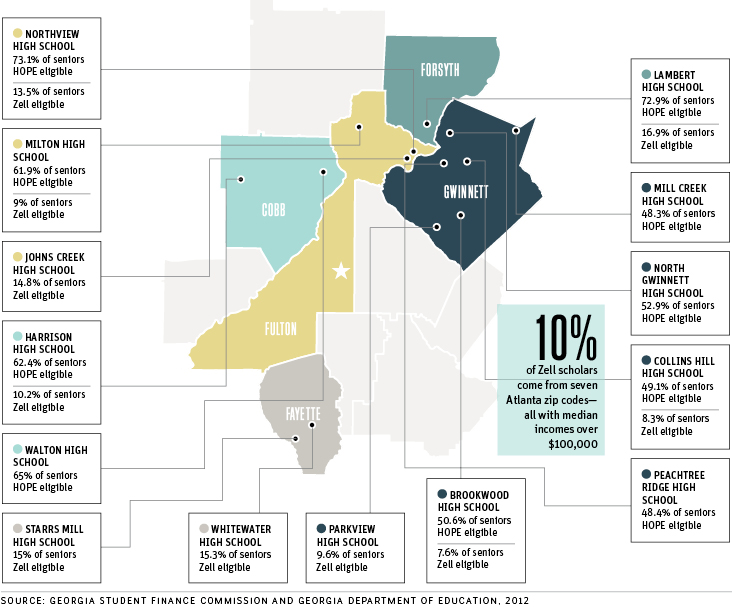
The ten public high schools with the most HOPE-eligible students and the ten with the most students eligible for the even more elite Zell Miller Scholarship (fourteen schools total because of overlap) are clustered in five metro Atlanta counties. NOTE: These schools were ranked by number of scholars. Percentages are provided for the reader’s information.


2. Georgia adults with at least a bachelor’s degree


3. HOPE scholarship and grant recipients
Total number of students receiving HOPE scholarship (college) and Grant (technical school) awards.

UPDATED_HOPEgraphics-01

4. Increasing competition
The rise in average two-part SAT scores of admitted freshmen


5. Diversity in the student population


6. Comparison of annual tuition and fees
In recent years, it has been easier for colleges to raise fees than tuition since HOPE was not obligated to cover fees. Consequently, add-ons now represent a much greater portion of total college costs.


7. UGA tuition and fees/semester
Georgia Student Finance Commission’s projections of future tuition and fees and what portions HOPE and Zell will pay.


8. How counties fare


9. How Georgia’s college aid compares to other states’
Georgia awards more scholarship dollars to its college students than any other state except South Carolina.

> HOPE Scholarship: The cons: Did the legistlature’s 2011 reforms ruin HOPE?

>HOPE Scholarship: The pros: The program has surpassed its goals. So why are people complaining?

> Our recommendation: Get rid of the Zell

These graphics originally appeared in our January 2014 issue.

[Updated June 5, 2014]


Follow Us

69,386FansLike
144,836FollowersFollow
493,480FollowersFollow

NEWSLETTERS