

Home 2014

Archives

How it feels to patrol the toughest neighborhoods

By now know that in the spring, these blog posts are chock full of festivals. And this one is no exception. But if you’re suffering from festival fatigue, this pre-holiday weekend has a lot of quirky activities, from dogs on a catwalk, to a quest for the greatest laugh, to ballerinas causing a ruckus. – See more at: http://www.atlantamagazine.com/agenda/2014/05/15/atlanta-events-may-15-16-17-18#sthash.ShfxOYsa.dpuf

Photograph by Fernando Decillis

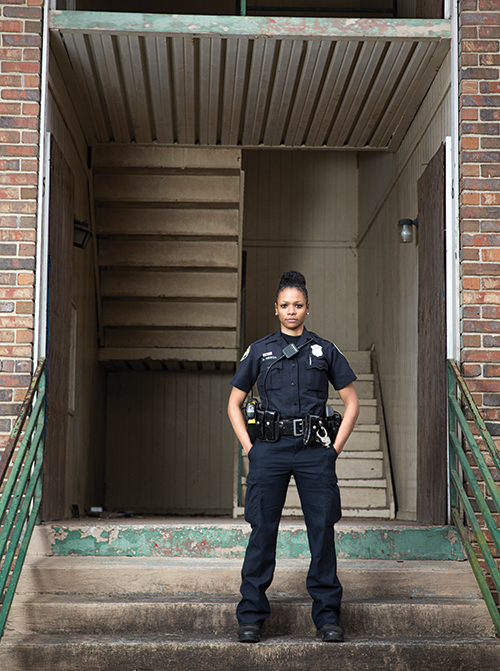
Ashley Gibson, 25, Atlanta Police Department Officer, Zone 3

A family dispute is flaring in a cramped kitchen in southeast Atlanta when Ashley Gibson arrives. Gibson is five foot three, with pearl earrings and pink-painted fingernails, her hair swept into a high bun that recalls her cheerleading years. Despite her slight stature, Gibson doesn’t flinch. The Gwinnett County native graduated the police academy two years ago and requested to work Atlanta Police Department’s Zone 3, a rectangular swath of generally tough neighborhoods stretching from Downtown to near the airport. Over the course of a dreary afternoon, Gibson, nicknamed “Smiley” for her sunny disposition, investigates an attempted burglary, races to assist officers at a high school brawl, sternly advises a pedestrian to pull up his pants, and tells one bozo on a four-wheeler to take it home. In the kitchen, Gibson settles everybody down and persuades one unruly teen to dole out apologies and hugs. The boy’s mother praises Gibson: “Girl, you good!”

I wanted to come here. I figured, I’m a big girl, I might as well start with a big department, where you can get good experience.

I don’t come out here judging people. Everyone has a story. You never know somebody’s struggle.

Couple weeks ago, I arrested a twelve-year-old for two felonies. She brought 4.7 grams of weed to school and tried to sell it. I was sad for her. She’s so young. They don’t realize your record follows you.

From what I hear, they used to call Zone 3 “the war zone.” It was a little more intense than it is now. Some zones are prettier than others. This isn’t the pretty Downtown area of Atlanta. Crime happens.

There are scenarios where you might encounter a subject that has a gun or knife on them. I wouldn’t say it’s an everyday occurrence. I’ve never had to pull my gun out. In some situations, if you can talk to people, that can get you a long way, that verbal judo.

Sometimes, being a female officer, people automatically underestimate you. That’s just a fact of life. To be honest, the females are the ones that give you a harder time than the males. I can’t say specifically why. People say, “You’re a police officer?” People are so quick to say that, but they can’t explain it, you know? What’s a female cop supposed to look like?

My dad wishes I would have gone into criminology instead of policing, but he still supports it. My mom tries to not let me know she worries. You have your own family, but here, in the work environment, in the zone, especially on [evening] watch, those officers really do become your brothers and your sisters. I truly believe that.

I ultimately want to be a homicide detective. I’ve always had that goal, ever since I was little. I know it’s kind of weird, especially for a girl. Homicide’s different, but I still view it as helping people in need.

This article originally appeared in our May 2014 issue.

How it feels to send someone to prison

James Bodiford, 64, Chief Judge of Cobb Superior Court

Thirty-seven years ago, at age twenty-seven, James Bodiford quit a job selling magazines to attend law school. In 1985 he was appointed chief magistrate judge of Cobb County, and in 1994 he was elected to Superior Court. Bodiford has presided over some of the region’s most prominent trials, including Fred Tokars, who was convicted of masterminding the murder of his wife; Lynn Turner, the so-called anti­freeze serial murderer; and Brian Nichols, the Fulton County Courthouse shooter. But as he approaches retirement this year, Bodiford says his decisions in non-capital cases will stay with him the most.

Some people think that sentencing a convicted murderer is the hardest. It’s not. It’s easy. Because in Georgia, murder gets a life imprisonment. If a jury convicts someone of murder, I know what I must do.

But on most offenses I have discretion, and I value that discretion. It weighs on me. Now, if you have a fourth-time convicted felon, then you’re not really thinking too much about that individual—if his life is lost here on Earth, that’s the way it is. But often you see a young person who has just made a mistake. As a judge, you have his or her complete life in front of you—even if you aren’t sentencing them to life in prison. They have parents, just like you did. Sometimes they are parents, like you are. They have friends, fellow church members, folks that believe in them. And you know that your sentence—be it two or five or twenty years—is going to have a huge impact not only on the convict but on the community.

And in the toughest cases, there may not even have been criminal intent. One case: A young woman was with her family in a van on their way home from a jewelry store, where she had taken her parents to show them the engagement ring her fiance had picked out. Meanwhile, in the oncoming lanes, two young men were drag racing when one of the drivers lost control, veered across the line, and crashed into the van. The daughter was killed. All I can do, as a judge, is punish those responsible and hand out a sentence. I try always to balance the victims and the harm the crime has caused the community against the criminal. In this case, the criminals were young, with no criminal records. They were educated, had family and community support. There was no alcohol involved. They didn’t mean to kill anyone. But they did. And did they show remorse? Accountability for their actions? Well, they chose to go to trial, which is absolutely their right. Rather than admitting guilt and saying they’re sorry, they decided to take their chances. A jury found the young men guilty of vehicular homicide. I gave them the median of seven years. Was it the right decision? Was I too harsh? Too lenient? Hard to say. I don’t regret it. I’ve run into people to whom I’ve given a second chance who shake my hand and thank me for helping them turn their lives around. I’ve seen others I let slide for small offenses right back in my courtroom for more serious crimes. I don’t have a crystal ball. As for these two young motorists: It’s been years since their release dates, and I haven’t seen them.

This article originally appeared in our May 2014 issue.

How it feels to be falsely accused

0

Photograph by Fernando Decillis

Clarence Harrison, 54, Georgia Innocence Project’s First Exoneree, Marietta

One morning in 1986, as Clarence Harrison played poker at a neighbor’s home in Decatur, a woman was attacked at a nearby bus stop. The assailant dragged her away and raped her several times, stealing her wristwatch in the process. Harrison became a suspect when a confidential informant told police they’d heard someone was selling a watch at his home. The victim singled out Harrison from a photographic lineup and later fingered him in court as the attacker. He was convicted of rape, robbery, and kidnapping and sentenced to life plus twenty years in prison. Harrison wrote to various organizations looking for help, until he was wrongly informed in the early 1990s that all evidence—including vital slides collected from a rape kit—had been destroyed. With help from a woman he’d met by chance during a call from prison, he contacted the fledgling Georgia Innocence Project in 2003, whose interns were able to track down two slides from Harrison’s case. A forensic scientist found that Harrison’s DNA could not possibly match that in the rape kit. In 2004, after serving seventeen years, nine months, and twenty-six days in prison, he was a free man.

Harrison married the woman who’d assisted him, Yvonne, seventeen days after his release, with strangers throughout Atlanta donating everything from the cake to the rings. Though the state awarded Harrison $1 million in restitution, his readjustment hasn’t been easy. A series of bad investments and tax troubles claimed much of the money. After a snowfall in 2010, he was struck by a van, knocked off a bridge, and severely injured. Holed up in the hospital, he lost a Laundromat in which he’d invested thousands, and he now lives on his wife’s income as a school kitchen steward.

The jury found me guilty, and I’m looking at these folks, not really believing. Then I look back and see my mama. She felt the hurt before I did, because I didn’t accept it. She had lost her son.

You’ve got nothing to look forward to, because they took the rest of your life. [In prison] I started out trying to work on my case. That didn’t help; I started getting too many migraine headaches, stressing myself out. Then basically you just give up. They told me the [DNA] evidence had been destroyed; they [denied] parole twice, and told me that life meant life.

In there, I liked to fight. It was fun to me. See, fighting in there was like recreation, something to do, entertainment. You get bored. In order to break the cycle, you might just start a fight. That was for me to keep my sanity.

What’d I miss the most? My kids, spending time with them. They were little girls when I left. When I came out, my daughters were grown. I still don’t have a relationship with them because they hold me responsible for things that happened in their life when I was gone. You don’t get your family back.

The day they told me they lost the evidence and when my mother passed—those would be the worst two days.

When they found the [DNA] evidence, I got scared, thought something was going to happen to it. I said, “Y’all gotta put that somewhere so it don’t get lost—don’t let nobody mess with it.” I told my wife, “I’m fixin’ to come home now!”

When the judge told me I was free, I said, “Free to do what? What you mean by free? I ain’t had time to prepare. Where am I going to live?” That was crazy there. That was hard.

I knew Atlanta very well. When I got out, was like I was somewhere else. When I left, [Interstate] 20 wasn’t but two lanes on each side. Now you got five lanes. It was a trip! They were putting up bigger homes and stuff, but the cars, they had shrunk. I was used to them big Cadillacs. All of the cars looked like little flying saucers.

After four or five years, you realize that you’re no better off than when you were in there. I don’t know whether it’s being institutionalized or what. That’s how you cope with society—reflecting back in there. You’re out here physically, but mentally you’re still in prison.

There’s five of us [GIP exonerees] from Georgia. We kind of hang out. When we have an issue, we’ll call one another and try to resolve it. We depend on each other more than we do anyone else—family members or anyone.

I’ve realized since I’ve been home how much they took from me. Just think, in twenty years I probably would have bought a business, had Social Security benefits, retirement, the whole thing. When they took my youth from me, they took my future away.

That’s the only thing I can still say: Through all the financial problems and everything else, I’m free. So I take it day by day, and just thank God.

This article originally appeared in our May 2014 issue.

Follow Us

69,386FansLike
144,836FollowersFollow
493,480FollowersFollow

NEWSLETTERS