
Home 2025

Archives

Editor’s Journal: I never wanted kittens. But Little Bit and Smackie Boy convinced me otherwise.

A person holding a ginger cat's paw

Almost 19 years ago, a colleague walked over, and from the look on her face, I knew she was up to some mischief. She engaged in small talk before she got to her point. She told me that a friend had found a litter of kittens under their front porch; the friend had rescued the kittens, but the mom had made an escape.

I knew immediately where this was going.

A couple of weeks later, I was sitting on the floor of her friend’s living room with five kittens scampering about. One, the runt of the litter, crawled onto my lap and stayed there until I put it back on the floor and agreed to adopt it. “Don’t you want two?” my friend said. “That way, they’ll never be lonely.”

No, I didn’t want two. But before I could stand up, a second cat crawled up on my lap, began to knead my belly, and then laid down as if he belonged there.

When I got them home, Little Bit jumped up on my ottoman and looked at me with wide, innocent eyes. I reached for my camera to take a photo. As I was about to hit the shutter, the other kitten jumped up behind him and, with a devilish look in his eyes, raised his right paw to smack his little brother. That was the photo I took. And so, he was named Smackie Boy.

Little Bit considered my lap his domain. Even though he was the bigger cat, Smackie accepted that. He usually waited until Little Bit had vacated his perch. It often felt like a conveyor belt: one cat off, the other cat on.

One afternoon, Smackie Boy jumped up and Little Bit refused to leave. To avoid a lap war, I lifted Little Bit up and put him on the floor so Smackie could have his turn. After Smackie had settled in, Little Bit made a loud noise in a hidden corner on the other side of the room. Smackie lifted his head in curiosity, then hopped off to go see what all the commotion was about. I spied Little Bit to the left of my chair. He jumped up and settled back into his spot on my lap. Smackie gave his brother the nastiest of looks and sulked away.

Once Little Bit passed away nearly five years ago, it was just Smackie and me. He began to spend more time sleeping on my lap, especially when it was cold. I was away from home for eight days recuperating from hip replacement surgery; when I returned, he spent the entire afternoon lying on the top of my chair with his left paw draped across my shoulder.

From a young age, the cats demanded to drink water from the bathroom faucet. They also learned to turn on the faucet when they were thirsty. Since they showed no aptitude for modulating the flow of water, my solution was to set the faucet to a constant dribble. Whenever I walked into the bathroom, Smackie would jump up on the counter and impatiently wait for me to brush him. When he grew tired of the brush, he would step into the sink, lower his head, and drink.

Over the past couple of years, Smackie Boy began to slow down. He could no longer make the jump from the floor to the bathroom countertop, so I put a chair next to it. Toward the end, even that became a challenge for him.

Nearly everyone I’ve talked to has asked, “Are you going to get another cat?” Experts believe that’s the exact wrong thing to say; we need time to process our grief after loss. We’re not talking about a broken coffee maker that you go to the store to replace, and then all is well. I understand our tendency is to want to fix each other rather than offer simple empathy, and that grief is uncomfortable. But it’s necessary for healing.

In this issue, we delve into the world of pets, and the deep relationship often forged between an animal and its human. You hang out together. You play together. Many times, you even sleep in the same bed. I have found that I weaved most of my daily routines around Smackie to one degree or another. I have found that I now have a lot of empty spaces in my life.

It’s a chilly spring morning as I write this. And I miss my little buddy.

This article appears in our June 2025 issue.

Editor’s Journal: Cheap eats—where budgeting and belonging meet

Chai Pani new menu
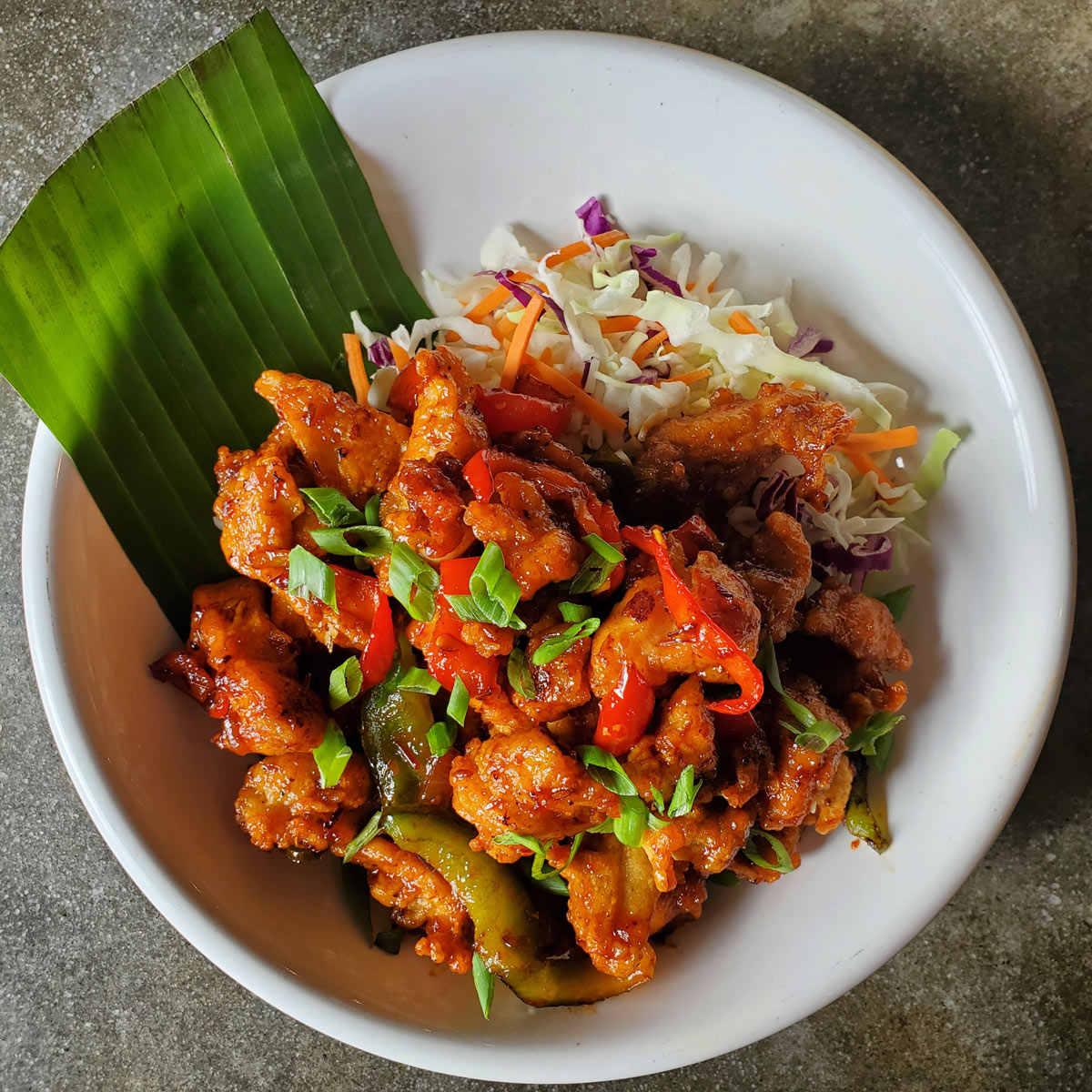
Chili chicken at Chai Pani

Photograph by Daniel Peach/Chai Pani Restaurant Group

For many of us, it’s a rite of passage. We graduate high school, strike out for college and, fending for ourselves for the first time on a tight budget, search for cheap places to eat.

I evolved from McDonald’s drive-thrus to sit-down meals at Waffle House and meat-and-three places. As my palate expanded, I developed a love affair with foods exotic to my childhood, particularly the spices of Mexican and Asian cuisines.

That endless quest for affordable and good food has stayed with me. Wherever I’ve lived, I’ve always had a nearby go-to cheap place to dine. In Macon, there was the soul food of the fabled H&H Restaurant and a barbecue joint that Otis Redding once frequented.

In Rhode Island, my house was in an Italian neighborhood, and there was an excellent pizza place around the corner that served traditional fish and chips on Fridays. In Las Vegas, there was a humble Thai restaurant that had a laab dish that I can still almost taste 20 years later.

I’ve carried that tradition of looking for cheap eats into my overseas travels. In Paris, it seemed I had a new “best meal of my life” almost every night, all at quaint restaurants that charged less than $20 for the experience. In Hong Kong, I explored the Temple Street Night Market in Kowloon and had my first taste of Asian street food. I also ate an 85-cent bowl of soup for lunch at the Po Lin Monastery on Lantau Island. The ingredients remain a mystery to this day, but it was delicious and the bowl was huge.

Atlanta, of course, is a movable feast for food explorers on a budget. Buford Highway and Duluth are meccas of affordable Asian cuisine. Through the years, I’ve stretched dollars at Eats and Majestic Diner on Ponce de Leon Avenue and at Zyka and Chai Pani in Decatur. La Fonda Latina and Fellini’s Pizza helped me avoid bankruptcy during college.

Cheap eats have an important role in the culinary ecosystem. Fine dining is great, but for most of us, that is a special occasion. With cheap eats, we can indulge ourselves anytime.

Breaking bread with friends and family is one of the hallmarks of our culture. It’s an important part of how human beings build community and kinship. When I think of cheap eats, I think of friends getting together to catch up with one another or to celebrate an accomplishment. I think of families gathering for holidays or to mark a birthday.

In this age of convenience and rush, however, we’ve become addicted to the cheapest of the cheap—fast food—and eat far too many meals in the car rather than at a shared dining table. And that comes with a cost.

In Thailand, people in a group don’t order individual dishes at a restaurant; they order a complete meal and everyone at the table shares in it. It’s their version of family-style dining. Sharing food becomes a joyous occasion, a means to celebrate simply being together. It strengthens and creates bonds. You don’t get any of that ordering a spicy chicken sandwich in the drive-thru.

Convenience is not always our friend. As we lose the ritual of gathering together for food, it feeds the social alienation and isolation that permeates modern society. The family unit becomes a group of individuals constantly going off in separate directions and seldom coming together. Everyone is on their own schedule, doing their own thing. Everyone is so busy.

As human beings, we have a deep need for love and belonging. We don’t get that from typing on a keyboard or staring at our phones or eating in our car. As Dr. Brené Brown says, when those needs are not met, we don’t function as we were meant to.Editor’s Journal: Cheap eats—where budgeting and belonging meet

Food is the oldest and easiest way for us to be social and build community, whether it’s served in a family dining room or at the table of a good restaurant with your family of choice. We hope this month’s list of cheap eats in and around Atlanta will inspire you to take a minute, gather good friends, and go eat good food.

And belong.

This article appears in our May 2025 issue.

Editor’s Journal: The Sir Elton grudge match

Elton John swinging a tennis racket
Sir Elton John competes in the World TeamTennis Smash Hits charity event benefiting the Elton John AIDS Foundation.

Photograph by Ethan Miller/Getty Images

I can say with particular pride that I was the first person to play tennis inside State Farm Arena.

Elton John staged a tennis benefit for his AIDS Foundation at the newly opened building, then Philips Arena, in 2000, with Andre Agassi, Pete Sampras, Billie Jean King, and other legendary players on hand. I was a tennis newbie and arranged to hit with doubles star Luke Jensen before the event for a story I was writing.

The crew had just finished setting up the court when Luke and I walked out, rackets in hand. It quickly turned into a tennis lesson, with Luke patiently teaching me how to improve my game. After a time, we were joined by 99X disc jockey Steve Barnes.

Then out walked Elton John. Luke gathered us at the net as Elton unpacked his rackets. “I promised to warm up Elton for a few minutes,” he said. “Stick around and we can hit some more afterwards.”

Barnes and I became their ball boys, chasing stray hits and feeding balls back to them between points. It was fascinating to be that close to Elton John and to observe him in a comfortable, unguarded setting. He was a quirky player, not at all athletic, but he played with a fierce intensity. (He even took a tennis pro on the road with him so he could play as he toured.)

They hit for 30 minutes; then the four of us gathered at the net. Elton and Luke shook hands and exchanged pleasantries. Even though we were all standing barely a foot apart from one another, Elton never looked at me or at Barnes. He never said “thank you” or even “hello.” I’ve never felt so invisible to another human being.

It’s no coincidence that Elton brought his annual fundraiser here. Atlanta is the tennis capital of the world, and in this issue, we explore how that came to be. The evolution started in 1952 when Bitsy Grant Tennis Center was opened by the City of Atlanta. Until then, tennis was the bastion of country clubs and the elite. At Bitsy Grant, anyone could play. Public tennis centers were eventually built all over the city.

I scorned tennis for much of my life. I fully embraced the stereotype that it was a sport for spoiled, rich brats. John McEnroe and Jimmy Connors were the poster boys for everything I disliked about the game.

But my girlfriend at the time had been blunt. “You’re out of shape,” she announced one morning. “You need to exercise, so I’m going to teach you how to play tennis.” By that evening, we were standing on a neighborhood court, and she was showing me how to hit. I think I fell in love with tennis in the moment of exhilaration after I hit my first forehand winner.

She’d played doubles on her high school team and relished beating up my clumsy strokes. Then, one evening, I took a set off her. It was my first up-close experience with a tennis tantrum. I’m not sure she ever forgave me.

Tennis turned out to be her ultimate gift to me. Bitsy Grant became my second home. I hit for hours against the center’s big wall and took group lessons twice a week. I loved to sit in a rocking chair on the back porch, chatting with my tennis buds and putting together pickup doubles matches.

I developed a strong game: a heavy forehand (when I could control it), a hard first serve (when I could nail it), and quick hands at the net for volleys (when I could get the ball to clear the net). In other words, I was like most amateur players: My aspirations far exceeded my skills.

Cranky knees and ankles eventually forced me to “retire” from tennis. I still miss going out on Bitsy’s majestic clay courts and whacking a tennis ball. I miss the thrill of hitting a clean forehand winner or serving an ace into the corner. I also know that I need to find another game to get some exercise. I don’t like gyms and I can’t run. Basketball, like tennis, is no longer an option.

Plus, I need motivation. How about this? I challenge Sir Elton to a no-holds-barred three-set grudge match. Playing pickleball. See you on the court, pal.

This article appears in our April 2025 issue.

Editor’s Journal: A visit to a sacred site of rock ‘n’ roll history in Memphis

Sun Studios

“I’ll meet you in the lobby at 4:30,” my friend said after we’d checked into our rooms at the fabled Peabody Hotel in Memphis. “We can see the ducks and then get dinner.”

I gave him a puzzled look. “The ducks?”

He smiled. “You’ll see.”

When I came back downstairs, a long red carpet was rolled out in front of the elevator. On either side of the red carpet, velvet ropes hung from metal stands. I was astute enough to understand that all this fuss wasn’t for me. I spied my friend standing behind one of the ropes and walked over to him. By then, a crowd had started to gather.

“What is this?” I asked.

He smiled. “You’ll see.”

A few minutes later, precisely at 5 o’clock, the parade began. I watched as five ducks (North American mallards, to be precise) climbed one by one out of the big fountain and, with considerable pomp and circumstance, formed into a line and waddled single file to the elevator. And then into the elevator. The doors closed and they were gone, all to applause and laughs of joy from everyone who had gathered to watch.

It was one of the craziest things I’ve ever seen: ducks getting the red-carpet treatment in the lobby of a luxury hotel. “It’s a famous Memphis tradition,” my friend explained. “They’re headed up to a coop on the roof for the night. Then they’ll come back down tomorrow at 11 and swim in the fountain all afternoon.”

Not only did they have cushy jobs, they got to sleep in every day. Nice work if you can get it.

The next morning after breakfast, we watched the beginning leg of the ducks’ daily journey. We had a meeting at 2 p.m., and until then our day was free. “Graceland or Sun?” my friend asked.

I had to ponder that one for a moment. “Sun,” I finally replied.

We drove a few blocks and reached one of the most hallowed addresses of my life: 706 Union Avenue, Sun Studio. I could almost see a youthful Elvis Presley nervously hanging around outside, trying to get the courage to go in and record a ballad to give to his mother.

A tour guide took us up the steps, and when we reached the door leading into the studio, I stood there for a moment to soak it all in. I was struck by how tiny it was—barely large enough to squeeze in a band with a full drum kit. Yet this was the room where Elvis had recorded “That’s All Right” with Scotty Moore on guitar and Bill Black on bass on a steamy July night in 1954. That moment, in the eyes of many, marked the invention of rock ‘n’ roll.

To my right was a stand that held a vintage microphone. “This is where Elvis stood at his first recording session, and this is the actual mic he used,” the tour guide said.

In a corner, a dark acoustic guitar sat on a stand. Near the nut, high up on the neck, a playing card was threaded through every other string. It was a replica of the guitar Johnny Cash used when he recorded at Sun. “If you listen to ‘I Walk The Line,’ you think there’s a drummer on that record,” the guide said. “There was no drummer. That was Johnny playing the ‘boom-chicka-boom’ rhythm with his guitar. That’s why he put a playing card through the strings, to mute them so he could get that sound.”

The three of us stood in that room for nearly an hour, asking questions and swapping stories about Elvis, Cash, Howlin’ Wolf, B.B. King, Carl Perkins, and Roy Orbison, all music heroes who found their sound in that one little recording studio. It was religious.

Sun Studio is part of this month’s “Must-Do South” feature story, in which we share some of our favorite spring travel destinations across the Southeast. We hope it inspires you to get out and explore the states around us.

And the ducks. By all means, you’ve got to see the ducks.

This article appears in our March 2025 issue.

Editor’s Journal: Loving Atlanta

0

A man shopping at a record store

My monthly ritual in college was a drive into Atlanta to make the rounds of the rich array of record stores across the city. My favorite haunt was Peaches, a warehouse-sized store that prided itself on having the back catalog of just about every music artist imaginable.

This was long before iTunes and Spotify. There was a sense of exploration and discovery from walking into a record shop that’s sadly absent in the digital age. Most often, I had a couple of target albums I knew I wanted; after that, I could spend an hour or more flipping through the bins of albums in search of something that would catch my eye. The store also had an area for “cutouts,” albums that had flopped on the market and could be had for a buck or two.

I’d usually walk out with five or six albums: a couple of certainties I knew were good and the rest experiments. That’s how I discovered Lucinda Williams early in her career, when she was still on an obscure indie label. I was pulled in by the album cover. It had a glowing blurb from Rolling Stone, and she looked particularly good sporting a black leather jacket in the photo. That was reason enough to take it home.

There were two primary sources for keeping up with current music: Rolling Stone, with its extensive record-review section, and the radio. Many of the Atlanta FM stations still had a free-form format that allowed the disc jockeys to play what they wanted to play, a blend of hits and deep album cuts.

At a certain point, part of my ritual began to include listening to the Saturday night jazz program on WABE as I drove into the city. I knew little about jazz, but I was drawn to it. The host of that show was a deep-voiced man named H. Johnson. He shared his encyclopedic knowledge of jazz between songs, often naming the musicians who played on a song and sharing stories about them.

He also had the annoying habit of starting a song, then turning down the music to talk over the record for a minute or so to share a tidbit he’d forgotten to mention during the intro. But the quality of songs he played made that a forgivable sin.

One particular night, I had just reached what I called “Six Flags Hill,” with its glorious panoramic view of the city skyline, when H. Johnson put on a song that instantly touched something in my soul. It was a singer I didn’t recognize, and she had one of the strongest, most soulful voices I’d ever heard. It featured a long solo section, and I knew I had a target album to find that evening at Peaches.

There was just one problem: H. Johnson often played six or seven songs back-to-back in a segment, then identified all the artists at the end. This song was at the beginning of one of those segments.

By the time I pulled into the Peaches parking lot, the music was still playing, and he had yet to identify the vocalist. I sat in my car and waited, frustrated. Finally, his voice returned, and I learned the singer was Dinah Washington and the song a Duke
Ellington composition: “I Let a Song Go Out of My Heart.”

I walked into the store, proceeded directly to the jazz section, and found the album. Score. It’s still one of my favorite records.

Decades later, H. Johnson remains a mainstay of WABE, with a blues show on Friday nights and the jazz show still on Saturdays. He is a tradition as rich as any in the city, and that’s why we feature him in this month’s cover package on the reasons we love Atlanta.
Those monthly trips into Atlanta began my bond with the city. I explored record shops, bookstores, and music clubs. It offered a world far beyond what I could find in my sleepy hometown.

I’ve lived in lots of places, but Atlanta remains singularly unique. Read on to discover our favorite things about the city. It’s our valentine to Atlanta.

This article appears in our February 2025 issue.

Editor’s Journal: The Gift of Willie B.

0
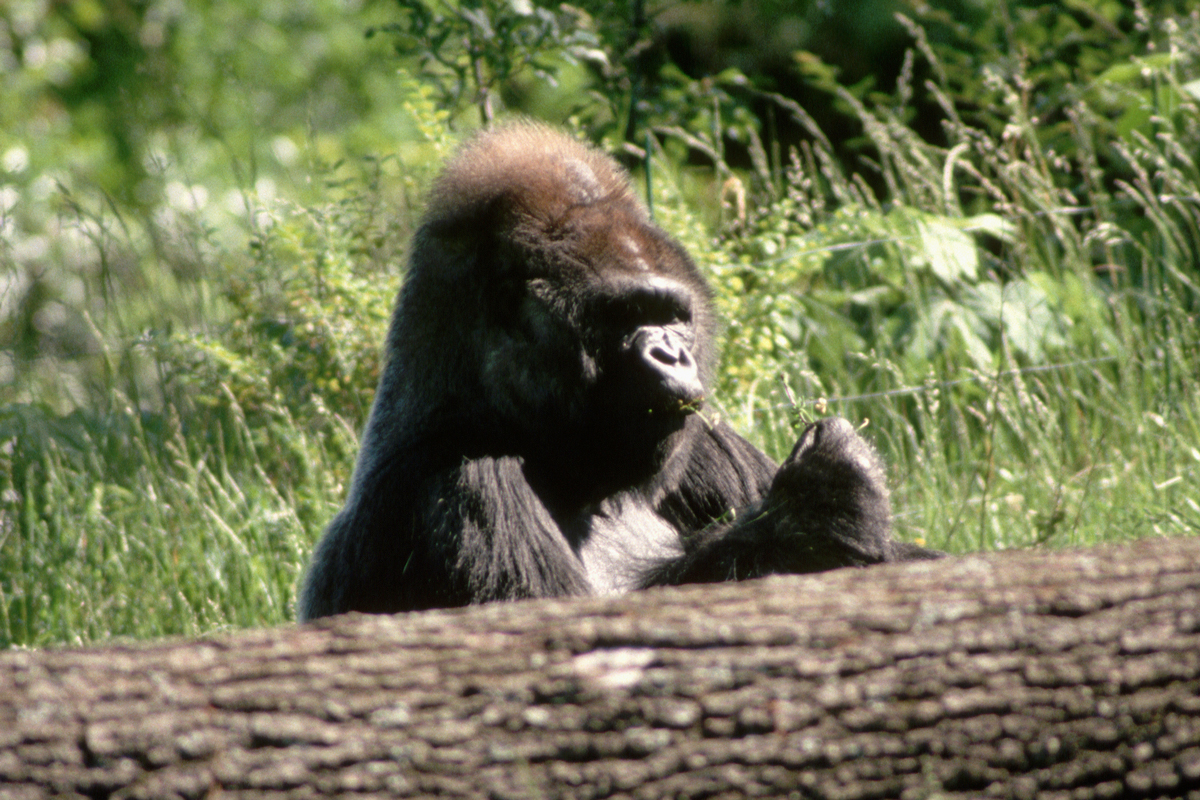
Famous Gorilla "Willie B" at Atlanta Zoo
Famous Gorilla “Willie B” at Atlanta Zoo

Photograph by Getty Images

Back when I was a freelance writer, I got called into the office for a meeting. “We’ve got a fantastic story idea, and you’re the only person who can write it,” I was told. Okay, flattery is always a good start.

My editors explained they wanted a story about Willie B., the iconic gorilla at Zoo Atlanta, who was about to reach the age of 40. “We want it written in his voice,” one of them said. “You can make it funny. Have him go to the Cheetah Lounge thinking he can pick up female gorillas.”

Willie B. became a national celebrity after he starred in a television commercial to demonstrate the durability of a particular brand of luggage; they tossed a suitcase into his cage and filmed him trying to destroy it. Brilliant marketing.

I remembered Willie B. from a school field trip to the zoo when I was seven. I’d never seen such a majestic and dangerous creature. But he lived in a concrete bunker with thick plexiglass on three sides for viewing. His entertainment was a tire swing and a black-and-white television. I inherently knew there was something wrong about that.

In the years since I’d last seen him, the zoo had finally done right by Willie B. They created an outdoor habitat and populated it with more than a dozen gorillas. After nearly three decades in solitude, Willie B. was now leading a robust life, even siring several children.

For two weeks, I shadowed him and spent time “backstage” where the gorillas were fed and slept. On my first few visits, Willie B. took every opportunity to frighten me by loudly banging on the bars of his sleeping cage whenever I was near.

During one visit, a female gorilla pulled a seat over next to her cage bars and motioned for me to come over. “Go ahead,” the gorilla keeper said. “That’s Kinyani. She’s a flirt. She wants to play.”

I walked up to her, and Kinyani reached through the bars and held my hand. I was awestruck, then mesmerized by how similar her fingers were to mine. With a quickness that startled me, she let go and grabbed my elbow with a powerful grip and tried to pull me into her cage. At the last moment, she let go. She hopped up and down with glee at her prank.

Every afternoon, I sat on the roof of the building that overlooks the habitat and observed Willie B. and his clan of gorillas. Then I’d go home at night and try to write. I had a lot of information, but I didn’t have a story to tell. I couldn’t imagine what Willie B. would want to say.

On my final day at the zoo, I spent the afternoon in the empty habitat next to the one Willie B. used. The gorilla habitats are separated by a deep concrete moat, and
I sat at the edge of it. After a while, Willie B. stood and stretched, then began to walk toward me. When he reached the moat, he sat at the edge.

We spent over an hour sitting less than 10 feet apart. It was the holiest moment of my life. I could hear each breath he took.

I could see ancient wisdom in his eyes. I could feel his essence. During that hour, Willie B. and I had a long, silent conversation, and by the time he stood and walked away, I knew exactly what I was going to write.

Willie B. died two years later, at age 42; Andrew Young spoke at his memorial service in front of several thousand people who came to say goodbye.

As we considered this month’s cover story, I thought of my old friend and the serenity I felt as I communed with the gorillas. We live in trying times, and it’s important to sometimes step outside the turmoil and just be: go into nature to rediscover our sense of self, feed our soul, and let our spirit dance to the beat of a different drum.

Willie B. gave me that gift—an understanding that for us to thrive, it’s important to stay in touch with the natural world. It remains our true home even though we spend much of our lives inside our own versions of concrete bunkers.

This article appears in our January 2025 issue.

Editor’s Journal: Atlanta’s great holiday traditions

0
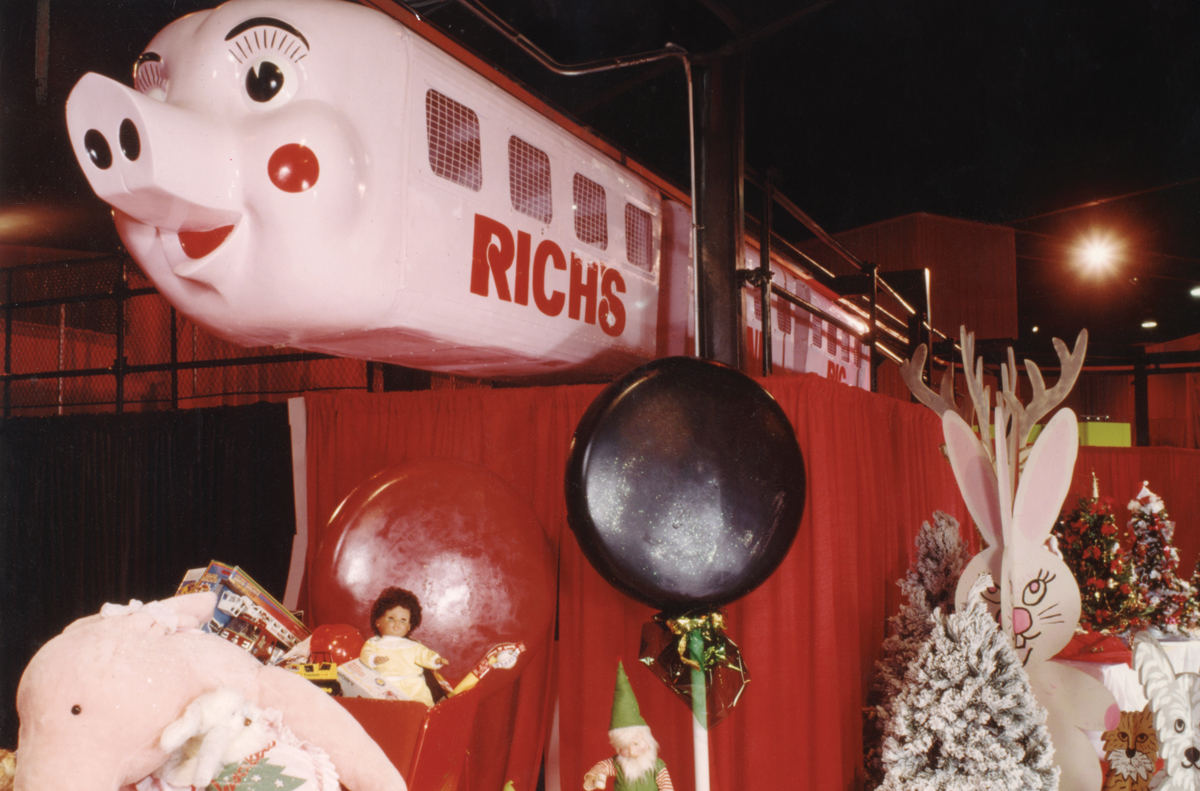
Pink Pig in 1953
Pink Pig in 1953

Photograph by Atlanta Journal-Constitution Photographic Archives, Special Collections and Archives, Georgia State University Library

Somewhere in the family archives, there is a photo of me as a toddler sitting on the lap of Santa Claus, my face bunched up in a teary-eyed primal scream. Obviously, the concept of the jolly ol’ Saint Nick was not sitting well with me.

The photo was taken inside Rich’s department store in downtown, and though I don’t have a specific memory of it, I suspect the afternoon included a ride on the famed Pink Pig. I mean, who could bring a kid to Rich’s during the holiday season and not put them aboard the Pink Pig?

I do, however, vividly remember that evening. The department store had two five-story buildings on either side of Forsyth: the “Store for Fashion” and the “Store for Homes.” They were connected by the Crystal Bridge, four glass-enclosed pedestrian walkways stacked on top of each other, one for each of the top four floors of the buildings.

Started in 1948 as a marketing gimmick, the lighting of the Great Tree on Thanksgiving night quickly became a local tradition. It was even featured on the cover of Time magazine in 1961, and in the Atlanta skyline of the day, it was a beacon that could be seen from miles away.

In the weeks preceding the lighting, local television news would follow the journey of the tree, from the selection process for the 70- to-90-foot-tall white pine to cutting it down to live broadcasts of a huge crane lifting it into place. I cannot begin to imagine the challenges of decorating a gigantic Christmas tree perched five stories above the ground on a narrow walkway. The lights required 13 miles of electrical wiring.

Before the lighting of the tree, each of the walkways of the Crystal Bridge would be filled with local choirs that took turns singing Christmas carols. Lit up by bright lights inside the walkways, and set against the night sky, the choirs seemed to be messengers sent from the heavens. Above them, perched atop the highest bridge and hidden in the darkness, lurked the evening’s main event: the Great Tree.

On this Thanksgiving night, my family ventured out into the frigid air to stand among the throngs outside the store on Forsyth Street. I was bundled up against the cold, sitting on my father’s shoulders and watching in wonder as a choir sang five stories above us.

The moment is forever etched in my memory. All four decks of the bridge lit up as the choirs joined to sing “O Holy Night.” And when a soloist reached the soaring line “O night divine,” the lights on the tree sprang to life.

It was the most magnificent thing my young eyes had ever witnessed: the multicolored lights reflecting off basketball-sized ornaments and mirror balls, and a huge, bright snowflake perched on top.

Even the best traditions change or fade away. Rich’s was sold, then folded into the Macy’s chain. The lighting of the Great Tree was moved to Underground Atlanta for a few years. Since 2000, the tree lighting has been held at Lenox Square. But the tree is now artificial, and it stands in a parking lot rather than atop the city skyline. That decision was made after the boom on a crane broke in 2012, sending the Great Tree into a free-fall crash onto Macy’s and piercing a hole in the roof above the Men’s Store.

The tradition of the Pink Pig also lives on. We give it a nostalgic look in this month’s Big Picture, because a modernized version returns this holiday season to the Georgia Festival of Trees at the Gas South Convention Center in Duluth. It’s apropos that the Pink Pig is featured in our annual Best of Atlanta issue, since it is one of Atlanta’s most iconic “bests.”
So, too, is the Great Tree. Decades away from my childhood, it remains one of my favorite ghosts of Christmas past.

This article appears in our December 2024 issue.

Editor’s Journal: The Georgia film industry is changing alongside Hollywood

0
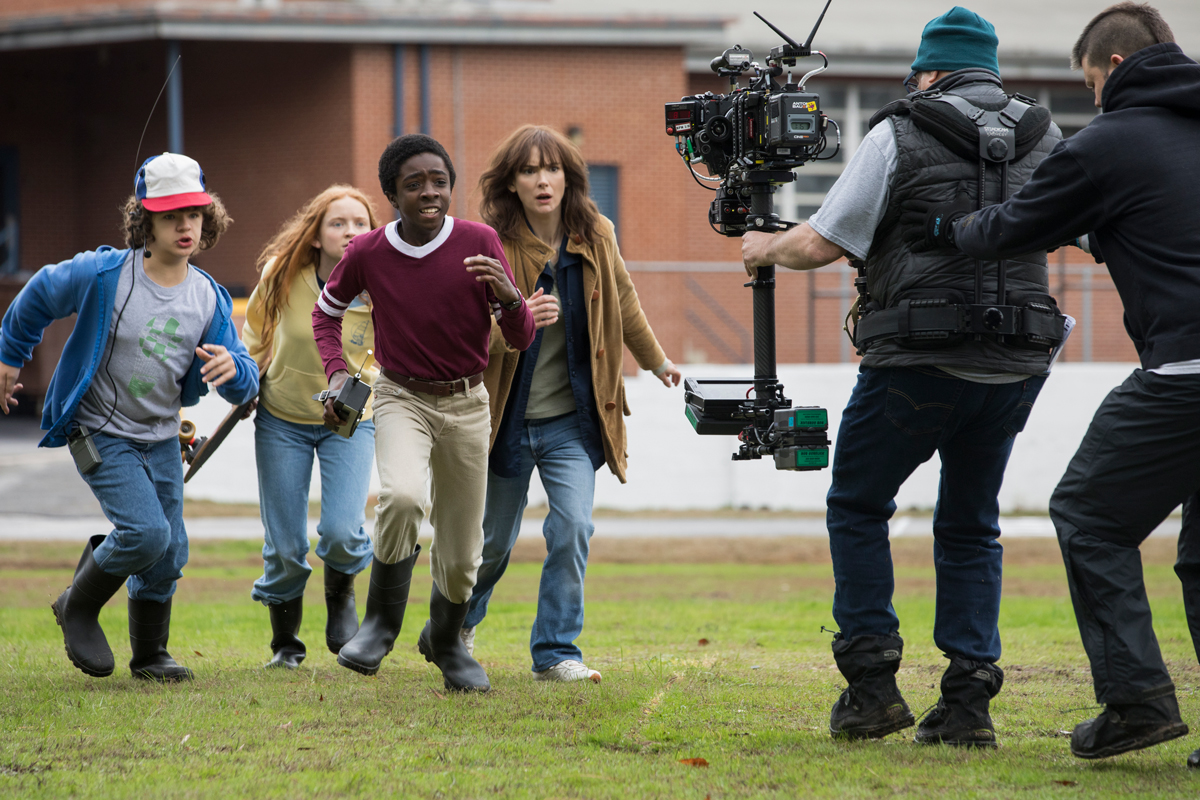
Filming on set of Stranger Things season 2

Photograph by Jackson Davis

A few years back, I ran into an old colleague who had been a designer for a publication where we had both worked. I asked him what he was up to now. “I’m doing film work,” he replied. “I’m an interactive motion graphic artist.”

A what?

“Have you ever seen a shot where someone is sitting at a computer and you can see their screen?” he explained. “I design what’s on their screen.” I didn’t even know that was a job.

In recent years, thanks to generous tax credits, Georgia has become known as the “Hollywood of the South,” and it has changed the landscape of the state. Some people, like my friend, have forged new film-related careers. The Atlanta area is suddenly rich in film soundstages. And it’s no longer a rarity to stumble upon an on-location film shoot, as I did a few times when Black Panther used The Woodruff Arts Center as a backdrop.

Georgia has come a long way since the 1970s, when Deliverance was the first film of note to use the state as a location. The star of that movie, Burt Reynolds, then shot Sharky’s Machine and Smokey and the Bandit here, and state leaders began to hype Georgia as a filming destination. But the industry exploded when the tax credits took hold. The state went from having 45,000 square feet of soundstage in 2010 to 4.1 million square feet today.

As Jewel Wicker reports in this month’s cover story, however, Georgia’s film industry is resetting. The heights of the prepandemic era are gone, perhaps never to return. State lawmakers seem to have an itchy trigger finger to weaken the tax credits. The industry has endured strikes by screenwriters and actors, along with a pullback of projects from streaming services. Everyone awaits a new normal, and no one is certain what that will be.

Film has been a significant part of popular culture for more than a century. From Harold Lloyd and Charlie Chaplin to George Lucas and Steven Spielberg, filmmakers have created new canvases that charm and thrill audiences. It’s hard to imagine a world without The Wizard of Oz, Casablanca, or Star Wars.

Watching the annual broadcast of The Wizard of Oz on television was a childhood ritual. I can remember my sense of wonder when the film opened in black-and-white, then switched to Technicolor when Dorothy opened the door of her house after the tornado set it down in the land of Oz.

I was introduced to many classic films for the first time at The Silver Screen repertory movie house at Peachtree Battle Shopping Center. Before cable television, before videotapes, before DVDs, and before streaming, movie houses like the Silver Screen flourished. The Silver Screen was known for its inspired double bills: Bogie and Bacall in To Have and Have Not and The Big Sleep; Bette Davis in Now, Voyager and Dark Victory; Alfred Hitchcock’s Spellbound paired with Notorious. There were also weekend showings of The Rocky Horror Picture Show.

The film industry has undergone massive change over the last 50 years. First, cable television, videotapes, and Blockbuster killed the need for repertory movie houses. Then Netflix killed the video stores by delivering DVDs to your doorstep. The pandemic and the ability to stream current films at home are only the latest game changers. The recent closing of the Regal Hollywood 24 off I-85 is symptomatic of that evolving landscape.

But there will always be a hunger for the escapism of a great film, no matter how it is delivered to the consumer. And Georgia—with its infrastructure and talent, both on-screen and off-screen—is set up to continue to attract film and television projects.

As Shoeless Joe Jackson said in Field of Dreams: “If you build it, he will come.” And Hollywood has certainly come south.

Read the full story: The Great Reset: When will Georgia’s film industry find a new normal?

This article appears in our November 2024 issue.

Editor’s Journal: The joy of discovering a new favorite restaurant

0
Atlanta's Best New Restaurants of 2024
A sandwich from The Little Hippo, one of our best new restaurants of 2024

Photograph by Martha Williams

It was a cold, rainy Saturday night, and we wanted some comfort food. At the time, I lived in Rhode Island. My girlfriend and I set out for Atwells Avenue on Federal Hill in Providence, a street chock-full of some of the best Italian restaurants in America. Federal Hill was also known as the home of the New England Mafia. The two sometimes commingled: There were restaurants where mob figures had been taken out by a hitman in the middle of the spaghetti course.

The restaurant we had chosen was packed, with a long line outside, and we decided we didn’t want to wait in bad weather.

On the way there, we’d passed a Mexican place that we’d never seen before. From the outside, it looked to be barely more than a hole in the wall. On the way back, I pulled over in front of the restaurant, and we debated whether to give it a try. I was reluctant because of the plainness of the facade. She was hesitant because she was of Mexican descent and disliked Americanized versions of her native cuisine. “Well, judging by the looks,” I said, “it’s either going to be the best Mexican I’ve ever had, or else it’s going to make us sick.”
Our hunger finally won out, and we went inside. The tiny dining area was barely 15 by 15 feet. There were a handful of tables for four. We found the last empty one, ordered, and held our breaths.

After the first few bites, my girlfriend stopped eating. She giggled and, with her big smile, said, “Wow, it tastes just like my grandmother’s food.” When the room began to empty, the young owner/chef walked over, and the three of us began a conversation that eventually turned into a friendship.

Pepe told us he had grown up in a little town in southern Mexico, and had dreamed of coming to the United States to open a restaurant and use his family’s recipes.

Whenever we went there afterward, which was often, Pepe would come over to greet us. He’d suggest dishes to order, usually whatever was the freshest item on the menu. “Try the goat special,” he told us once. “I went to the slaughterhouse at four o’clock this morning so I could pick the best goat.”

His recommendation was spot-on . . . after we’d gotten past the knowledge that the meat we were eating had been walking around only a few hours earlier.

Pepe introduced me to authentic Mexican cuisine. It was my first experience with traditional tacos. It was the first time I’d bitten into the luscious wet masa of tamales. It was the first time I’d tasted the chocolaty spice of mole sauce. His chips were handmade, thick and delicious, with rich and spicy salsa. Those meals set the standard for how I judge Mexican food to this day.

This was long before Yelp and Google reviews, when the internet was still dial-up. I told my editor at Rhode Island Monthly magazine about the place, they published a rave review, and all of a sudden this humble little joint was one of the hot spots of Providence. Pepe eventually expanded the space when a business next door closed; today, Restaurant Mexico Garibaldi bills itself as “Providence’s premier Mexican experience.” I still miss Pepe and his food, but it gives me a warm feeling to know that I stumbled across his restaurant weeks after it opened and had a hand in its success.

Starting a new restaurant is often a fast track down the boulevard of broken dreams. It’s estimated that up to 80 percent of new restaurants fail within the first five years. My favorite local barbecue place just went out of business after less than five years; the owner said it was a combination of high food costs and pandemic hangover.

In order to survive, a new restaurant obviously has to have food that stands out in the crowd, with equally good service and a smart location. There is also no small degree of luck involved. This month, we spotlight our 12 favorite new restaurants. They range from the modest to the grand, but all 12 share those traits. Most importantly, they each have food that will keep you wanting to go back for more.

As Pepe liked to say to us, “Buen provecho!”

This article appears in our October 2024 issue.

Editor’s Journal: Art matters

0

Vinyl recordMusic was my entree into the arts.

I was six years old when Elvis Presley’s jump blues version of “Your Cheatin’ Heart” came on the car radio one afternoon. I vividly remember leaning forward and turning up the volume because I’d never heard anything like that: the swinging bass by Bill Black, the blues-flavored guitar played by Scotty Moore. My mother and I were on our way to a Grant’s department store on a hot summer day, and once inside the air-conditioned coolness, I found a huge display rack for the new Elvis album. I raced over and saw that “Your Cheatin’ Heart” was the lead track. I might have refused to leave unless I left with a copy.

As was the case with many Elvis albums, there was a lot of dreck. But there were four blistering blues songs recorded early in his career that I listened to over and over. I can hear those songs today and still feel a taste of that excitement. I also can see how much they informed my musical tastes as an adult.

Art helps define who we are. And contrary to what a majority of the Georgia General Assembly seem to think, art matters. Georgia is dead last nationally in public arts funding, spending an embarrassingly meager 14 cents per person. Alabama spends $1.60 per person; South Carolina spends $1.79. We’re even behind Mississippi, which spends $4.45 per person.

I worked for 12 years at ArtsATL, a nonprofit that was in almost constant financial stress. It was not alone; most of the smaller arts organizations in the city are in a never-ending struggle to survive. Chambers of commerce across the state love to tout thriving local arts scenes to lure in tourists and new residents and new businesses. But when it comes to helping those artists thrive, Georgia has a failure of the imagination.

That is the paradox: The arts exist to fuel imagination. The arts stoke curiosity and creative thinking. They help us to better understand the world we’re living in. They open us up to other cultures and other ways of thinking. They bring us joy. They touch our hearts. They feed our souls. They make us better human beings.

Growing up in a small Georgia town, I had little exposure to visual arts, dance, or theater. The only art class I had in school was in the fifth grade. The teacher was well-intentioned, but she was a hair stylist by trade. She taught us to paint inside the lines and chided me when my brush strayed outside those boundaries. She also scolded me for using the wrong colors. By the end of the year, any interest I might have had in visual art was destroyed.

I was fortunate, however. I had another teacher who had a massive record collection and schooled me in music. He turned me on to Mozart and Brahms. Joan Baez and Bob Dylan. Mississippi John Hurt and Big Bill Broonzy. It was an education that expanded my universe, shaped my life, and inspired me to think about things in ways I had not before considered.

My first trip to Paris as an adult was transformational. In addition to stoking my culinary curiosity with all the exotic French food, I had the magical experience of standing before a Monet canvas. Stepping back from it, I could see the visual feast of colors in his painting. Walking up close, I could see the individual brush strokes and how meticulously he crafted his work. In recent years, I have also developed a deep appreciation for dance and theater. I have even come to enjoy opera.

From street art to fine art at the High Museum, Atlanta is home to a strong community of artists. They help define our city, they give it life and vibrancy. This month, we take a deep dive into that world and explore how the shift in leadership at the five major institutions has changed Atlanta’s arts landscape. The gremlin that constantly lurks in the background is that artists are doing great work in spite of, not because of, the kind of public financial support they deserve.

I don’t know much, but I do know that 14 cents doesn’t get you very far these days.

This article appears in our September 2024 issue.

Follow Us

69,386FansLike
144,836FollowersFollow
493,480FollowersFollow

NEWSLETTERS