


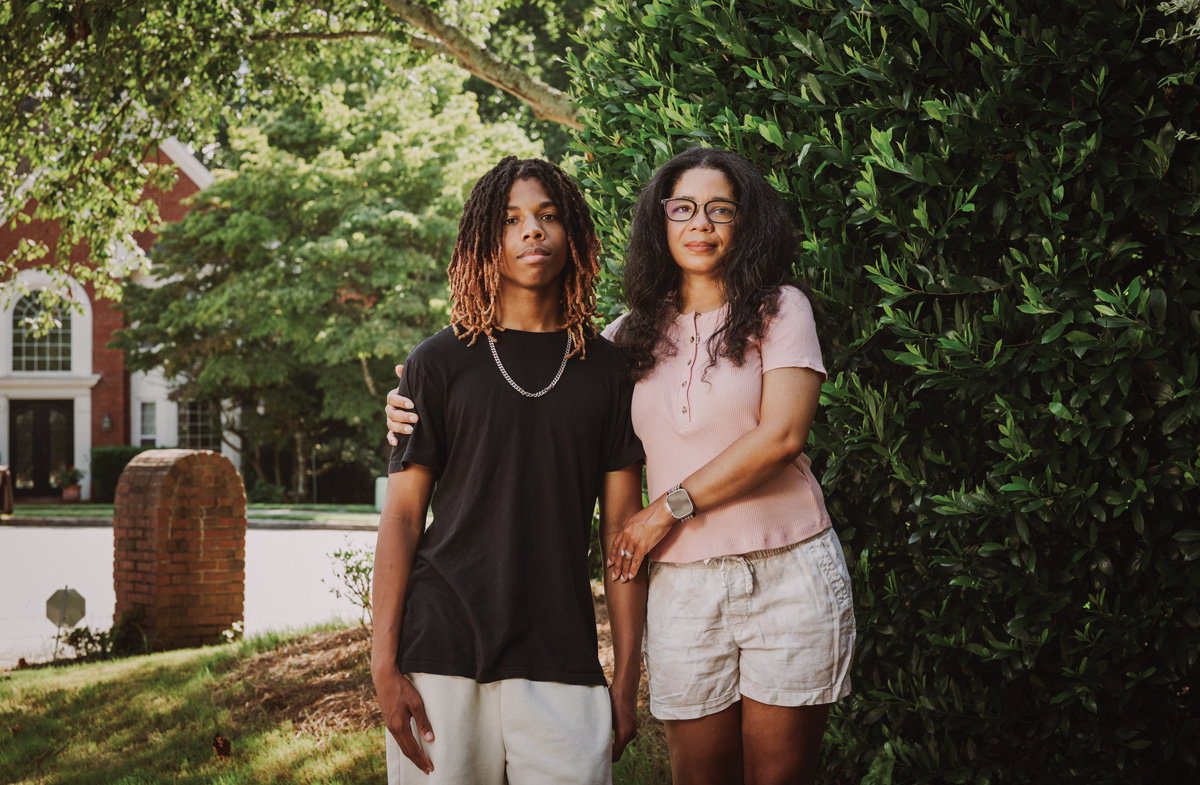
Photograph by Audra Melton
When Danielle Moore looked at her phone the afternoon of May 5, she saw a FaceTime call come in from her 14-year-old son, Carter. She clicked to accept and was stunned to find herself facing a Johns Creek police officer.
Carter had been hit by a car driver who didn’t look both ways and see him riding his e-bike on a sidewalk, the officer said. Panicked, Moore let out a small exhale when she heard Carter in the background talking with paramedics. She and her family, who were just leaving her daughter’s softball game in north Alpharetta, jumped in their car. “I drove as fast as I could,” Moore says.
When she arrived at the accident scene, Carter was on a stretcher, his broken leg stabilized, with paramedics preparing to lift him into an ambulance. “When he saw me, he reached his hand out for me,” she recalls. “It was traumatic.”
Electric bikes, called e-bikes for short, seem to be everywhere today: on the streets, on bike and multiuse trails, and on sidewalks. According to the bicycle industry trade group People for Bikes, e-bikes are now the fastest-growing segment of the bicycle market. Teens especially appreciate that these bikes offer mobility without the need for a driver’s license. Carter’s e-bike was a 2024 Christmas present. “It was very much something that he wanted and very much something that I was against; I was just nervous about him being out there on the roads with cars,” Moore says. “But we live in Johns Creek, and out here you see them all over. There’s just so many kids out here on the sidewalks and whatnot, just on their e-bikes and on their electric scooters.
“He did the research, and he presented that research to me, like, This is the one that I want. This one is legal. It goes this speed. It has this kind of braking power. He presented it to us, and we ended up getting it for him for Christmas.”
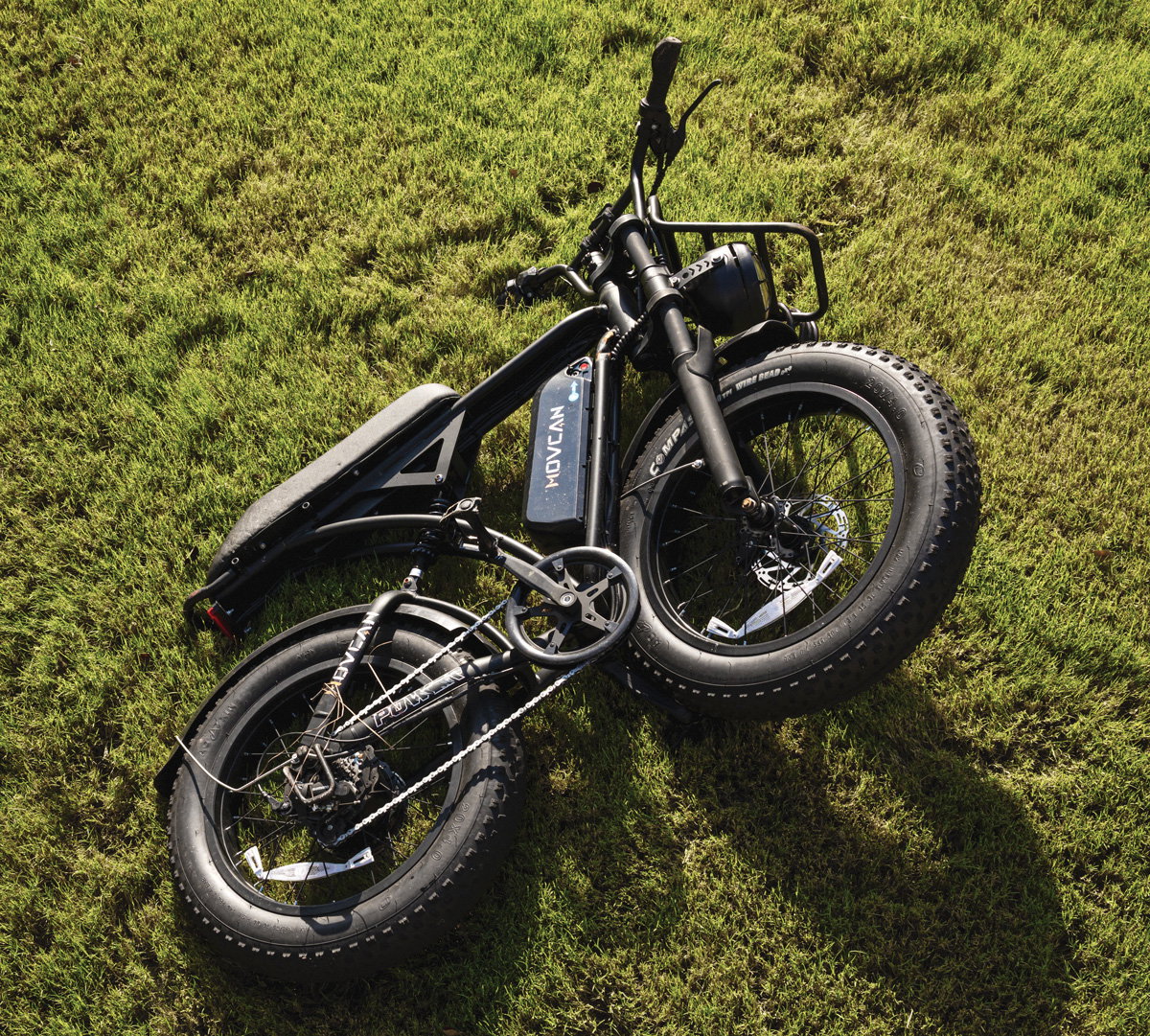
Unbeknownst to all of them, Carter’s new e-bike was technically not a bike at all, but an e-moto—a cross between an e-bike and a full-sized motorcycle.
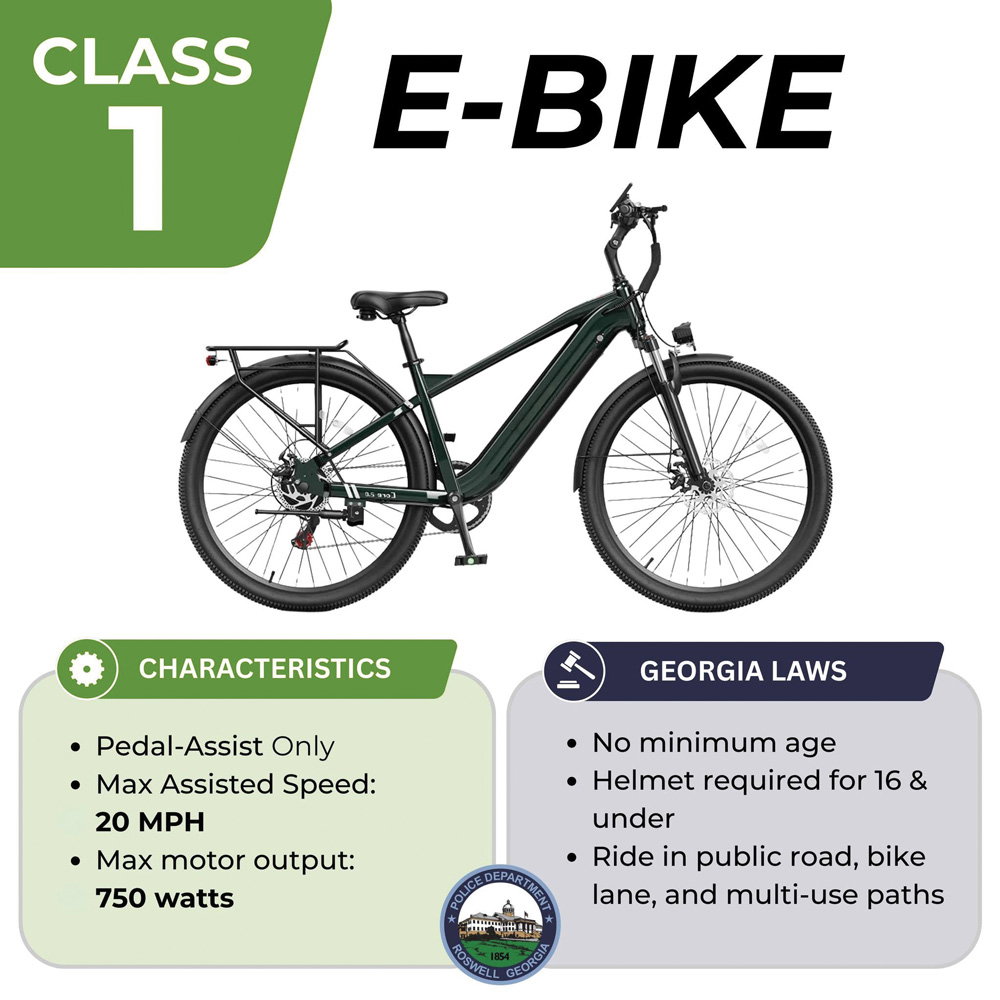
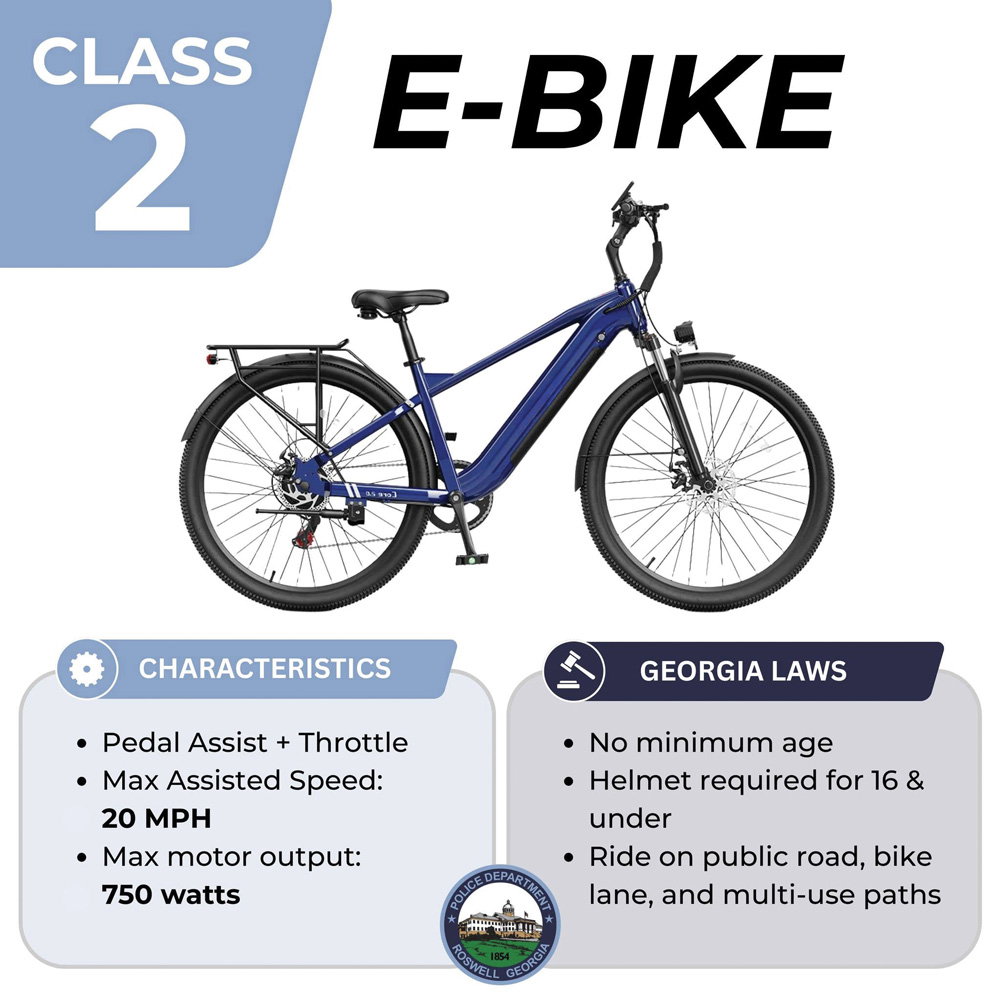
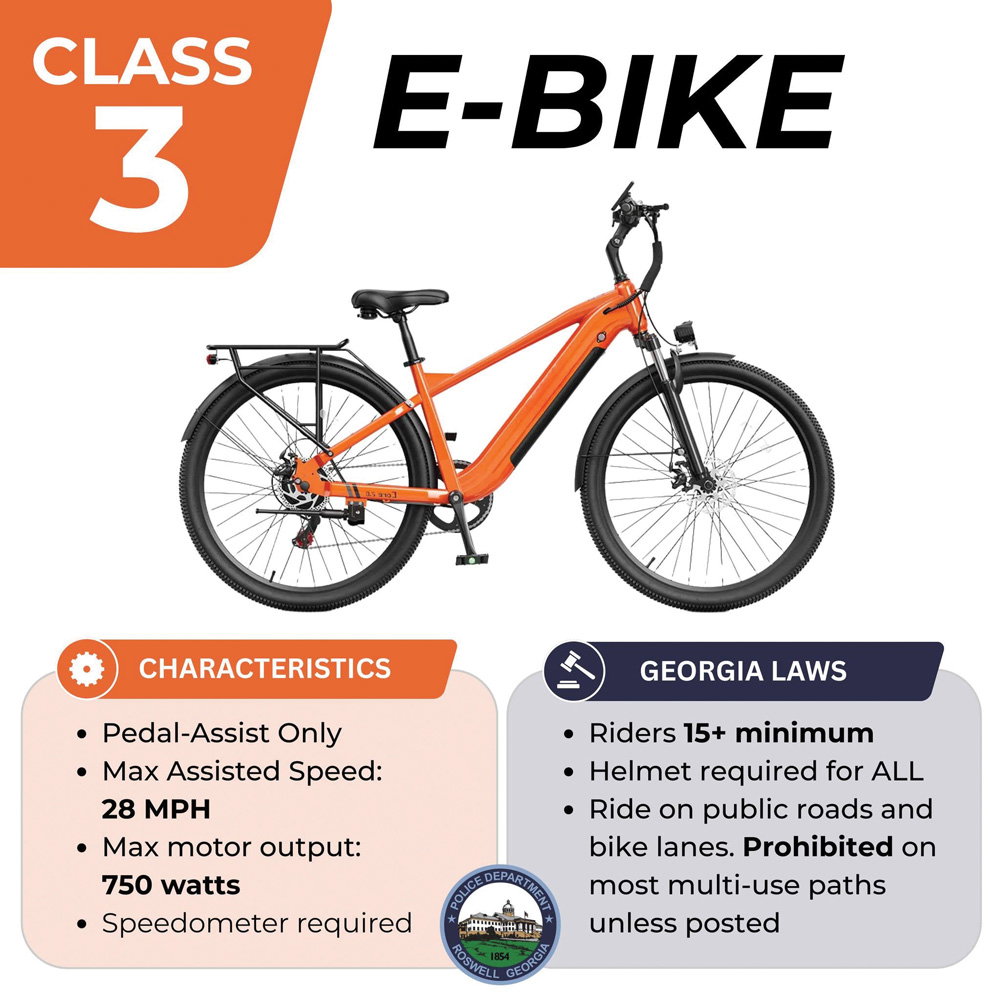
The Roswell Police Department posted this series of informational graphics on its social media accounts defining what is and is not a legal e-bike:
Courtesy of Roswell Police Department
Courtesy of Roswell Police Department
Courtesy of Roswell Police Department
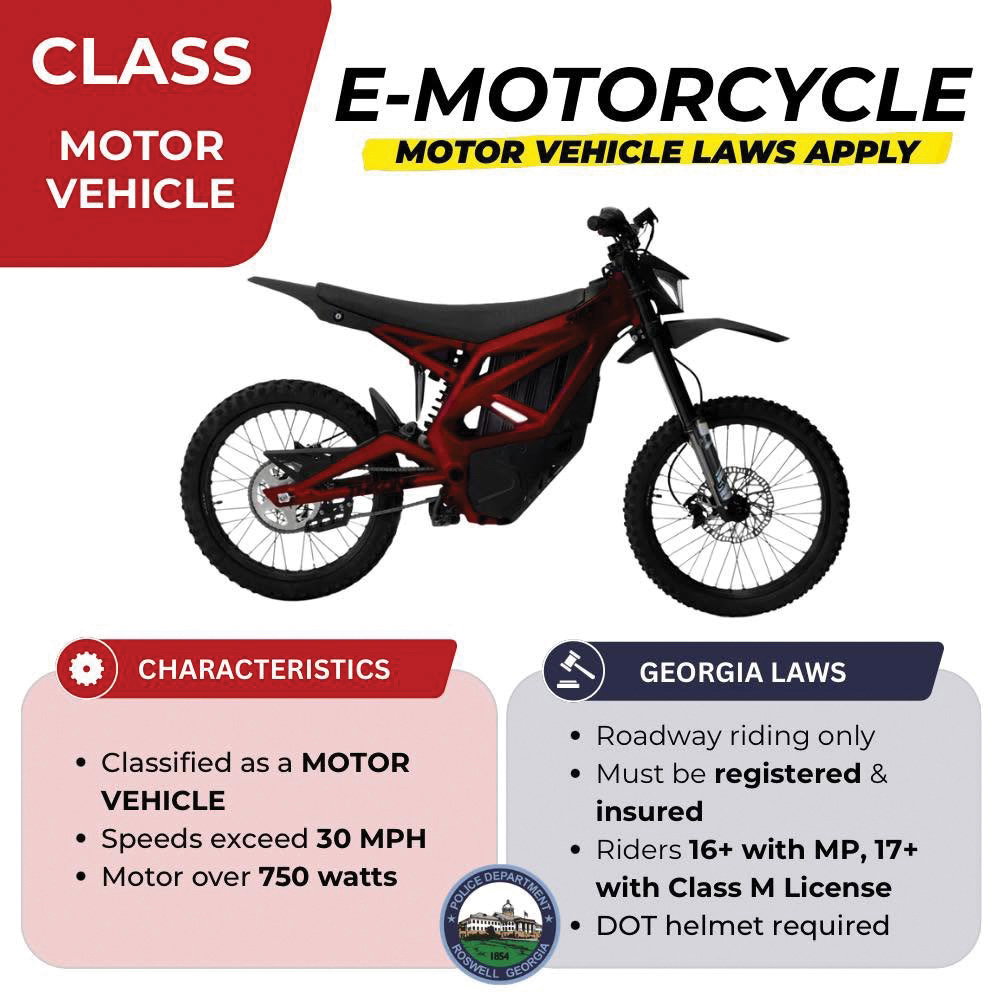
Courtesy of Roswell Police Department
Laws and regulations have been slow to keep up with the explosion of new e-bikes; existing laws are complex and not well-known. Current Georgia law has adopted a three-tier e-bike classification system developed by People for Bikes. To be a legal e-bike in Georgia, and in many other states, bikes must have working pedals and a motor that doesn’t exceed 750 watts of continuous power, the equivalent of about one horsepower. Carter’s Movcan v60 has a 1,500-watt motor—double the allowed limit.
For class 1 and 2 e-bikes, the power must cut out when the bike passes 20 miles per hour. Class 1 e-bikes operate with pedal assist, which means the power engages only when the rider is pedaling. Class 2 e-bikes can have throttles that accelerate the bike up to 20 miles per hour without pedaling. The law treats class 1 and 2 e-bikes the same as conventional bikes.
Class 3 e-bikes cannot have a throttle, but they allow pedal assist up to 28 miles per hour. Riders must be at least 15 years old and wear a helmet. Class 3 e-bikes are allowed only on the road; they’re banned from bike and multiuse paths like the Atlanta Beltline and the Silver Comet Trail.
Carter’s bike doesn’t fall into any of these categories. It has a throttle, but instead of cutting off at 20 miles per hour without pedaling (as a class 2 would), the throttle allows the bike to rev up to 30 miles per hour.
Then there was the problem of where Carter was riding. State law bans all bikes, electric or not, from sidewalks, though it allows local governments to make an exception for children under 12, a fact Moore says she learned after the accident. She had been under the impression that sidewalks were safer than streets, and when a neighbor told her in the summer of 2025 that he had seen Carter almost get hit by a car in their neighborhood, she unknowingly told her son to break the law. “When he came home that day, I told him that he needs to stay on the sidewalk and not ride in the street because it was just too dangerous,” she says. Moore learned about the ban when, after the accident, police cited Carter for riding on the sidewalk and for not having a license, vehicle registration, or insurance.
The Moores weren’t alone in their confusion over which e-bikes are legal. The e-bike industry has grown so rapidly that knowledge about the corresponding rules and regulations has lagged behind. The same day as Carter’s accident, the Roswell Police Department posted an informational graphic on their social media accounts defining what is and is not a legal e-bike. The post was widely shared on social media, and other metro police departments began posting similar materials. This summer, Sandy Springs police held a community meeting to spread the information.
Roswell police spokesman Timothy Lupo says the e-bike confusion is understandable. “They [e-motos] are advertised in ways that are probably slightly misleading for those who might be in the market for one,” he says. “Their goal is to sell more bikes, so I do certainly believe that there are some parents out there who don’t necessarily realize that they provided their child with something that’s not legal for them to ride . . . And, understandably, when you put a young child in control of a motor vehicle, people are going to get hurt, and that’s what we’re trying to prevent.”
The Moores bought Carter’s bike on Amazon, as do many people: Most e-motos are purchased online; local bike and e-bike stores generally don’t sell them. Amazon has now banned the sale of e-motos through its platform in California, bowing to pressure from officials there.
It can also be hard for police to tell the difference between legal and illegal bikes, says officer Michael Walker, a member of the Atlanta Police Department Path Force Unit. He patrols the Atlanta Beltline on an e-bike and has seen the growth in e-bike popularity and the increase in their power and speed. Still, “there’s no way for an officer to tell from looking at a bike what the wattage is,” he says.
Walker says when he and his fellow officers see someone, usually a teenage boy, riding what is obviously an electric dirt bike with foot pegs instead of pedals, they warn that person that the bike is not legal on paths or streets. If they see that person riding illegally a second time, Walker says they have a discussion with the parents if the rider is underage and may issue a citation.
“Today’s electric bikes have really evolved very quickly,” Walker says. “And the government’s kind of behind in terms of the laws. A lot of state governments are behind; city governments are behind. And it’s really up to us, as citizens that are riding the bikes, to use these appropriately.”
Photograph by Audra Melton
Carter says he was aware of the dangers and always wore a helmet and tried to ride safely. On the day of the accident, he was riding home from the first day of practice in his first year on the Centennial High School football team. As his mom instructed, he was riding on the sidewalk. A driver leaving a parking lot looked left for an opening in traffic but not right to see if a pedestrian, or an e-bike, was approaching. The SUV pulled out in front of Carter, and he hit its side.
“I had no time to react,” he says. “I tried to hit the brakes, but it just wasn’t enough time.”
Carter was taken to Children’s Healthcare of Atlanta, which has seen a growing number of e-bike accidents. Dr. Justin Sobrino is medical director of CHOA’s trauma department, and he says the pattern for e-bikes is similar to what he saw a few years ago with scooters. Two e-bike accident victims visited his emergency room in 2024. In 2025, there were 24.
Compared with conventional bikes, Sobrino said he sees more serious injuries from e-bike accidents: “They can achieve higher speeds, and thus you have more potential energy, which when transmitted to the human body, is going to result in more injuries.”
Carter’s broken leg kept him in the hospital three days. He spent the first one in bed, his leg in traction. Doctors operated on the second day, installing a metal rod in his leg with screws. After he spent a day in recovery, they sent him home with a wheelchair, crutches, and pain medication.
Before the accident, Moore said she had begun to appreciate all the e-bikes in her neighborhood, despite her earlier doubts. “I actually love that e-bikes have gotten so many kids outside because, you know, before they got so popular, I hardly would ever see kids out. But now they’re out and about and enjoying life outdoors,” she says.
Now she wishes the streets could be made safer for their use: “It’s just really dangerous for them, which is unfortunate.”
Photograph by Audra Melton
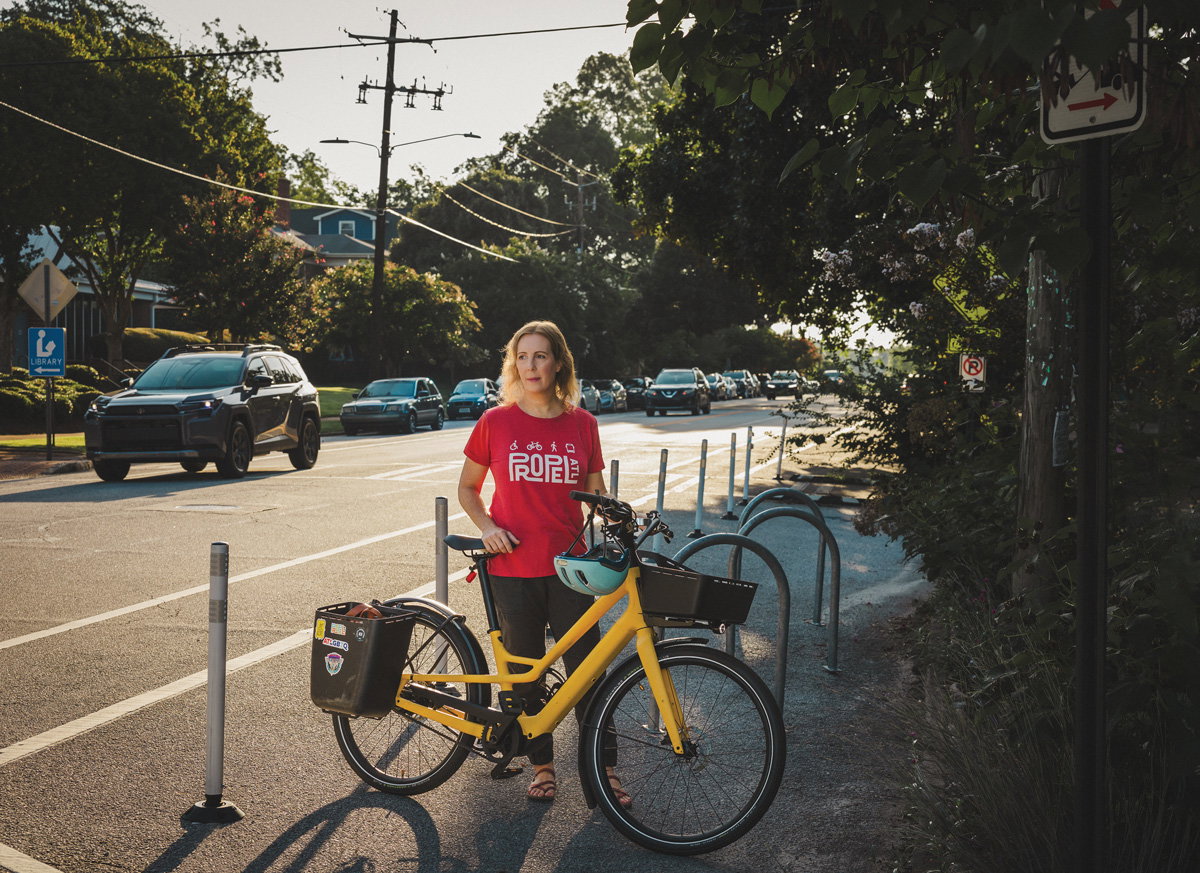
Rebecca Serna agrees. Serna is executive director of Propel ATL, an organization born out of the merging of the Atlanta Bicycle Coalition and Pedestrians Educating Drivers on Safety. “Biking can be great, but only if you have safe enough infrastructure and safe enough streets near you and where you’re going,” she says.
Serna herself is an e-bike convert. She had always traveled wherever and whenever she could on a conventional hybrid bike, but when she was pregnant with her second child 11 years ago, that started to become difficult. “He was a summer baby, so it was toward the end, and it was very hot,” she says. She saw an e-bike at a bike shop on the Beltline and traded her bike for a motorized one that allowed her to continue riding through the pregnancy.
She says she’s heard the complaints and seen the social media posts slamming e-bikes. But she insists these problems should be viewed in the context of the whole transportation system: Car crashes kill far more young people every year than e-bike accidents.
“This is a new thing, and people tend to respond to change with fear,” she says. “Of course, we want e-bikes to be as safe as possible. We’re concerned about high speeds in any vehicle because speeding and speeds that are inappropriate for the type of vehicle are really what’s the causal factor in most fatal and serious-injury crashes.”
Bruce Hagen is a personal injury lawyer who specializes in representing injured cyclists. He says his firm, Hagen Rosskopf, is seeing an uptick in e-bike cases. “We’ve had plenty,” he says, “not because they were e-bikes, but just because sometimes people in cars and trucks hit people on bikes.”
His law partner, Ken Rosskopf, was riding an e-bike when he was hit by a pickup truck and killed last August. Rosskopf, who was 85, was a well-known figure in the Atlanta cycling community, teaching bicycle-safety classes and training police in bike law and proper ways to investigate bicycle accidents. There’s a tinge of irony in Rosskopf’s unfortunate death, Hagen says, because at one point, the e-bike had been Rosskopf’s godsend: “You know, one of the great things about them [e-bikes] is that it allows so many mobility options for people who wouldn’t or couldn’t otherwise ride.
“I think the real issue is that parents are buying things thinking that what they’re purchasing are e-bikes, but in fact, what they’re buying are nonconforming electric motorcycles,” Hagen says.
State Representative Todd Jones (R-Cumming) plans to introduce an e-bike safety bill in the 2027 Georgia legislative session. “It’s shocking to me. I’ve got parents letting a 13-year-old go 60 miles an hour without a helmet,” he says. “I can’t even fathom. First of all, the 13-year-old doesn’t follow any proper traffic rules. There will be a bill. We can’t keep this going on.”
Jones is a cyclist who rides a conventional road bike for fitness and recreation and an e-bike for trips to the grocery store and other short errands. Jones said he can load his pedal-assist e-bike with groceries and ride up hills without getting too sweaty.
“That, to me, is an e-bike,” he says. “An e-moto is I hit a button, and effectively it goes almost like a moped. So that’s the distinction I want to make.” He says he would treat e-motos that can reach 35 miles per hour, similar to Carter’s, like low-powered gas-engine mopeds. They are motor vehicles requiring vehicle registration and a learners permit to operate. Electric bikes that can go even faster should be treated like motorcycles, he says.
Carter will miss the entire football season. He also had to miss the tryout he had earned for an elite baseball travel team. “I’ve been looking forward to that type of opportunity since I was six,” he says. “That was the first time I was given that type of opportunity to even try out. So it was really hard to have to say no to that.”
Carter’s doctors told him he will recover fully from his accident. So, would he consider getting back on his e-bike?
“I would. Definitely,” he says.
But his mom has a different opinion: “There will be no more bike riding for him . . . at least for a while.”
This article appears in our October 2026 issue.