



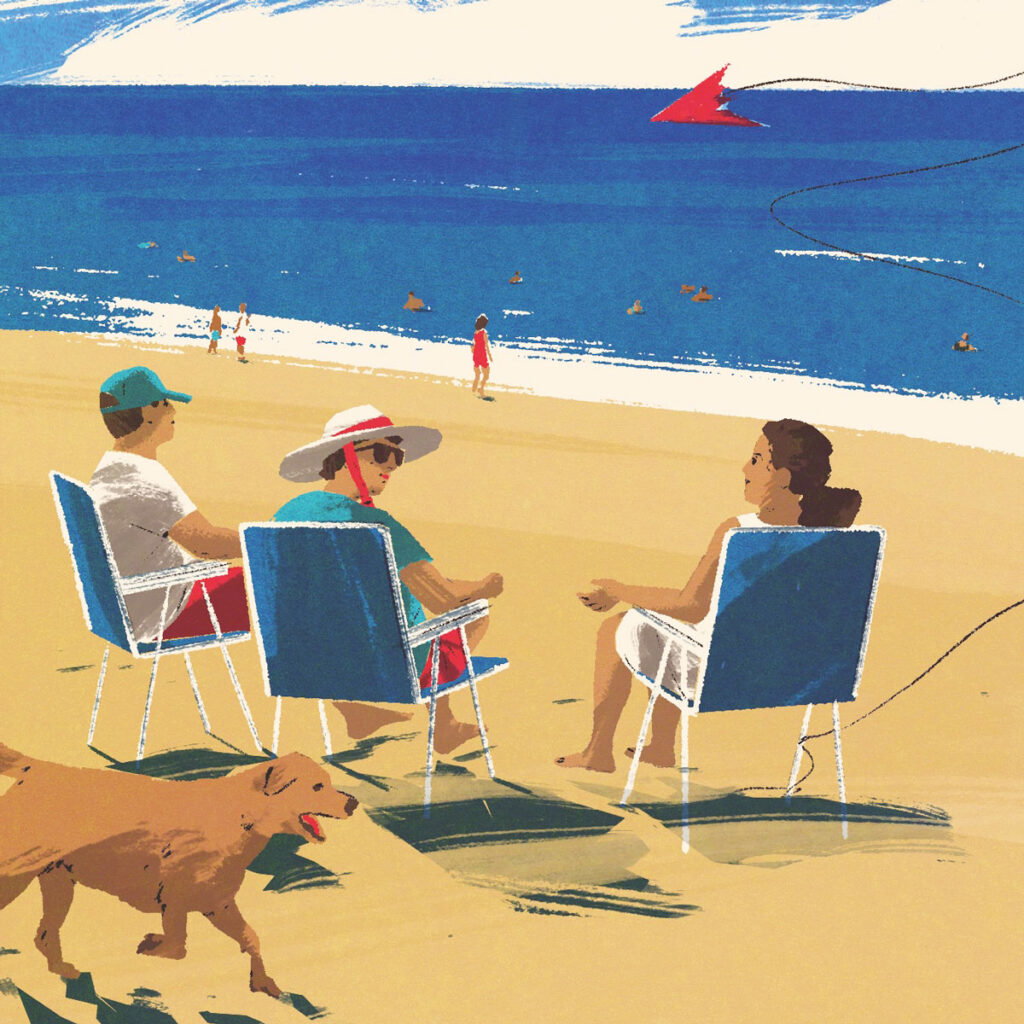
Illustration by Harry Tennant
Earlier this year, I started asking friends approaching 60 whether they consider themselves young for an older person or old for a middle-aged person. One especially sensible respondent said, “Let’s just call it autumn.”
As I grew up in New Jersey and Pennsylvania, my parents had such pronounced Richmond accents that my friends thought of me as bilingual. We used sir and ma’am in a way that seemed formal to the neighbors but was perfectly natural to us. Marianne and Tom wore their mild outsiderness with cachet, almost as a badge of honor.
Yet they also must have ached for family and familiarity because we hauled it back to Virginia for every vacation. Sometimes we’d go “home” to Richmond, other times to our cousins’ river place, but the best was Virginia Beach.
That was their beach growing up. My dad said he would occasionally cut school and go just for the day. My mother didn’t seem to believe this but agreed it was a summer center of gravity. Not fancier Sandbridge or Nags Head. Not Myrtle Beach, Kiawah, or Pawleys Island. Certainly not Cape Cod (drive north? Be serious). Just authentic, accessible “Va Beach.”
With a boardwalk dating from the 1880s, Virginia Beach cycles between mild neglect and thoughtful renaissance without ever losing its unpretentious heart. Its requisite strip is tacky but contained. It’s where you select the saltwater taffy or cheesy keychain for the girl feeding your cat and buy postcards you won’t send until you get home. Back then, Pete Smith’s Surf Shop would sell you a prestige T-shirt if you’d saved your allowance.
Sunburns from those trips have earned me frequent flyer status at the dermatologist. I still toss in my sleep dreaming of saltwater wipeouts that blanched my sinuses and tumbled me like a polished rock. The ocean helps you discover how small you are—and stays with you.
But eventually, everyone’s schedule got complicated, and vague itches for variety, whiter sand, or finer food developed (though nothing really outranks the Jewish Mother deli, RIP). Then after too many missed years, my grandmother restarted an annual roundup in a rented house on 52nd Street. She picked September to enjoy off-season rates, and we raced there from around the country for the chance to say “Yes, ma’am” to Ticki.
As much as I loved my little kid memories, I think I preferred those times as a young adult. Three generations at a stage when everyone was (almost) legal for a late afternoon beach beer. Someone would walk Ticki down while someone else carried her chair, and the rest of us lounged in the low ones, usually with a kite tied to an aluminum arm. The earth’s angle meant sunscreen felt optional and the water sparkled more brightly. Hardly anyone swam, but all toes were in the sand, and everyone sounded like home.
I look at those dinner table pictures that feature the same lime green tablecloth year after year as in-laws joined us and everyone aged.
I realize my parents were beginning their autumns, which is a very beautiful time.
• • •
Lucie André’s fixed fascination with stories sent her straight to the University of Virginia’s English department where she unknowingly prepared for arts administration, fundraising, and family adventures in New York, Atlanta, and Baltimore. Her debut novel, Never Ready, celebrates the power of art within a beautiful, terrible time: when downtown New York reckoned with AIDS.
This article appears in the Fall 2026 issue of Southbound.