



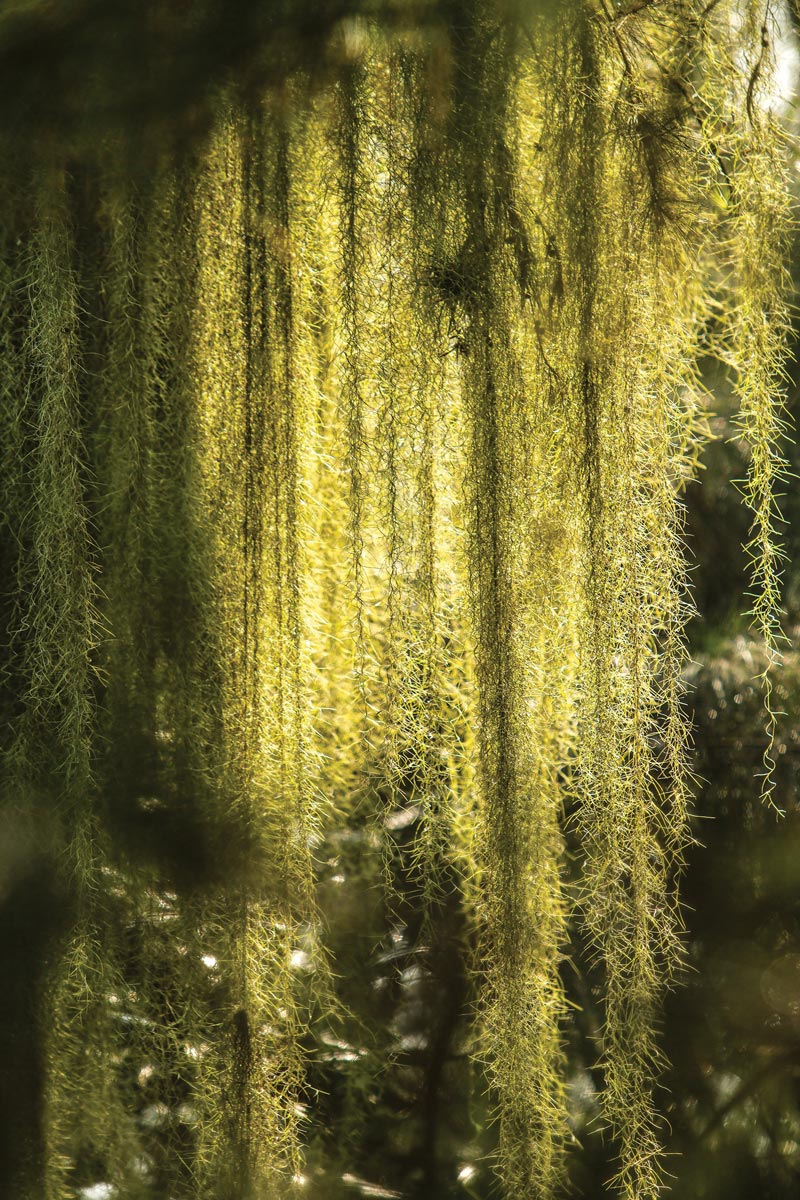
Photograph by Maurizio Catalucci
In his 1883 memoir, Life on the Mississippi, Mark Twain recounts how his riverboat copilot marked passage into the South by “shade-trees hung with venerable gray beards of Spanish moss.” Scores of writers, artists, and filmmakers since have drawn on the plant’s haunting silhouette and languid swaying as key visual signifiers of the region. Hanging in silvery curtains from southern live oaks and bald cypress trees, it’s a hallmark of iconic Southeastern cities—from Savannah and Charleston to Natchez and Mobile—and the eerie set dressing of Southern Gothic imagery.
- Spanish moss is neither Spanish nor moss but a flowering plant in the pineapple family native to the Americas.
- The plant isn’t parasitic; it belongs to a category of organisms called epiphytes that only use their host for support, drawing nutrients from the air and rainwater.
- One popular theory for the misleading name points to French colonists. Hearing local indigenous peoples refer to the plant as itla-okla or “tree hair,” the French adapted the term into “Spanish beard,” a dig at the facial hair of rival Spanish settlers. Over time, “beard” became “moss.”
- Historically, Spanish moss has served a wide range of practical applications: insulation, upholstery, mattress stuffing, and evaporative cooling pads used in “swamp cooler” air conditioners. These days, it’s primarily used as garden mulch.
- Stroll under canopies of live oak boughs heavy with Spanish moss at New Orleans City Park, Boone Hall Plantation & Gardens (entered by way of the legendary Avenue of Oaks) in Mount Pleasant, South Carolina, and Wormsloe State Historic Site near Savannah, Georgia.
This article appears in the Fall 2026 issue of Southbound.
Advertisement