
Home 2016

Archives

5 years of Groundbreakers: What our alums are doing now

2015: Smart Growth
WonderRoot
Founder Chris Appleton and his team have kicked off the EnRoute program, a public art project that explores issues of access, mobility and public transportation. Four murals are planned at MARTA stations along the north-south and east-west rail lines. The first, by artist Fahamu Pecou, was completed at King Memorial station this summer.

PATH 400
The 5.2-mile Greenway Trail part of Buckhead’s Trails and Greenways remains under construction, with about half of the project completed, including the first contiguous mile from Lenox Road to Wieuca. Initial agreements are now in place to connect the path to the Lenox MARTA station, and to extend it almost thee additional miles into Sandy Springs.

Avalon
Avalon, a mixed-use development in Alpharetta, has completed Phase I and will reveal its next phase in the spring of 2017. A bike share station was recently installed for guests. And in the last year, they’ve witnessed 12 marriage proposals take place on the grounds.

The City of Decatur
Decatur has officially gone green with a new High Performance Building standard that went into effect last November. Under this new standard, all buildings are required to obtain a green building certification, which more than 50 single-family houses and townhomes and four apartment buildings have already earned. The city has also undertaken several large-scale projects to improve access for pedestrians and cyclists, including a crosswalk facelift coming this fall.

Groundbreakers
Atlanta BeltLine Lantern Parade

Photograph by Steve Eberhardt

Chantelle Rytter
In addition to the BeltLine Lantern Parade, for which the city expects 60,000 attendees this year, Rytter has launched lantern parades in Grant Park, Decatur, and this year Sandy Springs. In June, the inaugural event, themed “Take it to the River,” featured floating lanterns on the Chattahoochee.

Jeremy Dahl, aka Machete Man
Since last fall, Dahl has been hard at work at the Fernbank Museum, clearing out the invasive plants from the 65-ace Fernbank Forest. He and his four apprentices also have continued their woodpecker conservation work and have begun a training program for local teachers who want to teach students how to collect their own scientific data.

Other 2015 finalists: Paces Properties, the Imperial Hotel, Clark Howard and Atlanta Habitat for Humanity, SCADpad, MARTA CEO Keith Parker

2014: Education
ArtsBridge
The arts education arm of the Cobb Energy Performing Arts Centre served more than 43,000 students and teachers during their 2015-16 season. They’ve also added three new initiatives: the Family Performances Series of popular children’s programs, a performing and visual arts college fair, and and a Director’s Bootcamp for fine-arts educators.

Groundbreakers
Fugees Academy

Photograph by Dustin Chambers

Fugees Academy
Last May, the Academy celebrated a milestone: its first graduating class of three seniors, Babba, Ogbai, and Ganaro. Thanks to support from the Drexel Fund and the Logan Family Foundation, Fugees Academy is exploring how to replicate their model and build a national network of schools serving refugee children.

Rollins Center for Language and Literacy
Since 2014, the Rollins Center has launched the Cox Campus, a free online teacher-training site that has so far benefitted more than 11,000 educators across Georgia and beyond. With grants from the Kellogg Foundation, the Belk Foundation and others, the center is also training more than 200 elementary school teachers in Atlanta Public Schools, with a focus on building young students’ language and critical thinking skills, vocabulary, and world knowledge.

Odyssey
Enrollment has increased by more than 23 percent since we last heard from Odyssey, a six-week summer program held on the campus of The Westminster Schools. Odyssey is strengthening the academic rigor of the program by hiring new teachers and incorporating a STEAM curriculum—Science, Technology, Engineering, Arts, and Math—at all grade levels. They have also launched Odyssey Career Quest for seniors, partnering with executives at several of Atlanta’s leading corporations to give students the opportunity to participate in boardroom discussions.

Other 2014 finalists: The Center for Civil and Human Rights, the Coretta Scott King Young Women’s Leadership Academy, Emory and Georgia Tech’s Biomedical Engineering Program, IS3D Educational Software, Midtown Buzz, READing Paws, VOX Teen Communications

2013: Health and Wellness

Georgia Organics Farm to School Program

Photograph by Ben Rollins

Georgia Organics Farm to School Program
More than 50 school districts across the state—including nearly every district in metro Atlanta—now participate in this program, whether by creating school gardens, serving local produce in the cafeteria, or incorporating garden-based lessons into the curriculum. Last April, First Lady Michelle Obama visited Burke County, where she commended the state’s farm-to-school efforts and planted a school garden.

Northside Hospital’s Bone Marrow Transplant Program
Northside’s program has continued to improve survival rates for transplants in which the donor is not a total match, and their approach has been adopted by many hospitals around the world. Today almost half of the transplant patients at the Northside receive bone marrow from a donor who is just a 50 percent match.

Indego Shepherd Center
In the past three years, Indego, a robotic device that allows people with paraplegia and mobility limitations to stand and walk, received CE Mark, the European approval for medical devices. And in late 2015, just before they earned FDA approval for rehabilitation and personal use in the U.S., the VA also announced that they will cover Indego for veterans who qualify.

Other 2013 finalists: Cancer Wellness, DETECT, Neurotrack, the Proctor Creek Project Partnership, Spelman College’s Wellness Revolution, C.J. and Kelli Stewart and L.E.A.D., the TEDDY Study

2012: Big Ideas
Atlanta BeltLine
Since 2012—the year the BeltLine opened to the public—construction has commenced on the Westside Trail and the Eastside Trail extension, a Streetcar System Plan has been adopted by City Council, and work has been completed on the Southwest Connector Spur Trail, the Gateway Trail, and a skate park at Arthur Langford Park. Next year, Atlantans can expect to stroll the newly completed Westside Trail for the first time.

Rosalyn Carter and the Carter Center Mental Health Program
The Rosalynn Carter Fellowships for Mental Health Journalism, which help journalists accurately report on mental health issues, have expanded to Colombia, the UAE, and Qatar. And as part of a three-year project in Liberia, the program worked alongside the country’s government to create a corps of 166 locally-trained mental health clinicians, whose work was particularly critical during the Ebola crisis.

Enterprise Innovation Institute
EI2, Georgia Tech’s development incubator for startups and entrepreneurs, welcomed its first corporate innovation center, Panasonic Automotive Systems, to Tech Square in 2012, and has since partnered with nearly a dozen other firms including Delta Air Lines, the Home Depot, AT&T, and Southern Company. In May, the U.S. Department of Commerce announced that the Institute will continue to operate the Minority Business Development Agency-Business Center Atlanta, with a five-year grant totaling nearly $1.5 million.

Harriet Robinson

Photograph by Gregory Miller

Harriet Robinson and GeoVax
Dr. Robinson, GeoVax’s chief scientific officer, continues to work on the HIV/AIDS vaccine that earned her a spot on our inaugural Groundbreakers awards. Her work, which is supported by the National Institutes of Health, is projected to enter two additional human trials in in fall 2016 and fall 2017. GeoVax has also broadened its research and development efforts to include an Ebola vaccine, and most recently a Zika vaccine.

Children’s Healthcare Strong4Life Program
Since 2012, the Children’s Healthcare of Atlanta Strong4Life Program has remained committed to reversing Georgia’s childhood obesity epidemic. To date, CHOA has reached nearly 1 million children and families. In 2016, Strong4Life is focused on helping new parents through a major advertising campaign targeting millennial moms and dads.

EUE/Screen Gems
In July 2015, Governor Deal appointed Kris Bagwell, executive vice president at EUE/Screen Gems Studios Atlanta, to the Georgia Film Music and Digital Entertainment Advisory Commission. Bagwell also continues to serve as the chairperson and founder of the Georgia Studio Alliance. The studio is getting a new 20,000-square-foot lighting and grip facility along with a new partnership with MBS Equipment Company.

Other 2012 finalists: Ponce City Market, arts patron Louis Corrigan, GATSBII and the Georgia Tech Human Factors and Aging Laboratory, Georgia State University, K. Rashid Nuri and Truly Living Well
Madeleine Hackney

Groundbreakers 2016
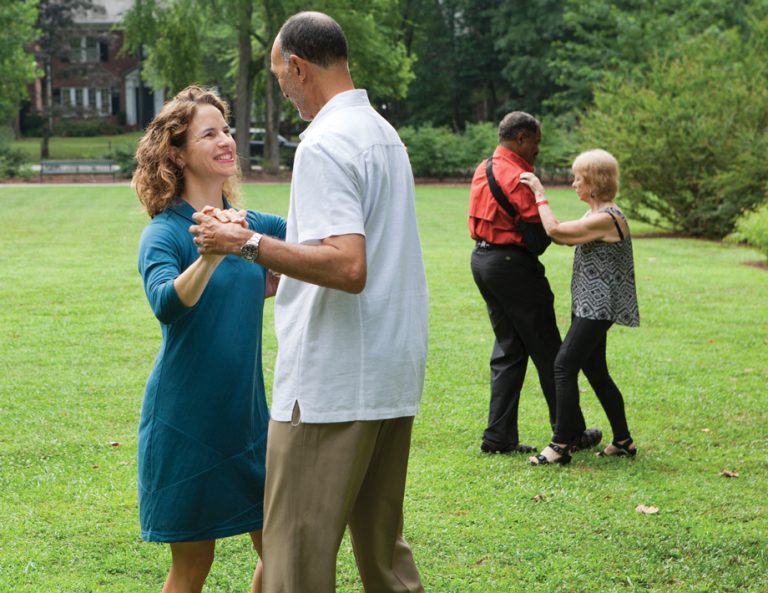
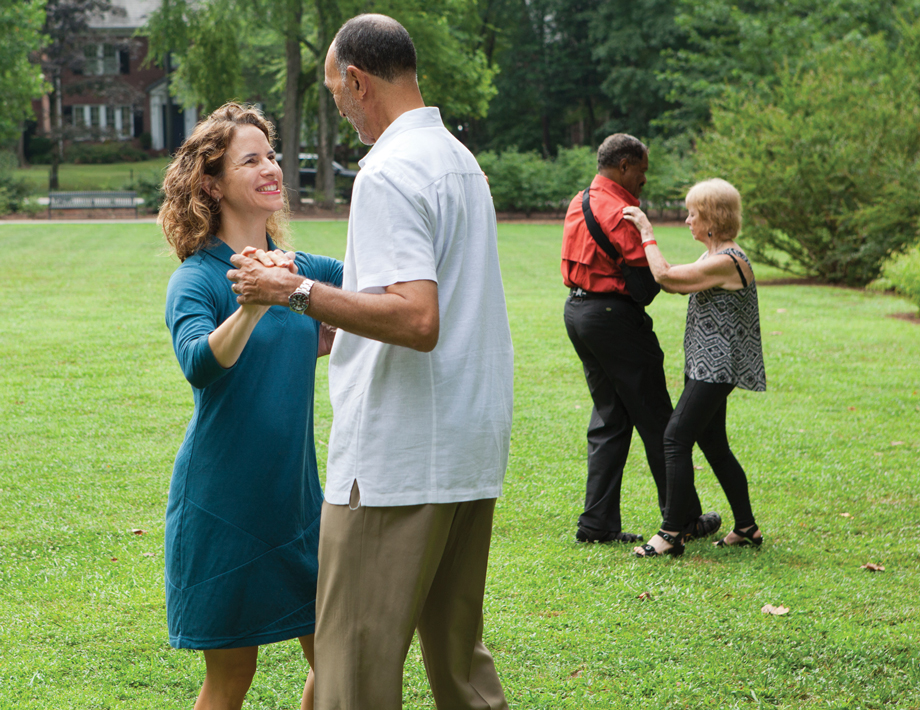
Madeleine Hackney (far left)

Photograph by Kaylinn Gilstrap

Setting aside walkers and canes, the newcomers timidly inched their way into a circle. Parkinson’s disease was slowly robbing them of balance and muscle control. But now, remarkably, they were ready to tango.

The instructor, Madeleine Hackney, flashed a reassuring smile. At her direction, they grasped their partners’ arms, elbow to elbow. With the stable anchor of a young volunteer, they tapped, swayed, and stepped to the beat.

Argentine tango is traditionally danced in close embrace, with spontaneity and musicality. Hackney, a research health scientist at the Atlanta VA Medical Center and a former professional dancer who once performed with the Radio City Rockettes, began adapting the rhythmic style in 2006 as a therapy for movement disorders.

People with Parkinson’s are often stiff. The disease destroys brain cells that produce dopamine, a chemical necessary for movement control, leaving patients prone to slowness, tremors, and even freezing in place. Some of the people in Hackney’s studies can walk only a few feet at a time. Yet somehow they manage to keep dancing—albeit with assistance—for an hour and a half.

Tango works well as a therapy because its pattern of slow and quick steps mirrors rehabilitative movements, says Hackney, who is also an assistant professor of geriatrics at Emory University. “There’s a general [therapeutic] effect of exercise, but tango can help you hone certain skills,” such as stepping backward or shifting weight from foot to foot, she says. disea

In controlled studies Hackney has conducted over the past decade, she showed that a series of 20 dance sessions led to improved gait, balance, and motor control in people with Parkinson’s and produced similar benefits for the very elderly and the visually impaired. Currently Hackney is using MRI to study the effects of tango on the brain. Her hypothesis: The music and dance steps spur “plasticity,” or long-lasting changes in neural connections.

So far Hackney has trained about 30 instructors in the Southeast to offer adapted tango as an exercise program for those with mobility issues. But her greater goal is to pave the way for patient-specific therapy treatments that would supplement medication.

Trudi Leggett of Stone Mountain signed up for a Hackney study last fall on the advice of her neurologist. She was diagnosed with Parkinson’s disease three and a half years ago and has problems with her legs. The muscles contract too much, which makes her walking erratic.

“She didn’t expect us to be what you see on Dancing with the Stars,” says Leggett. Little by little, she learned the steps. “We did all kinds of things I didn’t think I would ever be able to do,” she says, “but especially not with the limitations of the Parkinson’s.”

Cast your vote for Groundbreaker of the Year

Back to Groundbreakers

This article originally appeared in our September 2016 issue.

Clarkston Community Center Senior Refugee Program

Groundbreakers 2016
Vatiera Guragai of Bhutan is one of the program’s participants.

Photograph by Kaylinn Gilstrap

Four years after leaving his homeland of Bhutan, Bhupal Katwal, 62, still struggled to find the English words to explain the religious bigotry that propelled him to journey across the globe.

“My religion is Hindu. Hindu, no. Buddhist,” he said, shaking his head. But then Katwal smiled. “U.S., free country.”

The cornerstone of Katwal’s new life in America is the Senior Refugee Program at the Clarkston Community Center, which opened in 1994. Clarkston, a tiny city of just one square mile, has resettled thousands of refugees from dozens of countries in the past two decades, earning it the nickname “Ellis Island of the South.”

Not long after the city’s community center opened, the staff recognized that older refugees face unique hurdles in adapting to a different culture. “They’re the last [in the family] to get any kind of services,” says director Cindy Bowden. “They’re the last to learn English. They’re the last to get involved in the community. It’s important to offer them an avenue to belonging.”

To that end, the center provides free ESL instruction for older refugees and also refers them to caseworkers who can help with practical matters like obtaining healthcare and using a computer. This fall Bowden is developing a wheelchair-accessible garden that will host activities that unite older refugees with American-born seniors.

Teresa Hatten has been a teacher at the community center for five years, and her English lessons include discussion of differences. “We talk about the mosque, the church, the temple, the synagogue,” she says. One Christmas a student pointed to the sky to show Hatten that she believed in God. She came from a country fraught with religious turmoil. “She said, ‘Teacher, I love you.’”

Cast your vote for Groundbreaker of the Year

Back to Groundbreakers

This article originally appeared in our September 2016 issue.

TechSAge

Groundbreakers 2016
Photograph courtesy of TechSAge

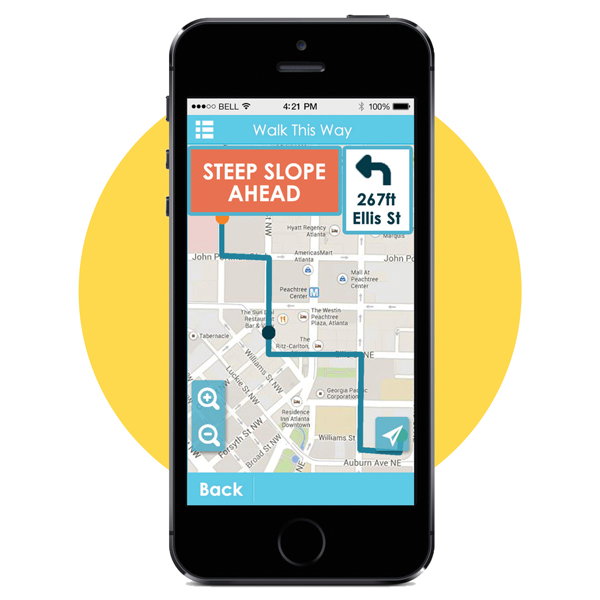
The woman guided her wheelchair onto the sidewalk along Spring Street in Midtown and considered her options. She was only going a few blocks to the Center for the Visually Impaired on West Peachtree Street and Fourth, but to get there smoothly, she had to consider potential barriers that able-bodied people don’t usually worry about, such as missing curb cuts, broken sidewalks, and steep slopes.

She consulted the new app on her smartphone, which directed her along Armstead Place rather than Fourth Street; there’s no walk signal or crosswalk across traffic-heavy Spring Street at Fourth. The app, called ALIGN (an acronym for Application for Locational Intelligence and Geospatial Navigation), developed at Georgia Tech and being tested in Midtown, allows users to select walking routes that avoid high-crime areas, uphill climbs, or even searingly hot and unshaded sidewalks.

It’s just one of many innovations emerging from the university’s Rehabilitation Engineering Research Center on Technologies to Support Successful Aging with Disability, or TechSAge. The center brings together nearly 30 researchers, all working on devices and designs to make life easier for people who are aging with physical limitations.

“There’s more power [in tech solutions] when we’re working together,” says architect Jon Sanford, who codirects TechSAge with Wendy Rogers and Tracy Mitzner, psychologists who specialize in the acceptance and use of technology by older adults. Sanford is a champion of “universal design,” which aims to make the built environment accessible to everyone, and many of the TechSAge developments, such as ALIGN, could also be useful for younger, able-bodied people.

Among their projects: TeleWellness Technologies uses a telerobot—basically a remote-controlled iPad affixed to a wheeled pole—to enable people to join an exercise class without leaving home. GatePal, another app, guides travelers through Hartsfield-Jackson airport with less frustration—for instance, directing them to shorter security lines, as people with disabilities may find it hard to stand for long stretches. Food for Thought, a video game accessible to people with visual or dexterity impairments, provides cognitive training for older adults. TechSAge also has a futuristic side, with research into smart beds that can be repositioned via the internet, robotic caregivers, and a SmartBathroom that uses sensors to automatically readjust hand supports and toilet height as needed.

The common thread: creating a user-friendly world, no matter what our abilities—or age.

Cast your vote for Groundbreaker of the Year

Back to Groundbreakers

This article originally appeared in our September 2016 issue.

The Giving Tree Intergenerational Preschool Program

Groundbreakers 2016
Photograph by Kaylinn Gilstrap

The Arbor Terrace assisted living facility in Alpharetta is typically a pretty quiet place. But on Wednesday and Friday mornings, the space is filled with an unexpected sound: the excited chatter and squeals of young children. At the Giving Tree Intergenerational Preschool Program—a pilot program implemented last January by the George Center for Music Therapy—classes of four- and five-year-olds join residents for weekly sessions of singing, playing instruments, and generally getting to know one another.

“Let’s pass out scarves to our adult friends!” chirps Melissa Sorensen, a music therapist with the George Center, who runs the program. About a dozen seniors sit in a circle, along with five kids ranging in age from toddlers to kindergarteners. (In the summertime the program morphs into weekly drop-in sessions for local children of all ages.) Today Sorensen is leading the group in a picnic-themed musical activity, and she wants the seniors to wave the scarves up and down while the kids pretend that they’re flying kites. Mary Poppins’s “Let’s Go Fly a Kite” plays over a set of speakers. During the school year, the ratio of seniors to kids is one-to-one, and some of the residents are jockeying for the children’s attention. One resident slyly tosses her scarf on the floor and asks a curly haired three-year-old girl to return it to her. The girl looks unsure but timidly complies.

“At first some of the kids are fearful,” says Sorensen. “Even if [the residents] are high-functioning, if they have disabilities or walkers, it can be kind of scary to small children. They don’t really know what to make of it.” To help reassure the kids and encourage connections, Sorensen initiates lots of games and activities in which young and old have to work together. She’ll ask older residents to talk about popular music from decades past or their favorite songs from childhood.

“The summertime drop-in program is great, but what’s so special about the preschool is that it’s the same kids over the course of 16 weeks. After a few sessions, I’ll start to hear, ‘I want to be with Miss Rose today!’” she says. “You start to see a mutual joy in the activities and a trusting relationship.”
Research shows that cross-generational connections benefit everyone involved. For young people, it provides a positive view of aging, making them less likely to stigmatize the elderly. For older adults, it can reduce the likelihood of depression and social isolation, improve speech and conversation, and strengthen feelings of self-worth. “[The program] is not just about being heart-warming,” says Sorensen. “It’s about therapeutic value.”

The Giving Tree program has proven so successful the George Center plans to expand it to two additional senior living facilities, with more to come. Stephanie Mock, the engagement director at Arbor Terrace, says that even residents that might not normally participate in music therapy will peek their heads in or inch their walkers toward the door when the kids arrive.

“In some cases, residents might not have grandkids or great-grandkids, or they might not live nearby,” she says. “We’re bringing in the outside world a little bit. To watch them light up when the children break out of line to come give a hug is amazing.”

Cast your vote for Groundbreaker of the Year

Back to Groundbreakers

This article originally appeared in our September 2016 issue.

The Fuqua Center for Late-Life Depression

Groundbreakers 2016
Illustration by Leonard Beard

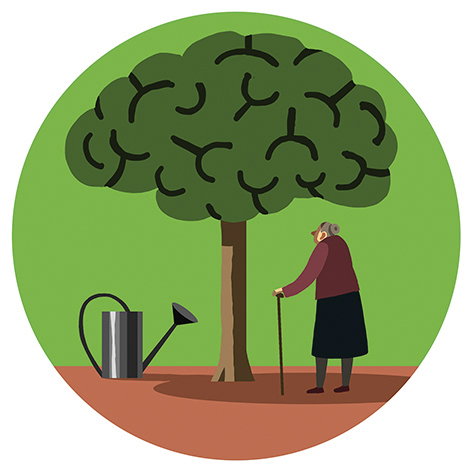
The first time Jocelyn Chen Wise visited Eleanor’s* northeast Atlanta apartment, she was shocked by the squalor. The bedroom was infested with cockroaches. The fridge was mostly empty. Nothing had been cleaned in ages. The biggest problem, though, wasn’t the octogenarian’s apartment, but the paranoia that trapped her inside. Eleanor’s family members, who also struggled with mental illness, were unable to help, and she grew frail and malnourished.

“She was spiraling,” recalls Wise, a project director with Emory University’s Fuqua Center for Late-Life Depression, who was tasked with bringing services to seniors living in the Atlanta Housing Authority’s high-rises. Wise realized Eleanor needed psychiatric and medical treatment and called a social worker at Adult Protective Services, then Wesley Woods Hospital to reserve a bed, followed by Emory Healthcare for an ambulance.

In Georgia one in five adults suffer from some kind of mental illness, and the rate is higher in adults over age 60. Depression also often gets overlooked as a side effect of dementia, Alzheimer’s, or Parkinson’s disease.

“When people get older, they fall off the map in terms of mental health services,” says Dr. William McDonald, a geriatric psychiatrist who heads the Fuqua Center. There’s an assumption that getting old means becoming senile and, along with that, a slow decline of mental well-being. But “depression is not a normal part of aging,” says Fuqua Center project coordinator Cathy Rambach. “Just because Grandma is old, it doesn’t mean she should be withdrawn, uninterested in what made her happy before.”

The Fuqua Center was created in 1999 with a $1 million donation from J.B. Fuqua—the late businessman and philanthropist who fought depression for five decades—and a mission to improve access to depression treatment for older adults and increase understanding of mental health issues affecting seniors. Part of the Emory Brain Health Center, McDonald’s team helps seniors find mental health services and assists providers in better address­ing the needs of their aging clients. The Fuqua Center’s work ranges from training employees of partnering agencies like the AHA (think maintenance workers fixing the air conditioners) to identify early signs of depression in their clients, to researching new ways to treat mental illness in the elderly.

The end goal is to allow seniors like Eleanor to remain happy, healthy, and independent for as long as possible. After Wise’s intervention, Eleanor spent nearly two weeks in the hospital, where doctors diagnosed her with psychosis and mild cognitive impairment, as well as underlying physical ailments, including vitamin deficiencies and malnutrition. Slowly but surely, she gained weight, eating triple helpings of hospital food, and her mental state improved. Once she was discharged, the Fuqua Center helped place Eleanor in a top-notch personal care home.

“It was a modest place,” Wise says. “But they loved having her there, they took good care of her, and she looked so much better. She had a total turnaround.”

* Name has been changed

Cast your vote for Groundbreaker of the Year

Back to Groundbreakers

This article originally appeared in our September 2016 issue.

SAGE Atlanta

Groundbreakers 2016
Illustration by Leonard Beard

When James* was diagnosed with lung cancer in his 80s, he was in a pretty good place compared to many of his peers. He had a solid network of supportive friends, and he had planned well. But James, a gay WWII veteran, needed help finding LGBT-friendly healthcare providers who would supply quality, consistent care in his last days. To do that, he turned to SAGE Atlanta, the five-year-old local chapter of SAGE USA, the country’s largest and oldest organization focused on LGBT seniors.

“When the time came, we helped him identify the best hospice and home health providers for LGBT individuals, so that he could end his life in the way that he wanted to,” says Linda Ellis, executive director of the Health Initiative, which oversees SAGE Atlanta. In addition to acting as an educational and referral resource for the LGBT community—often working in partnership with AARP Georgia, the Atlanta Regional Commission, and the Georgia Division of Aging Services—SAGE provides training for service providers like senior living centers, home health aides, doctors, and hospitals.

“What we’re trying to do is make sure that the senior center in your neighborhood or the assisted living facility that you can afford is LGBT friendly and supportive,” says Ellis. “And we’ll hold their hands as well, helping them figure out how to provide those resources and train their staffs and live out that commitment.”

“There’s a huge need for it,” says Anne McSweeney, president of CEU Concepts, who has worked with SAGE to offer continuing education courses for healthcare professionals. “Many times providers don’t realize what they’re missing until they’re in a situation with an LGBT client and they’re not sure how to proceed. You can see the lightbulbs going off in the room.”

Within the LGBT community, Ellis says that support for older adults is just as critical. LGBT elders face higher rates of poverty, isolation, and loneliness than their straight peers, and may be less likely to utilize health and social services for fear of discrimination. “This generation had to live their entire lives being stigmatized; they often had to sever connections with their families in order to come out,” says Ellis. “They’re much more dependent on ‘families of choice,’ but as they age, it’s easy to get lost.”

To help maintain those “families of choice,” SAGE offers weekly get-togethers for LGBT seniors, who gather for book clubs, potlucks, and educational talks. “It’s a pretty close-knit group,” says Clyne Hodges, 67, who has been involved with SAGE Atlanta since the chapter began. When another member recently found out he had cancer, the rest of the group coordinated to offer rides and take over household repairs. “It’s kind of like a village, where people help each other. You need people around your same age that you can relate to.”

Metro Atlanta has one of the biggest LGBT communities in the country, Ellis notes, “and if you are lucky enough to connect with us, we will do everything we can to support you. The unfortunate part is that for every person that we help, there are literally hundreds of folks who are doing it by themselves.”

* Name has been changed

Cast your vote for Groundbreaker of the Year

Back to Groundbreakers

This article originally appeared in our September 2016 issue.

Atlanta Regional Commission and the Lifelong Communities Initiative

Groundbreakers 2016
Illustration by Leonard Beard

One steamy July morning, in the dining room of a spacious Inman Park home, a group of longtime neighborhood residents strategized over muffins and coffee about how to combat the unpleasant problem of root-busted sidewalks. And how to address the fact that Inman Park is home to nearly 4,300 people and a multitude of pricey luxury apartments but not a single residence classified as senior housing. And how to help their elderly neighbors learn to trust and use ride share services like Uber should driving become impossible.

The volunteers are all part of Lifelong Inman Park, a 16-person committee formed three years ago that now meets monthly. Their objective: to age-proof the neighborhood they love, making it as livable as possible for all residents, whether they traverse its cracked sidewalks in wheelchairs or strollers. In other words, to make it a “lifelong community.” Time is of the essence. Just 13 percent of Inman Parkers are older than 55 now, but committee leaders like Judy Clements know “there’s a big wave of people coming along.” She recently inventoried the neighborhood’s multifamily housing stock, examining properties to determine their suitability for senior housing.

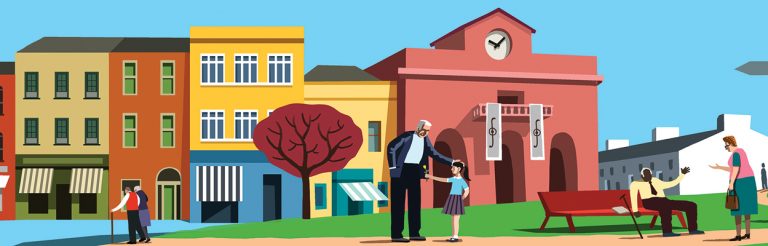
Inman Park’s group—along with more than 20 others in neighborhoods and cities across the metro area—is part of the Lifelong Communities Initiative. It was launched by the Atlanta Regional Commission in 2007 with grant money from the Robert Wood Johnson Foundation and later incorporated the expertise of “new urbanist” architects alongside input from regular citizens. The result was a framework for bucking suburban-style planning in favor of walkable, vibrant, mixed-used communities with citizenries of young and old.

According to the ARC, which functions as the regional planning and intergovernmental coordination agency for 10 counties around Atlanta, the number of metro residents age 65 and over swelled by 88.5 percent between 2000 and 2015, far outpacing the general populace.

The five original case study sites spanned the region: BeltLine/Boulevard, Conyers, Mableton, Fayetteville, and Toco Hills. “They’re all at various stages,” says Katie Perumbeti, the ARC’s Lifelong Communities Active Living Coordinator. “We keep them going.” The commission does that by hosting quarterly meetings, showing the groups how to find funding or make senior projects more economical, and relaying how other communities have navigated challenges or reached their goals.

One upstart that’s generated success quickly is Norcross, led by volunteer chairman Gary Brace, a recently retired actuary who calls the ARC a wellspring of good ideas. Each member of the Gwinnett city’s nine-person Lifelong Communities committee is in charge of singularly focused initiatives: installing walking and bike paths, designing a new park, planting more trees, and finding sustainable energy options, for example. They also encourage the development of smaller houses and townhomes—most within walking distance of Norcross’s picturesque downtown—that appeal to seniors. “I think [we are] on the cusp of blossoming into an extremely livable community,” says Brace.

Back in Inman Park, committee chairperson Cathie Berger stresses that the benefits of keeping seniors where they want to live are reciprocal. “Older people bring a balance into the community,” says Berger, who retired as manager of the ARC’s aging and health resources in 2013. “But where are people going to go, and what are cities going to do if all the [seniors] have to leave?”

Cast your vote for Groundbreaker of the Year

Back to Groundbreakers

This article originally appeared in our September 2016 issue.

HouseProud Atlanta

Groundbreakers 2016
Photograph by Lindentree Photography

For years patches upon patches held together Judy Craft’s 1940s bungalow in southwest Atlanta. But rudimentary fixes were no match for the rainstorms that pounded the city last December. On Christmas Day, the friendly 69-year-old widow watched as her dining room ceiling collapsed, opening the house to the cold sky.

Craft’s daughter, Evelyn, turned to the internet for emergency help and found a number for HouseProud Atlanta, a small Chosewood Park nonprofit that’s aided more than 700 low-income seniors since 1992. It provides home maintenance and repairs—everything from new toilets and wheelchair ramps to entire roofing or plumbing systems—for free. After performing a quick site analysis and getting quotes from contractors, HouseProud had the damage fixed in a few days, at no cost to the Craft family.

Needy homeowners can seek repair assistance from a handful of larger agencies, such as Meals on Wheels or Senior Connections, but HouseProud leaders and clients say their personalized approach is unique. Years of attending neighborhood meetings has ingratiated them to the small geographic zone they serve (an NPU-specific crescent of communities south of downtown, from Summerhill to Cascade). Their sole focus, repairing or maintaining the homes of seniors, has made them experts. Their average client is a widowed black woman living on less than $800 per month.

“For a lot of [clients], their home is their life,” says executive director Lisa Jones. “We want to make sure they have the option to stay.”

HouseProud’s record-high $389,000 budget for 2016, raised mostly from corporate sponsorships, covers two full-time salaries (Jones and program manager Al Shugart) as well as all supplies and contractor fees. They do receive a bit of federal funding, and Home Depot often supplies gift cards. But the operation is lean and relies on hundreds of volunteers—nearly 800 last year alone—to fulfill its mission of keeping seniors “warm, safe, and dry” in their existing homes.

The elbow grease is paying off. The Atlanta BeltLine selected HouseProud as a partner this year to repair eight houses along the under-construction Westside Trail at up to $25,000 each—relatively princely sums.

Another beneficiary, 69-year-old Ruby Dickerson and her husband, Robert, 72, of Cascade, were aghast to learn a sorely needed new roof would cost $5,000 that they didn’t have. HouseProud replaced it. “I’ve been in this house almost 50 years,” says the retired hospital clerk. “When I saw that brand-new roof, I cried. I’ll be forever grateful.”

Cast your vote for Groundbreaker of the Year

Back to Groundbreakers

This article originally appeared in our September 2016 issue.

Dr. Monica Parker

Groundbreakers 2016
Photograph by Kaylinn Gilstrap

Science shows that people of color are nearly twice as likely as their Caucasian counterparts to develop some form of dementia. And yet African Americans are consistently under-represented in Alzheimer’s studies. So geriatrics physician Dr. Monica Parker—whose mother and grandmother both suffered from dementia—doesn’t mince words when she’s doing community outreach for Emory’s centers on Alzheimer’s Disease Research and Brain Health. She’s been known to ask: “If you were diagnosed on the dementia spectrum tomorrow, which of your relatives would take care of your business affairs?” She then adds: “Who’s going to help you with more personal needs, including getting you in and out of the bathtub and wiping your derrière?”

Says Parker: “It tends to get a reaction, but that’s the point. We’re Baby Boomers. We think we’re going to live forever. We never stop to consider living forever with an impairment.”

For the past eight years, Parker has worked to foster relationships with Atlanta’s African American churches (including Cascade United Methodist Church, where Alzheimer’s day programs and support groups are now being developed) and historically black sororities (including the Atlanta chapters of Delta Sigma Theta and Alpha Kappa Alpha). A chief goal: persuading minorities to enroll in Emory’s Registry for Remembrance, which aims to educate African Americans about the disease and recruit them for long-term studies.

Parker says getting those of a certain age to consider joining research studies can be an uphill battle. “These are people who were alive during the Tuskegee experiments of the 1930s or grew up hearing about them from their parents,” she says. “African Americans, especially those raised in the deep South, are certainly more attuned to injustice and unfairness—and rightfully. They have a lingering suspicion of academic research centers.”

Another challenge: explaining the intimate connections between dementia and other chronic medical conditions like diabetes, high cholesterol, and hypertension. Basically, it all comes down to blood flow to the brain. “So many people say, ‘I don’t want to hear about diabetes,’” says Parker. “My response is, ‘If you don’t control this chronic disease and keep it in check, it will ultimately affect how your brain works later in life.’”

Thanks to Parker’s efforts, people are listening, and more importantly, they’re telling their friends. The community educational sessions she hosts at the Carter Center have already outgrown their original space as hundreds of aging residents sign up to attend. “Our meetings have mushroomed,” she says. “We’re seeing a lot more community participation in our research projects. It’s critically important data for us.”

Though Parker stresses, “I didn’t get into this work because of my personal acquaintance with this disease,” she believes that “hopefully, I’m more sensitive than someone who hasn’t had those experiences. It certainly makes me more motivated to take care of my own health. There are age, gender, and genetic factors with this disease that you can’t do anything about. But you can change what you put in your mouth. You can choose to be more proactive about going to the doctor. When a patient or someone I reach in the community chooses to age more healthfully, that’s a good day for me and this work.”

Cast your vote for Groundbreaker of the Year

Back to Groundbreakers

This article originally appeared in our September 2016 issue.

Follow Us

69,386FansLike
144,836FollowersFollow
493,480FollowersFollow

NEWSLETTERS