
Home 2025

Archives

Atlanta arts organizations are running on empty

0
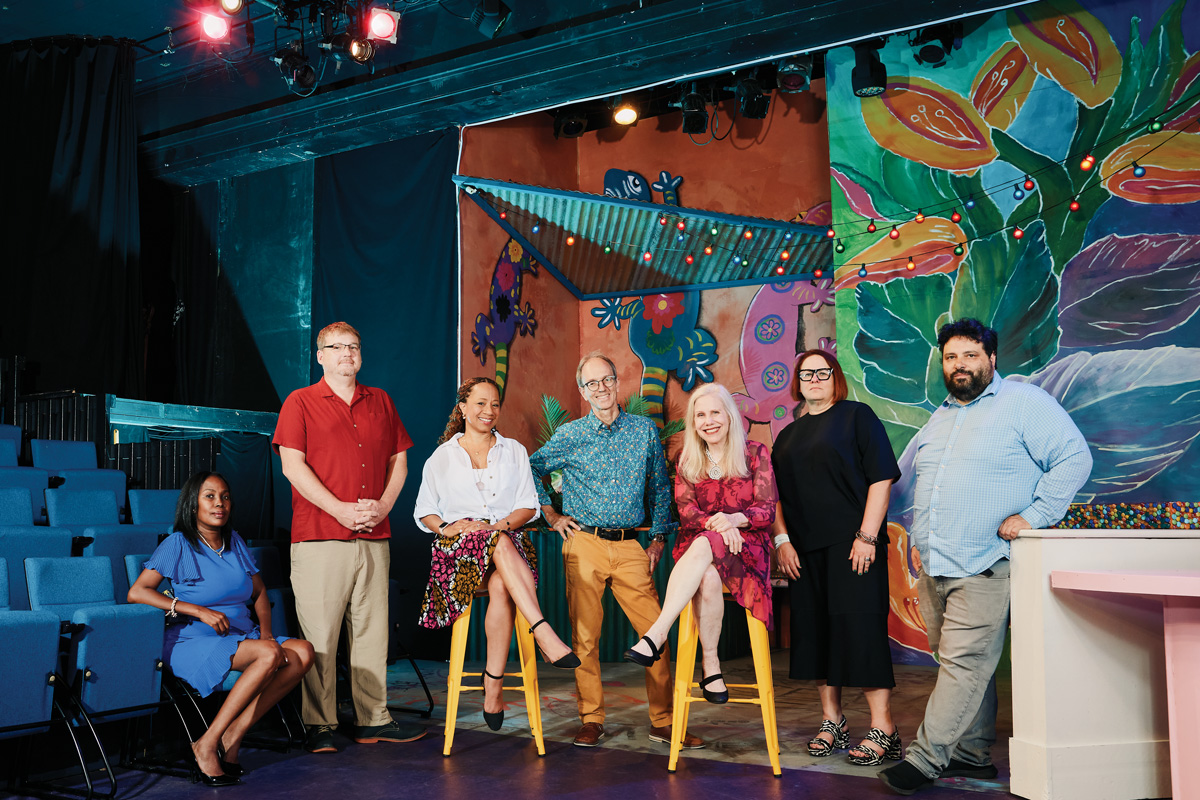
From left to right: Georgians for the Arts’ Waduda Muhammad; Mack Headrick, managing director of 7 Stages; Angela Harris, executive artistic director at Dance Canvas; Horizon cofounders Jeff and Lisa Adler; Laura Flusche, executive director of Museum of Design Atlanta; Alexander Scollon, managing director for Actor’s Express

Photograph by Ben Rollins

On a recent Friday, more than a dozen nonprofit arts leaders logged into Zoom for a weekly discussion about the joys and challenges of running their organizations. Formed during the Covid-19 pandemic, the virtual meeting has served as a space where attendees can share resources with one another—from props to recent news to new grant opportunities—and invite each other to upcoming events.

It has also served as an outlet for the metro Atlanta arts executives to discuss how they’re each navigating ongoing funding challenges. From corporate sponsors to local, state, and national grants, annual funding they could previously set their watch by has contracted significantly in recent years. The resulting budget cuts come as arts participation remains below pre-Covid numbers, but labor and materials cost significantly more.

The weekly meeting doesn’t have a set agenda, but attendees are rarely out of topics to discuss. And, because they often rely on the same funding sources, the discussion typically unfolds organically. On this day, Waduda Muhammad, executive director for the advocacy group Georgians for the Arts, informs everyone that her organization recently held its annual retreat and was pleased to have both a Democratic and a Republican state representative in attendance. Bipartisan support, she says, is crucial to securing government funding for the arts in the future.

Alexander Scollon, managing director for Actor’s Express, chimes in. He says he had two major takeaways from talks with the lawmakers. For one, the oft touted statistic that Georgia has consistently ranked at or near the bottom of public arts funding in the U.S. is “not an argument that holds any water, and they do not care.”

For at least a decade, arts executives have cited the statistic with the hopes of showing that, despite celebrating itself as an entertainment hub, the state doesn’t do much to support homegrown nonprofits in the arts. But this messaging doesn’t seem to be working on legislators, who often cite their support of the arts through legislation such as Georgia’s film tax credit.

Scollon notes that the two lawmakers did, however, care about the media coverage the state had been receiving. “They referenced getting negative press and no positive press” from arts groups, he says. “And they would pull that out as reasons to not continue supporting programming, because they would say, ‘Well, remember, you were beating us up in the press about this thing?’”

“What kind of good press do they want us to give them?” Lisa Adler, cofounder of Horizon Theatre Company, responds. “I mean, really, what on earth could we possibly say?”

Scollon agrees. But he says the discussion let him know that organizations such as Georgians for the Arts and the newer coalition Arts Capital | Atlanta should “find additional ways to communicate with [politicians] around successes, and maybe sometimes in spite of the way that they treat the industry.”

Muhammad chimes in, too, noting that arts leaders could discuss funding cuts with more nuance. For example, the Georgia Council for the Arts didn’t cut $3 million in funding. The reduction is a result of federal Covid aid disappearing. Sure, it’s disappointing that the funds are going away, regardless of the reason. But why this funding is shrinking does matter.

Arts organizations are also facing shifting waters at the National Endowment for the Arts. For the 2025 fiscal year, the NEA comprises roughly $1 million of the Georgia Council for the Arts’ $4.9 million grant pool. But, earlier this year, President Donald Trump renewed his proposal to eliminate the NEA in fiscal year 2026 after failing to do so in his first term. Arts leaders worry that with Covid funding coming to an end and the NEA facing an uncertain future, the arts council would have only $976,356 remaining to distribute via art grants statewide. Representatives with the Georgia Council for the Arts declined to speak with Atlanta magazine for this story.

NEA funding cuts have already hit the arts organizations directly. In May, hours after the president suggested eliminating the independent federal organization, the NEA emailed hundreds of arts nonprofits to inform them that their grants had been terminated. NPR obtained a copy of the email, which read, in part, “The NEA is updating its grantmaking policy priorities to focus funding on projects that reflect the nation’s rich artistic heritage and creativity as prioritized by the president.”

Among the nonprofits that received the email was the Atlanta Film Festival. Christopher Escobar, the festival’s executive director, says the festival’s $20,000 NEA grant had already been received and spent. “I was blindsided by the fact that something that’s already a done deal was getting retracted,” he says. “They’ve yet to ask for it back.”

JoJasmin López, a board member for drawchange, says half of her organization’s $100,000 NEA grant was rescinded before the arts nonprofit received it. The organization, which provides arts therapy programming to impoverished youth, has an annual budget of less than $500,000, so the loss is significant. López says it will impact drawchange’s ability to bring arts to homeless shelters.

“There is no elsewhere. If there was a magic tree that I could go get $40,000 from, I would have been at that tree. That tree don’t exist. We’ve already cut our budgets so razor-thin that there’s nothing left.”

The funding challenges don’t stop there, though. In the days prior to the Zoom meeting, Fulton County had begun sending out emails that announced how much grant funding arts organizations would receive this year. Last year, the county provided $3 million in grants to local arts groups and artists, with recipients receiving between $1,000 and $50,000. But, earlier this year, the county’s board of commissioners voted to approve a budget with a $1.7 million cut in funding. The reduction means the county will provide $1.3 million in grants which will be spread out among an expanding number of arts organizations.

Mack Headrick, managing director of 7 Stages Theatre and leader of the virtual meetings, says the theater company’s typical county funding was cut by 60 percent. Other organizations say they experienced similar cuts.

This was expected. Arts leaders knew Fulton County was slashing arts funding to reallocate money toward fixing the Fulton County Jail as federally mandated in the aftermath of a Department of Justice investigation. Still, the emails with the reduced grant amounts from the county was yet another frustrating blow to the arts in Atlanta.

On the day of the Zoom session, many of these arts leaders say they face a new fiscal year that would begin in less than a week, on July 1, and that they are forced to consider making cuts to personnel and programming.

“There is no elsewhere,” Headrick says. “If there was a magic tree that I could go get $40,000 from, I would have been at that tree. That tree don’t exist. We’ve already cut our budgets so razor-thin that there’s nothing left. Georgia Power is not going to take less for their bill. There’s nothing to cut except for programming and people.”

• • •

In some ways, the pandemic was both a wrecking ball and a salve.

“We felt like we had the money we needed to do what we wanted to do,” Laura Flusche, executive director of Museum of Design Atlanta (MODA), says of Covid relief funding. “Even though we couldn’t open the doors for a long time, it was still like, Oh, okay, we can focus on the work.”

But nonprofit arts organizations have had to contend with the sluggish return of audiences even after restrictions were lifted. Alexander Scollon of Actor’s Express says he can’t fully blame people, although the trend is frustrating. Prior to the pandemic (during which he also became a dad), he went to the movies two or three times per week. Since the pandemic, he’s gone only three times. “We have seen a steady increase since returning from the pandemic, but we’re still about 35 percent down on single ticket sales from 2019,” he says. “Costs have risen pretty significantly, both in labor and material costs. Everything’s about 20 percent more expensive, so we’re having a really hard time balancing that.”

The theater company builds all the sets for its shows. But Scollon says the prices of materials have fluctuated significantly in recent years, making it hard to create a realistic budget. “We build five or six sets a year,” he says. “That can add up to $150,000 over the course of the year that we had initially budgeted at half that cost.” With small margins for each show, increased production and labor costs mean the nonprofit may spend more money to produce a show than it earns back in revenue.

The Friday Zoom calls started as a meeting for theater groups during the pandemic before expanding to the larger arts community. In 2023, The Lyric Theatre cited financial issues for closing abruptly in the middle of its 42nd season. The news rocked the arts leaders. In their weekly meeting, they confided in one another about their lack of reserves and how precarious the future felt.

For MODA’s Flusche, the conversation affirmed that her organization wasn’t the only one struggling. “I do actually think the camaraderie and the sharing of these challenges that this group has produced is extraordinarily valuable, because there were times when I thought MODA was the only one [struggling],” she says. “I thought, Oh my God, we’re the organization that just can’t figure it out. To discover that this is a systemic problem and that we all are impacted by the way the arts are funded is actually empowering, and it makes me want to keep going.”

“There is this sort of background myth of, like, Well, if the arts can’t stand on their own feet, then should we be propping them up?

The arts executives quickly assembled an open letter and, eventually, founded Arts Capital | Atlanta with the hopes of creating more stable funding to prevent other companies from folding. The group, which meets weekly on Wednesdays and has a lot of the same participants as the Friday group, features representatives from more than 22 organizations but seeks to represent the approximately 210 nonprofit arts organizations operating in metro Atlanta. According to Arts Capital, 108 of these organizations are based in Fulton County.

After collecting data from 173 of these arts nonprofits, the group has calculated that it would need to raise $100 million to provide stability for the community. Organizers say this is the first local effort of its kind that is spearheaded by leaders within the arts community.

In December 2023, the coalition convened more than 100 people—including representatives from roughly a dozen foundations and nearly two dozen local arts organizations—for a “town hall” hosted by Moving in the Spirit, the youth-development organization based in Edgewood. Inside the nonprofit’s facility, arts executives anonymously responded to a real-time poll about their organization’s financial health.

“We asked the people in the audience, ‘How many months of operating reserve do you have?’” says Laura Hennighausen, Arts Capital’s facilitator. “How long could you survive if you lost a major grant?’ Those are questions that usually funders don’t really hear honest answers to.”

Arts Capital says only five of the arts nonprofits surveyed in metro Atlanta have an endowment. And 40 percent of organizations have zero dollars in operating reserves. Funding challenges aren’t exclusive to the smaller or lesser-known nonprofits, either. “​​I know of five that are moments away from closing, and some would blow your mind,” Headrick says.

people sitting and crafting at The Museum of Design Altanta
The Museum of Design Atlanta, like many local arts nonprofits, is surviving month to month.

Photograph by Mary Kelly

In 2022, MODA reported a revenue of $1.2 million, but the organization’s expenses totaled nearly $1.4 million. “We’re doing okay right now,” Flusche says. “I don’t think the prognosis for the next few years looks great. We, like many organizations, very much live month to month. Sometimes we’re in a better position than others, depending on what’s happening.”

Nonprofits seeking funding usually face a conundrum. They need to be honest about their finances, but if they’re too honest about their monetary struggles, they risk being seen as unstable and incapable of stewarding a donation. “In order to get a grant, you have to talk about how rosy everything is and how good you’re doing,” Headrick says. “You tell them how you’re impacting people. You never tell them what’s really happening on the financial side or the back side.”

Perhaps this is why the responses at the town hall elicited audible gasps. “The majority of these organizations have less than three months, [and] many of them have one month of operating reserve [or less], and funders just did not understand that,” Hennighausen says. “They thought it was better than that.”

• • •

Arts leaders cite the “culture wars” in the ’90s, as well as the 2008 recession, when discussing previous eras when funding for the arts was limited. For the latter, Georgians for the Arts’ Waduda Muhammad says the state’s arts funding “was cut by 80 percent, and it has not been restored since then.”

She joins others in echoing the sentiment that this period seems like an escalation from the struggles of the past. “This moment is a lot more catastrophic, just to be very clear,” she says. When funding was cut at the state level in 2008, arts organizations still had grant funding from the NEA, the Community Foundation of Greater Atlanta, Fulton County, and the City of Atlanta to buffer the loss. Now, arts groups are facing reductions from all of the agencies at the same time in the same year.

“Georgia is the only state that has not restored its funding prerecession,” Muhammad says. “The conversation has been centered around funding ever since then.”

Still, the arts advocate thinks the community leans too heavily on the notion that Georgia has consistently ranked at or near the bottom of state arts funding nationally.

“If you’re going to stand behind the Oh my gosh, Georgia is 50th in funding, then my follow-up question is, What have you done to impact that?” Muhammad says. “Have you reached out to your representative? Are you attending these meetings that we offer?”

Muhummad says one of the biggest challenges is competing with larger arts organizations, such as the Woodruff Arts Center, or the larger entertainment ecosystem in Atlanta. “When we talk to elected officials and we’re like, ‘Georgia is not supporting the arts,’ they’re like, ‘Yes, we do. We have the film industry. We have all of these other major events that are happening.’ It’s like, no. Those are larger entities. What we are supporting and fighting for is for the small nonprofits.”

According to a data compiled by Arts Capital | Atlanta, 75 percent of arts nonprofits in Atlanta operate on a budget of less than $500,000 per year. For the 50 percent that have an annual budget of $5,000 to $150,000, losing a grant worth $20,000 could be paralyzing.

The Atlanta Film Festival’s Christopher Escobar says he believes it is important that arts leaders reframe the way they’re presenting their request. This is not a charitable bailout, he emphasizes. Instead, he says, it’s an investment in an industry that has significant economic impact. A 2024 study conducted by Americans for the Arts found that the nonprofit arts and culture sector generated $1.3 billion in economic activity statewide in 2022.

“There is this sort of background myth of, like, Well, if the arts can’t stand on their own feet, then should we be propping them up?” Escobar says. “I think it’s important to call that out. First of all, if this were the case in other instances, we wouldn’t have sports stadiums. We wouldn’t have utilities. There’s a whole lot of things, both essential and nonessential, that that logic is not applied to. Well, if K–12 and college-level sports can’t stand on their own feet without needing all of this fundraising and all of these government dollars, then maybe we need to rethink their model. No one ever says that out loud.”

Muhammad agrees. “We’re not just asking for money because we’re begging for money, we’re asking for money because we know that we play a major role,” she says. “So how can we increase our visibility to our elected officials?”

As government funding has been cut, some funders have emphasized that grants are only a portion of income that supports arts organizations. W. Imara Canady, vice-chair of the Fulton County Arts & Culture Council, points to individual donors as the “greatest opportunity” for funding growth.

On the Friday weekly call, Lisa Adler of Horizon says her theater company has seen a rise in donations from individuals as news about grant funding has spread, but they have also lost two-thirds of their funding from Fulton County and the Georgia Council for the Arts due to budget cuts.

Nena Gilreath, cofounding director of Ballethnic Dance Company, quickly chimes in to say that this isn’t a one-size-fits-all solution. Smaller organizations, especially ones run by and serving minority communities, don’t often have access to individual donors with deep pockets.

Angela Harris, executive artistic director at Dance Canvas, notes that her organization operates within the larger world of ballet, which has historically been exclusionary toward Black dancers. Because of systemic racism, Harris says, White organizations within ballet tend to have larger networks and access to wealthy donors. They also tend to have board members who can donate when the organization is in need of a financial boost. “If the boards of organizations don’t have those networks, you’re also running into the same problem, because a lot of the foundations you have to be introduced to,” she says. “You have to be brought into those foundations and put in front of them.”

Corporate sponsorship for arts organizations has also dwindled in recent years, creating a perfect storm. Many arts groups say they’d previously received large, annual donations from companies such as Mailchimp, Spanx, and Warner Bros. Discovery. In recent years, though, through acquisitions and changing corporate priorities, these funding sources have all but dried up.

• • •

In late June, Arts Capital | Atlanta established a fund at the Community Foundation for Northeast Georgia and actively began fundraising efforts with a goal of $100 million. The news came after months of internal discussions among the group regarding what an equitable share of resources could look like for Atlanta’s arts community.

Hennighausen says working with the Community Foundation for Northeast Georgia is the best fit for what Arts Capital wants to do with the fund. “They are flexible, they are innovative, and they’re willing to really offer a lot of great things for the nonprofit partners that we work with,” she says, adding that the foundation also provides a new and welcomed funding partnership as well as exposure to organizations that are based outside of the perimeter.

Mack Headrick of 7 Stages attends both meetings and says he often informs the more informal Friday group about the Wednesday discussions of Arts Capital. The latter’s meetings are more structured, focused explicitly on creating bylaws and committees that will help it achieve its $100 million goal.

Once a month, funders such as the Community Foundation for Greater Atlanta, The Imlay Foundation, and The Zeist Foundation join the meetings. Frank Fernandez, president and CEO of the Community Foundation for Greater Atlanta, says recent conversations among funders have centered around how they can continue to support arts organizations in the changing landscape. The funder’s annual support of local arts has included its management of the Metro Atlanta Arts Fund for nearly three decades.

“They are really starting to build some energy around figuring out how Arts Capital becomes a sector intermediary that really convenes the arts community, that advocates on behalf of the arts community in terms of what its needs are,” Fernandez says. “We’re very supportive of that model because we’ve supported it in other sectors successfully and think it’s a good way to support and create a healthier ecosystem, especially for the arts.”

Regarding Arts Capital’s funding distribution model, Dance Canvas’s Angela Harris says she expressed a desire for all of the arts organizations to get the same amount of funding, regardless of their budget size. “It doesn’t matter if you are a $5,000 organization or if you are a $3 million organization. Everyone gets the same amount of money,” she says.

Harris says this recommendation stems from a frustration with how funding has traditionally benefited larger organizations at a disproportionate rate. “Most funding streams—especially government funding—base the amount of funding that you’re eligible for on your budget size,” she says. “If your budget size is $300,000 and you’re eligible for 40 percent of your budget, and my budget size is $150,000 and I’m eligible for 40 percent of my budget, you’re going to get more money than me, no matter if I’m doing more programming.”

Ultimately, the coalition decided to base funding on budget size, but in an inverse manner, in which the smallest organization would be eligible for the most amount of funding. Hennighausen says that unlike the government-funded grants, this funding would not be competitive. Rather, any organization that is within metro Atlanta and meets “a very general criteria” would simply have to fill out a form to receive its share.

Scollon of Actor’s Express says this model could be “transformational” for the city, if fundraising is successful. “This idea that the smallest organizations would get the largest percentage of their budgets to support them and also—because there are so many of them—the most amount of money would go to smaller organizations is pretty exciting for these organizations that haven’t had an opportunity to have transformational gifts in their history.”

Headrick says he’s worked in arts administration for roughly 15 years. During this time, he’s heard every recommendation and tried every piece of advice about diversifying income for arts nonprofits.

7 Stages has made reduction and changes to the size, scope, and quantity of its fully staged productions due to reductions in funding. As labor costs have risen, it has had to rely more on part-time staff. There’s long been a notion that people in the arts should accept making less money because they get to do work they’re passionate about. But people’s mentalities around work changed during Covid, and they’re not willing to experience grin-and-bear-it suffering anymore.

Headrick says he’s felt the shift, on a personal level, having just turned 50. “There’s no way that you could possibly see everything that’s happening every weekend in Atlanta,” he says. “It’s amazing, but it’s been borne on the backs of the artists and the arts administrators for decades, and we’re not doing it anymore.”

This article appears in our September 2025 issue.

He was one of Martin Luther King Jr.’s most trusted leaders. So why haven’t you ever heard of J.T. Johnson?

0
J.T. Johnson smiles in a yard with manicured greenery and a pool behind him
J.T. Johnson stayed behind the scenes, but was part of the foundation of the civil rights movement.

Photograph by Stephanie Eley

Whenever he speaks to a group of young people, they invariably wonder why they’re there, how quickly they can leave, and who exactly they’re looking at.

“My name is John Thomas Johnson,” the stranger informs them with startling authority, especially for someone of advanced age, “and I want you to know one thing.”

To engage captive audiences of jaded teenagers, he always begins the same.

“The civil rights movement was the most important thing of the 20th century,” J.T. Johnson says, his deep, gravelly voice intimidating in a way that demands respect. “And you guys—I’m not trying to put you down—but y’all know very little of anything about it.”

He doesn’t expect to be recognized. No schools or streets are named for him. He isn’t famous, though arguably he should be.

“J.T. was a personal assistant to Martin Luther King and Ralph Abernathy,” says Andrew Young, “and he was a friend of mine.”

Young, a former United Nations ambassador, congressman, and twice-elected mayor of Atlanta, is often identified as the last close associate of Martin Luther King Jr. still alive—but he points out the glaring omission.

“The movement was very much like an iceberg,” says Young. “There was a beautiful part at the top that you can see, but the frozen waters underneath were really the solid base. And J.T. Johnson was part of the solid base of the movement.”

Johnson was a leader of the Ground Crew, a sort of special forces unit within Dr. Martin Luther King’s organization the SCLC—the Southern Christian Leadership Council—and he ran operations in the streets of nearly every city where the movement played out.

“Dr. King was a genius who knew where people needed to be,” Johnson says. “This man had a way of convincing you and motivating you.”

Johnson’s undeserved obscurity doesn’t bother himmost of the time.

“Whatever you did in the civil rights movement, it was important,” Johnson says. “The janitor who turned off the lights at night after we left the church, they could have got killed. Especially the people who let us stay in their houses.”

With the trim, fit body of an athlete, Johnson was viewed as a confident physical presence during the movement. His appearance has remained so deceptively youthful and vigorous that until very recently, no one would guess, or believe, he’s 87. Now, on the mend after surgery, he’s lost some weight, and his advanced age is finally beginning to show.

He is keenly aware that Gen Z youths are angry and see him as an interloper in the 21st century, someone who has overstayed his welcome on their planet, an old man out of touch with the difficulties they face, and that among each other they likely dismiss him with an easy slur: Boomer.

He’s been called worse.

Johnson isn’t a Boomer, though. He was born in 1937, into the so-called Silent Generation, a label that doesn’t fit him at all. When he’s silent, Johnson appears to be simmering, a serious man with important things on his mind and not enough time for anything foolish. And seldom if ever has he been reluctant to speak out—not during the civil rights movement and certainly not while discussing it.

“That’s the first thing I’m going to talk to you about, if you want me to talk,” Johnson tells every young group. “Now, the other part of this is that I will listen to what you have to say—and you have to share.”

As it turns out, teenagers have plenty to say—and much of it is harrowing.

• • •

“They share a lot of suffering,” Johnson says, speaking quietly during a recent interview at his modest home in Cascade Heights, where he’s lived since 2003. “You’d be surprised what they tell you.”

Young people open up to Johnson about things like gun violence; grief over the deaths of classmates and friends; experiences with ketamine, fentanyl, and alcohol; sexual harassment, molestation, and assault; their own parents and problems at home; poverty; and the seeming inevitability of gang membership.

“Kids are raising themselves,” Johnson says. “And the gang folks know it, so they just grab them. They make them think that they’re their best friend in the world.”

He is adept at hearing what they have to say, at least partially because of his role in the movement.

“A lot of the foot soldiers were very young guys with a whole lot of energy, but they needed to be directed so they didn’t just go hog wild,” recalls Dr. Barbara Emerson, the oldest daughter of the brilliant but unpredictable provocateur Hosea Williams, a top King strategist and field general.

“J.T. was like a sergeant,” Emerson says. “He was an intermediary for the generals, and that was necessary to refine their decisions and make it all work for the foot soldiers. He was good at directing their raw energy.”

• • •

In the summer of 1962, Johnson was living happily in Harlem, New York, with no intention of ever returning to Georgia or the segregated South. He oversaw shipping and receiving at a manufacturing company, had spending money in his wallet, and loved New York’s thriving Black culture—and, of course, its women.

“I was having me a ball,” Johnson says.

One evening, he turned on The Huntley-Brinkley Report and was stunned to see Dr. Martin Luther King Jr. with large numbers of people who were being shoved around and beaten—people he knew.

“I said, ‘Oh, no. I’m going to end this fight,’” Johnson recalls.

Within two days, he packed everything, located a ride, and was on his way back to Albany, Georgia.

In the growing civil rights movement, his hometown had become ground zero—one of the first cities to protest with mass marches. “Albany’s half crazy,” Johnson says, dead serious and not even cracking a smile. “They didn’t fear nothing.”

“Dr. King was a genius who knew where people needed to be,” Johnson says. “This man had a way of convincing you and motivating you.”

Johnson was born an hour or so away in tiny Montezuma, where his grandfather, a Morehouse graduate, owned a small shoe shop. A local dry-cleaning operation was the other African American business nearby.

“They were the only two Blacks in that racist town that had anything down there,” he says.

His parents separated when he was in the fifth grade. Johnson says, without elaboration, that his mother and grandfather were alcoholics. He decided to leave his sister, Lucille, in the care of an aunt in Valdosta and went to stay with his father, Robert Ford Johnson, who had relocated to Albany to work in construction.

Soon after, however, his father landed “a serious contract” in Titusville, Florida. “So, he said, ‘We’re moving to Florida,’” Johnson remembers. “I said, “We ain’t moving. You’re moving to Florida. Not me. You have taught me everything I need to know. I can take care of myself in this house.’ I said, ‘You just go head on.’ So, he did.”

A money order for $40 would arrive every Sunday morning from Florida. “My daddy, he’d come home some weekends and hang out with me,” Johnson says, but mostly he was self-sufficient. For about 18 months, Johnson lived at home alone while he completed middle school. He became a Boy Scout, sang in the choir, and excelled at sports, especially football.

Lester Hankerson, J.T. Johnson, and Hosea Williams (left to right) lead a song at a Southern Christian Leadership Conference rally in Birmingham in 1965.

Courtesy of Bob Fitch photography archive, © Stanford University

“I was a great football player,” Johnson says. “I ain’t lying, now.”

Johnson may have been one of the greatest football players Georgia ever produced, but there’s no way to know for sure. Games at Black high schools weren’t covered in newspapers, record books weren’t kept, and few who saw him play are still alive.

Rutha Mae Harris is one.

“He was the best running back, I would say, in the entire state,” declares Harris, whose memories of him on the field remain vivid. She graduated from Monroe High School a year behind Johnson and considers him a brother. A retired teacher still living in Albany, Harris was active in the local civil rights movement and became one of the original Freedom Singers, a quartet that performed at mass meetings around the country.

Her mother, the no-nonsense widow of a Baptist minister, had four boys and four girls, including Rutha Mae, but decided to give Johnson a real home. He was in the eighth grade when she informed him, “Get rid of what you can get rid of, because you’re moving over here.”

Katie B. Harris, whom Johnson knew as “Little Mom,” would become a major influence in his life. “She was a different kind of lady,” Johnson says, with a slight chuckle.

After that, he lived at 623 Whitney Street, an address that was known in the community and commanded respect, for good reason. “They didn’t answer to White people,” Johnson says.

So, neither did he.

“I didn’t grow up nonviolent,” Johnson says. “But I ain’t never had a fight in my life—with nobody. I carried myself in a way nobody’s gonna bother me.”

Handsome, with flecks of gray in his hair even in high school, Johnson was always a snappy dresser. When he was recruited to spend a summer of backbreaking labor on a tobacco farm in Connecticut, fashionable men’s stores in the North caught his attention, and he came home with herringbone suits and several pairs of handcrafted Edmonds shoes. He returned to the farm in Hartford every year for more hard work and new attire.

“Mr. Debonaire,” Rutha Mae Harris recalls. “He was a very distinguished young man. Humble, outgoing, trustworthy, and smart.”

Scoutmaster Millard F. Adams, a Presbyterian minister, was a mentor to Johnson, enabling him to attend a Boy Scout jamboree in Cimarron, New Mexico, where he explored trails on horseback and camped overnight in fear of mountain lions. On the way, he stayed at the Butler Street YMCA in Atlanta.

Johnson was captain of the football team at Monroe High when Adams warned him school officials were planning to determine which teachers were members of the NAACP and fire them. So Johnson organized fellow players, cheerleaders, and other students. Hearing of plans for a walkout in protest, the officials backed off.

He enjoyed growing up in Albany, he says, but knew most doors were closed to him. He was getting nowhere, but he was getting there fast—very, very fast.

“There’s no limit to how many yards I gained in football games because I’d score five, six touchdowns every Friday night,” Johnson says. “We were great athletes because we didn’t have nothing else to do.”

He was told that legendary Georgia Tech head coach Bobby Dodd said that he wished he could recruit J.T. Johnson. “I would have liked to go to Georgia Tech myself, but that was not going to happen,” Johnson says. After graduating, he played a year at Albany State University, a Black college, before visiting Harlem and deciding to stay.

“He got his ass out of Albany,” says former civil rights activist Al Lingo, a White Protestant minister who lives in Atlanta and now teaches Buddhist meditation. “He was an informed Northern idealogue. He was exposed to something other than the South.”

Lingo had just graduated from seminary when he decided to do whatever he could to help the movement in any way he could—and his life became inextricably connected to Johnson’s when a publicity stunt helped change the course of history.

• • •

Never formally introduced, J.T. Johnson and Al Lingo met in a motel swimming pool in the United States’ oldest city one very hot day in the summer of 1964.

“J.T. set in motion the very firm commitment to John Kennedy’s bill on public accommodations,” Lingo says.

Not long before his assassination, President John F. Kennedy introduced a bill to prohibit discrimination based on race, but that proposed legislation faced determined resistance throughout the South, with powerful “Dixiecrats” attempting to block it with the longest filibuster in U.S. Senate history.

Hosea Williams had recruited Johnson from the Albany movement to join the SCLC’s Ground Crew in St. Augustine, Florida, and for weeks they and local demonstrators were attacked daily by law enforcement and the Ku Klux Klan—with virtually no press coverage.

“They beat us morning, noon, and night,” Johnson says. “They never lightened up. There was always blood in the streets, blood in the church, when we got back at night.”

On June 9, Andrew Young was violently ambushed, beaten, and repeatedly kicked while leading a nonviolent march. Until then, King had no intention of visiting St. Augustine at such a critical juncture. He arrived on June 10 with a show of force from the SCLC, the media right behind. Almost simultaneously, the 72-day filibuster ended, clearing the way for a vote but by no means ensuring passage.

To stir things up in Washington, King and his close friend and associate Ralph David Abernathy were arrested and jailed for attempting to enter the restaurant at St. Augustine’s Monson Motor Lodge to buy coffee on June 11.

A week later, Johnson was standing with Williams at the bayfront, directly across from the motel. “I’ll tell you what,” Williams said. “We got to do something to get some attention here.”

An idea suddenly occurred to Johnson.

Johnson (closest to the camera and facing away) swam in a “Whites Only” pool, a moment that gained worldwide attention.

Courtesy of Horace Cort/Associated Press

“The Monson’s got a swimming pool right up by the highway,” he observed—and together, they cooked up a plan to “integrate” the pool. Johnson easily recruited a few young Black volunteers to join him. Williams, meanwhile, went to find someone White.

Lingo had just arrived. He’d intended to join the voter drive in Mississippi but first dropped off a friend in Jacksonville, where he heard about what was going on in St. Augustine and headed there instead.

Williams asked Lingo and another White volunteer to check in to the motel on June 18, change into swimming trunks, and head for the pool. Behind the low-cut hedges, waiting to swim as Lingo’s invited guests, Johnson was hiding with his group—and television and newspaper photographers.

“I jumped over first,” Johnson says. “I waited on the girls, and when they got there, we all dived in.”

James Brock, manager of the Monson, initially had been distracted by protesters on the other side of the building. But when he realized Black and White people were swimming together in his pool, he seemed to lose his mind.

Brock ran around the side of the pool, wildly pouring muriatic acid into the water. Further chaos ensued as a uniformed police officer jumped into the pool to physically remove and arrest the swimmers. The acid was diluted in pool water and didn’t harm them—but the hate-filled images were damning.

“An absolute gift,” says Lingo. “It so happens that J.T. and I were in that pool.”

Footage of the melee led newscasts that night, and dramatic photos appeared on front pages around the world.

Johnson, Lingo, and the others had been roughed up while being arrested and were still in jail cells the next day, wearing only swimsuits, while President Lyndon Johnson demanded action.

“Our whole foreign policy and everything else can go to hell over this,” the president said in a phone conversation on June 19. Two weeks later, he signed the Civil Rights Act of 1964 into law.

J.T. Johnson has always credited James Brock. “Had it not been for him, I’m not so sure that we would have gotten that bill,” Johnson says. “Sometimes, your enemy can be your best friend.”

• • •

Less than a year later, Johnson played a role in events that led to another landmark piece of legislation, the Voting Rights Act of 1965—signed into law 60 years ago on August 6.

That spring, on what came to be called “Bloody Sunday,” nonviolent marchers led by Hosea Williams and John Lewis crossed the Edmund Pettus Bridge in Selma, Alabama, expecting to be turned around or arrested. Instead, they were savagely attacked by state troopers and local police.

Johnson had been sent ahead to Montgomery to organize the actual Selma-to-Montgomery march that would begin two weeks after Bloody Sunday, which drew people from around the world to take part in an epic trek that spanned 55 miles and required five days to complete.

“You don’t need to just pass through this world. Live in it. You have to make a contribution.”

At its conclusion, Johnson was one of the last people to see civil rights martyr Viola Liuzzo, a White housewife from Detroit who eagerly volunteered to help.

“She wanted to be part of this freedom movement, and she was very, very dedicated,” Johnson says. “We had a lot of respect for her.”

In the Dexter Avenue Baptist Church in Montgomery, Johnson ran into Liuzzo as she was about to drive Leroy Moton, a young Black volunteer, back to Selma. Alarmed, Johnson tried to talk her out of it, then summoned Hosea Williams to help, but neither of them could stop her.

“We couldn’t take her car keys,” Johnson says. “Maybe we should have, but we didn’t.”

She was shot and killed hours later by three members of the Ku Klux Klan.

• • •

Johnson was in Memphis on April 4, 1968, and had just left the Lorraine Motel when he stopped for gas, and a service station attendant asked if he’d heard the news. In disbelief, he turned around and sped back.

It was true. Martin Luther King had been killed by an assassin.

“He was our leader and we loved him,” Johnson explains simply.

Ralph Abernathy took over the SCLC and did his best to carry on the work of his closest friend—choosing Johnson as his chief aide. “Everybody hit the road running their own way,” Johnson says. “We could never get back in action.”

He maintains active membership in the SCLC to this day, cherishing the organization for what it originally was and what he believes it still could be. But he laments, “We don’t have civil rights leaders anymore.”

For him, the movement never ended.

“J.T. stuck with the movement until today,” Andrew Young says of his longtime friend. “He was one of the heroes who donated his life, contributed his life, gave his life, to the task of trying to make America the dream of our forefathers.”

Johnson still believes in the power of nonviolence as a means of social change, and he believes that its message will resonate, even with young people in 2025—if it is taught.

“They don’t hear anything about Martin Luther King or Gandhi in high school,” Johnson says. “They hear nothing about nonviolence.”

To facilitate what he believes is a critical dialogue with disaffected youth, he founded Take 2 America Foundation, but has struggled to obtain funding and community support for the nonprofit—in part, he believes, because his name isn’t better known.

“It was not how much you did, but whether the press was there when you did it,” says Young. “If Martin Luther King was not in town, the chances are the press was not there.”

But Johnson continues the fight; the message is too important. “You don’t need to just pass through this world,” Johnson likes to tell young people. “Live in it. You have to make a contribution.”

[Full disclosure: the author is communications director at the Andrew J. Young Foundation and is the producer of the Andrew Young Presents documentary series.]

This article appears in our August 2025 issue.

I’ve had enough. It’s time we talk about perimenopause.

a woman lays in bed with her hand on her headAbout two years ago, at the age of 49, I tried to type the word perimenopause into a text, and autocorrect didn’t give me any help. The first four letters yielded period or periods. The first five letters resulted in perimeter. Eventually, I typed the full word myself.

You may be thinking, Oh, what a hardship—you had to type out an entire word. But this situation was a telling one; it was as if perimenopause, as a term and as a phase of life, didn’t exist. Though people with ovaries had been going through it since the literal dawn of humanity, it wasn’t part of the lexicon.

Celebrities like 55-year-old Jennifer Lopez didn’t mention it, even though they surely were in it or had gone through it. Perimenopause wasn’t as acceptable a thing to discuss as, say, menstruation, because people who menstruate are young and fertile and bounce on trampolines with the utmost confidence in their period protection. This is a society obsessed with aging and with women doing anything they can to stop it, lest they become dry and withered and fade into invisibility. God forbid we talk about a phase of life that’s associated with getting older.

Around the time of that text about perimenopause, pharmaceutical advertisements focused on erectile dysfunction and various medications that might make you bleed from your eyeballs. Drug ads for women were more likely to zero in on how depression can make you sad at a family barbecue or how arthritis can make gardening painful and unpleasant, even when you’re wearing your favorite floppy hat.

I first heard the word menopause when I was a teenager and, believing this phase would be fantastic—“No more periods! Hooray!”—vowed I’d throw a menopause party when I’d used my last pad (ah, youth). But no one told me about perimenopause.

In case you’re just as unfamiliar with this phase of life: Perimenopause marks the time when ovaries gradually stop working. The body releases eggs less regularly, estrogen levels dip, periods become irregular, and fertility decreases. Hormone levels can whip around as wildly as a teenager’s, bringing on PMS symptoms and issues such as hot flashes—which can occur over a year or two, or maybe a decade, or maybe you’ll never be free of them—poor sleep, depressed mood, increased anxiety, heavy or erratic periods, and vaginal dryness.

These final years of a woman’s reproductive life can last four years. Or maybe just a few months. Or maybe you’ll go 10 years before your periods cease and menopause begins. Frankly, there’s a lot we don’t know because this kind of research has traditionally been underfunded. Patients and practitioners alike are often basing decisions on outdated, conflicting, or simply scarce data.

Menopause seems to be better understood. It is described as “the one universal” experience for people with ovaries in The M Factor: Shredding the Silence on Menopause, a film released in 2024 that was marketed as the first documentary on the topic.

“If you are born with ovaries, you will be menopausal,” Dr. Sharon Malone, an OB-GYN and an expert on menopause, says in the film. “You may or may not be pregnant. You may or may not have fibroids. You may or may not have many things that primarily affect women. Menopausal, I guarantee you, you will be.”

But, as I’ve learned firsthand, there are no other guarantees, particularly in perimenopause—no guarantees that a doctor will listen, that treatments will be offered and that they’ll work, that health influencers and Oprah can be trusted to tell the truth, that your hair won’t thin and your joints won’t ache and you won’t lose a tooth.

The only guarantee I can give you, from my experience, is that the journey can be a perilous, painful one that can leave you questioning your health and your sanity.

two men examine and take xrays of a woman's torso
“It’s been a perfect storm of silence, stigma, and science playing catch-up,” says Einat Shinar, a perimenopause specialist with the wellness practice Food for the Body and Soul.

Photograph by Getty Images

Perimenopause was believed to have first been described in the 1850s by a clinician named Dr. Edward John Tilt, who would author a book with a title that revealed the thinking of the time: The Change of Life in Health and Disease: A Practical Treatise on the Nervous and Other Affections Incidental to Women at the Decline of Life. The book talks about, among other things, women’s “hysteria” and includes a gem of an anecdote about a patient in perimenopause.

The woman was hanging clothes in the garden when she suddenly “felt giddy and fell down, remaining insensible for 10 minutes,” the book states. “Some time after, while in apparent good health, and talking to her husband, she was all at once deprived of speech. She was perfectly conscious, knew what she wished to say, but could not utter the words.”

She went on to complain of headaches. The doctor prescribed what was, essentially, an enema.

“The patient was discharged, still complaining of being once a day utterly unable to give utterance to her thoughts, but the speechlessness is of short duration,” Tilt writes. “She was in good circumstances, had a kind husband, seemed in fair health, and the change of life could alone account for her fits.”

Hormones had not been discovered at this time, and for decades, research was very limited. “It wasn’t until the 1980s and 1990s that we saw more focused research on perimenopause as a distinct physiological state,” says Einat Shinar, a health coach and perimenopause specialist who owns the Alpharetta-based wellness practice Food for the Body and Soul.

A turning point came when researchers began incorporating hormonal markers into their studies and examining a broader range of symptoms. In 1990, for example, researchers looked at biological females aged 35 to 55 and focused on symptoms of perimenopause, like heavy bleeding.

“Despite these efforts, comprehensive research remained limited until recent years, and even now in 2025, experts say there’s an urgent need for robust research,” Shinar says. “It’s been a perfect storm of silence, stigma, and science playing catch-up.”

Part of the problem, she says, is the medical education system. Consider this: 20 percent of medical students in a 2017 National Institutes of Health study said they received no menopause-related lectures during residency. “That’s unacceptable when you consider that about half of the population goes through [perimenopause and menopause].”

Although women and other people with ovaries were once expected to suffer quietly, many Baby Boomers and Generation X patients are now “louder, more informed, and not willing to be ignored,” Shinar says. “They’re demanding better care, sharing their stories publicly, and pushing for change.”

When I was attempting to write that text about perimenopause to a friend, I was experiencing bloating, cramping, irritability, deepened depression, and weight gain, and I didn’t know why.

My depression was brushed off by an OB-GYN nurse who handed me a pamphlet on sadness. The weight gain was perplexing for me, as I’m a personal trainer and fitness coach. She said weight gain came with aging and that maybe I should try working out more. But there was no healthy way to do “more”; I was already in the gym five days a week and eating healthily. I also played sports, and the extra 15 to 20 pounds was inhibiting my ability to move and perform.

She asked, “Are you having hot flashes?”

“No,” I answered.

She sent me on my way.

I next saw another OB-GYN provider about cramps and a hard, bloated feeling in my lower belly. She performed an ultrasound. “You might have adenomyosis, which involves an enlarged uterus,” she said.

“What can I do about that?” I asked.

“A hysterectomy,” the provider said. “We can’t really diagnose it or alleviate the symptoms without doing that surgery.”

I burst into tears. Bafflingly horrified that I’d be so upset at the prospect of having my uterus forcibly removed, she scrambled to find a colleague who then casually mentioned that, actually, an IUD might help manage my symptoms. So I signed up to get the Mirena inserted as soon as possible.

Dr. Dawn Mandeville smiles at the camera
Dr. Dawn Mandeville leads a sip-and-learn series called Menopause and Mocktails to “break down stigmas while fostering a supportive community and offering treatment options for those navigating this journey.”

Photograph by Katya Vilchyk

When I recently shared these experiences with obstetrician and gynecologist L. Dawn Mandeville, MD—who delivered my sons, now 13 and 15, but whom I hadn’t seen for care since—she sighed quietly. For decades, doctors like her had readily prescribed hormone therapy [also known as hormone replacement therapy] to help alleviate symptoms of perimenopause and menopause.

Indeed, the first hormone therapy drugs were approved by the Federal Drug Administration in 1942, though the treatment was not popularized until the 1960s. In the mid-1970s, research indicated that hormone therapy was linked to an increased risk of endometrial cancer. But newer research found that adding progesterone to hormone therapy minimized this risk, and its use resumed.

In 1991, the Women’s Health Initiative enrolled more than 160,000 women in a long-term study to look at strategies for preventing heart disease, breast and colorectal cancer, and osteoporosis in postmenopausal women. Then, in 2002, administrators of the study abruptly stopped it, having discovered that hormone therapy might raise the risk of those diseases.

The study linked hormone therapy to breast cancer, blood clots, and stroke. This created some panic among hormone users and forced healthcare providers to consider new guidance when prescribing hormone replacement.

Like most doctors, Mandeville relied on the study’s findings to help inform her decision-making with patients. “I might have been dismissive, handing a patient a pamphlet,” she says.

In the years following 2002, the Women’s Health Initiative data came under scrutiny after it was determined that the study only used synthetic hormone drugs instead of also using natural hormones such as estradiol and micronized progesterone.

The study also focused on older women who had already spent over 10 years in menopause without hormone therapy. It also didn’t look at whether subjects were predisposed to get cancer or have blood clots. Newer research has determined that younger patients with no history of these medical conditions can use hormone therapy with very low risk while treating symptoms, improving bone density, and helping to prevent dementia.

(The Women’s Health Initiative study, which has measured the effects of preventative care interventions on thousands of people over more than three decades, remains the largest such effort focused on women’s health. The study’s future is facing uncertainty under the administration of President Donald Trump.)

I don’t have any family history of breast cancer or the other issues associated with hormone therapy, so—after being dismissed by the OB-GYN nurse and the second OB-GYN provider—I took my case to my primary care physician. I was 50, and my blood work showed I was still fertile (my mother didn’t go through menopause until her 60s, so perhaps I was on that same path). The doctor brought out a list of perimenopausal symptoms, and I checked off at least 10.

She prescribed an estrogen patch, to head off hot flashes and any vaginal irritation or dryness; progesterone capsules, which work with estrogen and are said to help regulate menstrual cycles, improve mood, and promote better sleep; and a tiny daily dab of testosterone cream, to slow age-related decreases in muscle mass.

During the first week, I began to feel a little bit better. And then, as if an air conditioner had fallen from a high window and onto my head, my mood collapsed. I called my doctor, and she told me to take the estrogen patch off immediately and throw it away. I did, and within a day I was more emotionally stable.

The testosterone, which can overstimulate oil glands in the skin, was starting to make my face break out, so I stopped using that. And the progesterone didn’t seem to be doing anything on its own, so I ceased taking that as well. I ended up back at the beginning.

Then other symptoms started to show up. About six months after my 51st birthday, I began to experience intense brain fog. I couldn’t locate keys or later a giant gym bag or remember the words to a song I’d sung with my band for a decade. Once a prime pick for pop culture knowledge on trivia night, I became the person who says, “You know—that guy? The one in the thing? With the brown hair?” While teaching indoor cycling classes, I wouldn’t just play song mash-ups; I’d mash up words and cues as they came out of my mouth. I’d repeat myself to friends and have no memory of having told a story before.

“Brain fog is a very weird phenomenon,” says Dr. Lisa Mosconi, an associate professor of neuroscience in neurology and radiology and director of the Alzheimer’s Prevention Program at Weill Cornell Medicine/NewYork-Presbyterian Hospital, in The M Factor. “It doesn’t even really have a term in medicine—cognitive fatigue or mental fatigue. The brain won’t turn off, everything is a huge effort, you’re having trouble accessing information, words won’t come to mind.”

In the documentary, Mosconi continues, “What is really concerning, I think, is that these changes can be so severe as to prompt fears of either going crazy or developing dementia.”

Those thoughts certainly crossed my mind, particularly once my migraines—typically confined to once or twice a year as a result of exercising in hot weather—began hitting me as often as three times per month. I’d also developed a small tremor in my hands. So I made an appointment to see a neurologist, and an MRI showed no tumors, bleeds, or strokes. The test did, however, determine that I had a small amount of cerebral small vessel disease, also known as white cell vessel disease or white matter disease.

Cerebral small vessel disease is damage to the brain’s white matter from a lack of blood flow to those tissues and can be caused by migraines and sleep apnea, which I also have. Research also shows that, as we age, we are more likely to have damage in the brain’s white matter, and that damage can instigate or exacerbate issues with cognition, memory, learning, and communication among different parts of the brain.

“There are so many things going on during perimenopause that it can be hard to connect the dots. You don’t know what’s going on—only that you have more migraines and your memory isn’t what it used to be and your moods are down,” Mandeville tells me. “All of these things can happen when your brain receptors are not nourished by hormones. If you don’t have nourishment, you don’t function as well.”

In my case, it was difficult to say whether my perimenopause and cerebral small vessel disease were connected or just similar. Either way, my neurologist did not seem concerned. Still, I felt anxious and frustrated. Another symptom? Another issue to contend with as my reproductive life was ending? I did the hard work of bearing two children. The reward was that I got to dry up, fall apart, and potentially lose my faculties?


Frustration is,
as you might imagine, common among perimenopausal women. Amanda Vaughn, now a 47-year-old Oak Grove mom to 13-year-old identical twin girls, recently posted to the private Facebook group DAMES (Decatur Area Moms Enjoying Sanity) about pain in her tailbone.

That area had been “hurting for months,” she later tells me. “I’ve bought all those stupid old-people pillows with the cutout for the tailbone for the car and a seat at home where I work. Several DAMES asked me if I was perimenopausal or menopausal because they’ve had the same thing.”

Vaughn, a graphic designer with her church, reached out to me in April after I posted on the DAMES page a particularly horrifying finding cited in The M Factor: that 30 percent of women will lose a tooth within the first five years of menopause. This claim has since been batted about and argued ad nauseam, and ultimately there appears to be no strong research to support the suggested prevalence of this nightmare scenario.

(Anecdotal evidence from the DAMES group, however, showed that some people do lose teeth, and many others experience significant dental problems. But that could be due to oral hygiene or, again, the beauty of aging.)

After Vaughn saw that other women her age were having tailbone pain, she brought her case to her doctor and was not taken seriously. She sought another. “She agreed with all of my thinking about symptoms and said it was normal for perimenopause and gave me some HRT,” Vaughn says. “Now that I’m on board and know more about what’s going on with me, I want to share it with all the people.”

Mandeville, for her part, wishes she’d known more about perimenopause and menopause decades ago. “Hindsight is 20/20,” she says. “I have called several patients to apologize. I just didn’t know.”

In recent years, armed with better data, she has resumed prescribing hormone therapy—and was even planning to start a regimen herself. Then, one day, she felt shortness of breath and sharp, nearly unbearable pain in her back. She ignored both and went to work, but soon enough, she could not stand it and went to the hospital. There, she was told she had a pulmonary embolism, which is a blood clot blocking an artery in the lungs.
“This kind of diagnosis is either you diagnose it early enough and you’re alive, or you diagnose it because you’re dead,” she says. “My next thought was, Oh no, I can’t take hormones [because of blood clot risk].”

She began to deep-dive into the research, findings, and remedies, becoming an expert in perimenopause and menopause. She hosted a screening of The M Factor and leads a sip-and-learn series called Menopause and Mocktails to “break down stigmas while fostering a supportive community and offering treatment options for those navigating this journey,” she says.

Now Mandeville is so booked with perimenopausal and menopausal patients, she barely has time for regular OB-GYN appointments and delivering babies. “I’ve had patients cry because I’ll listen to them,” she says.

The market is listening, too. Once treatment options were nearly impossible to find, but today perimenopause- and menopause-related creams, supplements, and incontinence prevention devices are a multibillion-dollar business.

“Midlife women are a powerful economic force,” says Shinar of Food for the Body and Soul. “Companies are finally paying attention, because there’s real money to be made in supporting women’s health properly.”

Celebrities are, of course, jumping into the market. In April, there was An Oprah Winfrey Special: The Menopause Revolution, which saw her talk with Naomi Watts, Maria Shriver, and Halle Berry about their journeys of misdiagnosis and painful symptoms.

On her own website, Berry says she found out she was in perimenopause at the age of 54. She had “no warning from my doctors. I was not prepared and did not know where to turn for support.”

Her doctors told her she was just aging. So she went to see a specialist and, according to her website, spent a lot of time and money to end up more confused about her options. That’s when she turned her need for menopausal care into a business opportunity and founded Respin, a “12-week, expert-backed program, scientifically designed to help you build and stick to a plan to help you navigate menopause and help you feel better,” she says on the site.

What do you get for a $149-per-month membership? Connections with a “community of women who really get it”; access to chats and events; live discussions with experts; a content library; and early access to Berry-approved products.

The global perimenopause and menopause market is $15 billion and growing. “There are so many menopause-branded products on the market that are making a huge amount of money for companies,” says Dr. Louise Newson, a perimenopause and menopause specialist who serves on the UK Government’s Menopause Taskforce. “Brands know that they can now put the word meno in front of any product and use it as a marketing tool.”

This “menowashing” of brands should be challenged, Newson says, and consumers should do their research and be careful with unregulated supplements, vitamins, and other remedies. “Perimenopause and menopause are caused by low hormones,” she says. “So washing your hair with a menopause shampoo or taking an herbal supplement will not replace the missing hormones.”

Shinar compares the exploding market to mushrooms popping up after the rain. “My social media feed is full of ads for menopause supplements, hormone-balancing teas, cooling sleepwear, tracking devices, and more. It’s like a whole new wellness industry has appeared overnight, and it’s clearly targeting women in midlife,” she says.

Some of these offerings seem like a cash grab, she says.

“When you’re already dealing with brain fog, exhaustion, or mood swings, trying to figure out what actually works—and what’s just expensive hype—can be overwhelming,” Shinar says. “Not every woman can afford $80 supplements or $200 sleep trackers. Support during this transition shouldn’t be reserved for those who can spend the most.”

I’d love to take a magic (and reasonably priced) pill that would take away my perimenopausal symptoms. Instead, under the continued guidance of my primary care physician’s office, I’m considering the estrogen patch again. I’ve scheduled more tests for my brain. I’ve also started taking semaglutide, one of the diabetes drugs made famous for its weight-loss side effect. The medication has helped me even out my blood sugar and return to my comfortable weight. I can now move the way I want and need to, and I feel more like myself, which is helping my mood. I still have the IUD, which has brought my periods to a halt, and that means I’m not having as much bloating and cramping.

I’m encouraged by these changes, and I’m glad to see that perimenopause is becoming less and less a taboo topic. I know there are medical journeys much more challenging than this one, and that there are patients whose concerns receive even less attention.

But I still can’t help but feel anxious and frustrated. It’s as if perimenopause has made me a prisoner in my own body, unsure of what will happen next, what I can do about it, and whether someone or something will ever help.

This article appears in our July 2025 issue.

Inside an Atlanta prison classroom, inmates receive college credits and the rarest commodity of all: Hope

0
A classroom of inmates sit and listen to Sarah Higinbotham at the front of the room
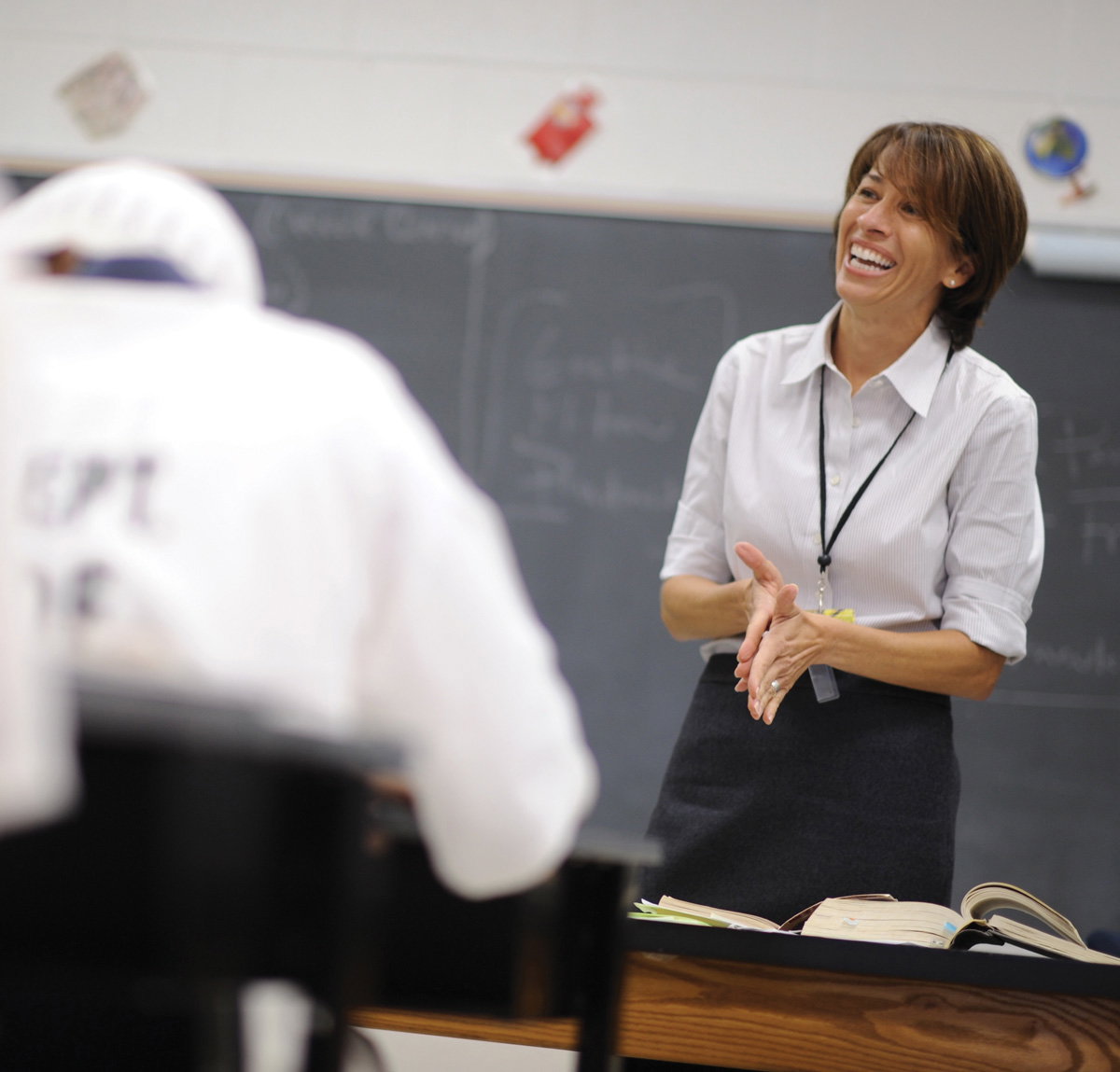
Sarah Higinbotham, cofounder of Common Good, teaches Shakespeare to prison inmates.

Photograph by Meg Buscema

Each time a door clangs shut behind us, my heart races a little faster. We’ve taken off our shoes, belts, and jewelry to get through security, handed over our IDs, and left phones and laptops in the car.

We’re winding our way through a forest of fences topped with concertina wire that surround a series of bland, beige buildings. I try to open one of the doors, forgetting for a moment that we must get buzzed through each one.

Walking beside me is Winfield Ward Murray, a member of the Morehouse College faculty who drives more than an hour south every Friday night through rush-hour traffic to this building in the Burruss Correctional Training Center outside Forsyth. The medium security state prison is home to 800 male inmates, from juvenile offenders to old men, and it’s where Murray teaches a weekly class about the U.S. Constitution and race and law.

He has asked me to speak to his class about my book, A Devil Went Down to Georgia: Race, Power, Privilege, and the Murder of Lita McClinton. Murray uses the case—in which a White husband orchestrated the murder of his Black wife in Buckhead in 1987—in his law classes at Morehouse, and my publisher has donated copies to Murray’s incarcerated students.

Being inside a prison is new to me. As another heavy metal gate closes and rattles my nerves, I harden a little, preparing for a heavy experience. Though Murray has told me about some of his students—how one wrote a symphony, another several books—I envision cold, hard, scary men. I can’t help it; this is my vision of prisoners in prison. People can be mean and scary, and the scariest, meanest of all people are in prison.

As we walk into the room, a big space that looks like a converted cafeteria, the men whoop and holler and surround us, joyful to see their professor and his guest, the author of the book they just read.

“I haven’t read a book in 10 years,” one man tells me. “But I stayed up late and read a hundred pages of your book. A hundred pages!” Several of them hug Murray and nervously shake my hand and thank me for coming. It’s not what I’m expecting at all. I’m overwhelmed with emotion, and it hits me: Their days are filled with hypervigilance, monotony, and small ideas. This two-hour class with Murray is an opportunity to escape and live in the juiciness of Big Ideas.

After the celebration of our arrival, Murray’s 13 students (a diverse group of Black, White, and Hispanic inmates) arrange three long tables into a U-shape. Murray sets down his books on a small table at the top of the U, so that everyone is facing him. Behind Murray, a bank of vending machines hums so loudly that I strain to hear. Also behind Murray, at a table beside the Coke machine, an older Black man named Boudreau sits off by himself. (Editor’s note: The names of inmates have been changed for this story.) I find out later he has been in prison so long—41 years—that he gets to informally audit the class, which means he comes—or doesn’t—as he pleases. A heavy door clangs when the prison staff periodically passes through. The idea is that Murray will teach for an hour, then we’ll switch places, and I’ll lead a discussion about my book.

I find a seat next to a Black man wearing a white knit cap named Miles, who slides me a thoughtful handwritten list of two dozen questions he’s eager to ask about my writing process. He tells me he read my book over the phone with his girlfriend every day until they finished it. He is a writer himself, he says, having self-published several books from behind prison walls.

On my other side is Jamal, a Black man with face and neck tattoos who barely looks old enough to order a beer. His hands shake a little as he fiddles with his pens and highlighters, and he shyly says hello. It strikes me that, like me, he’s also nervous.

All the men wear the same uniform of white pants with a navy stripe down the side, and white shirts with blue collars. The only thing that distinguishes their clothing is that each of them wears a different style of sneakers.

As everyone settles, Murray hands out a couple of books he’s bought or pulled off his own bookshelves to give to the men. This is clearly a weekly ritual that generates excitement: Who’s getting a book today? He gives Kent, a Black guy in his 50s, a book about the business of beekeeping. To Miles, the writer beside me, he gives a book about how to start a podcast. For next time, Jamal requests a copy of Bryan Stevenson’s Just Mercy: A Story of Justice and Redemption. Cory, a White man, wants a dictionary: He’s hungry to learn more words.

Today’s class is about the history of voting rights in the United States. Some of the students have taken the Louisiana Literacy Test, which was given to people registering to vote as a means to suppress Black voters before it was outlawed in 1963. Jamal has a copy and slides it over to me. The test is loaded with arbitrary questions intentionally worded to be confusing; it once gave White registrars great leeway in determining who qualified to vote.

The Voting Rights Act of 1965 was the first step in prohibiting this kind of racial discrimination in voting, Murray tells the class. “Think about how much effort went into not letting people vote,” he says.

Every man is leaning in, pens poised. There are no distractions, obviously no phones, and no one yawns. “I never thought about any of this stuff before,” says Kevin, a White man in his early 20s. “Now, it’s changed the way I think about everything.”

Murray meanders around the inside of the U, making eye contact with each of the men. Always impeccably dressed in a three-piece suit and shiny shoes, he offers his students—whether they’re at Morehouse College or in a Georgia prison—a new model of masculinity and power. He doesn’t bully, condescend, or overpower; he simply commands the room.

It’s clear that a couple of the students haven’t completed the reading—chapter two from The Voting Rights War: The NAACP and the Ongoing Struggle for Justice, by Gloria J. Browne-Marshall.

Murray gently but firmly chides them. “When I ask you to read something,” he says, “I expect you to read it.”

The men who didn’t finish the reading nod and apologize. They know how fortunate they are to be here—that there’s a long line of prisoners wanting to be here too. These men have been hand-selected to take this class based on a mix of criteria, including their interest, the warden’s discretion, and the expectation that, despite some serving life sentences, they will be discharged within a couple years, due to parole or early release. These college-accredited classes are meant to inspire critical thinking and prepare the inmates for life on the outside while giving them valuable credits toward an associate’s or bachelor’s degree.

“The most difficult thing about teaching in prison is that a lot of these guys have not had the best experience with education,” says Murray. Many prisoners have struggled with extreme poverty and lacked the basics: parental support, healthy food, school supplies, transportation, guidance. Some were told they were stupid or damaged or unworthy. Others dropped out of school and turned to crime because they couldn’t see another way out.

“So, the first hurdle you must get over is building trust by showing them that you’re going to teach them,” says Murray. “They need to see that this classroom is a safe place. Once you reach that plateau, once you have their trust, that’s when the class really takes flight.”

■ ■ ■

Winfield Ward Murray looks off camera
Winfield Ward Murray

Photograph by Johnathon Kelso

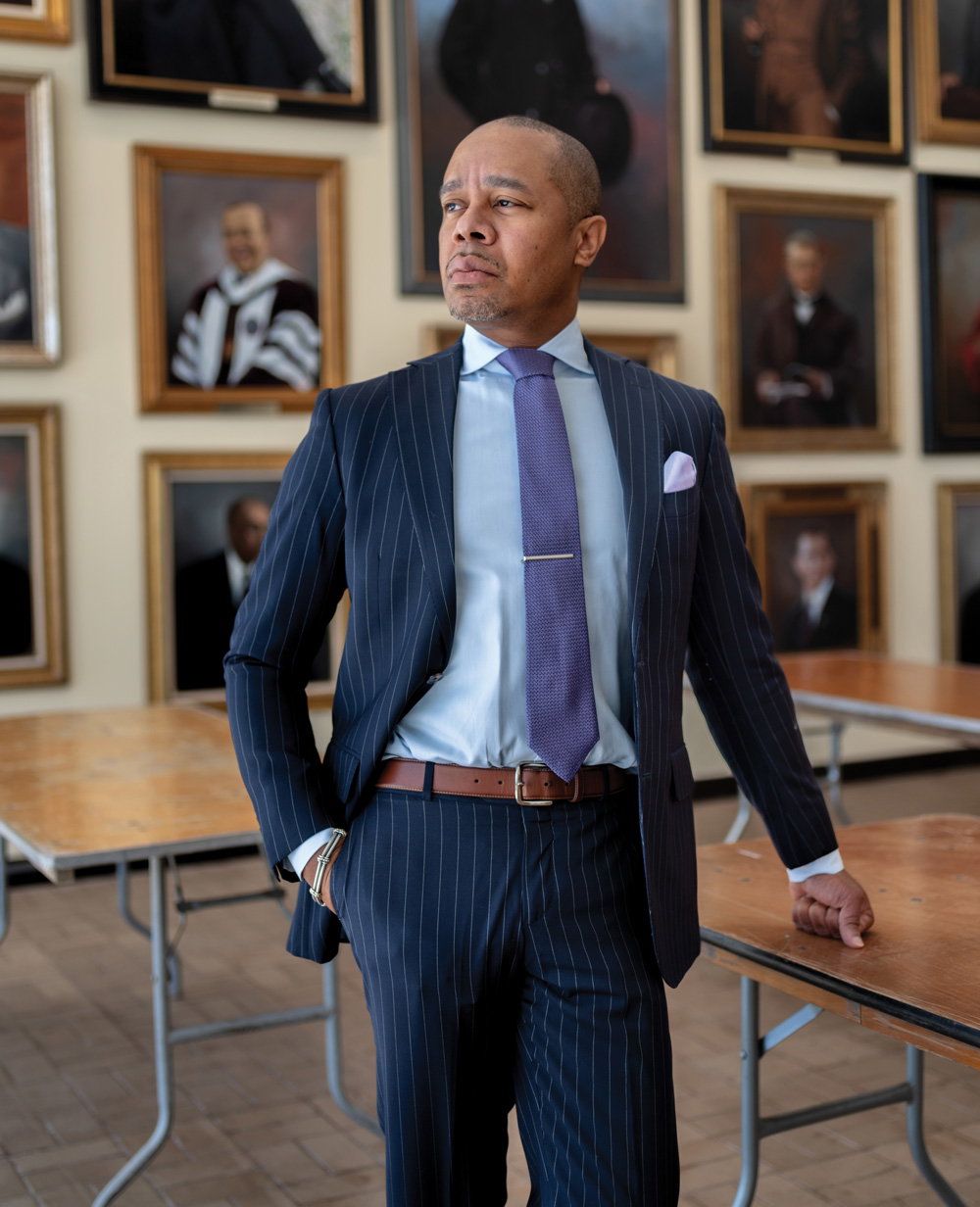
In addition to teaching at Morehouse, Murray is a federal immigration judge, who spends his days working his way through an inherited backlog of cases. He grew up with his parents in East Point and spent a lot of time with his grandmother in Collier Heights. His father is an Atlanta obstetrician-gynecologist who gave financial support to help found the Morehouse School of Medicine. A Morehouse alum, Murray is the fourth generation in his family to graduate from an Atlanta University Center school.

He went to law school at Howard University before completing a master’s in law at George Washington University. He’s worked as an Atlanta city prosecutor and was the deputy chief of staff to Mayor Keisha Lance Bottoms. He leads a nationally ranked moot court team: Under his leadership, Morehouse was the first of the HBCUs—historically Black colleges and universities—to win a national championship in 2015; earlier this year, Morehouse came in third out of 560 teams. He also actively participates in Leadership Atlanta, one of the country’s oldest community leadership organizations.

Murray is here as part of a partnership between Morehouse, the Andrew Young Center’s Higher Education in Prisons program, and Common Good Atlanta, a nonprofit that provides inmates with access to higher education. The nonprofit, which gives students college-level credits in literature, writing, history, art, science, math, and philosophy, was cofounded by Sarah Higinbotham, an associate professor at Emory University’s Oxford College.

At the height of the recession in 2008, Higinbotham was a 39-year-old getting her PhD in literature. As she delved into the depths of Shakespeare and Milton, she felt an overwhelming tug to share what she was learning. “I was extremely and acutely aware of what I was doing with my time, which was absorbing 150 years of beauty and wisdom and philosophy of the English Renaissance,” she says. “One thing I could think to do was to make the material I was learning accessible to people who had historically not had access to that kind of world.”

The idea to teach in prisons was inspired by Higinbotham’s uncle, a Vietnam veteran who was later incarcerated in another state. She was a new mother at the time, trying to balance life, and never got the chance to visit him in prison. Shortly after his release, he passed away. “He died without knowing that I was trying to get to see him,” she says.

She knew people in prisons often feel forgotten, so she began writing to wardens, asking if she could bring the literature she loved into prisons. When Phillips State Prison in Gwinnett County accepted her offer to teach a writing course, the class filled within minutes of being announced. “I was just going to do it for one semester,” she says. “That was 16 years ago.”

Today, faculty from five Georgia colleges and universities have partnered with Common Good to teach classes in 37 subjects in Georgia’s prisons.

The idea of educating prisoners has historically been a controversial one. Some people view prisoner education as being “soft on crime” while others, like Higinbotham and Murray, believe it a humane and essential path to reentry.

“Clearly we have a problem with mass incarceration,” Murray says, pointing out that the United States locks up more people per capita than any other nation in the world. Most prisoners are nonviolent offenders who will eventually be released and return to the general population.

According to the Prison Policy Initiative, currently 1.9 million people are incarcerated across the country. In Georgia, the incarceration rate is 881 per 100,000 residents, far exceeding the national average and surpassing that of any independent democratic nation. There are currently 95,000 people locked up in Georgia.

The national recidivism rate is 76.6 percent, according to a Bureau of Justice Statistics study; a whopping three-quarters of prisoners will be rearrested within five years of release. But when incarcerated people can pursue even a little education in prison, the recidivism rate plummets.

A recent report in the American Journal of Criminal Justice found that when inmates participate in a prison education program, their odds of recidivism decrease by 19 percent. For those who take college-level courses, the odds of recidivism decrease by 45 percent.

“If we are really trying to stop crime, if we’re really trying to make communities safer and to restore people, then prison education is what we need to be doing,” says Murray. Educated prisoners are less likely to repeat offend and more likely to find jobs, make higher incomes, and save taxpayer money. “There’s this narrative that you have to be tough on crime, and that tough on crime means longer sentences, but that doesn’t work. It also costs more.”

■ ■ ■

When I look around the room, I count: Of the 13 students, six are Black, three are Hispanic, and four are White. This is not reflective of the prison population. In these classes, Murray says, they aim for a diverse cross section of ages and races because what they’re after is diversity of thought—to foster more rounded conversations. If the class did reflect the prison population, most of the students would be Black.

Despite comprising 31 percent of the state’s population, Black Georgians make up almost 60 percent of the incarcerated population. Black people are 2.7 times more likely to be imprisoned compared to their White neighbors.

Murray says he found working as a prosecutor challenging because it often meant incarcerating a never-ending line of Black men. He believes prisons are necessary but also advocates for equitable sentencing and restorative justice programs that help offenders learn accountability, build confidence, and believe they can be contributing, law-abiding members of society.

“These men come into prison, and they really don’t know what to look forward to,” Murray says. “What I try to tell them is that no matter what age they are or how much time they’re serving, they’re still alive. Whether you’re in prison or not, you still have the ability to exercise your voice. You still have something to give.”

Murray believes that Morehouse, the only school in the country devoted to the education of Black men specifically, is uniquely positioned to serve Black inmates. “The best way for imprisoned Black men to get their lives back on track is by giving them the benefit of education,” he says. “What better institution to do that than one that is mission-driven to educate Black men?”

Dr. Kipton Jensen, a professor of philosophy at Morehouse and director of the Higher Education in Prisons program, agrees. “I feel like it’s a tender reminder about the core mission of HBCUs: to give a foothold to individuals who have been maligned by society,” Jensen says. “Providing education to prisoners is pushing the envelope to the next frontier of those who are most disenfranchised.”

To date, 23 members of the Morehouse faculty have taught in the prisons, often accompanied by student ambassadors who get to see firsthand how incarceration affects lives. Jensen says the eyes of everyone who teaches or visits the prisons are opened in a profound way. “Something about teaching inside [prison] made me come alive,” he says, and in true professor fashion offers a quote from philosopher Howard Thurman: Don’t ask what the world needs. Ask what makes you come alive and go do it. Because what the world needs is people who have come alive. “There’s something really beautiful about watching other people come alive,” he says.

■ ■ ■

When it’s my turn at the front of the class, my nervousness has dissipated. There’s something about being in this place that makes it easy to drop pretenses.

Murray frames the discussion to get us started. He says that Lita, the victim at the center of my book was, like him, a child of Atlanta. She was brutally murdered days after her 35th birthday, and it took nearly 20 years for anyone to be convicted of her murder.

“After reading your book, I felt like I actually knew her,” says John, a Black man in his mid-50s. We talk about the book for a while, but I find myself more interested in learning about them, so I ask them to go around the room and introduce themselves, tell me who they are.

In his 41 years of incarceration, Boudreau tells me, he has transferred prisons more times than he can remember, seen a fellow inmate shivved to death, repented and anguished over the singular event that landed him here, and written a memoir. I do the math: He got locked up in 1984, at the age of 25. He’s now 66. He hopes to get out so he can hug his elderly father one last time before he dies.

Jordan, a White man with thick-rimmed glasses and a tidy haircut, stays quiet for most of the class. When it’s his turn to speak, he tells us he grew up in chaos and extreme poverty, in which he could choose to go hungry with a mother who struggled with substance abuse or stay with his father, who beat him ruthlessly. He committed a crime when he was 15, and he’s about to turn 24. He’s grown from a child to a man . . . mostly in prison.

I ask if anyone wants to tell me how these college-level classes have changed them. Every single man throws up his hand. Javier, a Hispanic man in his late 20s, says he didn’t speak for the first five years he was incarcerated, but because of these classes, he’s been able to find his voice. John echoes this sentiment. “The shame of prison makes you quiet,” he says, but through the encouragement of Murray and other faculty, he’s learned “my voice matters.”

Sheldon, a Black man in his 20s, says he grew up ostracized as “a queer Black kid from Henry County.” He says this class has helped him see that his life doesn’t need to be determined by other people’s prejudices.

At the end of the class, Murray asks me to sign books for his students, and I get a quiet moment with each of them. Miles wants to learn more about publishing. Jamal, the tattooed young man, asks me to sign his book to his mother. When it’s Jordan’s turn, I ask him if he’s afraid to get out, having missed nearly a decade of his formative years. He thinks for a moment before responding. “I used to not want to get out because I felt like I had nothing to live for,” he says quietly. “But now I do.”

Boudreau hands me a sticky note with the name of his memoir. Even after more than four decades of incarceration, he finds hope. He nods in Murray’s direction and says, “I didn’t think it was possible, but the elixir of human kindness—it does exist.”

■ ■ ■

We all drive by jails and prisons all the time; usually they are sprawling complexes on cheap land in rural areas. Eyesores, mostly. Cages for some of the most heinous criminals, sure, but the majority of the people behind bars are nonviolent offenders, incarcerated for drug possession, theft, and other nonviolent crimes. Almost a quarter of them haven’t even been convicted yet; they are unable to afford bail, so they sit in jails, often for years, awaiting trials or sentencing. It’s easy when you drive past to forget that inside those walls are fathers and mothers, brothers and sisters, sons and daughters.

Over the course of the two hours at Burruss, I’ve learned a little about the men around the table. I don’t know what they did to get in here, and I don’t ask; I would not want to be judged by the worst mistakes I’ve made either. Of course, on the other side of every crime are people whose lives have been shattered by perpetrators of crime. Can these two things be true—that people can commit unforgivable crimes and still be deserving of empathy, education, and the opportunity to break out of the prison cycle?

Murray tells me about Rashawn, one of his former students who has been moved to a transition house, the last step before he’s released from prison, where he’s been since he was a teenager. Rashawn is now in his mid-30s, and although he’s about 15 years younger than Murray, they went to the same high school—Frederick Douglass High in northwest Atlanta. Unlike Murray, Rashawn grew up in the projects, a place he calls “eerily similar to prison.” When he was just 10 years old, with a mother and a sister addicted to crack cocaine, he became the provider for his family, including his sister’s two babies. Starving and desperate, he began selling drugs to buy diapers and groceries. As a teen, he got arrested and sent to prison.

“He never had a chance to be a kid,” says Murray, reflecting on how they were two distinct tales of the same city—both Black, one privileged, one not. “He’s one of the smartest people I’ve ever met.” During his time at Burruss, Rashawn earned six transferable college-level credits. He gave the commencement address for the Common Good Atlanta class of 2022. In it, he said:

I know that you think you know a few things about me. Know “my type.”
But you don’t.
You can’t.
Maybe because you don’t want to know. Or maybe you don’t care enough to know.
I would never have dreamed to have a year in my life where I read, digested, and discussed Shakespeare, Jay-Z, Brown v. Board of Education, Plato, and Van Gogh all in one year.
I know you didn’t know that I was more than a Black man who is in prison. It’s not your fault you didn’t know.

■ ■ ■

Sarah Higinbotham teaching a class
Sarah Higinbotham

Photograph by Meg Buscema

Sarah Higinbotham has made hundreds of trips to prisons and jails over the past 16 years and has never lost the joy of teaching incarcerated students. She spends a lot of her time supporting alumni—the hundreds of former prisoners who took Common Good–affiliated classes and are now back in the community. Sometimes she helps them get a driver’s license or find a place to live. She and her husband host holiday meals at their home, where alumni get together and play disc golf or sit around a bonfire. She helps coordinate cooking classes, concerts, and support groups. “With me, and with each other, they don’t have to pretend like they never went to prison,” she says.

She makes it a point to connect with people where they’re at, not just where they’ve been. “It is a shift in perception that people who have served time in prison are somehow less worthy of our community,” says Higinbotham, reflecting on why she and cofounder Bill Taft named their organization Common Good. “I do not approach what we’re doing as rehabilitation, but as an issue of human rights.”

Tiffany Kirk sits at a table
Tiffany Kirk, the executive director of Common Good Atlanta, says teaching in prisons is like going to church. “It’s that spiritual.”

Photograph by Ben Rollins

Tiffany Kirk, the executive director of Common Good Atlanta, says there’s plenty of professors who believe in the value of teaching in prisons. “We have a waitlist of faculty and no shortage of facilities that want us inside,” she says, but the nonprofit needs money. As head of the organization, she actively engages with community members and private foundations to raise funds to expand the number of classes they can offer inmates. Kirk, who also teaches financial literacy at the Metro Reentry Facility in DeKalb County, says teaching in prisons is like going to church. “It’s that spiritual.”

As we leave Burruss, there’s a palpable buzz in the room, a feeling that something important has taken place. We share handshakes, hugs. It’s dark outside, lights now illuminating the walkway and glinting off the concertina wire atop the high fences. Murray and I are quiet as we clang out through the maze of gates, knowing we get to go home to family, friends. We can drive anywhere, buy a burger or a beer, sleep on comfortable mattresses, cook eggs for breakfast. I feel a lump in my throat, a little speechless.

“I know,” says Murray, without me saying anything.

We get back to the car, check our phones, and drive away in silence. I watch in the side mirror as the prison shrinks and fades into the darkness. I think about Thurman’s quote, about coming alive. I look over at Murray, shoulder-checking as he pulls onto I-75. Despite the long day, I feel wildly alive.

This article appears in our June 2025 issue.

Fifty years after the fall of Saigon, a thriving Vietnamese community calls Atlanta home

0
Chùa Quang Minh, Georgia’s oldest Vietnamese Buddhist temple, hosts a meditation service.

Photograph by Audra Melton

About 30 pairs of shoes are perched on a rack outside the door at Chùa Quang Minh, Georgia’s oldest Vietnamese Buddhist temple, taken off as a gesture of respect. Devotees sit on floor cushions inside the hall for an evening meditation session. Carved golden dragons with pearls in their mouths wind around red wooden pillars at the front of the room, and offerings of fruit and flowers adorn each altar. The hall is quiet while the session is underway, but visually vibrant.

The meditation leader breaks the silence.

“Visualize any pain deep in your heart as smoke,” he says. “Then take a deep breath—and release. Take a deep breath—and release. Take a deep breath—and release.”

People have gathered at Chùa Quang Minh to pray, learn, and socialize since the temple opened just south of Grant Park in 1983. The congregation is more diverse today than ever before, but it has always included survivors of the war in Vietnam and their children. As they meditate, some of them are visualizing the release of the pain from that time that lingers deep in their hearts.

Lam Ngo is the president of the temple’s board. He thinks the teachings from tonight’s meditation are relevant to everyone, and that forgiveness is valuable because it brings peace to the person who forgives. At the same time, releasing the pain of the past can be particularly difficult for some who suffered the trauma of the Vietnam War.

“Some people have lost their whole family, all their dear ones, their home, their brothers and siblings,” Ngo says. “Or imagine you spend your youth in a reeducation camp, and you work like a slave. People are not going to forget that easily.”

This spring marks 50 years since the fall of Saigon—an event many refugees call “the day we lost the country.” A turbulent postwar era followed, with South Vietnamese people suffering imprisonment and persecution by the Communist regime. At that time, there was hardly a Vietnamese presence in Georgia. But in the decades since, metro Atlanta’s Vietnamese population has grown immensely and now ranks as the ninth-largest Viet community in the United States.

“We cannot change the past,” Ngo says. “But we can change the present and the future, if we understand the history.”

A Buddist monk chants during a meditation service
A Buddist monk chants during a meditation service at the Chùa Quang Minh Temple near Grant Park

Photograph by Audra Melton

North Vietnam took control of Saigon on April 30, 1975, resulting in the collapse of the South Vietnamese government. It marked the end of a 20-year civil war that pitted Communist North Vietnam and its allies against the U.S.-backed government in South Vietnam.

The United States, which had been embroiled in the conflict on the ground since 1965, executed a chaotic evacuation of its soldiers from Saigon, along with thousands of South Vietnamese civilians and orphans, and third-country nationals. Additional evacuation efforts were led by the South Vietnamese.

The first Vietnamese evacuees to resettle in Atlanta arrived here just a few weeks later. By the autumn of 1975, there were about 400 Vietnamese refugees in the Atlanta area, and within two years, that number almost doubled. Local nonprofit organizations such as Villa International and Catholic Social Services of Atlanta (now Catholic Charities Atlanta) helped them resettle.

In the late 1970s and especially the 1980s, the U.S. Vietnamese population increased dramatically as refugees known as “boat people” desperately fled South Vietnam—often by whatever means possible. The journey at sea was risky, with pirates, storms, and small leaky boats, and hundreds of thousands of boat people did not survive. But those who made it to refugee camps in other regions of Southeast Asia, and then ultimately to the U.S., formed new Vietnamese enclaves in Atlanta and other cities.

Several social agencies’ offices were in the Buford Highway area at that time. Plus, that area was accessible by public transit and had many low-cost housing options. The thoroughfare quickly became an anchor for Vietnamese refugees and other immigrant communities.

The Center for Pan Asian Community Services has served the Buford Highway area since 1980. John Nguyen, who now teaches classes at the center, was only a child when his parents put him on a boat with some other relatives, not knowing if they would ever see him again. They hoped he would find a safer, better life in the West.

After more than a year in refugee camps in Malaysia and the Philippines, Nguyen arrived in Atlanta when he was 13. The International Rescue Committee helped Nguyen find his brother, who had arrived in Atlanta on his own a while earlier. As teenagers with no other relatives in town, they lived in their own apartment together near Buford Highway.

“I wanted to go to school, but I couldn’t because of the language barrier,” Nguyen says. “So I just found odd jobs here and there and, at the same time, studied for the GED.”

During Nguyen’s early days in Atlanta, there weren’t many ways to reconnect with Vietnamese culture. There was only one restaurant that served Vietnamese food, and he says it wasn’t an authentic taste of home. But as more and more refugees settled into life in Atlanta and sponsored their family members to immigrate in the 1990s, Vietnamese supermarkets, bookstores, video stores, restaurants, and services popped up along Buford Highway.

To Nguyen, it felt a little like Saigon. 

various photos of temple members who passed away hang on a memorial wall
The temple has a memorial wall devoted to members who have recently passed away

Photograph by Audra Melton

an altar to the memory of the temple members who passed away
An altar to the memory of temple members who passed away

Photograph by Audra Melton

In the early 2000s, Vietnamese immigrants and other Asian American communities started shifting north, from DeKalb County into Gwinnett County. The Georgia Regional Transportation Authority launched bus service to Gwinnett in 2001, improving accessibility. Plus, Gwinnett offered newer, bigger homes, and after a few decades in the U.S., many immigrants had accumulated the wealth to buy them.

Entrepreneurship was, and still is, one of the most effective ways for immigrants to build capital when they cannot pursue the same kind of work in the U.S. that they did in their home countries.

Boat People SOS, an international social services organization with a branch office in Norcross, has a small-business support program that helps about 50 to 100 immigrant-owned businesses every year. “[Vietnamese immigrants] normally start their business by saving up money, or they just borrow money from relatives,” says Trinh Pham, who was a refugee herself and is now the organization’s executive director in Atlanta. “But there are so many other assistance opportunities from the government that they don’t know how to access.”

Boat People SOS helps immigrants access those financial resources for their businesses, and assists with other needs such as licenses and documents, marketing, new technology tools, and education about occupational hazards.

Nail salons, restaurants, boba (tea) shops, and snack shops are some of the most common choices for Vietnamese entrepreneurs, Pham says.

The organization’s office is next to a shopping plaza anchored by Hong Kong Supermarket, one of the largest and oldest Vietnamese-owned businesses in the Atlanta metro area. The plaza is home to restaurants, jewelers, hair salons, medical offices, gift shops, and more. Most of them are Vietnamese-owned. Vietnamese customers from out of state—Florida, Tennessee, the Carolinas—make day trips on weekends to eat, shop, and get services here.

Tommy Nguyen and his family opened Wow Banh Mi & Pho in the Hong Kong Supermarket plaza in 2022, replacing a seafood restaurant they had operated in the same spot. They are set to open a second Wow Banh Mi location this summer in Midtown.

In addition to working at the restaurants, Nguyen is a real-estate agent. “I’m a businessman,” he says. “I see anything we can do to make a living, and I do it.”

The restaurant gets all kinds of customers. Nguyen thinks non-Vietnamese Americans are drawn to Vietnamese cuisine because healthy eating has become a priority for them, and many Vietnamese dishes, with plenty of vegetables but little oil, are seen as good choices. 

Nguyen has seen other Vietnamese entrepreneurs embrace the recent boom in boba tea shops, a Taiwanese export that’s become popular across the West. But he sees boba shops as a trend that could come and go. So his family’s strategy has been to open restaurants, which he thinks will be more sustainable. “If you could only afford one, will you get your food or your drink?” he says.

According to 2021 census data, at least 48,000 self-identified Vietnamese people live in metro Atlanta, and more than half of them reside in Gwinnett County. Pham says this is probably a low estimate.

“We are never happy with the number on the census, because most of them
don’t respond,” she says. “In reality, some people say we could be double or triple that number.”

Georgia’s Vietnamese population has been growing as immigrants relocate here from other states and newcomers still arrive directly from Vietnam. Some have waited their entire lives for a relative in the U.S. to be able to sponsor their immigration by taking temporary financial responsibility for them until they get on their feet.

On a Saturday morning in February, five students ranging from 36 to 59 years old are seated in a classroom at the Center for Pan Asian Community Services office, each equipped with a textbook, a notebook, and pens. For brain fuel, a tall plastic jar in the middle of the table is filled with caffeinated, coffee-flavored hard candies called Kopiko—a Southeast Asian classic.

The students have their green cards, and their sights are set on citizenship. They spend six hours in this classroom every Saturday to prepare for their naturalization interviews and tests. Attendance is lower today than usual because many of the regular students are busy with Lunar New Year (Tết) festivities.

John Nguyen sits on his desk as he looks into the distance
John Nguyen came to the United States when he was 13; now he teaches classes to help new immigrants pass their citizenship tests

Photograph by Audra Melton

John Nguyen has led this class for the past nine years. He opens by drilling the students in English with questions they will be asked in their interviews. When he asks one student, “What is your race?” she stumbles over her answer, accidentally making a pun. Nguyen switches to Vietnamese to crack a joke in response, and everyone laughs.

“I’m dying,” Nguyen says, with his hand on his forehead. “This happens every time. There’s always something funny.” He keeps the energy in the room light to help the students stay engaged with the dry and sometimes difficult material.

Nguyen has come a long way since the days when he and his brother were struggling to survive as teens in a new city and culture. He ultimately earned his GED, attended community college, and completed a bachelor’s degree in visual communications. Since then, he has worked for advertising and marketing agencies.

In the early 2000s, he was able to sponsor his mother, father, and remaining siblings to join him in Georgia—the first time he had seen them since he set sail on the refugee boat as a child. Now he leverages his experience and knowledge to help others who are adjusting to life in the U.S., as he and his family had to.

“When I came over here, I didn’t have these kinds of resources,” Nguyen says. “I felt like there was a need for it. So we started the citizenship program.”

Nguyen says his students have a 98 percent success rate in achieving citizenship after his class. Some pass the test the first time; others have to try a few times. “They say, ‘I’m not gonna quit until I pass,’” he says.

But American politics have made their way into his classroom. A federal grant was supplying the monthly $6,700 that the organization requires to run three citizenship classes per week in different languages. That February morning was Nguyen’s last session before an executive order to freeze federal funds was issued by the White House. The class is now paused indefinitely.

“The students were so sad when I delivered the news,” Nguyen says. He hopes to provide ad hoc support to individual students by phone until funding is restored or another funder fills the gap.

A lot can happen in 50 years. The Vietnamese community has grown into an important part of Atlanta’s cultural patchwork, and the children of the early waves of refugees and immigrants have grown up. Now young adults, they are the ones who get to define what it means for their generations to be Vietnamese in America.

Jason Do came to the United States with his parents and brother in the early 1990s, when he was five years old, and arrived in Atlanta to join relatives who had previously resettled here.

Growing up, Do celebrated major Vietnamese holidays with his family, but he didn’t become seriously interested in the cultural traditions until he joined the Vietnamese Student Association at Georgia State University. The association connected him with Georgia’s broader Vietnamese community, including the Young Vietnamese Association of Georgia, a branch of the Vietnamese American Community of Georgia—a prominent social organization with a legacy going back more than 30 years.

“The majority of those members, they were born here—maybe in the late ’90s and early 2000s,” Do says. “Their parents had to find jobs and work to provide for the family. They didn’t have time to teach the kids about Vietnamese culture and traditions. So that’s where the association comes in, to try to help.”

As someone who was born in Vietnam and immigrated in early childhood, Do belongs to what scholars call the “1.5 generation,” which he himself calls the “middle generation.” With the association, Do has taught young adults about Vietnamese traditions, while in his career as an insurance agent and mortgage loan officer, he supports older Vietnamese clients in the home-buying process by working with them in their preferred language.

“We’re able to help the younger generation to know about Vietnamese culture and also help the older generation in the sense of assimilating to American culture,” he says.

Do and his wife have two children: a son who is two and a daughter who is five. “I make them speak Vietnamese at home,” Do says, “especially to my parents, because my parents don’t know much English. They know a little bit to get by, but their preferred communication will still be Vietnamese.”

Soon, he might enroll his daughter in a Vietnamese language class. He hopes his children will want to fully participate in Vietnamese traditions as they grow up.

“Of course not forcing them, just introducing them to it—if they like it, then they can continue,” he says. “They live in America, but I still want them to remember their heritage and where their family came from.”

The Hong Hing Lion Dance Team gathers around as some play the cymbals and drums while others dance
The Hong Hing Lion Dance Team continues a tradition that started in China, then became part of Vietnamese culture

Photograph by Audra Melton

Culture-sharing is an everyday norm for Generation Z, the most diverse generation in U.S. history, born roughly between 1997 and 2012. Now on the cusp of adulthood, or already navigating the early years of it, some Vietnamese American Gen Zers are enthusiastically sharing the traditions they learned in their upbringing with the rest of the world.

With a backdrop of the setting sun, clanging cymbals and pounding drums resonate through the neighborhood around Chùa Quang Minh on a Sunday evening to close out the Lunar New Year week. Invigorated by the instruments, pairs of athletic dancers on the Hong Hing Lion Dance Team bring to life three lions: gold, red, and pink. A man in a smiling Buddha costume leads the lions around the temple grounds as they bow in reverence to each statue and altar, delighting the audience along the way with acrobatic moves and bits of comedy.

3 young men practice dancing

Lion dance originated in China, but it’s important in Vietnamese tradition too. Lion dancers often perform at weddings, festivals, grand openings, and other big events. During the Lunar New Year season, Hong Hing’s schedule is packed with back-to-back performances at temples, churches, and Asian-owned businesses around the Atlanta area, as well as at one of the two major Tết festivals.

“I think it’s very important to understand where you come from; what your roots are,” says Kenn Ho, one of Hong Hing’s team leaders. “When I’m performing, I feel like I’m doing my best to keep the culture and the art and sport of lion dance alive.”

Ho cofounded Hong Hing in 2023 with three friends. One of them is Brian Nguyen, who says lion dance has been key for him to connect with Georgia’s Vietnamese community.

“I’m grateful that my parents were able to give me the opportunity to do this,” Nguyen says. Then he adds, laughing a little, “If they see this—I’m sorry that I got bad grades because I did lion dancing too much.”

Ho and Nguyen have engaged with their Vietnamese heritage through lion dance, but the group is not exclusive to Vietnamese American members. The dancers, all in their teens and 20s, represent a range of ethnic and racial identities, as do the audiences that seek out their performances.

“We’re looking to branch out and hopefully get [more] non-Asian people to join,” Ho says. “I think that would be a good way to have diversity within our team.”

a man stands amidst colorful Hong Hing Lion Dance Team flags

Vietnamese student associations at Atlanta-area institutions are a popular way for young Vietnamese Americans to grow their understanding of Vietnamese culture and share it with others.

Vincent Huynh, a pre-dentistry student at Emory University who is from Lilburn, is copresident of the Emory Vietnamese Student Association this year. His father was one of the founding members of the Emory chapter in the early 1990s. “It’s kind of big shoes to fill,” Huynh says. “But we always want to do bigger and better.”

When his father and a few other students were getting the club up and running, it was “just pizza parties,” Huynh says. Thirty years later, it’s a thriving, dynamic group that hosts at least two events per month, where students from all cultural backgrounds enjoy Vietnamese snacks, drinks, games, and holiday activities.

The club’s biggest event is Emory by Night, a springtime gala open to the entire Emory community and beyond. Inspired by Paris by Night, a variety show ubiquitous in Vietnamese American homes in the ’80s and ’90s, the gala features music, dance, and sketch performances.

“My parents used to always watch Paris by Night,” says Jena Vo, an Emory accounting student from Marietta on the organization’s executive board. “It’s very nostalgic.”

To illustrate the diversity of culture within Vietnam, each year the Emory association chooses a different region as the gala theme. Last year’s theme was “Sounds of the River,” in reference to Min Tây in the Mekong Delta; in 2023, “City of Lanterns,” highlighted Hi An on the coast. “I think it’s a really cool way to showcase different areas and cities that are not as commonly known,” Vo says.

This year’s theme was a poignant and timely ode to the heart of South Vietnam: “A Love Letter to Saigon.”

Sometimes the generations clash, says Angela Tran, a third-year nursing student and the other current copresident of the Emory association. She thinks traditional Vietnamese culture can be patriarchal, and there are certain parts she doesn’t agree with. But she respects what her parents’ generation went through after Saigon fell and how they’ve “rebuilt their lives from scratch here,” she says.

“We’ll always remember this,” Tran says. “It’s part of who we are.”

This article appears in our May 2025 issue.

Christopher Eubanks searches for the confidence that brought him to new heights at Wimbledon

0

Christopher Eubanks stands with his tennis racket on his shoulder

Sometimes, when his game feels off, Christopher Eubanks watches his own highlights on YouTube. Some of the videos he searches for are from the summer of 2023, when his tennis game peaked at the perfect time and place. He usually chooses his match against Stefanos Tsitsipas, the fifth best player in the world.

On his screen, playing on Wimbledon’s Centre Court, Eubanks is on fire. His serve clocks in at a blistering 129 mph, and he rushes the net constantly, pouncing on his opponent’s off-balanced returns. Four hours into the match, in the fifth set, instead of hitting a conservative second serve in play, he hits a 121 mph ace on the center line that freezes Tsitsipas still. Eubanks looks at his coaches in the stands, raises his eyebrows, and laughs.

In the clip, Eubanks is 47th in the world, but his play at Wimbledon is beating the best. After another long rally, he stretches his six-foot-seven frame to place a backhand drop shot just out of Tsitsipas’s reach. Eubanks now turns to the onlookers, already on their feet, and waves his arms up and down, sending them into a frenzy.

To finally win the match, he smashes a forehand past Tsitsipas. Eubanks’s hands are on his head and his mouth wide open as he takes in another drowning standing ovation from the crowd. “Wimbledon was such a blur,” Eubanks says, watching the highlights. “I was hardly thinking about anything, just my opponent. I was so focused that I can’t remember a lot of it.”

Eubanks, who grew up playing on the courts of the South Fulton Tennis Center, announced himself at Wimbledon in 2023. His string of upset wins was impressive, but the reckless abandonment he played with, plus the shock on his face after every win, made him a crowd favorite. His run ended in the quarterfinals, the furthest an American man had gone at the tournament since 2017, and his ranking jumped to number 29 in the world, a career high.

But since that summer on grass, Eubanks hasn’t been back on tennis’s biggest stages. The old adage “You’re only as good as your last game” rings particularly true for professional tennis: One bad day in the office punishes players’ ranking, which determines everything from the tournaments they play to the sponsorships they get. A bad year can sink their career. In 2024, Eubanks lost in the first or second round of all four Grand Slams, including a first-round exit at Wimbledon. A year and a half later, his ranking sits at 104th in the world, forcing him to play grueling qualifying tournaments at major events to make the main draw.

At 28, Eubanks’s window to rediscover his Wimbledon form is narrowing. His story begins and continues in Atlanta, where he trains in search of the confidence that has made him a world-class tennis player, if only for a moment.

● ● ●

When Georgia Tech head coach Kenny Thorne showed up to a practice at the South Fulton Tennis Center, he saw a unicorn.

Already at a lanky six feet, seven inches, a 17-year-old Eubanks hit with Donald Young Jr., a fellow Atlantan and, at the time, an established pro on the tennis circuit. Eubanks stumbled over himself at times trying to reach Young’s returns, but he would find his feet to hit a smooth one-handed backhand. His whip of a forehand sprayed across the court, with only so-so accuracy. Thorne knew that if Eubanks could develop a reliable winning forehand and a powerful serve, he could be one of the best players in the country.

For Thorne and most college coaches, Eubanks came out of nowhere. He was a late bloomer, who only popped up on Georgia Tech’s radar when he nearly beat a program commit at the 2013 USTA Southern Championships a few weeks before Thorne’s visit to South Fulton. Thorne offered Eubanks a spot on Georgia Tech’s team days after he saw him hit with Young.

Christopher Eubanks swings at a tennis ball

Unlike many of his college and pro peers, Eubanks is a product of the tennis centers in Atlanta’s public parks rather than those at country clubs or private tennis academies. His dad, Mark, and his older brother, Mark Jr., picked up tennis as a hobby because southwest Atlanta has so many accessible spots to play.

Eubanks’s first memories of tennis, and life, are at Burdett Tennis Center in College Park. When he was four years old, his dad gave him a racket and a tennis ball and told him to go beat the wall. He played in his first tennis tournament at the South Fulton Tennis Center when he was eight. Eubanks lost in a close match in the final, which was enough for his dad to see his potential. “My parents were super busy, with my dad working at Delta and my mom at a bank, but our lives became tennis,” Eubanks says. “So I went to school and then played tennis for hours after.”

Around this time, a golden age of junior tennis was happening in south Atlanta. Young (formerly the number one junior tennis player in the world), Taylor Townsend (currently the third best female doubles player in the world), and Zack Kennedy (who later rivaled Eubanks in college) all grew up in the area. (Several years later, a certain Coco Gauff also developed her game in south Atlanta.)

“When they were eight years old, Zack and Eubanks would be the only Black players at some tournaments, so our families connected,” says Sam Kennedy, Zack’s dad and coach. “We all started to hit together, and we just latched onto one another, because that’s what it took.”

“He can articulate tennis better than almost anyone, and you know, it’s important he does it as a Black man.”
— Sam Kennedy

Mark Eubanks and Kennedy were self-taught in tennis, and the dads worked together to impart good form and a strong mental game to their sons. “Chris’s dad is very disciplined, and his son was the same,” Kennedy says. “Chris was a calm kid, which made him a great learner for tennis, soaking up everything like a sponge.”

Even with a childhood dedicated to tennis, Eubanks still experienced growing pains. He was a good junior player but felt he was behind the other juniors who had better training. He played closely with Zack and other strong players but lost matches when doubt crept in. By the time Eubanks got to Westlake High School, Zack played ahead of him on the varsity tennis team. Another hurdle was his height. “He got so tall and skinny at 13, 14, that his head couldn’t tell his arms what to do fast enough,” Kennedy says.

In the car on the way to school in the fall of his sophomore year, Eubanks remembers his dad telling him it was time to look at tennis as all or nothing. “He decided that I would start going to South Fulton and train with Donald and the Youngs,” Eubanks says. “There was no warning but also no argument. I felt I wasn’t good enough, but the opportunity was undeniable.”

Eubanks idolized Young, whom many expected to quickly become a top pro player. His parents ran the South Fulton Tennis Center, and when Eubanks joined their tutelage in the fall of 2011, Young was preparing to play tournaments on the pro tour as a 22-year-old. Over a few months of daily lessons, Eubanks’s game improved quickly, and in May 2012, Young offered to bring Eubanks on tour with him.

They traveled all over the world that summer, with Eubanks as Young’s hitting partner. “Donald was like my big brother during that trip, and he constantly told me that I was good enough, which was something I really needed to hear,” says Eubanks. “Like, this was a guy who looked like me, from the same side of town, who was always telling me I could do it.”

While Eubanks was in Europe, he missed a crucial summer tennis season for recruiting, when college coaches scout and extend offers to talented high schoolers. But when he returned to practice at Westlake for his junior season, he beat Zack for the first time.

● ● ●

After Eubanks received his offer to Georgia Tech, the decision for his tennis future again was made for him. “My dad told me that I was going to Georgia Tech,” Eubanks says. “Tech made the most sense with it being home, plus I could still practice with Donald. I think I would have made the same decision.”

That decision, ultimately, panned out well for Eubanks. After developing a serve and refining his forehand, he became one of the best players in Georgia Tech tennis history. In three years in the program, he became a two-time All-American and earned Atlantic Coast Conference Player of the Year twice. He excelled in singles, reaching 90 career wins, which ties him fifth all-time at Georgia Tech.

In 2017, he entered the main draw at the Atlanta Open and won his first two professional matches. His performance resulted in a wild card entry to the U.S. Open, where he lost in the first round. As he approached his senior year at Georgia Tech, Eubanks had proved to himself that he was ready to turn professional. This time, he made the decision himself, without consulting his family or coaches.

Going pro is easier said than done. Although Eubanks had traveled with Young throughout high school, he was now on his own. He spent the first four years of his career fluctuating between 150th and 230th in the world, playing many small events on tour to find his footing and trying to reach Grand Slams by qualifying. By 2021, his major achievements were a tournament win at an ATP Challenger event in Knoxville and a 2020 U.S. Open doubles quarterfinal appearance. “I always thought it was a matter of time before the results came, but they didn’t,” Eubanks says. “I wasn’t thinking about quitting per se, but I began to feel like I was losing time.”

Christopher Eubanks

His breakthrough came in 2022, off the court. Eubanks saw his fellow Atlantan Taylor Townsend commentating for the Tennis Channel for Women’s Tennis Association (WTA) events that she didn’t play in. Eubanks loved to talk about tennis with other pros and thought commentating might be fun. His agent reached out to the Tennis Channel to see if there was an opportunity for him to play a similar role. His first match as an announcer was at the 2022 edition of the Knoxville ATP Challenger, the same tournament he had won the year before.

Announcing felt natural for Eubanks and brought an unexpected benefit. In the booth, he couldn’t surf highlights. It forced him to watch matches start to finish, and he started to pick up on the attitudes and patterns that led to success. “Everything seemed so glaringly obvious,” Eubanks says. “I could see myself in a lot of the guys who lost close matches, so if I focused on the little things, I could beat them.”

Eubanks put together the pieces of his puzzle in 2023. In March, he reached the quarterfinals of the Miami Open and lost a close match to the world number three, Daniil Medvedev. For the first time in his career, Eubanks cracked the top 100, debuting at 85. But at the start of the summer grass season, Eubanks was upset in the first round of a small tournament called the Surbiton Challenger.

He texted a friend, Grand Slam champion Kim Clijsters, that “grass is the stupidest surface to play tennis on.” Eubanks was surprised that Clijsters would admit she also struggled on grass, and she told him to move on the court more, which should help him get his feet underneath him for both his body and mind.

It was what he needed to hear. He won his first ATP Tour title on the grass courts in Mallorca, Spain, on a Saturday, and started qualifiers for Wimbledon on Monday. After the tour win, he started to trust his game. “I was like, I can’t win Mallorca and not get to the first round,” Eubanks says. “Then, once I was in the round, I really just wanted to play on grass as much as I could. After each win, I just thought, Who’s next?

His confidence was so high that you’d forget this was his Wimbledon debut. Next was Cameron Norrie, the 12th best player in the world and number one Brit, backed by his home crowd. To open the second-round match, Eubanks hit a pair of aces, then a smashing forehand winner. He played a nerveless match that dispatched Norrie in four sets. In the third round, Eubanks took care of Australian Christopher O’Connell in straight sets. You know what happened to Tsitsipas in the fourth round.

For the quarterfinal, Eubanks matched with Medvedev again. Eubanks felt prepared after their Miami matchup and by commentating on a few of his matches earlier that spring. After losing the first set 4–6, Eubanks’s serve became unstoppable, his play at the net impeccable. Eubanks won the second and third sets in a dominating fashion: 6–1 and 6–4. Medvedev had made only six errors up to that point, but Eubanks was still playing him off the court.

With the fourth set tied at 6–6, Eubanks’s serve faltered, and Medvedev evened the match. Maybe it was the heat, or maybe it was the eight matches he had played in two weeks; Eubanks looked exhausted and lost the final set 6–1.

● ● ●

This winter, Eubanks hibernated at the Byers Tennis Complex, an indoor facility on Georgia Tech’s campus. Other than a year living in Florida, Eubanks has always stayed in Atlanta, recently moving to an apartment on the Beltline to be closer to where he trains. He’s back in the lab, running through very specific match scenarios with his coaches to mentally prepare.

After his Wimbledon run, Eubanks has struggled to replicate the same form. On the court, he earned spots on Team USA rosters for the 2024 Davis Cup and 2024 Paris Olympics, but with middling results. On the tour, Eubanks lost in the first round of many tournaments, including Wimbledon. Off the court, though, Eubanks has appeared more and more in the commentary booth. He now serves as an analyst and on-court reporter with ESPN at Grand Slams, most recently at the U.S. and Australian Opens, after he exited those tournaments.

“He can articulate tennis better than almost anyone, and you know, it’s important he does it as a Black man,” Sam Kennedy says. Many of the junior players Kennedy coaches at South Fulton look up to Eubanks and tune in to ESPN to watch the hometown hero commentate. “But the coach in me knows that you can’t replicate Wimbledon unless you’re ‘all in’ one thing.”

Chris Eubanks on the Tennis Channel
Eubanks’s Wimbledon debut in 2023 was marked by an electric run into the quartferfinals. He credits some of that success to learning how to analyze the game on a deeper level once he became a part-time commentator for the Tennis Channel and ESPN.

Photograph from YouTube/The Tennis Channel

Eubanks is careful to balance commitments while recognizing that analyzing tennis unlocked something different at Wimbledon. “I really think commentating has helped me personally,” Eubanks says. “But I’m a tennis player first, and commentating should still just be an opportunity.”

Recently, there have been signs that Eubanks is ascending again. In November 2024, he won the ATP Challenger in Knoxville, the same tournament that precipitated his success at Wimbledon. Eubanks is confident that his prior up-and-down year made him stronger, and he hopes to get back to where he was as a player, and potentially better than before.

In his Beltline apartment, he watches his Wimbledon matches more and more. “It’s cool to see how I served that day and my great shots, but it’s not necessarily to reminisce,” he says. “I want to do everything to get back to that level. I’m trying to remember how I felt.”

This article appears in our April 2025 issue.

Atlanta’s Forgotten Tennis Pioneer: Horace Reid

0

Horace Reid holds a black and white photo of himself playing tennis when he was younger

The kid is clearly exhausted. Facing a fourth match point in the 1972 American Tennis Association (ATA) National Championships final against Arthur Carrington, a man several years his senior, the kid—Atlantan Horace Reid—can’t hide his fatigue. It’s hard to blame him: The physical toll of this four-hour match has been compounded by cramps and a torn rotator cuff.

Reid, a rising tennis star, cuts an eccentric figure: baby-faced with a short bowling ball of an Afro, mismatched socks, a cuff of rubber bands on either wrist, and a neckband stretched halfway down his torso. Barely 17, Reid looks more as if he’s late for homeroom than about to fend off another match point in a fifth-set tiebreaker. He does all he can to slow his heaving chest, to save his thick-rimmed glasses from slipping down the sweat-slicked slope of his nose.

The ATA is the country’s oldest African American tennis organization, and this year’s championship is the first to be televised. With a title on the line, Reid needs to win the next two points—which he precisely does. First, he drops a lob over his opponent’s head, and then, for match point, he smashes two forehands that send Carrington scrambling from end to end. “He goes for it!” Bud Collins, the legendary tennis announcer, gasps on TV, working the broadcast alongside Althea Gibson, a pioneering Black tennis champion. The commentators can barely believe what they’re seeing.

It was an improbable win—and one hell of a comeback—for Reid. But for those who knew him, the victory might have seemed inevitable: just the latest entry in the storybook rise of a late-to-the-game prodigy who, at 12, became the first Black player to win a Georgia State Junior Open title (in his first-ever USTA tournament, no less); was ranked top 10 in the nation by 14; and so thoroughly dominated his high school competition he felt the need to leave the state entirely.

It wasn’t unreasonable to imagine Reid on a rocket ship to the top of the tennis world. Many already saw him as the next great Black champion—a comparison Arthur Ashe seemed to endorse when he offered his support to Reid. But within a few years, Reid’s tennis dreams would be all but dashed: He’d quit college, fail to find consistency on the pro tour, and suffer an agonizing fallout with Ashe, his hero and would-be mentor. The rupture would not only hamstring Reid’s career, in his telling, but also burden him with a secret he felt he could never share: how everything went so wrong.

● ● ●

The whole thing started innocently enough—or maybe not. It was 1964, the summer Horace Reid turned nine, and the kid wanted to steal a tennis ball. There were just so many of them scattered on the other side of a high fence that separated Washington Park’s new tennis center from the neighborhood. But before Reid could begin his career of petty larceny, he heard a loud voice calling to him. “Hey, young man!”

The voice belonged to Branch Curington, a tennis pro who ran the center and would emerge as perhaps the most influential figure in Atlanta’s growing Black tennis community. On this day, Curington instructed Reid to help him pick up balls, offering an ice cream cone as a reward. The next day, Reid returned. But instead of ice cream, Curington handed him a racket.

For Reid, who was raised by a single mother, Curington represented more than a coach. “He became a father figure to me. My whole personality is based off of him,” says Reid, who sponged the fundamentals of tennis (and life) at Washington Park.

Horace Reid points to a back and white photo of himself when he was young, swinging his racket at a tennis ball
Reid first played tennis at Washington Park’s public tennis center in 1964 at nine years old. Just a few years later, at 12, he was the first Black player to win a Georgia State Junior Open title.

Photograph by Growl Bros.

The game came almost effortlessly. When Reid won the 1967 Georgia State Junior Open, held at Bitsy Grant Tennis Center, he did so as an unseeded entrant, becoming a citywide sensation. He began competing on the junior circuit and shot up the rankings, as his local celebrity morphed into national acclaim. Tennis’s chattering class anointed him “the next Arthur Ashe.”

Billy Martin, the current UCLA men’s tennis coach, remembers Reid’s game vividly. “Biggest forehand ever,” he says. “It was just an awesome shot.” Reid had an aggressive style that could “dominate the court,” per Martin, who also served as his doubles partner. (Together they won the 16-and-under National Clay Court Doubles Championship and made it to the finals of the Junior Orange Bowl.)

In a city rife with racial tensions, the effect of Reid’s successes could be seen almost overnight. Suddenly, droves of White kids were showing up at Washington Park, hoping to catch whatever magic dust Curington was sprinkling, while others invited Reid to play at old-money country clubs in north Atlanta.

For his part, Reid didn’t reflect too deeply on the meaning of being a Black star in a traditionally White sport. Which isn’t to say he had it easy. Racism stalked his travels across the South, while some within the Black community antagonized him too. Tennis was seen not just as a White game, but also as a “sissy” sport, and he was frequently derided as “a tennis bum” and “a faggot.”

“Horace has an important place in tennis for what he was able to achieve. He really was a pioneer, and he’s considered one of the legends of Bitsy Grant.”
— Richard Howell

Through it all, Reid maintained his confidence and independence. “That’s the Branch in me,” he says. His self-determination fueled his quirky fashion choices as well as his departure from Georgia after winning multiple state titles; high school rules prohibited him from playing in national competitions. It also led him to an early exit from the Port Washington Tennis Academy on Long Island, where he went to train under Harry Hopman, the renowned Australian Davis Cup coach, alongside players like John McEnroe and Vitas Gerulaitis. There, he clashed with Hopman, who favored intense conditioning over the technical development Reid still needed.

The breaking point came in the summer before his senior year, when Reid, fed up with Hopman, contacted Ashe. He’d met the champ once before, as an 11-year-old, and had idolized him ever since. Now Reid hoped his hero might thumb the scales on his behalf. Ashe drove to Long Island and brought Reid to Manhattan. As they wove through the city streets, Reid explained his situation: his desire for personalized coaching; his need for sponsorship money; and his dream of attending UCLA, Ashe’s alma mater.

When Ashe agreed to help, even offering use of his apartment, Reid could hardly believe it. “My feet are not even touching the ground at that point,” he recalls. “I got my hero mentoring me, sponsoring me . . . I got it made. There’s nothing that’s not going to be available to me.”

Reid remembers thinking, How can I not succeed?

● ● ●

There were early signs that Reid’s relationship with Ashe wasn’t all it had seemed—or all he’d built it up to be in his mind.

For starters, before his first tournament under Ashe’s patronage, Reid got stuck holding the bill after his luggage got lost in transit, despite Ashe’s promise to pay. “He said, ‘Don’t worry. Just keep the receipts,’” says Reid. But the reimbursement never came, and Reid was too timid to ask for the cash. There was also a lengthy letter Reid received that concluded with a list of eight reasons Ashe had decided to help. Reid found the list “strange” on its face, “but the thing that stood out was the eighth reason: because I was Black,” he says. “You’re telling me, in this era, me being Black is the last reason—the least important reason—for you to help me? I found that really weird.”

Horace Reid

Still, when Reid arrived at UCLA—where Ashe made good on his word to get him in and even paid for part of his scholarship—things were looking up. On the court, Reid played singles and doubles for one of the country’s top teams. Off the court, he hobnobbed with Hollywood royalty, teaching tennis to A-listers like Gene Hackman and eating Thanksgiving dinner with Marlon Brando. So you can imagine Reid’s surprise when, in a phone call before his sophomore year, Ashe suggested he transfer to a Division II school.

Reid wasn’t just blindsided; he felt betrayed. “It didn’t make any sense to me,” says Reid, who suspects Ashe was acting as a proxy for UCLA’s coach, Glenn Bassett, who he believes wanted his roster spot. “This was strictly him doing his buddy a favor, which hurt.” Questioning whether Ashe had his best interests at heart, Reid refused to transfer. “And, boy, he was not expecting me to say that, and things just went totally south.”

Ostensibly, their arrangement remained unchanged, but Reid sensed a newfound coldness from Ashe, who’d always been standoffish. Previously, sponsorship checks would arrive from around the world with regularity—if not with words of encouragement. Now, the mail stopped coming. Reid was forced to borrow money; he says Ashe promised he’d pay him back but never did. “It was so embarrassing,” says Reid. “He would say something and then wouldn’t do it. He was basically sending me a message. Like, ‘Hey, I’m done with you.’ But why wouldn’t he just say that to my face?”

The uncertainty took a toll. “I got so depressed that I stopped going to class,” he says. “He made me feel like I was a bad guy.” When J.D. McGhee, one of Reid’s earliest supporters, died in the summer of 1975, Reid flew home for the funeral—and never returned. “I just dropped out of school,” he says. “I didn’t know what I was going to do.”

● ● ●

In hindsight, Reid concedes he should have transferred to another program. “I still had eligibility,” he says. “I could have gone to any top 10 school.” Instead, reeling from his split with Ashe, he ditched the idea of further collegiate development and set out on the pro tour. It proved an uneven effort.

Despite his natural talent and flashes of brilliance, including a notable doubles run at the 1979 U.S. Open, Reid struggled to find his footing, peaking at 272 in the ATP singles rankings and 227 in doubles. His game could have used more seasoning, but Reid’s years on the circuit were also plagued by unreliable funding, leading to frequent stretches of inactivity.

The narrative of Reid’s career shifted from that of a can’t-miss wunderkind to a once-promising player who’d hit his ceiling. For Reid, this was a lonely time, not least because he felt he couldn’t tell his side of the story. “That’s what killed me,” he says. “I had to bite my lip. I couldn’t say anything, because whose word are you going to take? This guy is a tennis god. I’m a nobody.”

In 1982, by which time Reid had effectively given up, a reporter from the Atlanta Constitution convinced the then 27-year-old to go on record about his break with Ashe. The resulting article painted an unflattering picture of Reid as a player who just wasn’t good enough. Both Ashe and Bassett claimed Reid couldn’t hack it on a UCLA team that featured players like future champion Brian Teacher and Reid’s old pal Billy Martin. (Martin, who appreciates the difficult roster decisions every coach must make, nonetheless takes exception to this suggestion. He says, “He did make it there! He was on the team, and his level was very high.”) Worst of all was a line from Ashe denying he’d ever agreed to mentor Reid. Said Ashe, “I’ve never had what you might call a protege. I’ve never taken someone in.”

Reading that, Reid felt gaslit. “It still burns,” he says. “And it just pisses me off even more that the guy would sit there and bald-faced lie that he never took on that responsibility. Never had a protege? What do you call spending your money on me? What do you call offering me your apartment?”

Whatever transpired between the two athletes, there’s no question that Reid’s fractured relationship with Ashe paled in comparison to what he felt had been promised—and that disconnect has come to define, in Reid’s mind, the collapse of his athletic career over the many decades since.

● ● ●

Horace Reid stands on a tennis court

Today, Horace Reid works as the tennis director for a community organization in Camilla, about three hours south of Atlanta, where he often feels forgotten. The kids to whom he gives lessons know little about his backstory. It’s true: His name doesn’t ring out across the state as it once did. But according to Richard Howell, who chairs the selection committee for the Georgia Tennis Hall of Fame, nothing should take away from Reid’s legacy.

“Most young kids don’t even know who Wilt Chamberlain is,” says Howell, whose family helped Reid enter that first USTA tournament in 1967. “Horace has an important place in tennis for what he was able to achieve. He really was a pioneer, and he’s considered one of the legends of Bitsy Grant.”

In 1997, Reid was inducted into the Georgia Tennis Hall of Fame. But even that honor couldn’t close the book on his past. There had been a point, in the early ’90s, when Reid, desperate for closure, resolved to confront Ashe. But he never got the chance. “I remember I was in my car driving,” he says, “and on the news comes, ‘Arthur Ashe has died.’” Reid was stunned, and angry. He debated going to the funeral but couldn’t bring himself to do it. “I couldn’t sit there and mourn this guy when I hated him,” he says. “I literally hated him.”

Now 69, Reid believes there may still be a way to find peace: by taking a kid under his wing, just as Branch Curington did for him. It almost makes too much sense as a final chapter—to become the next Curington, the anti-Ashe—assuming he can locate such a youngster. “I haven’t found [that] one kid that wants to eat, sleep, and drink tennis like I did,” says Reid. “That’s literally all I want to do. Find a kid that wants to be great, and give them all the help that I got.”

And all the help he never did.

This article appears in our April 2025 issue.

Chasing Justice: A rabbi’s single-minded mission to exonerate Leo Frank

0

Leo Frank

One day 30 years ago, Steven Lebow, then the rabbi of Temple Kol Emeth in East Cobb County, received a mysterious phone call. The voice on the other end offered to show him a place where something terrible had occurred many decades before.

The two met at a nondescript one-story office building off Roswell Road in Marietta, a few blocks from The Big Chicken. “This is where it happened,” the man told the rabbi. “Don’t let your people forget what my people did to your people.”

Then he drove off. Lebow never got his name.

The building occupied the site of one of the most notorious lynchings in American history. On the morning of August 17, 1915, a vigilante group organized by Marietta’s leading citizens hanged Leo Frank, a Jewish factory superintendent who had been convicted of murdering a 13-year-old girl, Mary Phagan. She was found strangled in the basement of the downtown Atlanta pencil factory where she and Frank were both employed. After the lynching, Frank’s body dangled from an oak tree for hours as thousands of onlookers, drunk with vengeance, gathered to celebrate and pose for souvenir pictures, before his corpse was finally cut down and whisked away to an undertaker.

Eighty years later, the tree was gone. A dentist, an accountant, and a real estate agent were doing business at the site. Lebow introduced himself to the property owner, who was aware of the history, and he readily agreed to let the rabbi place a memorial plaque on the structure.

“Wrongly accused. Falsely convicted. Wantonly murdered,” Lebow’s inscription read.

Some people, he knew, would passionately disagree with those words.

■  ■  ■

Steven Lebow thinks of himself as Leo Frank’s rabbi. Born 40 years after the lynching and raised in Fort Lauderdale, Lebow is the son of a well-known auto dealer. He announced his interest in becoming a rabbi at age seven when he amused his parents by scrawling an admission inquiry to a rabbinical school in crayon.

Lebow learned about Frank during his graduate studies, when the trial and lynching was held up as one of the worst outbreaks of antisemitism in 20th-century America. Frank was convicted of Phagan’s murder in 1913 during a media-frenzied trial that wouldn’t stand muster in modern jurisprudence. But it wasn’t until his plight became a national cause that Georgians turned resentful about the outside pressure to free him. Frank was a Brooklyn transplant with an Ivy League education, and much of that resentment reeked of anti-Yankee, anti-Jewish prejudice.

Steven Lebow
Steven Lebow

Photograph by Stephanie Eley

“That’s when you heard, ‘Hang the Jew!’” Lebow says, sitting in his Marietta townhouse, a mile and a half from the lynching site. Frank was being held at a state prison in Milledgeville while his lawyers appealed. When Georgia Governor John M. Slaton commuted Frank’s sentence from death to life imprisonment, it enraged many Georgians. Vigilantes from Cobb County went to the prison in Milledgeville, broke in, kidnapped Frank, and sped him through the night to Marietta.

Lebow has pulled out some of his personal archive about the case—files, books, vintage newspapers—so he can bound off the sofa to consult this reference or check that allusion. Almost 70, the rabbi has a short, round shape, a smooth bald head, and the relentless enthusiasm of a believer.

He took an interest in Frank after he moved to Marietta in 1986 to lead Temple Kol Emeth and realized the Reform synagogue wasn’t far from the scene of the lynching. He started to acquire a reputation for outspokenness when he publicly opposed the Cobb County Board of Commissioners’ controversial 1993 resolution condemning homosexuality.

Two years later, as the 80th anniversary of the Frank lynching approached, Lebow received the mysterious phone call. That August, he organized and led a memorial service at the site.

“I’m not interested in litigating the lynching,” he says. “I don’t want to blame Marietta or shame the families of the lynchers. I know some of them, and they’re good people. I just want to clear the name of an innocent man.”

Lebow has led four more memorial services since the first one. One was held in a small park off Roswell Road, across from a Mexican restaurant, where historical markers about the lynching were moved because the state took most of the original site to build improvements on I-75. As the program began, with off-duty police watching from the periphery, a pickup truck barreled by, and a passing voice bellowed something about Jews.

The rabbi paid for the security. It wasn’t the first time he’s spent money on Frank. Over the years, he has leased billboards, printed T-shirts, and even commissioned a custom Coca-Cola bottle with the label “Leo Frank Innocent.” “It was a promotion where you could put your name on a bottle,” he says. “They must have thought his last name was Innocent.”

A plaque that reads: Leo Frank (1884-1915). Wrongly accused, Falsely convicted, Wantonly murdered. Pardoned, 1986. Remembered on the 80th yahrzeith, 1995-5755. By the Jewish Community of Cobb County.
Lebow erected a plaque at the spot where the lynching occurred in Marietta; he is determined in his mission to gain Leo Frank’s exoneration.

Photograph courtesy of leofrank.org

When Lebow retired in 2020 and became a rabbi emeritus, he had no shortage of hobbies to choose from. He writes and has penned several science-fiction stories and a graphic novel. He collects comic books—thousands of them—finding solace in the fantasy that good guys always win. But recently he sold some of his comics to help finance his most demanding pursuit: winning exoneration for Frank. He has spent thousands of dollars on the cause.

Lebow’s wife of 40 years, Madeline Sable, a real-estate agent, didn’t fully grasp his commitment at first. “That lynching happened so long ago, and there are so many injustices today,” she says. “But it’s such a stain on Georgia. This is important to him. If it weren’t this, it’d be more comic books.”

With typical humor, Lebow tells a story to show that he understands how peculiar his obsession may look to others. Years ago, Shira, one of his two daughters, was assigned to do a school project about Georgia history. Her father suggested the Frank case and took her to the lynching site. They snapped a picture of the memorial plaque, and she pasted it on a shoebox to represent the building.

After Shira submitted the project, her teacher said Lebow may want to look at the last part of his daughter’s report, where she shared what she’d learned from the experience.

“I learned that the Leo Frank case is boring,” she wrote. “And I also learned to never listen to my father again!”

■  ■  ■

People sometimes ask Lebow if Frank hasn’t already been exonerated. He hasn’t. But the state once came close.

In 1982, Alonzo Mann, an octogenarian who had been Frank’s office boy as a teenager, gave an affidavit saying that he had seen Jim Conley, a janitor at the pencil factory, carrying Mary Phagan’s body but said nothing at the time because Conley threatened to kill him. The Anti-Defamation League petitioned the State Board of Pardons and Paroles to grant Frank a posthumous pardon, but it declined, finding the new information insufficient to prove his innocence.

The ADL tried again and asked the board to at least apologize for Georgia’s failure to protect Frank from his lynchers. This time, the parole board agreed to honor the ADL’s request, issuing a conditional pardon in 1986. The wording pointedly refused to address Frank’s guilt or innocence.

Lebow wants to settle that question once and for all. Around the time of the lynching centennial, in 2015, he sought legal help.

He enlisted Donald E. Wilkes, a University of Georgia law professor, who came up with the idea of writing an “extraordinary motion” to vacate Frank’s murder conviction. The person bringing the action was listed as “Rabbi Steven Lebow, Next Friend of Leo Frank.”

The motion was modeled after a handful of cases in other states in which historic injustices were remedied. In Tennessee, for instance, a court in 2000 dismissed the 1906 conviction of Ed Johnson, a Black man found guilty of spurious rape charges. Johnson was lynched from a bridge in Chattanooga after a mob kidnapped him from his jail cell.

To bring the action, Lebow went to see one of the most prominent lawyers in Cobb County, former governor Roy Barnes, who agreed to take the case pro bono.

Barnes had been fascinated by the Frank-Phagan story since law school. A Cobb native, he’s careful to point out that his family wasn’t there in 1915—“We were still up in the mountains making liquor,” he jokes—but his wife Marie’s was. Her grandfather was a barber who also ran a taxi service that provided transportation for the lynching party.

“There’s no question in my mind that Leo Frank was innocent,” Barnes says. “It’s one of the greatest miscarriages of justice I have ever seen.”

Mary Phagan
Mary Phagan was 13 when she was murdered inside an Atlanta pencil factory in 1913. A janitor, Jim Conley, was also a suspect in the case.

Photograph courtesy of the Floyd Jillson Collection at the Kenan Research Center at the Atlanta History Center

Jim Conley
Jim Conley

Photograph courtesy of the Floyd Jillson Collection at the Kenan Research Center at the Atlanta History Center

He lists several reasons for his thinking, chief among them two: The trial judge had a change of heart and died believing Frank had not been proved guilty beyond a reasonable doubt. And the lawyer who represented Conley, William M. Smith, announced soon after the verdict that he thought his client was the killer. His opinion was based on his analysis of two notes found at the scene of the crime, notes he believed his client had hastily written to implicate others after he strangled Phagan.

Barnes was involved in the 1980s effort to exonerate Frank. As a state senator and floor leader for then governor Joe Frank Harris, he helped write the language that was sent to Pardons and Paroles in 1986, calling for a full exoneration. But the language was changed.

When Lebow approached him, Barnes thought it would be wiser to enlist the office that prosecuted Frank in the first place. He spoke with Paul Howard, the Fulton County district attorney at the time, who suggested that the Frank conviction be part of a broader reconsideration of cases that ended in lynching.

Howard’s reasoning? Frank was an exception. More than 5,000 people were lynched in the South from the 1870s to the 1950s—more than 500 of them in Georgia alone—and almost all of them were African American.

“Every White supremacist in America knows who Leo Frank was. Every day we see his name dragged through the mud with the worst sort of anti-Jewish stereotyping.”

Lebow well understands that Frank has received far more attention than most lynching victims ever have. Last year the rabbi visited the Legacy Museum in Montgomery and was moved by its dramatic lynching memorial. He also joined the Cobb County Remembrance Coalition, a group of citizens inspired by the Alabama museum and its parent organization, Equal Justice Initiative, to document lynchings in the community.

It didn’t take long for the committee to find one. Fifteen years before Frank, John Bailey, a young Black man, was arrested for assaulting a teenager in Marietta. A mob broke him out of jail, strung him up on the square, and shot him repeatedly. Lebow had never heard of Bailey, but last March his synagogue held a candlelight vigil for him that drew the Cobb County Board of Commissioners chairwoman and the district attorney.

“Rabbi Lebow has been a great partner,” says Bev Jackson, a former TV producer who helped organize the remembrance committee. “He’s seeking justice for a better-known man, but we don’t spend time comparing the cases. Both of them were lynched and neither deserved it.”

■  ■  ■

In May 2019, when Paul Howard announced that Fulton County’s newly created Conviction Integrity Unit would reexamine the Frank case, Barnes stood by his side at the news conference as Lebow looked on from the audience. They had every reason to feel optimistic.

But months later, the momentum started to fizzle. First the Covid-19 pandemic struck and slowed the legal system. Then the Black Lives Matter movement ignited in Atlanta after police killed a young man named Rayshard Brooks at a Wendy’s on the south side. Howard swiftly filed murder charges against one of the officers, a move that many saw as an act of political desperation because he was facing a tough reelection campaign—which he lost.

Then Howard’s successor, Fani Willis, became embroiled in the 2020 election case against Donald Trump and his allies in Georgia. As that prosecution quickened, Barnes advised Lebow that the Frank exoneration would probably have to wait.

“There’s no doubt in my mind that if the jury had heard all the evidence, there would have been a different verdict. There might have been a different defendant.”

The situation grew more complicated when news broke that Willis had carried on a romantic relationship with Nathan Wade, whom she had hired as special prosecutor on the election case. As congressional and state investigators began to ask questions about her behavior, Willis asked Barnes, whom she has known for years, to represent her legally.

Barnes does not believe the election mess will prevent the DA’s office from addressing the Frank case. “Fani and I have talked about it,” he says. “She says they know that they need to get to it. If we ever get past this Trump business, I think the district attorney’s office will give it full consideration and recommend that a court vacate the conviction. When that occurs, I don’t know.”

Barnes turns 77 this year and admits that the unresolved matter of Leo Frank “really gnaws on me.”

One reason it troubles him is that antisemitism has been on the rise. The ADL, which keeps count of antisemitic events in the United States, reported more than 8,000 of them in 2023, the most since it started keeping records more than 40 years ago. Frank often figures in the scurrilous messaging online.

“Every White supremacist in America knows who Leo Frank was,” says Eytan Davidson, director of the ADL’s Southeast office. “Every day we see his name dragged through the mud with the worst sort of anti-Jewish stereotyping.”

Barnes encountered the ugliness a couple of years ago when the FBI phoned his office to warn about a credible death threat from a militia man with a previous conviction. Barnes assumed the man was upset with him for removing the Confederate battle emblem from the state flag. For years after he left the governor’s office, Neo-Confederate supporters harassed and occasionally menaced him.

But this time it wasn’t the flag. “He had a picture online of me with Rabbi Lebow,” Barnes says. “He thought I’d gotten too close to the Jews.”

■  ■  ■

Mary Phagan lies buried in the Marietta City Cemetery less than a mile from Lebow’s townhouse. Toys often decorate her grave; last Christmas season, a teddy bear in a turquoise skirt sat propped against her headstone. One of the markers, placed by a Confederate group, suggests how her murder inflamed Southern fears of change, urbanization, and Northern exploitation. “In this day of fading ideals and disappearing landmarks,” it reads, “Little Mary Phagan’s heroism is an heirloom, than which there is nothing more precious among the old red hills of Georgia.”

Sometimes, around the April 26 anniversary of her murder, Lebow visits the grave to say a prayer. “I try to understand how it feels for the Phagan family,” he says. “No one should have to endure the murder of a child.”

Mary Phagan Kean, the victim’s great niece and namesake, wishes Lebow wouldn’t bother coming. “I don’t want him there,” she says. “He’s a liar and he’s promoting propaganda.”

Kean and Lebow have sparred about Leo Frank for years. She first became interested in the story as a teenager, when a teacher asked her whether she was related to the girl who was killed in Atlanta. Kean started going to libraries and archives to read about the case. When the petitions came before the Board of Pardons and Paroles, she and her family attended the hearings to oppose any sort of clemency. In 1987, she published a book about their side of the saga, The Murder of Little Mary Phagan, and plans to release a revised edition this year.

Now 70 and retired from a career as a special-ed teacher and administrator, Kean lives in Ellijay and maintains at least five websites about the case, arguing that the conviction was justified. She doesn’t condone the lynching, but she believes Frank deserved punishment. She regards him as a sexual deviant who preyed on the girls and young women who overwhelmingly staffed the pencil factory. She also maintains that then governor Slaton, who is usually depicted as a profile in courage because he made the politically unpopular decision to commute Frank’s death sentence, did so only because he was bribed by wealthy Jews.

Kean has attended some of the talks about the Frank case, partly to push back—and partly for another reason: She not only bears her great aunt’s name but also, when she was younger, bore a striking resemblance to her.

“I go because I want them to remember that a girl was murdered,” she says. “I want them to see my face so they see her face.”

Last year, when Kean read in the Atlanta Jewish Times that Lebow was donating boxes of Frank papers to the Georgia State University Library, she responded in kind. She contacted David Mitchell, executive director of the Atlanta Preservation Center, who was handling Lebow’s donation, and arranged to give an even larger cache of materials to the library. She wanted her right of rebuttal to continue after she’s gone.

In the meantime, Kean is monitoring Barnes and Lebow’s efforts. “If Leo Frank gets exonerated,” she declares, “I’d seriously think about filing a lawsuit against the rabbi for the generational trauma he’s caused my family.”

■  ■  ■

After the most recent Frank memorial, an unexpected ally approached Lebow at Temple Kol Emeth: Chuck Clay, a Cobb County lawyer and former head of the state Republican Party, whose extended family included a member of the lynching conspiracy.

He offered to help with the exoneration, perhaps by talking with people who had the ear of Governor Brian Kemp. “He might be interested,” Clay says. “It’s never too late to salve a wound.”

A photo of the court room during Frank's trial

Clay has examined the case and believes the jury reached a reasonable verdict given the evidence it was allowed to hear in 1913. But evidence that would have supported Frank’s innocence was suppressed. “There’s no doubt in my mind that if the jury had heard all the evidence, there would have been a different verdict,” he says. “There might have been a different defendant.”

The historical consensus today is that Frank was probably innocent and that Conley, the janitor, most likely killed Phagan. But it’s hard to prove innocence 110 years after the fact, especially when the forensic evidence—not to mention the trial transcript—has vanished. The trial was also wrapped in racial overtones. Antisemitism was at an apex (Frank’s conviction and lynching spurred the creation of the ADL). And Frank’s defenders used what one historian described as “virulently racist” language to impugn the testimony of Conley, who was Black.

Steve Oney, who wrote the definitive book on the case, And the Dead Shall Rise (2003), believes that Frank almost certainly didn’t kill Phagan. Last spring, when Oney spoke at the Dahlonega Literary Festival, Lebow stood up in the crowd and asked him point-blank whether he thought Frank was innocent. Oney said it was a 99 percent probability. The rabbi came away pleased that the odds were rising but disappointed that they hadn’t reached 100 percent.

“I’m glad Lebow is out there advocating for Leo Frank,” Oney says. “But I wish he could see more of the shades of gray. I do admire his tenacity. He’s never going to let it go.”

Even if Lebow and Barnes succeed—if the state pardons Frank or a court vacates the verdict—Oney says that wouldn’t settle it. “The debate is never going to end.”

So Lebow presses on. Sometimes he’s excited by the prospect of an exoneration. Other times he despairs and wonders whether he’ll live to see it. In one email, assessing his progress, he gave himself an A for effort but a D for results. What had he really accomplished? he mused: Bubkis, nothing, zilch, zero.

Leo Frank and Jim Conley
Frank’s murder trial in Atlanta received enormous media attention against a backdrop of antisemitism and racist overtones. Conley, a suspect in the murder, was the state’s star witness against Frank (left).

Photograph courtesy of the Floyd Jillson Collection at the Kenan Research Center at the Atlanta History Center

Whenever it all seems futile, Lebow tries to refocus. To remind himself of his purpose, he keeps on his desk a photo of Frank dangling from the oak tree.

“I take it down when our children come to visit,” he says. “They don’t need to be reminded that Daddy has a macabre interest in a lynching.”

When they leave, he puts the photo back up, in all its clarifying awfulness.

This article appears in our March 2025 issue.

Faye Yager, the crusader for sexually abused children in Atlanta

0
Faye Yager
Allan Detrich was granted photography access to the Children of the Underground, and captured Faye Yager as she comforted a child escaping into the network.

Photograph by Allan Detrich

MANY WHO DISAPPEARED into Faye Yager’s underground first passed through Atlanta—and still speak in awe of “the Mansion.”

“I always think about that house,” says Mandie Ervin, who was six when she lived here with her mother as fugitives for about three months in late 1991. “It was so big.”

An opulent, 19-room Tudor home on fashionable Curlew Court in Sandy Springs, it stands five stories and, in those days, often had a Rolls-Royce parked in front. That was at the height of Faye’s fame as a crusader for sexually abused children and just before her very devoted husband depleted his entire wealth, spending whatever it took to defend her against criminal charges.

Ultimately, several years later, even the house was sold.

“Faye knew she was doing the right thing,” says Dr. Howard Yager. “She was very, very strong.” He quickly adds, “I was stressed to the max.”

Faye, who died on August 3 at age 75, was a housewife and mother of five, an interior designer with a penchant for collecting fine antiques, and an expert cook who could improve pretty much any recipe with a pinch of this or that. And for over a decade, she also built and operated a sophisticated, clandestine network to help hundreds and perhaps thousands of abused women and children disappear and start new lives.

“Otherwise,” Howard says, with no humor intended, “we had a perfect marriage.”

❦     ❦     ❦

THE ONLY REASON I’M TALKING TO YOU is Howard Yager says I can trust you,” she declared bluntly, the first time I visited her at the Mansion, in 1998.

Wearing the apron she donned whenever she entered her house, Faye Yager spoke tersely, with a clipped, no-nonsense, distinctive Southern twang I’d heard before—on numerous television appearances and in a courtroom—sounding more like a reproachful librarian than the nation’s best-known vigilante.

I’d covered her dramatic criminal trial in 1992 but didn’t yet know her.

A phone in the kitchen rang almost constantly. Some were calls from mothers asking her for help, but most were pranks and harassment, including anonymous threats to kill her husband or rape her children. Private investigators and bounty hunters had contacted her friends with reward offers for information. Dead animals were left on the doorstep.

“It’s horrifying,” Faye said. “I’d have to be stupid to sit here and tell you this is not scary.”

Her husband happened to be my doctor. Though her name had never come up in our conversations, during an office visit one day, Dr. Yager asked if I knew who she was and whether I’d like to have her last interview. Faye had not yet announced she was preparing to give up the organization known as “Children of the Underground” for a simpler life operating a bed-and-breakfast in North Carolina.

Fathers of missing children had grown in number and organized. The one who worried her was a millionaire named Bipin Shah, a developer of the ATM. Shah was determined to locate his ex-wife—who accused him of spousal abuse—and two daughters, and with a $2 million reward, he ultimately did, in Switzerland. Even though Shah was never accused of abusing his children, Yager had accepted them into the underground, violating her own protocol. She knew Shah was about to appear on the cover of Time magazine to publicize his search and that Connie Chung was working on what Faye described as a “hit piece” for ABC’s 20/20.

“If they’ve abused a woman and they can’t get to her anymore, then I become the batting cage they go after,” she said.

A self-taught expert in the art of creating false identities and obtaining birth certificates, passports, and other government documents needed to support new lives, she was lauded by many as a fearless protector who stepped in when the justice system failed. She was also decried by others as a dangerous avenger taking the law into her own hands.

In the ’80s and ’90s, Faye Yager gained widespread notoriety as a fierce and occasionally reckless advocate for child victims of sexual abuse at a time when the subject was barely acknowledged or discussed. Sharp-tongued, outspoken, and reliably sensational, she became a staple on daytime talk shows of the era.

Almost always, her youngest son was backstage or in the studio audience, taking in everything. As a boy, Josh Yager was never far from her side. “She took me with her everywhere she went,” he says.

Faye Yager
Faye Yager, the founder of the Children of the Underground

Photograph by Allan Detrich

Most days, they could be found at the Dunkin Donuts on Roswell Road—the de facto headquarters of Children of the Underground—where employees allowed Josh behind the counter and kept him entertained while Faye sipped coffee with a “Sally,” the code name for women who came to her for help.

“The people who worked at Dunkin Donuts loved her,” he says. “They let her take calls there and were very protective.”

Josh was in the car when Faye drove to a post office box she checked daily, to the pay phone she trusted, to meetings in parking lots where documents and envelopes were passed back and forth, and to a Holiday Inn she frequently used as a hideout for mothers on the run with their children. After that, they might head up the street to peruse new items at an auction house or drive to a farmers market to pick out something to cook for dinner.

Howard, after a full day of treating patients, would return home to one of the best meals in Atlanta, blissfully unaware of what Faye had been up to all day and asking few questions. “The less I knew about it,” he says, “the less I could be examined about it.”

But he adds, “A lot of people were going in and out of my house.”

❦     ❦     ❦

WHILE PREPARING TO ENTER THE UNDERGROUND with her mother in 1991, Mandie Ervin took part in Halloween for the first time at the Mansion. The holiday had been considered off limits because of her family’s strict religious beliefs, but Faye Yager dressed her in a costume, painted her face, and sent her door-to-door on the cul-de-sac.

“It was a really pretty neighborhood,” Mandie remembers. “I recall going trick-or-treating with a girl who was much older than me, and I think that was Faye’s daughter.”

If not exactly thrilled, the Yager children were accustomed to strangers in and out of their home and often kept to themselves or were away doing their own things. Mandie has a distinct memory of one of Faye’s teenage sons bursting into the house one day and, without speaking to anybody, rushing upstairs to his room, slamming the door, and “blasting” the new R.E.M. song, Losing My Religion—a teen anthem about acute frustration and being at the end of one’s rope.

“You can’t imagine the constant chaos, just the personal toll that the whole family took in this pursuit of hers,” says Dr. Joshua Yager, now 40 and married with two young daughters. Proverbially following in the footsteps of his father, he’s a successful physician with his own family practice in Chamblee.

He has never doubted the righteousness of the cause to which his mother devoted so much of her life. But that didn’t make things any easier when he and his siblings were growing up.

“We believed in what she was doing, so it was a very willing sacrifice,” the younger Dr. Yager explains, speaking slowly and choosing each word carefully. “But it’s not an easy
sacrifice. It was an extremely, extremely tough sacrifice.”

Says his father, “Every day was a new challenge.”

❦     ❦     ❦

“I DID WHATEVER FAYE ASKED me to,” April Curtis says. “I would do anything for that woman.”

In many ways, April and Faye built the underground together. In an emotional interview, she revealed more than she ever has about the extent of their relationship, which both women had reason to downplay until now. Even April’s father and stepmother became involved, providing safe haven in Oregon for women and children on the run whenever Faye called, which was often.

“I don’t trust many people at all,” April says. “My whole life has been affected by my time in the underground. My entire life. Working under the table during those years,
I just don’t ever feel like I can ever trust again, and especially men, and especially the justice system. It’s still very hard for me because there’s still a lot of anger I have, and I try to deal with that every day.”

Children of the Underground did not yet exist by that name in early 1988 when April fled California with her daughter, Amanda, following sexual abuse allegations against the child’s father. “She was three!” April says, weeping.

She had been a fugitive for two months when she found Faye. “When I first heard about the underground, I thought it was all set up and everything, and then later found out Faye was just one step ahead of me,” April recalls. “She didn’t have a lot of ‘safe homes’ ready.”

April and Amanda would hide out briefly at the home of Faye’s mother in West Virginia, then in Atlanta at the Mansion. But, first, they embarked on a daring publicity tour.

Faye had been talking to an investigative reporter at U.S. News & World Report, but the story moved from obscurity to prominence when April agreed to let the magazine publish a photograph of her with Amanda on the cover.

A month later, actively sought for kidnapping, April made another risky appearance with Amanda, being interviewed as guests on an episode of The Geraldo Rivera Show titled “Parents on the Run.”

“Is your daddy a good man, or do you think he’s a bad man?” Rivera asked four-year-old Amanda.

“He’s a bad man,” Amanda responded.

Rivera turned to ask the opinion of an expert seated next to them, psychologist Larry Spiegel, who had been invited on the show as an advocate for fathers unjustly charged with child abuse. “She should not be believed,” Dr. Spiegel replied.

Despite having been acquitted in court on charges involving his own daughter, Dr. Spiegel’s wife and children had disappeared—with Faye’s assistance. He was unaware Yager was in the audience, wearing sunglasses as a disguise, until she rose to accuse him of assaulting some of his patients.

“That’s not true, Faye,” he protested. “You know that.”

Flustered by the ambush, but trying to remain calm, Dr. Spiegel turned to Rivera and declared, “What I would like to know is why this woman— she’s playing judge and jury by herself, taking into her own hands and affecting the lives of innocent children—is permitted to just do this and get away with it.”

“You are lying!” Faye snapped at him angrily. “You raped your child, and you know you did!”

That shocking moment helped make Faye Yager a household name and led to retaliation. Dr. Spiegel sued for slander—successfully—but never collected the $5 million he was awarded.

“My mom simply filed bankruptcy,” says Josh Yager. “She didn’t have anything in her name.”

She did not even bother to respond to Dr. Spiegel’s lawsuit or to numerous others brought by distraught fathers. In case after case, unenforceable judgments were entered against Faye, who claimed to be indigent. “I’m a kept woman,” she used to quip.

“She was a force of nature,” says April Curtis, her voice cracking with emotion as she remembers those earliest days with the woman whose life would become inextricably entwined with her own over more than three ensuing decades.

Amanda, now grown, spent much of her life in the underground. She describes Faye Yager using one word: “Badass!”

❦     ❦     ❦

RAISED IN A RELIGOUS FAMILY, Billie Faye Wisen was a coal miner’s daughter from West Virginia, the second oldest of 11 children. Strong minded and independent even as a teenager, she was known to use a ladder to sneak out of the house at night with a younger sister, but the trouble they got into was harmless enough.

At 17, Faye married Roger Lee Jones.

The simple world she had known and understood came to a sudden end one morning in 1972, when she walked into her kitchen and discovered Jones molesting their infant daughter, Michelle, in her high chair. Faye threw a milk carton at her husband, then tossed all his belongings into the front yard.

He looked at her and said, “Faye, you really didn’t see that. We need to go to the doctor.”

In those days, just half a century ago, a woman couldn’t even obtain a credit card without her husband’s signature, and allegations of sex abuse in “good” families were rarely believed in court.

Jones, by all appearances a respectable accountant, claimed his wife had lost her mind and was dangerous—even to Michelle—and succeeded in having Faye committed to a mental hospital where she received at least 10 electroshock treatments.

Cobb County Superior Court Judge Luther Hames found Faye in contempt of court for absconding with Michelle after the initial custody hearing, and she spent 20 days in jail. He awarded full custody to her father—refusing to change his mind even when the child was diagnosed with gonorrhea at the age of four.

“I had no evidence of molestation.” Judge Hames protested to The Atlanta Constitution years later. “It was her word against his.”

By then, a lot of damage had been done to a lot of people.

Michelle later testified that Jones forced her to have sex throughout her childhood, until one day, at 13, she told him she wasn’t going to be his wife and would kill him if he touched her again. Apparently, he believed her and didn’t. But that didn’t stop him from molesting other children.

In August of 1986, police showed up at the mobile home where Jones was living with Michelle, by then 17, behind a used car lot he owned in Sarasota, Florida. A different young girl, this one 13, had told her parents she had been lured there by Jones, plied with wine, and molested.

They discovered a trove of videotapes showing Jones had secretly recorded himself performing sexual acts with girls as young as 10. Though he was arrested on multiple felony charges, he was released on bond and, predictably enough, fled. He remained at large for more than two years and became the first child molestation suspect ever placed on the FBI’s Ten Most Wanted List.

The FBI characterized him as a “menace to society.” In 1990, a judge in Florida sentenced him to serve 40 years in prison. However, Jones is free today—a registered sex offender listed as living in Jacksonville.

In that time, Faye was transformed. Reunited with her oldest daughter for the first time in 15 years, the Sandy Springs interior designer declared war on what she called “court-ordered rape.”

Fueled with rage—and vindication—she set out not merely to stir public awareness and outrage over what she considered a broken judicial system, but to save children from their abusers using an underground network. “Yeah, I am breaking the law,” she bluntly told The Atlanta Constitution.

J. Tom Morgan had come to know and admire Faye Yager by the time he was elected district attorney of DeKalb County in 1992. “As a prosecutor, I could not endorse it,” says Morgan, a nationally recognized expert on the prosecution of crimes against children who is now teaching law in North Carolina. “But I certainly understood it, and I know that she helped some of the children in cases where we were not able to successfully prosecute the defendant. And I knew without a doubt that these kids had been abused.”

He turned a blind eye and never considered bringing charges against her in his jurisdiction. “I wouldn’t describe her as a zealot, like some people,” says Morgan. “She was driven by her own horrible, tragic experience with the system.”

❦     ❦     ❦

WITH REPORTS ON 60 MINUTES and in Life magazine, Faye was flooded with calls not only from women desperate for help, but also from volunteers offering sanctuary, and the Children of the Underground grew exponentially. “These were people who had no stake in it at all but were inspired to reach out to my mom, wanting to do something,” Josh Yager explains.

“The network was extremely loose,” he says, “but it operated as an underground railroad is supposed to, where they go to one person, that one person gives them to another, but doesn’t know where they go after that. And so, it becomes untraceable.”

Thus, Faye Yager did not know April Curtis and Amanda were living in the peaceful village of Hilton, New York, until April was arrested in 1993. A neighbor reported their whereabouts to the National Center for Missing and Exploited Children—an organization Faye often condemned.

After she was returned to California, April scored a victory when she won custody of Amanda, but it came at a cost: The 11-year-old was forced to resume visitation with her father.

Two years later, in early 1997, the child became desperate. She says her father had threatened to put her in a mental hospital. She didn’t want to place her mother in legal jeopardy again. So, she called Faye herself.

Amanda, then 13, enters the Underground for the second time, getting into an escape car marked by a purple ribbon on the radio antenna.

Photograph by Allan Detrich

Amanda, at 13, decided she would return to the underground, this time alone. She says Faye told her, “I’m going to take care of you, but also you’re going to take care of yourself, and you have to be ready to do that. You have to be strong. You have to commit to this.”

Determined, the girl did commit. One morning, her father dropped her at a school bus stop, and once he left, she walked up a side street and got into a car she’d been told would be waiting. “It wasn’t someone I knew,” Amanda recalls. “It wasn’t even someone I then stayed with. It was just someone who volunteered to do that.”

She stayed in the Mansion long enough to consider Atlanta her second home and even went to school here for a while. Her memories are of Six Flags and fireflies, along with humidity, heat, and thunderstorms. But she couldn’t stay.

Amanda, laying on a pillow in the back seat of a car

Amanda remained on the run—living for a while in France—until she turned 18. Then, she emerged from hiding and celebrated her freedom. She has not seen her father since the day she got into that car.

“This isn’t something that was fun to do,” she says. “It was a survival need. I didn’t go to high school. I never went to a prom or a sleepover as a teenager. Trying to relate to people, I always felt like I was a fraud.”

Unlike her mother, Amanda declined to participate in the 2022 documentary series Children of the Underground, produced for FX and now streaming on Hulu. “My father is still out there, and I don’t want him to know anything about me now,” she says.

She spoke for this article on the condition it would reveal no details about her current life—other than the fact she is still in counseling. “I can’t imagine getting to a point where I don’t need it,” she says.

❦     ❦     ❦

MOST OF THOSE WHO CAME TO FAYE YAGER and lived with her family were damaged or broken in some way, almost by definition.

“I remember a little girl asking me if I wanted to see her vagina,” Josh Yager says, lowering his voice. He immediately reported the incident to his mother, but such things have stayed with him over the years. “It would be false to say that I went through that period unscathed. I didn’t outwardly show it.”

Josh says he spent a good bit of time in the counselor’s office at school. “I ended up going to a psychologist for a year as well.”

Faye’s detractors were many—the most obvious of which, of course, were outraged fathers whose families disappeared. Most never saw their children again. Virtually all protested they were wrongfully accused, and at least some were.

Officers serve a subpoena to Yager to try to force her to reveal the location of a child in the network.
Yager admitted the Underground violated the law, but for a greater good. Here, officers serve a subpoena to try to force her to reveal the location of a child in the network.

Photograph by Allan Detrich

“If you look at all of the publicity, you really end up reading about, like, 15 cases,” says Josh. “It’s impossible to be correct 100 percent of the time, but I think what got covered in the news was often when there was a problem, and never the other thousand times.”

Mandie Ervin has never been the subject of a newspaper story or television report—even though, as a “missing child,” her face appeared on milk cartons distributed across the United States. She is amused by the inaccuracy of age-progressed photos on wanted posters distributed on behalf of the father who, for years, continued to hunt for her.

Six years old when she entered the underground, Mandie lived as Samantha Cristina Sandoval Anderson in Mexico until she was 18. Though she liked the country, she adds, “I did not grow up as a normal child and I missed out on a lot of things.”

Now 39, Mandie is a social worker. She is no longer in therapy but hopes to resume soon and has been in therapy for much of her life. “I feel like Faye helped us a lot and I’m grateful,” she says.

During the three months she and her mom lived at the Mansion, Mandie’s mother performed various odd jobs for Faye—including visits to cemeteries. “That’s how she was paying Faye back,” Mandie recalls. “My mom was helping her get names and create fake documents. Faye would use deceased people, based on when they had died.”

“You want to know what’s crazy?” Josh asks now. “She was in the middle of preparing for a trial.”

At the time, Faye was facing state criminal charges in Cobb County yet continued to operate Children of the Underground. “I mean, it’s nuts,” he says.

❦     ❦     ❦

MONDAY, APRIL 16, 1990, wasn’t a “normal” day—even for the Yagers.

For one thing, Josh saw himself on the front page of The Atlanta Constitution. In a large photograph, he and his older brother, Zach, are shown looking over their mother’s shoulder as she peruses an open notebook stuffed with documents. The picture accompanied a prominent feature article about Faye’s arrest on Saturday, two days earlier.

The nation’s best-known protector of children was accused of cruelty to children and other felony charges that could have sent her to prison for years and perhaps the rest of her life. But the underground wasn’t going to run itself, and Faye, released on bond, was out and about with Josh when a no-knock warrant was executed.

“I distinctly remember the raid at our house,” Josh Yager says. “It was the turning point for everything.”

FBI agents and officers from three metro Atlanta police departments swarmed the Mansion. Howard Yager, alone in the house, was terrified. He was sick in bed following a procedure for prostate cancer, though just how sick he did not yet realize. “I was in kidney failure,” Howard says. “They had to help me downstairs.”

Ordered to sit at the kitchen table, the doctor watched as his home and the belongings in it were trashed. “They ransacked the house, threw everything on the floor,” he says. “I sat in the kitchen watching them take stuff out.”

Faye Yager holding her head in her hand in the court room

Faye and Josh arrived to find pandemonium. “Literally, the FBI just obliterated our house,” says Josh. “The search was overzealous to the point that it felt like a purposeful insult. I mean, every single room, every single drawer. How else can you interpret rifling through children’s underwear drawers and leaving all the clothing and toys strewn everywhere? It’s the scariest thing I’ve ever been through.”

Authorities seized about 40 files and VHS tapes, including one titled Lowering Your Cholesterol, but nothing Faye considered to be of consequence, nothing that would betray the location of any missing women and children or expose any of her confederates working for the underground.

“I’m not stupid,” she said. “I don’t keep anything that’s going to lead to any kids.”

J. Tom Morgan wasn’t surprised. “She was smart and methodical and a good planner,” he says.

Yager holding hands with her husband, Howard, in the court room
Yager (holding hands with her husband, Howard) was acquitted of child abuse charges in Cobb County in 1992. After the trial, jurors lined up to hug her.

Photogarph by Joe McTyre/Atlanta Journal-Constituion via AP

An engrossing trial in Cobb County focused in part on Faye’s assertions that she had discovered many of the cases brought to her involved Satanism, with fathers subjecting their children to ritualistic sexual abuse. Prosecutors argued she bullied children with suggestive questions, which unintentionally provided the answers she wanted to elicit, and played videotapes demonstrating several of her interrogations.

But her defense put the system on trial. Faye was a compelling witness, and so was her daughter Michelle, who provided straightforward, harrowing testimony about the ordeal she had endured most of her life—all because of obvious mistakes made years before in the very same courthouse.

After four weeks, as the jury deliberated, Faye, exhausted and fearful, slumped across the table, head down and arms spread. A short time later, her relief was evident as the verdicts were read in court: not guilty on all counts.

When it was over, jurors lined up to hug her.

She emerged as a heroic figure whose tragic past and good intentions made her all but immune to further prosecution. It was obvious no jury would convict Faye Yager. She was never charged again.

❦     ❦     ❦

ON A DRAB MORNING LAST SEPTEMBER, just as the earliest rain from Hurricane Helene reached Atlanta, Howard Yager’s longtime patients came to pick up their medical records, say a regretful goodbye, and express condolences. Yager wrote a few last prescriptions with a shaky hand.

“These people, I know all their family,” he says in a soft, gravelly voice. “Their mother, father, sister, brother—the whole family history.”

He came to Atlanta when he was drafted during the Vietnam War, but he was granted a deferment to work at the Centers for Disease Control and Prevention while serving in the U.S. Public Health Service Commissioned Corps.

For 50 years, a small brick building in the heart of Buckhead has been home to his busy practice—easy to miss among the trendy shops and businesses on the narrow, increasingly fashionable Shadowlawn Avenue. The interior, however, was unlike any other doctor’s office in the city. As in an old curiosity shoppe, every bit of space, from the waiting area to three exam rooms, was adorned with antique medical items, a collection curated by his late wife.

In a back office, Zach Yager is in town from California, cleaning out old drawers and cabinets. “I keep finding her packets of Sweet’N Low,” Zach says sadly.

For the past several years, Howard managed to keep his office open a few days a week while tending to his wife’s health at home. Frail at 83, and grieving, he was persuaded by his children to give up his work.

It is not a happy retirement. He opened the practice in 1975, the same year he married the love of his life—for better or worse.

Scattered around the country and the world, children who grew up in the underground are now in their 30s and 40s. Some have surfaced here and there, but the whereabouts and life stories of the rest remains a mystery. Faye Yager always contended that the underground would continue without her, but many doubt that, and whether or not it still exists in some form is a mystery.

Most of the underground’s secrets, it would seem, died with Faye. But not all. Subpoenaed in a civil case at the age of 12, Josh Yager repeatedly invoked his Fifth Amendment right against self-incrimination.

Much of the information so eagerly sought by police and the FBI was known to a little boy who was along on visits to safe houses across the United States and even abroad.

“They thought they were going to get the answer there,” he says of the futile search at the Mansion. “And I knew all the answers, actually. I went with her to all those places. I met the Sallys.”

Soon after his mother’s death, while grieving, Josh emptied a very full storage locker his mother had kept for many years.

He declined to say what he found inside it.

This article appears in our February 2025 issue.

21 Reasons We Love Atlanta: Because singing at a Kroger can land you in a Francis Ford Coppola movie

0

Robert Kim

It only took 45 minutes to change Robert Kim’s life. Hoping to salvage an unsuccessful overnight fishing trip in Peachtree City, he took a karaoke machine and his schnauzer, Roscoe, to the nearby Kroger. Kim—a retired actor, Elvis impersonator, and headshot photographer—usually croons at the Brookhaven Kroger closer to his house; he didn’t know how the Peachtree City suburbanites would react to, as he puts it, “a 74-year-old Asian guy singing Frank Sinatra in the parking lot.” But the audience stuffed his tip jar in less than an hour.

That night at his motel, a British woman approached Kim and asked if he would sing for her friend, who had heard him earlier during his grocery run. “There was an older guy with a beard sitting in a cheap plastic lawn chair, and I asked what he wanted to hear,” Kim recalls. “He said, ‘I’m easy, whatever you like.’” So for the rest of the night, Kim serenaded the group with Sinatra.

The “guy with the beard” was, in fact, the legendary filmmaker Francis Ford Coppola. Kim could barely believe the auteur was at such a “fleabag motel,” but as it turned out, Coppola had just bought the place to convert into his new All-Movie Hotel. As Kim was leaving the next day, Coppola pulled up in a golf cart and asked where he usually sang. Kim replied that he sang in front of supermarkets for tips. “Francis said, ‘You know, we’re very much alike, because I work for tips too.’” Of course, Coppola’s tips include 23 feature films. The five-time Oscar winner was in Atlanta to film his $120 million (famously self-funded) futuristic epic Megalopolis.

Kim figured the extraordinary encounter would simply be a story he’d recount for people who hardly believed him: his weekend entertaining Francis Ford Coppola and his crew of Megalopolis, like Game of Thrones star Nathalie Emmanuel—the Brit who invited him to sing. But the next day, Kim awoke to an email inviting him to audition for the film. Just bring Roscoe and the karaoke machine, the email instructed; they’d send a limo. “Francis gives me a big hug and says, ‘Robert, I’d like you to sing for my entire cast.’” Kim recalls. “It was terrifying.”

He got the part: an Elvis impersonator in full regalia (costume to be provided by Kim), who sings “America the Beautiful.” Then he didn’t hear from anyone for three months, until one night when he got the call that his scene was shooting. “I dig through mothballs to find the Elvis costume—all wrinkled and full of coffee stains,” Kim says.

He sang at 3:30 a.m. in the rain for what only amounted to a few frames of screentime. “But after I finished, Francis came up to me and said, ‘I told you you’d be in the movie, didn’t I?”’

Back to 21 Reasons We Love Atlanta.

This article appears in our February 2025 issue.

Follow Us

69,386FansLike
144,836FollowersFollow
493,480FollowersFollow

NEWSLETTERS