
Home 1974

Archives

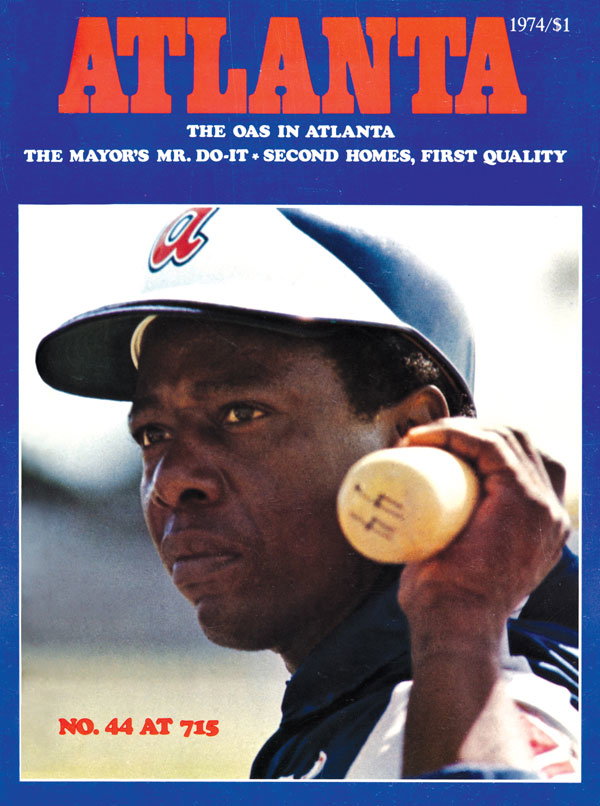
Coming: Mr. 715

This article originally appeared in our April 1974 issue.

He is almost always just Hank. He is recognized wherever he goes and people want to touch him, get his autograph and pose for pictures with him.

He was 20 when he began these sojourns, swatting No. 1 in 1954, when Eisenhower was President. Hank is supposed to have said then that this first trip around the League was like riding through a beautiful park and getting paid for it.

Of all those playgrounds, only Wrigley Field in Chicago still is used for baseball; everywhere else, he is older than any piece of baseball turf. All has changed save him. Only one player still is performing in the major leagues who was there when he arrived. Seven managers are younger than he. In his first Spring he played the Dodgers in Brooklyn; in his golden Summer, and now with the turning of his leaves, they are in Los Angeles.

Before the Atlanta Braves ever played one game, Hank Aaron already had hit more home runs than all but a half-dozen players then in the Hall of Fame. By now, he has stolen more bases than Rabbit Maranville, hit for more bases than either Babe Ruth or Georgia’s Ty Cobb, caught more fly balls than Tris Speaker, scored more runs than Honus Wagner, and driven in more than Ted Williams.

This is the season—probably the month—when Aaron, at 40, takes a moon walk above one of the most hallowed individual records in American sport, the 714 home runs hit by George Herman Ruth. Only in the last year or two has Aaron attracted the national attention his exploits have merited for years. His statistical accomplishments are so vast and continuous that putting them into perspective is like trying to remember numbers of passing freight cars.

He has gone to the plate more than 11,000 times, hit for more than 6,000 total bases and collected more than 500 doubles. As impressive as all those accomplishments are, the big number is 715. His relentless pursuit of that treasure has made Aaron the single most conspicuous figure in American sports.

The enormousness of it has closed in fast on Aaron, on and off the field. As the climax approached at the end of last season, he was walked increasingly because opposing pitchers frankly feared him. Opposition infields overshifted, trying to force him to hit to right field. Aaron ignored them and took the overhead route; in baseball vernacular, he “went for the pump.” Aaron wants everybody to come in with their hard stuff. When pitchers get shifty, trying to nip the outside corner, he disapproves but adjusts accordingly, grumbling all the while about pitchers who “want to fool everybody.” Aaron prefers the problem of hitting against a man such as the New York Mets’ Tom Seaver.

“A man like Seaver, he says, ‘All right big guy, here it is. Pschoo!’ Why hold on to the ball? Why sneak it in? That’s not what the good dudes do—Gibson . . . Seaver. ‘Here’s the heat,’ they say. ‘Here, you want me? Pschoo!'”

Some baseball aficionados cite such comment as evidence of the massive pressure on Aaron. They also observe the number of times Aaron stepped out of the batter’s box last season, how tightly he seems to grip his bat, the way he questions umpires about strikes. But when Babe Ruth is chasing you, people see things they never noticed before. And, yes, it is a matter of Ruth chasing Aaron, the old legends dogging Aaron’s steps, wraiths in pinstripes hounding him.

Always one to read and answer fan mail, Aaron realizes that while most letter writers are pulling for him, a disturbing number do not want him to hit 715. For some who bode him ill, the reason is that Ruth is a colussus in their pantheon. For others, Aaron’s color is sufficient to denigrate his quest. Letters that begin “Dear Nigger,” and go downhill from there, say far more about the mind of parts of the nation than they do about Aaron. “It bothers me,” he says. “I have seen a President shot and his brother shot. The man who murdered Dr. Martin Luther King is in jail, but that isn’t doing Dr. King much good is it? I have four children and I have to be concerned about their welfare.”

Yet Aaron seems to thrive on pressure: it has made him all the more steadfast in his Olympian ambition.

Perhaps this helps explain why the pressure hasn’t seemed to take a noticeable physical toll. Aaron’s wiry, superbly conditioned body shows only the faintest signs of wear. A consummate and deliberate craftsman, he is the same Aaron players have held in awe for years. An accomplished outfielder with keen baseball savvy, Aaron is said never to have made a mental error like throwing to the wrong base. His quick wrists (at eight inches around, they are bigger than Muhammad Ali’s) still snap the bat with sizzling speed, and he hits what are known in baseball’s dugouts as “frozen ropes.” At 190 pounds, Aaron is only 10 pounds heavier than when he broke into the big leagues 20 years ago with Milwaukee. He is the most steady player in a sport that demands consistency of its genuine heroes.

His record in this respect is scintillating. Only twice has he failed to hit at least .280; once was in 1966, when the Braves moved from Milwaukee to Atlanta. His average that year fell to .279, but with 44 home runs and 127 runs batted in, nobody could complain that his hitting was inadequate. Because of his consistency and high performance in so many categories, even an average season for him produces eye-opening statistics. Despite his ability, longevity, consistency and willingness to play, even when injured, the national fame accorded Mickey Mantle, Willie Mays and Stan Musial wasn’t granted Aaron until last year. Perhaps it was because he did not play in New York, and thereby missed the glow of glory that flooded Mickey and Willie, or that he did not come into the Big City and rip the fence in Ebbets Field as Stan did. Being in Milwaukee and Atlanta did not help Aaron’s publicity value, but all of that has changed. Still, Aaron is somewhat resentful. He remarked plaintively in a recent interview with CBS-TV’s Heywood Hale Broun that “I wish all this fame had come earlier. I’m 40 years old now, and I gotta pace myself . . . can’t go as fast as I once did.”

Being the first ballplayer outside New York or Los Angeles to make it to the media vitals has not been easy for Aaron, a flesh-and-blood Everyman who has demonstrated that a hero need not be mythic. He prefers a subdued lifestyle free of curiosity-seekers and paparazzi; his wardrobe is fastidious, not flashy; he drives a 1973 Chevrolet. As one friend reports, “Hank’s idea of a big night out is dinner at a Polynesian restaurant.”

Hank Aaron 1973
Hank Aaron talks during a press conference before filming “The Flip Wilson Show” on October 15, 1973.

Photograph by by Michael Ochs Archives/Getty Images

In the last six months, Aaron has made TV appearances with Merv Griffin, Flip Wilson and Dinah Shore. Last year he appeared on the covers of publications as disparate as Newsweek and Jet. Now his likeness will proliferate like posters when the circus is due. More recently, he popped up on the sports, business, and entertainment pages, and his wedding last Fall put him on the society pages. Three books on Aaron were scheduled for March and April release, and another will be rushed into print as soon as he cracks 715. Another book on Aaron may be written by George Plimpton. (In August, 1968, Atlanta magazine already pictured Aaron on its cover: that issue featured an extract from a book written by Atlanta Journal sports editor Furman Bisher.)

At the outset of this year, a barnstorming, banquet-circuit tour took Aaron to Chicago, Boston, New Hampshire, Milwaukee, and New York—not to mention celebrations honoring him in Atlanta, and his birthplace, Mobile. While in Los Angeles, Aaron was offered a part in a movie which is to costar Harry Belafonte and Sidney Poitier.

“I was to play a bartender,” Aaron said. “They gave me about a page of lines to learn, and I was to serve a few drinks, but I turned it down. It would have been fun, but I just don’t want to make another trip to the West Coast. That’s a different world out there . . . they’re too fast. I don’t want any part of it.”

Hank’s business manager, Berle Adams, is determined to “get an organizational structure around Hank that we can work with and try to control.” While Aaron is not a great one for getting to business meetings on time, he has filmed a series of Brut commercials, plugged Lifebuoy soap and Oh Henry chocolate bars, and signed a pact with the Magnavox Corp. calling for payment of $1 million over a five-year period.

The Magnavox pact calls for Aaron to engage in promotional activities, including his own TV specials. At a New York press conference detailing his Magnavox contract, Aaron said he not only was signing his exclusive services but also the balls, bats, uniforms and other memorabilia associated with his career.

“Each ball, each bat, even the uniform Hank uses, will become our possession,” Alfred di Scipio, a Magnavox official, told the New York assemblage. “They will be carried around the country for people to touch so they can feel a part of this legendary event.” Aaron’s Magnavox contract allows his commitments to other companies until their expiration, when his promotional activities fall under the sole direction Magnavox.

Aaron has become much more than a baseball superstar. He eclipses the sports page and is, in the lexicon of Hollywood, a singular merchandising phenomenon. The home of Lt. Gov. Lester Maddox, Dr. Martin Luther King Jr., Margaret Mitchell and Ralph McGill has put him on a pedestal. The Atlanta Chamber of Commerce and the City of Atlanta initiated a massive “Atlanta Salutes Hank Aaron” celebration which encompasses a citywide Aaron billboard campaign, an Aaron Scholarship Fund administered by the Metropolitan Foundation of Atlanta, and other salutes such as street and school names, and a bust of Hank to be placed at Atlanta Stadium.

At the recent “Atlanta Salutes Hank Aaron Dinner” Gov. Jimmy Carter read a proclamation citing Aaron as an honorary Admiral in the Georgia Navy. Mayor Maynard Jackson awarded him a sterling silver medal, Atlanta’s second highest honor for public service. Explaining why it was not the City’s highest honor, a gold medal, Hizzoner quipped: “I’m saving that one until he breaks the record.” Braves’ announcer Ernie Johnson, observing that a player must wait five years after terminating his playing career to be eligible for the Hall of Fame, commented: “Special dispensations have been granted in special cases in the past, and if Hank Aaron has to wait five years, it’s injustice!”

There is something serenely beautiful in the way Aaron is being honored in Atlanta—a way no black athlete could have been feted as little as 20 years ago. Aaron, while keenly aware of it, takes it in stride: His overall cool throughout the adulation has bordered on the comatose. Now and then he reflects on the magnitude of these tributes: “I have always thought the way I could do the most for my race was through excelling in my conduct on and off the field as a player. Now, because of the position I’m in, I hope I can inspire a few kids to be a success in life. The problems we have in Atlanta are no different than anywhere else: I want to break Ruth’s record as an example to children, especially black children.”

Ivan Allen Jr., mayor of Atlanta when the Braves moved from Milwaukee in 1966, offers this perspective on Aaron: “There was a lot of subtle apprehension about how the South’s first major league sports franchise and its black players would go over. Hank played a major role in smoothing the transition and confirming the end of segregation in the South through his thoughtful consideration and cooperative attitude with everyone, and his exemplary conduct. He taught us how to do it. The first time he knocked one over that left-field fence here, everyone forgot his color.”

Five years ago, the thought that Aaron would be as much a fixture of American culture as Coca-Cola would have been preposterous. The conventional wisdom around the big leagues then was that Ruth’s record not only was untouchable but inviolable, and anyone who thought otherwise obviously had taken leave of his senses. Aaron in less halcyon days remarked: “People keep wondering if I’ll be around long enough to break Babe Ruth’s home run record. I really don’t know. I do know that I will not hang on just for the sake of hanging on—picking up 12 one year and maybe 20 the next and jumping from club to club. I have too much respect for the game of baseball to do that just to chase someone’s record.”

This is the gist of the Aaron legend: immense self-respect. It’s also a kind of class which Aaron attains simply by being himself, a man who would like to pare life to certain essentials but finds it hard. Aaron is first and foremost a baseball player (“The only thing I really know is baseball”) and all the Hollywoodish packaging and grooming cannot obscure that fact. For all his business deals, for all the largesse he has raked in, Aaron seems somewhat uncomfortable about the whole business.

His off-season schedule kicked off at 8 a.m. daily and usually stretched nonstop to midnight: TV commercials, speaking engagements, and discussions with civic leaders—in town one day, out the next. Trying to rap with Aaron during the off-season was a hit-and-run proposition—five minutes here, 10 there, and catch me if you can. The irony is that the acclaim denied him through much of his career now threatens to overwhelm Aaron. In defense, he has developed stock answers for the stock questions he hears every day. His pursuit of the Babe also has become a wish for solitude. Aaron couldn’t wait to get to Spring training this year: “It’s gonna be like a vacation,” he said.

Baseball: That’s where Aaron’s roots are. There he takes his ease; there is his domain. One recalls Braves third baseman Darrell Evans teasing a sartorially resplendent Aaron prior to the Atlanta Salutes Hank Aaron Dinner: “Hey, ‘Supe’”—( short for Superstar)—”how come ya got ‘that fancy jacket on? Whaddya doin’— gettin’ married again?” Hank grinned, but you felt he wanted to take off the damned tuxedo, pick up a bat and start limbering up right there in the Marriott’s Grand Ballroom.

Braves owner Bill Bartholomay once said of him: “One of the few right things I might have done in Milwaukee was to get to know Aaron right away. My admiration for him goes beyond description. He’s Mr. Brave.”

Aaron must admire records because he has created so many of them; yet, for all of the scuffled hysteria over his chase of the Babe, Aaron observes: “To be frank, it is not as important to me as to baseball. The only thing I ever thought about was to be as good as I could. I never thought about being the greatest ballplayer or anything; just to be as good as I could.”

A friend has noted that “for all the commercials, endorsements and business connections, he’ll never be a ‘Broadway Hank.’ The thing about Hank is that he’s really simplified. Simplified. He doesn’t complicate anything. Thoreau would have loved the guy.” So when Commissioner of Baseball Bowie Kuhn failed to congratulate Aaron on his 700th home run, and issued an edict warning pitchers not to “groove” Nos. 714 and 715 for Aaron, it was construed as scandalous. Some pitchers had made some offhand remarks about “groovin’ the biggies,” but only Kuhn took the talk seriously.

Other so-called experts on baseball have referred to the architecture of Atlanta Stadium as the real reason Aaron’s about to overtake Ruth. While it is a park without any wind factor, and because of the altitude of Atlanta, the ball rockets over the wall as if launched from Cape Kennedy. One look at this park and you want to pick up a bat. To suggest, as many have, that this is the principal reason why Aaron has pulled even with the Babe smacks of errant folly.

Such minutiae and petty slights, coupled with the Hall of Fame’s lack of enthusiasm for Aaron mementoes, are an understandable source of annoyance to Aaron, although he will not be caught badmouthing Kuhn or the Hall of Fame. “I like to let the record book speak for itself.”

In the last game of the 1973 season, 40,517 turned out at Atlanta Stadium on a rainy Sept. 30 to see if Aaron could finish off the Babe. Each time Aaron came to bat, there it was, louder still: noise, enthusiasm, recognition. In his first three times at bat that day Hank hit three singles. When he popped up in has last at-bat in 1973, the din was enormous. All Aaron had done for his year’s work, at the age of 39, was slam 40 home runs, hit .301, and knock in 96 runs.

When Hank Aaron paused on his way to the dugout that day, it was beyond any mere note of excitement; it was with absolute authority. The only baseball player before Jackie Robinson, Willie Mays and Aaron who played with the kind of zest and gusto referred to as “black style” was Enos Slaughter.

There was the echo of the tone of one of William Faulkner’s characters who said, standing at the wagon: “Them that’s going, get in the goddam wagon. Them that ain’t, get out of the goddam way.”

Aaron’s in the front wagon.

This article originally appeared in our April 1974 issue.

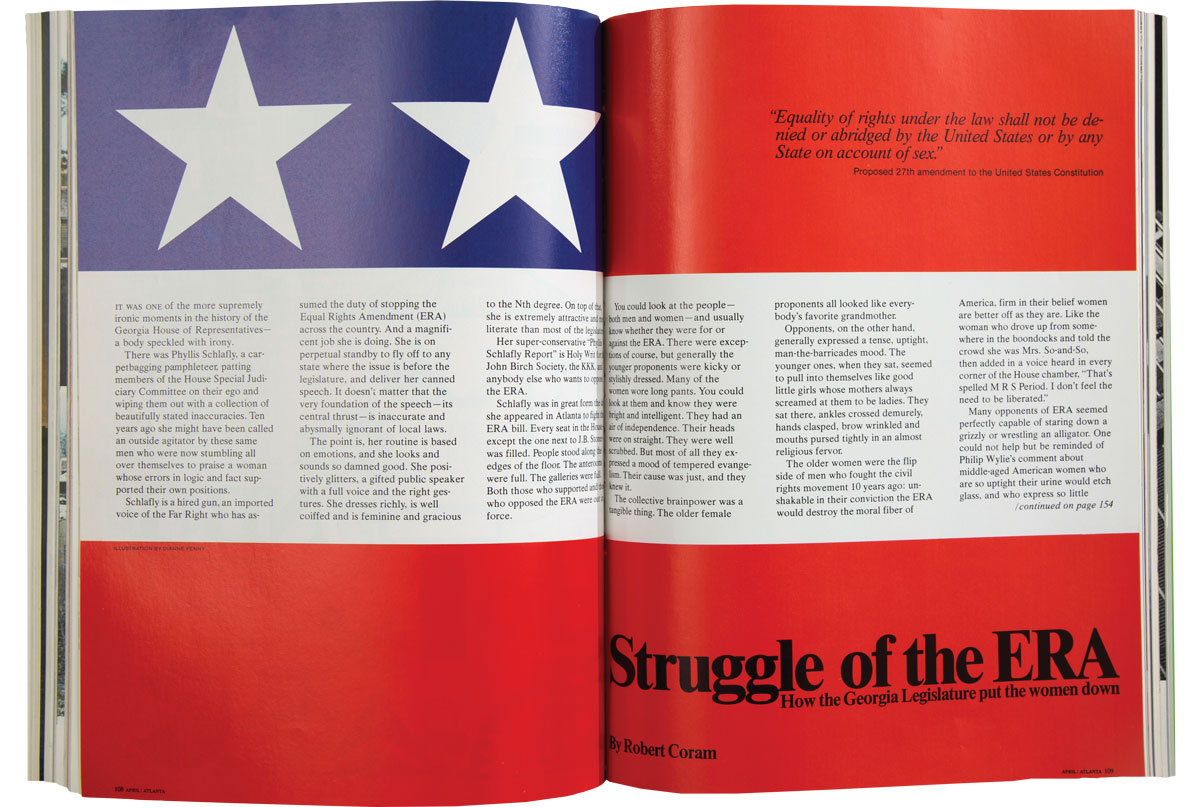
Struggle of the ERA

Editor’s note: This sometimes off-base article details the legislature’s run-in with the infamous Phyllis Schlafly and the fight to pass the Equal Rights Amendment in Georgia, something the state (and country) has yet to do. After this article published in April 1973, four magazine staffers, including Coram, filed sex discrimination suits against the magazine’s owner (the Chamber of Commerce) on the grounds that women doing the same jobs didn’t have comparable salaries. The suit was settled out of court, and the chamber standardized its pay scale and urged its members to do the same.

It was one of the more supremely ironic moments in the history of the Georgia House of Representatives—a body speckled with irony.

There was Phyllis Schlafly, a carpetbagging pamphleteer, patting members of the House Special Judiciary Committee on their ego and wiping them out with a collection of beautifully stated inaccuracies. Ten years ago she might have been called an outside agitator by these same men who were now stumbling all over themselves to praise a woman whose errors in logic and fact supported their own positions.

Schlafly is a hired gun, an imported voice of the Far Right who has assumed the duty of stopping the Equal Rights Amendment (ERA) across the country. And a magnificent job she is doing. She is on perpetual standby to fly off to any state where the issue is before the legislature and deliver her canned speech. It doesn’t matter that the very foundation of the speech—its central thrust— is inaccurate and abysmally ignorant of local laws.

The point is, her routine is based on emotions, and she looks and sounds so damned good. She positively glitters, a gifted public speaker with a full voice and the right gesture. She dresses richly, is well coiffed, and is feminine and gracious to the Nth degree. On top of that, she is extremely attractive and more literate than most of the legislators.

Her super-conservative Phyllis Schlafly Report is Holy Writ for the John Birch Society, the KKK, and anybody else who wants to oppose the ERA.

Schlafly was in great form the day she appeared in Atlanta to fight the ERA bill. Every seat in the House—except the one next to J.B. Stoner—was filled. People stood along the edges of the floor. The anterooms were full. The galleries were full. Both those who supported and those who opposed the ERA were out in force.

You could look at the people—both men and women—and usually know whether they were for or against the ERA. There were exceptions of course, but generally the younger proponents were kicky or stylishly dressed. Many of the women wore long pants. You could look at them and know they were bright and intelligent. They had an air of independence. Their heads were on straight. They were well scrubbed. But most of all they expressed a mood of tempered evangelism. Their cause was just, and they knew it.

The collective brainpower was a tangible thing. The older female proponents all looked like everybody’s favorite grandmother.

Opponents, on the other hand, generally expressed a tense, uptight, man-the-barricades mood. The younger ones, when they sat, seemed to pull into themselves like good little girls whose mothers always screamed at them to be ladies. They sat there, ankles crossed demurely, hands clasped, brow wrinkled, and mouths pursed tightly in an almost religious fervor.

The other women were the flip side of men who fought the civil rights movement 10 years ago: unshakable in their conviction the ERA would destroy the moral fiber of America, firm in their belief women are better off as they are. Like the woman who drove up from somewhere in the boondocks and told the crowd she was Mrs. So-and-So, then added in a voice heard in every corner of the House chamber, “That’s spelled M R S Period. I don’t feel the need to be liberated.”

Many opponents of ERA seemed perfectly capable of staring down a grizzly or wrestling an alligator. One could not help but be reminded of Philip Wylie’s comment about middle-aged American women who are so uptight their urine would etch glass, and who express so little appeal they couldn’t make a hermit move 10 paces off a rock ledge.

All the ERA opponents—male and female—were clad in the armor of a righteous cause. It was both a Holy War and a battle against those who would destroy the American mother. God and patriotism were on this side, and the speakers never let the crowd forget it. Many waved the Bible, literally holding one in the air and screaming like Old Testament prophets.

This group was too uptight even to take part in that good old American tradition of hissing and booing when a speaker was obviously trying to put out a smoke job. The proponents hung loose enough to go in for a little gentle, almost good-natured hissing at some of the more outlandish statements of the opposition. But the opposition felt it was above such low behavior and said so.

Most of the ERA supporters were from Atlanta. A few came from out in the boondocks. They represented many of the most distinguished groups in the state: the Governor’s Commission of the Status of Women, the National Organization for Women, the League of Women Voters, the American Association of University Women, the Women’s Political Caucus, the Georgia Women Lawyers, Common Cause—dozens of groups.

Opponents generally were representing themselves, though a few groups had spokesmen—the John Birch Society, the Ku Klux Klan. But Schlafly was the Big Gun of the opposition. She was the only out-of-stater who testified—a fact the committee found convenient to overlook.

Anyway, Schlafly is the star. She sits there very composed, very demure, accepting the homage paid her, not at all rattled at being pointed out as the celebrity of the day, the woman who wrote A Choice Not an Echo—a Goldwater paean full of alleged leftist conspiracy. She leads off the opposition rebuttal and is given all the time she wants. Her entire presentation is centered around what she calls the “wonderful rights of women.” Brought down to the nitty-gritty, the three main “wonderful rights of women” she discussed were dower rights, protective legislation for women, and the right of support wives have from husbands. It was Schlafly’s contention the ERA would wipe these out; that women would lose the privileges now afforded them.

Representative Andy Roach, chairman of the Special Judiciary Committee, which by its nature requires members be lawyers and have some acquaintance with the law, nodded his head in agreement as Schlafly talked about dower rights which allot a man’s real estate to his widow. What he apparently didn’t know and what Schlafly obviously did not know is that the Georgia Legislature abolished dower rights several years ago. And the Legislature abolished most protective legislation as being repressive towards women. Also, Title VII of the U.S. Civil Rights Act of 1964, which prohibits discrimination in employment on account of sex, has either eliminated most protective legislation or extended its protection to men.

As for the right of support, this is a false protection. The courts almost never issue a support decree as long as a man and wife are living together. A husband can give his wife $20 a week and his girlfriend $150 a week, and there is nothing the wife can do, right of support or not. And if you think such instances are not common, ask anybody at the Legal Aid Society.

The basic principle of the ERA is simply that sex is not a permissible factor in determining the legal rights of women and men. (Twenty-nine states have voted to ratify the ERA. 38 states must approve for it to become an amendment to the Constitution.)

Women like to say that men are also protected by the ERA but in essence, the proposed amendment (which was not ratified by the Georgia Legislature) would most benefit white women. Black men, Black women, and white men now have constitutional protection not afforded white women, a majority group treated like a minority.

The heart of the ERA involves property rights, marriage and divorce, right to engage in an occupation, and freedom from discrimination in employment and education. But the opposition in the Georgia Legislature effectively camouflaged these central issues by contending the ERA means women could use men’s bathrooms; that rape would no longer be a crime. J.B. Stoner, the KKK spokesman, told the packed House that ERA would “destroy motherhood and the home,” that it would “put women in racially mixed barracks with men,” and that it would “legalize prostitution.” The Reverend Bob Spencer, one of God’s spokesmen on the Far Right and one of a number of clerical types who spoke against the ERA, said, “The Equal Rights Amendment is a denial of God.”

Representative Bob Howard of the Special Judiciary Committee told a reporter privately the bill meant that “people, irrespective of their plumbing, will use the same bathrooms.”

While all of this is emotional nonsense, the Schlafly technique carried much credence. She contends the ERA will wipe out laws protecting women against rape, and she quotes an article from the Yale Law Review—considered the best thing ever written on the ERA—as her authority. Now, the Yale Law Review is a periodical of no small import in legal circles. When Schlafly quotes the YLR and even gives the page number, then that’s gospel, brother. And only perhaps one of 100 who hear her will ever read the article in its entirety. Were they to do so, they would note certain of her discrepancies.

For instance, she gives a page number and even a quote to substantiate her contention that rape laws would be invalidated by the ERA. Strong stuff. Except the quote is from a summary at the end of a section of the article and has nothing specifically to do with rape. If she had gone to the specific section of the article having to do with rape laws, she would have read that a law based on a unique physical characteristic of men—a law very narrow and specific in scope—probably would be upheld by the courts. ERA or not.

Schlafly also uses the YLR article to buttress her contention the ERA would make women subject to the draft and combat duty. But the ERA will no more require all women to be drafted than all men are drafted. With the coming abolition of the draft, this will become a moot point. And as for serving in combat, fewer than 1 percent of members of the military ever see combat. What opponents fail to mention is that women in the military are eligible, on an equal basis with men, for education benefit, medical services, and preferential veterans’ treatment which go along with military service.

The list of fallacies is endless. One more deserves a passing mention only because of the humor involved. The Schlafly Report says ratification of the ERA would have a profound effect on the weakened structure of American family life, and that destruction of the family is “one of the foremost goals in taking over a country” by communism. It also ties in the women’s liberation movement with ERA (the two are not synonymous) and says the “evil influence” behind women’s lib is revealed in its clenched fist, which is a symbol of the Communist. Contrast this alleged Communist affiliation with the fact the ERA has been or is supported by President Dwight Eisenhower, President Richard Nixon, Governor George Wallace, the Women’s Christian Temperance Union, the National Federation of Republican Women’s Clubs and Atlanta Journal Associate Editor John Crown—not exactly a hotbed of fellow travelers.

Schlafly’s errors in logic and fact went completely over the heads of Committee members. She just looked so good standing there. And she sounded like a million dollars. And when she said the Supreme Court would be issuing interpretations of the ERA if it were ratified, and that this was wrong because it preempted the duty of state legislatures which were much closer to the people, then that had the Committee members nodding their head in agreement. That woman flat knew what she was doing. Anybody who comes to Georgia to badmouth the Supreme Court and to tell local legislators they are close to the people is mashing the right emotional button.

Representative Roach was standing in the aisle by the side of the House chamber while Schlafly was speaking. This comment by her made him nudge a colleague in agreement and nod his head sagely.

Then, a reporter asked him why most legislators seemed to frown on the ERA. He said the legislation would “reduce the dignity of the ladies. It will take them out of the prestigious position they now hold.” He indicated the Committee was not favorably disposed toward the ERA, but, when pressed for specific reasons, he could only nod toward Schlafly and reply, “Because of what she is saying.” Yeah, but specifically what is she saying that you agree with? “Just everything she is saying.”

Roach’s forecast of defeat was accurate. The ERA never came out of committee. It was gone but far from forgotten. A coalition of more than a dozen of the most distinguished women’s groups in Georgia sent Representative Roach and every member of his Committee a petition stating they wished to see the amendment brought out of Committee so the full House could vote on it. Then, Mamie K. Taylor, the dowager queen of the ERA effort, went to Roach. It is difficult to determine whether she purported to represent all of the groups supporting the ERA or just her own. The point is that Roach and the Committee members had in their hands petitions from groups representing hundreds of supporters, yet they used the word of one woman to buttress their own feelings and to bottle up the bill in Committee. It was one of the more cavalier, autocratic decisions of any House committee during the past session.

Roach showed a studied contempt for the intelligence of the ERA supporters when he told them that, by bottling the amendment up in Committee, he had shown his support; that this action saved the ERA; that next year it could blossom full-blown.

In many ways, the ERA movement can be linked to the Civil Rights Movement of 10 years ago. It polarizes people’s emotions. Its central thrust is obscured by a plethora of non-issues. Those who fought the Civil Rights Movement are in many cases the same ones fighting the ERA.

ERA—like the Civil Rights Movement—is an idea whose time has come. Not this year and maybe not even next year. But the rights and privileges sought by women are so intrinsically right, they cannot long be denied.

Perhaps the great tragedy of the failure of the ERA is that legislators did not allow themselves to learn what the ERA truly is about. Almost to a man they pooh-poohed it. Their contempt was hardly veiled even in public. They told supporters they needed to study it a bit more. More often, they patted ERA forces on the head, smiled, and suggested they go home and let the men handle the legislative chores. More than one woman was propositioned by legislators when his support was sought. Many legislators—including such top leaders as George Busbee—simply waffled on their public pledge of support.

In summary, the level of consciousness of legislators toward women was not raised. And this is sad. Just as it is impossible for a white person to know the misery of being Black, it is equally impossible for a man to know the humiliations of being a woman. No effort was made. “Those men put us down in ways they’d never put down Blacks,” one woman said.

Here were men, men whom Schlafly said were close to the people, overlooking one of the state’s greatest resources. They elected to perpetuate a system that does not allow women to be people; a system that, with few exceptions, does not allow women to approach their potential; does not allow women to develop and leave a heritage of womanhood. ERA’s logic in the South faces the emotions of the moonlight-and-magnolia syndrome—a syndrome that sees women only as decorative objects devoid of brainpower; a syndrome that further views bright, aggressive females as having lesbian tendencies.

All these females have endured too long. Like the Blacks of the Sixties, they are becoming increasingly aware of their potential political power. They have worked inside political campaigns for years. They know the female of the species far outnumbers the male in registered voters. And come the next election year, it is entirely possible that some of the legislators who opposed the ERA, who denigrated the ERA and the women who supported it, who went back on their word, will find out what womanpower is all about. 

This article was originally published in our April 1973 issue and reprinted in our January 2021 issue.

S.C.L.C.: What’s Happened to the Dream


This article originally appeared in our April 1972 issue.

On a Memphis motel balcony four years ago this month, a 30.06 slug tore the life from Dr. Martin Luther King Jr. His colleague and intimate friend, the Rev. Ralph David Abernathy, was standing inches behind him when the bullet struck.

“I got down over him and I patted his cheek until I got his attention,” Abernathy recalled days ago. “I know talked. His lips quivered, and his eyes said to me, ‘Don’t you let me down, Ralph.’ It was like an inner voice.”

Abernathy succeeded King as president of the Southern Christian Leadership Conference (SCLC), that loose confederation of towering egos and simple folk who want justice which served as the vehicle for King’s movement. But many were convinced that SCLC’s fuel was King’s charisma, and without him, it would falter.

They could make a good case.

The mellifluous, urgent baritone solo of Martin Luther King has been supplanted by a cacophony of militant rhetoric in America. SCLC, the one-time vanguard of the black American revolution, is in the back seat to the headline potential of Huey Newton and Angela Davis.

SCLC has moved from mule train to Whisperjet, from frequent street marches to sedate board rooms. Around SCLC’s yellow-brick headquarters on Atlanta’s Auburn Avenue, the symbolic denim of revolution yielded to double-breasted suits and mod accoutrements. Many faces familiar in King’s day have vanished. So has much of the drama.

“Used to be, if there was trouble somewhere, everybody in the place would pick up and go,” said the Rev. Andrew Young, one-time King lieutenant and now the conservatively dressed director of Atlanta’s Community Relations Commission. “We’d have maybe two people to answer the phone. Everybody else would go march.”

And march and march and march … in Southern towns like Selma and Grenada, towns that never had made a Northern headline; in better known cities like Montgomery and Birmingham, which soon took on new symbolism … places that were never the same after SCLC had mounted a campaign.

Today, SCLC rarely commits all its resources to a single issue. Instead of a hundred or more workers in the field, there are only a dozen. Its 48 other staffers—most of them in Atlanta—have desk jobs to perform and phones to answer.

Has Abernathy failed King’s admonition not to “let me down”? Is SCLC a walking cadaver?

“The times have changed,” King’s jowly successor intoned slowly, his booted feet propped on a thick, monogrammed attache case by his desk. “We were having problems prior to Dr. King’s assassination. Had he lived, he would have changed with the times, too.

He would have been saying ‘right on’ and ‘power to the people’ just like the rest of us.”

(One staffer confided that King had decided just before his death to let his close-cropped hair grow to moderate Afro length.)

“During Dr. King’s lifetime,” Abernathy added, “we dealt with the obvious, overt forms of segregation. Now we are faced with more subtle forms. Sure, we have the right to eat downtown and stay in a hotel. But do we have the right to hold the job to earn the money to pay the hotel bill? We earned the right to schools, but do we have quality education? There once was a time when we could expose evil through mass demonstrations. But demonstrations alone will not solve our problems. We have to have jobs, income, control of our communities.

“The philosophy of our organization is still the same: militant nonviolence. But the strategy has changed.”

Even if the more sophisticated challenges of jobs and political power were amenable to mass confrontation tactics, it is doubtful that such demonstrations would command the headlines that they did before.

The Rev. Hosea Williams, a firebrand SCLC organizer whose mere presence in a small Southern town sets old-line white leaders boiling, summarized it: “Unless you go out and get you a gun and shoot at some white folks—you can’t just talk about it, you got to shoot at someone now—you don’t make the press. But if you go out and do some hard work like we did in Sandersville, or Columbus, or all over Alabama right now, the press doesn’t write about that—things that would have made front-page stories 10 years ago.”

The last time an old-style campaign got both headlines and results was in 1969, when SCLC joined with union organizers in a 113-day strike to help poorly paid Charleston, S.C., hospital workers win collective bargaining rights. SCLC—including King’s widow, Coretta Scott King—defied state and local police to march and kneel in prayer in the middle of the street. And Abernathy, in best Old Movement fashion, spent 21 days fasting in Charleston jail.

It’s not that SCLC’s reduced cadre of field workers aren’t still manning the trenches in civil rights backwaters. It’s just that their work rarely is treated as news. Few newspaper readers, for example, may realize that:

  • Last August, a black man was found, bludgeoned to death, in the trunk of a state patrol car in Ayden, N.C. The patrolman driver was transferred to another part of the state, but not prosecuted. SCLC field worker Golden Frinks led ensuing protests; he and 175 rural blacks were arrested in two days of marching, in one instance having to dodge a police car which charged into the line of march.
  • A black girl, 19, was killed last September when a white man drove his car into a civil rights march which protested the firing of black teachers in Butler, Ala. Though charged with murder, the white driver was released the same day on a small bond. Abernathy and some 300 local blacks went to jail for two days in the ensuing protests, while SCLC Board Chairman man Joe Lowery negotiated a nondiscriminatory hiring agreement with the Butler, Ala., power structure.
  • SCLC spent about $200,000 of its $900,000 budget in 1971 on a little publicized “War on Repression,” which included welfare marches in Nevada and Wall Street, and a mule train march in Washington on Moratorium Day, in conjunction with other peace groups.
  • It backed a march in Daytona Beach, Fla., to protest the low pay of domestic workers there.
  • SCLC helped Sandersville, Ga., blacks win a majority on the city council last November, and in the 1970 elections was instrumental in the election of black governments in Greene County, Ala., and Hancock County, Ga.

These events were noted by occasional reporters, but outside the immediate localities (and sometimes even there) the stories rated no better than inside-page coverage. Gone were the battalions of TV cameramen who filmed the clubbing of voting-rights marchers on Edmund Pettus Bridge in Selma, or the fire-hosing and police dog attacks on public accommodations petitioners in Birmingham.

With SCLC’s lower public profile has come a lower budget.

SCLC raises its money strictly through private donations. It owns what is considered the best mailing list of liberals in the country: some 200,000 names, mostly of whites. It steadfastly resists efforts of other organizations to buy the list, but it recently tested the potency of the list by mailing an appeal for Angela Davis’ defense. In three months’ time, it brought $47,000. The postage cost alone, however, was formidable.

It has shied away from federal grants and foundations.

“They always have string attached,” Andrew Young explained, “like no political activity.” SCLC donors must be especially devoted because their contributions are not tax-deductible.

In the times of the Selma March (1965); the March on Washington, when King delivered his “I have a dream” speech at the Lincoln Memorial (1963); and of King’s assassination (1968), SCLC’s receipts soared to $2 million each year (non-taxed). Last year’s $900,000 income, although less than half those peaks, hardly suggests a moribund organization.

Shifted emphasis of goals, less dramatic tactics, and lower levels of publicity also have wrought internal changes. Of necessity, the lower budget brought staff reductions. (Not that SCLC pay ever was lavish. Example: The Rev. James Orange, a burly, highly effective field worker who looks utterly at home in dungarees, after nearly 10 tough years in the Movement, recently received a raise to $6,500 a year—plus, presumably, free soul food almost anywhere he goes.)

Many volunteers and some of the old staff are gone because the old glamor is. New recruits and those who remain have accommodated to the new rhythms.

Dorothy Cotton, who has been at SCLC so long she “can’t even remember my life before the Movement,” summarized it: “The hectic days of living and working with Dr. King—wow! It was exciting, beautiful, moving. But it was also killing. You just can’t live at that pitch constantly. One year you can run down the street shouting ‘Freedom now!’ But after a few years, you’ve got to put some flesh on that skeleton. I guess this leads to a more coat-and-tie approach.”

Young, always a coat-and-tie man, left day-to-day work with SCLC first to run for Congress and later to plant his roots more solidly in Atlanta soil with the Community Relations Commission. He remains a member of the SCLC board.

Coretta King also is a board member, and occasionally makes appearances for SCLC causes, but her general absence from the scene continually inspires reports that she and Abernathy are at odds. Both deeply resent these allegations.

A more accurate reading is that Mrs. King is occupied—even preoccupied—with raising her four school-age children, and seeking funds for the Martin Luther King Memorial Center, an ambitious four-block complex of research, meeting and museum facilities planned in the neighborhood of Ebenezer Baptist Church, where King was co-pastor with his father. These commitments, plus a protective secretary, make her almost inaccessible to reporters. (Even after three weeks’ attempts to reach her for this article, she was “not available.”)

“Dr. King used to say we had a team of wild horses,” recalled Tom Offenburger, a white journalist who left U.S. News & World Report to answer King’s clarion. “They could go off on their own thing, but then he could pull it all together again.”

Most of the “wild horses” have left the corral, and gradually—often subtly—SCLC is becoming Abernathy’s organization.

The Rev. James Bevel drifted out of SCLC and was heard from most recently urging a Gov. George Wallace-Rep. Shirley Chisholm ticket.

The Rev. T. Y. Rogers died in an automobile accident.

The Rev. Jesse Jackson, often cited as Abernathy’s most potent rival, resigned a few months ago in a much celebrated flap when Abernathy and the SCLC board attempted to curb Jackson’s near autonomy in the organization’s Chicago operation. The handsome, dynamic young Chicago minister promptly established his own black rights organization, PUSH (People United to Save Humanity).

Hosea Williams, most flamboyant and controversial of all the “horses,” was bypassed last spring when young Stoney Cooks, who has less seniority, was named executive director. Williams was placed on leave of absence, made a trip around the world (with funds raised from churches), and returned to write a book. Although Williams was never especially noted for his piety, Abernathy recently ordained his as a minister. Despite their differences, Williams rejects any criticism of Abernathy’s leadership:

“You must be kidding! Abernathy is the most unsung hero in the movement. Dr. King never made a decision that he didn’t consult Ralph David Abernathy. And if Ralph said no, you could bet your bottom dollar that was a dead idea.

“Ralph is not as intellectual as Dr. King, but he’s no dumb man. Everybody knows the guts Ralph’s got. And they know Ralph cannot be bought out. Ralph is able to relate better to the masses than Dr. King was. Dr. King tried. He’d put on some old boots and go down to the pool hall and shoot pool. And they’d accept him a little bit. But as soon as he’d open his mouth—there was something about that man—they’d back away and want to put him on a pedestal. And you’d see ’em looking at him, just wanting to touch him. He was something particular.

“Ralph’s different. Ralph couldn’t do that if he wanted to. There ain’t a bum in the streets won’t say, ‘Hey, Abernathy,’ and throw his arm around Ralph. But that’s the type leader we need today. Black people have developed to the point today that they no longer need a leader they can look up at. They need one they can look at!”

UnKingly though Abernathy admittedly is, and fragmented as the black rights movement is into militants, moderates and separatists, a recent Lou Harris survey showed that black Americans rank Abernathy their most respected leader—a position once held by his friend and predecessor, King.

And as much as some externals have changed, SCLC retains some of its original essences. It is still more a force than an organization, more an idea than a bureaucracy. Mail may still go unanswered, phone calls unreturned, timeclocks unpunched, appointments tardy or unkept.

The slightly shabby headquarters of the Movement that helped change America remains in that focus of black Atlanta, “sweet Auburn,” a soul stew of churches, high-booted prostitutes, “Jesus Saves” neon, billiard parlors, old men in a barber shop, pushers in rakish hats, soul-food lunchrooms, and the prestigious, black-owned Atlanta Life Insurance Company.

It is appropriate that SCLC is there, in the Prince Hall Free & Accepted Masons Building, rather than in the other focus, the West Side, with its Atlanta University complex and $50,000 homes, for SCLC’s strength remains with the poor and troubled.

“You can’t get too poor, and your house can’t be too run down for SCLC,” remarked Thomas Gilmore, whom SCLC helped elect the first black sheriff of Greene County, Ala. (Black officeholders in the Old South have risen in number from about 100 in 1965 to 873 today. Many received SCLC assistance.)

“SCLC is at its very tops out in the Perry Counties, Choctaw Counties, Wilcox Counties,” said a long-time U.S. Justice Department official, a close observer of the civil rights struggle for more than a decade. “They’re the best out in the field working with the regular folks as community organizers.”

“I’ve got 30 people who can ‘turn on’ any county in the South,” claimed Stoney Cooks. “We are the organization that can turn people on. (State Rep.) Julian Bond ain’t got nobody but himself, his wife and children.”

This ability to talk the language of the people not only influences the kinds of projects SCLC undertakes, but also carves a niche distinct from other civil rights organizations and from labor unions.

In a few rural backwaters, where the Civil Rights Act of 1964 and the Voting Rights Act of 1965 still encounter bitter-end resistance, SCLC projects resemble those of the old days. But increasingly, they are economic and political. Hosea Williams summed it up:

“We’ve got to get the movement out of the streets and into the banks, the chambers of commerce, the college classrooms. We’ve got to stop running to the white community. We’ve got to develop our community. We’ve got to change the slums from a dungeon of shame to a haven of beauty. And then, hell, the white folks’ll be trying to move into our neighborhood.”

SCLC’s major program theme this year is “Politics ’72.” It includes voter registration drives, now rolling at Atlanta University, in parts of North Carolina and Mississippi, and in the Alabama Black Belt. It will support sympathetic candidates in key congressional districts around the country (notably Georgia’s Fifth District, where Atlanta’s Andrew Young will be taking his second shot at the seat).

Abernathy probably will lead a delegation of demonstrators to the Democratic National Convention in July in Miami Beach to apply public pressure to black delegates. SCLC played an important role in organizing black students who elected Shirley Chisholm delegates at the Fifth District Democratic Convention last month.

A formidable propaganda apparatus undergirds SCLC’s politicking. Hundreds of thousands of leaflets, flyers and posters will be distributed to explain voter registration. (One sample, affixed to a wall in the SCLC lobby: “This house is 100% registered to vote. Is yours?”)

SCLC also distributes a half-hour taped radio program to more than 150 black radio stations each week. Called “Martin Luther King Speaks,” it is aimed at devout blacks for whom the Promised Land and the struggle for equal rights are one and the same. Programs often include King’s voice. “Luckily, we taped every speech he made,” Offenburger sighed.

In the area of citizen education and government—as contrasted with politics—SCLC also operates workshops through a tax-exempt Southern Christian Leadership Foundation, which spent $300,000 last year (one-third as much as SCLC’s entire budget but not part of it).

The recession of the late Sixties and early Seventies has handicapped SCLC’s efforts to upgrade jobs for blacks. The organization has been most effective in protest situations such as the Charleston hospital workers’ strike. In 1970, when 500 black and white steelworkers struck in Georgetown, S.C., SCLC helped coordinate their protests into a successful strike. Currently, two SCLC field workers in Birmingham are girding for a re-run of Charleston: More than 2,000 employes from three hospitals already have signed pledge cards asking for collective bargaining.

The National Association for the Advancement of Colored People (NAACP) has been involved in voter education and politics far longer than SCLC. The Urban League has more seniority in solving employment problems. And labor unions would seem on the surface to have enough experience in union organizing to get along without SCLC’s help.

Has SCLC then become a fifth wheel, a drain on the diminished resources of black-rights causes?

If SCLC has a raison d’etre, it lies not in staking out exclusive projects, but in its special ability to talk to and “turn on” poor blacks. NAACP, no slouch at such organization, is more oriented to litigation. Urban League tends to operate more through established channels of power.

As for union support, Abernathy said: “We can get into these hospitals very easy. We speak the people’s language, and they believe in us. They’ve never been in a union before. Once they are organized, they choose the union; we don’t. Soul power and union power are a winning combination.”

“The black American is in the church,” Hosea Williams added. “His whole being is in the church.” Anent his own new preaching role, he explained: “You got to go where the people are before you can take them where they ought to be.”

SCLC’s fate is directly related to the faith it can instill in its constituency. Can that faith survive without the charisma of King? Without the drama and headlines of monumental, all-troops confrontations?”

Four years should be long enough for some sort of answer. Abernathy has found his.

In the first months after King’s assassination, he recalled, trying to operate SCLC was “kind of like being a widower, being the father and the mother to the movement. We had always been together, even in jail.

“The thing I miss most, now I don’t have anybody to laugh with.”

Abernathy lived long in King’s shadow, though he says that people who attempt to compare him with King “are not sincere supporters of the Movement.”

The turning point for Abernathy was a religious experience.

“When ‘d leave the office late at night, I used to walk up to the (King) tomb and listen for his voice. But the tomb never said anything. One night last year I got home from a staff meeting about four in the morning. We had had terrible disagreements, and I didn’t know what to do.

“I looked at Dr. King’s picture in my hallway, and I said, ‘Martin, I’ve done everything I know how. What can I do?’ You may not believe this, but I know he talked to me . . . an inner voice. He said, ‘Ralph, don’t look to me. I don’t have the answer. Look to the Cross.’

“I got back in my car—and drove down to my church and sat in a pew for about an hour. The Cross is always illuminated. Finally, I realized I would no longer find the answers in Martin Luther King. He was a great spirit. He lived. But the answers must come from Christianity.”

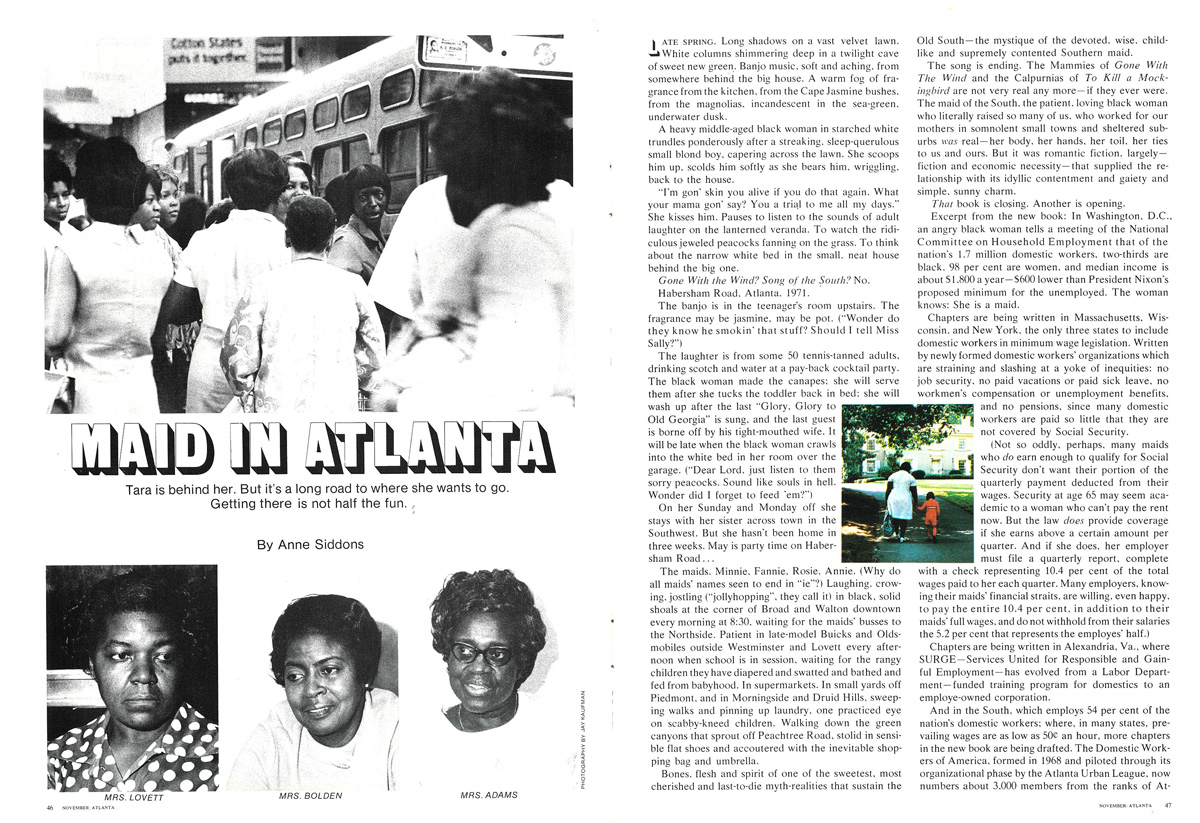
Maid in Atlanta: Tara is behind her. But it’s a long road to where she wants to go.

Anne Rivers Siddons Maid in Atlanta 1971 Atlanta MagazineThis article was originally published in our November 1971 issue.

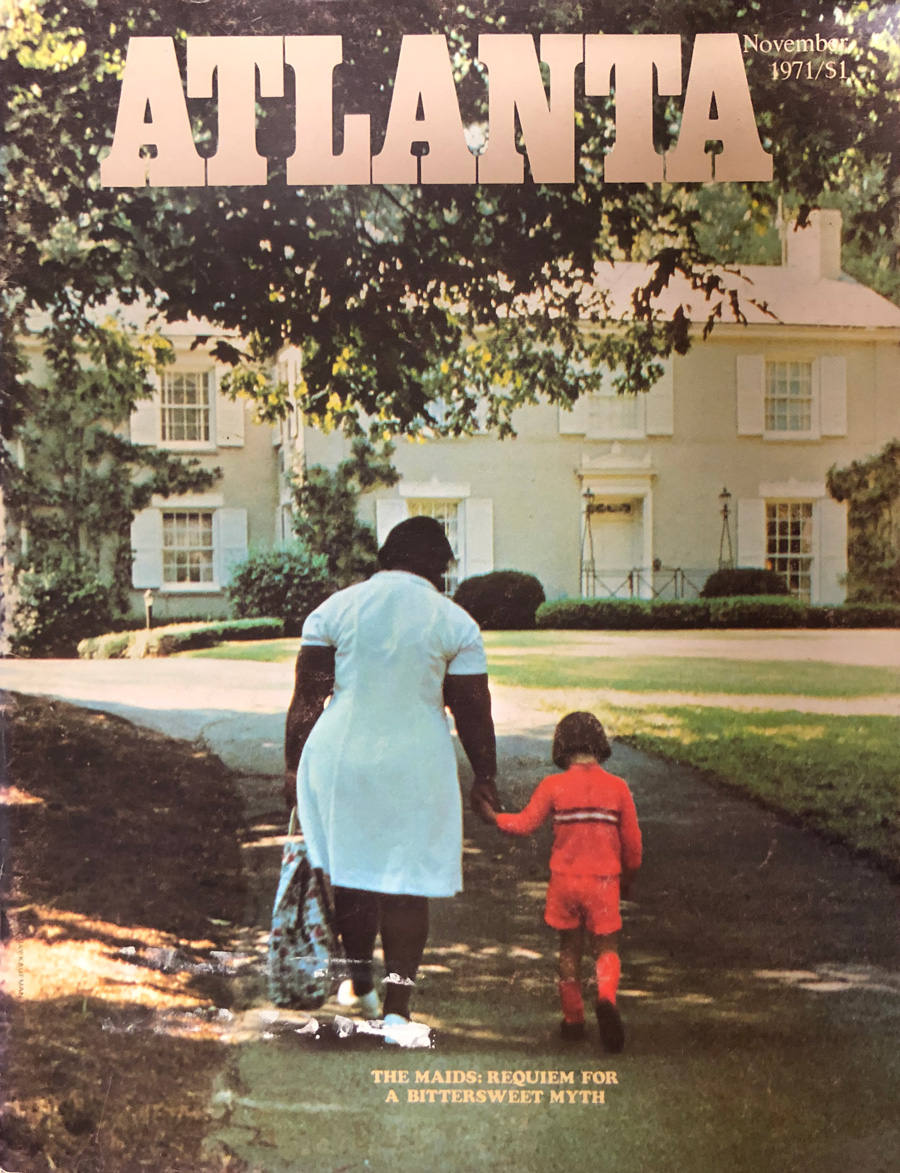
Late spring. Long shadows on a vast velvet lawn. White columns shimmering deep in a twilight cave of sweet new green. Banjo music, soft and aching, from somewhere behind the big house. A warm fog of fragrance from the kitchen, from the Cape Jasmine bushes, from the magnolias, incandescent in the sea-green, underwater dusk.

A heavy, middle-aged black woman in starched white trundles ponderously after a streaking, sleep-querulous small blond boy, capering across the lawn. She scoops him up, scolds him softly as she bears him, wriggling, back to the house.

“I’m gon’ skin you alive if you do that again. What your mama gon’ say? You a trial to me all my days.” She kisses him. Pauses to listen to the sounds of adult laughter on the lanterned veranda. To watch the ridiculous jeweled peacocks fanning on the grass. To think about the narrow white bed in the small, neat house behind the big one.

Gone with the Wind? Song of the South? No.

Habersham Road, Atlanta, 1971.

The banjo is in the teenager’s room upstairs. The fragrance may be jasmine, may be pot. (“Wonder do they know he smokin’ that stuff? Should I tell Miss Sally?”)

The laughter is from some 50 tennis-tanned adults, drinking scotch and water at a pay-back cocktail party. The black woman made the canapés; she will serve them after she tucks the toddler back in bed; she will wash up after the last “Glory, Glory to Old Georgia” is sung, and the last guest is borne off by his tight-mouthed wife. It will be late when the black woman crawls into the white bed in her room over the garage. (“Dear Lord, just listen to them sorry peacocks. Sound like souls in hell. Wonder did I forget to feed ’em?”)

On her Sunday and Monday off she stays with her sister across town in the Southwest. But she hasn’t been home in three weeks. May is party time on Habersham Road…

The maids. Minnie, Fannie, Rosie, Annie. (Why do all maids’ names seem to end in “ie”?) Laughing, crowing, jostling (“jollyhopping,” they call it) in black, solid shoals at the corner of Broad and Walton downtown every morning at 8:30, waiting for the maids’ buses to the Northside. Patient in late-model Buicks and Oldsmobiles outside Westminster and Lovett every afternoon when school is in session, waiting for the rangy children they have diapered and swatted and bathed and fed from babyhood. In supermarkets. In small yards off Piedmont, and in Morningside and Druid Hills, sweeping walks and pinning up laundry, one practiced eye on scabby-kneed children. Walking down the green canyons that sprout off Peachtree Road, stolid in sensible flat shoes and accoutered with the inevitable shopping bag and umbrella.

Bones, flesh and spirit of one of the sweetest, most cherished and last-to-die myth-realities that sustain the Old South—the mystique of the devoted, wise, child-like and supremely contented Southern maid.

Anne Rivers Siddons Maid in Atlanta 1971 Atlanta MagazineThe song is ending. The Mammies of Gone With the Wind and the Calpurnias of To Kill a Mockingbird are not very real any more—if they ever were. The maid of the South, the patient, loving black woman who literally raised so many of us, who worked for our mothers in somnolent small towns and sheltered suburbs was real—her body, her hands, her toil, her ties to us and ours. But it was romantic fiction, largely—fiction and economic necessity—that supplied the relationship with its idyllic contentment and gaiety and simple, sunny charm.

That book is closing. Another is opening.

Excerpt from the new book: In Washington, D.C., an angry black woman tells a meeting of the National Committee on Household Employment that of the nation’s 1.7 million domestic workers, two-thirds are black, 98 percent are women, and median income is about $1,800 a year—$600 lower than President Nixon’s proposed minimum for the unemployed. The woman knows: She is a maid.

Chapters are being written in Massachusetts, Wisconsin, and New York, the only three states to include domestic workers in minimum wage legislation. Written by newly formed domestic workers’ organizations which are straining and slashing at yoke of inequities: no job security, no paid vacations or paid sick leave, no workmen’s compensation or unemployment benefits, and no pensions, since many domestic workers are paid to little that they are not covered by Social Security.

(Not so oddly, perhaps, many maids who do earn enough to qualify for Social Security don’t want their portion of the quarterly payment deducted from their wages. Security at age 65 may seem academic to a woman who can’t pay the rent now. But the law does provide coverage if she earns above a certain amount per quarter. And if she does, her employer must file a quarterly report, complete with a check representing 10.4 percent of the total wages paid to her each quarter. Many employers, knowing their maids’ financial straits, are willing, even happy, to pay the entire 10.4 percent, in addition to their maids’ full wages, and do not withhold from their salaries the 5.2 percent that represents the employees’ half.)

Chapters are being written in Alexandria, Va., where SURGE—Services United for Responsible and Gainful Employment—has evolved from a Labor Department-funded training program for domestics to an employee-owned corporation.

And in the South, which employs 54 percent of the nation’s domestic workers; where, in many states, prevailing wages are as low as 50 cents an hour, more chapters in the new book are being drafted. The Domestic Workers of America, formed in 1968 and piloted through its organizational phase by the Atlanta Urban League, now numbers about 3,000 members from the ranks of Atlanta’s 30,000-plus domestic workers.

To the average worker, demands of these new groups seem elementary, basic. They are the things taken for granted in even the lowest-paying of most jobs: insurance coverage, workmen’s compensation, unemployment benefits, a basic living wage—in the words of Mrs. Edith B. Sloan, executive director of the National Committee on Household Employment—pay, protection, professionalism.

The Three Ps. But behind the Three Ps, the col statistics, the neatly drafted demands for tangible, workadays benefits, is the cry for what hasn’t been in the kitchen with Dinah for all these years…respect. Dignity. Simple, garden-variety humanity.

Charles Stinson Jr., director of community services for the Atlanta Urban League, knows the territory: He helped inaugurate the infant Domestic Workers of America in May, 1968.

What these women are fighting—have fought all along—is a lack of basic awareness that they’re highly skilled workers, human beings of dignity, productiveness and standing. Until they’re spelled out, their employers usually don’t stop to assess the skills they have—and neither do they. The maid’s a capable human being, working for a living like you and me, and she does her job like nobody on earth.

“She cleans and cares for a big house, every piece of fine furniture and porcelain and silver in it. She’s a chauffeur—and a good one. She knows how to take care of expensive clothing and fabrics, she runs sophisticated appliances, she cooks large meals, sometime gourmet meals. She serves at parties and does a mountain of dishes afterwards. And she does everything for those children, from seeing that they’re safe to applying emergency first aid, to listening to their homework, to disciplining them, to helping them make moral and ethical value judgments.

“You think that doesn’t take skill and sensitivity and dedication? Would you do it for seven or eight dollars a day and no protection or job security? Because, until 1968, that’s what an average Atlanta maid earned.

“But you still hear women saying, ‘Why is she always asking for money? Why does she fuss about working a little later some days? She just doesn’t want to work. Mother’s maid wasn’t like that.’

“I’ll give you an example. Back when the union was first organized, and were getting a good bit of publicity, this guy call and he says, ‘Look, I’m good to my maid, but I want to tell you something. Her husband picks her up after work, and sometimes if she’s not finished, he pulls a few weeds for me. Well, I always give him a nice plate of something, a nice meal—same thing we eat—whenever he does. And now they’re both mad at me.’”

Stinson laughed softly, helplessly, in angry defeat.

“‘A nice plate of something.’ Does his boss dock his salary on payday because he took him to lunch the day before? When people start really seeing their domestic employees, seeing them as people earning a living in the same world and paying the same prices that they themselves do, instead of thinking of them the same way their parents and grandparents did—then it will come, all of it. The money, the working conditions, the respect. But not ’til then.”

Slowly, ponderously, to the accompaniment of a litany of frustration, things are changing, thanks mainly to organization and perseverance.

A domestic workers’ union in New York State won inclusion in the state’s minimum wage legislation. In Massachusetts, a group successfully pressed for inclusion in the state’s labor laws. Domestics in the Charlotte, N.C., area won shorter hours and higher pay. A bill before Congress includes domestic workers under the Federal minimum wage, but it is still wrapped in the tendrils of committee bureaucracy.

In Atlanta, public awareness has grown, and with it, the pay scale has risen from $7-$8 a day to the current average of $12 (lower than their hoped-for $15), but little has been done in the way of legislation. [Editor’s note: $8 in 1971 is about $51 in 2019. $12 is about $72. $15 is about $95.]

A bill proposed by state Sen. Leroy Johnson in February, 1969, to establish a minimum wage for domestic workers, was defeated. A carefully drawn training program, in which 25 domestic workers were to be recruited and trained every eight weeks in all phases of domestic work, was drafted in a proposed contract between the Urban League and the U.S. Department of Labor, but was turned down for funding because there was, at the time, a pilot domestic training program in progress in Washington, and the Labor Department wanted to evaluate it before funding new projects. The tabling of the training program was especially painful to Lyndon Wade, executive director of the Urban League, who believes strongly that sophisticated training is the most workable answer to the domestics’ employment dilemma.

“People have said to me, ‘Why bother with domestics? Why don’t you design training programs for future bank presidents, high-potential people who can really contribute to society?’ The training of domestics, though, is something that in a short time can make a lot of people employable. It’s logical, it’s feasible. It could really raise salaries. It could be done here and now. We want to concentrate on this area because the future bank president can and will get his training somewhere else. But who’s giving these people a hand?”

In a tiny, cluttered, mercilessly fluorescent office at 5 Forsyth Street, a soft-voiced, steel-spined dynamo of a woman is giving them a hand…and heart and soul and every ounce of energy and time she has. Mrs. Dorothy Bolden, former maid, longtime president of the Domestic Workers of America, and the most vocal champion of the Southern maid, has taken their cause to the public, via TV, to city officials, to MARTA officials, to Washington, as a delegate to a domestic opportunities conference (“And do you believe it? I was the only maid there.”), to the state legislature, to a spate of local, state, and federal agencies; to utility companies, rental agencies—and to towns and cities the South over, where she helps other domestic groups to organize. (“I need to do a lot of work in some of those places, but I figure my mouth ain’t gonna make it any cooler for the maids there. I’ll go when the time is right.”) In addition, she operates a domestic workers’ placement agency, strictly within the new guidelines of the union.

“I have three rules for ladies hiring a maid. And the first is, I don’t want to see any maid down on her knees. Maids have been exposed too long to bad weather and cold water. They have arthritis so bad they cannot bend their knees and legs and feet. Once that woman is down on the floor, she can’t get up. I have arthritis in my knees because I’ve stayed on my knees on scrub pads all my life. And those pads were so thin that the water came through. No, honey, I been on my knees. And so have those women. No more.

“The second rule is, she doesn’t wash windows. Those ladies don’t carry insurance on their maids, in case she falls. No paid sick leave, either. You’ve got to realize, most maids are heads and sole supports of their household.

“And third, I don’t want her to reach up way over her head. She’s got arthritis in her arms and shoulders, too. People who hire maids just don’t think about things like arthritis. If you live on the Northside and you got arthritis, you didn’t get it from scrubbing floors.”

Like a sweet-voiced bulldog, Mrs. Bolden will tackle every inequity that confronts her flock. And at this point in time, she believes that the right tack for her union is heightened public awareness of domestics’ rights, instead of truculent militance—awareness and independence.

“We organized this union ourselves, because who knows our positions better than we do? Female domestics fear outside organizations, big unions. I did. We know we have to do it on our own, not merge with any other national union. A lot of unions have been bugging me to merge. But who can tell the truth about these women, who can honestly represent them, but maids themselves? No outside could know.”

Probably not. These placid, self-contained women are so much a part of the furniture of our world that it’s easy to take them for granted. They are not given to talking about their problems. Or ours.

“Maids are dignified women,” said Dorothy Bolden. “You don’t see them participating in unrest. They go through town on the way to their jobs, and they mind their own business. If they jollyhop, they jollyhop on the bus with each other. This is the way they get along. They stick together. They may think old Mary up there at the front talks too much, but they don’t throw her off the bus.

“Something that has been overlooked for a long time is the act that maids have more integrity than most people. A maid will not betray a confidence, I don’t care what she sees or hears. A lot of her times, her lady is waiting when she comes in the door, to tell her everything about what Mr. John did to her. And the maid consolates that lady. She says, ‘Oh, it’s not that bad.’ She does not go back and tell her friends what her lady said. And she won’t tell her employer her problems with her money, or her kids, either.”

On a clear fall night recently, a group of maids met in Dorothy Bolden’s tiny office—and they did talk about their problems. Like an ageless, resigned, Greek chorus, punctuated with flashes of soft, matriarchal, mordant humor, sparked with low, musical, indulgent laughter at “Miss Sally,” they talked—and the timeless agonies and frustrations came clear: neglected families. All had children of their own. No other adult guidance. All were divorced, or widowed, heads of household, sole wage-earners. Niggling, day-to-day indignities. And never, ever enough money.

Mrs. Lovett: “It’s kind of hard to be away from your children all day. There are so many things you could be doing for them, you’re doing for a white lady’s children instead. But you just learn not to fret about it, or you’ll be crying all the time you’re taking care of her kids. And then she’ll say you’re too sad to be around the children.”

Mrs. Evans: “I won’t leave my child at a day nursery. Way we do it, we pay a little something to a neighbor, or there’s an aunt or grandmother, or sister. We help each other with our children. It just works that way. You leave your own with your own.”

Mrs. Reese: “I didn’t put mine in a nursery. An elderly lady kept him for me. Somehow or another, it look like he turned out pretty good.”

Mrs. Bolden: “You all are being too easy. Look at your boy. He’s swamped with women. There’s his mother. She’s everything to him—mother, father, wage-earner. Then, he goes to school and he’s got a woman teacher. His counselor is a woman—when he can get to see her. Usually there’s 10 kids ahead of him. Do you wonder why, when the man on the street corner says, ‘Hey, you wanna turn on?’ he’s willing, even anxious, to do it? That man may be the wrong kind of male figure, but he’s the only one that boy has.”

Mrs. Bolden: “Low pay is the worst thing, of course. Let me explain this to you. Some of these women want a maid to work, but they don’t want to pay her. Honest to God, they know better than to pay their maids so bad. But it’s a marketplace. Any woman’s going to shop for a bargain, and that’s how she’s going to shop for a maid. They shop through bridge clubs, through garden clubs. I got a letter I could show you, I got from a woman back during Maids’ Honor Day. It says, the going price on this street is eight dollars. Going price! For a human being!”

Mrs. Beckham: “It’s bad when you’ve got a family that’s not concerned about Social Security and things like that. Because then, what are you doing to do when you’re retired? I wish people could understand that if you can’t manage on what you are making, you might as well not work. Almost enough just isn’t enough.”

Mrs. Evans: “I had to tell a lady not long ago that I was sorry, I just couldn’t work for eight dollars and car fare, because I have to support my family. I don’t have any income but what I work for.”

Mrs. Bolden: “$12 a day is average; it’s what we established in 1968. And it ought to be at least $15. But we still have people making five, eight, ten dollars a day—and no car fare. But if you think that’s bad, think about this: There are people out in Fayette, Coweta, counties like that, making seven or eight dollars a week. Why do they stand for it? Who in that county is going to pay them more?

“Let me tell you something else about money. It’s not only that they don’t pay their maids enough. It’s that they don’t pay them often enough. What happens to that maid when Miss Sally is on vacation for three, six weeks? I’ll tell you. She hurts. I placed a maid once in one of the most beautiful houses in this city, and those folks would go off all summer and leave that woman without anything. She and her sister were buying a home over on Boulevard, and then her sister got sick and couldn’t work, and that woman didn’t have anything coming in ’til her folks got back. They’re living in Capitol Homes now. Lost their house. Well, I finally got that maid five days a week somewhere else, and you know? That first woman called up and raised cain with me.”

Mrs. Adams: “Another thing: A maid sees this low utility bill come in to this white lady’s big house. She thinks, ‘This lady runs everything in this house all day and all night long. Why is her bill so low? Mine’s $40.” [Editor’s note: $40 in 1971 is about $253 in 2019.]

Mrs. Bolden: “I figured that one out, honey. That meter reader isn’t going to walk ’way round your house to read your meter if you aren’t home to make sure he does. He’ll estimate. And then, you can see for yourself how those maids’ houses are wired. The heat’s going out the cracks and the cold’s coming in. You huddle together to keep warm and you pay more. I once asked the gas company to let some of us retired maids read those meters. Well, they say, they don’t discriminate against anybody. I haven’t stirred that up yet, but I’ll get to it.

“It makes me so blue. People say, ‘She don’t manage her money right. She don’t shop for bargains.’ When is she going to shop for bargains? She’s just got time to run to the closest store when she gets home, and that’s the one that’s charging her an arm and a leg. Sure, she’d do better at Richway. How’s she going to get to Richway at seven at night with no car? From one loan office to another, that’s how she lives, and you know what those interest rates are.

“But the thing that really gets me boiling is when they say, ‘Look at her, she’s got two TV sets in that little old run-down house of hers, and yet she doesn’t fix up that house decent. I’m tired of hearing that. Does that maid go out to dinner, does she go to the theatre? Does she go to the movies with her husband? She hasn’t got the husband, and she hasn’t got the money. What else is she doing to do but watch TV? She knows what her house looks like. But that house is clean.”

Mrs. Evans: “You wouldn’t believe what some ladies’ houses are like. They’re filthy. You go in, and those dishes been piled up all weekend, and they look like somebody spit in ’em. And some of ’em got dogs, and you got to get up that dog hair off everything. It takes all day to get dog hair off a good carpet.”

Mrs. Bolden: “Another rule I have, and that is that no maid has got to clean up dog and cat droppings. We’ve been treated too much like animals ourselves. Some of those ladies think more of their dogs than they do of their maids. I’ve worked in a home myself where they fed the dog off a plate and I ate off a napkin. And I’ve seen the time that the dog got the steak they had for dinner while I ate a baloney sandwich.”

Mrs. Reese: “You haven’t heard the half of it. A lot of maids have to bring their lunch. A lot of people won’t feed their maids.”

Mrs. Adams: “I’ve often said that if I had to carry me a sandwich, I wouldn’t work there. I feel like if I work for you, you should feed me.”

Mrs. Bolden: “You always have been an independent soul. You started this protest business before this union ever got born.”

Mrs. Adams: “That’s right. I was getting up at four in the morning to catch my bus and get there in time to cook their breakfast by 6:30, and one day I just said, ‘I’m not going to do this anymore.’ Well, I think they respected me for that. You know, I worked for them for 30 years.”

Mrs. Bolden: “But I have had maids call me and say, ‘My lady doesn’t want me to touch anything in her refrigerator. What should I do?’ I try to find another place for that maid. But before this, there wasn’t much a maid could do if she was mistreated, except maybe try to stick up for herself a little.”

Mrs. Lovett: “And you smiled while you were sticking.”

Mrs. Bolden: “Well, if it gets too bad, a maid can quit. The word gets around; maids know who’s good to work for and who isn’t. Pretty soon that lady’s having a might hard time getting a maid. She’s going to be better to her next one. Maids are getting scarce. That one thing alone is going to make folks treat their maids better. I found out that nearly a million maids left their jobs last year, and there aren’t many young women going into the field. Why would they, if they can do something else? Maids are mostly older women who got to work. They’re widows, or they’re separated. The average maid is about 46 years old.”

Mrs. Beckham: “This young generation, they don’t have any patience. Most of them are looking to find the dollar and cut the time. They go to factories. To be a maid, you got to be able to love that lady’s children. I know I nursed children for 25 years, and I had time left over to love my own children. This younger generation, look like they don’t even love their own children.”

Mrs. Bolden: “Another thing that’s changing, everybody wants a live-in maid. But they’re not getting live-in help much any more. I know, all the ads in the paper are looking for live-in. But I’m not placing them. A person’s leisure time is her independence; she’s got to be with her family some time. Those weekends off, lots of times they turn into half a day, or Sunday, and when is she going to do her shopping? There’s a high city official right now, you couldn’t get much higher, and he’s looking for a live-in maid. He’s going to have a hard time.”

Mrs. Evans: “But it’s mainly a question of respect. I left a job not long ago because a lady was trying to make me get down on my knees with a brush to scrub the floor, instead of using a mop. And I told her I was sorry, but I got on my knees for one thing—to pray—and then I used a pillow. And I took off that uniform and left. I wasn’t making but $7, anyway.”

Mrs. Bolden: “That’s right, honey. Some women just like knowing they’ve got the power to get another woman down on her knees. Well, that’s going to change. It’ll be slow, but it’s going to change. You know, this union doesn’t serve me. I don’t get paid. But it’s serving these sisters of mine, and so it really does serve me. I see, I know the pride that maids can take in their work, if people will let them. And as I tell them, if I fall dead tomorrow, this must stand.”

This article was originally published in our November 1971 issue. Inflation rates calculated here.

Ivan Allen and the Stadium

In this cover story from August 1964, now-legendary sports columnist Furman Bisher projected the impact that the new stadium would have on Atlanta’s economy and reputation. Mayor Ivan Allen Jr. was spearheading the venture—although the city had yet to be granted a franchise. No worry, asserted Bisher. Allen and the “Atlanta Whatachumacallits” would give the city “an entirely fresh image throughout the country.”
 
A Major League Boost for the Economy
There’s a cavernous concrete oval rising like an elevator on the edge of town, and Ivan Allen Jr. has staked a piece of his political future on his ability to fill it with mayor league ballplayers and playing customers. What will it mean for the city?
By Furman Bisher
 
Say the San Francisco Giants, featuring the incompaorable Willie Mays, are in town to play the Atlanta Whatachumacallits in a weekend series of National League games.
 
On a Saturday morning, 400 festive excursionists will climb aboard a train in Chattanooga, Tenneseee, and the train will point its snub nose in the direction of Atlanta.
 
In Jacksonville, Florida, a charter airline will pack eighty passengers aboard on a Sunday morning and take off for Atlanta. That afternoon, the eighty Floridians will watch a doubleheader, have dinner in local restaurants, then fly home that night.
 
Private planes will lift off runways over the whole South and their piots will aim them toward some haven near Atlanta at intervals over the same exciting weekend. All bunched together, they will provide Willie Mays with another appreciative audience.


Follow Us

69,386FansLike
144,836FollowersFollow
493,480FollowersFollow

NEWSLETTERS