
Home 1990

Archives

Are We Having Fun Yet? A Chronicle of One Long, Twisted Buckhead Night

0

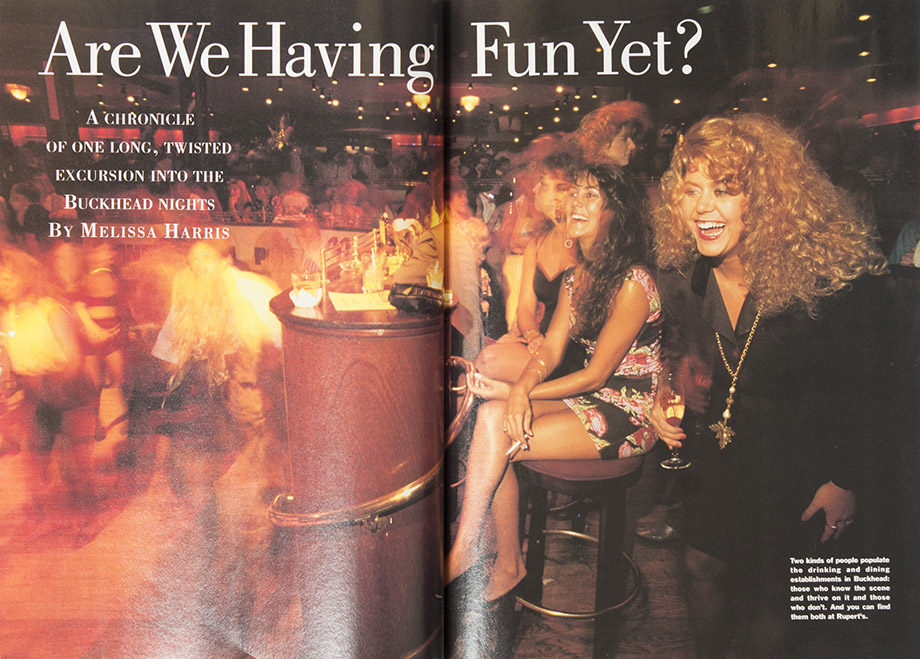
0315_archive_havingfun_cck_oneuseonlyOn a warm Friday at midnight, Pharr Road and East Paces Ferry remain in perpetual motion. Uphill, downhill, around and around, a stream of pedestrians swarms against a backdrop of neon and headlights and music. Blond women with suntanned shoulders and tall men in crisp shirts and signet rings duck into the dark niches of Otto’s and Peachtree Café. Swaggering packs of college boys in Bermuda shorts gravitate to the shoulder-to-shoulder chaos of East Village Grille or Acme Bar and Grill. From the street, Buckhead ‘s second-story patio bars look like over booked cruise ships ready to chug off into the night.

New arrivals cruise slowly, pausing in front of Club D or Candide to see who is waiting in line. And, of course, to be seen. Carloads of exuberant men roll down their windows and call to women on the sidewalk, “Hey, where’s a good place to go tonight. So where are you going? By yourself or meeting a guy?”

As best I can surmise, a good place to go tonight is The Avenue, a discotheque next to C.J ‘s Landing, a beer-patio- and-guy-with-a-guitar bar. The line wraps around the front of the building to the end of the block, as thick as the sidewalk can hold. Even by warm Friday night standards, The Avenue is crawling.

A large American car pulls up and deposits four almost identically clad, almost-clad females onto the curb. They all wear tight black mini dresses though not all four should—and they teeter on high heels to the front of the line. The prettiest, wearing a black bolero hat, steps up to the tall man who is standing at the entrance to the club. He is the St. Peter of The Avenue.

“You watch. They’ re going to get in, ” remarks a bystander attired in blue jeans and shirt-sleeves. This he directs to a group of about 15 other people who are loitering in the street in front of The Avenue.

“She is nice,” says a guy next to him. The young men put their heads together for an admiring dissection. Before they get their fill, the nice one and her friends are in the door. No one protests. The guys in the street look at each other and laugh.

“So what’s going on here?” I ask the first guy. “What ‘s all the commotion about?”

“These people are all in line to get into The Avenue. It’s new. The guy at the door is choosing who gets to go in.”

“But who are these other people just standing around?”

“These are all the people watching the people who are trying to get in to The Avenue.”

And this is Buckhead on a warm Friday at midnight: wannabes watching wannabes. The scene validates everything I have ever believed about going out in Buckhead. Having fun might be the occasional byproduct of the experience, but it is not the purpose. Not fun in the carefree, unselfconscious definition of the word. Buckhead fun is more like that in a high-stakes game of chess, where the moves you make are calculated to one effect: winning. In the night air is the palpable sensation of trying.

Virginia-Highland has its strivers, but no place will turn you away for wearing blue jeans. After dark its woody pubs are the convivial land of a thousand light beer commercials. Little Five Points, with its anti-fashion activists, surely tries to make its own kind of statement. But in those two hubs, sincerity is, if nothing else, stylish. In Buckhead, sincerity is a moot point. You dress, you’re up for it, you go forth and conquer.

Two kinds of people populate the drinking and dancing establishments in after-dark Buckhead: those who know the scene and thrive on it, and those who don’ t. The insiders and the outsiders. Given the choice, I will usually go elsewhere. Given no choice—when an obligation or majority vote determines my agenda—I worry about what to wear and what to say and where to park my car in Buckhead. Upon arrival, I watch the insiders and wonder if everyone else really feels like an outsider, too.

But I know people who prefer Buckhead, who are fed by it, who are baffled by skeptics like me. I decide to enlist them to show me the Buckhead the “tourists” don’t see. Anyone knows some places where you can go for an evening in Buckhead, but these are the people who know where you go.

The first person who comes to mind is Michelle. A salon industry consultant, she is 29, self-assured, ambitious and recognizes lots of people in the clubs. We met last winter through a friend at Azio, the new Italian restaurant-bar-haunt in Buckhead, and took an instant though inexplicable liking to one another. Instant because we share some sensibilities, inexplicable because she doesn’t share my skepticism about Buckhead.

“You want me to show you Buckhead?” Michelle says maternally. “Come on. I’ll take you around.”

The other expert I line up is Bob, a stranger to me but a celebrated insider to the Buckhead scene. I learned about him from a local restaurant manager (“He knows all the ins and outs of Buckhead”) who gave me his phone number. When I call Bob and ask him to guide me through Buckhead nightlife, he has no questions and is immediately agreeable. He calls himself a nightlife “professional.”

“In Buckhead, you have what I call your rookies and your professionals,” says Bob on the phone. “Weekends are for the rookies. Tuesday and Thursday nights are for the professionals.” We agree to meet Thursday at Beesley’s of Buckhead, a restaurant and wine bar. A professional hangout on a professional night.

Bob’s name isn’t really Bob. But by Thursday he will have decided that his real name can’t be used. He has this life and then he has his life with his kids, and the kids come first. By then, my Buckhead insecurities will have proven well founded. I really don’t know what to wear or what to say. I don’t even know the most rudimentary tricks of parking in Buckhead. By Thursday I will learn what I have always suspected, that in Buckhead you have your rookies and you have your professionals, and I am a rookie.

But the week is still young.

Tuesday night at Rupert’s. Oh yes, it’s Ladies’ Night. The crowd is late 20s and up and, on the whole, not sophisticated. “White pumps and suntan pantyhose!” moans Michelle, who takes grimacing notice of every female so outfitted. She grimaces a lot that night.

In the late 1970s and early 1980s—the last shudders of disco—Rupert’s was one of the most famous nightspots in the Southeast. Then it was called the Limelight, and Southerners from all over came to gape at the strangely dressed people pulsating on the dance floor. Preppy college girls and secretaries dressed in fishnet stockings and gold lipstick came to be uninhibited for an evening. Live sharks and, at another time, tigers actually circled under a translucent dance floor. The private rooms with sofas and glass-topped coffee tables developed their own sordid reputation.

Rupert’s, heir to the Limelight facility, is about as aesthetically unfascinating as a disco could be: crimson carpets, dark wood, a hardwood dance floor and stage. It attracts a lot of women in white pumps and suntan pantyhose, not-yet middle management types, and out-of-town software salesmen. Most of the men wear suits, or jackets and ties, and stand around with a drink in had, staring at the dance floor. The music is Top 40, delivered by an 18-piece orchestra with a constantly rotating lineup of singers.

One of the first men we talk to at Ladies’ Night is David. Michelle knows him from Club D, where he works. “But I have a day job, too,” he quickly adds. He tells this to all the workingwomen. David looks to be in his early 20s, with a dark, flattop haircut and the energy and attention span of a hummingbird. He seems bored by attempts at normal conversation, and he never answers a straight question with a straight answer. “People tell me I look like Richard Gere,” he says, leaning close to a woman he has just met. “Do you think I do?” Before she can respond, he has turned and slipped his arm around the waist of another nearby female.

I run into David every night that week. “He’s a boy toy,” Michelle says later.

Michelle has a serious boyfriend in another state, but she has male friends in Atlanta she calls boy toys. Among boy toys, she explains, are babycakes (men in their early 20s), honeybuns (men in their mid-20s to 30s) and sugar daddies (men in their 40s and up).

The crowd at Rupert’s is mostly white. There are several black men, nearly all of whom are dancing with white women. Aside from Michelle, a tall, striking Jamaican, there are few black women in the club. She is pulled aside by a 6’6” black man in a red tie and dark, pinstriped suit. Calvin also works at Club D and is someone she knows. Calvin tells her he wants to dance with me.

On the dance floor, Calvin stares impassively over my head at nothing in particular and kind of marches in place for the first minute or so. After brief opening remarks, he begins to interrogate me aggressively about my marital and dating status. “If you’ve got a boyfriend, what are you doing here?” he challenges. When I try to put him off in a friendly way, he just laughs. He thinks I am baiting him. After several songs I’m ready to sit down. But each new song just so happens to be one of Calvin’s favorites. Calvin hovers for the rest of the night and, like David, will materialize out of the ethers every night I am out.

“You’re just the kind of girl I like,” says Calvin.

“What do you mean?” I ask.

“Not too skinny.”

I laugh and say thanks a lot. He sincerely means this as a compliment, but the comment irritates me for the rest of the evening. I go to the restroom and talk to Helen, the attendant and only woman in Rupert’s besides me who is wearing sensible shoes. She explains that she has a metal plate in her leg and can’t stand for long periods of time.

I smoke two of her cigarettes while other women, very skinny women, use her hairspray and lipstick and breath spray, leaving $1 bills in her basket. I try to engage Helen in a conversation about the women she sees in the bathroom at Rupert’s on Ladies’ Night, but she has worked here too long to remember any particular stories that seem worth telling.

Everyone seems sober and well behaved, I think, remembering a recent evening at Aunt Charley’s where I saw two girls in the bathroom stall. Under the door I could see one of them sprawled on the concrete floor in front of the toilet. Later, when the two girls emerged, I could tell by her aroma and ashen face which one was not having a good time.

“I bet this isn’t the kind of place where women come into the bathroom and get sick,” I venture.

Helen rolls her eyes at me to indicate I must be kidding. I don’t really want to go back out. I keep hanging around, just standing in the restroom and talking to this grandmotherly woman in flat shoes. I laugh and tell Helen what Calvin has said to me, fishing for reassurance.

She doesn’t get it. “Well, he’s right,” she looks me up and down admiringly. “You are a nice size.”

Two women fussing over how good the other looks and teasing their hair overhear our exchange. “What is he talking about?” one of them says indignantly. “You look great. Men are PIGS.”

Back at the bar, I ask the bartender what I can safely drink after Jagermeister, a hideously sweet yet popular liqueur Michelle has selected for us. He shakes his head and laughs. “You gave up your right not to be sick when you started drinking Jagermeister.”

“Standing alone by the cash register and chain-smoking is Frank, a brooding 30ish Italian with a thick accent who is either weird or drunk or both. At first he tells me he is a civil engineer, but later says he runs a restaurant-bar downtown. “I have a lot of female friends, and I don’t sleep with them,” comments Frank, impervious, as far as I can tell, to whatever it is we are discussing. “Look at me. I keep the coupons.” Frank opens his billfold and shows me a 50-cents-off coupon for condoms. He looks at me for a reaction, but I’m not sure what kind.

Frank offers me a drink. “My drink is free here,” he notes.

“Why?” I ask.

He smiles and shrugs. “I don’t know.”

I begin writing down his comments on a napkin on the bar. He doesn’t seem to notice. The next day when I read the napkin it says, “I try to make communication with someone who has loneliness, and I’ll just make a call to you so say hello… I walk into the trees and I walk into the woods and I feel loneliness and that’s the way I love it… It’s very complicated, my life, and I love every minute of it.”

Michelle appears at the bar. She can’t locate her new boy toy, a 23-year-old stockbroker who just moved into town from Vermont, and she has to work in the morning. No sooner have I pulled out my car keys than Calvin darts up and wrestles them from my hand. “I want to see what kind of car you drive,” he says. He insists that he is going to walk me to my car and kiss me goodnight. Michelle intervenes and retrieves my keys. Frank stops me on my way out the door and says again that he wants to buy me a drink.

It’s almost 3 a.m. and we want food. Michelle and I drive a few miles south on Peachtree to the inevitable source: R. Thomas, a hip 24-hour restaurant with $7 hamburgers on nine-grain bread that take an hour to arrive.

“Did you have fun tonight?” Michelle asks incredulously. “I mean, I had so much fun. That was fun! Do you normally have this much fun?”

Yeah, sure, I thought it was pretty okay. I mean it was fun, I guess. It surprises and pleases me that Michelle thinks it was extraordinarily fun. Maybe I’m more clued in than I give myself credit for.

Tomorrow, she is supposed to call the cute boy from Vermont. She has his phone number. “If he thinks I’m not going to call him,” she chuckles, “he’s in for a big surprise!”

As we are waiting for our food, the boy toy from Vermont walks into R. Thomas. He is with another woman from the nightclub.

All week long I have exposed my knees in Buckhead. On Thursday I put on a straight black skirt that hits me midcalf, with low heels and a long jacket. I am going to meet Bob and the professionals, the grown-ups, and I don’t want to handicap myself.

The sun is still out when I walk into the bar at Beesley’s. There are about 10 or 12 people there. A handsome 30ish man in a nice suit blocks my path at the door and says, “Hel-lo! Are you married? Engaged? Living with someone? Got a boyfriend? Pinned? Lavaliered?” He takes it for granted that any woman who comes into Beesley’s is familiar with the college fraternity ritual of getting “pinned” or “lavaliered.” I am in a world where successful adults still speak fondly and often of their Greek affiliations.

I assume he is Bob, who is expecting someone who fits my description, but he isn’t. His first name is King. King leads me to a booth where Bob is entrenched with two other men. I am not surprised to see him because I had no expectations, no idea what a nightlife professional would look like.

Bob is short, heavyset and bald on top with a silver beard and searing black eyes. He is wearing a casual dark brown shirt with a print pattern and cotton slacks. Next to him is Jerry, a big man dressed in a suit with a pocket-handkerchief. Jerry’s hair is sprayed and he wears a gold ring with his initials in block letters. I slide in next to Peter, a low-key Australian in a tan suit, who is drinking wine.

Bob reacts to me the same way 1 react to him: not at all. He introduces me to Jerry and Peter but still asks few questions. “You’re late. Order a drink. I’m four ahead of you,” he commands. “I always drink five in a row and then pace myself.”

He and Jerry launch into a running dialogue that consists almost entirely of rib-nudging and private jokes. No one feels comfortable. Jerry tells jokes about blacks, women, Jewish women, homosexuals and lesbians. He discriminates against no one. Bob laughs and laughs and gnaws on the straw from his drink. Every time I get halfway through my gin-and- tonic, he orders me another one.

Amy, the advertising manager of Beesley’s, comes over to the table to banter with the men. By now it is dark, and the discussion turns to Buckhead nightlife.

“I saw a guy in here the other night wearing a shirt that said I’LL SLEEP WHEN I DIE,” says Bob. “Isn’t that great? Have you seen the one that says EXCESS IS NOT ENOUGH?”

Amy tells them about good put-downs she’s heard women use on men in Beesley’s. Jerry turns to me, “Melissa, what do you say to men in bars who won’t leave you alone?”

I think about Calvin. “Um, well, I don’t know. I guess I’m just too nice to people. I really don’t know what I say.”

Everyone just stares at me. Bob orders me another cocktail.

I am already asking for club soda when Bob and I make the second stop on our tour of Buckhead. Otto’s, just across East Paces Ferry, is even darker than Beesley’s. The crowd is a little older, more sophisticated and mostly male. The women I see are with men. There is a piano man in the middle of the room. I don’t imagine anyone is ordering beer. Bob gets me my club soda and a gin and tonic.

“People come here to pound ’em,” Bob announces. “Not to dance, not to eat, not to pick up women. This is a drinking bar.”

Bob knows the bartender and most of the customers. Peter is there, with his wife, a slim brunette in a blue silk outfit, who doesn’t say much. I sit next to them at the bar while Bob bounces from person to person. He brings a few older men in suits over to meet me. They don’t know why they are being introduced to me, and I can’t think of anything interesting to say to them. I feel like a nun at a bar mitzvah.

Once, after witnessing my conversation with one of his friends, Bob barks at me in an annoyed tone, “Don’t say, ‘Really.'”

Whatever natural wit and conversational skills I possess have abandoned me, and I say “really?” in response to almost everything his friends tell me.

“Why not?” I ask Bob.

“You sound naive.”

(I don’t know what to say!)

The evening is progressing strangely. I tell Peter and his wife what Rob said to me about saying “really.”

“What will you say?” Peter says to me. He sounds like he is slurring his words, but it may just be his accent. Peter waves his arm toward the bar. “You must take things from these people and rise above them.”

Peter points to a doughy, boyish man in a pullover shirt standing at the bar. “That guy smoking a cigar, heesh gotta trust. So he smokes his cigars and checks on his interest once in a while.”

Bob and I don’t stay at Otto’s long. We have had just enough alcohol to feel uneasy about our mutant pairing but not enough to laugh about it. Otto’s is a professional bar where he mingles with other professionals. Everyone can see that the young woman with him tonight is not a professional, not someone they recognize—literally or figuratively—and Bob must know they see this and are thinking things.

But the next stop is Club D, and there will be plenty of amateurs. Plenty of camouflage for me.

Club D calls itself a piano bar and dance club, but even the piano bar in the front of the club has a throbbing, disco atmosphere. People would like to watch people here, but there are too many of them packed too tightly together. Bob knows a few people but not most of them—and vice versa. Tonight is Ladies’ Night at Club D.

Once we are inside Club D, Bob becomes friendlier, more relaxed. We sit in the piano bar overlooking Peachtree Street, and Bob illuminates me—at my request—on the subject of Buckhead women. His theory is that 45 percent of the women who come to Buckhead come to dance, have a few drinks and a few laughs and go home. Another 35 percent are seeking some sort of male reinforcement to feel better about themselves but not necessarily for a partner. The other 20 percent, he says, are looking for a mate. I do not question his numbers, but I wonder how he came up with them and why.

Bob introduces me to Denise, one of the owners and the “D” in Club D, formerly Oliver’s. She explains that Club D is the same concept as Oliver’s but with a different attitude. Denise is a fine-boned blonde in leopard-print pants and a blouse with a leopard-print lapel. We discover we are both from Birmingham. This amuses me in a smug sort of way. I imagine the people who would say Club D is the hottest bar in Atlanta would be the first to make a wisecrack about Birmingham.

Meanwhile, Bob is maneuvering through the crowd, but he sends a procession of acquaintances over to the bar where I am seated.

One of them is Michael, a taciturn, sharp dresser who is in management at The Ritz-Carlton. The entire time I am talking to Michael he keeps one eye on me and one eye on the rest of the room. There is Holly, a slightly daffy model I once met at Rupert’s with Michelle. She tells me she got so excited over a song she heard on MTV the other day that she hurt herself dancing around her living room.

Throughout the evening Bob makes observations about women, and about himself and women. “Women trust me because I’m nonthreatening,” he says. “I’m a father figure.” Later he tells me that, on the way back from the bathroom, two different women approached him and asked him if he were alone. “See what I mean?” he says. The father figure describes young women in skimpy outfits as “hard bellies and bullet tits.”

This is how you pick up women in Buckhead, says Bob. He wets a $20 bill and pastes it to his forehead. He says this derisively, but in a little while he shows me his Rolex and remarks, “That’s $20,000 you’re looking at.”

“Why would you want to spend $20,000 for a watch?” I ask him, genuinely curious.

“Because I can,” he snaps.

Bob is one of those who knows—or talks like he knows—just enough about women to be dangerous. He would make John Derek feel proud, and he is firmly in command. He spends much of the rest of our time at Club D analyzing me, how I should dress, how men react to me. “Here, drink this.” “Don’ t write that down. I’ll remember everything and tell you later.” “You dress like a damn schoolmarm. You should show off those legs.”

At Club D we hook up with Joni. Her real name is not Joni either. She is very friendly—very friendly—and very outgoing. Later in the evening I form a theory that may explain why she is so friendly, and I decide not to use her real name. Joni is 29 and looks 23. She comes from a wealthy family and her mother was a centerfold. She says she goes out at night because she spends all day long talking to bankers, stockbrokers, doctors and lawyers. Joni is a hairdresser.

Bob, Joni and I talk at a table in the back of Club D for a long time. They already know each other, and each of them gets up periodically to talk with other people they know. We vote to go down the street to Candide.

As we are leaving, Bob admits that earlier at Beesley’s he was indeed dreading this night. Now he says he is having a good time, a fact that seems to astonish him. “You come across as very naive, but you didn’t just fall off the turnip truck,” he laughs. “You should really use that to your advantage.”

I am glad to finally have Bob in my corner. I think.

Everyone says Candide is a European bar. The main lounge in the back is a long, low-slung room furnished with a bar, sofas and an aquarium, and it has white brick walls washed by ice-clue lights. It’s the kind of place where people lounge around on the sofas and try to look worldly and nonchalant, but mostly they just look at each other. One Saturday night I was in Candide with a Dutch friend, and I asked him if this was indeed a European bar.

He frowned. “These are sill people in here.”

Fronting Peachtree Street is Candide’s art gallery as well as a cave like disco room with blazing fluorescent murals on the wall. The music is mainly European club mixes, with some smarmy ’70s disco music thrown in for irony. Dancing with a partner, especially one of the opposite sex, brands you as passé.

Candide hosts all sorts of special evens, such as champagne parties and art openings. Near the front door—where they extort a $7 per-person cover charge Friday and Saturday—is a sign for “House Vogue,” left over from an event Candide has canceled. I ask a tall black man wearing eyeliner if House Vogue is the night where people come here to “vogue.” Vogueing, the subject of a hit song by Madonna, is a dance craze in which you pause periodically and strike a pose like a fashion model. He doesn’t hesitate. “Oh, no. Vogeuing is out. It’s dead. It’s been out for two years.” He looks at the other door person and smirks. Whatever is hot with mainstream America will only date you at Candide.

Candide is almost empty when we arrive, and even more so when we leave. I spend most of the time at the bar talking with Joni and a young white guy with dreadlocks who tells me his close friends just call him “Mudhead.” He, too, is very friendly, and he sits at the bar and smiles. Every time I look at him, he smiles.

Prudishness has no place at Candide. I discern this when I am standing at the bathroom mirror applying lipstick and a young Hispanic-looking man with a pompadour and a baggy suit walks into one of the dark stalls and urinates. When he comes out, he is friendly and enthusiastic and says his name is Fab. He gives me three phone numbers and writes, “Call me!” in my notebook.

Joni talks to the bartender. She says he saved her life one night, but she means he cheered her up. “People say this is the snottiest bar, but I love it,” she says to him. She orders a shot of goldwasser, a magical-looking liqueur with metallic gold flakes swirling around in it. I order one too, but Bob sees and takes it away from me. He knows what you should and shouldn’t drink at 2:30 in the morning.

Joni and I go to dance in the disco room, just us and about five Asian people. Bob looks in periodically, and decides that when I dance I am really uninhibited and he sees another whole side to me. I realize I am long overdue for a club soda.

The evening has reached that decrepit stage when you can no longer ignore the feeling that you probably should be at home, in bed, alone, with the covers pulled over your head. So we make the only rational choice: We go to The Gold Club.

Our party has grown to four. In the backseat is Joni and a friend of Bob’s, a 40ish man in a summer suit with a Southern accent. Bob and I, Bob’s car phone and answering machine are in front. Bob can’t believe I have agreed to go to The Gold Club. He thinks this is great.

Joni produces a small wad of aluminum foil. Inside is a green, hallucinogenic mushroom. She eats a piece and offers some to the rest of us. Bob’s friend says he has never tried mushrooms, but he takes some anyway. Bob and I decline.

When we arrive at The Gold Club, Joni tells the bouncer she works at Cheetah III and she goes in without paying. “You do?” I say to her, surprised less by the fact that she is an exotic dancer than by the fact that I am the last to know. She furrows her brow and puts her finger to her lips to say, “Shut up.” She is only lying.

On the way to our table, she pulls me aside and says to keep an eye on Bob’s friend because in about 45 minutes that mushroom is going to kick in. He keeps saying, “I don’t feel anything.

The Gold Club is so desolate you could almost hear a G-string drop. There are more naked women dancing than there are men sitting and looking. One of the dancers is Bob’s neighbor and she stands at our table chatting brightly, stark naked. Two other dancers come over and Joni and I talk to them, too. Secured in their garters are jumbled patties of paper money, three inches thick. At our table the women outnumber the men 2-to-1, and even though three are nude, our eyes belie a sense of conspiratorial sisterhood of a shared and heady secret. It is funny and preposterous that men will empty their billfolds for this, and we all know it.

Bob is watching me for a reaction, any reaction. I have never been to The Gold Club before. To me it is like Disney World, only the characters wear different costumes. I am not shocked. In fact I feel more comfortable at The Gold Club than anywhere we have been tonight. It’s straightforward. Everything is just what it seems. There are naked women dancing for money, and there are men paying women to dance naked.

We hang around until the last dance, about 30 more minutes. When the valet brings Bob’s car around, the sense of foreboding returns. As we pull out of the parking lot, Bob’s friend asks Joni for “a bump,” but I do not look into the backseat to see if there is any cocaine. I don’t want to know.

We drop the two of them off next door to Rupert’s at Club 112, which opens at midnight and closes at 6:30 a.m. The two of them pass by the big, furtive bouncers in neckties and pass through the opaque blackness of the open door. From the front seat of the car I decide I have seen enough.

But there is one problem. I don’t know how to park in Buckhead.

At 7 p.m., more than eight hours ago, I valet parked my car in a parking deck near Beesley’s. At 2 a.m. the valet service closed, and my keys were locked up for the night. I cannot get into my car. Tomorrow I will realize this is a blessing, but not tonight. Bob agrees to drive me home. On the way there I realize I also cannot get into my apartment. “This is getting more interesting all the time,” Bob says.

Then I remember the window with the broken lock, the one I have feebly jammed with a stick because the rental office has yet to come over and fix it. For the first time, I hope that the stick won’t hold. I have never tested it.

We rattle the window and shake it, but the stick holds firm. I try to push the panic back down into my stomach and my mind runs through a list of friends who might not be too alarmed if I rang their bell at 4 a.m. and asked to spend the night. I can’t think of anyone.

Bob thinks he can remove one side of the window. He pulls and grunts and maneuvers, but it will only come part of the way out of the frame.

Then, suddenly, the window shatters into tiny pieces, leaving a hole large enough to climb through. Relief floods over me. I am an outsider on the inside once more.

This article originally appeared in our October 1990 issue.

The Parable of Julian Bond & John Lewis

My father got his Ph.D. from the University of Chicago. He taught at a succession of black colleges. He was president of Fort Valley State College, president of Lincoln University in Pennsylvania, dean of education at Atlanta University. [At Lincoln University,] we had this great big old white house like a Southern plantation house. In our home were all the great figures of the day. I have a picture of me sitting on Paul Robeson’s knee while Robeson sings to me. I have a picture of Albert Einstein. It was just an incredible life for a kid. . . . I never really knew what a segregated school was until high school. At George School [a Quaker institution in Pennsylvania], I started dating this white girl from Virginia. . . . We’d go into Philadelphia on Saturdays or Sundays, then get back to school around 6 or 7 in the evening. Then one afternoon, the dean of men called me into his office. . . . He looked like a tennis player or a country club golf pro who had just begun to age. He told me, in a very calm and polite voice, that he’d appreciate it if I didn’t wear my school jacket on those trips to Philadelphia. It was just as though he had slapped me across the face. All of a sudden, you realize all the talk there’s been, all the whispering. . . . And also that you’re a Negro. That moment was the first time I realize realized it—that distance. . . . I simply couldn’t speak anything to him. I just stood up and walked out of his office.
Former State Sen. Julian Bond, from separate conversations with Marshall Frady and Vincent Coppola

My father couldn’t afford a newspaper subscription. I’d walk half a mile to get my grandfather’s paper after he got done reading it. I kept up with what was going on, reading that paper and listening to that radio. . . . We ordered everything from the Sears & Roebuck catalog. We called it ‘the Wish Book.’ . . . I was bused 18 miles to the Pike County Training School. Black schools were ‘training schools’; whites went to high schools. We had old broken-down buses, ragged books, a rundown building. White students had new buses, nice painted buildings with the grounds kept up. . . . In Troy, they had a soda fountain where you could get Coca-Cola. We called it a combination. A black person could not take a seat. We had to stand at the end of the counter. ‘May I have a combination?’ You put your money down and went outside to the street corner to drink it. . . . As a young child I saw a difference. I resented it. Even the country road where I grew up—because black people owned the land, the road was left unpaved for many, many years. When it rained, the bus got stuck in the mud. That was life in Alabama.
—U.S. Rep. John Lewis


John Lewis and Julian Bond. Two men whose lives were shaped in the crucible of the civil rights movement, whose beings were transformed by the soaring energy and ringing eloquence of the man who came to symbolize that movement, Martin Luther King Jr., and whose major roles have been played out in the cold vacuum of his absence. Men whose youth was spent amid heat and tumult, roaring debate, clangor and public outcry, who now in their 50th year are trying to come to some assessment of themselves, to reaffirm or refix the stars that have guided them. Private men who live intensely public lives. Men so different as to be from other worlds, yet inextricably entwined. Bound at first by the color of their skin, and again by the essential rightness of their participation in the movement. Bound by friendship and the common struggle for human dignity.

Over time, they drifted apart. In 1986, they became rivals, then bitter enemies as they each sought the 5th District congressional seat; each struggle to wrest a prize that shimmered with grail-like significance. Bond, the long-anointed prince—a national figure in his 20s, the first black man ever nominated vice president by a major party—would find ascendancy in victory. Congress would be the field upon which his brilliant mind and intellectual passions would play. Lewis, the sharecropper’s son, would take his dogged, determined pursuit of the Beloved Community to the national arena.

John Lewis won. Today, he works out of the Cannon Building on Capitol Hill in an office hung with movement memorabilia, including an almost-autobiographical voter registration poster. HANDS THAT PICK COTTON NOW CAN PICK OUR PUBLIC OFFICIALS. There is also a harrowing, March 1965 LIFE magazine cover, “The Savage Season Begins,” showing Lewis and Hosea Williams—leading the march across Selma’s Edmund Pettus Bridge—about to be overwhelmed by tear gas, mounted police and swirling clubs. Gone are the overalls and the speech impediment that once muffled his words, but never his eloquence. John Lewis now favors dark suits and muted ties; he displays the beginnings of a paunch. The big, rough farmer’s hands are there, and they speak of a lifelong commitment to “tearing down barriers.”

Julian Bond lost. He, too, lives in Washington, D.C., but carries his office in a nylon book bag on his shoulder. This spring, he’ll be criss-crossing the country, speaking at colleges, recalling the movement years. Last fall, Bond taught a popular civil rights course and a seminar on Southern black politics at Harvard University. Observed there, crew-cut, slender, dressed in a light-gray suit with a turquoise shirt buttoned at the collar, he looked more like a fashion model than an academic. His voice—described by the Saturday Evening Post’s Marshal Frady as “textured, it seemed, of flannel”—was as powerful, distinctive and resonant as King’s or Kennedy’s. A masterful teacher, Bond pointed out inconsistencies in his students’ analyses, provided insights and “I was there” actualities. He held them in thrall, an elegant, ephemeral piece of history.

Bond watchers say he is history. The youthful promise he sustained like some middle-aged Peter Pan will never be realized. Julian Bond, they say, could have been Andrew Young or Jesse Jackson. Opportunities stretched endlessly before him. This telegenic man who hosted both Saturday Night Live! and Eyes on the Prize. He could have been the first black vice president, even president. He could have been the voice of a generation of Americans of every color and social class. They say the allegations of cocaine abuse, bruited (and then retracted) by wife Alice, and the subsequent media circus, signaled the destruction of Julian Bond the public figure. (He has never admitted to using drugs, nor has he been charged in any drug-related incident.) Bond has fled Atlanta, they whisper, his life a tatter of ruptured friendships and disorder.

“I love Julian like a brother,” says John Lewis. “But he fumbled the ball. He had unbelievable opportunities. He just didn’t take advantage.”

Bond, sitting after class in an office in the Afro-American Studies Center, lights a Salem and dismisses—though not without bitterness—the scrutiny of his personal affairs. “I had 13 reporters assigned to me. You feel awful about it, but really, what can you do?” (Things had gotten chaotic. At one point Alice Bond filed charges against Carmen Lopez Butler, alleged to have been Bond’s girlfriend, for hitting her in the head with a high-heeled shoe. Lopez was later convicted of drug dealing.) “It’s the price you pay for being public,” he says. “And you pay it sooner or later. You just try—and I’m determined—to keep going.”

The issue of promise measured against achievement is less easily dismissed. “I’ve been cursed most of my life with this picture of the hesitant person,” Bond says. “I think I’ve been kind of bold. . . . I can’t do what other people want me to do. I’m absolutely content and fulfilled right now [teaching and lecturing]. It’s enough for me. I’m confused as to why it’s not enough for anyone else.”


Given the religious framework upon which the civil rights movement was built, it would be easy to seize upon the Bible story of the servants, one of whom took the talent entrusted to him by his master and multiplied it while another kept his buried, as a metaphor for the personal and career odysseys of Lewis and Bond. Life is much more complex—a thousand decisions and indecisions, strung together by twists of fate and fortune. The outcome always uncertain. “Here I am teaching at Harvard without a Ph.D.,” says Bond. “I think I’m doing really well.”

Others say the twin tales of John Lewis and Julian Bond teach more secular lessons. “Julian Bond was spoiled,” says one prominent Atlanta politician. “He indulged himself. I can remember sitting with him and Vernon Jordan and having some discussion. And Julian’s eyes got to wandering. He wasn’t interested in what we were talking about.”

“One of the things the civil rights movement showed every man,” adds Stanley Wise, a former executive secretary of the Student Nonviolent Coordinating Committee (SNCC), “was that a wealth of women of every race, class and description were completely at your beck and call. You had to fend them off in every city, village and farm. You kept bumping your head so hard and so often against this wall. It was impossible.”

Time magazine called John Lewis ‘a saint,’” says Joseph Lowery, president of the Southern Christian Leadership Conference (SCLC). “I never heard anybody in the black community say that. . . . John Lewis gives the appearance of humility. I don’t know whether he’s humble or not, but white folk think he’s humble. And white people tend to like humble black folk.”


Looking back at their youths and the times that rounded their passage into maturity—talking to them and to those who knew them or marched beside them—it seems clear that the paths taken, the choices made, and the lives lived by John Lewis and Julian Bond were as preordained as Calvinist theology.

“The movement became a way of life, a part of me. Even if I wanted to separate myself, it would be difficult.”
—John Lewis.

The third of ten children born to sharecropper Eddie Lewis and his wife, Willie Mae, John Lewis was out in the blistering Alabama fields at age 4, picking cotton, gathering peanuts, pulling corn. The family survived on the leavings after their white landlord deducted his rent in cash or crops. They lived in “Carter’s Quarters,” a tract that had been home to Willie Mae Carter’s family since slavery days. Ironically, it was just a few miles from where John Lewis’s great opponent, Gov. George Wallace, was raised.

Lewis was a stubborn, willful child. Some days when his father wanted him out in the fields, he’d get up early and hide under the house. “When the bus came I would run out and get on and go to school. I did that many, many times.” He looked after the family chicken flock with evangelical zeal, preaching to them in the evenings, even baptizing a couple of birds. “My first nonviolent protest,” Lewis says, “was against my mother and father when they wanted to kill some chickens or trade ’em to the rolling store for flour or sugar. Sometimes I’d take an egg from one hen and give it to another. I was never able to save the $18.95 to buy the cheapest incubator in the Sears & Roebuck catalog.”

Somehow, his father scraped together $300 to buy 110 acres, land precious enough to John Lewis that he still trucks over fruit trees and flowers from Pike Nursery in Atlanta to plant there. At the time, Lewis felt otherwise. “I saw the life of my mother, my father, my grandfather, my great-grandfather had lived. I’d argue with my father. ‘Why go through this year after year?’ My mother would say, ‘Why, Robert [Lewis’s middle name], this is the only thing we can really do. It’s what we go to do.’ My desire was to get away from that. To do something better, but I didn’t know what.”

The fact that his parents’ hopes were clouded by discrimination gnawed at Lewis. “In 1951, I went by car with my uncle and cousins to Buffalo, N.Y. I remember going into Sattler’s department store and riding escalators for the first time. It was a different world. You saw white and black people in the same shops and restaurants.” Back in Alabama, the treat of an occasional Saturday matinee with his cousins soured: “We had to go upstairs to the ‘Buzzard’s Roost,’ the section marked ‘Colored.’ To this day, I don’t like going to movies because of what I saw.”

Over the crackle and static of the old vacuum-tube radio, Lewis heard the rolling thunder and reasoned passion of Martin Luther King’s sermons as King led the 1955 Montgomery bus boycott. He felt a stirring in himself, “a calling, an obligation . . . to this holy, righteous cause.” His mother, then working as a laundress in a white Baptist orphanage, brought home a newspaper article about work scholarships being offered Negro students by the American Baptist Seminary in Nashville. He was accepted in 1957, “and left home with this huge old trunk and $100 my Uncle Otis Carter handed to me,” he says. “I’ll never forget that as long as I live. It was the first time I had $100 solid in my hand.” His father took him to the bus station. John Lewis submitted to riding in the back of the Greyhound to Nashville.

Lewis worked as a janitor and spent hours in the seminary kitchen “washing those big pots and pans.” He began hitching across the Cumberland River to attend evening workshops on the philosophy and discipline of nonviolent protest, conducted by a man who would have a seminal influence on him—James M. Lawson Jr.—a black graduate student and Gandhian disciple who had spent three years in India. Over the next few years, the workshops blossomed into demonstrations against Nashville’s segregated department stores and restaurants.

Lewis was always in the first ranks, taking incredible punishment, as if he believed his blood could somehow expiate the flaring hatreds. “He thinks it’s possible to change the world,” says former SNCC secretary Stanley Wise. “He didn’t start off that way. He thought it was possible to change one restaurant or one voting pattern. At some point he began to believe the world could be changed through nonviolence. Therefore, you had to live that life. John Lewis decided to live free, regardless of whether he was free or not.”

Wise recalls his first, unfortunate meeting with Lewis: “I was 19, a student at Howard University. I arrived in Nashville with students from Georgetown and other D.C.-area schools. . . . There was a restaurant four or five blocks from Fisk University. About 90 of us marched over there. There was a giant white fella—must have been 6-foot-7, 6-foot-8—a really husky dude. People would up to the door and attempt to enter. As soon as you grabbed the door, he would let go with all his force against your head. Kapow! It was just absolutely unbelievable.

“One of the group was a girl who had had polio. She had braces on both legs and walked with crutches. She was about the third or fourth person to walk up to the door and this guy was not running out of energy at all. She came up and he just slammed her so hard that her crutches flew out of her hands and she fell back against the glass. And she literally crawled back up to the door and he hit her again. Oh God! Her boyfriend came up, picked her up and put her aside. And he went to the door. It went on until this person tired and they locked the door. I had just never seen such brutality.

“A lot of people had not wanted to go to this particular restaurant, but John was determined. He decided the place should be done, even if he had to go alone.”

“He wouldn’t waver,” says civil rights activist Will Campbell, recalling another Nashville episode. “There had been demonstrations outside the downtown movie theaters. Considerable violence had erupted the night before. Marchers had been chased and beaten. The Nashville Christian Leadership Council board [NCLC, a splinter of Martin Luther King’s SCLC] was meeting. We made a pitch to John, who was a student representative on the board. We said we felt the city needed a cooling-off period. John was just sitting there very calm. He said, ‘Yeah, but we’re gonna march.’

“The next person made his speech. It went all around. I was the last one, and I was getting a little impatient. I said, ‘John, it seems that you agree with everything everyone says, but you say, ‘We’re gonna march.’ You agree there is probably going to be serious violence, but you’re going to march? What it comes down to is your own stubbornness. Your own sin.’ He looked at me, completely unflappable, and said, ‘Yeah, but we’re gonna march.’

“They marched and nothing happened.”

“He’s beyond driven,” explains Stanley Wise. “Many times, I thought John might be killed. . . . We had many shouting matches where I felt he was too close to the line.” One one occasion, Lewis did back off. In 1958, he decided to personally integrate Troy State University, whose campus lay a few miles from his home. Lewis met with Martin Luther King Jr. and Ralph Abernathy in Montgomery, seeking and winning their support. “I had a discussion with my mother and father when I got back,” he says. “They were so terrified, so afraid, I dropped the whole thing.”

In May 1961, Lewis was among the original 13 interracial “freedom riders” chosen by the Congress of Racial Equality (CORE) to test the U.S. Supreme Court decision outlawing segregation in the area of interstate travel. Prepping for the trip in Washington, D.C., Lewis, then 21, ate his first Chinese food. “Absolutely good stuff,” he recalls. “Served in silver covered dishes. The best food I’d ever had.” During the meal, someone announced, “Eat well because this might be the Last Supper.”

Freedom Riders rode regularly scheduled buses, along with “regular” white and black passengers scrupulously following segregation’s dictates. Lewis go to Rock Hill, S.C., where he and his seatmate, Albert Bigelow, were attacked trying to enter a “whites only” waiting room. Then Lewis was called away from the trip. While he was gone, his Greyhound bus was attacked and burned in Anniston, Ala.; other freedom riders traveling on a Trailways bus were set upon in Birmingham. CORE’s James Farmer called off the trip.

Lewis rushed back to Nashville, where he pleaded with Campbell and other NCLC board members for money to buy 10 bus tickets to New Orleans. Lewis got the money. They left on Wednesday morning, May 17, and got as far as Birmingham, where public safety commissioner Eugene “Bull” Connor wrapped them in protective custody and dumped them back on the Tennessee state line. Again they tried, making for Montgomery with Bobby Kennedy’s Justice Department scrambling to guarantee their safety. The bus rolled with a highway patrol car alongside and a spotter plane overhead. Lewis picks up the story:

“It was the strangest feeling at the Montgomery bus station. You didn’t see any people. Just nothing. We started down the steps. An angry mob, maybe 2,000 people with baseball bats, lead pipes and chains, rushed at us. I was hit on the head with a wooden crate, left lying in the street semiconscious. Most of the police just disappeared. Floyd Mann, the Alabama state patrol public safety director, came and stood over us. He fired his gun up in the air two three times saying, ‘There’ll be no killing here today! There’ll be no killing here today!’

“A week ago, I saw Floyd for the first time since 1961, in Montgomery,” continues Lewis. “He walked up, shook my hand and gave me a hug. He said, ‘John Lewis, do you know who I am?’ I said, ‘Yes, Mr. Mann.’ He said, ‘I wanted to say congratulations. I’ve followed you all the years of your career.’ I said, ‘Your saving my life made it possible.’”

The ride continued, after rioting whites surrounded Ralph Abernathy’s First Baptist Church, where the riders had taken shelter after John F. Kennedy clamped the city under martial law and sent National Guard troops to the rescue. It ended in Jackson, Miss., where the protesters were arrested and eventually packed off to the infamous Mississippi State Penitentiary in Parchman. “I spent 37 days in jail,” says Lewis. “I missed my own graduation. . . . On the way to Parchman, one of the deputies looked me over and said, ‘We got niggers in there that will eat you up.’”

“Look at that girl shake that thing.

We cannot all be Martin Luther King.”

—from an early poem written by Julian Bond

In his memorable 1967 profile, Marshall Frady captured what may have been the essential Julian Bond, a tall, boyishly handsome, “whimsically improbably revolutionary . . . [who] suggested one of those languid, leisurely, bright, introspective and exquisitely detached young men in Henry James novels, always preferring to dwell on the periphery of passionate events and conflicts . . .”

Unfortunately, no one—including Bond himself—seems to have paid Frady much attention.

At the time, Julian Bond, 27, the son of Horace Mann Bond, Ph.D. (one of the most distinguished educators in the country), had dropped out of Morehouse College a bare semester from graduating. He left school to write sports and an advance to the lovelorn column for the Atlanta Inquirer, a black weekly newspaper. Bond had begun, then abandoned, an autobiography and had written—in Frady’s words—“a few slight verses of a somewhat diaphanous excellence that were published in several anthologies.” Some years before, he’d run off to north Georgia and married a bright, attractive college coed named Alice Clopton and by 1967 had fathered three children. (He and Alice later had two more children.)

Bond had also managed to offend and infuriate most of the stalwarts in the Georgia House of Representatives, to which he’d won election, only to be denied his seat after refusing to disavow anti-war remarks (the Vietnam debate was raging) made by fellow members of SNCC. Bond was reinstated twice in special elections—to no avail. “They can keep on electing him til Gabriel blows his trumpet,” thundered one rural Georgia politician at the time. “But they ain’t ever gonna get him in here.”

The U.S. Supreme Court ruled otherwise: Bond had been unfairly deprived and would have to be reinstated. The legislators imagined some furious amalgam of H. Rap Brown, Huey P. Newton and Jomo Kenyatta invading their domain. Instead, Bond showed up polite and soft-spoken, dressed—according to Frady—in a somber blue suit with vest, chain and a pocketwatch, looking like a “fledgling banker.”

Bond proved to be no bomb thrower. Over time he grew comfortable with the intellectual process of crafting legislation and the precise rituals of parliamentary procedure. In 1974, he moved to the state Senate, eventually becoming chairman of the Fulton County delegation. And there he remained—serving, all told, 10 terms in both houses—before resigning to square off against John Lewis in the 1986 5th District election. Ironically, Bond waged a two-year battle in the courts and legislature to create the black-majority congressional district that Lewis took away from him.

The years in the Statehouse took their toll. The media image of Bond was the Man of Promise, a gentleman-scholar-statesman on the move. In reality, he was a young, inexperienced legislator thrust into the indelicate world of cigar smoke, backslapping, and back-room dealmaking.


In 1968, during the tempestuous Democratic National Convention in Chicago, Bond was again propelled into the national limelight. A delegate, wanting to get anti-war activist Allard Lowenstein to the podium, nominated Julian Bond—the co-chairman of a group of insurgent Georgia delegates—for vice president. Lowenstein was to give the seconding speech. Bond, basking in the glow of the television cameras, was forced to explain in his crisp, perfectly articulated phrasing, that though honored, he was in fact too young for the job.

Long after the election was captured by Richard Nixon’s Republicans, Bond traveled the country making personal appearances, giving speeches, seemingly building support for some great quest. The country was hurting. King and the Kennedys were gone: the sun was setting on the liberal agenda. Bond was young, gifted and black. His father’s career was a testimony that “those who had some advantage or opportunity had a responsibility to others.” According to Bond, his mother, a “sweet, very soft, retiring person,” contributed another characteristic. “From her I get this feeling that if you wait and choose your moment, your chance will come. It’ll be there.”

So Julian Bond waited. Pursuing, he says, his father’s commitment to the “life of the mind … the world to be found in books … in argument, discussion and theories. An entire life that could be lived in your mind.” And he waited. People grew impatient. “I was struck by the number of people who knew me,” he says, in his Harvard office, “but really didn’t know me. They’d seen me on TV. They were sitting in their underwear drinking beer and I was, in effect, there with them. That was the first shock. The second shock was they began saying, ‘Why don’t you do this? Why don’t you do that?’ . . . People in New York and California saw me on TV and said, ‘That guy’s going some place. We expect him to be governor of Georgia.’

“Well, it’s iffy whether Andy Young is going to be governor, 20 years later. They had an unrealistic expectation of what was possible. … I still meet people who are real flattering and say, ‘Gee, we thought you’d be governor by now.’ I say, ‘Gee, it’s something I never thought about.’ I neither thought about nor wanted to be governor of Georgia. . . . I’ve had a multiplicity of interests for the last 25 years of my life, and I want to have them for the next 25.”

“Multiplicity of interests” can also mean a lack of focus, the kind of singleminded determination that drives a John Lewis. Will Campbell, who knew the late Horace Bond, and knows both John and Julian, gently suggests the privileged, well-educated Bond simply “did not know as much of what it meant to be black as John Lewis did.”

Campbell then carries his analysis a giant step further: “In terms of this total makeup and accomplishments, Julian Bond would have been better off if the civil rights movement had never happened. It was inevitable that he become involved when it hit. He had no choice but to be involved—and I know he has no regrets—but it sapped a lot of his energies for a number of years. He might very well have gone a lot further as a journalist or writer or political figure.”

In fact, Bond’s plunge into the movement began rather diffidently, particularly when compared to John Lewis’s “We’re gonna march” directness:

“On Feb. 3, 1960,” says Bond, “I was a Morehouse student, sitting in the Yates and Milton drugstore. Lonnie King, a schoolmate, showed me a copy of the Atlanta Daily World that read, ‘Students Sit In at Greensboro for Third Day.’

“Lonnie asked, ‘What do you think?’

“I said, ‘I think it’s great.’

“’Do you think it ought to happen here?’

“’I’m sure it will happen here.’

“’Don’t you think we ought to make it happen here?’

“’What do you mean we?’

“He said, ‘You take this side of the drugstore and I’ll take that side, and we’ll organize a meeting.’ I agreed, and it changed the whole course of my life. . . . I was a 20-year-old college junior with no career plans other than perhaps being a writer of some kind. My only goal was to finish college and get some kind of job. I was fairly aimless, purposeless. It was possible to be that way. It mayn’t have been six months from then, but it was then. Montgomery had been four years before. There was a little civil rights activity, but I thought that was something you had to be older to do. It was nothing I could do. I’d seen TV pictures of high school students in Little Rock in ’57 integrating the schools. I thought how brave and courageous they were, and I wished I could do something like that. But I neither had the opportunity nor did I see the opportunity. I didn’t look for anything. If Lonnie King had not come along, who’s to say what would have happened?”

According to Marshall Frady, Bond, queried about the Freedom Rides, remarked, “You’d have to be a fool to want to go on a bus trip through those states.”

Even Bond’s 1965 entrance into politics had more to do with intellectual curiosity than fire-in-the-belly commitment. “A friend of mine was running for the House in the district adjacent to the one I eventually ran in. I remember him urging me to do it. It was at his urging that I did it. It was something that I’d thought about.”


Lewis and Bond became fast friends in the ’60s. As SNCC officers they traveled the South organizing the Voter Education Project. In 1964, as part of a SNCC delegation, they spend three weeks together in Africa. “We were close friends, dear friends,” says Lewis. “Alice and Julian would come to visit Lillian and me, and the four of us would stay up until 1 or 2 a.m. playing Scrabble. We’d have so much fun.”

In 1969, Lewis wrote a remarkable letter to Bond, telling Julian his “presence [had] filled a vacuum” left by the deaths of Robert Kennedy and Martin Luther King. “You became the hope of millions who had previously identified with these two great men. . . . Julian, you have an obligation to the youth of today to use your influence.”

Lewis wanted Bond to go after the 5th District congressional seat then held by Fletcher Thompson: “You should seriously consider running and run like you have never run before!” the letter continued. “If you do decide to run, you cannot afford to let the luxury of being a political celebrity and in demand throughout the country keep you from tackling the ‘nitty-gritty’ and difficult problems. . . . ”

“Somehow, someway,” says Lewis, shaking his head, “Julian made the decision not to run. Andy Young called me late one night from Harry Belafonte’s apartment in New York after he’d read my letter. He said, “If Julian fails to do it, I will do it.”

Bond tells a somewhat different version of the story. “It was a rainy night. Andy had driven me home from some meeting. We sat in the car outside my house. I thought he had the better chance. He had the ability to raise money. I thought he could get white votes I couldn’t get. He didn’t carry the negative burden I had. Remember, this was a few years away from my being the draft-card burner. I was the militant in the state legislature.

“Of course, we’ll never know. Andy ran and lost. Then ran and won [in 1972].”


In 1981, John Lewis was elected to the Atlanta City Council. By most accounts his record of legislative achievements was dismal. In part, his ineffectiveness reflected his overriding interest in national and international human rights issues. He also wanted unending ethics-in-government campaigns, thundering against council President Marvin Arrington and other council members with the righteous indignation he’d mustered for Ross Barnett, George Wallace and P.W. Botha. Lewis, of course, believed every word he said, and didn’t hesitate to say ’em before TV cameras and packed galleries. Arrington worked more quietly, effectively guaranteeing that any measure with Lewis’s name on it would stay locked in some committee until South Africa froze over.

“It’s not easy to get into local politics and be the kind of person who has to deal with water, sewers and roads,” says DeKalb County Chief Executive Officer Manuel Maloof, a longtime Lewis observer. “John Lewis was never cut out for that. He’s a visionary. Visionaries don’t make good local officials. I would not say that John Lewis was a good local official, but he was the goddamn conscience of that council. He used to make those bastards so mad, they didn’t know what to do!”

In February 1986, Lewis announced he was running for Congress. “A lot of people laughed,” says SCLC president Joseph Lowery. “They said, ‘We’re surprised he made the City Council, now he’s talking about Congress!” Lowery adds, “John soon got their attention with his unrelenting pursuit.” Twenty years earlier, Lowery had watched a painfully shy Lewis, hampered by a speech impediment, force himself to address crowds and meetings. “Whatever was in him just had to come out.”

Meanwhile, Julian Bond was finally making his move. “I’d created the seat, drawn the lines myself,” he says. “I’d made it possible for a black person to be elected. I wanted badly to be there. I could see myself there. It seemed natural to me, the next step.”

Bond banked on his celebrity. Jazzman Miles Davis and Washington Mayor Marion Barry scheduled benefits in his behalf (in retrospect not such great ideas). Media consultant David Garth, who had run campaigns for New York Gov. Mario Cuomo and Los Angeles Mayor Tom Bradley, signed on, as did Eugene Duffy, Andrew Young’s right-hand man. Marvin Arrington threw a party.

Insiders say Bond’s supporters had already started mapping his congressional agenda. “I thought Julian was the kind of figure that would be needed, given the waning of liberal influence in the country,” says Stanley Wise, who abandoned Lewis for Bond. “I thought Julian would become chairman of the Congressional Black Caucus. He could put something on the agenda, move them in new directions. They had even anticipated his coming . . . had indicated they were willing to sublimate their egos. . . . America tends to listen when its sharpest minds can articulate a position. That’s the kind of nuance Julian’s election posed.”

When the two were forced into a runoff, Lewis says, “I knew I’d win. I’d outwork him.” Lewis, Time magazine’s “living saint,” also showed he could hit below the belt. When Bond challenged him in one debate on an alleged conflict involving campaign contributions (“If it looks like a duck, walks like a duck, it must be a duck”), Lewis responded that Bond was ducking the drug-test issue. (Lewis still maintains he had not heard any rumors about Bond’s alleged cocaine use.) Thus began the “Jar Wars” stage of the campaign. Bond refused to be tested. Instead, it was their 25-year friendship that went down the toilet. The two men did not speak again until the fall of 1989.

Julian Bond (who won a majority among blacks) says whites cost him the election. “I had the reputation of being a race man,” he says. “I think many white voters said, ‘If Bond gets into office, he’s only going to be worried about them and not about us. John Lewis will worry about us all. He’ll be worried about everyone.’ That was a correct analysis for them to have. They were right.”

In the black churches the issue was whether Julian Bond was a “man of faith.” Other voters found his confidence off-putting. Stanley Wise argues that Bond might have been “too sophisticated for the electorate.” Manuel Maloof, never one to pull punches, says “the people recognized that Bond had never contributed much. The only thing I can remember him doing is burning his draft card. . . . As for coming up with meaningful legislation, being a leader, resolving issues that blacks felt were important . . . no, he did not do that. . . . And John pounded him on it.”

The defeat was devastating. “You feel people have individually rejected you,” says Bond. “Each one standing in your face saying, ‘No, we don’t like you.’” Bond had given up his state Senate seat. He was without income for nine months during the campaign. “He needed to move on,” says one close friend unwilling to be identified. “What kind of options did he have? He seriously wanted to be executive director of the NAACP. The personal problems were boiling.”

In the months after the election, Bond was observed a number of times in southside discos with Carmen Lopez Butler (who sold jewelry at many of the clubs) and other individuals one would not expect to find in his company. On March 19, 1987, Alice Bond walked into the Atlanta Police Bureau’s Narcotics Squad office on Martin Luther King Jr. Drive, described Carmen Lopez Butler as her husband’s drug supplier and implicated a number of prominent Atlantans as drug users. She later withdrew her allegations in the press. “In 25 years, I have never ever seen Julian Bond take drugs,” says Stanley Wise. “It came as a total shock to me. But given all the sources, you just couldn’t say that all of it was nonsense. That’s what was so tragic about it.”

Later that year, Julian Bond moved to Washington. His marriage ended in divorce.


Two years later, on a bright, warm autumn afternoon, Julian Bond cuts across Harvard Yard heading for the subway that will carry him to the airport and back to Washington. He speaks animatedly about a play he’s “about halfway through … about a black political person. Some of the things have happened to me or I saw or heard about them happening to other people. Things I don’t think I could have made up.” He’s writing a detective novel, but admits to being “about a page-and-a-half into it.” He’s hosting America’s Black Forum, a syndicated TV show, and will spend the next few months on the lecture circuit: “I have something to do almost every day,” he says. Bond won’t discuss his personal life, or a paternity suit recently filed against him in Atlanta by a woman named Deborah Kaye Moore.

He has mixed feelings about leaving Atlanta. “I miss Culver Kidd. I miss hearing the lieutenant governor pound that gavel. I miss those faces I served with all those years … the secretaries, the people who hang around the Capitol. I miss the ambience. . . . But I wouldn’t go back to it to save my soul. . . . You find yourself in different circumstances. You begin to make new friends. You find that life goes on. You’ve got to move on. I’ve moved on.”

This article originally appeared in our March 1990 issue.

Surviving High School

0

The two boys – Eric and Curt – grew up together, dreamers on a dead-end street. Overweight and unathletic, they shied away from rough sports and played with GJ. Joes in their back yards, preferring to conduct their wars in miniature. Down the block was a clan of tough kids, and on many afternoons one of the boys would have to fight his way home from school. “Curt and I were both the same,” remembers Eric. “We lived in a fantasy world, and we both got picked on a lot. “

Photography by Ralph Daniel

In middle school, Eric became known as a “no-account,” Curt as a “geek,” and by the time the two boys enrolled in Cobb County’s George Walton Comprehensive High School, they welcomed the opportunity to redefine themselves. They lost weight and sprouted tall; they grew their hair long and donned torn jeans and black T-shirts emblazoned with the logos of rock bands – the garb of the “freak.” In the parking lot they hung around with kids on Walton’s fringe, kids hopped up on anger and rebellion and in some cases, pot and liquor and acid and coke. In time, each of the boys would make a name for himself, becoming familiar to other students as a “character,” a bundle of idiosyncrasies, a voice sounding loud over the din.

For all their similarities, however, there is one big difference between Eric Stone and Curt Hersey. One survived high school. The other did not.

From his origins as a geek, Curt grew into an image of cocksureness: a skinny, slouchy kid with black, shoulder-length hair, a penchant for ’60s rock ‘n’ roll and a voice full of pseudo-California cool. He joined Walton’s Drama Gub and starred in plays, competed in the Academic Bowl, produced his own videos. He had a pretty girlfriend and, with money from a job at Wendy’s, made the payments on a rumbling, red Camaro Z28. He could circulate in rival cliques; he did not drink, use drugs or condone casual sex. In June, he graduated from Walton and prepared to enroll in Berry College. 

Eric was neither so fortunate, so smart or so strong-willed. This is his memory of himself: He first smoked pot at 13 and quickly established himself as one of the most notorious of Walton’s druggies. He let his kinky blond hair bloom into an enormous frizzball and grew conspicuous for his red eyes and wasted grin. Eric Stoned, the kids called him. Never much of a student, he flunked 10th grade and dropped out of school altogether in May 1987. “One day, I just decided I wasn’t going to go anymore,” he says. By that time, he had been introduced to the chemical pyrotechnics of LSD and would spend his weekends watching the shapes change on his TV and dinosaurs rise out of the earth. Not long after he dropped out, his parents expelled him from their home, and he took to living in the woods or breaking into churches and sleeping on the pews. On Halloween weekend he attended a Walton party and met an old girlfriend who told him what he himself suspected: “Eric, you’re dying.” The next morning, he phoned his mother, met her for breakfast and asked for help. He was admitted to Charter Peachford Hospital two weeks later and now works at a McDonald’s in Cobb County.

This is the story of how two teen-agers with such similar beginnings can come to such different ends. It is the story of Eric Stone and Curt Hersey and the millions of other adolescents stewing in the unforgiving melting pot of American high schools. It is the story of the opportunities available to stop the slide of kids like Eric and how those opportunities are too often squandered. It is the story of how parents can alert themselves to the intangibles separating the winners from the losers. It is the story of surviving high school.

High School. No other American institution is balanced so uneasily between the extremes of promise and perdition, dream and nightmare. For decades parents blithely accepted the notion that children entering the ninth grade were embarking on the best years of their lives, and the ears of sullen teen-agers rang with admonitions to enjoy these precious moments while they had the chance. Lately, with the news media rife with stories of teen-age suicide and malfeasance, the circle has broken, and parents worry that their charges are straying into gardens of corruption, vales of terror and tears.

The reality, of course, encompasses both extremes and obeys neither. High school, by definition, is a time of turmoil and transformation. It is a rite of initiation, and very few who participate in its mysteries emerge unchanged or unscathed. With their hormones in riot and the cherished purity of childhood receding like a dream, high-school students find themselves called upon to establish a stronghold in the precarious gap between innocence and experience. For a period of four years, their lives are defined and dominated by stark polarities: rebellion and obedience; anger and docility; individuality and conformity; idealism and cruelty; the desire to experiment and the need for safety. Although not a therapeutic setting, high school asks that a wild child exhibit self-control, that a passive child speak out, that a muddled child resolve his contradictions. Should the child succeed, he or she earns the right to be judged as an adult and to be held accountable by adult standards and laws.

It is an uncertain reward: the dawning of adulthood in a process as traumatic as childbirth. There are, however, no Lamaze classes for the parents of teen-agers, and while infants come into the world howling and desperate with need, adolescents pass through high school silent and wary and as secretive as Masons. They have their own clothes, customs, language, food, music and handshakes; they close their bedroom doors; they are the Mad Hatters of their own Wonderland, and they are at pains to reduce their parents to uncomprehending Alices.

Unfortunately, many parents respond to secrecy with withdrawal and to rejection with retreat. They trust themselves too little, and biology – the natural imperatives of “growing up” – too much. “At Oxford Book Store, scores of shelves in the childcare section are devoted to the rearing of children aged 1 to 13; only one is earmarked for parents with teen-agers. Psychologists, counselors and social workers tell stories of hyperactive children deprived of treatment and therapy at the magic age of 13; of kids with learning disabilities encouraged to “sink or swim”; of desperate psychological crises being written off as the inevitable “phases” of a teen-ager’s life; of parents who mistake storms of adolescent confusion for avowals of self-determination and try not to “interfere”; of parents who think they don’t have to be parents anymore.

They inevitably discover they are sadly, even tragically, mistaken. They do have to be parents; their boy’s first shave does not excuse abdication of responsibility any more than their boy’s first step. Indeed, the intricacies of adolescence test the skills of the parent – and require parenting – as thoroughly as the first days of infancy.

Suddenly the parent walks a tightrope that punishes both arrogance and indecision. Suddenly art works better than science, and mother and father must re-examine the shifting lines of their dominion: Should rebellion be crushed or encouraged? Should experimentation be treated or tolerated? That glum face, that failing grade is it depression or self-pity, disability or simple disinclination? In the absence of ready answers, parents must rely on instinct; in the absence of unerring instinct, they must seek education.

Education. For a mother who recalls suckling her son or a father who remembers romping through playgrounds with his daughter, the word must rankle, must serve as a bitter reminder of our culture’s addiction to complexity. What can anyone teach me about my child that I don’t already know? There might be someone who knows more about algebra and trigonometry, but no one knows more about my kid. For years, such attitudes bolstered the invisible boundaries of the American family and rallied the troops in times of crisis. Over the past generation, however, as the family unit has undergone a dramatic mutation, schools have followed suit, evolving so rapidly that both adolescent psychologists and students at Walton sound a common refrain: “Parents don’t know what goes on here. “

It is not a novel complaint. Since the first rush of rock ‘n’ roll signaled the advent of a full-blown youth culture, high school students have tended to succumb to their own brand of chauvinism, accusing their parents of an inability to appreciate the complexities of adolescent life. In light of the realities facing the class of 1989, however, parental ignorance no longer seems cute or cartoonish or even a matter of hip vs. square. For some families it is a matter of life vs. death. Allover Atlanta there are drug-treatment centers populated by kids who cut classes, committed crimes, ran away from home, slept on the floors of roadside rest rooms and were never asked if they were using drugs. There is the drinking condoned until the car wreck and the unnoticed depression that mounts into suicide.

“Generally, a parent does not enlist the help of a crisis-prevention program until the child’s crisis becomes the parent’s crisis,” says Babs Pirkle, past president of the Walton Parent-Teacher-Student Association. “Parents say, ‘I’m so tired of hearing about drugs and alcohol. Can’t you find something else to have our PTSA programs on?’ If we had a seminar on teen suicide tomorrow night, out of approximately 2,200 kids, there might be 10 or 20 parents here.”

Such lapses in parental vigilance may be forgiven, if not totally excused. From the blur of statistics and the bray of the media, there often spring weariness and resignation, a learned helplessness in the face of trends that are seemingly beyond individual control. Fortunately, this country has not suffered its upheavals entirely in vain, has not struggled with drugs, suicide and the dissolution of the family completely immune to insight. Over the years, from America’s vast apparatus of hospitals, treatment centers, encounter groups, counselors, social workers, social scientists and psychologists, there has emerged a profile of the child who is at risk for self-destructive behavior. It is a democratic profile. The child is neither rich nor poor. The child does not have to be scruffy, rowdy, slow or criminal. The child is simply one of the 20 percent of the American population somehow disposed – by genetics, family history or environment – to abuse food, alcohol, drugs or sex. In some treatment centers they are called “dry druggies” – addicts waiting to happen. 

According to experts, parents have recourse to only one reliable mechanism, and that is education. Twenty years ago, parents seeking to educate themselves and their children about drugs might have grabbed a few pamphlets from the doctor’s office and learned the shape and smell of a marijuana joint, where to look for track marks, the side effects of LSD. Today educating a child about drugs and alcohol means undertaking a clear-eyed and coldhearted assessment of risk. Does chemical dependence run in the family? Has either parent’ struggled with addiction? Does the child exhibit emotional dependence, a fondness for medication, a bottomless self-image? If so, the child should know that he may be carrying a sometimes terminal disease – the disease that justifies the existence of all those hospitals and treatment centers ringing Atlanta, the disease that spared Curt Hersey and almost killed Eric Stone. 

Eric Stone is clean now. In the manner prescribed by Alcoholics Anonymous and Narcotics Anonymous, he hit bottom, sought treatment, bounced back. These days he works in a McDonald’s not far from where he went to school, and every so often an old classmate from Walton will stop in for a burger, acknowledging him with a nod or a wink. He wears a blue tie smudged with grease, blue slacks, black motorcycle boots; in his shirt pocket he keeps a pack of unfiltered Pall Malls. He is a big, friendly kid with thick chapped lips and wavy blond hair cut to suburban standards. Every so often, when he talks about the old days, he’ll remember scoring some good Jamaican pot or some pure acid, and his face will wash over with nostalgia – his eyes will scrunch up, and his lips will erupt into a big, stoned grin.

Eric blames himself for his problems. Nothing could have stopped him, he says; he hated school, loved getting stoned, and that was that. For him to heal, he had to hit bottom, had to face death. No other way. At the hospital, he learned that once the process of addiction is started, it tends to move in a predictable and circumscribed direction: down.

But perhaps Eric was not completely responsible for all that has happened to him. From the moment he first hit the halls of Walton, Eric Stone was a walking inventory of susceptibility, the quintessential adolescent at risk. He was adopted. He says “documentation shows that his natural parents used drugs. He was slightly dyslexic and had spent most of his school days struggling with his disability. He did not get along with his adopted parents. He cut out of the house at night. He thought of himself as a nobody. In short, he was ready to fall through the cracks.

Falling through the cracks. For a cliché, the phrase is mighty versatile and descriptive, and at Walton it is part of the lingo. The kids use it – so do the teachers, counselors and administrators – to describe what happens to the loners, druggies, dropouts and suicides. They look around at the masses scarfing pizza and salads and baked potatoes in the lunchroom, and they say, “In a school this big, it is easy for kids to fall through the cracks.”

Created in 1976 to receive the overflow of students in surging East Cobb, Walton High School might have been designed to facilitate psychological free-falls. It is huge – around 2,100 kids in four grades. It is affluent – not a single student lives in an apartment, according to school officials. It is academically oriented – 90 percent of the kids go to college. It is image-obsessed and self-consciously pointed toward the future: it calls its library “the media center” and its cafeteria “the commons”; it produces an annual video yearbook to complement the standard bound edition; it does not have a school paper. It is, in fact, a glittering reflection of the thriving subdivisions that feed it, and for the most part the students verify the opinion of assistant principal Tom Higgins: “These kids buy into what America is selling.”

Unfortunately, every photo has its negative, and every gilded surface its underside. “A school of excellence” such as Walton often cannot reconcile itself to those who don’t excel. In recent years, certain incidents have exposed a darkness at the edge of Walton’s carefully constructed image: A few years ago a drunken Walton student stabbed a student from rival Wheeler High to death; two years ago a Walton student masterminded a rampage of arson and vandalism through Cobb Country businesses and schools, including Walton; last year a senior killed himself six weeks into the fall semester. The explanation, voiced by several Walton students interviewed for this article: “Well, he was new.” (By the end of the 1987-88 school year, eight students had killed themselves in Cobb County.) 

The words “he was new” echo through the halls of Walton almost as often as “falling through the cracks.” A lot of the school’s students are new. Although she does not keep statistics on the number of students who transfer to Walton from other school systems, Lib Newton, head of the guidance department, guesses that at least 20 percent ‘of the students come from “somewhere else” and knows that very few were born and raised in Cobb County. Newcomers often do not find Walton – like other affluent suburban high schools – an easy place in which to thrive. Neither, for that matter, do the legions of kids who are not particularly handsome, pretty, smart, rich, talented, athletic, witty or outspoken – the kids at the dead center of the bell curve. For these students high school can become a struggle for self-definition, conducted in a society as harsh and vast and unyielding as any conjured up by the naturalistic novelists of the 19th century.

“In small schools, most kids have a role because there are enough slots for everybody,” says Dr. Catherine Blusiewicz, an adolescent psychologist in DeKalb County. “In a big school, though, there’s a lot more students, but you still have only 40 kids on the football team, seven girls in homecoming court, 50 kids in the band. So there’s this large group of kids in the middle ground walking around undefined.”

Touring the halls of Walton High School, it is difficult not to be impressed by the sheer size of the students, by their physical beauty, by their flair and style. Interviews reveal their sophistication and incredible media savvy. But most startling is their awesome capability to categorize their comrades. These kids keep mental dossiers. Like employees at a large corporation, they can provide rapid-fire job descriptions of anyone within shouting distance. Jock. Bop. Twinkie. Born Again. Geek. Freak. New Wave. Skinhead. Art Snob. Pseudo Art Snob. They know the arcane secrets of each group (for instance, that “all the Born Agains work at the Chick-fil-A”), where each group sits for lunch and, most importantly, their own place. At one table a slight, pimply boy was asked if he was a jock. “No,” he said, “but I wish I was.”

“Then what are you?”

“I’m ROTC,” the boy answered.

“Where is that on the social scale?”

“Oh,” the boy answered matter-of- factly, “we’re the lowest. We’re lower than the freaks. There’s the jocks and bops, then there’s the freaks, and then there’s us.”

For most parents the term peer pressure stirs up images of other kids prodding their children to misbehave. For students at many suburban high schools, peer pressure is something different: the pressure to announce yourself, to accept a tag stating your name, rank and musical preference. Says Walton’s Angel Thomas, a garrulous girl in artfully tom jeans, “The minute you come here, you get asked, ‘What are you? What kind of music do you listen to? Do you do drugs?’ All these things you can and can’t do.”

When Eric Stone entered Walton in the ninth grade, he knew very well what he could and couldn’t do. He couldn’t excel at schoolwork. He couldn’t be a Casanova – he was too shy with girls. He couldn’t be what he calls “one of those intimidating, dominating guys with big arms pushing kids around in the halls.” And yet he wanted to be somebody at Walton – so he cast his lot with the freaks and found something he could do very well.

“If you wanted a name for yourself,” says Eric, “you either had to be real good at football, real good-looking or real fucked up. I was the third.” 

They sit in the comer of the cafeteria, backs against the wall, four of them at a table usually occupied by 12. Eight have either been suspended or are cutting lunch period. An administrator walks by, and they give him a fascist salute, a mocking Sieg Heil. He does not acknowledge them. A few weeks earlier a food fight had rocked the calm of the cafeteria, a bowl of mashed potatoes had been upended on a coach’s head, and these boys with the long hair and the black heavy-metal T-shirts – these freaks – had shouldered the blame.

They do not match the image that has come to personify Walton students. They are not blond and sassy; they do not wear penny loafers or mousse their hair. Two of them have Italian surnames; one rubs a 5-o’clock shadow; one sports an earring the shape of a crucifix. They all have written messages and phone numbers on their forearms, the ink: sinking into their skin like homemade tattoos. Once the administrator stalks past their table, they begin to complain about the way they are treated: “You know, it’s like, ‘hair and black, you lose,’ ” says Chris Angelo, leader of the pack. “Just because you don’t fit in, then they [the administration] are like, ‘You don’t even exist here.’ ” 

Yet despite the complaints and suspensions, 1988 has been a pretty good year for Walton’s freaks and metalheads. A few years ago a group of jocks called hard-asses – beefy kids with a grudge against those who didn’t share the Walton spirit – waged war against them. “There was fighting all the time,” Chris Angelo says. This year it has been different. This year a beautiful blond bop named Jessica Hall dumped her jock boyfriend – out of boredom, she says – and went after Chris Angelo. She dropped notes in his locker, wrote messages in his schoolbooks and, she says, “became obsessed with him.” Soon he reciprocated, and for a while the relationship might have been inspired by an early-‘6Os torch song, the young lovers ostracized by their friends for violating Walton’s social code. She was “degrading herself”; he had “sold out.” In time, though, Chris and Jessica would initiate a small-scale revolution, and now some of the freaks like to flip open their wallets and show off pictures of their boppy girlfriends. 

It is hardly a new story. It is, in fact, a classic theme of high school mythology – the lure of the rebel, the bad boy, the greaser, the freak. In 1988, however, a parent whose child gravitates beyond the pale of social convention must answer a question: Is my kid’s attraction to the fringe element a manifestation of normal adolescent unrest, or is it a symptom of something dangerous? When Atlanta hospitals and treatment centers hand out information sheets describing the telltale signs of drug abuse, the flyers inevitably warn parents to watch out for a fixation on rock music and its iconography, for abrupt shifts in hairstyle and dress and, most importantly, for unexplained changes in an adolescent’s circle of friends. They tell parents, in other words, to watch out for kids like Chris Angelo.

But the world is never as uncomplicated as pamphlets and flyers imply. Appearances deceive. Chris Angelo makes good grades and wants to go to the Air Force Academy. An English teacher who has spent time talking to “the longhairs” says, “these kids often have a lot more to say than the ones in the penny loafers and Generra [a popular and expensive brand of clothing].” According to many Walton students, the jocks and “the popular kids” indulge in as many drugs as the boys and girls in the shadows. “It turns out that the majority of kids in this school who do drugs are the kids you would never suspect,” says Robin Holman, a cheerleader and art student. “They just don’t get pegged.”

Indeed, if parents listen long enough to students, psychologists and counselors, they will reach the distressing conclusion that no one is above suspicion. No one escapes the specter of risk. On the one hand, the rebellious child is always but a step away from “acting out” – the psychological term for turning tension into trouble. On the other, the quiet, studious child may flirt with depression, the high school hero may front a dysfunctional family, and the chipper homecoming queen may maintain her figure through an eating disorder. (The anorexic, in particular, is often characterized by an aversion to open rebellion.) Rage and rebellion are the hallmarks of teen-age life, and for parent and child to survive, they must reconcile themselves to these dark forces, carefully balancing indulgence against repression.

So what is a parent to do when a child starts to dress in eccentric clothing and hang out with self-styled outcasts and misfits? Says Dr. Blusiewicz: “Find out why. When you look at your child’s friends, find out why he or she is drawn to them. Is the group organized around some kind of skill, or is it organized around failure? Some kids – especially new kids – go to fringe groups because they are the easiest to fit in with. There are no standards; they don’t have to compete. But just as the group is the easiest to get into, it’s the easiest to fall out of, and when they fall, there is no support … I’m a big believer in activities. You know, the band kids may be nerdy, but there’s 60 of them, and they get in a bus and joke around.”

“If parents stick to some basic norms, then they can be confident that their kids will be able to get past whatever phase he or she is going through,” says Ellen Singer, a family therapist in Cobb County. “Are the kids passing school? Are they drug and alcohol free? If they are following these tenets, who cares what they wear or how long they grow their hair? Is your only gripe that your daughter brings home a greaser? Then forget it. “

In ninth grade Curt Hersey joined what he now calls “the bad crowd.” He flunked two classes and glimpsed, in the fates of his potsmoking friends, what the future had in store for him. “I’m glad I hung around with some of those guys, because I saw what drugs were doing to them and didn’t want any part of that.” Although he never cut his hair and never abandoned his Led Zeppelin T-shirts, he retreated to Walton’s creative flank and stayed there until graduation, “a crowd of one.” All through high school, however, he obeyed his parents’ dictum to “care for people weaker than yourself” and brought home a succession of kids who were having trouble with their families – kids who were fighting with their parents, kids who had been kicked out of their homes.

“Curt was always picking up strays,” says his father, Les. “We welcomed everybody, and, believe me, he brought home some strange children. But they were good kids at heart, and we never had an anxious moment with Curt.”

Eric Stone, on the other hand, was more committed to a single course of action, and by the 10th grade, his dedication to altered states of consciousness had won him some of the notoriety he craved. “I wasn’t famous,” he says, “I was infamous. People used to pass me in the halls and say, ‘Look at that burnout.’ ” One of his classmates remembers him pulling a notebook off her desk, leafing through it and then saying, in a thickened, foggy voice, “Oh wow.” Although some of his friends – including Curt Hersey – implored him to clean up his act, he wouldn’t, or couldn’t. For years he had struggled in school, and his struggle had never paid off. Now he had given up the fight, and he was having fun.

“School and I never got along,” says Eric. “From the first grade on up.” The phrasing is revealing. Like many kids with learning disabilities, Eric considered himself a failure and quietly despised the institutions – elementary school, middle school, high school – that had brought him so low. In time his learning disabilities would inspire behavior disorders, and his behavior disorders would intensify his war against the classroom. “Behavior disorders and learning disabilities go hand in hand,” says Tweetie Moore, director of the New School, a special school for children with learning problems. “I have never seen an LD child who didn’t have low self-esteem and wasn’t acting out in some way. We don’t even differentiate between learning disabilities and behavior disorders here.”

At Walton Eric took courses provided by the school’s special education department. In all public schools there is, by law, a program designed for children with learning or behavioral dysfunctions; Walton’s employs seven teachers and caters to approximately 100 students. Some are dyslexic; some have difficulties with short-term memory or auditory processing; some are, in the words of special education department chairman Susan Case, “emotionally committed to failing”; some are gifted; some have behavioral problems. Once the students are tested and diagnosed as candidates for special education, they work with the department’s teachers to improve their study skills and motivation, and they attend both special-ed and “team-taught” classes – that is, classes taught by a combination of special-ed and regular faculty.

For many Walton students the department’s programs are more than sufficient; Susan Case says that about half her LD kids go on to college. For Eric Stone, however, the special education department could do virtually nothing. He would meet with his teachers; he would meet with his parents and his teachers; and then he would go out and get high. “We can provide all the help in the world,” Case says, “but if a student doesn’t want to accept it, there’s nothing we can do.”

Amazingly, Case says she never knew that Eric was using drugs. Over the past few years, various treatment centers have established satellites in the suburbs and have hired counselors to travel from school to school and alert teachers to the symptoms of drug use. In 1987 Cobb County appointed two full-time “crisis consultants” to assume part of the drug-education burden. They are not enough. Parents who think that such programs are going to root the menace of drugs from schools need only look as far ~ Eric Stone. For years he played the role of pothead; he flaunted it, reveled in it, and when nobody caught him, he regarded himself as a Ferris Bueller-type figure – wily, charmed, above the law. The only people who didn’t know he was stoned were his teachers.

It is because of students like Eric Stone that Tweetie Moore recommends a therapeutic approach for children with learning disabilities. “At a lot of public schools, these kids either get no treatment or they get a period a day,” she says. “You can’t treat pieces of kids. We get kids who for years have gone to school and just sat there. How many years can you let them sit?” At the New School both parents and students must participate in group sessions with their peers, and students work at a curriculum designed to “give them the experience of success.” 

“A lot of these kids have failed so often they think you can’t do anything about failure. We try to teach them that you sure can.”

The New School also asks parents to sign a “policy statement” when they enroll their child. The policy statement reserves the school “the right to search a student, his/ her belongings and his/her vehicle . . . [and to collect urine samples for drug screenings] should student exhibit behavior that leads a staff member . . . to suspect that the student has used an illegal substance or is in possession of an illegal substance.”

“We’re very up-front with what we expect from our kids and what we expect from our parents,” says Moore. 

Walton High School has four guidance counselors for its 2,100 students. Cobb County has 15 school psychologists for all its 78 schools. It has two crisis consultants who educate faculty, intervene in the aftermath of suicides and work to connect troubled kids with treatment centers and hospitals. They are federally funded, and when the funding runs out, they may not have jobs. Susan Case says a school is in the business of education, not therapy. Parents with a child like Eric Stone cannot depend on the school system to stop his fall. They have to rely on themselves.

“It doesn’t matter where children fit in,” says Liz Jones, one of Cobb’s crisis consultants, “as long as their family offers the proper love and support.”

Eric, however, says that from the onset of his school years, he did not get along with his adopted parents. In elementary school, he says, “there was always a lot of friction because I was never good in school and that was my dad’s big thing.” In middle school tests identified Eric’s dyslexia, but no one could prod him to apply himself to schoolwork. He ran away from home for the first time just before the release of final report cards in eighth grade. A pattern was established: “Sometimes my mom would throw me out and sometimes I would just leave.

Most of the time I stayed with friends; sometimes I just wandered around.” By the time Eric reached 10th grade, Frank and Aloma Stone had lost control of their son, and out of desperation Mrs. Stone attended a ToughLove meeting. She never went back. 

“ToughLove was for kids on drugs. I didn’t think that was a problem we had with Eric,” she said. 

Mrs. Stone was not quite accurate in her assessment.

Often an organization of last resort, ToughLove was created to give parents power – to provide them with enough peer support to “take a stand” with their children. According to Rod Revels, representative for ToughLove in Georgia, the group encourages confrontation and teaches that “kids are responsible for their own actions.” Not a quick fix, ToughLove works with parents who over the years have ceded control to their children and now want it back. Predictably, the children often rebel against the challenge to their authority, and the parent has to call in other ToughLove parents for a show of force.

Although ToughLove’s methods have not met with universal approval, the organization’s very existence – and popularity within the psychotherapeutic community – signals a turnabout in the nation’s attitudes toward parenting. Teachers at Walton, and the counselors and psychologists treating the kids who have gone astray, repeatedly condemn the parents who “look to the schools to raise their children,” who “need acceptance from their kids,” who “have lost confidence in setting limits,” who “want to be kids more than they want to be parents.” Once considered the vanguard of a permissive society, psychologists now lead the call for parents to reassert their traditional dominion.

“Families become dysfunctional when the rules change a lot,” says Scott Andersen, program director of Brawner Psychiatric Institute’s adolescent units. “When kids get into trouble, they’re begging for someone to say no, they’re begging for limits. Parents need to understand that their job is to say no. Kids don’t want their parents to be friends. They want them to be Mom and Dad.”

Yet once again the inevitable contradictions of raising children muddle the consensus. According to Andersen, if a child is having a crisis, “the most important thing that a parent can do is tell him you are going to fix it. You don’t have to know how; you just have to know that you’re going to do it, and the kid has to know that you’re going to do it. That’s half the battle.”

At the same time, however, many therapists call upon parents to “quit rescuing their children from the consequences of their actions.” Says Ellen Singer: “Consequences are still the best teacher. Sometimes you just have to say, ‘OK, young man, here it is: This is your life.’

“You can let them learn from failure,” adds Singer, “unless alcohol and drugs are involved. Because then a disease has been introduced, and free will has been taken away.”

In the summer after he dropped out of Walton, Eric Stone left home for the last time. Asked to relinquish the keys to his motorcycle, he argued with his father, and soon the argument turned violent. “Some weapons were involved,” Eric says, preferring not to give details. “The cops were called, and I headed out.” By this time he had an appointment with the Bottom. He moved into a friend’s house, and then into a friend’s car, and then, when the car was impounded, into a lean-to in the woods, a former home for hoboes. During the day, he wandered the streets, and as October blew in, he started to shiver. Finally, on Halloween, his former girlfriend told him

to look at himself, and at last somebody got through to him. He looked at himself, didn’t like what he saw, and phoned home. “My mother said I could come home if I went into rehab.” He dropped acid one more time, at a Pink Floyd concert, and then checked into Charter Peachford, he says.

For kids like Eric Stone, the treatment centers and the hospitals are often the last stop before death. To pass through the locked doors of Brawner Psychiatric Institute’s adolescent units, for example, is to intrude upon a village of the prematurely damned. Yes, the kids look wholesome enough in their acid-washed jeans and oversized sweat shirts, and the halls echo with the clatter of air hockey and the whisper of teen-age gossip. When asked where they would be if they didn’t get treatment, however, almost all volunteer the same answer. The 13-year-old boy, still wearing the T-shirt of his elementary school, addicted to “huffing gasoline and hairspray” . . . the girl whose father broke her fingers as a form of discipline. . . the boy who skipped school for two years without anyone taking notice … the pint-size dealer who carried a gun to school. . . . They all say the same thing. They say they would be dead.

For the most part, they are addicts and alcoholics, given to outrageous benders, and they ably demonstrate the intimacy of drugs and depression, the faint line between chemical dependence and emotional collapse. Indeed, while many therapists insist that addiction masks a deeper unrest, a growing contingent holds that chemical dependence is a primary disease, sneaking out of the genes and nervous systems of the unlucky. Addicts, in this formulation, are both born and made. “With the kids we see, the constant variable is chemical dependency,” says Dr. Mike Carpenter, a Cobb crisis consultant. “Either in themselves or somewhere in their family.”

The case of Toby Otterburn reveals the difficulty of deciding whether chemicals are the cause or the effect. A patient at Straight, a treatment center in Marietta, Toby says he started smoking and dealing pot in sixth grade. As his dependence mounted, he flunked his classes, switched schools, stole money, pilfered drugs from his father’s veterinary practice, and eventually forced his parents to buy a safe for their cash and belongings. He shaved the sides of his head and let his red bangs grow to his chin. He could not, he says, “look a single person in the eye.” To help him, his parents took him to the man who was supposedly “the best psychiatrist in North Carolina.” The psychiatrist never asked if he was using drugs. 

“I used to go to his office stoned,” Toby says. “It baffled me: ‘This guy’s supposed to be the best, and it’s never crossed his mind that I’m a druggie.’ I tried to get better, but I always got worse. I knew I was messing up. I had no family relationships, no friends, and I felt like crap about myself. But I couldn’t admit it was drugs. I thought everything else was a mess, but the drugs were OK. I protected my habit. Be that’s all I had; I was living for drugs, and if you took them away, what would be left? What was I going to do without them? Play Putt-Putt?”

The jets from Dobbins Air Force Base shriek overhead, and the mud-streaked Camaros and Firebirds fill the parking lot of Oakwood, Cobb County’s alternative high school. The boys and girls empty out of the cars, stamp out their cigarettes, and head for the full-length mirrors by the entrance to the school. The boys, by and large, sport scruffy, unconventional hairstyles, and the girls wear tight jeans and high heels. Yet when they get to the mirrors, they look at themselves, and they preen and laugh. Carla Northcutt laughs, too.

The mirrors, after all, were Northcutt’s idea. As principal of Oakwood, she had come to the belief that these kids had been “dragged through the crap vat of life,” and she wanted to give them an opportunity to strut. From allover Cobb County, they had come to her, most of them failures in one way or another at their home schools, and she had given them another chance. In the halls they throw their arms around her shoulders and call her “Mama.” Once she leaves them, though, and heads back to her office, she smiles no longer. For years she has seen the dark side of Cobb County’s affluence – the kids damaged by broken families, undue expectations, and the rigid social categorization of other schools – and now she reaches an unsettling conclusion about American high schools.

“Society is sick, and that’s reflected in its institutions. High school is just another piece of the pie. It’s made of the same ingredients as the society at large. If the pie burns, so does high school.”

Right now, according to Northcutt and other professionals who work with troubled kids, the pie is already smoking. There is a consensus: in order to stop kids like Toby Otterburn from using drugs, society can’t just ask them to say no or send them off to play Putt-Putt. It has to give them something else. Says Iris Bolton, director of the Link, a counseling center with a highly regarded teen-suicide program: “A lot of kids don’t have meaning and purpose. They’re under pressure to get good grades, to go to a good college, to get a good job and make money. Then they look at their parents and see that none of this stuff guarantees happiness. The best way to teach a child is by example, and parents have to look at what their own lives are saying to their children.”

Children do not necessarily thrive in ease and comfort. “Parents have to give their children a role,” says Catherine Blusiewicz. “A lot of children today don’t even have chores. They don’t feel important to their parents. Often they don’t feel necessary in any area of their life. When I went to school, there were a lot of working-class kids whose jobs were absolutely critical to their families. High school is a very limited world. Parents have to broaden that world into something beyond what is dictated by the child’s peers. Children have to know that regardless of what their peers say, they always have a role in the family.” “A person who is going to survive life is going to survive high school,” says Carla Northcutt. “But high school doesn’t teach those skills. Those skills are spiritual. Those skills are from your parents and your family.”

Although Eric Stone did not survive high school, he is, so far, surviving life. He touched bottom and somehow found strength and the will to live. He is lucky. For some people, he says, “the only bottom is death.” Now as he looks back over his ordeal, he just shakes his head. “As young as I am, I’ve had it pretty rough – and it’s all my fault.”

Occasionally, Curt Hersey drops by Eric’s house, and the two boys play pool like they did in the old days. Curt is the high school survivor – the nonconformist who managed to get by on his own terms. But apparently he did not survive without strain. 

Two days after he graduated from Walton, Curt went to his doctor with stomach cramps. The doctors initially diagnosed an ulcer and then changed their minds. To this day, as Curt prepares to go to college, they can’t figure out the source of the problem.

Warning Signs
When ATLANTA Magazine asked counselors, psychologists and social workers to identify the symptons of teenagers in trouble, they answered: 

1. An overwhelming desire for isolation. Troubled teens sequester themselves from the family and do not share in the family’s emotional life. The televsion or the stereo is always on.

2. The abandonment of old friends. Often, troubled teens will not want to introduce their new friends to their parents.

3. A change in attitudes. “A lot of times, the thought changes before the behavior,” says Barry Lockenbach, a counselor at Straight. “There is a change in the clothing they wear and a change in their hygiene. They use more slang and profanity, and they show less respect for authority. Often, they turn away from their spiritual beliefs.”

4. Running away or sneaking out of theh ouse in the middle of the night.

5. Frequent automobile accidents.

6. Dropping grades, dwindling interest in sports and extracurricular activities. “Just by looking at a kid’s record, you can usually tell when he began smoking pot,” says Carla Northcutt, principal of Oakwood High School.

7. Trouble holding a job.

8. Stealing money from parents.

9. Inability to follow home rule.

10. “The children to watch out for,” says Dr. Catherine Blusiewicz, “are the ones with no hope or interests — the ones who are always bored and show a lack of joy or enthusiasm and don’t participate in any activites.” —T.J.

Dealing with Teen-Age Sexuality
“Sex is not really a taboo type of thing,” says one Walton High School student and honor student. “It’s everybody. Personally, I don’t think you should only have sex when you’re married.”

Such a casual attitude — almost 60 percent of high school students polled by People magazine in 1987 were not virgins — can make even sophisticated ’80s parents feel frightened and helpless. Family psychologist Catherine Blusiewicz offers parents tips for dealing with their child’s sexuality.

“Encourage communcation about sex,” Blusiewicz recommends. “If sexuality is characterized as taboo — something that no one can even allude to — it becomes a source of rebellion. Teen-agers naturally think: ‘There must be something to it if it’s such a secret at home.’ ” 

Give teen-agers specific guidelines for acceptable behavior — no matter how sophisticated the teen-ager may seem. That may include curfews, limits on the number of nights they can go out, restrictions about the kinds of places they may go. Adult places, such as nightclubs, encourage adult behavior, which includes sex, Blusiewicz says. Make sure adult chaperones will be present at parties your child is invited to. These restrictions certainly won’t always be welcomed, but secretly most kids are relieved at not having to make their own choices, she says.

Overt sexual promiscuity in teen-agers — especially girls — is often a sign of depression, Blusiewicz says. Girls in this state of mind may dress too provocatively and wear too much makeup. She notes that teen-age sexual rebelliousness is common in families where parents are either too restrictive or too liberal about sex. “Parents need to strive for the middle ground,” she advises.

If parent-child communications stagnate, allow the child to seek advice about sex from another family member or adult friend of the family. If that doesn’t work, Blusiewicz says, professional counseling may be in order. —Melissa Harris

Mom, Dad … I’m a Geek
Not fitting in can be the most devastating experience of a teen-ager’s life. According to psychologists, it can provide a child with a negative self-image that often becomes a self-fulfilling prophecy.

 How can a parent help a child who does not fit in, who is branded a “geek”? Unfortunately, while there may be a lot to say, there is not an awful lot to do. “There’s no way a parent can make a child feel better,” says Ellen Singer, a counselor with a practice in Cobb County. “The parent can love and encourage the child to be his or her own person, but if a child is suffering in school, there is no way a parent can change that child’s feelings.” 

Some tips: “Look around for ways the kid can be special. Whatever the child’s gift, look for a class or a club or some kind of evening program that bring it out. There are also wilderness programs — an outdoor camping or survival situation – that can force the child to use his gifts. All parents tell their kids how special they are; sometimes an experience outside the home can back up what the parent has been saying.

 “Encourage the child to bring somebody over to the house to spend the weekend; don’t let him fall into the trap of isolation. If the parent has ever had any similar experiences, it’s very important to look back and share that with.  the child. A kid looks at a parent as someone who has it all together; it is sometimes very comforting to know that has not always been the case.

. .. Most importantly, the parent should not pontificate or preach or try to cajole the kid away from his feelings. Empathy is the key. You give him a big hug and then cross your fingers.” —T.J.

Diseases of Obediance
Anorexia nervosa is a disease of obedience of the A student, the daddy’s girl, the overachiever. A few years ago, Dr. Nyda Williams Brown, a psychiatrist at Brawner Psychiatric Institute and one of Atlanta’s foremost authorities on anorexia and bulimia, had four patients from one Cobb County high school — three cheerleaders and one member of the homecoming court. Overall, about half of Dr. Brown’s patients are high school girls.

“Anorexics don’t rebel except by not eating,” says Brown. “Part of my job is to teach them more healthy ways to rebel and to tell parents that if their daughter skips school, that doesn’t mean that she is a moral degenerate. The parents have to be willing not to crush them. One of my patients was a 12- year-old girl who started going to school with her shirt on backwards. That was her rebellion, and that was OK.”

Anorexics are easy to spot. Bulimics are harder, especially as their compulsion progresses and they become expert in the art of vomiting. Dr. Brown’s tip: If you suspect your daughter is bulimic, try to catch her early, before she has learned how to hide it. Look, especially, for signs of vomit under the rim of the toilet. —T.J.

High School by the Numbers

  • Fifty-seven percent of high school students have lost their virginity; by age 19, eight in 10 males and seven in 10 females will have had intercourse. The average age for first-time sex is 16.9 years old.
  • One-third of students have sex at least monthly. Thirty-nine percent of these use birth control when having sex; most wait at least nine months after their first sexual encounter before seeking contraceptive advice.
  • Three thousand American high school girls become pregnant daily; more than 500,000 will have abortions. Only half of all teen mothers finish high school. 
  • Ninety-six percent of sexually active high school students know AIDS can be spread heterosexually; 26 percent say they have changed their behavior because of AIDS.
  • Forty-nine percent of parents say they talk to their teen-agers about sex at least every two months; only 22 percent of kids say they are honest with their parents when discussing sex. 
  • Slightly more than 23 percent of high school students smoked pot in 1987; in Georgia, that figure was 18 percent.
  • Over 42,000 senior high school students in Georgia smoked pot in 1987; nearly 3,000 seniors tried cocaine.
  • Sixty-four percent of Georgia’s high school seniors drank wine coolers in 1987; 61 percent drank beer.
  • The freshman year of high school, when students are 14-15 years old, is the age when more Cobb County students first tried beer, wine coolers, liquor, pot, uppers, downers, inhalants and hallucinogens. Of the 5.7 percent of Cobb County high school students who have used cocaine, most had their first experience with it between the ages of 14 and 17. Most teenagers’ beer drinking — 38.3 percent — is done at a “friend’s house,” Cobb students say. Almost 21 percent reported drinking beer at home.
  • Georgia ranked 48th in the United States (tied with Louisiana) last year in producing high school graduates, a drop from 39th in 1982.
  • Teen-aged suicide increased significantly in 1987 in several greater Atlanta counties. Cobb County, for example, had seven teen suicides during 1987, up from two in 1986. DeKalb County had four teen-age suicides in 1985, three in 1986, and six in 1987. Fulton County had seven teen-age suicides in 1985, four in 1986, and eight in 1987.
  • Approximately 80 percent of all teen suicides were using chemicals at the time of death. Sixty percent were chemically dependent. —M.H.

Survival Tips
ATLANTA Magazine asked psychologists, counselors, teachers and parents for tips on howto help your kids survive high school. This is what we heard:

Contracts work wonders. If your kid wants the car, make him agree to clean his room every day, or come home every night exactly at 10. If he signs a contract, then you have a piece of paper to fall back on. And if you set a cutfew; stick to it.” (Scott Andersen, Brawner Psychiatric Institute)

Listen to what your kids are saying. Some of it might sound ridiculous, but some of it will always make sense, and that’s what you should try to develop.”(Catherine Bluslewicz, adolescent psychologist) 

Turn off the damn TV and converse.” (Will Rumbaugh, Walton English teacher) . 

Confront your children! I see so many kids who say, ‘I come home stoned. My parents know it, and they ignore me.’ Keep asking questions. Keep trying to communicate. If that fails, then it might be time to see a counselor.” (Charles P. Stewart, Charter Peachford)

Kids have a problem sitting down and talking when you say, ‘Let’s have a talk.’ If you want to seriously talk to your kids, do the things you normally do, but do it with them. Say, ‘Hey, I have to go to the hardware store. Why don’t you come along?’ Then talk to them.” (Scott Andersen)

Instill a mind-set where the kid knows the family history and knows his risks for addiction. How many times do you hear of people basing their decision whether to drink on their family history? Unfortunately, not too often.” (Mike Carpenter, Cobb County Crisis Consultant) 

Accept their quirks [such as unconventional hairstyles and clothing]. Acceptance takes the power from them.” (Ellen Singer, counselor)

Parents shouldn’t say, ‘It’s only high school.’ They say, ‘Oh, forget it, you’re just upset because you have all these little things to do.’ They don’t realize that when you’re 17, school is your life; it’s your job. Of course it’s important.” (Angel Thomas, ’88 Walton graduate) 

I tell my kids, ‘You’re having trouble being a teen-ager? Remember, I’m having trouble being the mom of a teen-ager. Help me be a good teen-age mother.’ “(Carol Hale, teacher at Dunwoody High, mother of a teen-ager) —T.J.

Money Talks
When it came time for Walton High School’s 1988 prom, senior Larry Ritter wanted to make it something special. “Quite frankly, I was going to try to outdo everybody,” Ritter admits. “I was going to charter a helicopter, which actually would have been cheaper than a limousine. That would have been a nice entrance.”

So what was the problem?

“We had to eat,” Ritter explains, “and I figured out it would be tough going to dinner before the prom in a helicopter.”

In the end Ritter and his date had to settle for a plain old limousine. Some Walton kids were taking limos to school dances back when they were eighth-graders at Dickerson Middle School. By no means do Walton’s well accessoried adolescents hold a monopoly on materialism. Some public schools around the country have begun instating school uniforms to counteract what they call “fashion wars” – even at the elementary school level. “Their materialism is tied into the basic insecurity most teen-agers feel,” says one high school counselor. “All these things are the props that make them feel more accepted.”

Those props range from pricey sound systems to BMWs for graduation gifts. But the one occasion when everybody takes a shot at stealing the show is prom night. Most kids spend at least $200 or $300 apiece on prom night – and that’s expectation, not the exception. One Walton teacher likens it to Academy Awards night. 

Prom dresses at Bonnie’s Boutiqlle, a popular shop for Walton girls, range from $100 to $475. The majority of Walton girls have their dresses custom-made, says designer Roy Jordan. Senior girls often want full-length sequin dresses, he says. Matching shoes, purses and lingerie can run into $100 or more.

For boys there are tuxedos, which rent for around $50. “The prom students tend to go with more expensive tuxedos, Pierre Cardin coats and such,” says an employee of Gingiss Formalwear. 

Flowers for her – rose wrist corsages – begin at about $15. A stretch limo can rent for more than $60 an hour. (Couples usually “economize” here by sharing the cost.) Dinner must be at one of the city’s ritziest establishments. One Walton student says his dinner tab – which included chateaubriand – at Pano’s and Paul’s came to about $100. After the prom, which is little more than a quick stop for having photographs made, it is standard to proceed to a nearby hotel, where a few couples usually go in together on a room for unchaperoned partying. Add another $30 per person to the total. —M.H.

Suicide Threats: Danger or Manipulation
Most parents know that suicide has become a major topic of high school life. Most parents also know that their children are expert manipulators and will not be above intimating self-destruction if they think such talk will further their ends. One parent said her daughter went through a phase of saying, “Do you want me to commit suicide?” whenever she was being punished.

Parents who wonder what they· should do when faced by such threats should know that four out of five suicides talk about it first. 

“In this day and age, it’s unethical for a parent to minimize talk about suicide,” says Dr. Charles P. Stewart, medical director of adolescent services for Charter Peachford Hospital. 

“Parents should require the child early on to differentiate between a serious threat and manipulation. The parent should say: ‘If you are genuinely suicidal, we will go for help right now.” Make it clear that you will not tolerate that kind of manipulation, Pin them downright about it, and be prepared to follow through.” —T.J.

Looking Ahead
How many times should students take the ACT (American College Testing Assessment) or the Scholastic Aptitude Test (SAT), and how should they prepare for these college admission tests?

Facts:

  • Research shows that of the students taking the SAT a second time, 65 percent receive higher scores and 35 percent receive lower scores. The higher the initial score, the more likely the second score will be lower and vice versa. 
  • About 20 to 25 percent of students take the ACT a second time. Of those who do, 55 percent score higher, 27 percent score lower and 18 percent retain the Same score. The average score gain is less than one point.
Recommendations:
  • The College Board, which administers the SAT, says a four-year college preparatory curriculum and the Preliminary Scholastic Aptitude Test (pSAT) are the best means of preparation for the SAT. The PSAT is a shorter, practice version of the SAT.
  • Students should take the PSAT in the fall of their sophomore or junior year ~ usually the junior year. The SAT should be taken in the spring of a student’s 11th-grade year. It is offered seven times a year in Georgia. 
  • Students can ask their counselors for Taking the SAT, the free practice book given out by the College Board. Some schools have software computer programs to help students prepare for both the PSAT and SAT. Additionally, booklets of retired tests, such as Ten SATs, are sold in bookstores.
  • The, College Board suggests students and parents find out what free help is available in the high school and what the student can do individually to improve his score before paying for a commercially offered SAT-readiness course.
  • The ACT is usually taken in the spring of the 11th grade or during the 12th grade. The test is offered five times a year.
  • P-ACT+ is the practice for the ACT, usually taken in October of the student’s 10th-grade year. Students are advised to pick up Preparing for the ACT assessment, the program’s official practice book. Some high schools offer ACT preparation courses. The American College Testing Program does not officially endorse any commercial test preparation.

Black Students
An irony of suburban high schools: Although black students are a tiny minority in a sea of white faces, they are insulated from some of the anxieties bedeviling their white classmates.

“When black students come here, they immediately know they have a group to hang with,” says one black student at Walton.

Another says, “We are able to fit in with all groups because we’re immediately classified as blacks, and not as ‘geeks’ or anything like that.”

Indeed, as they sit together at one cafeteria table, Walton’s black students broadcast a message that could be a universal tonic for kids with the high school blues: “We stick together and find strength in ourselves.”

“When someone commits suicide, we can’t sympathize, because none of us ever think about it,” says a black student. “The white kids aren’t as individually adjusted as we are. A white kid will say, ‘Omigod, this person doesn’t like me.’ We’re like, ‘We don’t care, because we never expected them to like us in the first place.’ We go on with it.” —T.J.

The Party’s Over

The tiny dance floor is packed. Guitar riffs flash like lightning from amplifiers three feet above the crush of swaying, sweating dancers. In the men’s room, a couple is clumsily trying to have sex standing in the toilet stall next to the overflowing urinal. “Put it there,” slurs the dark-haired woman to her obviously smashed partner. Outside, a tourist visiting from Toronto meets an attractive, well-educated woman, a chemist, she tells him. Half an hour later, they are having oral sex in the parking lot alongside someone’s parked van. He couldn’t remember her name. — Friday night at Carlos McGee’s, July 1981

In the men’s room, Michael, the valet, is dispensing condoms along with towels and cologne. He keeps them out of sight under the sink. ‘I’ve handed out two boxes since Thursday, he says. Outside, tanned, trim and elegantly dressed young people circle each other like mating peacocks. But behind the familiar ritual, there is a new and troubling uncertainty — a fear that disease and painful death may lurk just a kiss away. Just a kiss away. — Friday night at élan, July 1987

Photography by Kurt Fisher/Bed: Innovations

They sat there, two sultry orchids in the perfumed hothouse that is elan on a busy night. Donna, auburn-haired and full of figure, wore a clingy, purple dress; she had lived in New York and New Orleans before moving to Atlanta. Cindy was every Northern boy’s dream of a Southern girl, sparkly blue eyes and feathered blond hair, a cheerleader’s body sheathed in a tight turquoise dress set off by matching spike-heeled shoes. They were savvy and sassy, career-oriented, open and funny, the kind of women married guys convince themselves don’t exist – and single guys hesitate to approach. Women who make otherwise sane and settled men want to send the wife and kids off to visit her folks in Knoxville.

Both were recently divorced; neither was involved in a relationship. Work filled their days, but loneliness nibbled at the edges of their lives. They had come, they said, to dance and have a few drinks, to ease the tensions of the job and the burdens of single parenthood. They had come, driven like so many of us, in the hope of meeting that special someone. That hope seemed more distant and fragile than ever. There was hesitation in their eyes and a nervousness behind their smiles. They looked past the schools of slick-haired and Armani-attired predators who circled their table looking for an opening.

They were frightened to death of AIDS.

The fear might be groundless – the deadly epidemic does not appear to be moving rapidly into the general population — but it is real. It is threatening the nonstop party that has been underway in At1anta for the past 20 years. The lines may be as long as ever outside the Buckhead bars, and the after-hours action as frantic, but the last thought after the last drink on the couch is no longer, “Will he respect me in the morning?” 

“In the past, your pride was hurt,” says. Donna. “Now you can die. . .. .It’s not that my morality has changed. My dread of the A-word has increased.”

AIDS — acquired immune deficiency syndrome — is a disease that reaches beyond its victims. It has created a new medical category, the worried well, who suffer from a new syndrome: ‘FRAIDS. They’re everywhere in Atlanta: pinstriped professionals visiting doctors and therapists; suddenly meek good ol’ boys calling anonymously to the AIDS hotline; guilt-driven husbands and unfaithful wives surreptitiously visiting clinics to. be tested for the virus.

Donna, 39, is worried about “a mistake I may have made three years ago.” A bisexual lover? An intravenous drug user? She won’t explain. “You used to see those signs – SPEED KILLS,” she says reaching for her drink. “Now it’s SEX KILLS.” Cindy, 26, is concerned about men she hasn’t yet met. “How can you even tell if a guy’s been a homosexual?” she asks bleakly.

For that matter, how can you tell if he’s been with a woman who’s been with a bisexual infected with the virus? Or if that perky sorority sister has slept with a fraternity brother who had sex with an infected prostitute the last time Georgia played in the Sugar Bowl? The permutations are endless and terrifying. When you go to bed with someone, say the experts, every sexual partner in that person’s past is climbing in with you.

Both women have drastically reduced their sexual contacts. “I was much more willing to have brief encounters, brief friendships,” says Donna, a sales manager with a national corporation. She pauses. “Listen, most women don’t want one night stands, but it often works out that way.” She has dated “at least 20” men in the past year and gone to bed “with three or four.” Cindy won’t cite statistics; she’s “dated a lot, but only gone to bed with very, very few.” Even those nag at her. “So you date a guy for two months before going to bed with him. You let feelings come into play. Then you do it and hope to God. . . . But who’s going to stop in a moment of passion and say ‘Let’s take a test’?”

“It does no good to ask these questions,” agrees Donna. “A person’s sexual history is unknowable. Besides, how can you trust a man’s answers? . . . I personally would never go for a test. If I were positive, it would signal the end of my life. I don’t think I am, but who knows? I’m getting older. Who needs this grief?”

“The sexual revolution got out of hand,” says Cindy. “People screwing whoever they wanted, wherever they wanted. There’s nothing wrong with sexuality, but it’s wrong to pick up someone, screw them and leave them somewhere.” As she speaks, she is joined by George, a bulky man in a shiny brown suit with matching tie and yellow pocket handkerchief. George, who resembles the fighter Gerrie Coetzee, whisks Cindy off to the dance floor. They return; he finds the conversation none-too-promising. He begins to murmur earnestly into Cindy’s ear; the murmur quickly graduates to a nuzzle.

“Tell me,” asks Donna with a laugh. “Does this look like a man who is worried about AIDS?”

We are living in what will certainly be called the AIDS Era, as surely as we lived through the Vietnam Era. (In a few years, the epidemic will have claimed more lives than that unhappy war.) Like Vietnam, AIDS is cutting across every segment of society; It is divisive and destructive and may be, ultimately, unbeatable. A disease has become part of the national consciousness. Moralists debate its “meaning” from the lecturn and pulpit. (Have you ever heard anyone trying to “justify” cancer?) AIDS is the subject of cocktail party concern and tabloid gossip. It has already taken its place beside nuclear war in the nightmares of our children. “I haven’t heard an AIDS joke in a long time,” says Emory student Christie Constantino. “AIDS will affect everyone in the long run. It already has – we’re all worried about it.”

AIDS has become more than a devastating disease caused by a mindless agent existing on the borderline between the animate and the inanimate, between life and non-life. AIDS is more, linking as it does, sex with painful death, pitting as it does, traditional morality against two decades of sexual and personal liberation. AIDS raises, as Georgia State University sociologist Jackie Boles puts it, that ultimately troubling question: “Did Mom and Dad really know what was best for us?”

According to a national survey conducted last summer by the Los Angeles Times, nearly one in five Americans has radically changed his lifestyle (i.e. sexual behavior) because of fear of AIDS — a threefold increase since 1985. Most of the changes have been in the 18 to-24 age group, and among those who reported multiple sexual partners in the year preceding the poll. More than 10 percent of those surveyed said they had personally known someone who tested positive, contracted, or died from AIDS. The disease is now the second most-feared — after cancer — in the nation.

“Many of my patients are absolutely, astronomically frightened,” says Dr. Steven Morganstern, a well-known Atlanta urologist. “AIDS is something they know I can’t cure.” But Morganstern’s patients are typically not AIDS victims or risk group members. He’s treating world-weary college students convinced that commonplace urinary tract infections are “something lethal.” He’s working with a 32-year-old banker, symptomatic, yet free of any infection, a victim of what Morganstern calls the “galloping guilts.” And then there’s the psychiatrist. “He comes in and says ‘Steve, I trust you to the nth degree. I screwed this girl four months ago, and now I’m terrified. Please help me. Tell me what to do.’ And this is from an M.D.! A psychiatrist!”

Morganstern is also seeing the darker side: gay patients who test positive for HIV (human immunodeficiency virus, the agent that causes AIDS) “and continue to go out.” He’s convinced many people are indulging in reckless sexual behavior that will accelerate the spread of AIDS into the general population. He mentions a man he’s treating for genital warts (caused by human papilloma virus, which has been linked to cervical cancer in women). “This guy walks in and starts bragging about the chicks he’s going to bed with. . . . ‘This divorcee . . . this 23-year-old . . . this nurse.’ I’m standing there amazed! He’s a walking social indignity! He knows what he has, and he knows he’s putting every one of those women at risk.

“Sex is an extremely strong human drive,” Morganstern continues, groping for an explanation. “Sometimes it overrides rational behavior.” The doctor has put together a bit of safe sex dialogue he’d like incorporated into everyone’s single’s bar repertoire, a mantra to be endlessly repeated in the AIDS Era:

“I’m free of disease. Are you? I wouldn’t want to transmit anything to you. I know you wouldn’t want to transmit anything to me. Have you used IV drugs? Have you engaged in bisexual or homosexual activity? Do you have herpes? Do you have syphilis? Do you have warts?”

“Forget being swept away,” he mutters with the wisdom of a man who has spent too many years looking directly at other people’s mistakes and malfunctions. “When you meet someone in a bar and they want to go to bed with you, and you want to go to bed with them, remember, as fresh and exciting as that moment seems, it’s happened before – to both of you.”

Heterosexual victims — men and women infected through sexual contact with someone with AIDS or at risk for the disease — account for about 4 percent of all cases. (In Georgia there have been just 18 of these cases.) The overwhelming majority have been black and Hispanic women living in the Northeast and Florida whose sex partners were drug abusers. Nationwide, more than 40,500 persons have contracted AIDS; more than 23,000 have died; 1.5 million more may be infected with the virus, their fate uncertain. Ninety percent of these have been gay or bisexual men or IV drug abusers. Hemophilia- and blood transfusion-associated cases make up 3 percent of the total; unknowns, patients for whom information is incomplete (due to death, refusal to be interviewed, etc.) make up the final 3 percent of all adult cases. “We’re not seeing a dramatic shift in the kinds of cases,” says Dr. Harold Jaffe, chief of AIDS  epidemiology at the U.S. Centers for Disease Control in Atlanta.

In recent studies of heterosexuals seeking treatment at sexually transmitted disease clinics, none of 300 surveyed in Seattle tested positive for the AIDS virus; in Denver only one of 1,000 had been exposed. In Atlanta, only one of 92 prostitutes surveyed in a year-long study was infected. “This suggests very, very low rates in the general population,” says Jaffe.

Yet, the panic grows. Talk to any nurse in town about the fear on the hospital wards. (The CDC recently reported three health care workers had been infected, apparently by patients’ blood coming in contact with minor skin abrasions or acne.) AIDS can incubate for years; the virus spreads silently without symptoms. By some estimates, heterosexuals will comprise 9 percent of the 270,000 AIDS cases predicted for 1991. No one knows how many seemingly healthy people are infected with, or passing the virus to, others. And what can you say for sure about that seemingly healthy person standing next to you at the bar, or smiling at you across the crowded floor of the health club?

Harvey is convinced he’s going to get AIDS. He’s not gay or bisexual and doesn’t inject himself with illicit drugs. He is a construction worker who believes — despite all his precautions – that infected vaginal secretions will penetrate his scraped and scratched hands and perhaps he will die. His fear drove him to Atlanta’s first safe sex party for heterosexual males held last August. Harvey, a trim, darkhaired man in his late 20s, wanted information on “hand condoms” — known to the rest of the world as surgical gloves. 

Safe sex parties — organized by AID Atlanta, a nonprofit organization that ministers to AIDS patients and others affected by the disease — provide instruction and advice on how to avoid becoming infected or passing the virus on to others. The mood may be light, but the message is blunt and deadly serious. Nearly 2,000 gay men in Atlanta have attended these functions. (Estimates of AIDS virus infection in Atlanta’s gay community run as high as 30 percent.) In the last year, nervous heterosexual women — mostly professionals in their 20s — have begun to sign up. “The big fear among women,” says Lynn Hampton, one of the organizers, “is ‘How do I suggest using a condom? He’ll think I think he’s gay or I’m a slut.’ Rather than suggesting, many are abstaining from sex.”

The condom is king in the AIDS Era, a must for all but the most secure sexual partners. Atlanta pharmacies all report higher condom sales, with young women increasingly making purchases. The big seller is the traditional latex condom ($4 to $7 a dozen), but the upscale crowd is opting for lambskin ($25 per dozen), clearly the BMW of prophylactics. “It’s the folks on Habersham Road that want the lambskins,” says Steve Falkenhainer, manager of the King’s pharmacy in Peachtree Battle shopping center.

At the safe sex party, a candy bowl contained condoms of various textures and qualities (lubricated, ribbed, receptacled); later they were distributed as favors. Despite comedian Robin Williams’ lament that a condom makes his penis “look like a terrorist,” the hosts insisted that condoms could be imaginatively incorporated into foreplay; they were a. must for vaginal, anal, even oral sex — the latter a seemingly daunting proposition. “You can coat it with mouthwash or a little vanilla extract,” suggested Hampton wanly.

Harvey got to try on his hand condoms (“kinda kinky”), recommended for those who practice “mutual masturbation.” (The AIDS virus has been cultured from vaginal secretions and pre-ejaculatory fluids.) “In Atlanta, chances are you will never meet a woman who has AIDS,” said Hampton, but no one seemed to hear. When one party goer offered statistics that suggested the incidence of AIDS virus infection among heterosexuals who are neither members nor the sex partners of high-risk groups is one per 100,000 or lower, he was accused of having a bad attitude.

“This is war,” said Harvey. “When I go into battle, I go prepared.” In truth, Harvey had already surrendered. He later admitted he had given up sex entirely because of AIDS. The real surprise at the party was David. He was tall and curly-haired, a handsome, virile and sophisticated man, a lady-killer by anyone’s measure. He announced he’d been tested for the AIDS virus and was negative. “Why were you tested?” someone asked. “I’m a practicing bisexual,” he replied. The room fell silent. David was a living example of the bridge everyone is worried about, a pathway that could introduce AIDS into the heterosexual pool. In Minnesota, for example, one third of the AIDS cases have been bisexual men. At least two women in a Minneapolis swingers’ club were infected by such men.

David is not the stereotypical bisexual male — a male who marries and raises a family because it is what society demands, but is sexually and emotionally attracted to men. David loves women, and sleeps with them without telling them he is bisexual.

If AIDS does explode into the straight population, Atlanta may well be Ground Zero. Georgia is first nationwide in gonorrhea cases, fifth in the number of teen pregnancies. There are an estimated 3,000 drug addicts in Atlanta and a booming, convention-driven prostitute trade. Atlanta’s whores may not yet be infected with the AIDS virus, but fully 50 percent of them admit to using IV drugs. One of them admitted to having 5,000 sexual contacts. On Cypress Street, feral packs of male hustlers – many of them drug users – service the furtive needs of bisexual men, some of whom return to prosperous suburbs to join wives and children at Little League games. Many of these drug abusing hustlers have girlfriends who are prostitutes. “AIDS is a sexually transmitted disease,” says Ken South, the former director of AID Atlanta, “and Georgia is a sexually active state. This isn’t just a half dozen queers in Midtown having sex. Atlanta is a cauldron for infection.” 

Elaine sits in the living room of the elegant Tudor home. She is trim and attractive – tanned and toned to perfection. The air conditioner hums softly in the background. The lawn beyond the windows sweeps abruptly downward to Habersham Road. This is another Atlanta, separated from the mundane, workaday city by distance only money can measure. “I fear AIDS,” she says with a little shiver. “It’s out there.” She tries to remember when the uneasiness began. Perhaps when her dentist, then her electrolysist, began wearing gloves.

“At parties,” she says, “you know how you always talk about sex, religion, and politics – those three categories. AIDS is now a category.”

She’s read a lot, but like most people, doesn’t believe everything the government is telling her about the epidemic. She knows the disease is not supposed to be spread by casual contact. “[But] what if someone cuts himself in a restaurant and it’s transmitted?” she asks. Elaine and her husband, . George, travel a good deal. “We have a lot of friends in New York,” she says. “Everybody there knows someone who’s got it, who’s died from it. The feeling has filtered down.”

She’s worried about her children, both still preadolescents. She bought material for them to read. “Terrific stuff,” she says. “I want them to be educated.”

George takes many business trips. “I tell him ‘You better not fool around.’ It’s playful and joking. He tells me the same. I know he’s safe …. I’d cut his balls off.” Elaine says she has a lot of friends, successful career women, divorced or never married, approaching 40. “They’ve been fooling around since their 20s. They’ve banged a lot of eyes out. Now they’re terrified.”

And then she reveals one of Buckhead’s open secrets: another pathway for AIDS. “I know firsthand that a lot of men are seeing hookers. I’m talking about high-class hookers. It’s a way of life around here. They’re in unhappy relationships with their wives. This is how they cope.

“We’ll pay for it,” she laughs. “Us poor Buckhead wives.” 

Sociologist Jackie Boles is an expert in the field of so-called “deviate occupations” — prostitutes, strippers, etc. “Masturbation is OK,” she reports. “Voyeurism is nice. There’s definitely an increase in S&M activity among prostitutes’ requests. Think about it. You’re the customer and you are the only one who is bleeding.” She laughs raucously. “You’re the bleedee!” 

There is something more that makes Atlanta particularly susceptible to the terrors — real and imagined — of AIDS. Something beyond the reach of statistics and epidemiological surveys. Something to do with youth, sex, money, power and expectation. The perception of a once-tired city reborn and shaped in the image of tens of thousands of young people who were drawn here: rural Southerners escaping the choking grasp of small-town life; Northerners fleeing the bleak realities of the Rust Belt; blacks realizing the barriers were finally lifted; college kids eager to embark on life’s first adventures. A desire for life in the fast lane. . . a sense of limits to exceed and new horizons to explore.

An illusion, perhaps, but one powerful enough to make Atlanta one of the premier party towns in America for two decades.”It was personified liberation,” says Boles. “People came to Hotlanta. Young, ambitious, good-looking people who wanted to be free.” And they were. Bars and clubs sprouted like weeds – Billy’s and Harrison’s, elan and Limelight, Carlos McGee’s, Fitzgerald’s, Zazu’s, a hundred others, some with a half-life as short as plutonium 232 and about as explosive. Music played; whiskey flowed. Drugs were everywhere, easing the way past other barriers.

“Sex was safe for the first time,” says Boles. “If you got some disease, you got a shot of penicillin. You had birth control. You had cars. These happy occurrences all came at once.. . . All of a sudden sex was a natural, biological thing, like breathing. The more you do it, the healthier you are. Sex kept down psychoses and neuroses, cleaned out your pores, regulated your heartbeat. If you were overweight or drank too much, have sex. Sex could be substituted for all these other drives. Wasn’t that wonderful?” 

“Nobody ever died· from too much sex.

“And then,” continues Boles, “things started going wrong. Women weren’t using birth control; illegitimate births began to soar. Women got STDs from too many partners. They became sterile. You had herpes.”

And the lonely weight of all the onenight stands, and all the shameless; nameless encounters began to build. The foundations of newly liberated Atlanta suddenly seemed cracked and shaky; the old Atlanta, the bedrock, guilt-driven, Bible Belt town, began to stir and rumble. AIDS was suddenly among us.

People began to die from sex. There have been 864 cases of AIDS recorded in Georgia. Eighty percent of them are in Atlanta; 508 have died. By 1991, there will be 5,000 people in the city dying of AIDS. 

“Human beings always try to get meaning out of what is happening,” says Boles. “Why do we suddenly have a plague? The obvious lessons are being drawn, too easily I think: perhaps sex is not natural after all; maybe sex is  dangerous and has to be controlled. If not, we’re going to have chaos.” 

Roy Griffen knows chaos firsthand. The blue-eyed, 34-year-old Alabamian with the baseball catcher’s body is living everyone else’s nightmare. He has AIDS. Hospitalized four times in the past two years because of a debilitating diarrhea caused by an obscure parasite known as cryptosporida, Griffen recovered only to develop pneumocystis carinii pneumonia (the deadliest AIDS-related infection) last January.

“Don’t call me an AIDS victim,” he says sipping a root beer. “No one mugged me and gave me AIDS. I went out and got it myself.” When he speaks, there is an old man’s wheeze in his voice. His face is flushed and once again he has begun to cough up yellow-green sputum — all signs of recurrent pneumonia. Once, he worked outdoors and did all kinds of manual labor.

That seems such a long time ago. Now he admits he can’t walk two blocks without getting out of breath. Like so many other young people, Griffen came to Atlanta chasing a dream. Not to comer the real estate market or make partner in a big law firm. Griffen, a modest man whose roots run deep in the rocky soil of northern Alabama, wanted to be a landscaper. That and nothing more. He wasn’t gay until he was 26 years old. He’d married his childhood sweetheart, spent six years in the Air Force, even got in a year of college. He was the first on either side of his family to finish high school.

Deep down, he knew he was different. He loved Marilyn dearly and never strayed as long as they were married. He understood just how different he was in one of those strange flashes of insight: “My wife and I were shopping. I realized we were both looking at the same man.” It troubled him.

“I was raised to believe that gays were dirty old men in the bushes,” he says. “I was not that way. So I told myself I mustn’t be gay. It was a very slow process coming to terms with these feelings.”

He told his wife the marriage was over. “She blamed herself,” he says. “I said ‘If you were Dolly Parton, I’d still feel the same way.’ ” Griffen “came out” eight years ago and enjoyed his new-found sexual freedom.

“I tired of that very quickly,” he says. “I wanted to settle into a real lifestyle. “

He must have been infected almost immediately.

Griffen arrived in Atlanta in 1984, the AIDS virus already singing in his blood. He began working with a landscaper learning the trade. Within a year he began to get sick. “I knew I had AIDS long before they told me,” he says. “I was hoping it was something else.” He wanted to die at home. He was a Southerner and this is what Southerners have always done. “My grandfather was an invalid for nine years and we took care of him. We never thought of a nursing home,” he says. Griffen wanted to stay in an old trailer next to his grandmother’s house. “I was very sick. I had no insurance. One of my aunts told the rest of my family I had AIDS. She said she could tell from my voice.”

They turned him away.

“My family is afraid of AIDS. They live in a very rural area. People would mark them. They’d be outcasts.”

This is what he says now. At the time, he tried to kill himself. A year ago he met Bud; both men were suffering from ARC, or AIDS-related complex, a debilitating assortment of symptoms and so-called “opportunistic infections” that are often precursors to full-blown AIDS. The two men grew close. Sex was never an issue.

“I’ve had no sex drive for a long, long time,” says Griffen. Bud died early on a Sunday morning in June – in the same bed Roy now sleeps in.

He is alone much of the time. Some of his friends have abandoned him. He understands.”For them to deal with me, they have to deal with AIDS,” he says. “They don’t want that.”

Griffen doesn’t want to die among strangers in Grady Hospital. He is counting on the staff of AID Atlanta to be with him, but still, on those dark and haunted nights, he grows afraid.

He is not sorry for the way he has lived his life. “I’m a much better person of having been gay,” he says. “I’ve had to deal with bigotry and oppression, but I realized my true feelings and acted upon them. Not too many people can say that. . . I guess I’ve not been successful by the world’s standards, but I’m successful by mine. I’m a Christian. I have faith. I am at peace with myself.

“But,” he adds, “it’s a funny thing. To some people I’m the scum of the earth.”

With the faith that so often comforts the dying, Griffen believes some good can come out of a plague. “A higher power may be working here to remind us that we have to interact with each other as human beings and not sex objects,” he says. Dr. Morganstern agrees. “The sensual thing was getting out of hand. There is going to be a refocusing of sexual attitudes.”

Others worry that the main consequence of the epidemic will be a swing back to the sexual repression of the ’50s, before the drawing of sexual liberation in the ’60s. Sensing these attitudinal changes, politicians are now beginning to evaluate what the situation means for them. Privately, many epidemiologists worry that AIDS is becoming politicized. “There is no doubt that increased funding is coming, in part, because of heterosexual fear,” says the CDC’s Jaffe. “We have to wonder if the money will be spent wisely. Will heterosexual hysteria feed demands for more testing, quarantine and other repressive measures?

“AIDS is so terrible, we don’t want anybody to take a risk and get it,” continues Jaffe. “But the major problem continues to be infected drug abusers and their sex partners – people who don’t read newspaper editorials and have lots of other problems in their lives. . . . The panic will grow worse. The feeling out there is for more restrictive policies. Political leaders sense what the public wants. If it is not what the public health community is giving them, then the politicians will take over.”

It is not surprising that people want assurance in a time of pestilence. When science and medicine cannot provide guarantees, perhaps the law will. Others simply don’t want the party to end. “We’re really upset,” says one divorce-scarred and whiskey- soaked veteran, “because sex is our favorite activity.”

“The thinking is,” counters Ken South, the former AID Atlanta director, “as long as I know everyone who’s positive and everyone who’s negative, I can be safe. But it isn’t the responsibility of the state to lock up infected people and protect the poor uninfecteds. It’s defensive driving. Every sexually active American is going to have to practice safe sex . . . wear rubbers. They don’t want to do it. They don’t want to change. They don’t like it.” 

So the party goes on, though the hour is late and the floor is not as crowded as it once was. Maybe it will take, as psychologist Dr. Catherine Blusiewicz puts it, “the death of the firstheterosexual movie star from AIDS” to halt it completely.

It goes on because very, very few straight Americans – outside doctors, health care types and grieving family members – have ever seen an AIDS victim in the horrible final stages of disease.

The party goes on because all of us want love but many have come to accept something less: sex as the synonym for love. The party goes on because sexual behavior is almost impossible to modify. Blusiewicz cites one of her patients, “an extremely sexually active 16-year-old girl,” who is convinced that AIDS will destroy the human race. But, says the therapist, “in terms of how she behaves sexually, it has no input.”

On the other side of the generation gap stands Lane, a 50-year-old divorced grandfather and a fixture at the bar of the Creekside Cafe. Lane does not believe AIDS will penetrate his magic circle of lawyers, businessmen and media types. He’s not particularly concerned. “To have it hit you,” he says, “you got to know somebody it nailed.”

He says this though he’s slept with 12 women in the last year and used a condom with only two. He says this despite the fact that Mary, one of his dates, is so frightened of AIDS she fled in terror from a portrait painted by an AIDS victim (just a touch away!). Another of his dates recently threw a news clipping on AIDS in front of him saying, “Since my divorce, you’re the only man I slept with. If I got it, it has to be you.”

Not to worry, says Lane. “If it does hit, it will be the meat market places, the bars with loud music and plastic people. . . . Obviously, I consider myself real.”

The question occurs: “But for how much longer?”

(Some names in this story have been changed where requested by the individuals interviewed.)


Troubled Voices
Calls to AID Atlanta run the gamut: Can a person get AIDS from deep kissing? What about oral sex? 

The phone rings constantly, 12 hours a day, seven days a week. Answering them is never easy. Volunteers at AID Atlanta’s Info-Line are often plunged headlong into the nightmare world of dying or newly diagnosed AIDS victims. Begun four years ago to provide AIDS information, the hotline has become much more: a crisis intervention mechanism, a shoulder to cry on, a no-nonsense authority on safe sex and risk reduction.

On a recent Friday morning, Ellen Lappa, a self-proclaimed “tennis-playing Dunwoody housewife,” was working the phones. Calls ranged from the tragic to the absurd, from a man with “a friend with some symptoms,” to a guy afraid to put his hemorrhoid-troubled backside on a public toilet. Following is a random selection from the log of calls that came in on Lappa’s watch, along with a few of her responses. Think of it as a quick peek at Atlanta’s AIDS-troubled psyche:

Caller No.1: (White male, rural accent.) “Is there a chance of getting AIDS from deep kissing or wet kissing?”Lappa: “It’s highly unlikely.”

Caller: “What about oral sex? I get these little abrasions on my penis?”

Lappa: “Our advice is to always use a condom. It’s like wearing a seat belt.”

Caller No.2: (Ambulance driver.) “Can AIDS be transmitted by perspiration? What if I got a patient who was violent and sweaty? I’d have to be real careful, right?”

Lappa: “It would take about a quart of perspiration in your bloodstream to infect you.”

Caller: “Well, I was watching this basketball game. . . I saw these kids, all soaking and rubbing against each other. It got me to thinking … “

Caller No.3: (Gay white male.) “I have shingles (herpes zoster, a painful inflammation of the nerve endings caused by a viral infection). Someone told me it was a precursor to AIDS. But everybody in my family has shingles. I need to know for sure.”

Caller No.4: (White female, rich Southern accent.) “I read where one of the first symptoms is swelling of the lymph glands. Can you tell me a little bit about that? My glands have been swollen since Monday. I haven’t been with anybody but my husband in six years, but I’ve become a little paranoid. I’m sure you understand. . .”

Caller No.5: (Black male, scared, not doing a good job hiding it.) “I had sex with a woman in December. A friend just told me she has AIDS. Her roommate put her out on the street. . . I can’t fmd her . . . My wife has this rash. Her doctor says something funny’s going on.”

Caller No.6: (White female, bluecollar, nervous.) “How soon would you know if you were infected with AIDS . . . . On Monday, I went to bed with this guy who’s … not my husband. He’s a very promiscuous person. My fear is exposing my husband. This is myfault and I don’t want to risk anyone else’s life. Do you see where I’m coming from? A few years ago, this wasn’t such a problem. . . . Hell, I don’t even know what test to go for.”

Lappa: (Explains that it can take as long as six months for antibodies to the AIDS virus to appear in the bloodstream after infection. Therefore, it could take that long for any reliable test results. She tries a joke.) “Tell your husband you were bitten by a mosquito. Really, you’re going to drive yourself crazy.”

Caller: (Not amused.) “So, it’s sort of a ‘hang in there’ thing? . . . My husband’s a workaholic. We only have sex on Saturday night. It’s already Friday…. “

Caller No.7: (White male, business type.) “My brother lives in San Francisco. He told me he’s had swollen glands for two years. He says everybody out there has them. He’s the only brother I have. I don’t want to lose him. [Long pause.] He’s coming to Atlanta for Thanksgiving. There are children involved. I understand there’s no risk from casual contact. Is that right? Should my children be allowed to touch and hug him?”

Lappa: “He’ll need lots of hugs. Feel perfectly comfortable with him coming to visit for the holidays.”

Caller No.8: (Airline pilot.) “I’m worried about my copilot. He’s screwing everything in sight.”

Caller No.9: (White woman, upperclass.) “Honey, I just want to find out how prevalent this is in the heterosexual community, because several years ago, I had an affair.”

Caller No. 10: (Young white male, giddy, obviously calling from a pay phone.) “Is oral sex safe?”

Lappa: “Not a hundred percent safe, but … “

Caller: (Interrupting with a laugh.)”I won’t go into the details, but I can promise you it won’t happen again!”

Lappa: “How well do you know this… woman?”

Caller: (Laughing crazily.) “Hell, I don’t even know her name!”

Caller No. 11: (Gay white male.) “My name is Phil and I’ve just learned my best friend has AIDS. Please tell me what I can do …. “


The Testing Dilemma 
“Completely Confidential AIDS TESTING. No name or identification required. Buckhead location. Call 261-9327 for information.” — Advertisement, Atlanta Constitution, July 1987 

When you call you are told to ask for Cathy. Cathy doesn’t exist. The name alerts nurses and technicians at the Piedmont Minor Emergency Clinic that you, an anonymous person, are requesting a very special test – one which determines whether you’ve been exposed to the virus that causes the acquired immune deficiency syndrome.

When you arrive, there is no waiting. Let the lucky folks with splintered bones and jagged lacerations sit in the waiting room. You are escorted straight to the lab and given five pages of AIDS information to read. A technician carefully draws 5 cubic centimeters of your blood and assigns you a number. You’re probably worried even if you’re among

the 10 percent coming in for premarital testing. You ask lots of questions: “How long does it take for antibodies to the virus to appear in my blood?” “What does it mean to be positive?” “Will I get AIDS?” The last question, of course, cannot be answered.

If you are really nervous, you ask the nurse if the needle she’s using is sterile. “It’s funny,” says Selena Colvin, the clinic’s head nurse. “I’m doing an AIDS test on them and they want to know if my needles are sterile.”

The whole thing takes about 20 minutes. Your blood is stoppered and centrifuged (to separate out the sera) and wrapped in a plastic transport bag along with a requisition sheet listing your number. A courier comes by to pick up the specimen; it is driven to International Clinical Laboratories’ Doraville facility, logged onto a computer, then flown to a Nashville laboratory where the actual testing (an almost fully automated procedure) takes place.

At the Piedmont Minor Emergency Clinic, you pay $80 (always in cash). No charts are written up; no medical records established. The typical clients (75 percent) are white males and females with college backgrounds. If male, you are between 40 and 50 years old. You are likely to be heterosexual. If you are blatantly gay, the nurses may try to remember your face and number and make friendly bets on you.

You might be the accountant in your late’ 40s who had an affair with his secretary. You’ve done this before, of course – the office affairs – but suddenly you don’t trust this woman. You ask how you should break the news to your wife if you test positive. As an afterthought, you wonder if you should tell the secretary.

Perhaps, you’re the pretty, darkhaired woman in your early 30s who arrives in a business suit and carrying a brief case. You haven’t had a relationship in years – maybe you’ve been too busy with a career. You’ve met a new guy you really like. You don’t want to sleep with him until you know for sure.

You might be the clean-cut man, mid-20s, coming in for premarital testing. You’ve had other lovers (female). Now that you’re getting married, you want to be certain. There might be children to consider. Besides, didn’t President Reagan himself recommend routine premarital testing for the AIDS virus? So you use your own name (never, ever do that) because you have nothing to hide. And you mail in a claim to your insurance company for reimbursement. And your insurance is canceled. And you are labeled high risk. And, says nurse Colvin, who heard this very story from a doctor at another testing site, “You’ll never be able to get medical insurance again.”

After five days, the courier brings back your results. You call the clinic and give them your ID number. If you’re a risk group member, you are terrified. Ice water is coursing through your veins. Everyone else is just plain scared. You recall the information sheet given you when you first showed up at the clinic. One of the topics was “Should I take the test?” And the nurse specifically asked how the results might affect your life. You wish you had paid more attention. If your test is negative, the nurse tells you so right over the phone. You breathe real deep and say things like “It’s abstinence for me.”

If you are positive, the test will be run at least twice and a fmal, very reliable test called the Western blot will confirm the results. You then are referred to a doctor who will attempt to calm and counsel you over the phone. Of course, he will fail, because at that moment, you are inconsolable. And doing it over the phone is ineffective at best, inhuman at worst.

If you were the young man who tempted fate and gambled with death by allowing the nurses to assign you the identification number 13, you lost. 

Your test came back positive.

“I’m Monica Kaufman and Here’s What’s Happening”

It was a good thing that her preschool daughter spent the night before with Clinton Deveaux, the municipal court judge who is now her ex-husband after a disappointing six-year marriage, because for Monica Kaufman, the most visible media personality in Atlanta after 10 years as co-anchor at WSB television, this is not a day for dallying.

 Photograph by David Carter

She begins it by walking through the early morning rain from her roomy old mansion of a house in Ansley Park to catch the bus for a downtown session with a lawyer about making out a new will (“I figure at 38 it’s about time”), then a stop at a Ford dealership to pick up her faltering, new, pale green Thunderbird, and next a long drive out to the province of Dunwoody to continue interviewing financial advisers who would dearly love to show her how to invest her $175,000 salary. Finally, the personal stuff out of the way but no lunch in sight, by 1:30 on a warm but drizzly Thursday afternoon she finds herself stepping over winos on the steps of the fierce, granite St. Luke’s Episcopal Church at Fifth and Peachtree and entering a disheveled annex to do her weekly volunteer bit for the Junior League: tutoring two teen-age inner-city girls in math.

She is wearing what she’ll wear this evening on the 6 and 11 o’clock news shows – two-piece tweed suit, frilly mint blouse, demure pearl necklace, hair in a short, springy, boyish cut – but to the girls she might as well be wearing jeans. Kokethea (black, chubby, 17) and Christy (blonde, smacking gum, 14), both in jeans and loose tops, brighten and say hello to Monica when she enters the room, but they seem to have no time for celebrity worship.

For the next hour, her jacket off in the musty old room, Kaufman moves back and forth between the two girls. “Decrease means to subtract, take away,” she says to Kokethea, who is new at the personal computers. “That’s the minus sign. OK? D for ‘down,’ decrease …. How’d you do, little one?” she says to Christy, who is taking a test, using the printer. “It may take us 50 years to do it, but if you’ve got the time so do I. … You getting tired, honey?”

“Sleepy,” Kokethea says.

“Rain does that to you,” Kaufman tells her.

“Really?”

“It does, it really does. Everybody’s sleepy on rainy days.”

It has been 10 years now since she slipped into town, an effervescent young black woman with a marriage, four years of newspapering and two years of television experience behind her in her hometown of Louisville, Kentucky, and in that decade she has built a following that is perhaps unparalleled in Atlanta’s broadcasting history. Until two years ago, when most ratings showed W AGA-TV (Channel 5) wresting the lead from WSB-TV(Channel 2) during the 6 and 11 o’clock news slots, Kaufman was Atlanta television personified. As the credits rolled and the music died at dusk each weekday, it was as though she had just stopped by for a chat: “Hi, I’m Monica Kaufman, and here’s what’s happening.” Monica is people. Says Tom Houck, the curmudgeon talk-show host at WGST radio: “I venture to say that there’s a lot of crackers whose only thoughts about blacks had to do with slavery who say Monica’s great without even giving it a thought. … She’s the queen. No doubt about it.”

The talk of “civic involvement” “Miss Community Service” – comes up repeatedly in conversations about her, and with good reason. She averages 140 speaking engagements a year now (it was nearly double that before her daughter Claire came along), all over the state, accepting no fee except the $20 and mileage paid by WSB. She is an active Junior Leaguer and a member of everything from the NAACP to Goodwill Industries. The list goes on: United Way, National Association of Black Journalists, Sigma Delta Chi (the fraternity of journalists, where often she can be found stuffing envelopes and licking stamps). She has received four Emmy awards (one, “The Making of Nightline,” leading to her unbounded admiration for ABC’s Ted Koppel). One must understand that she manages to juggle all of this around a schedule that requires her to check into the station around 3 o’clock on most weekday afternoons and stay there until midnight. Still, she is a pushover for what she calls “the other stuff.”

Community Paragon

After saying goodbye to Kokethea and Christy, again promising to come back for the appreciation dinner that night, Kaufman dashes to her car for a quick drive to a studio where she will tape a Junior League Public Service spot.

At WSB they speak of her schedule as B.C. and A.C., “Before Claire” and “After Claire,” because the child has wrought major changes on her life. “Clint lives in Renaissance City, very close to the house, so it’s easy for us to swap Claire back and forth almost every day,” she says, talking above the mild FM rock music on the car radio and the purring of the windshield-wiper motor. One is struck by how much smaller she seems in person than on television. “She and Clint are a hoot together. And me, well, I’m an only child, so that makes her the love of my life right now.” It doesn’t matter that Claire was adopted at the age of 6 months, she says. “We just don’t make a big deal out of it. She knows. But I don’t want her to win a Pulitzer Prize, or go to jail for that matter, and have people call her ‘adopted daughter of Monica Kaufman.’ “

Kaufman doesn’t just enter a room; she claims it. There are three fellow Junior Leaguers waiting for her in the cozy little anteroom, each of them white and 30ish and dressed in their Buckhead Junior League uniforms of severe A-line suits and white lace collars. When they see her they begin babbling like sorority sisters. When one of them asks about Claire, Kaufman quickly passes around the latest snapshot. She asks directions to the ladies’ room “so I can put on my face” (“But I thought you already had it on, Monica”) and when she returns with her etui, in less than 10 minutes, there is no discernible difference except for a slight blush to her cheeks. 

“You mean you do your own makeup?” one of them asks.

“Sure,” she says. “It’s the contact that take so long.”

“I thought you’d have your own hairdresser and all.”

“Oh, no, that’s in New York. Ten years ago when I came here we were only the 16th-rated market in the country. Now we’re 13. Maybe in another five years we’ll be 10th and I’ll get a dressing and the works so I won’t have to go to New York.”

“Say it isn’t so, say you won’t leave us, Monica” is the look on their faces as he is whisked down the hall to a cubicle studio. She is back in 10 or 15 minutes (“Hi, I’m Monica Kaufman, and I can tell you who the Junior League is,” was her leading to the promo), swiping a turkey sandwich from a table (“We’ll call it lunch”), pausing long enough to leave them with a Claire story. She hustles away, into the rain again, for the drive, finally, to WSB for another night’s work.

All of this is a long way from Smoketown, a crowded black neighborhood on the east side of Louisville, where Monica Rosie Lee Jones was raised by her mother after her parents divorced when she was 4 years old. While he mother worked at a multitude of jobs, one of them requiring her to walk or take buses all over downtown Louisville to deliver false teeth for a dental lab, Monica was attending an all-girls Catholic school. Staying afloat wasn’t easy.

No sooner had she finished high school and enrolled at the University of Louisville, to major in English and philosophy (“I thought I wanted to be a teacher”), than she got married. “I was 19 and my mother nearly died. But, you know, when you go to an all-girls Catholic high school and you grow up in a strict family,…” His name was Jerry Kaufman, 21, a 6-foot-8, 240-pound accountant who had been a basketball player at Drake University, and when they married in 1967 Monica dropped out of college and took a job with a bank that happened to be directly across the street from the daily Louisville Times and Courier-Journal newspapers.

Then the first of a series of mentors, Frank Stanley Sr., publisher of the black-oriented Louisville Defender, stepped into her life. “He was taking a lot of black kids under his wing then and he told me, ‘You will learn how to type.’ So I learned how to type and he let me write columns for the Defender He and his wife even sponsored me in a beauty contest once.” On a whim, bored with the bank job, she walked across the street and got a job as a “go-fer” on the Louisville Times: answering phones, writing obituaries, serving as “newsroom clerk.”

Thus began a remarkable string of fortuitous incidents which have greased her career ever since. Soon after she arrived at the Times, the editor of the newspaper’s consumer column abruptly resigned and the job fell to young Monica Kaufman. Not four months later the executive editor of the paper told her to apply for the Columbia Graduate School of Journalism’s 1969 summer program for minorities, and she won. When she returned from the summer in New York she was first put on general assignment at the Louisville Times but then moved over to the women’s department. She stayed with the Times for three more years, working on her college degree again, singing “Nancy Wilson and Sarah Vaughan stuff” in nightclubs to bring in more money for college – before she quit and took a public relations job with a Louisville distiller. Then, in 1973, when she was 26 and restless, Monica Kaufman crossed paths with television.

“I’d auditioned with the NBC station in Louisville and they said no and I asked them why and they told me. ‘You’ll never be on TV, you don’t look the part, you don’t sound the part, forget it.’ So I took a charm course: makeup, doing hair, how to dress, the visual things. Part of the course was to work one day of the week with no pay, to literally sell the clothes off your back, and you learned to memorize a lot. I’d walk down the hall of this restaurant, dressed in something from Byck’s Department Store, and I’d go up to a table full of women and say, ‘Hello, I’m Monica Kaufman and I’m from Byck’s Department Store. Getting ready for the holidays? Can I show you this outfit?’ And ‘da-da-da-da. . . .’ A woman named June Dorsey was in there one night and she asked me, ‘What do you do when you don’t do this?’ So me, not being shy, I gave her my whole history. She said, ‘OK, I want you to meet my husband, he’s news director at WHAS.’ And I got my job.”

She spent two years at WHAS-TV, first as a reporter, then as a weekend anchor and within months as the full-blown anchor, and then “a couple of things happened.” She finally completed the work for her degree at the University of Louisville, nearly eight years after first enrolling, and one month after being rejected by Atlanta’s WAGA-TV she got a call from WSB-TV which was looking for a female co-anchor, and thus one marriage was consummated while another died. “Jerry (Kaufman) said, ‘Great, Atlanta’s a great town,’ but when they offered me the job it was the beginning of the end of the marriage. He said, ‘I’m not following a woman all over the country.’ He’d had a devoted, traditional wife for eight years, but suddenly she had changed on him. My mother said, ‘Honey, good jobs are a lot harder to find than good men.’ ” So they divorced and she moved on to Atlanta, working first as a reporter so she and the city could .get to know each other, and three months later, in December 1975, Monica Kaufman sidled up next to John Pruitt on the set at White Columns and debuted as co-anchor on the 6 o’clock news.

Showtime at White Columns. She has called ahead from the public service taping to say she is running late, and when she bursts through a back door to the WSB-TV newsroom she finds the place jumping. The big story of the day is a hurricane blowing on the Gulf Coast and the major issue for Kaufman and her co-anchor, Terry Wood, is whether there will be live film or will they have to talk their way through the first broadcast.

She and Wood have identical cubicles side-by-side in the very center of the newsroom – 4-by-8 “work centers” with plastic desk tops and hanging drawers and typewriters and telephones – and while Wood goes to confer with the news director, Mark Engel, about the status of WSB’s “up-link” (meaning, film or no film tonight?) Kaufman digs into the rest of the turkey sandwich and a heaping pile of messages. She can see dozens of snapshots of daughter Claire push-pinned above her desk, and an array of feminist buttons and samplers (“A Woman’s Place Is in Control” and “Uppity Women Unite”).

Terry Wood, Kaufman’s co-anchor, also looks different in person: a sort of frumpy, short, puppy-dog fellow with softly coiffed hair and a plain open face and, on this night, wearing cotton khakis and crepe-soled shoes. He has been with WSB for a year and a half, having come in from Salt Lake City, and he seems eager to talk about his cohort. “Putting on a newscast is essentially the same, as far as choreography is concerned, from place to place. Oh, there’ll be some differences here and there in the staging and the cue cards. But Monica helped me tremendously, from the first day, and I’ll tell you that’s saying something. In this business there’s a lot of ego, a lot of jealousy. I’ve got a buddy in Philly, he lasted eight months before the co-anchor did him in. Monica and I, though, we get along and I think it shows on the air. She has amazing adaptability.”

By 5:35, with news time fast approaching, Kaufman has shut down the incoming calls and is touching up her makeup at her desk. At some point she hustled to the set and did a live promo for the upcoming 6 o’clock news, and she also phoned Claire. 

Then she slips into her tweed jacket, trundles into the studio and takes her place beside Terry Wood, larger than life now in his gold-buttoned blue blazer.

If there is a void in her life – forget about the money, her beloved Claire, the celebrity – it is the lack of the man. She will joke about it. “So here I am at 38, all my parts working, but nobody to produce with – and I just bought The Joy of Sex to improve my technique,” she says with an easy but hearty laugh.

But when she talks about the men in her life to date, from Jerry Kaufman through Clinton Deveaux to her current mystery suitor, it is clear that a powerful and lasting ‘ relationship with a powerful and lasting man has become almost an obsession. Not surprisingly, it goes back to her absentee father: “He came back into my life after I had graduated from high school. He’s in Indianapolis now, remarried, with five children from his second marriage. My mother never said anything negative about him, and that’s how I learned how to deal with a spouse who’s no longer at the house. That’s why I wanted joint custody of Claire. Clinton is responsible, he wouldn’t leave the city, but I wanted it made clear that he’s legally as responsible as 1. The last time I saw my father he said, ‘I’m proud of my other children, but I wonder why they haven’t done what you’ve done.’ And I said, ‘Because they had you there, and I’ve been trying since I was 4 or 5 to prove to you that you made a mistake by not staying in touch.’ “

On Clinton Deveaux: “We met when I first came to Atlanta and I covered the Legislature: It was a whirlwind, that’s probably what was wrong with it. May to September. Jerry didn’t want kids, but Clinton and I did, so I went through the whole fertility workup and had corrective surgery but still nothing happened. So we adopted Claire when she was 6 months old and we moved into this house and about halfway through our six years together the marriage began falling apart. That’s something I won’t discuss.” But then she does. “I knew I’d made a mistake the day I got married. I was late for my wedding. A girlfriend and I were sitting at the breakfast table, running our mouths, and my mother and Clint had to tell me to please hurry up and get dressed; If I had been the strong person I think I am I would’ve just stood up and said, ‘I’m sorry, but we can’t get married.’ I’ve told Clint that. Clint is a wonderful conversationalist, a great dancer, excellent with Claire. He’s a very nice man. I just don’t want to be married to him.” 

And the new man in her life: “I’m dating someone I love very much, but I don’t want to marry him. I’m afraid to get married again, really scared. I wanted a longstanding family with a houseful of kids, but maybe it’s too late for another kid. Anyway, with this man, it’s nice to have somebody who can basically say, ‘I can buy you and sell you and I don’t care what you do.’ He is as busy as I am. His children are grown and married, he’s 55, and he lives out of town. And I think that’s a concern in the marriage part, that he is out of town, because I don’t want to move. He’s very special. Oh, it sounds like I’m 16 again. He’s strong, affectionate, owns his own business, is likely to fly in if he senses I need cuddling.” She giggles like, indeed, a teen-age girl. “I’m a real hard person to live with. You have to hold your own with me. I need someone whose personality is just as strong as mine, because if not I’ll run over you roughshod.”

Wish List

So what about it? Will Monica Kaufman hear an offer she can’t refuse from the man of her dreams or the network of her choosing – or has she, in her own words, “stayed too long at the fair”? Engel, WSB’s news director, says he has “a piece of paper here that says I can force her to work here, but I’ll never have to use it because she loves it here. She’s part of Atlanta.” But that contract, which comes up for renewal in August, has a “network out” in it and, says Monica, “God knows what might happen between now and then.” For years, or at least since Claire, she has been asking to be excused from the 11 o’clock show in order to live a more nearly normal life; but there is no disputing WSB’s runner-up status at 11 at night, meaning there is little chance she will get that wish.

She has a wish list, sure, but it is so fanciful that she may never see it come true. “My dream job would be early morning anchoring,..’ she says. “Ted Koppel, I’d work for him as a researcher. Peter Jennings and Tom Brokaw, I could work with them. And Dan Rather, but I don’t think he could work with a co-anchor. But those jobs don’t open up. And for a black woman? Give me a break. Nobody’s had a chance since Barbara Walters in that 6 to 7 slot. You haven’t seen another woman. If anybody does it, interestingly enough, it might be Diane Sawyer of Louisville, Kentucky. I should have moved two or three years ago, if I wanted to do it, but I didn’t. I’m not in the pipeline.”

Following the 6 o’clock broadcast there is the usual 20-minute “critique” of the show in Mark Engel’s office, where Monica and Terry and the other principals talk about what went right and what went wrong; she announces that she will be at the Parish Hall of St. Luke’s (“I’ll have my beeper on”) and drives to the appreciation banquet. Scores of kids are there, dressed in their finest, and many of them rush Kaufman when they see her enter the hall. Afterwards there are speeches and entertainment. The 11 o’clock news is closing up on her, but Kaufman lingers, and when she sees that three of the girls she knows — Kokethea among them — are planning to take late-night buses back to their apartments, all of them in rough parts of town, she won’t hear of it. She takes each of them home in her Thunderbird and it doesn’t bother her that she barely makes it to WSB in time to do the 11 o’clock broadcast. What worries her is hearing that one of the boys who had been at the banquet went home and was stabbed to death by his father.

The Children of Dr. King: Living with the Legacy

Living with the Legacy Martin Luther King Children 1985This article originally appeared in our January 1985 issue.
My father was sent to do a very specific job. . . . He was a God-sent man and when his work was done he moved on higher. . . . —Yolanda Denise King

“I hate the man who killed my daddy.” That’s what 12-year old Yolanda King said to her mother several hours after Dr. Martin Luther King Jr. had been assassinated. As they sat on the bed in Coretta Scott King’s dimly lit bedroom, the widow of the slain civil rights leader gathered all her courage and compassion and told her oldest child, “Your daddy wouldn’t want you to (hate the man).” With tears streaming down her face, Yolanda looked at her mother and said, “I’m not going to cry, I’m just not going to cry, because my daddy is really not dead and one day I’m going to see him again – in heaven.” Mrs. King put her arms around Yolanda and said, “Your daddy would be so proud of you.”

Earlier that day, April 4, 1968, at 6:01 p.m., as he stood on the balcony of the Lorraine Motel in Memphis, leaning slightly forward talking to someone below, a Remmington-Peters soft-point, metal-jacket bullet, fired from a high-velocity .30-06 rifle, entered the right side of Dr. King’s face, one inch to the right of and one inch below his mouth. The bullet fractured his jaw, exited the lower part of his face and reentered his body in the neck area. The disintegrating shell severed numerous vital arteries, fractured King’s spinal column in several places and came to rest on the left side of his back. A few hours later, at St. Joseph’s Hospital, he died.

In Atlanta, Yolanda had been watching the news on television while her brothers, Martin III and Dexter, and sister Bernice, played in the spacious, five-bedroom King home on Sunset Street, near Morris Brown College. There was a story on the news about the speech her father had given the previous night in Memphis, where he had gone to participate in a strike of that city’s garbage collectors. “He looked sad,” Yolanda recalls. “His eyes were somewhere else, he looked removed, there was a detachment I had never seen before.”

Shortly after the broadcast was over, a special bulletin aired announcing that King had been shot. Yolanda screamed and ran into the room where her mother was already getting the news by telephone from Jesse Jackson. Yolanda went to her room to pray: “Please don’t let my daddy die.”

‘It’s Real Bad’

Sixteen years later Coretta King is sitting in her spacious office, with its panoramic view of the courtyard of the Dr. Martin Luther King Jr. Center for Nonviolent Change. She is busily opening correspondence with an ebony letter opener and trying to eat a quick meal before rushing off to a meeting. She is recalling, for the sake of a reporter, the day her husband died.

“It seemed like all the children came in at the same time, just after I got the first call from Jesse. . . . Jesse calling me first was kind of odd in a way, because I wasn’t that close to Jesse. . . . With no tact, he said, ‘Mrs. King, Doc just got shot and you better catch the first thing smokin’ to Memphis.’ A few minutes later. Andy (Young) telephoned and asked, ‘Coretta, did you hear about Martin? … Well I’ll tell you, it’s real bad, but he’s alive and you need to come right away.’ “Mrs. King sighs softly, remembering. “Just the fact that Andy had to mention that and there was something in his voice, I said to myself, ‘This is probably it.'”

That was “it.”

And with the last breath exhaled from King’s body, the wind left the sails of the civil rights movement, a people were without a leader, a country had lost its provocateer of social justice and the world was absent one of the most inspirational men of this century.

But in addition, in a more private way, four children, ages 12, 10, 7 and 5, had lost their father.

Mrs. King has pursued her late husband’s dream of racial harmony. But it is the children who have had to work out how to incorporate their father’s social and spiritual legacy into their own lives. “We were able to convey to the children that what their daddy was doing was important,” Mrs. King says, “in the sense that he was doing God’s work and that he was helping people. . . . Going to jail became a badge of honor, rather than disgrace for them. They thought what Daddy was doing was noble because of the way it was explained.”

An Impressive History

Dr. King was continuing, albeit magnified, the leadership-role endemic to his family. Yolanda, Marty, Dexter and Bunny are not the prodigy of some poor obscure son of a black family from Georgia and his Alabama farm girl bride. They are the inheritors of three generations of family history steeped in service and community stature.

Their paternal great-grandfather, the Rev. A.D. Williams, founded Atlanta’s Ebenezer Baptist Church in 1894 and was its pastor until his death in 1931. Under his leadership, and later the pastorate of their paternal grandfather, the late Martin Luther King, Sr., “Daddy” King, the congregation grew to more than 4,000 members. The church became a bedrock of Auburn Avenue, that isle of economic, social and cultural enterprise for the South’s blacks during the segregated first two-thirds of this century.

Daddy King, as he was universally called, led the fight for equal pay for black and white teachers in Atlanta, wouldn’t ride on the city’s segregated buses and helped eliminate Jim Crow elevators in the local courthouse. He passed away in November, following a lifetime of civil rights service.

On their mother’s side, the King children’s great-grandfather, Jeff Scott, owned the 300-acre farm near Marion, Alabama, on which their mother was born. Their maternal grandparents, Obadiah and Bernice Scott, were the proprietors of a small trucking firm, a gas station, a grocery store and a chicken farm around Marion. They sent their daughter Coretta to Antioch College in Yellow Springs, Ohio, where her sister had been the first black to integrate the school. Coretta would meet M.L. King, as he was called then, in 1962, while they were both pursuing postgraduate work in Boston: she at the New England Conservatory of Music while he was studying for a doctorate at Boston University.

The international fame of their father might have left the King children haughty. It has not. They are humble people, who do without the trappings of celebrity. There are no limousines, no bodyguards and no swollen egos. Yolanda, Marty, Dexter and Bernice grew up in the same house that their parents purchased 25 years ago and where their mother still lives with Bernice.

Although Dr. King spent much of his time traveling, he was very close to his children. “Martin always set aside time for family outings,” Mrs. King remembers “We’d go bowling, we’d swim in Herman Russell’s indoor pool and we’d attend the annual Southeastern Fair. He was able to convey to the children that they were a priority. . . . They always felt that Daddy loved them.

“They had a lot of fun with him,” she says as a faint smile crosses her face, “He was not the one to discipline them. Unfortunately, I had to be the disciplinarian and do most of the teaching on how they were to behave. . . . I often felt that Martin was so deprived in one sense; he loved children so much, he wanted to have eight. . . . ”

After the assassination, “It was hard,” Mrs. King says. “For a while, the children were afraid when I would go someplace.” Once, 5-year-old Bernice pleaded with her mother not to go to the bank. “Don’t go, don’t do!, you might get shot,” she said. “Later. . . “Mrs. King continues, “when I started traveling more, I asked them if they were afraid. They said ‘Well not really because you always come back.’ That helped reassure me. But once Marty told me, as I was preparing to go to Charleston, South Carolina: ‘I understand about you having to do Daddy’s work and all that, but sometimes I wish I had two Mommies, one to write books and do Daddy’s work and one to stay home with us.’ They understood,” Mrs. King says, “But it was painful.”

Not only did Yolanda, Marty, Dexter and Bernice understand, they picked up the gauntlet and joined what in the 1980s is the silent struggle for social equality. Although the tools they employ are as different as their personalities and appearances, the Dr. Martin Luther King Jr. Center for Nonviolent Change, which started in the basement of their home and is now housed in an $8 million complex adjacent to Ebenezer, is the common skewer that binds them to their father’s goals.

“I don’t have any choice in my involvement at the center.” Twenty-eight year- old Yolanda makes the observation over dinner at the Mansion Restaurant, the candlelight in the dimly lit room reflecting off her glasses. Pushing her long corn-rowed braids aside, she says, “We didn’t hear about being responsible, we saw it everyday.”

Next page: Balancing a legacy with personal dreams

Yolanda’s business card manifestly displays her “involvement.” It lists her as an actress/director/lecturer. The order of the listing is indicative of how she characterizes herself. Yolanda is one of those rare people who have known, since early childhood, what she wanted to do when she grew up. She wrote her first play when she was 7 years old, “a rags to riches story about a queen . . . with absolutely no plot.” She continued to write plays, finding would-be stars in the neighborhood children. “By the time I was 12, I had decided to be an artist.”

Yolanda’s official responsibility at the center is director of the Cultural Affairs Institute. Several years ago she established a New York-based theatrical company with Attallah Shabazz, daughter of the slain Black Muslim Malcolm X. Yolanda splits her time between New York and her Midtown Atlanta home.

“I want to produce my own work,” she says, “to do the kind of roles that are meaningful and educational for blacks. There is no substance, no worth in things being produced today. . . . There is no message or meaning and it can be destructive, demeaning and not healthy. Broadway musicals like Ain’t Misbehavin’, Eubie and Bubblin’ Brown Sugar depict blacks having a light, wonderful time and that was just not so for blacks in the ’20s and ’30s.”

The Struggle

Her theatrical company breaks even, more or less, and she reaps no salary from the King Center. She earns much of her income by delivering lectures around the country. “There are things that need to be said. It’s imperative that we keep talking about the struggle for civil rights and tell the story of who we are and our heritage. Black youth, in general, have no understanding of our past. Young black people who don’t know who Martin Luther King Jr. was, don’t know nothin’. You have to know where you’ve been, to know where you’re going.”

There are expectations when you’re the child of Dr. Martin Luther King Jr. Perhaps of nobody quite as much as Marty, who was once introduced by a jubilant master of ceremony as “Martin Luther King Jr. III.”

“When I was younger, I had problems signing autographs. I didn’t know why anyone would want my signature. Then someone explained the legacy. A stranger told me, ‘I always wanted your father’s autograph and now I can’t get it, so I would like yours.’ After that I began to accept it.”

Marty relates the anecdote in his sparsely furnished office at the King Center, where he recently had been appointed vice president and director of the center’s Youth Programs project. At 26, he has the cuddly physique of an overgrown teddy bear. With meticulously manicured full beard and close-cropped hair, he has inherited the soft round features of his mother’s face.

Although Marty describes himself as a “timid” child, he is intrepid about giving his views: “Today, it’s even more difficult to motivate black people than it was in the ’60s,” he says, “though issues are there.” Universities in Georgia are insensitive to the needs of blacks, he claims.

Reality

Marty’s Youth Program is designed to teach young blacks how to lead and confront issues affecting their communities. “Leaders need . . . training and direction. . . . I don’t know if we’ll (blacks) ever need one leader again. Certainly, we’re all looking for that one messiah, but I don’t think it’s going to be about that. The greatest leadership is a . . . collective body. A whole conglomerate of different persons. Because what happens is, if there is one leader and something happens to him, the whole movement dissipates.”

Marty speaks often of the spiritual essence, strength, resolve and responsibility implicit in working for social equality. At times he sounds more like a minister, than a social activist. Even though his father, grandfather, great-grandfather and great-great-grandfather were ministers, he says there was no family pressure to enter the pulpit. But, he adds, “Sometimes God calls you and your ears are closed.”

“Marty could identify with his father,” says Mrs. King. “He was with Martin a great deal and went to St. Augustine, Florida, where he saw Klansmen in their robes every night.” Marty recalled the 1964 trip and vividly remembers a black man being severely beaten.

When Dr. King was assassinated, Marty had some sense of the violence of the civil rights movement. He had seen it. “But Bunny (Bernice) and Dexter were greatly affected by the assassination,” Mrs. King says. “They were so young.”

Bernice readily admits that her memory of her father is a series of vague recollections clarified by her mother, sister and brothers. She was only 5 years old when Dr. King was killed. “But sometimes,” Bernice says, “it seems as if it was only yesterday. It worries me that I didn’t get to know him. My birthday falls a week before the day he was shot. . . . It still bothers me, especially on Father’s Day. I try to keep busy. It’s a rough thing to deal with, especially when people criticize his policies. I say ‘Look, I lost a father because he was out there risking his life to help blacks.’ ”

At 21, Bernice is blunt, forthright and unpretentious; Clad in beige shorts, white pullover top and sandals, she says her studies at Spelman College, where she is a senior psychology major, have kept her from being as “involved” as Marty and Yolanda. With her feet propped up against a desk in an idle office of the King Center, she says, “I don’t know what my role will be, but I will be helping, I know that. I want to become a member of the board (of directors) and go from there. Yolanda and I talked about me being president of the center when Mother is gone. I can’t remember what I said, but the gist was I didn’t think so. I don’t like to be at the top. I’d rather work in the background. . . . ”

Although Bernice says she would rather “work in the background,” the path she has traveled and her future goals are a prelude to leadership. She has attended four Democratic National Conventions, has made several speeches before various groups, has addressed the United Nations and she plans to become a lawyer: “I want to help those black brothers and sisters who don’t get a fair chance in the criminal courtroom.”

“Bernice wants to attend a major university, a fully integrated one, where she can pursue a masters degree in divinity while she gets her law degree. “I need to get a taste of that. Sometimes I build up prejudices, dislikes for whites (and that’s not right), we’re all the same, we’re all human.”

Bernice says she feels no pressure from being the daughter of Dr. King. “I am trying to establish myself. I’m Bernice and accept me as Bernice.”

Pressure

Dexter has also felt the pressure of being a King. “There is pressure,” he says. “My father was placed here for a special reason and I am the fruit of his labor. I have something personal to do that I cannot run from or I’ll be running forever.”

Named after the Dexter Avenue Baptist Church in Montgomery, his father’s first pastorate, at 23 Dexter is the least known of the King siblings. But he is the possessor of most of Dr. King’s outward characteristics: facial features, resonant voice and the melodic cadence of speech that stirred the nation to action. “There are those who have even said I am his reincarnation. . . . But I feel that no one, including myself, can be another Martin Luther King Jr.”

Dexter is a senior at Morris Brown College. After he gets his business finance degree, he wants to pursue an MBA or law degree. “I’m preparing myself academically, mentally, emotionally and physically. . . . No one will listen,” he says, “unless you set an example and prove yourself worthy of a leadership role. That’s one of the things that made my father so effective, in the sense of touching so many people universally.

Dressed in a light blue jump suit, with sunglasses, sandals, pipe and portable phone, Dexter does not exactly incite visions of community service or social justice. But in a small waiting area of the center’s board room, he methodically voiced how he will contribute to the fruition of his father’s work. “The Poor Peoples’ March on Washington in 1968 is where my father left off. That was an economic approach toward helping poor people. . . . I want to utilize entrepreneurship, the business spirit to carry on in that perspective.”

Several weeks after Dr. King’s assassination, Mrs. King says, she overheard a conversation between “Bunny” and Dexter. “Daddy’s going up to heaven and his spirit’s alive,” Bernice told her brother. Dexter remembers those moribund days and recalls what Andrew Young told him that eased some of the anguish of Dr. King’s death. Your father did not die in pain, he told the youngster. The Lord took him in a peaceful way. “That made me feel a little better,” Dexter says. “The strength of the family has surpressed or cancelled any hatred . . . . You cannot let anyone cause you to stoop so low that you hate them . . . .

Yolanda, Marty, Dexter and Bernice were innately influenced by a man who provided the spirit of a movement destined to affect Americans for: generations to come, who spoke words such as these, in 1963, from Letter From Birmingham Jail: “When you suddenly find your.· tongue twisted and your speech stammering as you seek to explain to your 6-year old daughter why she can’t go to the public amusement park that has just been advertised on television, and see tears welling up in her eyes when she is told that Funtown is closed to colored children, and see ominous clouds of inferiority beginning to form in her little mental sky, and see her beginning to distort her personality by developing an unconscious bitterness toward white people; when you have to concoct an answer for a 5-year-old son who is asking: ‘Daddy, why do white people treat colored people so mean? … ‘ ”

“Each of us has a role,” Marty says. “All four of us are destined to be involved.” Although Dr. King’s death left a tremendous void, he also left behind a mighty legacy: his ideals; his accomplishments; and Yolanda, Marty, Dexter and Bernice.

Leaders and Landmarks

This article originally appeared in our May 1981 issue.

When Donald L. Hollowell settled in Atlanta in 1951, with his law degree from Loyola University and his honorable discharge as Captain from the U.S. Army, he could enter the courthouse through the front door—but couldn’t eat in the cafeteria. If he rode a bus, he had to sit in the last few rows—or stand. Like all other blacks (or “Negroes” in the style of those days), he could not be served at the airport or any downtown restaurant or spend the night at an Atlanta hotel. He and his family were not permitted to use a city swimming pool or the public library.

The list of restrictions was endless.

And it was the law.

“Racial segregation was the order of the day,” he recalls, sitting at his desk in his tenth floor office in the Citizens Trust Building, where he now serves as regional attorney for the Atlanta office of the Equal Employment Opportunity Commission (EEOC). “It permeated every facet of life outside the home and, therefore, within the home.”

Hollowell grew up in Kansas, where there was little racial segregation. During part of his first and third grade years, he was in segregated classes. But, as he explains, “There were not enough blacks in [his hometown in] Kansas to warrant special schools—or special facilities of any kind, for that matter. Beyond elementary school, nothing was segregated.” (Ironically, the landmark 1954 Supreme Court decision outlawing public school segregation originated in Hollowell’s home state, not the rigidly segregated South.)

Hollowell was not a stranger to the South. As a member of the football, basketball and track teams of  Lane College in Jackson, Tennessee, he had visited many Southern cities, including Atlanta. During World War II, he had been stationed for a time at Ft. Benning and had visited Atlanta frequently. He had experienced the daily hardships of a racially segregated society.

Why, then, did a young black lawyer starting his professional career choose a city where schools, housing, public accommodations, jobs, medical care, churches—everything—were strictly segregated?

It was partly happenstance. His family had moved to California during the War, and he had no real ties back in Kansas. His wife Louise, a native Georgian, had stayed in Atlanta while Hollowell was fighting in Europe. Her mother, who lived with them, opposed a move to California. But the decision to remain in Atlanta went deeper than convenience.

“I recognized that the bulk of the culture of the black people grew out of the South, and also I saw an opportunity for service. There were only ten black attorneys in Atlanta at the time, and, as far as I knew, there were none outside Atlanta. We heard about a black lawyer down in Savannah, but I was never able to find him,” Hollowell recalls.

Atlanta had the need; Hollowell had the skills. Was it possible for a black lawyer to practice in the South as a lawyer, not as a black lawyer? He consulted with both whites and blacks in the area. Their consensus was a definite maybe. It was possible, they told him.

Hollowell never doubted that it was, and his 30-year legal career has been guided by that conviction. He is first and foremost a legal craftsman, working within the system, prodding it to correct itself, but never straying outside of it.

Even during the early Fifties in the Deep South, Hollowell’s insistence on being accorded the respect due a lawyer has served him well. “I never let anybody treat me otherwise,” he says simply. “In practicing law, there are only limited situations where there might be a suggestion of racial overtones. In the courtroom there are set procedures and everybody knows them. There is an aura of respect about lawyers. Bailiffs, sheriffs, judges, all come to recognize you if you’re a person with some skill.

“There were times,” he adds, “when people didn’t do that. Sometimes I had to deal with them directly, but in most circumstances, you may call upon the court, the judge himself, to correct the ‘mistakes’—invoke the sovereign presence of the court, so to speak.

“There were many, of course, who gave less than a damn about who you were or what you did if your skin was black, but looking back at all the places we went all over the South, there were surprisingly few. There were some threats of violence, some phone calls, but no instances of real violence. No crosses burned.

“There is a kind of protection that comes from being associated with the law,” Hollowell explains. And from consistently conducting oneself with personal dignity, he might add.

So in 1951, he settled in Atlanta, passed the Georgia Bar exam and began to practice law in association with Cassandra Maxwell, who had recently moved to Atlanta from South Carolina, where she had been the first black female to be admitted to the bar.

At that time, there was hardly a crack in the fortified wall of segregation. Black police officers had been hired a few years earlier but were given no authority to arrest whites. Schools and colleges, public and private, were strictly segregated by race. There was no black official in City government nor any black elected to the State legislature. The Metropolitan Opera sang primarily to whites only (with a few blacks in the top gallery). The only desegregated hospital was operated by the Veterans Administration. Grady Memorial Hospital required anyone calling for emergency service to designate the race of the victim; strictly segregated funeral homes provided the vehicles. There was no black physician on Grady’s staff. The daily papers ran “help wanted” ads under the classifications “for whites” and “for Negroes.”

Perhaps the tenor of those years was best exemplified in the response to a 1955 Supreme Court order requiring the municipal golf courses to either admit blacks or close. The City chose to keep them open, but in announcing capitulation, then-Mayor William B. Hartsfield reassured the white public there were “only a few dozen Negro players and golf, by its very nature, is a segregated game and neither necessary nor compulsory.”

While a college education is not compulsory—or even necessary to many—it is a lot more important than a golf game. The state’s university system, particularly the University of Georgia, became a new target for the foes of segregation, and much stronger resistance developed.

The dean of the small band of black lawyers in Atlanta was “Colonel” (never “Mister”) A. T. Walden, who had begun work in the early Fifties on a suit to force the University of Georgia Law School to admit a black student, Horace Ward. Walden invited Hollowell to join the suit which ended inconclusively after a few skirmishes. “They sent Horace off to the Army,” Hollowell remembers. Ward later decided to get his law degree at Northwestern University. Today, Judge Ward presides over the U. S. District Court in Atlanta.

Hollowell’s association with Walden in that effort, however, began his career devotion to civil rights. He won a suit in 1959 to admit blacks to the Georgia State College of Business Administration (now Georgia State University) and filed suit against the University of Georgia. That, he says “made it all clear. Between the Georgia State decision and the University suit, it was the whole package.” Georgia law required the Legislature to discontinue appropriations to any white school which admitted black students. The suit raised the threat the University would be closed down. That same argument had been used about public schools.

“Many whites wouldn’t have raised an eyebrow if the public schools were closed,” Hollowell says. “But the University shutting down was quite another prospect.”

The case was Holmes vs. Danner (Danner was director of admissions). The decision was handed down in December, 1960. In January, 1961, Federal marshals accompanied Hollowell and his clients, Hamilton Holmes and Charlayne Hunter, to Athens, where they registered at the University. The Legislature did not cut off appropriations. The University did not close down.

Holmes later attended Emory University School of Medicine, where he is now a staff member, in addition to maintaining a private orthopedics practice. Hunter went from the University to The New Yorker Magazine, NBC, The New York Times and is now seen on PBS public affairs television programs.

When the first issue of ATLANTA appeared in May, 1961, the city was preparing for desegregation of its public school system. The Board of Education had faced the same choice the City had faced with its golf courses: desegregate or close. The choice was desegregation—but under an elaborate plan which resulted in an actual total of nine black high school students attending four formerly all-white schools.

The city was absorbing the impact of an agreement to desegregate lunch counters, struck between downtown merchants and Atlanta University Center students. But still on the books and in practice were ordinances requiring segregation in city parks, theaters and other “places of public assembly, where assembly is for charge or free.”

The 1960 sit-ins kept Hollowell busy. One weekend, he recalls, he and another black attorney, C. B. King, had 750 clients in jails in five counties. Dealing with this required not only mammoth legal efforts but the even more enormous task of finding and persuading property owners to pledge their property for bail bonds. Their clients included Martin Luther King, Jr., who had moved back to his native Atlanta from Montgomery and was arrested with students at a sit-in at Rich’s. Reports were that both Presidential candidates John F. Kennedy and Richard Nixon telephoned authorities on King’s behalf. Kennedy’s call, the story goes, came first, winning black votes for him. Hollowell, however, denies knowledge of any such telephone calls playing any part in King’s release. As attorney for King and others arrested, he relied not on political influence but on the legal system and his own professional skills.

The dam had begun to crumble. By the end of 1961, Georgia Tech had admitted a black student. The new Atlanta airport had been desegregated. Stouffer’s new Top of the Mart restaurant had opened—desegregated.

The next two years saw a flood tide of legal actions and ripple effects sweeping away most local and state laws separating the races. City ordinances requiring segregation in public places and at public assemblies were invalidated. Agnes Scott College and Oglethorpe University accepted black students’ applications. Black policemen were granted authority to arrest whites. Grady Hospital appointed its first black intern.

By 1963 City Hall was desegregated. Fulton County had its first elected black senator in the General Assembly. There were 144 black students in ten previously white Atlanta high schools. The barrier between black and white real estate was literally removed when the Supreme Court ordered the dismantling of barriers called “racial buffers” on Peyton and Harlan Roads. The Atlanta Journal and Constitution removed racial classifications in the want ads and obituary columns.

The focus of the Civil Rights Movement shifted to the Federal level, not to repeal laws which required racial segregation but to enact laws which would prohibit discrimination and provide enforcement of that prohibition. The Fair Housing Act, the Voting Rights Act and the Civil Rights Act of 1964 addressed many areas of life—education, public services, political participation, community relations. The Civil Rights Act, however, directly addressed the issue of employment.

Hollowell never had thought of working for the government, but when he was recruited to establish a field office in Atlanta for the EEOC, created by the Civil Rights Act, he accepted. It was the only Federal agency set up to serve the individual claiming harm by discrimination.

Only through the EEOC did the law confer upon a Federal agency the right to file suit to redress grievances, and this new law, through this agency, would most directly affect the greatest number of individuals. For a lawyer who wanted to influence and make law, it was an ideal position.

It was Hollowell who sent to Washington discrimination charges from which grew landmark legal decisions, putting flesh on the bare bones legal statement that “it shall be an unlawful employment practice for an employer to discriminate in employment” because of race, creed, color, sex, religion or national origin. When a black man in North Carolina, Willie Griggs, filed a discrimination charge against Duke Power Company, Hollowell pursued the case to the Supreme Court. In Griggs vs. Duke Power, the Court ruled an employment qualification which tends to screen out more applicants of one race than another must be job-related and have some validity in predicting success on the job. That decision required realistic re-examination of qualifications for just about every job in the United States, including those in Federal, state and local governments.

Until 1972 the EEOC had no authority to take legal action in its own name. Amendments gave the Agency that authority. Hollowell’s Atlanta office was the first to go to Federal Court as plaintiff under the broader enforcement powers.

With typically careful understatement, Hollowell describes the atmosphere when he opened the EEOC Atlanta Regional Office: “There was a generally negative attitude in this region against government telling people how to conduct business.

“It was not always safe. In Birmingham an EEOC investigative team of black and white males had to run for their car. A white investigator in a textile plant where the secretary was the wife of the local police chief found himself locked up in jail for six hours. I recall driving down the highway with a white female staff member and having a big semi-tractor driven by a young white male try to force us off the highway. There were attempts at intimidation through Congressional offices, but I am happy to say that I found the Congressional investigations to be fair.”

The Civil Rights Movement today, Hollowell says, is “stagnated—but not without reason. You can’t stay at that high level of intensity exhibited in the Sixties. There must be a period of implementation, of developing strategies. We have made great strides in removing ostensible vestiges of discrimination, but right-thinking people, black and white, must be about the business of completing the job.

“The job is to achieve meaningful desegregation. In the Eighties, the emphasis will continue to be employment—that is critical—and also education, housing and certainly political education.”

The greatest strength of the civil rights movement in the Sixties was its exceptional leadership, says Hollowell, citing “the quality of the white leadership, the bond between the students, teachers and University officials in the black community, the cooperative relationship between young and mature civil rights activists.” He puts particular emphasis on Mayors Hartsfield and Allen, who were intent on trying to maintain an atmosphere in which the city could move forward. “It is to their credit that they were able to guide the city through what could have been a terrible time.”

The movement’s weaknesses, he reflects, were the inability of blacks to exert any political clout (Hollowell himself ran unsuccessfully for Superior Court judge in 1964), difficulty in “getting a coalescence on thought and action among all the different factions in the black community and, at times, the sheer numbers of persons involved.”

And there was real fear. In fact, Hollowell says, the tactic of non-violent civil disobedience (sitting in, “going limp”) grew out of recognition of violent reprisals. “There was no way for the movement to be a success through use of physical force. Nobody wanted to get hurt,” Hollowell says.

“Some were beaten and received other acts of physical violence, but most of those involved in demonstrations escaped without violence. The leaders of the movement were [philosophically] committed to non-violence and so could sell it as a particular way of accomplishing the goals.”

Louise Hollowell adds, “During the University of Georgia suit, I was just a little frightened.” But not for herself. “People were generally considerate of me personally. They would phone and say ‘Tell Mr. Hollowell to get you out of the house,’ that they were going to blow it up by midnight. When I got that call, I called the Police Chief [Herbert Jenkins], and he asked me, ‘Mrs. Hollowell, are you scared?’ I said, ‘Well, I am just a little frightened.’ He said they would send somebody out. For about two nights, they patrolled the house. Other than that, I never felt in any real danger.”

While not discounting the cost of her husband’s absences from home and his professional preoccupation, she doesn’t find the price was too high. “I have been very happy that he could make such a worthwhile contribution,” she insists. “There was so much to be done.”

Hollowell prefers not to characterize his feelings about his accomplishments as “pride” but rather “satisfaction.” His highest level of satisfaction, he insists, has come not from the far-reaching employment discrimination cases or even the history-making University of Georgia suit but in two criminal cases. In one, he successfully appealed the death sentence of a 15-year-old black youth. In the other, he gained the acquittal of Willie Nash, who had “confessed” to a crime after spending several hours in a wooded area with five carloads of police officers.

“The major change for me personally,”” reflects Hollowell, “is an inner peace, a peace that comes to people who have been relieved of the strain, the tension, the indignity of always having to decide if you can do this or that because of segregation laws. [There has been a] change in increased freedom of association, broadened flow of ideas, of viewing blacks—and women—as they move up into the business structure at all levels. Part of my life was trying to remove these shackles. It’s a state of mind that has changed. It’s the freedom to tackle a problem, void of that hard-case steel of segregation that always had to be gotten rid of before you could get to the problem.”

The priorities for the future, Hollowell believes, are increased political participation, better education for the masses and an increased “sense of history.” He says, however, there are pressing needs to find “ways to remove the scourge of drugs and limit the amount of crime.”

“If we fail in that at any point, we will have trouble in implementing rights. We are servants of the people, and only to the extent that we perform well, do we merit the opportunity to serve and lead.”

“I Have a Dream…”

This article originally appeared in our September 1980 issue.

“On Auburn Avenue, we expect to restore his birthplace and continue the life of Ebenezer Baptist Church, his spiritual home. Together with these, in a memorial park, we plan to locate his final place of entombment and build as well a living, open Freedom Hall which will tell for many generations the story of the movement which he led.”
Coretta Scott King
January 15, 1969

Since Mrs. King uttered that statement over 11 years ago, the Martin Luther King, Jr. Center for Social Change has had many vocal critics, some in Atlanta, others nationwide.

Boyd Lewis, a reporter for Radio Station WABE in Atlanta, has been among the most critical and caustic. In his probing investigative reports, also carried on the national public radio network, Lewis questioned what happened to $5 million in grants which have come to the Center during the past 11 years; why it took ten years for the organization to file an annual fiscal report with the State of Georgia; the function of the Fund for Peace, Nonviolence and Brotherhood, which received a total of $362,191 from the Center from 1971 to 1977; and the fact that the chairman of the board of trustees didn’t know of the existence of this fund.

Lewis also asked why Jimmy Carter was given the Martin Luther King, Jr. Peace Prize in 1979, implying it was a politically motivated gesture to help the Center receive large sums of money from a variety of Federal agencies. Why did the Southern Christian Leadership Conference which was founded by Dr. King, picket the 1979 MLK birthday week activities?

What, exactly, is the Martin Luther King, Jr. Center for Social Change?

Mrs. King granted ATLANTA Magazine a four-hour interview when the initial research into these questions began, and other Center staff members were equally helpful. Board members were interviewed, along with former directors in an attempt to unravel some of the mystery often associated with what the Center is doing.

To investigate allegations of financial mismanagement and possible violations of the regulations for solicitation and collection of funds for charitable purposes, interviews were held with officials in the Georgia Secretary of State’s Office and with officials in the Office of the Attorney General. Atlanta Constitution reporters who had written a series of articles on the Center in 1979 were questioned, and the publisher of a black newspaper in Atlanta — a critic of what the Center has and has not been doing — was interviewed.

In short, opinions and facts were gathered from friend and foe alike in an effort to gather sufficient information to objectively analyze the organization and its success or failure in reaching its stated goals and objectives.

One conclusion comes across loud and clear after interviewing scores of individuals: there is a great deal of general confusion about the real purpose of the Center.

John Cox, an active board member, chairperson of the steering committee for King Week 1980, and a Delta Air Lines executive, says the Center is “a Mecca for black people. It symbolizes a great person, a great man.” He further states that “it is a national organization,” and that it has “a national and an international mission.” It is not a local center, he says. “It is manifested in Atlanta and in other parts of the country.
Some, however, feel good works should begin at home.

C. A. Scott, owner and publisher of The Atlanta Voice, believes the King Center should be doing more in Atlanta to help the elderly and the needy in emergency situations. He also believes the mission of the Center should be primarily to “carry out the basic non-violent philosophy of Dr. King.” Mr. Scott, an active Republican, also says Mrs. King is too partisan to the Democratic Party and President Carter. (Mrs. King, Dr. Martin Luther King, Sr., and most of the King family have publicly endorsed Carter for President in the 1980 election.)

Mrs. King considers her personal work and efforts as being vital parts of the contribution the King Center is making, and it is difficult to separate the activities of the Center from her activities. From 1971 to 1977, $362,191 was taken from the treasury of the Center and “donated” to the MLK Fund for Peace and Non-Violence. The address for this Fund was Mrs. King’s home, and there is no public accounting for how these funds were spent. Official King Center records indicate Mrs. King received a salary of only one dollar per year from 1968 through 1978. Her annual stipend as of October, 1979, is $12,000 per year.

Mrs. Christine Farris, treasurer of the Center and sister of the slain Nobel Prize winner, says the Fund was used to pay for the Center’s non-profit business affairs. (The Fund has since been succeeded by the President’s Program.)

In 1978 Mrs. King spent $80,000 to attend conferences and do whatever she felt was necessary to accomplish the goals of the Center. Nonviolent Change, an occasional newsletter put out by the Center, noted in its Winter, 1979, edition that the President’s Program “includes Mrs. King’s work as she travels across the country speaking out on social change issues as Chief Executive of the King Center.” (In 1979 her work also took her to Europe and Asia.)

Lloyd Davis, the new Executive Vice President and Chief Operating Officer of the Center, agrees with Mrs. King that her efforts have been crucial in helping the organization move toward meeting its goals and objectives. He says the nation would not now have the Humphrey-Hawkins full-employment bill had it not been for the King Center and the personal efforts of Mrs. King and other officers in helping persuade key people in Washington to support the bill. Davis also says we would not have other pieces of social-oriented legislation without the efforts which have been put forth through the Center’s President’s Program. He cites the White House Conference on Families (on which Mrs. King was the deputy chairperson) and support of the Equal Rights Amendment and causes of the labor movement as examples of important and meaningful activities of the King Center and Mrs. King.

Some argue Mrs. King could have participated in all of these activities as an individual even if there were no such entity as the MLK Center for Social Change. Her stature as the widow of Dr. King might easily qualify her to sit on numerous boards and commissions. Supporters contend her position as President of an organization dedicated to social change gives her the opportunity to establish her own identity and reputation as an effective leader and organizer, fighting for issues and causes she believes are just and right.

An Atlanta Constitution series on the King Center, published October 17 and 18, 1979, by Carole Ashkinaze, Seth Kantor, Jim Stewart and Tina McElroy, delineated the Center’s ability to raise millions of dollars during the past 11 years for its many projects and activities. Steve Klein, who is in charge of the Center’s pubic relations, says he did not consider the series an objective evaluation of the entire organization, although he did admit the King Center generally got better coverage from the Constitution and the Atlanta Journal than from most newspapers.

In an effort to investigate allegations that the organization might be raising funds for one purpose and using them for another, ATLANTA Magazine examined certain reports which have been recorded with the Secretary of State’s Office. According to the state law which regulates professional fund raisers, every charitable organization which has received contributions during the preceding calendar year “shall file a written report with the department [Department of State] on or before March 31st of each year . . . ” The Center for Social Change, which began receiving funds in 1971, did not file until 1979, after WABE’s Boyd Lewis discovered the Center had never filed a financial report in Georgia.

A careful review of the reports filed since 1979 by this reporter and Boyd Lewis found no evidence of a misappropriation of funds. Officials and board members state their lawyers had not known they had to file a report in Georgia.

But what have they been doing with all that money?

Next Page: A center out of touch with its community

One Atlanta journalist who has covered the Center since its conception says he still does not know what the goals of the organization are. When reminded that the King Center would be a memorial to Dr. King, he replies, “Is this in keeping with the hopes and aspirations of the people Martin Luther King, Jr. struggled to help and to improve conditions for?” He says he does not think so.

Others tend to voice similar opinions. Many say they feel that what the Center is and what it aspires to be do not meet the goals and vision of the person for whom it is named. Over and over again, those in the streets around the Center and in the towers overlooking the city echo the aforementioned reporter: “They do not maintain their ties with the underclass, the underprivileged, the underpaid, etc. And if they don’t do that, then they’re not doing what Martin Luther King wanted done.”

Ms. Ella Mae Brayboy, the Center’s new full-time community organization specialist, is viewed as the staff person who is really in touch with the community. She says her title is Outreach Coordinator. Most of her efforts seem to be directed toward the Neighborhood Revitalization Program, which is described in the organization’s 1979 annual report as a program which “seeks to integrate and coordinate the economic, cultural and physical development of the MLK Historical District with the surrounding ‘Sweet Auburn and Old Fourth Ward’ community.” The long range goal is to “make the District one of the greatest tourist attractions in the nation.”

Ms. Brayboy is involved with the “citizen participation component” of the program, and she was most cooperative in attempting to illustrate how the King Center is really in touch with the poor and oppressed in Atlanta. Aside from two student interns, she is the only staff person who is actively working as a liaison between the poor and the plethora of social service programs in Atlanta. She says the organization is “fast becoming an information and referral agency in the community.” When asked what is the major criticism she most often hears about the King Center, she admits, “The people haven’t really known what the Center is designing itself to do.” She says there is much confusion between the city-owned MLK Community Center and the MLK Center for Social Change. One thing she would like to make clear is the distinction between the two “King Centers.”

The King Center Complex’s programs and facilities are being developed in a four-phase plan which is now in its final phase. Phase I, was the restoration of Dr. King’s birthplace, 501 Auburn Ave., completed in January of 1975. Phase II was the MLK Community Center at 450 Auburn Ave., opened in 1976. Phase III, the Permanent Entombment and the Inter-Faith Peace Chapel, was dedicated in 1977. Phase IV, the Freedom Hall Complex, is the last remaining component. When groundbreaking ceremonies were held in October, 1979, the first spadeful of dirt was jointly thrown by Jesse Hill, Rev. Andrew Young, Dr. Martin Luther King, Sr., Mrs. Coretta Scott King and Henry Ford II, chairman of the Freedom Hall fund-raising campaign. Mr. Ford has helped raise over $8.2 million to construct Freedom Hall.

The King Historic District is a five-block area which does not technically include the City-owned King Community Center. The Community Center is adjacent to the King Historical District, and the City of Atlanta is responsible for its coordination of services, operation and maintenance. Inside, along with a variety of City and Fulton County programs, is a day care center operated by the Center for Social Change. The other four human service agencies in the Center include a branch of the Atlantic Public Library; a gymnasium, game rooms and a beautiful covered pool operated by the Bureau of Parks and Recreation; an office of the Fulton County Department of Family and Children Services; and a neighborhood service center operated by Economic Opportunity Atlanta.

The objective of the Community Center is “to provide direct access to a broad range of human services at the neighborhood level. The Community Center serves as a catalyst or hub from which community life emanates and flourishes.” So states an official brochure published by the Atlanta Bureau of Human Services. At the bottom of the brochure is the statement: “In support of the Martin Luther King, Jr. Center for Social Change.”

What this all means is that the Community Center is not really a part of the Center for Social Change. It is not even a part of the King Historical District. It is, however, a part of the King Center Complex. Along with a display of Freedom Hall in the Center’s lobby, a large sign states: “Freedom Hall will complete the ten-year construction plan of the Martin Luther King, Jr. Center for Social Change. Freedom Hall’s two wings will contain the King Library and Archives, the International Conference Center, Secretariats for the Institutes on Non-Violence and on Policy Research, seminar classrooms for the Scholarship Internship Program and a two-story exhibit area depicting man’s continuing commitment to human rights.”

There is, then, a relationship between the Community Center and the Center for Social Change. Without the efforts of Mrs. King, it is doubtful the Community Center, opened in 1976, would have so quickly received over $3 million from H.U.D., the Department of Interior, the City of Atlanta and a million-dollar grant from an anonymous donor.

When local residents, however, are asked if they think Mrs. King is doing anything for the community, the responses are vague. One man says he thinks she is doing something to help, but he doesn’t know exactly what it is. “She never gets out to walk among the poor in the community or in the projects [which are across the street from the Community Center],” he says and adds that he feels she should be more in touch with the people in the area.

When a group of young working men are asked what they think of the Center for Social Change, they think they are being asked about the Community Center. When the distinction is made clear between the Community Center, (where the gym and pool tables are) and the King Center up the street next to the “birth home,” the response is: “I didn’t even know a center was up there.”

Darell E. Lumpkin, who has lived within five blocks of the King home all his 24 years, says, “They’re not doing nothing as far as I know. I hear about it on the news.” Samuel Perkins, his friend who works at Western Electric, agrees that he also has no knowledge of any activities of the Center.

A janitor in a group of apartments within a few blocks of the King Center is asked what he thinks the Center has done to continue the work of Dr. King. His answer is swift and direct: “Nothing.”

When an elderly woman is asked what she thinks the King Center should do to carry on the work of Dr. King, she answers, “If they own so much property, they should tear down some of these raggedy-assed houses and put up some decent houses for people to live in.”

Wheat Street Garden Public Housing (also known as the Martin Luther King Apartments), where the above interviews were conducted, is a slum area with numerous abandoned buildings, broken windows, derelicts sleeping in empty apartments and doorways. Children living there complain about rats in their homes and in their play areas — play areas which are cluttered with broken wine and beer bottles, frequented daily by winos who make passes and remarks to seven- and eight-year-old children. Most of the play equipment is broken, there are no swings, no see-saws, no semblance of any attention by City officials to the recreational needs of these children. Of the 15 to 20 youths who gather around a tape recorder, eager to talk, playful, at times serious, few even know who Martin Luther King, Jr., really was. To many he is a holiday — a day out of school; to some, a great black man. None of these youngsters, ranging in age from eight to 14, all black, has ever heard of the MLK Center for Social Change.

Harrison Anderson, administrator of the Community Center right next to the projects, admits there is great confusion between the two centers. His primary concern is money to maintain his operation; he has had the same allocation for the last three years, despite inflation. He says they need help from the private business sector desperately. Millions are being poured into building Freedom Hall across the street, but employment programs are being cut back in the Community Center due to lack of funds.

When the proposed Freedom Hall was shown in a slide presentation, previewed during 1980 King Week festivities, the narration (spoken by critically acclaimed actor James Earl Jones) stated, “This is the way he would have wanted it.”

Some, it is obvious, doubt that.

Leon Hall, now a City official, is one of six past administrators of the Center for Social Change. A close friend of Dr. King and one of the leaders in the Civil Rights Movement, Hall is a firm supporter of the Center and its objectives. He was very much in the middle of things from 1875 to 1979, and he was director of the 1979 January program with the title Special Assistant to the President. He admits there were many problems getting the Center off the ground and many mistakes were made. He also says people expect much from this organization, perhaps too much, just as they expected so much from Dr. King.

One journalist says the problems with the Center might be more image oriented, more psychological than concrete, adding, “But if it is psychological, then surely there is something that can be done about it.”

One of the things which could possibly be done is to let people know more about programs the Center is working on. Steve Kline, the PR man, says no one looks at the programs; they just keep focusing in on the activities of Mrs. King. He feels there has been no good press recently on the success of the Center’s programs.

Next page: Measuring the benefits

In its annual report for the 1979 program year, the Center for Social Change gives a lengthy report on nine programs and under “New Directions” briefly discusses three on the drawing boards. Also under the “New Directions” are nine institutes, all reported to have been established.

One of the primary programs seems to be the President’s Program (of the King Center), which gives Mrs. King “an opportunity to pursue those interests where she can make a unique contribution.” During 1979, it permitted her to chair the Full Employment Action Council, which the annual report states “made possible the passage of the Humphrey-Hawkins Full Employment Act.”

Many people, of course, are critical of the usefulness of this act. “It is a goal — which is easy to set forth — but it does not mandate that these goals must be reached,” says one critic, while others say, “It simply set another goal. How many people does it feed? How many businesses has it persuaded to hire unemployed and under-employed poor people?” and “How many minds has it changed that are prejudiced against black people?” Another sums it up this way: “The HH Bill is meaningless when it comes to actually changing unemployment.”

The President’s Program has allowed Mrs. King to attend the United Nations as the first voting public delegate and “to represent the Center in a wide range of activities from board membership on the National Alliance of Business to serving as Commissioner during the International Women’s Year.” Also under this program, Mrs. King “utilized press conferences, congressional testimony, media interviews, articles and countless speaking engagements to focus public attention on a variety of critical issues ranging from unemployment, crime and violence to disarmament and self-determination for developing nations.”

The Archives Project, which was the center of a minor controversy and the focus of an Atlanta Constitution article in October, 1979, recently lost its archivist, David Levine. It is operating under a three-year grant from the National Endowment for the Humanities and is supposed to be “one of the most complete historical records of the organizations dedicated to carrying on the work of Dr. King.”

Prior to leaving the staff, Levine was quoted as saying the Archives may not be open to the general public in Freedom Hall. As of that interview, he said no final policy decision had been made on whether to restrict access solely to “qualified” scholars.

Day Care, or The Early Learning Center Program, is housed within the Community Center across the street from Ebenezer Baptist Church. It provides basic day care and meals for an average 68 pre-school children. The director, Ms. Brunetta Lucas, has a highly trained staff of ten full-time and three part-time teachers. Four of the ten “lead teachers” are fully accredited four-year college graduates; the other six are graduates of the Atlanta Area Technical School who are certified in early childhood education.

Despite some criticism, the program appears to be’ an excellent one where children are being taught nonviolent problem-solving techniques and families are being counseled to relieve domestic and economic problems. There are over 200 applications on file for persons requesting and needing child care. The problem has received ratings of excellence from many State and Federal agencies.

The Reading Academy has enrolled more than 600 students and trained more than 500 tutors since 1976. During the 1979-1980 school year, it attempted to establish several satellite reading programs in the inner-city of Atlanta. Among students pre-tested for the program during 1978-1979, 467 read below the fourth grade level, and of those, 37 were illiterate. Eighty-five per cent of all students from 1976 to 1979 were between the ages of 26 and 45. The greatest gains were made by those whose reading levels upon entrance into the program were from the first through the sixth grade.

The Scholars Internship program is in its fifth year and is supposed to involve 11 weeks of intensive study, discussion and field work. The initial two weeks are intended to be devoted to seminars and discussions in which the interns explore the theories, history, key movements and strategies which give nonviolent social change its spirit and power. More than 80 college students have participated in this program as of January, 1980.

Students enrolled during the 1980 winter quarter were an integrated group of males and females, bright and eager to become involved in promoting social change.

These six students were somewhat disappointed there had been no intensive two-week preparatory period because of a recent change in staff at the Center. The new director had only been on board for a month, and the promised seminars had not been organized beforehand. Most of the students had field assignments, and most were pleased with what they were learning at the King Center.

One girl, from Antioch University (Mrs. King’s alma mater), was very upset because the Center was not as socially active as she had expected. She asked at one meeting, “How can a place that is institutionalized promote social change?” She felt if the King Center became a part of the system, it would have to give up many of its values and ideals. Most of the students had no prior knowledge of the Center until they were told about it by college officials. Martin Luther King Week is the most widely known activity of the King Center. Annually, during the week of MLK’s birthday — January 15th — scores of dignitaries come to Atlanta from around the world to honor Dr. King.

Speakers at the 1980 observance described the Center for Social Change as “the centerpiece of Atlanta, Georgia and the heartbeat of the nation. The week-long program was stimulating and often inspiring. The question on many minds was what do we do for the next 51 weeks? Freedom Hall was discussed extensively, and a strategy session outlined a scheme for network building. There were solemn presentations on topics such as “Solutions to the Problems of Crime and Violence” and emotional discussions of ERA and the power of the gay lobby.

Mrs. Rosa Parks, known as the “Precipitator of the Montgomery, Alabama Bus Protest (1955-56)” was this year’s recipient of the Martin Luther King, Jr. Nonviolent Peace Prize. (The award last year went to President Carter, provoking protest from the SCLC and several organizations representing the poor and oppressed.)

Freedom Tours is a major income-producing program of the Center. Managed by Isaac Farris — husband of Dr. King’s sister, Christine — the Tours are estimated to attract more than 200,000 people per year to Atlanta. The King Center says this is the “the largest number of visitors for any site in Atlanta.” The Atlanta Chamber of Commerce estimates this number will have approached 500,000 by mid-1980. The charge for the tour is $2 per person.

Buses can be seen rolling up Auburn Avenue daily, stopping in front of Ebenezer Church, the permanent entombment, the birth home, the Community Center or the organization’s headquarters. The doors do not open, however, until the buses reach the area of the MLK Complex. After the tour, the visitors get back on the bus and roll out of the area to their hotels and motels. Officials at the Center say the Tours “have a very positive effect on the local economy.”

Auburn Avenue businessmen would disagree.

“Sweet Auburn” is now a depressed area, suffering from urban decay and neglect. There is no visible evidence to suggest the Tours are helping local black businesses in any significant way. No food is purchased locally by those on tour, and all souvenirs are purchased from the souvenir shop operated by the Center and located in front of the ongoing Freedom Hall construction.

Under “New Directions” in its annual report, the King Center discusses the Neighborhood Revitalization, Chaplains, Scholars Intern and Communications Programs, in addition to new programs such as Volunteer and Committee on Research and Program Development. These efforts are still in the developmental stage.

Also in the planning stage — becoming operational over a five-year period, beginning this year — are nine Institutes: those for Policy Research and Dissemination, Youth Policy, Cultural Affairs, Theology and Philosophy, Economic Development, Labor, Governmental Affairs, International Affairs and Nonviolence. The latter recently completed a summer program in cooperation with the National Education Association.

The Center also proposes to create at Freedom Hall one of the world’s major “think tanks.” Mrs. King said at the annual board luncheon during this year’s MLK Week, “I believe that if we can get enough people committed to the nonviolent struggle, we will see even more wondrous change than has taken place since Martin Luther King, Jr., was born half a century ago. Just think of it! A world-wide nonviolent movement could lead to an end to the arms race and a genuine process of disarmament.”

The goals of the King Center, clearly, are ambitious and extensive. Local board members stress that the past decade has been dedicated to building a vehicle to promote meaningful change, that the next decade will be used to get that vehicle in motion, and the following decade will be a period of serious reflection and analysis to determine if the nonviolent approach is an effective strategy to humanize a nation contaminated with racism and economic exploitation.

Those eager to judge, it seems, will have to be patient for a while, to wait and see if the Martin Luther King, Jr. Center for Social Change will address the experiences of all people, especially those who are poor and oppressed, those for whom it was intended.

Anatomy of a Divorce

0

Divorce has many witnesses, many victims. It is a lurid duet that entices observers to the dance; the pas de deux expands, flowers into a monstrous choreography and draws in friends, children and relatives. Each divorce is the death of a small civilization. Two people declare war on each other, and their screams and tears and days of withdrawal infect their entire world with the bacilli of their pain. There are no clean divorces. Divorces should be conducted in abattoirs, surgical wards, blood banks or funeral homes. The greatest fury comes from the wound where love once issued forth.

Illustration by Jaff Seijas

I have studied the divorces of my friends and learned some things. I have studied my own divorce and learned much more. I find it hard to believe how many people are getting divorced in Atlanta, Georgia. I find it hard to believe that this number of people voluntarily or involuntarily submit to such extraordinary pain.

I think it would have been easier if Barbara had died. I would have been gallant at her funeral, worn dark glasses, shed real tears and taken the children aside to tell them myself. It would have been far easier to have a mate die than to stare at each other across a table, telling each other that it was over, that it did not work. It was a killing thing to look at the mother of my children and know that we would not be together for the rest of our lives. We would not grow old with each other as we once had thought. It was strange to think of her growing old with another man. It was terrifying to cast off, to pull up the secure anchorage of our marriage and say goodbye to all of that. It is hard to reject a part of your own history.

When I moved out of our house into my apartment, I told myself one thing: I did not want to die alone. When I meet men or women who are separated or divorced, I ask them how they are dealing with solitude. They never ask what I mean. By then they are veterans of loneliness, and they have learned to deal with it. Or, they have not. I have not learned to enjoy my solitude. It is but one of the failures of my divorce.

Each divorce has its own special grotesqueries, its own labyrinthine excesses and its own bizarre denouements. It often is a communicable disease, and married couples feel threatened around their divorced friends. Cancer patients have felt the same rejection from their friends whose cells are healthy, whose cells are not under the obscene assault.

There is an unanswerable mystery in all divorces. How does it happen that two people who once loved each other, who promised to live out their lives together, who were not happy when deprived of the other’s presence, who felt incomplete and unfinished in the absence of that person — by what dark conjuring of circumstances, by what sordid legerdemain and by whose dispirited auspices are they brought to that moment of grisly illumination when they decide it has gone irretrievably wrong? How can love change its garments and come disguised as indifference, anger, even loathing? These are some of the questions that thunder obsessively through the minds of men and women who voluntarily or involuntarily enter that injured league of the divorced. The league is an alliance of the damaged.

Divorce should be declared a form of insanity. I have seen no one walk out of a divorce unmarked. It is one of the few acts you can go through that changes you completely, that by definition will make you a different person than you were before the process began. And that is precisely why divorce is so insidious and harmful and also why it is often so good for you. You can enter the sinister cocoon as a butterfly and stagger out later as a caterpillar doomed to walk under the eye of the spider. Or you can reverse the process.

There are no laws of nature which apply, only laws of suffering which are different for every single person who enters that sad, sad country. When I went through my divorce, I saw it as a literal country, and it was treeless, airless and had no transit system to take me out; in that country there were no furloughs, no flags and no holidays. I entered it as an initiate to the league, and I entered without passport, without directions or maps, and I entered it absolutely alone, and I had to make my own roads as I walked and to choose my own landmarks and memorize the shimmering, hostile geography of that terrain. Insanity or hopelessness was a natural product of that land, and it grew in vast orchards like malignant fruit. As the marriage broke up, everything broke up. The mind was set on fire with startling images of decay and loss. I did not know the precise day that I arrived in that country, nor was I ever certain about the precise day I left. I am not even certain that you can ever renounce your citizenship there completely.

One thing is certain: a divorce does not begin when one person looks at another and says, “I want to put an end to this.” The divorce has begun long before those words are uttered. Nor does the divorce end when the papers are signed. Its life span is unpredictable and open-ended. It begins when the hurt begins, when you come to the astonishing realization that you are lonely even though you are married, that you feel ineffably alone even though you are with the person that you vowed to be with all of your life. Divorce is the process of institutionalizing that loneliness, of building a grotesque cathedral out of nightmare and anger and guilt to pay loathsome homage to that loneliness. I studied the architecture of that cathedral and tried to learn some things. It is one of the surprising byproducts of divorce that you learn more from it than anything you have ever done before. All veterans of the dark country agreed with that. All of them.

When I drive around the city of Atlanta, I am acutely aware of the number of people who are enduring their own personal seasons of loneliness as marriages come apart and the histories of couples stagger toward their completion. Not enough people seem aware that divorce is a time of mental illness, a process of psychological deterioration so severe that the city itself becomes an enemy landscape, the city receives the embittered investiture of blame for all that has taken place. For no esthetic reason whatsoever, I still hate the silhouette of the Peachtree Plaza hotel simply because it was being built as I was falling apart, that it was rising inexorably skyward as I was plunging into the depths, that it was a symbol of growth and renewal at the very moment that I had slipped into the ice of a long and brutal psychic Winter.

For an entire year I did little but talk about my divorce, and I searched out people who had shared the experience, who had made the promenade through the volcano. People who have gone through divorce compose an obsessed and articulate tribe, minstrels of hurt who can sing of those days with insight and defeat and wonderment. We find each other at parties, we become friends with each other, we date each other, and we compare scars and stories. The nights of Atlanta are filled up with our voices repeating over and over again the tales of our wounded folklore as we greet each other honorably and tenderly, as brothers, as sisters, as survivors of the worst times of our lives.

I have listened to stories of extraordinary destructiveness and anger, and I have recorded them in a journal I keep on divorces. One woman took her wedding pictures and cut them into small fragments. At a party celebrating his divorce, a man played — for his friends’ edification — the tapes of his wife and her lover talking on the telephone. A neighbor of mine had her face beaten in by her drunken husband who threatened to shoot her with a riot gun if she left him. A man was run down in the street by his wife after he told her firmly in the office of their marriage counselor that their marriage was over and that he was having an affair with a woman he loved more than her. She broke his pelvis, and he urinated out of tubes for six months. His affair was platonic for the same period of time.

Each divorce has its own natural metaphors that organically grow out of the special circumstances of the dying marriage. The metaphors assume many shapes, some unthreatening, some ludicrous, some hilarious and some phantasmagoric, all final. They come to represent the end of the thing, the last acting out of the ceremony of amputation.

One man and woman separated in a tearful angry scene, and both of them removed their wedding rings simultaneously as a symbolic and official gesture that it was over. They had a brief reconciliation and put their rings back on when he returned to the house. The husband’s ring finger broke out in a terrible, swollen rash, and he removed his ring again. He left for good a week later.

Another man was inordinately proud of his salt-water aquarium that he filled with exotic eels, brilliant fish and graceful plants that flourished in that fake, diminutive ocean five hours from the sea. He left his wife two weeks after witnessing the birth of his first son. What visitors noticed when they went to check on her and the children was that she was not taking care of the aquarium. The fish began dying of negligence, of starvation and of unconcern. An eel escaped the tank, and she did not find it until it began decomposing. The aquarium was the pride of the husband who abandoned her — his hobby, not hers; his identity, not hers. The death of the marriage and the death of the aquarium became irretrievably linked in my mind. There came a day when there was not a single thing left alive in the tank, but it continued to sit in the same place, with the light on, with the oxygen bubbling, supporting nothing except the memory of life.

For a long time I could not discover my own metaphor of loss. Often the people involved find the metaphor invisible, and it is sometimes only visible to those who are watching the disintegration from a distance. It was months after the event that I realized the death of our dog, Beau, was the irrefutable message that Barbara and I were finished.

Beau was a feisty, crotchety dachshund Barbara had owned when we married. Dachshunds had never seemed like real dogs to me, and it took a year of pained toleration for us to form our alliance. But Beau had one of those brilliantly illuminating inner lives that only lovers of dogs can ever understand. To be licked by Beau when you awoke in the morning was a fine thing. Beau had a specific and unrepentable genius for companionship and for making himself completely comfortable. He had perfected the arts of sloth and cowardice except when I was with him on walks through the streets and parks of Atlanta. On those walks he would transfigure himself and his fat, ludicrous frame into a creature from the pages of The Call of the Wild. Without the slightest provocation he would attack all dogs who weighed over a hundred pounds, were closely akin to German police dogs and Dobermans and who had not gotten their rabies shots. These big dogs, amused and randy killers, would be ready to swallow Beau like he was a vitamin E tablet when I would be forced to enter the fray to remove the fangs of the Doberman or the mastiff from Beau’s throat. I was bitten three times the first year Beau and I got together. We noticed that Beau never picked a fight when I was not inches from his side, and I just hoped we would not one day surprise a lion together.

On one of the first days of our separation, when I went to the house to get some clothes, my youngest daughter, Megan, ran out to tell me that Beau was hit by a car but that he would be all right since a man had taken him to Briarcliff Animal Clinic. I drove to the clinic, ran past the receptionist and found Doctor Ruth Tyree, who had been Beau’s veterinarian since we had come to Atlanta. She carried Beau in to see me and laid him on the examining table. I had not cried during the terrible process of breaking away from Barbara. I told her that I was angry at my inability to cry, that the imprint of the American male weighed heavily upon me, and I hoped that I could weep with ease some day.

I did not cry when I saw Beau; I came completely apart. It was not weeping; it was screaming. It was not sadness; it was despair. The wheel of the car had crushed Beau’s spine, almost severing it in half. Heavily drugged, Beau looked up at me while Doctor Tyree handed me a piece of paper, saying that she needed my signature before they could put Beau to sleep. She also handed me an X-ray showing the massive, irreparable damage done to Beau’s spine.

I could not write my name because I could not see the paper and because I could not hold the pen. I leaned against the far end of the examining table and cried as I had never cried in my life, crying not just for Beau but for Barbara, the children, myself, for the death of marriage, for inconsolable loss and for the agony, the agony, the unspeakable agony of those days. Doctor Tyree touched me gently on the shoulder and I heard her crying above me. And Beau in the last grand gesture of his life dragged himself the length of the table on his two good legs and began licking the tears as they ran down my face.

I do not remember signing the necessary papers or thanking the veterinarian for her help or stumbling out into the bright afternoon and into my car. I remember the vet telling me that there was nothing anyone could do, that it was over. And I remember looking into Beau’s eyes arid telling him that I loved him, that I needed him, and that I would miss him. It was over and there was nothing anyone could do. I had lost my dog and found my metaphor. In the X-ray of my dog’s crushed spine, I was looking at a portrait of my broken marriage. But there are no metaphors powerful enough to describe the moment when you tell the children about the divorce. Divorces without children are minor-league divorces. To look into the eyes of your children and to tell them that you are mutilating their family, that you are changing the structure of their world by a process of radical surgery that will make all their tomorrows different is an act of desperate courage that I never want to repeat in my life.

When I talk to people about their divorces, the children are the subject that produces the heaviest sorrow. It is their parents’ last act of solidarity together, and it is the absolute sign that the marriage is over. No parents lightly skip into a room to inform their children that their life as a family is finished. How did it feel? How did you do it? Friends asked me after the fact. It felt as though I had poured gasoline over myself, called my children into the room and struck a match. Or, more precisely, that I had doused my entire family with gasoline, and we sat in our house on Briarcliff Road and burned together, our screams a pained, exquisite symphony of our collective grief.

When the three girls entered the room for the conversation that would bring them into the furious center of the divorce itself — when they no longer would be merely silent, involuntary victims of the dance macabre of those harsh days — they held their eyes to the floor and would not look at me or Barbara. A majestic fragility shimmered about the room. The natural inclination of every parent is to spare his or her children from as much pain as humanly possible. Barbara and I had not told them a single thing about our problems, but their faces on this day told me that they knew. Their faces were all dark wrings and grief of human hurt. As I studied the profiles of these young sweet girls, I felt like Judas Iscariot studying the beads of Caesar as he fingered his 30 pieces of silver. My betrayal of them filled the room as I told the children while Barbara wept. My betrayal of them trailed behind them as they left the room and went upstairs to talk the divorce over with each other and Barbara went to the kitchen to make us very strong drinks. My betrayal of them shouted at me when they returned to the room and still refused to look at me.

But they had written me notes of farewell since it was me who was moving out of the house. When I read the notes, I did not see how I could ever survive such excruciating pain, such colossal guilt and such relentless melodrama. The notes, scrawled in childish hands, said, “I love you, Daddy. I will visit you.” The notes had that existential smell of the moment, of gasoline and phosphorous, and matches held by small and fragile hands. At that moment the seeds of nightmare rooted deep into the outback of my subconscious, and for months I would dream of visiting my three daughters locked in the same lightless room of a mental hospital. The fear of damaged children was my most crippling obsession in those first months alone.

For a year I walked around feeling like I had undergone a lobotomy. My voice was edged with desperation, and I sometimes did not recognize my own voice as I spoke. Anxiety became a longterm tenant in my stomach, and it was my first experience with completely losing my sense of humor. I felt like a piece of Gothic architecture set loose to roam on Peachtree Street.

Even familiar objects acquired an emotional significance, a psychological content they never had before. There were records I could not listen to because of their association with Barbara, poems I could not read from books I could not pick up, pictures that wounded; and I found it difficult to ride by the house where Barbara and I had lived the final years of our marriage. The house itself was a villain in my consciousness as though the design of the wallpaper or the shape of its rooms affected the structure of the marriage itself. There is a restaurant I will never return to in my life because it was the scene of an angry argument between us. I returned to none of the stores where we used to shop, and I visited none of the neighbors. It was a year when memory was an acid.

I began to develop the odd habits of the very lonely. I turned the stereo on as soon as I entered my apartment. I needed to hear another human voice and the companionship of noise, and I dreaded all moments of silence. I turned on every light in the apartment as I feared nighttime irrationally. I called my friends long distance, then would sometimes call them again. I invented excuses to call my friends in Atlanta. I would drink to the point of not caring that I was alone and lonely and desperate. Then I would call other friends in Atlanta. I cooked elaborate meals for myself, then would not be able to eat them.

My brain swam with images, with fantasies I could not control nor slow down. I worried about the men that Barbara would date. I knew I had no right to worry and I worried even more. I was afraid that she would date men who would be cruel to her, who would abuse her, who would be unworthy of her, who would take advantage of her loneliness and vulnerability, who would ignore the kids.

I wondered what movies they would see, where they would eat dinner, whether or not they would hold hands or make love, whether they would make love at Barbara’s house and if the children would know or hear. I had left Barbara, and I still had a primitive need to possess her. I wanted her to have a wonderful time with men, and at the same time I wanted her to have a terrible time. I wanted her to forget me; I wanted her to miss me.

I had entered into the dark country of divorce, and for a year I was one of its ruined citizens. I suffered. I suffered. I survived. For an entire year I studied myself on the edge, and I learned things that I could not have learned except through total submergence in grief and anxiety and guilt. I introduced myself to the stranger that lived within. It was at once the most painful and valuable year I have ever spent. That is the one gift of the dark country.

I want to write a novel one day and tell about the lives of American men and women in the Seventies and how they related to each other and, more significantly, how they failed to relate to each other. I will write about my divorce from Barbara, about my friends and how they reacted during the divorce, and about the kind men and women who helped pull me through it. If people did not understand what I was experiencing, there was at least a sublime heroism in their attempts to understand.

I want to tell about what I learned during my year of grief. I want to say in the book that in the Seventies I found myself locked in the dilemma of the American male. In that season of inestimable sadness, American women were beginning to find out exactly what was wrong with men, and they began writing and talking about it with extraordinary clarity and the gifts that came from centuries of studying the subject firsthand.

I will try to tell honestly what it was like for a woman to have a relationship with me and what I was thinking and how I was feeling toward her and how it seemed like a very bad thing to love me. Because I was raised an American male, I will tell that I did not learn to give or receive affection, that I did not learn to weep when I was hurting, that I did not learn to love women in ways that made them feel secure and desirable and needed. I will tell of the day I told the great Atlanta therapist, Marion O’Neill, that whenever I uttered the words “I love you” to a woman, they had the hollow dispossessed sound of someone ordering a meal for the first time in a foreign language. I will tell that I felt inexhaustible but inexpressible reserves of love within me, and I searched for women who were able to translate my silences, interpreters who understood about the inarticulate lover screaming from within.

I looked for women who would make me more like women. And it was unfair and cruel to all of them and far too much to ask. I will tell about listening to feminists and reading Ms. Magazine and feeling as if every one of the women had studied me personally for a very long time. I will tell about being an American male in the Seventies and how I became a feminist because I thought it right and because I knew it was my only hope and the only hope for other men like me.

Barbara and I have had one success in our divorce, and it is an extraordinarily rare one. We have remained friends, and when the residue of anger and hurt subsides with time, we have an outside chance of becoming best friends again. We meet each other for drinks or lunch occasionally, and I have become friends with her boyfriend, Tom Pearce. When she was graduated from Emory Law School, I gave her a party to celebrate. When I left the party, I looked back and saw Barbara and Tom holding hands. They looked very happy together, and it was painful to recognize it. I wanted to go back and say something to Tom, but I mostly wanted to say it to Barbara. I wanted to say that I admired his taste in women.

The Kroffts create a world in Atlanta

Atlanta July 1974 The World of Sid & Marty Krofft
Our July 1974 cover with Sid (left) and Marty Krofft and Pufnstuf

This article was originally published in our July 1974 issue.

In the North Hollywood “entertainment factory” of Sid and Marty Krofft one day last month, a pink, red and yellow sign warned assorted humans, sea monsters, friendly dragons, witches and talking trees: “381 days to go.”

Th Almighty may have created the world in six, but 381 working days seemed dammed few to complete designs, build, and cross the continent to install the high-rise “World of Sid & Marty Krofft” in Atlanta’s Omni International.

In one area of the cavernous California workroom a spherical mockup vehicle powered by ganged car batteries lurched and spun around an asymmetrical track—prototype of a wild, eye-dazzling “pinball machine” ride.

Nearby, engineering director Bob Symons turned on the power, and a bare-frame mechanical model of Witchiepoo swayed, stirring a caldron.

In another part of the building, project designer Steve Ehlers fitted plastic triangles on the top level of a large scale model of Omni International (OI), trying to settle on a visual theme for the park entrance atop OI’s eight-story-high escalator.

All around the building, “factory” workers were racing the deadline: designers, costumers, mask-makers, machinists, carpenters. And in their Hollywood offices a few miles away, Sid and Marty Krofft were retracing for a reporter the steps that had led to what Marty called “the culmination of a lot of dreams”—a central-city, enclosed, vertical theme-amusement park: something unique on the entertainment stage.

Officials of Krofft and of International City Corp. (ICC), developers of Omni International, didn’t even start talking about the World until about a year ago. Until six months ago, they were thinking horizontally—a site atop the railroad gulch parking decks. In original plans for the OI megastructure, the side facing Omni coliseum was scheduled as a world trade pavilion. But when a nearby World Congress Center with its own display space looked certain, OI’s plans became duplicative as a locked-on Xerox. Hmmm. What else could they put there?

“At first I didn’t like it,” Marty Krofft recalled. “But it took me about seven minutes to realize: ‘Hey, we’re urban. If we can make it work up and down, we can go anywhere with it.'”

If their record is any measure, they will take the idea to other cities, and they will be into even more innovative projects. The lives of the Brothers Krofft may have been as hectic and unprogrammed as anyone else’s, but as they capsuled it over several hours’ interview in their office, the progression from puppets to theme park seemed part of some logically composed master plan.

The Kroffts are a fifth generation show biz family. The first Krofft puppet theater was operating in Athens in the late 1700’s. It was always accepted in the family that Sid would inherit the mantle. About his kid brother Marty, they weren’t so sure. In fact Sid was performing on stage before Marty was born. “When I was seven years old, I was on stage in the big time, billed as the world’s youngest puppeteer,” Sid said.

It was not the best time to be in puppets, though. Vaudeville was moribund. Movies were in their heyday. Public tastes in entertainment had changed. Besides, Sid was never content to repeat old routines.

When he was in his teens, skating great Sonja Henie remarked after one of this shows: “You ought to put that act on ice.” He took it in the complimentary sense, and auditioned for an ice show before he could even skate, clinging to a puppet rack to steady himself on the rink. He was signed for the show, and his act was a smash. Critic Brooks Atkinson penned a rave. Sid was on ice a lot after that—still having trouble skating backward.

He did a lot of “second act” work—i.e., opening cabaret shows and warming audiences for the stars. Sid was a “success”: He was increasingly in demand as a back-up, and drawing good money for the day and the job. But he was restless, frequently wondering how he could break out of his second banana role. The way out was to be along odyssey.

At the Lido
He spent nine years after the war in Europe, including a stint at the Lido in Paris, which later inspired a breakthrough in the Krofft fortunes—the ribald, adults-only Poupées de Paris shows.

Jack Benny “discovered” Sid in Europe and brought him back to the State for a TV show. Although Sid had a commitment to go back to London, an improbable set of negotiations led him to open Judy Garland’s Las Vegas premiere, and then tour with her. He needed assistance, and signed Brother Marty, who was then a successful 18-year-old car salesman.

“I joined Sid and took over,” Marty declares. In a business sense, he did. Marty is a detail man, an enthusiast. During several hours of interviewing, he stayed “up” the whole time, obviously relishing recollections of the Kroffts’ career. (“Hey, we haven’t done this in years.”) But after a half hour or so of polite attention, Sid slipped into a faraway stare. Maybe he was seeing some new visual effect of the OI basement ride, or details of the puppet show there, or some new fantasy-companion for Pufnstuf.

Shutting off the here-and-now and peering into the caverns of imagination may be Sid’s greatest gift. That’s how Les Poupées was born: Sid and Marty were living in a rented house once owned by Rudolph Valentino. “Sid woke me up one morning about four and said, ‘Hey, why don’t we open the Krofft Theater again, only like the Lido?'” Marty recalled.

The Kroffts’ poupées elaborately costumed. They wore real furs and jewels. They used famous voices. And many critics found the show wittier than the Parisian model. Les Poupées debuted in 1960 in Sepulveda in the San Fernando Valley, which is like nowhere, but in 1962 it settled into PJ’s in Hollywood for a long run. In the same year, the Kroffts took a second unit of Poupées to Seattle for the World’s Fair. In 1964-65 they were the only moneymakers at the New York World’s Fair. In 1968 the show played San Antonio’s HemisFair. In New York, Fair czar Robert Moses made them drape the dolls’ are breasts because no adults-only shows were allowed. (It wasn’t all that risqué. “My kids could have seen it,” Marty declares.)

Mounting Poupées, says Marty, is “when we went from an act to a business.” They had to organize a production crew and build a workshop. It was to prove valuable experience.

More important, the naughty marionettes had given them a name. In 1958, when they tried a TV pilot, they had gone nowhere, said Paramount; your names just don’t sell to sponsors. “Les Poupées brought us into the public eye pretty quickly,” says Marty. So did 15 weeks of presenting “the girls” on the Dean Martin show in 1965. (Martin fired them; the Kroffts wonder aloud whether the puppets weren’t getting too much fan mail.)

Six Flags
In 1967, Sid and Marty took another of the giant steps toward The World of Sid & Marty Krofft in Atlanta. They opened a puppet theater at Six Flags Over Georgia, and established their “entertainment factory”—the phrase is theirs—in California. Six Flags management invested int he factory on the assumption that much of its work would be for its amusement parks—rides, scenery, etc. But after the initial contract work was completed, Six Flags became less and less a factor in Krofft Enterprises. Eventually, the Kroffts bought out Six Flags’ interest in the factory.

Meantime, Sid and Marty had assembled a production crew of about 200. Many had to be dropped after the Six Flags job, but the Kroffts had the production nucleus for their next major project.

By then they also had the name to satisfy TV sponsors. And they had the character, though he didn’t have a name yet: For the Coke Pavilion at HemisFair they had created a show intermingling puppets and live actors. Its hero was a lovable big-domed dragon now famous to millions of the Saturday TV matinee set as H. R. Pufnstuf. In 1969 he became the star of a children’s series so durable that the original 17 segments still rerun on network TV.

Pufnstuf
“Pufnstuf is still our symbol,” Marty declares. “What Mickey Mouse is to Disney, Pufnstuf is to us.”

Why the name? “He just looked like Pufnstuf,” Sid explains.

Comparison with Disney is inevitable, especially now that the Kroffts are launching theme park operations. Similarities are obvious, but one distinction is subtle: Disney evolved out of two-dimensional cartooning, the Kroffts out of puppeteering. They think three-dimensionally. They have considered the cartooning medium but rejected it. “If we went into animation, we would be in competition with ourselves,” Marty believes.

Since Pufnstuf, the Kroffts have used human-sized puppets, manipulated from inside, for three more series: The Bugaloos, Lidsville, and Sigmund and the Sea Monsters. The Sigmund set was destroyed last Spring when fire razed part of the Goldwyn Studios. Within a month, a new set was opening on another lot. The Kroffts also are producing Land of the Lost, a series employing human characters and dinosaurs painstakingly animated with models and stop-motion photography under the supervision of two-time Oscar winner Gene Warren.

Sigmund is another creation of Sid’s unfettered imagination. “Sid went to La Jolla one weekend,” Marty reported. “An incredible piece of seaweed floated up onto the beach from a cave. He said it was almost alive. He went to get his car to pick it up, but before he got it, a wave took it back into the caves.” That blob of seaweed became a lovable, many-tentacled sea monster who runs away from the cave of his churlish family to live with two young boys (unbeknownst to adults).

“When Sid tells a story, he believes it,” said Albert Tenzer, executive vice president of Krofft Productions and a former RAND Corporation think-tanker. It’s not like ‘Hey, I just made up this story.’ You believe. He has an unlimited ability to deal in visions.”

Sigmund bears several Kroft hallmarks: the secrets children guard from the adult world, the diminution of scary creatures, the lack of violence (even villains like Pufnstuf’s Witchiepoo are more fun than fright). In the Kroffts’ world, there are no inanimate objects. In Pufnstuf, mushrooms menace and houses sneeze. Most of the creature-characters are child-scaled; to operate them, the Kroffts probably employ more [little people] than anyone else in show business.

A child reacts to in-person Krofft critters like a bobbysoxer to early Frank Sinatra. Touching them is an irresistible urge. And at the Omni International theme park, the Kroffts will encourage that. The characters will wander through the various levels throughout the day, then periodically congregate for production numbers. The park will have party rooms so that Pufnstuf and his buddies can come wish the honoree happy birthday. “A world you’re going to be able to touch,” Sid calls it.

The Kroffts are as excited about the urban setting of their Atlanta World as they are about the theme park business itself.

City Life
“The city is where it really is,” says Marty Krofft. “If the city lives, the world lives. We were looking for people (partners) in the city, but finding the right kind of people is almost impossible. We were under a lucky star when we met Maurice Alpert and Tom Cousins.

(Cousins Properties Inc. and Alpert Investment Corp. are the joint venture partners in International City Corp. [ICC], which is developing and will operate Omni International. Krofft Development Corp. and ICC in turn have established a second-generation joint venture, Krofft International, to operate The World of Sid & Marty Krofft after Krofft Development designs, builds and installs it.)

“They’re long-term people, not short-term,” says budget exec Al Tenzer of their Atlanta partners. “They’re not looking to maximize money in 18 months.” Finding appropriate development and entertainment partners, says Tenzer, “is like meeting the right woman.”

For ICC President Maurice Alpert, the theme park is a significant addition to his formula for a healthy downtown. “To make central cities work, you have to create a critical mass of attractions,” he declares. “Look at what happened to cities with shopping centers and suburbia. Lifestyles were drastically changed. People come downtown, if at all, for government or entertainment or other special purposes. We’ve got to change the habits of people. We’re aiming at middle-class, middle-of-the-road people.”

A World for All
Everyone involved in the World project insists that it’s not just for children, and not just for tourists. Krofft International President Al Alsup, an attorney who bonded the joint venture, expects about 65 percent of the patronage from the Metro Atlanta trading area. He projects 1.2 million admissions in the first year, 2 million a year by 1980. The park will operate year-round.

“This is not a kiddie park,” Marty Krofft declares. “This is not a full-day experience because in the ’70s, you don’t have a day.” Adds Al Alsup: “It’s a half-day experience people can program without giving up a whole day or two or three.”

An enclosed park is unusual, a vertical park unique. It has unique problems, too, because of space lost to stairs, elevator shafts, walls and supports. The Kroffts are taking advantage of these spatial transitions. An elevator to the basement ride thus becomes a mine shaft. Others become “infinity elevators” with mirrors facing mirrors to enhance the sensation of motion.

At the North Hollywood Krofft facotry last month, design art director Steve Ehlers was running through a story-board tour of the park. Others interrupted to pick up the narration. It’s like that at the factory: Everyone has assigned duties but “old-timers” wander across the lines. When your business is creativity, you can’t afford to be structured.

Atlanta magazine needs a July cover photo of the Kroffts and their critters—and it needs it pronto. Whammo! An ad hoc task force consisting of the president, assorted vice presidents, art directors, engineers, and publicity man work after hours debating alternatives, then lining up a studio, photographer, electricians, costumes, actors.

A lot of park design concepts are evolving from such improvisation and consensus. Take the entrance to the World at the top of OI’s spectacular 200-foot-long, eight-story-high escalator. Earlier designs conceived a fairly literal castle. Now Ehlers is working with triangular plastic panels suggesting stylized turrets. He warns that that may not be the final design. The decision will be critical because whatever is there will loom large over the vast roofed courtyard of OI.

The top level contains no major attractions. A mini-roller coaster moves patrons past glass-walled views of Atlanta into the main park. The first level down, dubbed “tranquility,” is a garden of rides: a caterpillar ride, a frog ride, a butterfly ride, a beautiful “crystal carousel” of mythological beasts. If the kids are flagging already, there’s a fast-food patio.

Next down is “uptown”—Las Vegas brassy in light and color, with games in arcades, mini-shows, and a pinball ride that bounces riders in ball-shaped cars into giant bumpers, then plunges them into a “dark ride”—i.e., a controlled-lighting tunnel. This level—referred to as “1095” because of its elevation above sea level—also contains Krofft International offices and catered-party rooms. Officials expect birthday parties at the World to be for children what Sunday brunch at the Plaza is for adults in New York.

At “1075” is “Lidsville,” where goods will retail from hat-shaped shops. Here also is the main puppet theater, and entry to a basement (“1025”) dark ride.

If the Atlanta World of Sid & Marty Krofft is as successful as its backers are betting, Al Alsup says there may eventually be five regional Worlds. But don’t tell Sid and Marty anybody is thinking so small. They’re looking overseas already. Tomorrow the world.

Editor’s Note: The World of Sid & Marty Krofft opened in May 1976 with a grand opening ceremony attended by Mayor Maynard Jackson. It closed just six months later, in November 1976, largely due to poor attendance. Learn more in this 2023 article from the Atlanta History Center.

This article was originally published in our July 1974 issue.

Follow Us

69,386FansLike
144,836FollowersFollow
493,480FollowersFollow

NEWSLETTERS