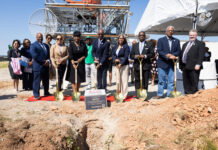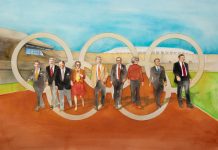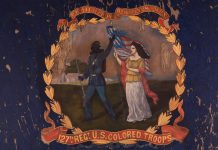



Photograph courtesy of the Kenan Research Center at the Atlanta History Center
Less than seven years after the first airplane flight at Kitty Hawk, North Carolina, aviation arrived in Atlanta on the same site as today’s Hartsfield-Jackson Atlanta International Airport. In 1925, the company that would eventually become Delta Air Lines formed, and that same year, the City of Atlanta leased an early airfield south of the city for its first municipal airport.
We have partnered with the Atlanta History Center for this century-long timeline of Hartsfield-Jackson and Delta Air Lines. The center is working with Gary Lee Super Design Associates to produce Blue Skies: 100 Years of the Atlanta Airport, a permanent exhibition that will open at Hartsfield-Jackson in the pedestrian tunnel between Concourses D and E in February.
November 9, 1909
Atlanta Speedway opens at the future site of Candler Field. Asa G. Candler organizes it under the auspices of the Atlanta Automobile Association, with Asa G. Candler Jr. (his son) as president. Candler is best known as the founder of the Coca-Cola Company. The speedway soon closes.
November 15–17, 1911
For the second year in a row, Asa Candler Jr. organizes an “aerial exhibition” at the old speedway. It includes air races and features famed stunt pilot Lincoln Beachey. More than 8,000 people attend, including a 21-year-old William B. Hartsfield.
1914–1918
World War I revolutionizes aviation. During 1917, Congress appropriates $695 million to build an air corps. By the end of the war, there are over 10,000 trained pilots, 175,000 mechanics, and 48 large training fields.

Photograph courtesy of the Kenan Research Center at the Atlanta History Center
January 12, 1920
Captain W.C. Lambert, an Ohioan and notable WWI pilot, is in the city for a few days with his passenger-carrying aeroplane when he tells an Atlanta Constitution reporter, “Atlanta has many advantages for establishing a great flying center here . . . Atlanta should awake to the fact that she occupies a vantage point in the aeroplane industry.” In a stunt, he takes some of the Mack Sennett Bathing Beauties on a plane ride over the city.
1925
Huff, Daland & Company, predecessor of Delta Air Lines, is formed as an Ogdensburg, New York–based manufacturer of aerial sprayers and crop dusters. The company begins to focus on the pernicious boll weevil, then the scourge of cotton crops in the South. Its dusting division is called Huff Daland Dusters Inc. It is initially based in Macon but later moves to Monroe, Louisiana. C.E. Woolman is chief entomologist. He later becomes the CEO and principal founder of Delta Air Lines.
April 16, 1925
The City of Atlanta enters into a lease with Asa G. Candler Inc. for the old Atlanta Speedway for use as an airfield. Later that year, it is named Candler Field because William Hartsfield (now a city alderman) hopes to have Candler eventually donate, rather than sell, the field to the city.
May 27, 1926
Roscoe Turner attempts the first airline passenger service from Atlanta to New York. He leaves Candler Field for New York with several passengers, including Hartsfield—as well as a $1 million check for the Federal Reserve Bank of New York. The plane makes it only as far as Abbeville, South Carolina, due to mechanical issues. Despite extensive repair efforts, the flight is canceled.

Photograph courtesy of the Kenan Research Center at the Atlanta History Center
September 15, 1926
The first airline to serve the airport is Florida Airways. The initial route is Atlanta-Jacksonville-Tampa-Miami, thanks to an airmail contract. The 10 bags of mail on that first plane, Miss Atlanta, are rushed downtown. Its arrival is greeted with much ceremony, including a formation flyover by Army Air Corps pilots. Florida Airways ceases operation less than a year later.
August 19, 1927
New Orleans–based St. Tammany–Gulf Coast Airways receives an airmail contract for an Atlanta–New Orleans route. Later, St. Tammany–Gulf Coast Airways is acquired by Gulf Coast Airways, a division of Southern Air Transport. It will begin using the common brand American Airways when it and 29 companies merge in 1930.

Photograph courtesy of the Kenan Research Center at the Atlanta History Center
October 11, 1927
Charles Lindbergh visits Atlanta Airport during a cross-country tour following his solo flight across the Atlantic. After landing at Candler Field, Lindbergh ends up ankle deep in mud after his aircraft becomes stuck in the wet Georgia red clay.
November 19, 1927
Pennsylvania-based Pitcairn Aviation (predecessor of Eastern Air Lines), receives an airmail contract for the Atlanta-Jacksonville-Miami route formerly held by Florida Airways. Days later, it also receives the contract for an Atlanta–New York mail route.
May 8, 1928
A Pitcairn Aviation plane crashes into Stone Mountain a week after the start of the Atlanta–New York route. The plane left Candler Field in foggy conditions, then smashed into the mountain. The plane is demolished, but pilot Johnny Kytle drags the mailbags off the ruins and hands them over to someone to take back to Candler Field.

Photograph courtesy of the Kenan Research Center at the Atlanta History Center
November 22, 1928
Huff Daland Dusters Inc. is acquired by a new company called Delta Air Service using capital from a group of Monroe, Louisiana, businessmen. It is named after the Mississippi Delta. C.E. Woolman remains as chief entomologist and soon becomes vice president and general manager.
April 13, 1929
The City of Atlanta purchases Candler Field, a 300-acre tract, for $94,400 ($100,000 minus a 5 percent discount for payment in cash) from Asa G. Candler Inc.
Summer 1929
John H. “Jack” Gray is hired as the first field manager. As airport manager, he is required to live at the field to handle emergencies and to turn on the field lights for fliers arriving in the middle of the night. After overseeing the construction of three terminals (in 1933, 1948, and 1961), he retires in 1961.
January 17, 1930
Following its purchase by Clement Keys’s North American Aviation, Pitcairn Aviation becomes Eastern Air Transport. It opens hangar and maintenance facilities at the airport and later in the year relocates its entire operations headquarters and purchasing and engine-overhaul departments to Atlanta. Eastern also converts offices in a corner of its hangar into a passenger waiting area furnished with chairs and couches. It is considered the airport’s first terminal.
June 11, 1930
Expecting to get an airmail contract between Atlanta and Fort Worth, Texas, Delta Air Lines begins passenger service between both cities. When the contract is awarded to American Airways, Delta discontinues its service, sells its airliners, and returns to the crop-dusting business.

Photograph courtesy of the Kenan Research Center at the Atlanta History Center
December 10, 1930
Eastern Air Transport adds passenger service to Atlanta.
February 1932
Construction starts on a new Atlanta Municipal Airport terminal and administration building. It is completed and dedicated on May 7, built in part by a $35,000 loan from American Airways. American’s motivation? If Atlanta is to become a major interchange between American’s West Coast line and Eastern Air Transport’s north-south line, it needs first-class passenger facilities.
1934
Eastern Air Transport becomes Eastern Air Lines after being purchased by General Motors. American Airways Company is acquired by E. L. Cord, who renames it American Air Lines. The company loses all of its Atlanta routes. American’s Chicago-Atlanta and Atlanta–New Orleans routes go to Eastern, and Atlanta-Dallas to Delta Air Corporation.
July 4, 1934
Delta Air Corporation (Delta Air Lines) enters the Atlanta passenger and airmail market to stay.

Photograph courtesy of the Kenan Research Center at the Atlanta History Center
1937
William B. Hartsfield is elected mayor of Atlanta.
Late 1930s
Eastern Air Lines has its hub operation at Atlanta. It’s dubbed the “Midnight Merry-Go-Round” for the large number of craft to land and depart.
March 1, 1941
Delta Air Lines moves its headquarters from Louisiana to Atlanta.
1939–1945
The Atlanta airport almost doubles in size during World War II, with land acquisitions and runway expansions. Also, Delta hires female mechanics and reservations workers. The terminal building is expanded.
May 9, 1948
A new airport terminal opens. It includes significantly more ticket space and waiting areas, large photographic murals by Atlantan Thurston Hatcher, and the Dobbs House restaurant. The restaurant features depictions of plantation life that glorify the old South and include a live Uncle Remus character at its front door. The restaurant also segregates its Black and White diners.
1950s
While the terminal remains segregated, “White” and “Colored” signs are removed. Very few Black people are employed at the airport, and those who are fill positions such as janitors, porters, and aircraft cleaners. Black and White locker rooms, showers, and eating areas remain separate.
May 1, 1953
Chicago & Southern Air Lines is merged into Delta, giving Delta its first international routes to the Caribbean and South America (albeit not out of Atlanta just yet).
1955
The Atlanta Municipal Airport is the eighth busiest in the United States, with 2.1 million passengers. The 1948 terminal is already woefully inadequate. Additional concourse space and aircraft parking spaces are constructed, but the airport needs a new terminal. Architecture and engineering firm Robert and Company is hired to design a terminal for the jet age.
August 4, 1958
The Dobbs House declines to seat a Black passenger, insurance executive H.D. Coke of Birmingham, and the other members of his travel party in its main dining room. In response, Coke files a lawsuit. One year later, an “eat-in” conducted by five members of Congress of Racial Equality (CORE) helps bring attention to the cause. Finally, on January 6, 1960, the courts rule that the 14th Amendment rights of Coke and other Black diners have been violated. Segregation at the airport ends.
July 22, 1959
Delta receives its first jet, a DC-8 N801E.
May 3, 1961
A new international-style terminal designed by Edward Moulthrop (who later will become renowned for his artistic wood bowls) of Robert and Company opens. The new, sleek modern terminal is one of the key achievements in the career of Mayor Hartsfield. The terminal is designed to handle 6 million passengers per year.
June 3, 1962
A Boeing 707 crashes during takeoff at Orly Field outside Paris, killing all 122 passengers and eight crew members. On the plane were 106 members of the Atlanta Art Association coming home from a monthlong tour of art exhibits. Many are Atlanta cultural and civic leaders, and the loss has a devastating impact on the city. The Woodruff Arts Center will be founded in 1968 in honor of the victims of the Orly crash.
1967
The 1961 terminal is now handling 11.2 million passengers annually, almost double its design capacity.
February 25, 1969
Officials decide to develop the existing airport to its maximum rather than build a second airport. Delta and Eastern, however, are unwilling to finance a new terminal. Why sink money into a new terminal at the airport’s midfield, the airlines contend, when studies and projections show that a second airport will be needed in the 1980s?

Photograph courtesy of Atlanta Journal-Constitution via AP
September 1970
Delta initiates wide-body jet service at Atlanta with the arrival of the first 747 in its fleet.
February 22, 1971
Former Mayor William B. Hartsfield dies. A week later, the Board of Aldermen vote to rename the airport William B. Hartsfield Atlanta Airport.
1971
Airport planner Maxwell Walker develops a phased expansion plan for the airport. It envisions gradually adding 95 gates at the airport’s midfield (compared to the 67 then at the 1961 terminal), which would be used simultaneously with the 1961 terminal. The plan calls for all the gates to eventually be transferred to the midfield.
1971
Expansion of the 1961 terminal increases its design capacity to 14.5 million people yearly.
July 1, 1971
Eastern Air Lines makes Atlanta an international airport by starting nonstop flights to Mexico City. The Board of Aldermen votes to rename the airport William B. Hartsfield International Airport.
1973
The completion of a third parallel runway means that two planes can land simultaneously at the airport. This helps control congestion.

Photograph courtesy of the Kenan Research Center at the Atlanta History Center
January 1974
Maynard Jackson becomes the first Black mayor of Atlanta. Keenly aware of the importance of commercial aviation, Jackson quickly becomes a pivotal figure in the airport’s history.
Midsummer 1974
Delta decides it cannot wait for a second airport to be constructed. It throws its weight behind the midfield plan. Other airlines come along to support; Eastern is the final holdout.
1975
The 1961 terminal handles 25 million passengers with 69 gates. The airport is so overcrowded that Eastern, Delta, and Piedmont are parking planes away from the terminal and using mobile lounges and buses to transport passengers to and from planes.
1976
The design goal for the new midfield terminal is for the airport to handle 55 million passengers a year. Project budget is pegged at $380 million. January 1, 1981, is set as the target opening date.
April 30, 1978
Delta Air Lines initiates nonstop service to London—the airline’s first nonstop international service from Atlanta.
September 21, 1980
The new Midfield Terminal (today known as the domestic terminal) opens. Delta Air Lines makes a point of having both the first flight to depart from and the first flight to arrive at the new terminal.
1981
Atlanta takes the title of the world’s busiest airport for the first time when, for a period of four months, the airport handles more passengers than any other airport in the world. For the next 15 years, Hartsfield and Chicago O’Hare International Airport will trade the title of “World’s Busiest” back and forth.
February 1, 1984
Air Atlanta, founded and run by African American entrepreneur Michael Hollis, takes to the skies. The airline is unique for its time; not only is the founder and CEO Black, but significant capital invested in the airline is from North Carolina Mutual Life Insurance Company, a Black-owned business. Then former Mayor Maynard Jackson is on the board of the company. Although well-regarded by its passengers, the airline ceases operations on April 3, 1987.
April 1, 1987
Delta Air Lines merges with Western Airlines, making Delta the fourth-largest airline in the U.S.
January 19, 1991
After a long labor dispute, Eastern Air Lines shuts down, bankrupt. At the time, the airline employed 6,900 workers in Atlanta.
September 21, 1994
A new international terminal, Concourse E, opens in time for the 1996 Olympic Games.
July 19 – August 4, 1996
Atlanta hosts the Centennial Olympic Games. The Atlanta airport handles more than 1.4 million passengers and 10,000 athletes from almost 200 countries during the games.
1998
Hartsfield overtakes O’Hare as the world’s busiest airport, a distinction it has held ever since (except for 2020).

Photograph courtesy of Delta Air Lines
June 23, 2003
Jackson dies. The name of airport is changed to Hartsfield-Jackson Atlanta International Airport.
September 14, 2005
Delta Air Lines—struggling amid high fuel prices and still reeling from the financial disruption to the airline industry after the September 11, 2001, terrorist attacks—files for Chapter 11 bankruptcy. Its charismatic CEO, Gerald “Jerry” Grinstein, steers the company back to profitability and pulls the company out of bankruptcy in less than 20 months.
May 27, 2006
A fifth runway that crosses over I-285 opens. It allows for triple simultaneous landings.
May 16, 2012
The new $1.4 billion Maynard Holbrook Jackson Jr. International Terminal opens at Hartsfield-Jackson. The Atlanta Journal-Constitution refers to the terminal as a “new front door” for Atlanta.
2019
The airport handles a record 110,531,300 passengers for the year.
2020
The Covid-19 pandemic disrupts air travel as never before. Airlines respond by grounding flights and airplanes. They slowly ramp service back up in 2021 and 2022 as the threat of the virus abates.
2024
Hartsfield-Jackson handles 108,100,000 passengers for the calendar year.
This article appears in our October 2025 issue.