




Illustration by Joe Magee
The Atlanta Journal-Constitution print edition, 157, dies on December 31, 2025, succumbing to burgeoning digital news coverage. No service is planned.
The print paper’s readers are of two minds about losing their lifelong daily habit. Some say the death moves the newspaper full bore into the modern digital world. Others don’t know what they will do without it. From the Silent Generation to Gen Z, the loss is felt.
“We’ve always taken the paper even when we couldn’t buy groceries,” said Florrie Bowles, 85, of Atlanta. “I don’t think I’ll ever read it online. I like to hold it in my hand.” She and her husband, Dan, have subscribed to the paper for 67 years.
While they get most of their news digitally, Gen Z subscribers are nostalgic about the print newspapers they grew up reading. When it comes to articles younger readers want to preserve, they want a print newspaper, said Kennesaw State University student Mary Wingate.
“Part of its specialness comes from the printed newspaper,” she said. “We enjoy newspapers to commemorate things, a keepsake. The concept of it is important to people my age. Articles on paper are more permanent.”
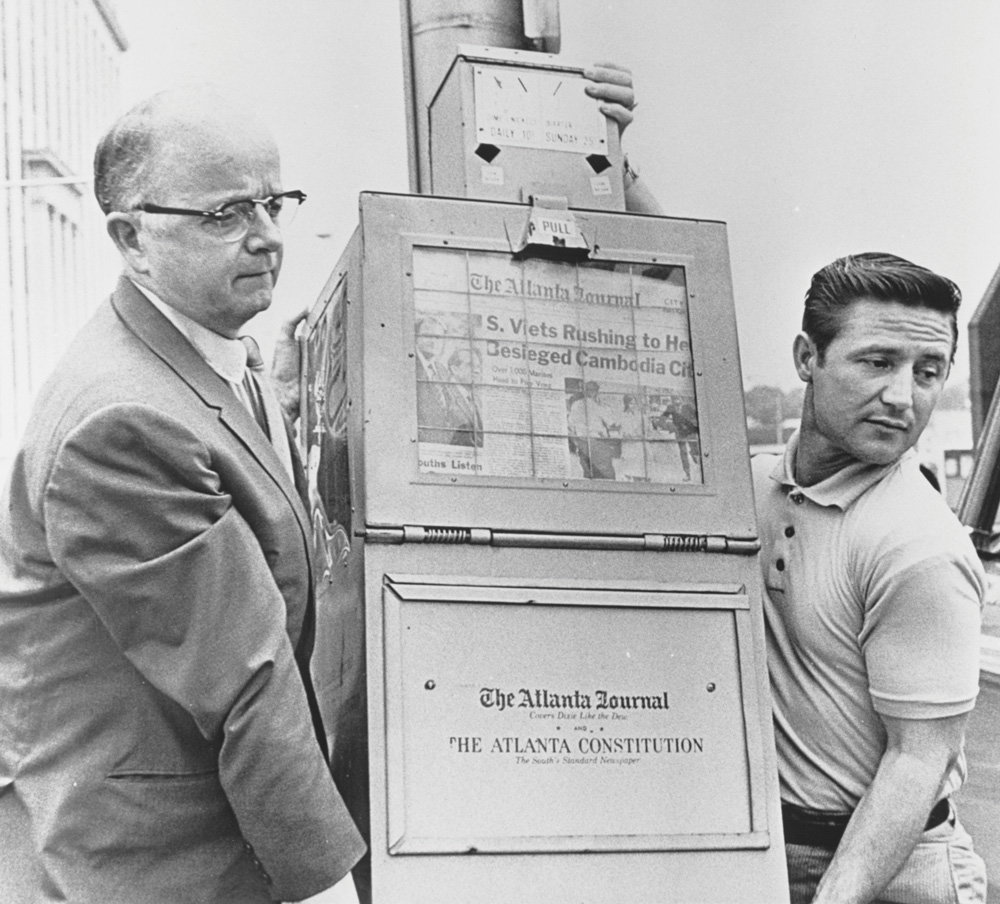
Photograph by Joe McTyre Photograph Collection, Kenan Research Center, Atlanta History Center
For 157 years, the printed Atlanta Journal-Constitution has been the shared memory bank for readers. Simply mentioning a name triggers those memories: Ralph McGill, Furman Bisher, Mike Luckovich, Celestine Sibley, Lewis Grizzard, Bill Torpy, and earlier reporters Joel Chandler Harris and Margaret Mitchell before they became world famous. Copies of front-page headlines are saved, some even reprinted onto T-shirts: “It’s Atlanta!” and “CHAMPS!”
Obituaries are clipped from the paper, shared with distant friends and relatives and saved in the family Bible. Funeral homeowner Willie Watkins foresees a decline in subscriptions when the paper goes 100 percent digital. “I think it’s a sad day,” he said. “A lot of people don’t have computers. Older people, they’ll just be lost.”
“Covers Dixie Like the Dew” was the Atlanta Journal’s motto, published on its masthead daily. Today’s slogan for the Atlanta Journal-Constitution is “The Substance and Soul of the South.” Whether reading the news online or in print, subscribers value its Southern personality.
The Atlanta Journal-Constitution has about 115,000 paid subscribers. Today the paper has 75,000 digital-only subscriptions. The 40,000 print subscriptions are profitable but represent a shrinking part of the business, according to AJC president and publisher Andrew Morse.
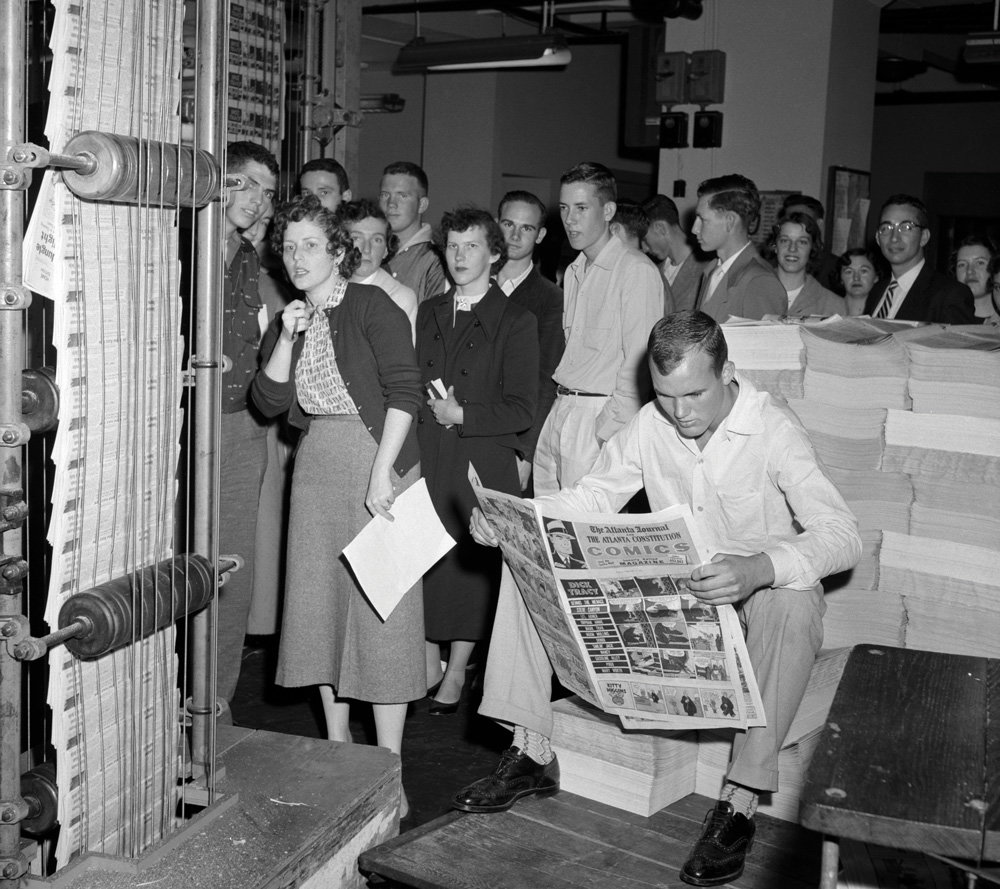
Photograph by Kenan Research Center, Atlanta History Center

Photograph by Kenan Research Center, Atlanta History Center
With the demise of AJC news on paper, some speculate whether it still can be called a newspaper. Cheeky readers suggest newspaper be replaced by NewsPlatform, NewsDigit, or the Daily Dige. Come up with your own term.
Jim Auchmutey, a 30-year veteran AJC reporter, now retired, disagrees. “Language is full of antiquated things that we still use and people understand,” he said. “Calling it a newspaper still sounds okay because that’s what we deal in.”
The morning Atlanta Constitution, first published in 1868, was followed by the afternoon Atlanta Journal in 1883; the two relished fierce competition and hijinks between reporters. Each had opposite editorial voices, beloved columnists, and unsparing coverage that has merited a dozen coveted Pulitzer Prizes over seven decades. In 2001 the papers combined into the Atlanta Journal-Constitution.
The Pulitzers are bestowed for superlative news coverage, bold editorial stances, excellent editorial cartooning, and explanatory science reporting. The newspapers held to account government, business . . . whatever affected its readers. In 1891 a story ran with this headline: “What’s in Coca-Cola? A Popular Drink Which Is Said to Foster the Cocaine Habit.” In the 1930s and ’40s, Governor Eugene Talmadge referred to the Journal and the Constitution as “them lying Atlanta newspapers.” Lester Maddox, Georgia governor from 1967 to 1971, was picketing the newspaper offices until shortly before his death in 2003.

Photograph by Kenan Research Center, Atlanta History Center

Photograph by Kenan Research Center, Atlanta History Center
Behind hard-hitting news coverage was journalists’ behavior that never made print. In the early 1930s, a familiar visitor to the Constitution was a man wearing a long overcoat—even during the summer. It was lined with half pints; he was the staff’s favorite bootlegger. Today drinking and smoking are not allowed in the building. The most colorful back stories are shared by longtime reporters over drinks at Manuel’s Tavern.
As AJC print subscribers work through the five stages of grief, there are resources to help them through the process. A delightful special section of historical tidbits compiled by Auchmutey was published June 16, 1993. It’s titled “The Atlanta Constitution Turns 125.” The Atlanta History Center’s Kenan Research Center houses a comprehensive digitized collection of the print newspaper available to the public at no charge. Make an appointment, and the helpful research staff will assist you with everything from locating a specific article to printing out an entire newspaper page.
The final print edition of the Atlanta Journal-Constitution falls on a Wednesday. The publisher assures all print subscribers that they will have a copy delivered then even if they wouldn’t ordinarily get home delivery that day.

Photograph by Kenan Research Center, Atlanta History Center
The venerable Xernona Clayton, 95, civil rights activist and broadcast legend, has a subscription to the Atlanta Journal-Constitution print edition and is fretting through her grief. “I absolutely cannot live without the paper,” she said. “I cannot imagine what I’ll do. I’m trying to decide whether to die now or later.”
As of January 1, 2026, the paper’s survivors will include 40,000 Atlanta Journal-Constitution print subscribers. In lieu of flowers, readers are asked to refresh their browsers.
This article appears in our December 2025 issue.