

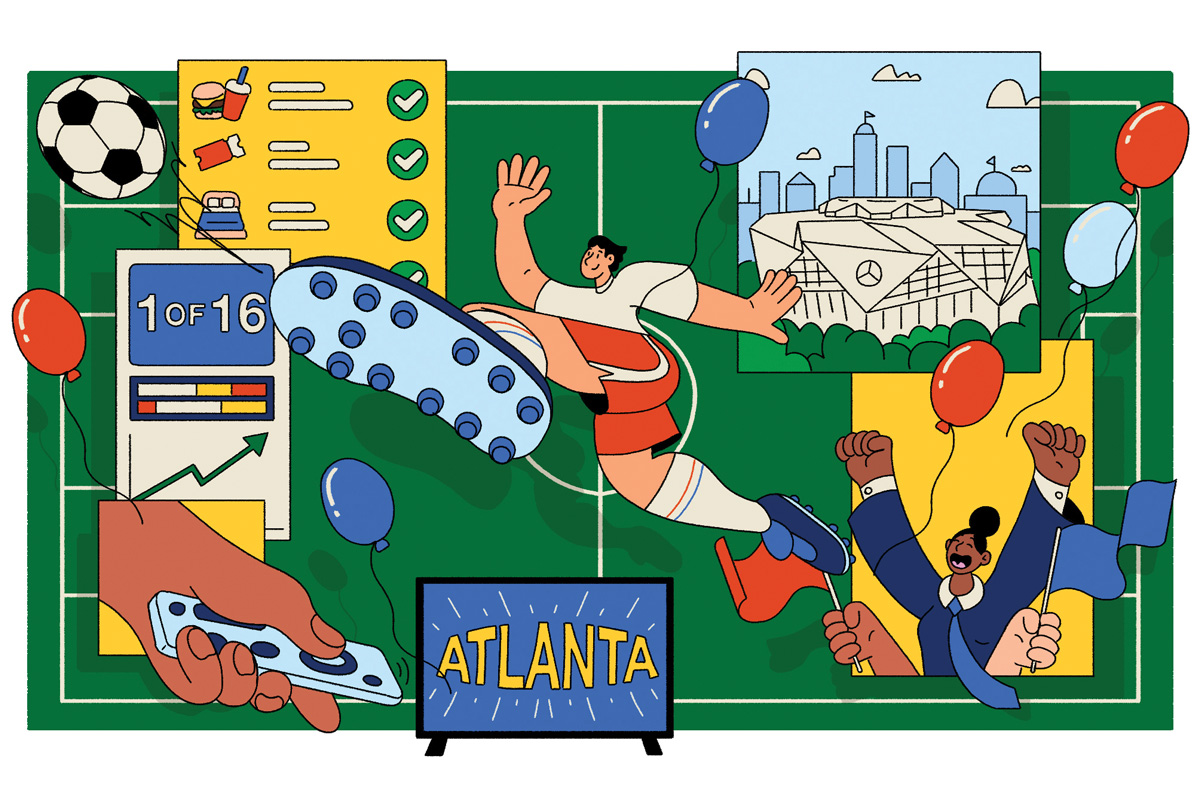
Illustration by Linn Fritz
In 2017, Atlanta was one of more than 40 candidate cities in the United States, Canada, and Mexico competing to host FIFA World Cup 2026™. To make it to the list of 16 North American host cities for 2026, each candidate had to offer not only an immense, luxury stadium, but also world-class transportation, airports, hotels, security, medical facilities, and the funds—and sports fans—to back everything up.
Atlanta had it all. “We’re a championship city, and our logistics package is very attractive,” says William Pate, president and CEO of Atlanta Convention & Visitors Bureau, referencing the city’s airlift and accessibility, hotel portfolio, and walkability to several world-class attractions and more than 300 downtown dining options.
That’s not to say there wasn’t stiff competition. Dallas and Los Angeles both won host city bids in 1994, plus they entered this round with new stadiums (AT&T and SoFi, respectively), making both cities virtual locks. Still, Atlanta had a giant new weapon in its arsenal: Mercedes-Benz Stadium, which opened in 2017. It also had the relatively new Atlanta United FC, winner of the 2018 MLS Cup.
In 2018, FIFA narrowed the candidate list to 23, and Atlanta made the cut. Over the next few years, FIFA visited, evaluated, and inspected each of these nearly two dozen cities. Atlanta made sure to highlight its downtown campus, which includes the stadium, fan festival sites, the convention center, and more than 13,000 hotel rooms all connected within a short walking distance, making it easy for fans, teams, and media to move between venues.
It all culminated in a 2022 nationally televised, hour-long broadcast from New York announcing the 16 winners. FIFA asked each candidate city to host a viewing party for the announcement, and in Atlanta, Mayor Andre Dickens, Governor Brian Kemp, and Atlanta VIPs and bid partners gathered for the party at Mercedes-Benz Stadium with AMB Sports and Entertainment Chairman Arthur Blank.
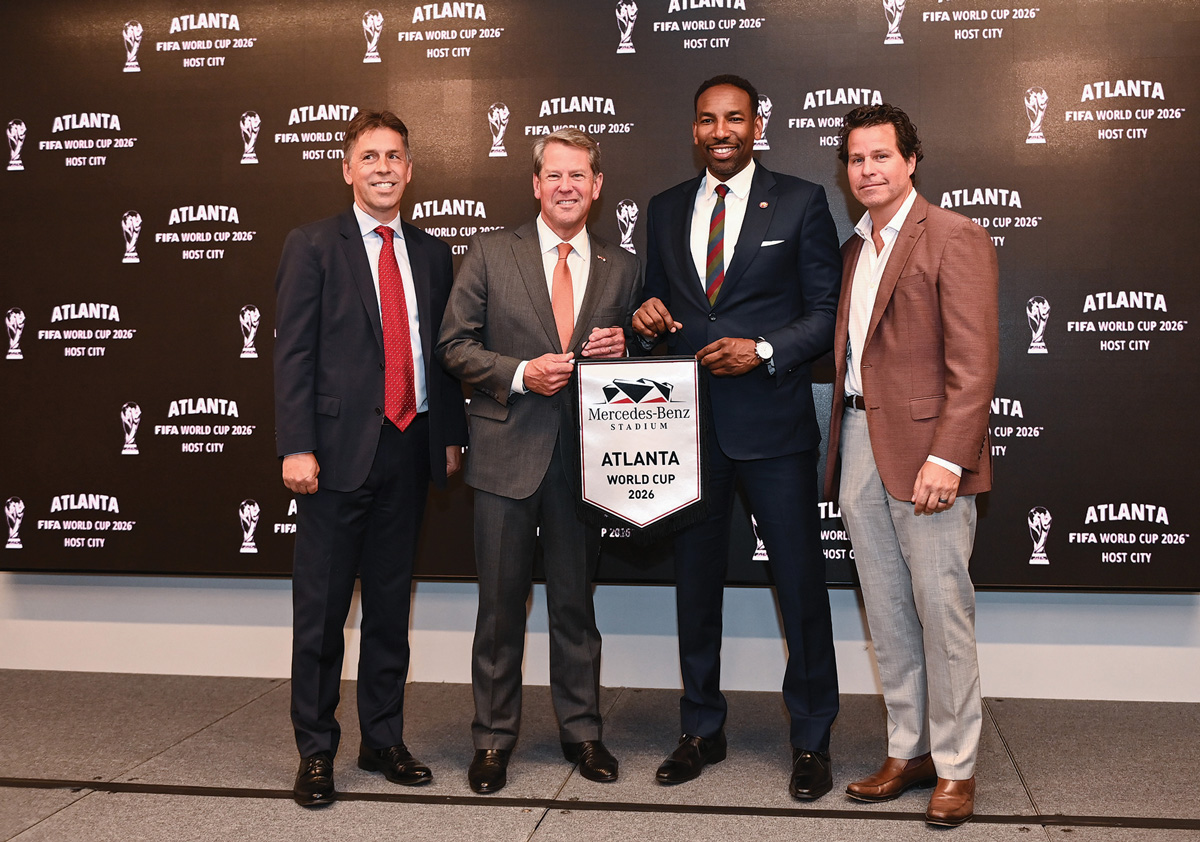
Dietmar Exler, chief operating officer overseeing Mercedes-Benz Stadium, remembers being anxious. “You never want to be overconfident,” he says, adding that he was worried about everyone in the room facing the attending journalists if Atlanta was disappointed.
FIFA began announcing cities from the “West” region to the “East,” with the winning city names appearing onscreen. First came Vancouver, Seattle, and San Francisco. “Everyone was feeling good,” says Dan Corso, president of the Atlanta Sports Council and Atlanta World Cup Host Committee, the 40-year-old organization that led the bid effort. “None of us were paying attention at the time.” Next up were Guadalajara, Monterrey, Mexico City. “They’ll get to the East here soon, and then we can pay attention.” Dallas, Kansas City. “Oh, that’s still Central . . . Then, all of a sudden, Atlanta popped on the screen.”
“It was quiet in the room for 15 seconds because everybody was thinking, We’re not Central,” Exler says, “and then the room exploded with applause. It was a fantastic feeling.”
Exler says FIFA later told him Atlanta joined the Central announcement to help balance the numbers. Corso says he still teases FIFA friends: “You made us change time zones just to get selected!”
The announcement capped five years of work—and marked the beginning of four more years of preparation. “I feel very confident that we’re going to have a fantastic event,” Pate says. “We’re going to make FIFA very proud.”