

Home 2015
Archives
The Dirty Birds made it to the Super Bowl


After a 7–9 season in 1997, no one gave coach Dan Reeves’s 1998 squad a chance. But on the legs of running back Jamal Anderson—who rushed for 1,846 yards, nearly twice as much as he ever had or would again—and a smothering defense, the Falcons rattled off a nine-game winning streak to end the season a franchise-best 14–2 atop the NFC West. During a Week 15 victory over the hated ’Aints, Reeves suffered chest pains and eventually underwent open-heart surgery. The beloved coach was back on the sideline in time to engineer two playoff wins—the second an overtime upset over the juggernaut Vikings that sent Atlanta to its first-ever Super Bowl against the defending champions, the Broncos. The wind was promptly sucked out from beneath our wings as Reeves’s old nemesis, John Elway, threw for 336 yards in a sound 34–19 Bronco stomping. Hopes soared the following year, but Anderson blew out his knee, and the Falcons crawled to a 5–11 finish. And of course, they haven’t returned to the Super Bowl since.
This article originally appeared in our March 2015 issue.
Unbelievable! The Braves’ 1991 worst to first season
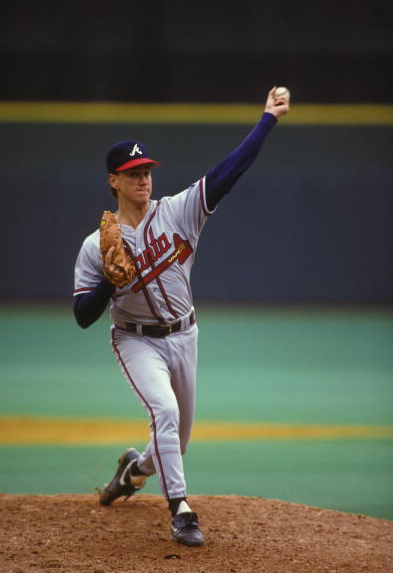
Who ever would have believed a baseball team could convince us eternity doesn’t last forever? Well, that actually happened back in autumn of 1991—the year October began to taste like honey, when leaves turned brighter shades of gold and crimson, and Atlanta nights felt fresh as mountain air. Who ever would have believed the Atlanta Braves’ melancholy baseball world would inexplicably explode and turn upside down—that a team enduring 22 consecutive losing months, that had not ended a season since 1983 with more victories than defeats, that in 1990 had led the entire National League in errors and finished in last place, would chase away the ghosts of seasons past?
Who ever would have believed—with half the 1991 season familiarly squandered—the Braves would catch sight of the hated first-place Dodgers, nine and a half games in the distance, and not think of it as a bridge too far? That aging Terry Pendleton would lead the league in hitting, that John Smoltz would lose 11 of his first 13 decisions then win 12 of his final 14, that future Hall of Fame pitcher Tom Glavine would win 20 games for the first time, that narcotically electrified Otis Nixon would steal 72 bases and gracefully defy gravity (before a drug test shortened his season)?
Who ever would have believed 2.1 million of us would sit in orange seats that for years collected dust from shattered dreams; that we would wave crimson tomahawks and chant throaty imitations of an indigenous war cry; that with every single heartbeat, we would feel vibrations of hope?
Who ever would have believed that in October 1991, Atlanta would drape itself in the red, white, and blue bunting of a National League pennant winner; that in the first World Series in our city’s history, every scoreless inning in the seventh and final game would become a miniature apocalypse; that it would take the game’s only run—scored in the final inning on the season’s final swing—to pierce our collective heart?
Who ever would have believed a team that for nearly a decade failed to contradict the taunting sobriquet of “Loserville” would inspire 750,000 Atlantans to line downtown streets and cheer as the Braves—losers, technically, yes—were touted with a parade celebrating their trip to the Series and journey from worst to first?
Change can cause reactions like that—the moment you realize you are no longer where you were, but you are not yet to where you will get. Who ever would have believed there would follow 13 championship seasons in Atlanta, one of them as World Champions of 1995? Who ever would have believed eternity doesn’t last forever?
Lee Walburn, editor in chief of Atlanta magazine throughout the 1990s, was the public relations manager for the Atlanta Braves in the 1960s.
This article originally appeared in our March 2015 issue.
Six degrees of Babyface

Atlanta became the epicenter of hip-hop and R&B thanks to hitmakers Kenneth “Babyface” Edmonds and Antonio “L.A.” Reid (33 number one singles!). Their LaFace Records created stars, jump-started stalled careers, and spawned a web of connections—snaring even Kevin Bacon and the film Six Degrees of Separation.

This article originally appeared in our March 2015 issue.
Atlanta’s true Olympic legacy: Not brick, mortar, or granite


Between three syllables uttered on September 18, 1990, everything changed in Atlanta, and so did our city’s place in the world. That morning I tuned in to the live audio feed from Tokyo on my sleek black Panasonic alarm clock/radio/cassette player. A hush fell as Juan Antonio Samaranch opened the envelope with a rustle, like an Oscars presenter.
“The International Olympic Committee has awarded the 1996 Olympic Games to the city of . . . ”
Pause.
“At-lan-ta.”
For the next six years, the city anxiously and proudly fixed itself up for its world stage debut, and you can see geographic mementos today. Decades of wrangling with neighborhood activists ended when the state and city brokered a deal to build Freedom Parkway to the Carter Center, putting to rest a planned expressway. A patchwork swath of storefronts and vacant lots (goodbye, Club Rio) became Centennial Olympic Park. Public art rose, raising hackles. The only thing Atlantans agreed on was a loathing for the Olympic Cauldron, which we and national critics dubbed the Giant French Fry Box.
Unlike Athens, Greece, the city considered a lock to host the Centennial Olympics, Atlanta had no ancient history, just modern ruins—neighborhoods near venues such as the Olympic stadium (now Turner Field) that had been long neglected. My job on the Atlanta Journal-Constitution’s Olympic team sent me to community meetings where two future mayors sometimes squared off: attorney Bill Campbell, then a glib, debonair city council member whose downtown district included major venues under construction; and former City Hall arts maven Shirley Franklin, the top female executive at the Atlanta Committee for the Olympic Games. Meanwhile, then-mayor Maynard Jackson was promising two pinnacles: the best Olympics ever and a shiny, better Atlanta.
Would we be ready? That was the question that drove everything and everyone. Buildings and arenas were obvious deadline projects; a more unwieldy task was dressing Atlanta’s sprawling footprint, cul-de-sacs, and one-way streets in a uniform everyone would recognize as “the look” of the 1996 Games.
For that, they turned to an old Southern icon, an enduring emblem of the cotton fields: a quilt. For our forested city, the design was a quilt of leaves, a box-and-vine design that adorned billboards, banners, tickets—even the medals. It inspired the design of Centennial Olympic Park and underpinned the city’s reputation for uniting across barriers of race, religion, and politics. This emblem suggested that Atlanta had connected its mishmash of ragged pieces for strength. We needed that narrative the second week of the Olympics, after terrorist Eric Robert Rudolph set off a bomb in the park, killing one person and injuring 111 more. When Atlanta gets burned, it’s in our DNA to rally and mend. The park reopened with a memorial service, and the Games marched forward.
The park, stadium, and other structures are tangible artifacts of Atlanta’s two weeks in the international spotlight, but the real legacy of the Games is not found in brick, concrete, and circles of dancing water. The Olympics ushered in a population and business boom, doubling the size of the metro area and attracting a new, multicultural generation of Atlantans.
At night I snuggle under layers of my own memories, sewn into a king-sized quilt made from my collection of Olympic T-shirts. In any other context, the bright interlocking-ring-patterned fabric from Olympic volunteers’ polo shirts would be downright ugly. I included a few Izzys, just to show my kids what a bizarre mascot Atlanta foisted on eBay. Southerners are collectors, and if you ask us what we kept from the Atlanta Olympics, you will discover boxes of pins (maybe even the rare interlocking onion rings from the Varsity) or strong dogwood trees, grown from the seedlings given to Centennial Park visitors at the post-Olympic reopening. These are symbols of our shared roots, when Atlanta was razing and rising during those extraordinary six years.
Michelle Hiskey covered four Olympics as an AJC staff writer. She now serves as a senior editor at Emory University and contributor to the Saporta Report.
This article originally appeared in our March 2015 issue.
TLC dominated the charts and tabloids
There’s few better times for soccer fans than World Cup season—and Atlanta soccer pubs and sports bars are joining in on the celebration. With so many to choose from, here are a few that stand out because of their deals, giveaways, and special World Cup menus through July 15. Best of all, many are opening early and offering breakfast specials for the extra dedicated fans. So whether you want to catch the morning or afternoon game, one thing is certain: you won’t have to break the bank. Fado Irish Pub This popular Irish pub will not only show all World Cup matches, but both of their Buckhead and Midtown locations will have a special World Cup menu as well. The menus at either location might vary slightly, but at the Buckhead location, you can expect offers like $10 sandwiches or burgers, $5 beers, $3 mimosas (until 3 p.m.), $6 bloody Mary’s (until 3 p.m.), and $20 buckets of beer. Doors open as early as 7:45 a.m. for the morning games. Buckhead: 273 Buckhead Avenue, 404-841-0066; Midtown: 933 Peachtree Street, 404-260-7190 Rí Rá Irish Pub Want to switch things up and catch the early game? This Irish pub in Midtown is perfect for that. They will open at 7:30 a.m. for all the morning matches and offer delicious breakfast specials (for orders placed before 11 a.m.) and $4 drinks to keep dedicated fans taken care of. 1080 Peachtree Street Northwest, 404-477-1700 Big Sky Buckhead If you wake up early, but not that early, then head here for brunch. Their morning specials carry on until 3:30 p.m. and include brunch options like $7 pandebono baskets, $10 chicken and biscuits, $10 arepas, and $15 steak and eggs. They’ll have $17 mix and match beer buckets all day though. During the World Cup season, doors open 7:30 a.m. or 11 a.m. depending on the specific game. 3201 Cains Hill Place Northwest, 404-228-8856 El Ponce Feelin’ Mexican food? Check this place out for well-rounded deals on food and drinks. For all World Cup games, they will be offering their full brunch menu which is usually just offered on Sundays. They also have a special Match Day menu that offers burritos, grande chilaquiles, and more. For drinks, they will offer several Heineken specials: $10 for a 32-oz Heineken that comes with a complimentary Atlanta United mug with refills for $6 (customers can bring this back anytime during the World Cup or Atlanta United matches for the refills), $20 Heineken & Heineken Light Bucket, and $7 for a 16-oz Heineken and 1-oz shot of Tequila. 939 Ponce De Leon Avenue Northeast, 404-881-6040 Der Biergarten If you’re rooting for Germany and want a taste of German culture too, Der Biergarten offers $10 liters of beer and $5 brats for any Germany match until July 15. Beyond that, Der Biergarten’s atmosphere attracts Germany fans from all over Atlanta, so you’ll all be cheering together. 300 Marietta Street, 404- 521-2728 The Midway Pub This East Atlanta Village pub has one of the biggest patios in the area and more than 100 selections of beer. Not only will they be open for all World Cup games, including all the morning ones, but they will also be giving away prizes (like Atlanta United tickets) and offering specials. They will have a World Cup loyalty program, called the “Passport Rewards Program,” which will allow customers to earn Midway money to spend at the restaurant for every game they attend there. 552 Flat Shoals Avenue Southeast, 404-584-0335 The Elder Tree A stylish and contemporary Irish pub and soccer club — The Elder Tree will be opening at 8 a.m. for all the matches and offering $3 Heineken draft specials, Atlanta United player signings, and giveaways like jerseys or balls. They are proud founding members of Atlanta’s MLS soccer club, Atlanta United FC — so expect to be around a lot of soccer fans. Other sports bars like Brewhouse Cafe and Hudson FC International Sports Pub may not have specific World Cup specials, however, they will surely have great menus and a game atmosphere you’d want to be a part of. 469 Flat Shoals Ave SE Atlanta, GA 30316 (404) 658-6108
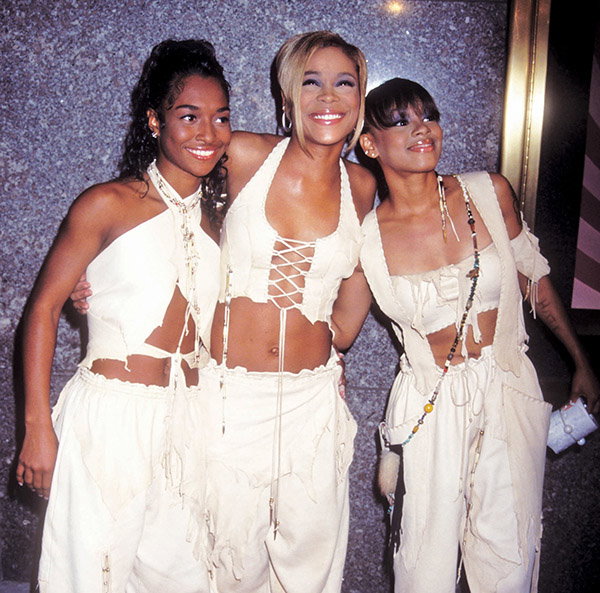
No Atlanta act bookended the decade better than TLC. Tionne “T-Boz” Watkins, Lisa “Left Eye” Lopes, and Rozonda “Chilli” Thomas burst onto the scene with their DayGlo fashions and a 1992 debut, “Ooooooohhh. . . On the TLC Tip.” From then until 1999’s “FanMail” (hit single: “No Scrubs”), the tumultuous trio dominated both the charts and the tabloids. For a time, they surpassed even the Supremes to become the all-time biggest-selling female pop group. TLC’s rise came to a halt in 2002 after Lopes died in a car crash. In 2013 the two surviving members executive-produced the VH1 docudrama “CrazySexyCool: The TLC Story.” Watkins and Thomas began performing again as TLC and this year will go on tour with NKOTB.
Says Thomas of TLC’s endurance: “It’s so crazy to me when a 10-year-old comes up and knows who I am, thanks to the VH1 movie. It’s grabbed a whole other generation. It makes me feel good to know that we did the right thing when we first came out with our direction and how we felt about female empowerment.”
This article originally appeared in our March 2015 issue.
5 not-so-true romances: The couples who kept our tongues wagging
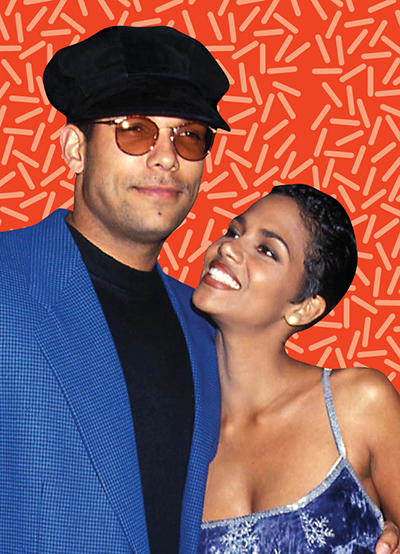
David Justice & Halle Berry
The actress spied the Braves right fielder on TV and sent him her number; less than 12 months later, they married in a ceremony at his Sandy Springs home on New Year’s Day 1993. But after its whirlwind start, the marriage was plagued by distance and jealousy. Berry filed for divorce in 1996, later admitting the split left her suicidal.
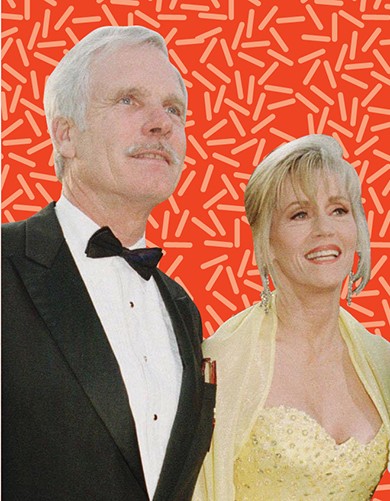
Ted Turner & Jane Fonda
The White House. The Oscars. The World Series. The media titan and Hollywood star’s romance was flashy. And turbulent: In a memoir, Fonda claimed Turner cheated on her a month after their December 1991 marriage. They divorced a decade later but remain amicable supporters of each other’s causes.
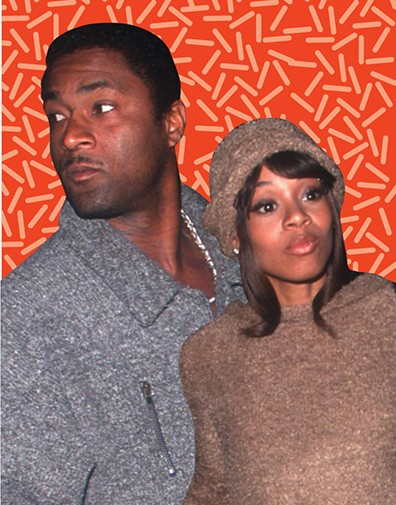
Lisa Lopes & Andre Rison
She rapped for megagroup TLC. He ran routes for the Falcons. But relationship drama made more headlines for “Left Eye” and Rison. Cases in point: In 1993 he was arrested, charged with beating her and firing a gun outside the Disco Kroger after bystanders tried to intervene; a year later, she set his mansion on fire. Yet the two remained on and off—rumored to be engaged—until her fatal car accident in 2002.
Marla Maples & Donald Trump
Dalton native Maples, the other woman who came between “the Donald” and his first wife, Ivana, wed Trump in 1993. From an eight-carat diamond to the six-foot-tall cake, their love was extravagant. But not lasting. When they divorced in 1997, the former Miss Hawaiian Tropic got a reported $1.9 million.

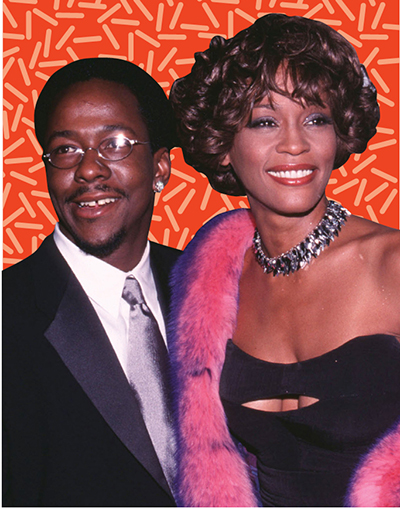
Whitney Houston & Bobby Brown
Once upon a time—before the reality show, “crack is whack,” or legal spectacle—Houston and Brown’s fairytale romance played out in Atlanta. Granted, it was no typical fairytale; after their 1992 wedding, they set up house in the Powers Ferry Road mansion once owned by pornographer Mike Thevis. But Atlanta loved to see them dining at the Palm Restaurant, holding court in Hotel Nikko, and singing at Forest Park’s Living Word Church of God in Christ, whose minister worked with Houston on 1996’s The Preacher’s Wife and wrote the film’s song “Hold on, Help Is on the Way.” The couple divorced in 2007, five years before her death.
This article originally appeared in our March 2015 issue.
By the numbers: Atlanta’s 90s sprawl

People moved here at the staggering rate of 360 per day, bursting the region’s boundaries and transforming its culture.
3.5 million
metro Atlanta residents, 1996
5.5 million
metro Atlanta residents, 2014
43%
rate our suburban population grew during the ’90s. Between 1990 and 1998, more than 650,000 people moved to the northern suburbs; only 170,000 moved to the southside.
1
Atlanta’s rank in 2000—out of all metros on Earth—for longest average commute (35 miles). In 1997 the average Atlanta driver lost 68 hours a year due to traffic—up from 30 hours in 1990.
27 acres
amount of tree cover lost per day in the 1990s as construction and building boomed
995%
rate Atlanta’s Hispanic population grew between 1980 and 2000
1,000
number of foreign companies located in metro Atlanta by 1995; today that number is 2,800.
This article originally appeared in our March 2015 issue under the headline “Sprawl City.”
Corruption in DeKalb is nothing new—remember Pat Jarvis?
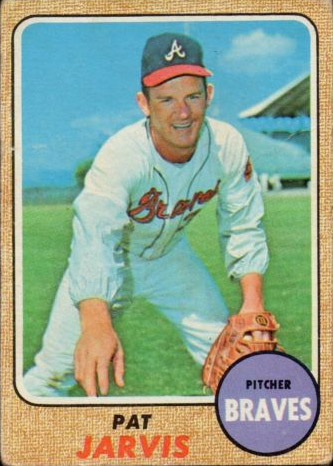
 During his seven-year stint as an Atlanta Braves pitcher, Pat Jarvis won 83 games and earned the nickname “Little Bulldog” for his compact frame and gutsy competitiveness. He retired in 1974 and two years later transitioned to political infields, winning election as sheriff of DeKalb County, which already had a reputation as a swamp of corruption. In 1972 Sheriff J. Lamar Martin was convicted of bribery. Jarvis succeeded Ray Bonner—indicted (later cleared) on charges of misrepresenting a fundraising company.
Sheriff for 19 years, Jarvis scored wins (opening the mammoth jail) and earned questionable calls (an ethics investigation). He resigned in 1995; a year later federal prosecutors began probing his actions behind the badge. Their findings: Jarvis had pocketed as much as $200,000 in kickbacks. He ultimately pleaded guilty to mail fraud and in 1999 began serving a 15-month federal prison sentence.
Today Jarvis, 74, lives on a 44-acre farm near Rutledge and is focused on new ventures—a farmers market and restaurant. He remains upbeat: “My whole career in Atlanta has been fantastic.”
Jarvis would turn out to be the least infamous of DeKalb’s incarcerated ex-sheriffs. In 2007 Sidney Dorsey was sentenced to life plus 23 years for ordering the murder of Derwin Brown, who’d beat him in a runoff.
This article originally appeared in our March 2015 issue.
Back in the day: Michael Krohngold


We opened the Velvet in this vacated 6,000-square-foot building downtown. Everybody came: gay, straight, bankers, punks, you name it. This was before event photographers and cellphone cameras. Bono would come in, hang out all night, fall off a barstool, and close the place down—and nobody ever knew about it. Sunday Disco Hell with DJ Romeo Cologne was one of our biggest nights. Jermaine Dupri and Andre Rison would come in, back when Andre was dating Lisa “Left Eye” Lopes, and order bottles of Cristal. The dancers from the Cheetah would be there after the strip club closed. On Super Bowl Sunday 1994, the Buffalo Bills called and said they were on the way; the cheerleaders were coming too. At 11 o’clock, with a line down the block, the city permits officials walked in and shut us down because only places that served food could be open on Sundays. So we installed a pizza kitchen and six weeks later reopened with our “To Hell and Back” night, and in walked Dallas Austin with Madonna. She was in shorts, no makeup, and eating raw asparagus with two crazy-tall male dancers. She went upstairs and danced in her own little world. She came back the next week and brought friends. The pizza oven paid for itself in no time.
As told to Richard L. Eldredge
This article originally appeared in our March 2015 issue.
NEWSLETTERS