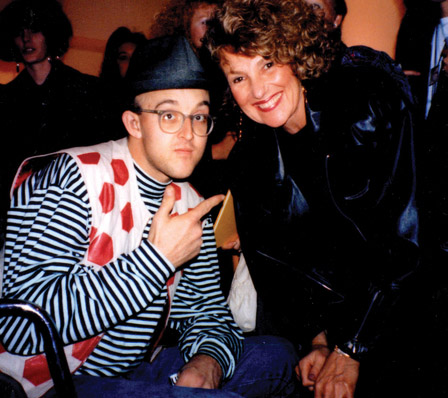
For me, the 1990s started out with an exhibition by Keith Haring, followed by shows displaying works by Robert Mapplethorpe, Cindy Sherman, Annie Leibovitz, and Helmut Newton. I gave Thornton Dial and Radcliffe Bailey their first shows. It was quite the decade. In the 1990s, you still had a lot of Southerners who didn’t like change. They really wanted what their grandma had. I was never afraid to introduce artists like Mapplethorpe to Atlanta. I like to shock. I like to take risks. I mean, I didn’t show his “X Portfolio,” but there would be enough shocking things that little old ladies would come into the gallery, look around with very serious faces, and when they got to the door, they’d look at each other and start giggling.
I worked with Elton John for three years. It didn’t hurt that I suggested we do a fundraising auction for the Elton John AIDS Foundation, and we ended up netting $750,000. I would not tell dealers in New York who my client was. Many people were not yet aware that he was living here. I would have them mail me a huge amount of great photographs, and Elton would come in and go through each pile and pick out what he liked.
When CNN anchor Bernard Shaw flew to Iraq to interview Saddam Hussein, he didn’t intend to make history as a war correspondent. Shaw—along with reporters Peter Arnett and John Holliman and producer Robert Wiener—was in a hotel awaiting a call from Hussein’s reps when the deadline for U.N. sanctions passed. War was imminent and the U.S. was going to bomb Baghdad. The first TV cable news journalists to cover a war in real time, they broadcast from their hotel room. CNN’s ratings soared and audiences rooted for the “Boys of Baghdad,” even as Shaw, off-air, feared for his life. As he told viewers at one point, “This feels like we’re in the center of hell.”
Holliman died in 1998. In recent years, Arnett has taught journalism at China’s Shantou University. Shaw, now 74, is retired in Takoma Park, Maryland. “I learned from four years in the Marine Corps that a bullet does not discriminate,” he says. “So I made my peace with the fact that I could be dead at any moment. When I likened Baghdad to hell, my wife and children happened to be watching. They had never heard fear in their father’s voice before, and they started to cry. My wife, Linda, stood up in front of the TV set and said, ‘This is your father’s job.’ She didn’t let on, but she knew I was in big trouble.”
Who knew? The 2002 HBO movie Live from Baghdad chronicled CNN’s groundbreaking coverage. The film focused on producer Robert Wiener, played by Michael Keaton. Robert Wisdom (best known as Major “Bunny” Colvin on The Wire) portrayed Shaw.
My first day at CNN was August 1, 1990. After a career spent in newspapers, I needed time to become familiar with CNN’s staff, operations, finances, and plans for the future. But on my second day—August 2, 1990—Saddam Hussein invaded Kuwait. There would be no orientation honeymoon. President George H.W. Bush announced on CNN and other channels, “This will not stand.”
Sanctions would force Hussein to withdraw from Kuwait—or the United States and its allies would drive him out militarily. Too much oil and too many urgent dangers to U.S. allies in the region were at stake.
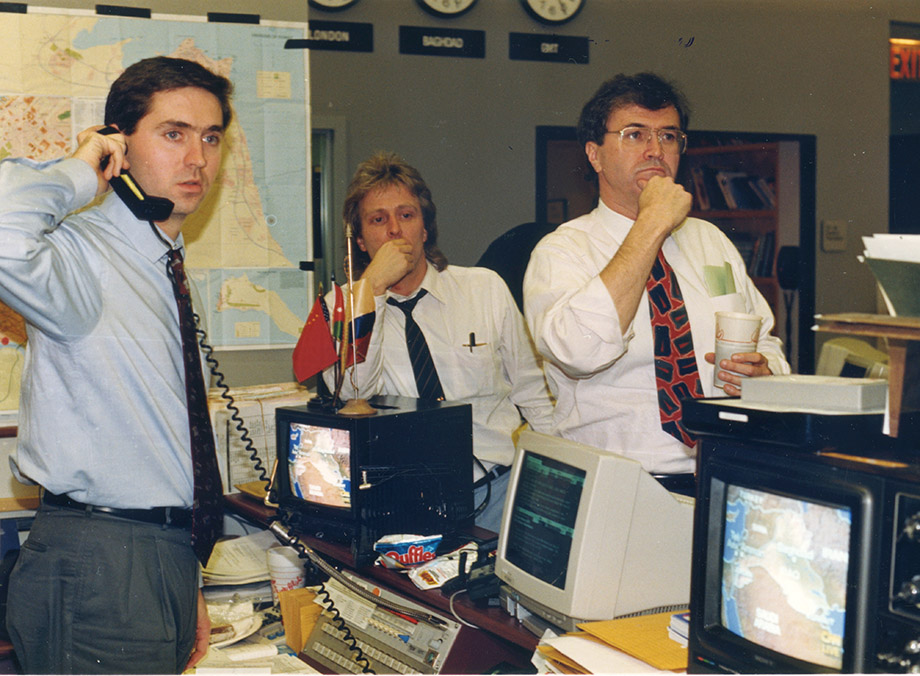
Johnson, right, at CNN during the war
Photograph courtesy of Tom Johnson
It was clear that CNN needed to be prepared to cover a major military conflict. I advised Ted Turner that the network would need to exceed its forecast budget by millions if we hoped to provide 24-hour war coverage. Mobile ground uplinks needed to be placed. Satellite transponders needed to be booked. Circuits needed to be reserved. Staffers needed to be deployed.
I asked Turner, “How much money over our 1991 budget am I authorized to spend?”
His answer was swift and short: “You spend whatever you think it takes, pal.”
With that authority, CNN prepared for war.
Eason Jordan and Robert Wiener had the foresight to install a “four wire,” a separate system to send audio feeds from the Al Rasheed Hotel to CNN’s center in Jordan and then back to Atlanta by satellite feeds. “The first thing that will go down after an attack on Iraq will be its power systems and its communications,” Wiener said.
When the war finally started, we were ready. On January 16, 1991, CNN anchor Bernard Shaw reported to the world, “The skies over Baghdad have been illuminated . . .”
As predicted, Iraqi power and communications systems were destroyed by stealth fighter jets and cruise missiles. Every media company based in Baghdad—except CNN—lost power and transmission capabilities. Only CNN broadcast live to hundreds of millions of people worldwide. All channels turned to us for exclusive coverage; there was no place else.
Back then CNN was the only global 24/7 news channel. That live coverage of war—the first time it had been televised worldwide—transformed the media landscape. CNN became required viewing for informed citizens and heads of state, the one truly global news source. That has changed now, with multiple cable networks and news breaking on social media. But without the investment in journalism from visionary owners such as Turner, today’s networks focus more on commentary than newsgathering.
The Gulf War was the most significant moment in CNN’s history—all possible because Turner said, “Spend whatever you think it takes, pal.”
Georgia native Tom Johnson was chairman and CEO of CNN from 1990 to 2001.
He could do it all: Score touchdowns. Steal bases. Rap. Okay, maybe not rap. But Deion Sanders was a freakishly talented athlete, and for three seasons in the early ’90s, the stars aligned so that he was both a Falcon (feared pass defender) and a Brave (feared base runner). In 1992 it all came together: With the Falcons, Sanders led the NFL in kickoff-return yards, and with the Braves, he batted .304. On October 11, he attempted to become the first man to play in two pro leagues in the same day, flying from a Falcons game in Miami to a Braves game in Pittsburgh. Alas, he didn’t play that night. Today he’s a Pro Football Hall of Famer and an analyst for CBS Sports.
Mike Tokars was four yearsold on November 29, 1992. Yet he remembers the events of that night clearly, and he recounts them with an almost unsettling calm.
He recalls waking up in the back of his mother’s 4Runner, which was in the garage of the family’s East Cobb home. A strange man emerged from the house with a sawed-off shotgun. The stranger kicked the family’s Springer Spaniel, Jake; jumped into the backseat beside Mike; and ordered Mike’s mother, Sara Tokars, to drive to a vacant residential development about a half mile away, where she pulled over. Then a gunshot. The stranger fled. From the passenger seat, Mike’s six-year-old brother, Rick, leaned over and turned off the ignition. Seeing their mother slumped over the steering wheel, Rick told Mike they had to go for help. But Mike sensed she was dead. The two boys ran about a hundred yards through the dark, through bushes with thorns that cut them, their blood mixing with that of their mother. The next morning, over a breakfast of their uncle’s waffles, the two boys kept saying: If only Dad had been there with his gun.
Photograph courtesy of Mike Tokars
The brothers moved in with their maternal grandparents in coastal Bradenton, Florida. Their father, Fred Tokars—a high-profile Atlanta criminal defense attorney—would call and occasionally visit. He phoned on Mike’s sixth birthday, but when Mike tried to pass the phone to his brother, Rick refused. They both knew their father had been arrested, but Rick knew the implications. Back in Atlanta, Fred Tokars was charged with hiring the stranger, Curtis Rower, to kill Sara in an attempt to cover up his secret life of drug trafficking and money laundering. Mike never spoke to his father again. “At that point, he was no longer a good guy in my eyes,” says Mike.
Fred Tokars’s 1997 trial and conviction was broadcast nationally on Court TV. Mike did not attend. Family and friends shielded the boys, but “sometimes it would come up,” says Mike. “And when it didn’t, I knew that they knew.” Eventually public memory of the tragedy faded. “As we got older, we had more control over who knew,” says Mike. “I was always open about it with my close friends. I wanted to explain—talking about my parents made me feel like a normal person.” Mike says that wasn’t the case with his brother, who was much more guarded. “I can’t remember a single instance of us talking about it,” says Mike. “We didn’t need to.” On the 10th anniversary of their mother’s murder, Mike tried to broach the topic; Rick cut him off, and the two went surfing.
Rick went to college in San Diego and is now an avid surfer and traveler. Mike stayed closer to home, attending Tallahassee Community College and then the University of South Florida, where he majored in history and English literature. But he devoted more time and energy to touring the South by van and playing guitar in punk rock and ska bands. Reading “The Rum Diary” by Hunter S. Thompson inspired him to become a reporter and writer, so he moved to New York, where he interned and freelanced. On a whim, he applied to the Master of Journalism program at Columbia University and was shocked to be accepted. He plans to graduate this spring.
Reporters occasionally contact Mike about his parents; from inside prison his father has become a prolific prosecution witness, having helped solve six murders. Mike says his experience gives him insight into and empathy for the people he writes about who have suffered loss. More than anything, facing evil at such an early age has shaped the way he has approached his own life. “I don’t take anything for granted, don’t expect to be comfortable or safe,” he says. That’s not necessarily negative, he explains, using a surfing analogy: “When you’re in the water, you always worry that there’s a shark. But there’s a calmness when you actually spot a fin—you know the evil is there.”
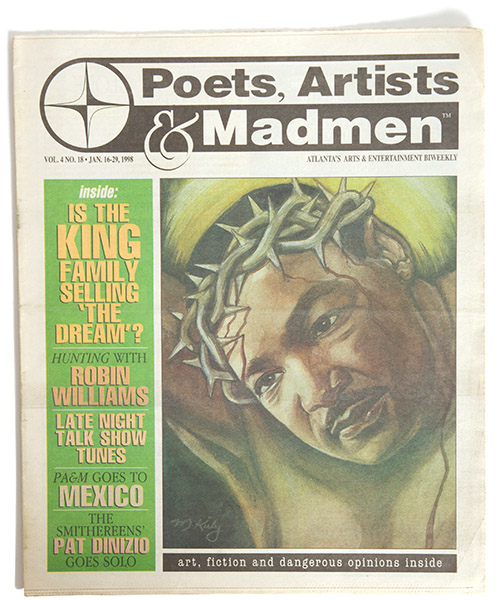
Over four decades, upstarts have tried—and failed—to take down “Creative Loafing.”Two of our favorite would-be alternatives to the alternative had short-lived blazes of glory in the 1990s: literary “HighPoint” and out-there “Poets, Artists & Madmen.”
Our nightlife hit an ecstatic peak in the 1990s, a decade lubricated by the free-flowing cash of the dot-com boom, the flash of the burgeoning hip-hop scene, and the youthful exuberance of the Olympics. Of those years, none, arguably, was better than 1996, when you could conceivably hit all of these places in one glorious night.
Rupert’s Filling the shoes of the Limelight—the disco of “Disco Kroger” fame—was a tall order, but Rupert’s kept Buckhead dancing thanks to its 12-piece house band, the self-proclaimed “fabulous” Rupert’s Orchestra, which pumped out vanilla covers of Top 40 hits. Fate The club closed by the late 1990s, but you can still book the band for your next soiree.
Backstreet One of the largest gay bars in the Southeast, this two-story Midtown club was among the few Atlanta nightspots with a 24/7 liquor license. Home to Charlie Brown’s Cabaret and a disco floor that drew gay and straight revelers, Backstreet was the go-to place to party after other clubs closed. Fate It stopped rainin’ men in 2004 after a city ordinance mandated 3 a.m. closings.
Buckhead Village Scene By day the moneyed heart of Atlanta, by night its stoked loins. After an altercation involving a posse belonging to the NFL’s Ray Lewis left two stiffs on the sidewalk in 2000, the powers that be tightened the screws and brought the party to a close. Fate Then, clubs with names like Uranus. Now, Buckhead Atlanta boutiques.
MJQ Entered through an unmarked side door of a seedy hotel, the original MJQ was an underground Euro lounge dropped in the middle of Ponce. The thrift store furniture and cans of beer served out of coolers provided the perfect setting for the mix of acid jazz and trip-hop. Fate In 1997 it relocated down the street to another basement lair. Still doesn’t have a sign.
Club Kaya Before it was replaced by the flashier Vision in the early aughts, Kaya was a scruffy, DJ-driven dance club and launch pad for the city’s emerging hip-hop artists. A notably mixed-race clientele often queued around the building to see shows featuring Jay Z, Ludacris, Kurtis Blow, and other rap luminaries. Fate Razed in 2006 for the 1010 Midtown condo tower.
The Chamber Girls in cages. Guys on leashes. When this kinkier cousin to the Masquerade opened in an unmarked warehouse off Cheshire Bridge Road in 1994, it scratched an itch Atlanta didn’t know it had. Suburbanites swarmed in to gyrate to industrial music and ogle BDSM acts played out on various stages. Fate The cat-o’-nine-tails were retired in 2005.
The Gold Club This edifice to the ecdysiast’s art was a haven for excess throughout the decade: an epilepsy-inducing blur of neon, mirrors, and throbbing music; wall-to-wall hotties serving up in-your-face table dances; and stratospheric bar tabs. A stop here became de rigueur for NBA stars with names like Ewing, Rodman, and Mutombo. Then came federal indictments alleging the strip club was little more than a gilded brothel, with profits funneled to the Mafia. Fate The building on Piedmont Road is now the Gold Room, just a plain old nightclub.
Atlanta poured $1 billion into an Olympic building frenzy—supplemented by cash from TV rights, corporate sponsorships, and ticket sales. This generated a $5 billion economic impact that summer, and decades of population growth and international investment. But how have those construction projects paid off?
Illustration by Walter Newton
★★★★★ 1 Centennial Olympic Park Before the Games 5 acres of blight During the Games A favorite gathering spot for locals and visitors; everyone loved that fountain Today A 21-acre oasis surrounded by zillion-dollar new attractions like the aquarium and the Center for Civil and Human Rights
★★★★ 2 Olympic Village Before the Games Fanciful ideas—high-rises straddling North Avenue!—were ditched for a cluster of mid-rise dorms on Georgia Tech’s campus and incorporating land previously occupied by Techwood Homes, a historic but troubled housing project. During the Games The $200 million village housed 14,000 athletes and coaches from 197 nations. Today Tech dorms
★★★★ 3 Concourse Eat the Atlanta airport Before the Games Okay, not technically an Olympic project. But the Games spurred a 1.3 million-square-foot expansion, completed in 1994. During the Games The $305 million international concourse impressed Olympic delegates and handled a crush of visitors. Today The Games boosted ATL to world’s-busiest-airport status, and the hub still spurs growth here.
★★★ 4 Centennial Olympic Stadium Before the Games A run-down area decimated by highways (1950s) and a ballpark (1960s) During the Games A spiffy stadium for opening and closing ceremonies and track and field; an old ballpark for, well, baseball Today Retrofitted as Turner Field, the stadium was heralded by fans, but redevelopment of the surrounding area stalled. The Braves looked this Olympic gift horse in the mouth; they’re exiting for the burbs in 2017.
★★★ 5 Georgia International Horse Park Before the Games Undeveloped land in Rockdale County During the Games Equestrian, mountain bike, modern pentathlon Today The 1,400-acre park is used for festivals, equestrian events, and concerts. It’s also popular for weddings and reunions.
★★ 6 Clayton CountyInternational Park Before the Games “Atlanta Beach,” a privately owned park During the Games Beach volleyball’s crowd-pleasing Olympic debut Today The park offers tennis, pavilion rentals, beach access, and—of course—a chance to exercise your inner Karch Kiraly on one of 11 Olympic courts.
★★ 7 Olympic Aquatic Center Before the Games Thanks to $17 million from the state and Games organizers, Georgia Tech’s athletics complex was doubled with the addition of a (temporary) water polo facility and (permanent) competition pool. During the Games Venue for diving, swimming, water polo, and synchronized swimming events Today Houses a swimming and diving arena—and palatial digs named one of the “Coolest College Recreation Centers” in the U.S. by Men’s Health in 2014
★ 8 Stone Mountain Tennis Center Before the Games A corner of Stone Mountain Park During the Games A $22 million tennis venue (Agassi won gold!) Today Plagued by repair problems, the center flopped as a park attraction. It was shut down in 2007 and turned over to Gwinnett County in 2009.
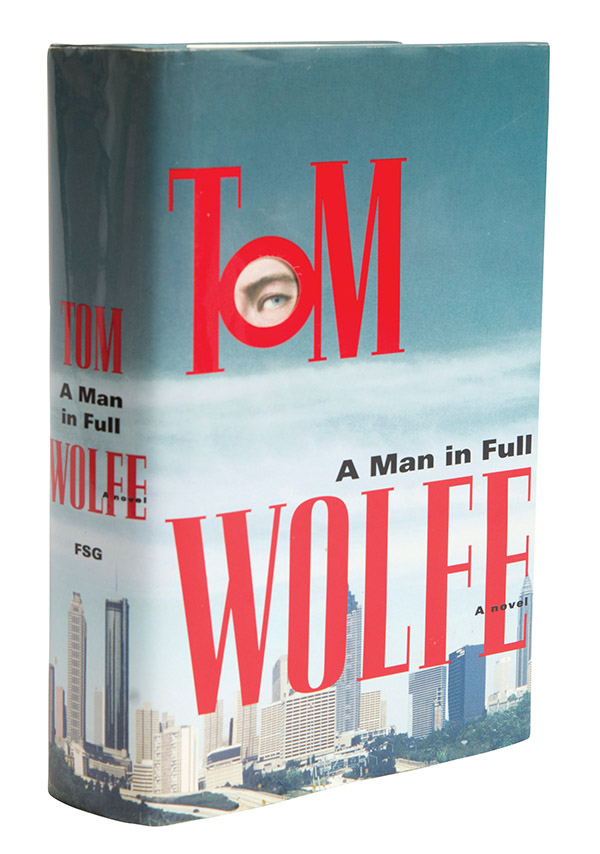
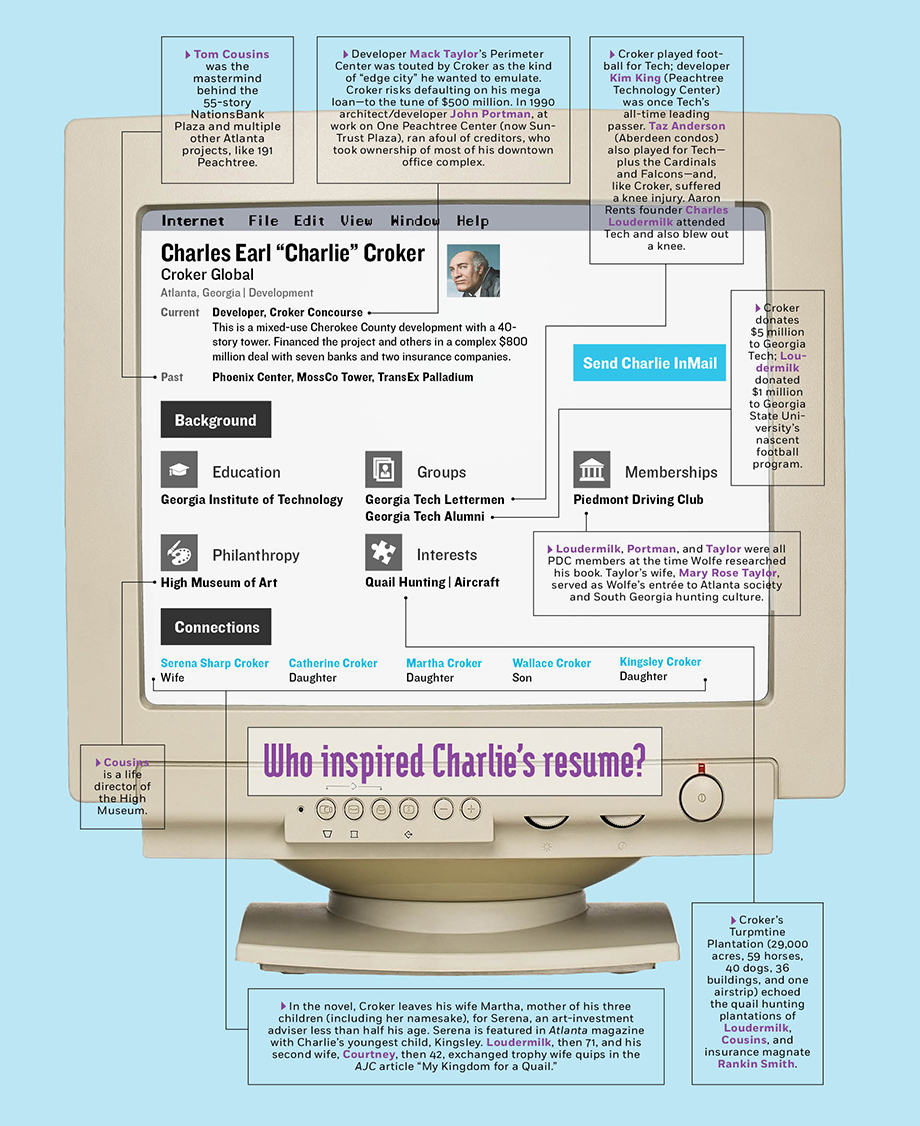
Well before its 1998 publication, Tom Wolfe’s Atlanta-centric “A Man in Full” was the talk of Buckhead’s cocktail party circuit; once the 742-page opus hit shelves, the chatter became deafening. In response to Wolfe’s theme of racial tension (one plot twist: a KKK rally staged to lower property values), former mayor Sam Massell “disinvited” Wolfe from a Buckhead Coalition luncheon and then-mayor Bill Campbell released a statement touting Atlanta’s “history of racial harmony.” Fueling all this controversy: the AJC “Wolfe Watch” column. When the author appeared at the Borders store in Buckhead, more than 1,000 fans stood in line—some for nine hours. Wolfe’s protagonist Charlie Croker, the 60-year-old builder of high-rises and Old-Meets-New South blowhard, was fictional, but the “King of the Crackers” bore a likeness to several Atlanta businessmen, blistering Buckhead society like a shotgun blast to defenseless quail. Everyone claimed to know who “Charlie” really was—the problem was, nobody could agree.
The Dome debuted August 23, 1992, with a Falcons preseason victory over the Eagles (Hammer kicked things off; John Denver sang the national anthem; Travis Tritt played halftime). But the arena’s quintessentially ’90s color scheme (think Color Me Badd CD cover) had already taken center stage. For some, the only shade more off-putting than those on the exterior (plum, aqua) and seats (various teals) was in the visitors locker room (salmon). Decor for the home team: gray, red, and black.