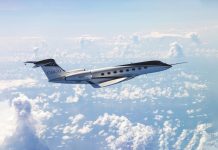



Photograph by Todd Burandt
When Zaheer Faruqi launched Axis Aviation, a business providing spare aircraft parts, from his two-car garage in Peachtree City on September 1, 2001, he couldn’t possibly have predicted the problems or possibilities headed his way. His first inkling came 10 days later. As the American aviation industry ground to a halt in the wake of the airplane-fueled terrorist attack on September 11, Faruqi floundered. He was facing the first of many entrepreneurial hurdles—a U.S.-based business without a U.S. customer base—while simultaneously juggling a personal one: having a profile dangerously similar to the masterminds of 9/11.
“Oh, for sure it was discouraging,” says the Pakistan- born Faruqi, CEO of what is now Aventure Aviation. “I respect what was going on at the time, but they began looking for anybody with a different appearance, who had worked in the Middle East, had an aviation background, was from a faith they were looking for. It was a rough period. But in a way, it was actually an opportunity for me, because I realized I needed to branch out, look somewhere else for the business. In the United States, airlines were still recovering from the setbacks they had after 9/11.”
In late 2002, amid the mayhem, Faruqi made a decision that would change the trajectory of Aventure Aviation. He looked for help—and found it. Enter the Georgia Department of Economic Development (GDEcD) and a working relationship that has lasted almost as long as the company itself. “They guided me . . . and that’s how I branched out,” Faruqi says from his office near Atlanta.

Photography by Todd Burandt
Branching out is putting it lightly. From its humble beginnings inside a garage, Aventure Aviation has grown into a global behemoth, with locations in China, Pakistan, Turkey, England, Canada, and the U.S. How did Faruqi do it? Simple. The one-time aerospace engineer remembered that an airplane takes off against the wind, not with it.
LEARNING TO FLY
Faruqi always knew he’d work in aviation. As a child growing up in Karachi, Pakistan, he spent Sundays with his dad at the airport, watching planes take off and land. “It would fascinate me, watching those airplanes disappear,” he says. “The airplane would show up right there, the passengers would get on, and an hour later it would just take off. I would wonder, Wow, where did they go?” That curiosity brought him to Inglewood, California, to attend Northrop University (closed in 1991), where he earned degrees in administration management and aircraft maintenance engineering. He received a diploma in aircraft and power plant maintenance, which led him to apply for and earn a Federal Aviation Administration (FAA) airframe and power plant license. This enabled Faruqi to inspect, maintain, and repair aircraft in compliance with FAA regulations.

Photography by Todd Burandt

Photography by Todd Burandt
After graduating, Faruqi worked with an engineering company in the design and development of aviation products, for international airlines in structures engineering, with an aircraft maintenance organization and, later, for Avatar Alliance, a now-defunct aviation parts company in Fairburn, Georgia. It was there that he saw an opportunity to launch a different kind of company, one he calls “the AutoZone of aviation.” Faruqi’s vision was to source and send spare parts to ensure commercial aircraft would spend more time in the skies generating revenue than on the ground waiting for maintenance. He accepted parts on consignment, encouraging airlines to sign over their spares. It took two years before he signed his first consignment deal in September 2003.
But Faruqi is not a man who is easily deterred. When then-President Georgia W. Bush coined the term “Axis of Evil” in response to the terrorist attacks, Faruqi renamed and rebranded his business, transforming Axis Aviation into Aventure Aviation, a combination of the words “aviation” and “venture.” When opportunities dried up in the wake of 9/11, Faruqi kept at it. When business opened back up and copycat companies with deeper pockets had a competitive advantage in U.S. sales, Faruqi went looking for other opportunities. He found them with the help of GDEcD. “They were telling me that they have international offices and maybe I should contact them to find out if my product would sell overseas,” he says. “Every time they would ask me, ‘Have you tried this?’ I would always try it. They were very influential.”
GOING GLOBAL
Faruqi’s first GDEcD foray took him on an international trade trip to Toronto and Montreal. There, he filled his free time with appointments where he could sell himself and his company. “I was eager to do business,” he says. “And to solve customers’ problems.” Following that trip, he inked his first international deal with Air Canada Jazz, a company that became his best international customer and, ultimately, prompted Aventure to open its first international office in Toronto in 2005 to better service its growing customer base. After that, Faruqi was hooked. If GDEcD offered it, he used it. “I was a sponge and going after whatever they would say. It really helped,” he says.
Today, 60 percent of Aventure Aviation’s revenue comes from international customers. And much of the credit for that goes to GDEcD and the worldwide representatives they have strategically stationed around the globe, Faruqi says. Take, for example, China. It was a GDEcD representative who suggested Faruqi consider expanding Aventure Aviation to Beijing. Faruqi, who had never been to China, agreed to an exploratory visit.
When he arrived on-site, the local GDEcD representative handed him Aventure Aviation business cards and a brochure translated into Mandarin. “I couldn’t have done that myself. I had no clue how to do it, but this gentleman had done it,” Faruqi says. “And then he guided me on how to go out and meet certain people. He made appointments for me and arranged for an interpreter from his office to accompany me to the meetings. Sometimes you need those boots on the ground to help you. And the Georgia Department of Economic Development helped me.”
GDEcD gives credit back to Aventure Aviation. “They’ve been a model client for us in how they’ve made use of all our resources, been smart in using them, acted on the information, been very responsive, and just generally been a smart consumer of the free services available,” said Taube Ponce, GDEcD’s senior international trade manager.

Photography by Todd Burandt.
CLEAR SKIES
Growth internationally fueled growth at home. In 2003, at the insistence of Faruqi’s wife, Aventure Aviation moved from the family’s garage in Peachtree City to a shared space six miles away. Faruqi steered sales from the office, while another Georgia company, then known as Hipage, handled shipping and receiving in the shared warehouse. Just five years later, with its first international office operating in Toronto, Aventure built a new global headquarters, constructing a 16,000-square-foot, purpose-built facility with office and warehouse space near Atlanta.
In 2010, the company established a military division, opening in new markets to grow the business. And in 2014, Aventure acquired its first aircraft, a Boeing 767, dismantling it to harvest and sell the parts. The acquisition represented a considerable shift in the company’s operation. “My early model was to take on consignments, because consignments don’t cost me any money, and it was really helping the airline offload their surplus material,” Faruqi says.
Over the last decade, airlines have become more cost-sensitive. Rather than buying excess material to keep on hand, they prefer to buy what they need when they need it. Ever responsive to market shifts, Aventure’s model has changed with the times. “Anybody who has ready-to-go material has a better chance of a sale as opposed to consignment,” Faruqi says. “I don’t go after consignment. I go out and buy the airplanes that are being retired.” That change brought a historic acquisition in June 2025, when Aventure Aviation completed the largest aircraft deal in its history, purchasing 12 Boeing 737NGs from Alaska Airlines. The purchase enabled the company to “exponentially increase our spares inventory and customer base,” Faruqi says.
Just six weeks later, the company opened a 70,000-square-foot warehouse, the first phase of its new headquarters in Peachtree City. Construction of a second phase, including a 54,000-square-foot office and an additional 36,000 square feet of warehouse space, is slated to begin later this year as part of the company’s silver anniversary celebration.
SOARING AHEAD
Aventure Aviation now operates in six countries, with 70 employees around the world. Of those, 31 are based internationally. The company has earned exporting accolades aplenty, including being named the 2025 Exporter of the Year for Georgia and the Southeast Region by the Small Business Administration, receiving a 2022 Exporter of the Year Award from the Export-Import Bank of the United States, and achieving the 2021 U.S. President’s “E” Award for Export Excellence.
What else does Faruqi have planned to mark 25 years in business? “We have decided to grow our company,” he says without a hint of irony. In addition to the headquarters expansion, Faruqi completed Aventure’s first corporate acquisition: Atlanta Aviation International, an FAA-certified repair station based in Atlanta. And, of course, they’ll continue to buy airplanes, a feat that’s easier now that the 12-aircraft purchase is complete. “We’ve already been approached by several sellers,” Faruqi says.
For his part, Faruqi will continue to focus on his role as CEO, a title he says has nothing to do with being a chief executive and everything to do with his focus on the company’s customers, employees, and owners, including his three sons, Talha, Hamzah, and Osman. “Those are the three key aspects of the business that keep me excited,” he says. But they’re just part of the winning combination that has brought the company such success. GDEcD is the other, Faruqi says. “As we proudly celebrate our 25-year existence as a successful company in Georgia, we now have a strong foundation, which will help us grow exponentially,” he says.
See this entire feature in GaBiz Spring 2026.