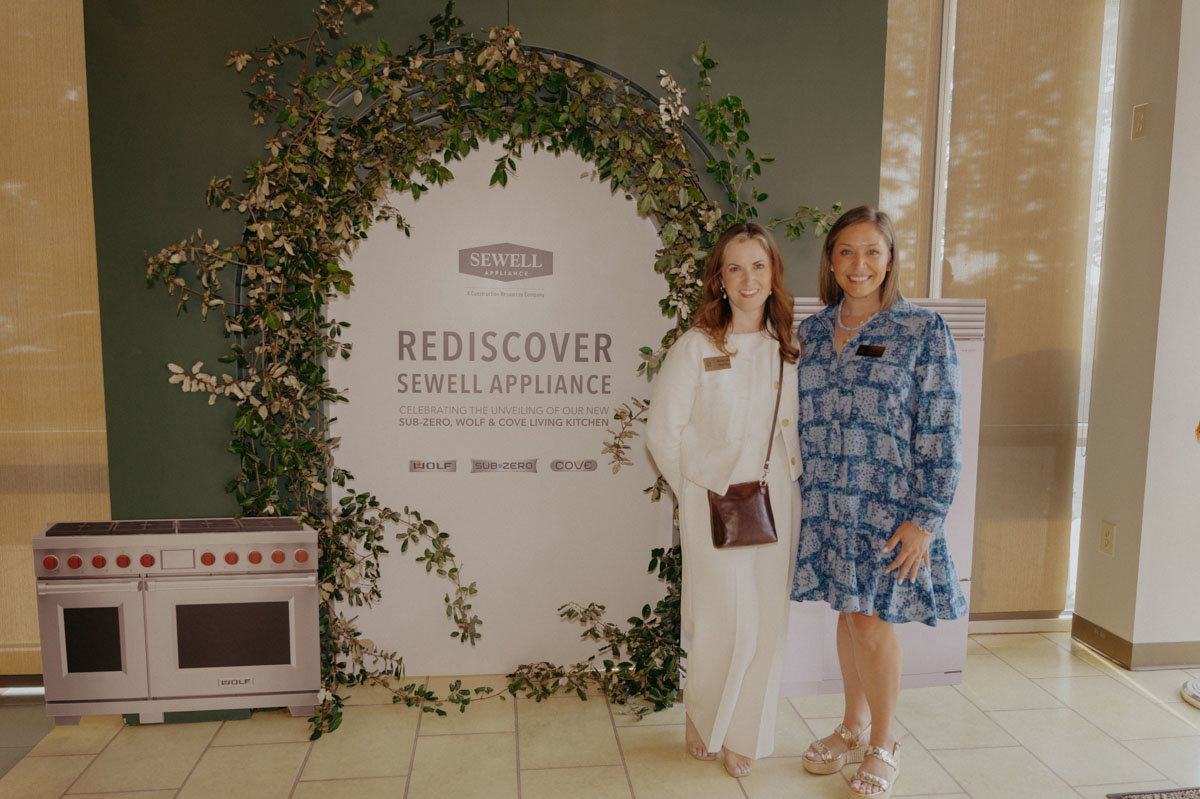
Sewell Appliance in Sandy Springs recently introduced its newly renovated Sub-Zero, Wolf, and Cove Living Kitchen. Pictured are team members from parent company Construction Resources.
Photo courtesy of Le Content Agency
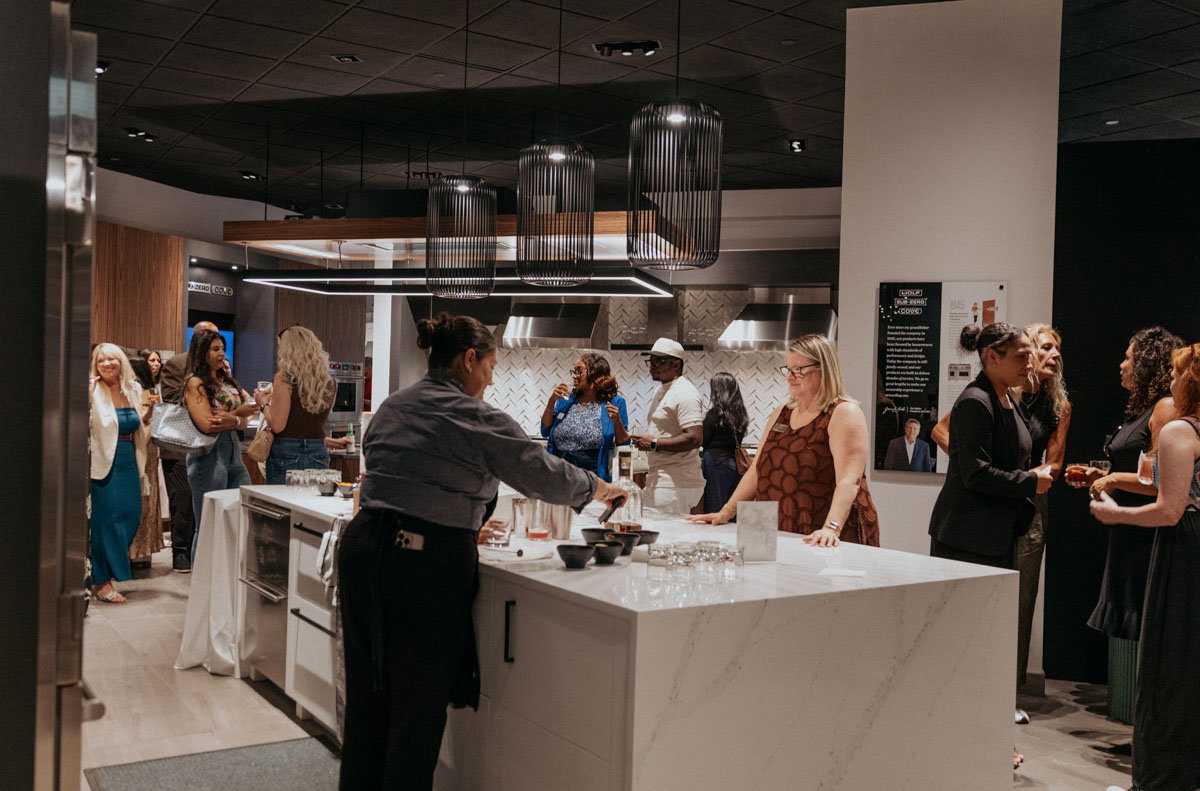
Attendees enjoyed delicious food during the event.
Photo courtesy of Le Content Agency
Sewell Appliance, a division of Construction Resources, recently held a grand re-opening in its Sandy Springs showroom to introduce the newly renovated Sub-Zero, Wolf, and Cove Living Kitchen. The Sewell showroom spans more than 12,000 square feet and features more than 40 top-tier brands. Sub-Zero, Wolf, and Cove are iconic names in the luxury appliance space, designed to bring commercial kitchen performance into the home.
According to Sub-Zero Group’s Director of Sales Operations Eric Stieber, the Living Kitchen represents one of the company’s most significant dealer showroom investments to date. “At more than 1,600 square feet, this is our second-largest dealer display,” he says, noting that the largest is located at Sewell’s parent company, CR Design Center I Westside. “We have longstanding relationships with both Sewell Appliance and Construction Resources, and the scale of this investment underscores those partnerships.”
Chef George preparing dishes in the Sub-Zero, Wolf, and Cove Living Kitchen at Sewell Appliance.
Photo courtesy of Le Content Agency
The Living Kitchen spans 1,600 square feet in size and features more than 85 products from the Sub-Zero, Wolf, and Cove portfolio.
Photo courtesy of Le Content Agency
Featuring more than 85 products from the Sub-Zero, Wolf, and Cove product line, the Living Kitchen enables Sewell customers to see exactly how the appliances look in luxury kitchen environments and make side-by-side comparisons. “The experience is both aspirational and practical,” says Sam Rose, vice president of initiatives and integration at Construction Resources. “Designers and homeowners appreciate being able to view the appliances in thoughtfully designed environments, and it helps the decision-making process when products can be seen and touched.”
Stieber agrees, noting that the Living Kitchen is meant to be an immersive experience. “Updated displays highlight current design trends while making it easy for shoppers to see our full portfolio,” which includes products ranging from dual-fuel ranges and convection ovens to state-of-the-art dishwashers and wine refrigerators. Equally important, the renovated space reflects the exceptional craftsmanship and performance that customers have come to expect from the Sub-Zero, Wolf, and Cove appliance brands, including smart technology and connected features that simplify everyday life.
Guests enjoyed close-up views of the Sub-Zero, Wolf, and Cove product line.
Photo courtesy of Le Content Agency
Guests enjoyed close-up views of the Sub-Zero, Wolf, and Cove product line.
Photo courtesy of Le Content Agency
Elegant and approachable
The timing was right to reimagine the Living Kitchen, says Rose, noting that it was last renovated in 2018. “We wanted the space to feel up-to-date and inspiring and reflect the same level of innovation found in the products displayed there.” The space was also designed with flexibility in mind to accommodate future product introductions and updates.
According to Stieber, the makeover was an easy decision. “Following the renovation of Sub-Zero, Wolf and Cove’s Atlanta showroom, it was only natural to update the Living Kitchen at Sewell,” he says. “It was an opportunity to elevate the branded space within one of our most valued retail partners.”
Designed by award-winning OPN Architects, the Living Kitchen is both elegant and approachable. Materials and finishes were selected from a number of high-end industry partners, including Bedrosians, Cosentino, Hudson Valley, Signature Hardware, TileBar, Transceramica, UMI, and Visual Comfort. Together, these elements create a luxury kitchen environment that not only highlights the appliances but also reflects how consumers want to live and entertain.
A toast to the newly renovated Living Kitchen at Sewell Appliance.
Photo courtesy of Le Content Agency
Beyond its curated kitchen settings, the Sewell showroom is known for its knowledgeable and highly trained team. “We offer guidance tailored to every project, whether it’s a high-end custom new build or a modest renovation,” Rose says. The result is a premium consultative experience that helps homeowners and trade professionals alike explore the possibilities for their projects and make more informed decisions.
That commitment to best-in-class service extends from product selection through white-glove installation. “We make sure that every project runs smoothly from beginning to end,” Rose concludes, noting that the store averages 4,000 installations per year. For trade partners in particular, the showroom serves as an extension of their own businesses. “Designers and builders can bring their clients here, and our beautiful and functional environment provides a streamlined and stress-free appliance selection experience.”
Sewell Appliance is located at 7455 Trowbridge Road in Sandy Springs. It is open Monday through Friday from 8:30 a.m. to 5:30 p.m. and Saturday from 10:30 a.m. to 3:30 p.m.
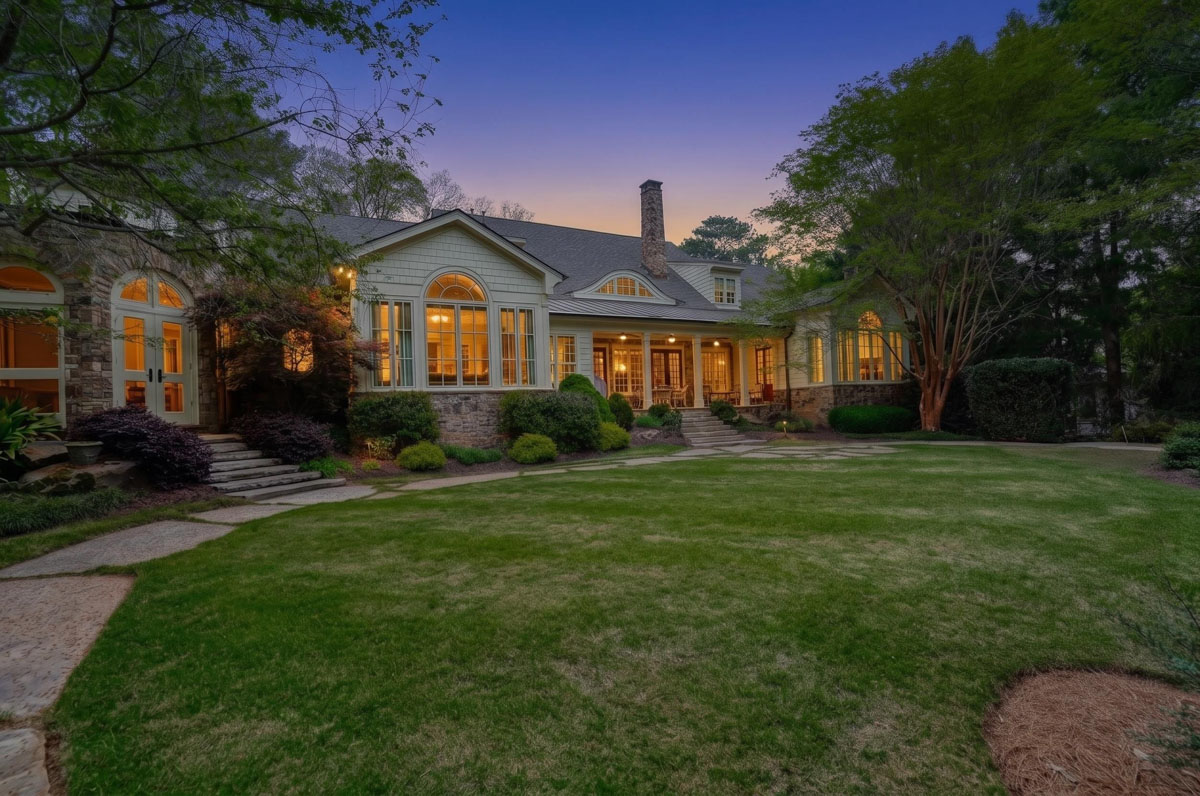
Actor Josh Brolin’s former family home in Sandy Springs at 5000 Long Island Drive NW is now up for sale.
Photo courtesy of Studio Housing Atlanta.
Not far from Chastain Park, a charming Sandy Springs estate at 5000 Long Island Drive NW, built in 2003, occupies 1.48 wooded acres. Gated and cloaked in trees so that the road disappears from view, the property offers roughly 10,000 square feet, with seven bedrooms, eight full baths and four half ones, spread between the main residence and an unexpected bonus: a detached two‑story guest house containing dual apartments.
Actor Josh Brolin and his wife, Kathryn, have owned the property since 2020. It’s now up for sale.
The master bedroom inside the former family home of actor Josh Brolin. The home in Sandy Springs has eight full baths and four half ones.
Photo courtesy of Studio Housing Atlanta.
As a Georgia native and UGA graduate, Kathryn’s family ties in Atlanta figured prominently into the couple’s decision to put down roots in her home state. The Brolins had genuine plans to make the property a forever home for themselves and their two children. Though work later pulled them west, for a time they returned for holidays and short stays.
With the long view initially in mind, they hired Los Angeles-based Pierce & Ward—an AD100 firm—to reimagine the home’s interiors. The design scheme layers patterned wallpapers, mineral-hued colors, contemporary art, and antiques throughout.
“I love the rich colors and maximalist touches,” says listing agent Jacob Bean of Studio Housing Atlanta.
The master bedroom inside Josh Brolin’s former family home features patterned wallpaper and interior design by Pierce & Ward.
Photo courtesy of Studio Housing Atlanta.
Despite its large size, the house doesn’t feel cavernous; discrete rooms provide intimacy without sacrificing openness. That variable scale is evident in the contrast between the front den, where the family enjoyed reading by the fireplace, and the vaulted, two-story living room.
The soaring main-floor primary suite pairs Pierce & Ward’s palette and a triangle-peaked upholstered headboard with a fireside lounge and two boutique-style closets.
Map wallpaper adorns the walls of a children’s play space inside Josh Brolin’s former family home in Sandy Springs.
Photo courtesy of Studio Housing Atlanta.
Upstairs, additional bedrooms join a children’s play space wrapped in map-printed wallpaper that inspires curiosity and encourages learning. The lower level also includes an in-law suite with a private exterior entrance, adding another option for multigenerational living.
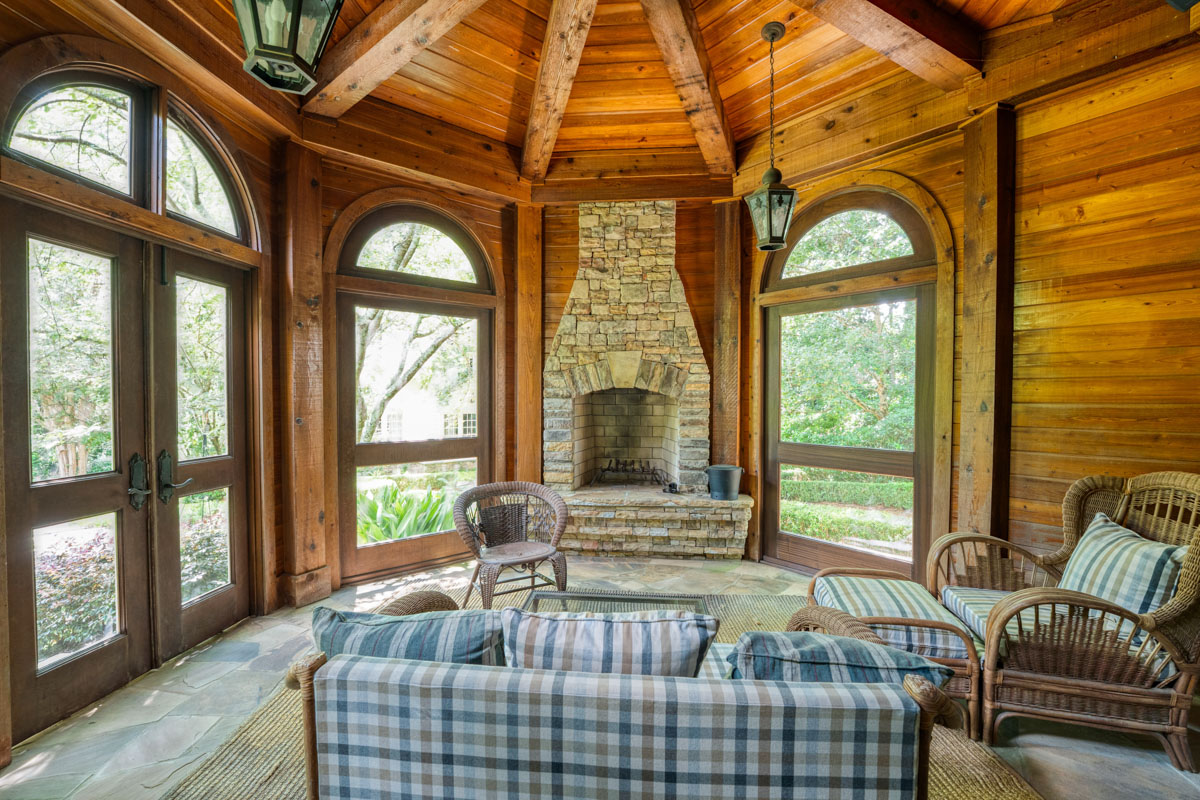
Ancillary spaces include a wood-paneled screened rotunda with a fireplace and grill, a gym with a sauna and cold plunge, and a terrace-level home cinema where Bean says the Brolins often gathered for movie nights. Outdoors, natural stones encircle a heated pool with two waterfalls and a hot tub giving way to a hidden park tucked behind bamboo.
A sun room in Josh Brolin’s former family home boast a stone fireplace.
Photo courtesy of Studio Housing Atlanta.
The guest house apartments offer flexibility for long-term visitors or on-site staff, with an adjoining pea-gravel motor court for extra parking or alfresco affairs.
The Brolins are open to selling most of the home’s furnishings—excluding certain artworks and sentimental pieces—allowing the next owner to preserve the coveted Pierce & Ward design.
This Sandy Springs estate is on the market for $4,750,000. For more information, contact Jacob Bean of Studio Housing Atlanta at 701-480-9698 or jacobcurtisbean@gmail.com.
An aerial view of the living room inside the former family home of Josh Brolin.
Adam Forrand, president and CEO of the Greater Perimeter Chamber of Commerce.
Photography by Ben Rollins
When metro Atlanta residents, commuters, and visitors cross the border into Sandy Springs, a special message, etched into the metal under the crisp blue-and-white “Welcome to Sandy Springs” sign, greets them. It reads: “Protected by SSPD,” referring to the Sandy Springs Police Department. “It’s a testament to the pride that the city, the residents, and businesses take in their police force,” says Adam Forrand, president and CEO of the Greater Perimeter Chamber of Commerce, which represents Sandy Springs and its neighbor, Dunwoody.
Experts often refer to the three-legged stool of economic development. Business development, the first leg, includes strategies and initiatives launched by chambers of commerce, industry associations, or governments to spur economic growth. Talent development, the second leg, ensures a skilled and trained workforce in the pipeline. For the third leg, community development, “the main categorical expectation is public safety,” says Forrand. “That’s the basis which allows us to attract and train talent and build businesses around it.”
Full Support in Sandy Springs
Sandy Springs, with a population of 109,000, sits about 16 miles north of downtown Atlanta and consistently ranks as one of the wealthiest cities in Georgia and the best places to live in the U.S. It is home to several global and Fortune 500 companies, including UPS, Newell Brands, Cox Communications, Mercedes-Benz USA, and Intercontinental Exchange, a financial services provider that operates the New York Stock Exchange. Many local businesses and start-ups have clustered around the large corporations.
Public safety was the number one argument—along with local control over zoning and taxes—when Sandy Springs seceded from Atlanta and incorporated in 2005. It became the blueprint for Georgia’s city hood movement, with communities such as Johns Creek, Milton, Dunwoody, Brookhaven, and Mableton following suit.
Snapshot of the City of
Sandy Springs
Incorporated: December 2005 Population: 109,000 Largest Medical Center Cluster in Georgia: Includes Northside Hospital, Emory Saint Joseph’s Hospital, and Children’s Healthcare of Atlanta Approximately: 38.5 square miles Professional and Business Support Jobs: More than 90,000 Police Department Employees: 204, including 153 full-time sworn officers Resident Participation Rate: 74%, 10 percentage points higher than state and national averages Calls for Service (2025): 98,048 Office, Retail, and Commercial Space: Over 60 million square feet Global Headquarters Located in Sandy Springs: UPS, Newell Brands, Cox Enterprises, and Mercedes-Benz USA Resident Business Growth: 23% increase over the past 10 years
For full stats and illustrations, read the Spring 2026 issue.
Today, Sandy Springs has a police force with 153 full- time sworn officers and a fire department with 125 first responders. Robust law enforcement remains a key factor for businesses to flock to the suburban city, says Forrand.
Metrics that businesses look for in a public safety agency—mainly police, but also fire and emergency medical services—include fast response times and high visibility. The community also expects its police force to conduct criminal investigations swiftly and effectively, ranging from violent and property offenses to white-collar and cybercrime, adds Forrand. This requires agencies to have strong working relationships with corporate security and state and federal law enforcement, like the Georgia Bureau of Investigation and the FBI.
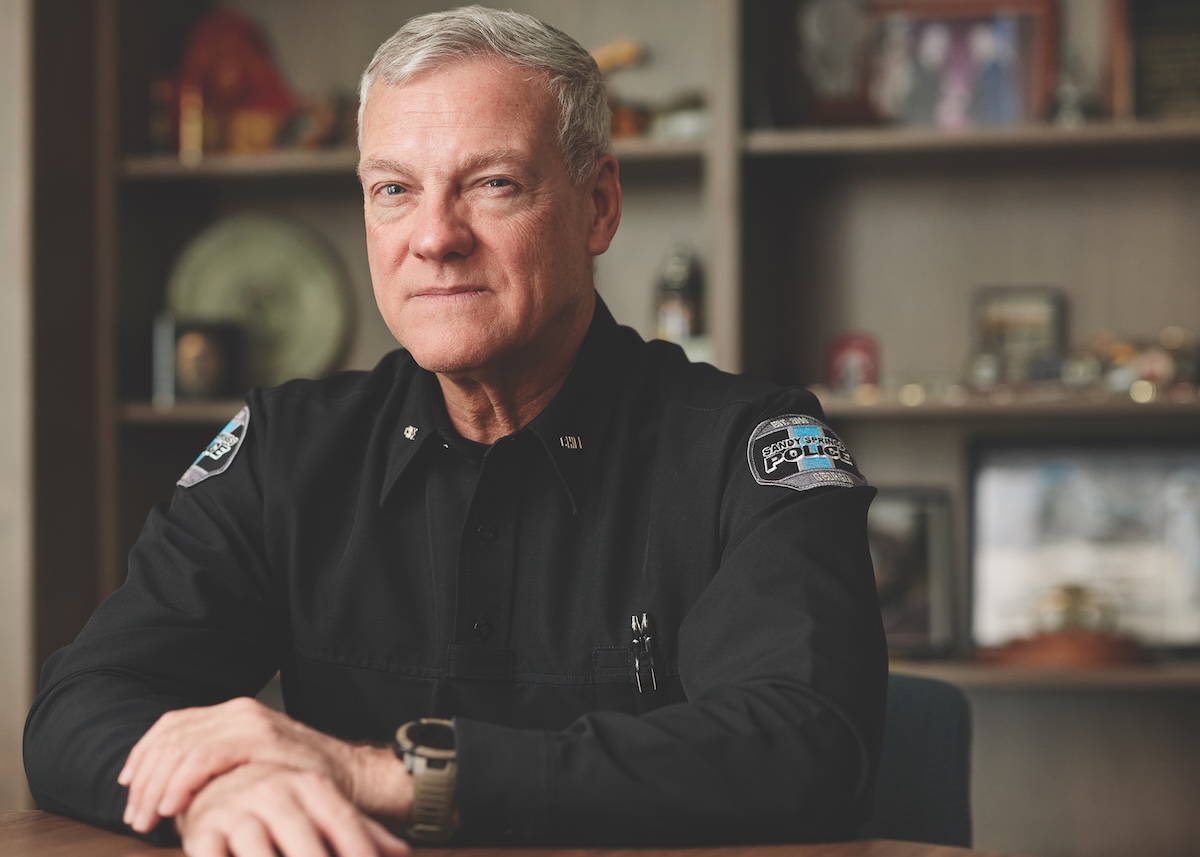
Sandy Springs police are well-equipped for these challenges, says Police Chief Kenneth DeSimone, a 37-year law enforcement veteran and retired U.S. Marine Corps colonel. “We provide good customer service,” he says as he sits in his bright third-floor office at the new police headquarters, a 130,000-square-foot state-of-the-art public safety hub that opened in 2025 and cost $56 million to build. The department has a SWAT team, a river patrol division, and a public order unit called Quick Response Force.
The city’s strong tax base has allowed the department to grow from 86 officers when it began operating in 2006. The force wasn’t immune to the recruitment and retention crisis that has rippled through agencies across the country since 2014. Back then, anti-police sentiments intensified after what was interpreted as an unwarranted shooting of Michael Brown by an officer in Ferguson, Missouri (later ruled by a grand jury and the U.S. Department of Justice as self-defense). The public anger surged again following the killing of George Floyd in Minneapolis in 2020, fueling the defund-the-police movement and taking a toll on officer morale.
Staff numbers shrunk in Sandy Springs as well, though not as drastically as in other jurisdictions, says DeSimone, who has been the police chief for 13 years. Now, the department is back to full strength, allowing officers to train above the minimum requirements.
“If you have barely enough officers to keep on the road, you’re jumping from 911 call to 911 call,” he says. “And you can’t spend time on extra training.”
Some police training in Sandy Springs is done in-house. There are firearms simulators and defensive tactics rooms in the new headquarters building. The department uses a simulation house in a nearby jurisdiction to practice skills such as close-quarters tactics and room clearing, and trains at live-fire ranges around North Georgia and at the new Atlanta Public Safety Training Center for vehicle pursuits.
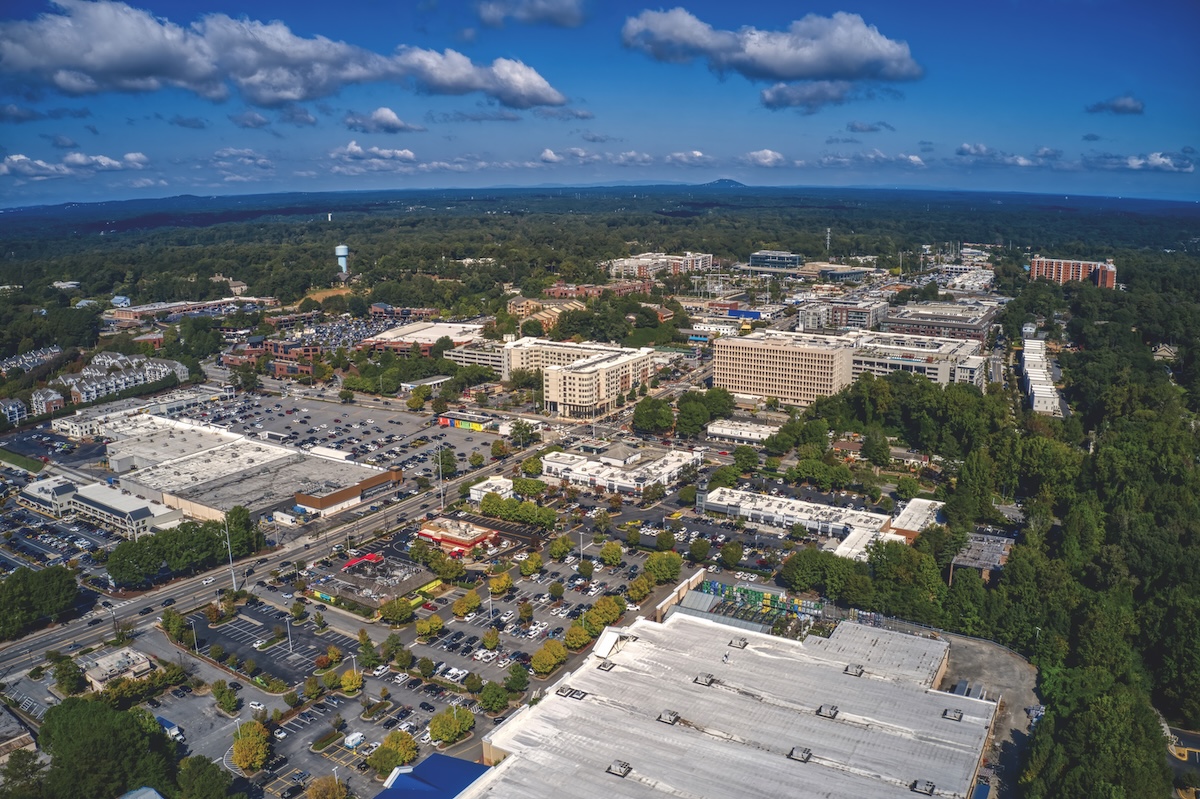
The Sandy Springs landscape is dotted with major corporations.
iStockphoto.com
Right On Target
Being fully staffed and well-funded also allows a police department to develop and nurture talent within its ranks, says DeSimone, which in turn boosts the force’s overall performance. “We can afford to find out what people’s strengths are and place them accordingly,” he adds, noting that some officers are great at undercover narcotics but don’t excel at traffic investigations, while others thrive as criminal intelligence detectives but wouldn’t be the best choice as patrol officers.
Another benefit for officers serving in a healthy business environment is the availability of off-duty jobs to supplement their income. Northside Hospital, for example, one of the largest employers in Sandy Springs, hires police officers for enhanced security.
Members of the department’s command staff regularly attend meetings and events organized by the Chamber of Commerce and other local business groups. DeSimone says he speaks with corporate leaders often, discussing “everything from cyber threats to workplace violence, from domestic terrorism to graffiti vandalism.”
Sandy Springs police also make sure the force remains highly visible to the community, whether that’s by its distinctly painted squad cars—black, with a bold blue stripe— patrolling the city, or by posting catchy social media videos of fast-paced pursuits and skillful vehicle interceptions (otherwise known as PIT maneuvers).
A Symbiotic Relationship
Crime, public safety, and economic development are deeply interconnected, says Sergio Gárate, professor of finance and director of the real estate program at Emory University’s Goizueta Business School in Atlanta. “Data clearly show that high crime depresses economic activity, resulting in lower tax collection.”
Strong public safety, on the other hand, fosters economic growth by attracting investment and consumers. A thriving business environment improves safety by creating opportunities and reducing poverty-driven crime, Gárate notes.
“But there’s a trade off,” he says. “Building a robust public safety landscape with a strong police force, with surveillance cameras and other technologies to deter crime, is not free, and the effectiveness of these policies isn’t always guaranteed.”
Public safety can serve as a powerful economic develop- ment tool, but strategies and formulas vary depending on an area’s geographic location, history, and social makeup.
Taking Care of Business in Troup County
In Troup County, ties between public safety and business are equally strong, yet the journey has been different. With a population of around 70,000, the county, spanning 446 square miles, is home to police departments in LaGrange, West Point, and Hogansville, as well as the sheriff’s office. There’s also a Georgia State Patrol post. Lieutenant Stewart Smith started as a frontline deputy with the Troup County Sheriff’s Office 28 years ago. “I’m a local boy. I’ve seen the area go through ups and downs,” he says. “And I’ve seen the industry landscape grow and change—and our public safety footprint change with it.”
Starting with cotton mills in the late 19th century, textile manufacturing was a major part of the economy until about 30 years ago, when the textile industry moved o shore for cheaper labor. The county has transitioned into other sectors, notably automotive part suppliers that support the Kia Motors plant in West Point and the Hyundai plant in nearby Montgomery, Alabama. Battery giant Duracell operates a large manufacturing facility in LaGrange. There are plans to build an Amazon sorting facility and a Google data center in Troup County. Tourism is also growing, mostly around Great Wolf Lodge, an indoor water park resort.
The main reasons businesses are drawn to Troup County—located in the so-called “Growth Corridor of the South” along I-85—include strong connectivity, industrial infrastructure, a skilled workforce, tax incentives, and an affordable cost of living. But safety remains the baseline, says Connie Hensler, president and CEO of the LaGrange– Troup County Chamber of Commerce, the region’s leading business network with about 750 members.
Sandy Springs Police Chief Kenneth DeSimone.
Photography by Ben Rollins
“People want to live in an area that’s safe,” Hensler says. “That includes companies’ employees and their families.” Businesses of all sizes also want their property and assets to be secure, she adds. Low crime is a key argument for companies when making a location decision and factored into the cost of doing business, a calculation that includes real estate prices, insurance premiums, and salaries, says Emory’s Gárate.
Law enforcement agencies must deliver on this expectation, says Smith, who serves as public information officer for the Troup County Sheri ’s Office. The agency has 150 sworn deputies and detention officers who regularly interact with the broader community.
The mission includes patrolling the county, responding to 911 calls, and conducting criminal investigations. They also proactively provide safety services to citizens.
For example, Smith and his colleagues offer active shooter, self-defense, and first aid classes to local businesses, churches, and schools. They also provide safety and security assessments for business owners. And they work with security teams at companies like Kia to keep up to date on their safety and emergency management plans, so, in case of an incident, the public safety response is fast.
Going above and beyond is part of the department’s public safety playbook. “We check on our local businesses at night, making sure the locations are secure,” says Smith.
All About Access
Being present, visible, and accessible is key to the relationship between public safety and the business community. The LaGrange Police Department, with 100 sworn staff, has a dedicated community outreach officer who serves as a liaison between law enforcement and local business owners. The officer patrols the downtown business district, attends meetings hosted by the city’s economic development agency and the Chamber of Commerce, and provides regular updates on crime, potential threats, and calls for service.
“That’s hugely important, especially for smaller businesses that don’t have their own private security to handle safety issues,” Hensler says.
Public safety is also the theme of the Chamber’s annual Valor Awards. Each year, Troup County’s business community honors the area’s public safety professionals and first responders for their outstanding bravery, dedication, and teamwork during critical incidents and crises.
Troup County at a Glance
Population: 70,000 Largest Industry: Automotive and automotive supply manufacturing Approximately: 446 square miles Manufacturing Facilities: More than 120, up from 105 in 2014 Troup County Sheriff’s Office: 170 employees, including 150 sworn staff Regional Manufacturing Employment: 36.8%, compared to the national average of 7.8% Calls for Service (2025): 27,048 LaGrange Police Department: 100 sworn staff First Troup County Sheriff Took Office: 1827 Hogansville Police Department: 25 sworn staff Manufacturing GDP Growth: 4.4% annual increase over the last 10 years, compared to a national increase of 3.9% West Point Police Department: 16 sworn staff
Besides the recognition, public safety agencies in Troup County reap tangible benefits from the growing business community, says Smith—just as they do in Sandy Springs.
After taking a hit during the 2020 recruitment crisis, staff levels at the sheriff’s office are back to over 80 percent. In January, the county government approved additional deputy positions, and the starting pay was bumped up by 5 percent.
“These are small steps, but they help ensure that we can stay competitive, that we can attract and retain good employees,” says Smith.
The area’s broad and diverse industry base also helps officers secure long-term contracts for off-duty work, he adds, whether that’s providing on-site security at one of the manufacturing plants and warehouses or helping with work-zone safety during road construction.
Troup County is set for growth, but Lieutenant Smith remembers more difficult times. His advice to colleagues working for public safety agencies in less thriving areas is to stay the course and deliver on the core mission to respond to 911 calls, fight crime, and provide safety for the community.
But also, he says, “Don’t just stay in your shell. Get out, shake hands, and get to know the business owners in your area, one at a time.”