

Home 2015

Archives

Fresh on the Scene: Marcel, Good Luck Gourmet, Doggy Dogg, Gogi House

The bar at Marcel
The bar at Marcel

Photograph by Caroline C. Kilgore

The porterhouse at Marcel
The côte de boeuf at Marcel

Photograph by Caroline C. Kilgore

Marcel
The latest addition to Ford Fry’s stable is this retro, Francophile steakhouse—built in a record three months—in the former Abattoir space in the White Provisions Building. With ambitions to create the city’s most luxurious (and most expensive) steakhouse, Fry gave the dining room a glamorous makeover, with heavy curtains, gold and brass accessories, and big, curvy leather banquettes. The luxury ends there. Cuts like the lean, bone-in filet monsieur and the New York strip (all from one of Chicago’s best meat purveyors, Meats by Linz) suffer from the bitter aftertaste of burnt thyme. The best value on the menu is a thinly sliced entrecôte buried in a delicious sauce verte and served with fries ($29.95). It doesn’t feel like a classic, but it’s a better deal than the unjustly small and pricey seafood platter ($88.95). A majority of the sides and desserts—often the most reliable pillar of a steakhouse—are creative but need serious reworking. For now, stick to the cheesy potatoes aligot, a sharp Bibb lettuce salad with a mustard vinaigrette, and a decadent chocolate cake that’s a cross between a soufflé and a molten lava cake. 1170 Howell Mill Road, 404-665-4555 

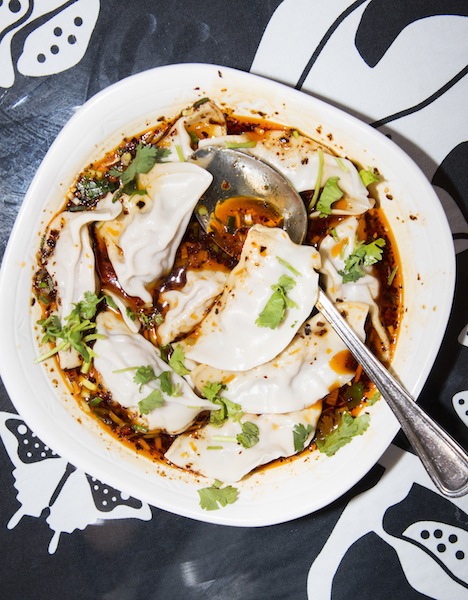
Dumplings at Good Luck Gourmet
Chengdu-style dumplings in red chili oil from Good Luck Gourmet

Photograph by Caroline C. Kilgore

Good Luck Gourmet
Almost as suddenly as Gu’s Bistro on Buford Highway closed, a new family-run restaurant has taken its place. Good Luck Gourmet showcases the meat-heavy cuisine of Xi’an in China’s Shaanxi province, which has remained largely undiscovered among diners. It’s the only place in Atlanta to find dishes like hearty steamed lamb soup with glass noodles and Xi’an bread (basically flatbread), juicy minced pork “hamburger” seasoned with hot chile peppers, red-cooked beef stewed in soy sauce and spices, and housemade tofu in a sumptuous gravy. You’ll spot a few spicy Sichuan touches on the menu—Xi’an is a mere nine-hour drive to Chengdu, just a hop and a skip by China’s standards—including some fine-tuned dumplings in chili oil. Yet Xi’an has its own beautiful version of cold noodles in a brick-red chile sauce, as well as dry hot pots flavored with garlic, ginger, onion, and numbing Sichuan pepper. The restaurant doesn’t serve alcohol, and English isn’t the staff’s forte, but don’t let that keep you from a great meal. 5750 Buford Highway, Doraville, 770-451-8118

Hot dogs from Doggy Dogg

Photograph by Caroline C. Kilgore

Doggy Dogg
Looks like James Hammerl’s wildly popular food cart hot dogs have finally found a permanent home. At the tiny brick-and-mortar location—with a cheerful pocket-sized patio—in the old Las Brasas space off East Howard Avenue, Hammerl sources his buns from Ratio Bakeshop; juicy, all-natural sausages from the Spotted Trotter in Kirkwood; and condiments like kimchi and sauerkraut from other local purveyors. Top dogs, all of which are seared on a flattop, include the El Perro (chorizo with onion, jalapeños, cilantro pesto, and hot sauce) and the Götze (a Bavarian brat with pork belly bits). You’ll also find Mexican Coke, local beers, and late-night weekend hours—smart touches for a place that charges $6 to $8 for a frank. 310 East Howard Avenue, Decatur 

Gogi House
The air is thick with smoke at this Korean barbecue newcomer, located in the vast parking lot of a Duluth shopping complex. “Gogi” is Korean for “meat,” and tables are equipped with live-charcoal pits topped with grills that change depending on whether you’re cooking marinated meat. The banchan (side dishes), including a rare raw crab in hot pepper paste, enhance the experience, as do delightful rice cakes and matsutake mushrooms. The staff does the majority of the cooking, leaving customers to wrap tender morsels of short ribs, steak, and pork belly in perilla leaves, lettuce, and sliced sweet radishes. In addition to the meat combos, the menu also offers many traditional Korean dishes, from soups to pancakes. 3490 Gwinnett Place Drive, 678-417-6898

Is SweetWater Brewing Company headed to Wall Street?

0

Few people are more constitutionally suited to the good life than Freddy Bensch, a co-founder and chairman of SweetWater. When he’s not coming to work in shorts and sandals, Bensch famously enjoys fly fishing in Montana. His business card identifies him as the company’s “Big Kahuna.” But life could soon be getting even better for Bensch.

Late last week, Reuters reported the 18-year-old Atlanta institution is preparing for a possible initial public offering that could value the company in the hundreds of millions of dollars. That’s a lot of fly rods. SweetWater’s spokesperson declined comment on the media report, which was based on unnamed sources. If it goes down, the Midtown company would be only the third craft brewery—behind Boston Beer Company, the company that owns Samuel Adams, and Craft Brew Alliance, brewers of Redhook Ale—to be publicly traded on a major stock exchange.

Founded by Bensch and Kevin McNerney in 1997, Sweetwater has grown from a local industry pioneer, best known for its pleasingly hoppy beers and independent branding, to a regional powerhouse that helped pave the way for Georgia’s craft beer boom. SweetWater’s potential IPO would follow the brewery’s decision to sell off a minority share to private-equity firm TSG Consumer Partners in late 2014.

“It shouldn’t really surprise anyone that they are going public,” Crawford Moran, who founded the late lamented Dogwood Brewing and now is owner of Slice & Pint near Emory, told us. “That’s how [private equity] firms make their money. It’s funny how many CEOs there are in the craft brewing world now. I don’t ever remember meeting one in the craft brewing world until a few years ago!”

SweetWater recently named a new CEO, having promoted Kim Jones from chief financial officer to the head of the brewery. Bill Waters, a veteran exec who’s worked for Coors Brewing Company and Molson Coors Brewing Company, filled Jones’ former post. Both moves follow a major expansion of its production facilities three years ago.

SweetWater’s potential IPO, which could happen as early as later this year according to Reuters, would come amid a national craft beer market boom. According to the Brewers Association, U.S. craft beer sales soared 22 percent in 2014, becoming a $19.6 billion industry that makes up 11 percent of the industry’s total market share. SweetWater paced slightly ahead of that trend, producing 192,500 barrels—increasing its sales by 24 percent—over the same period.

Though SweetWater has continued to find success, Georgia ranks 47th in breweries per capita. During the 2015 legislative session, lawmakers tweaked the state’s beer laws to allow people to pay for tours that may come with up to 72 ounces of “souvenir” beer. But craft brewers still remained hampered by the inability to directly sell six packs to customers due to the state’s antiquated distribution laws.

State Rep. Brett Harrell, R-Snellville, one of the officials working to change Georgia’s craft beer laws, told us he does “not foresee any impact on state legislation” should SweetWater become beholden to stockholders. However, the brewery’s IPO would further speak volumes to an industry bursting at the seams with its potential for growth, yet still limited in its ability to tap into that potential.

On one hand, SweetWater’s potential IPO makes complete sense given that the company, whose very raison d’etre was all about making the public feel better through its carefully calibrated brews, would now offer the public a chance to own a small share. Yet how will it change the company’s ethos, one boosting the noted tagline, “Don’t float the mainstream?” Bensch may be required to trade in some of his fly rods for financial statements—and leave the Birkenstocks outside the boardroom.

Additional reporting by Osayi Endolyn

Herban Fix Vegan Kitchen will revive the old Dogwood Space on Peachtree next month

Seared pom pom mushroom steak with assorted vegetables

The stand-alone building at 565 Peachtree Street, formerly the home of Dogwood Restaurant until it closed in 2011, is finally getting a new tenant. Chef Wendy Chang (formerly of Eurasia and Tamarind) will open Herban Fix Vegan Kitchen, serving plant-based, organic, and locally sourced fare come mid-August.

“Our hope is to bring a business to Atlanta that can also contribute positively to our delicate ecosystem; we sincerely believe that something that is good for our health, good for the planet, and beneficial to the animals can also be great for business,” says Steven Won, who is consulting on the restaurant.

The Asian-inspired restaurant will serve lunch, dinner, and eventually brunch, with items like seared pom pom mushroom steak with vegetables; garden wrap with water chestnuts, shiitake, celery, carrots, and tofu; and soy beef noodle stew with Asian greens. There will also be sweet pea ravioli in curry jus with leeks and mushrooms, and Asian glutinous rice fused with shiitake mushroom and taro.

Annie Lin, also of Eurasia, will lead the “bar program,” offering tonics made from organic fruits and vegetables, plus juices and smoothies. The only alcohol offered will be wine.

The Herban Fix team is keeping a lot of Dogwood’s simple, modern look and feel, “adding in touches of earth elements where farm-to-table meets modern,” Won says.

As for the name, it’s a combination of “herbivore” and “urban.” “It perfectly expresses our desire to satisfy the urban community’s craving for delicious plant-based cuisine,” Won says.

Joseph & Co. to offer food-to-go plus packaged gourmet goods in Glenwood Park

Chef Joseph Marini
Chef Joseph Marini

Courtesy of Joanne Torres

Residents of Glenwood Park are getting their own food boutique store in October. Joseph & Co. will offer “provisions for the home” at 925 Garrett Street near Gunshow. Founded by longtime New England chef and caterer Joseph Marini, Joseph & Co. will reflect his classical French training and seek to “re-inspire people to home economics,” he says.

Marini will serve Octane Coffee, lattes, and espresso, alongside homemade scones (date ginger and white chocolate pistachio), cookies, and cakes (spiced pear pistachio with ginger buttercream frosting). For lunch, there will be seasonal deep-dish quiche, chicken salad, and egg salad. Dinners will be portioned for two or four and focus on Italian or French cuisine (think lasagna or eggplant parmesan). All items will be served in natural balsa wood containers.

The gourmet packaged section of the store will focus on local or regional goods such as jams from Preserving Place, meats from Spotted Trotter, and cheese from Many Fold Farm, in addition to artisanal risottos and whole grain dark rice.

Marini says he wants to help people create an “artful kitchen” for both entertaining and everyday dining. So in addition to food, Joseph & Co. will sell quality utensils, platters, cutting boards, and linens, as well as select organic cleaning, garden and floral products. “That’s all part of creating a beautiful table,” Marini says. Cooking and entertaining classes like floral arranging and herb growing, and cookbook singings are also in the works. The 1,200 square foot space will have a modern European look with a rustic touch. The color scheme will be clean and muted using white, gray, and black.

Hugh Acheson’s new cookbook The Broad Fork is vegetable-driven

0
The Broad Fork
Photograph by Rinne Allen

Call it the bacon backlash or the cauliflower comeback, but after years of nose-to-tail, lardcore cooking, vegetables are finally getting their moment in the sun. Miller Union’s Steven Satterfield kicked off spring with Root to Leaf, a cookbook dedicated only to fruits, vegetables, and nuts. Now Empire State South’s Hugh Acheson has also entered the garden game with The Broad Fork, a vegetable-driven cookbook that, like Satterfield’s, is organized by season. “Many think the perfect Southern meal is a bucket of fast-food fried chicken, but to me, it is a spread of fried thighs with succotash, tomato salad, rice purloo, squash casserole, dressed dandelion greens, crisped okra, and baked grits,” he writes in his introduction. As much as it’s a solid index of engaging recipes, The Broad Fork is also a guided tour through Acheson’s thinking: Tips for poaching eggs and making chicken stock are broken up with stories about his early days in the kitchen, how he feeds his kids, and nonprofits working to end extreme poverty. His opinions, his approach, and his history are tightly bound together in this personal work, which is well suited to any kitchen.

Lobster with peas and seared fingerling potatoes 

Ingredients
Kosher salt
1 pound fresh English peas, shelled
1 pound fingerling potatoes
2 tablespoons canola oil
1 cup chicken stock
2 tablespoons unsalted butter
Juice of 1 lemon
2 1 1/2-pound lobsters, cooked, shelled, and chopped
1 tablespoon chopped fresh chives

1. Prepare an ice water bath and set it near the stove. In a medium stockpot, bring 4 quarts of water to a boil and season it well with kosher salt. Blanch the peas in the boiling water for 2 minutes, or until they are tender and bright green. Immediately drain the peas and shock them in the ice water. Allow them to chill. Then remove them from the ice water and place them on a plate lined with paper towels.

2. Place the fingerling potatoes in a small pot, and add cold water to cover and enough kosher salt so you can taste it. Place the pot over high heat and bring to a boil. Reduce the heat and slowly simmer the potatoes for 5 minutes, or until they are fork-tender. Drain the potatoes and cool them in the refrigerator. Once they are cool, dry them well and cut them into bite-size pieces.

3. In a large sauté pan, heat the canola oil over high heat. Once the oil comes to a slight smoke, add the potatoes and turn the heat down to medium. Crisp the potatoes until they are golden brown, about 5 minutes, and season them with a few pinches of kosher salt. Take the potatoes out of the pan and set them aside.

4. Pour the chicken stock into the same pan, add the butter, and reduce over high heat until the mixture starts to thicken, about 2 minutes. Add the lemon juice, peas, lobster, and potatoes, and warm through. Adjust the seasoning with kosher salt, and arrange on a platter. Garnish the dish with the chives.

Serves 4

A version of this article originally appeared in our July 2015 issue.

How the new Beer Jobs Bill is impacting local breweries

0

7715VorelBeerGeorgia’s new beer laws (“The Beer Jobs Bill,” SB 63) went into effect at the beginning of the month, bringing us one step closer toward the simple business rights enjoyed by breweries in nearly every other state of the union. We’re not all the way there—not even close—but the bill was the hopeful beginning of an ongoing period of reform that will create a more advantageous (and sensible) business climate for small brewers in Georgia. But ask yourself this: Do you really know how the law is impacting your favorite local brewer?

Redefining the Tour
The most obvious and best-publicized result of the new law is that breweries can now sell beer on site to be taken home—or more accurately, they still can’t “sell you beer,” but they can “sell you a brewery tour” that happens to come with some beer to take home with you. That beer can be in an array of new packages: regular old bottles, glass growlers, and even the popular new 32 oz. “Crowler” can.

This notion of “selling a tour” is actually different from the previous law, which said that breweries were selling you “a commemorative glass” every time you visited, which just so happened to come with a free tour and free beer samples. That the tour is now technically the product being offered at breweries means you’ll no longer be given glassware to take home every time, which in turn means that many of the breweries will be investing in better, permanent glassware for consumers to use. It also means that the concept and definition of a “tour” has been stretching to the boundaries of logic as a way of streamlining the system. In fact, several breweries such as Wild Heaven Craft Beers and Monday Night Brewing are eliminating the traditional guided tour in favor of simple signs or posters that constitute a “self-guided tour.” In order to buy beer to take home, then, all the consumer technically needs to do is glance at one of those posters to fulfill the requirement that a tour has happened.

Does it make any sense? No way. But it serves its purpose in the eyes of brewery owners such as Brian Purcell, CEO and founder of Three Taverns in Decatur, and helps make visits more satisfying, giving many of the breweries an incentive to be open to the public on additional days.

“We’ve increased our hours, which we hope will make the experience of visiting better because there won’t be as many people packed in at one time and they’re able to sit down, relax, and enjoy the space more,” Purcell said. “It’s more like the brewery experience I enjoy, which you previously had to go to other states to find. Standing in line the whole time to get your beer samples isn’t the experience we want to offer.” 

New opportunities for limited-releases
Breweries can also use this system to release special, limited, and otherwise non-distributed beer directly to the consumer. If you want to try Wild Heaven’s new sour, Swan Swan Hummingbird, for instance, you’ll have to visit the brewery and fill up a Crowler. In this way, the breweries can send customers home with experimental or limited beers that are never even intended for an official bottling.

“There are a lot of benefits in the new law, and plenty of awkwardness in it as well,” says Wild Heaven founder Nick Purdy. “The fact that they can take limited releases in Crowlers is exactly the kind of thing that gets craft beer drinkers excited and wanting to visit. We’ll always try to have a few going that are special, that you can only get by visiting the brewery.”

The provenance of those Crowler cans, by the way, is probably closer than you realize. Just down the interstate in Athens, Dixie Canner has been in business since 1895, and the countertop Crowler seamers available at breweries like Blue Tarp, Jekyll and Wild Heaven are their proprietary design. The cans themselves come from the monolithic Ball Corp., which sells to Dixie in bulk. The Athens company then sells much smaller palettes of cans along with the seamers to individual breweries. Before July 1, Dixie Canner did little business in Georgia, but the passage of the law has finally opened their home state as a ripe new opportunity.

“It’s a convenient, attractive, exciting package for the consumers,” says Parish Stapleton, the owner of Dixie Canner. “I feel like over the next several months you’ll see them popping up in a lot of new breweries. It’s a step closer to fair play for the breweries as well. I’ve never understood what the difference is between a brewery and a winery where you can drink on site and take away as much wine as you want. Shouldn’t it be the same with breweries?”

Other Atlanta-area breweries will use the conditions of the law to host new types of events in their facilities that were previously impossible. SweetWater in particular sees this as an opportunity to start regularly hosting “bottle release events” in conjunction with new releases, something that makes perfect sense, given that they just launched a new line of 750 ml cork-and-caged bottles. The letter of the new law will allow consumers to visit the brewery, do the obligated special “tour,” and then leave with limited edition bottles, all without having to hunt for them at a liquor store.

“It’s fun to introduce folks to incredibly special brews like those in the Cork & Cage series with a full sensory experience at the brewery,” says SweetWater “minister of propaganda” Steve Farace. “When we released the first brew from our series, The Pit & The Pendulum, tour-goers got to meet the farmer who supplied the peaches, they sampled the brew by the tank where it fermented while the brewer explained the production process, and we had the individual ingredients in that brew out on a table to touch and smell. We would’ve done the same thing pre-July 1, but folks being able to take home a bottle really rounds out the experience.”

Food trucks on deck
It’s not just the breweries or brewing industry suppliers who benefit. Atlanta’s food truck community has received a direct boon in the law passage, as they are now allowed to partner with breweries directly, parking their trucks on or near the brewery grounds. It’s an obvious partnership, given that the breweries aren’t allowed to sell food to the public from the same facility where they make beer for distribution.

“The craft beer scene is growing immensely in Atlanta and we’ve already made connections with Eventide, Orpheus, Wild Heaven and maybe even SweetWater,” says Jeff Latham, owner of the Tex’s Tacos truck, which has served Atlanta for four years. “They just work together so well in terms of atmosphere and clientele. It’s not high-class fine dining, but at the breweries you find people who still care about good chefs putting out good food directly to the streets. They go hand-in-hand, it’s a win-win.”

Even the beer retailers see potential benefits to be had as a result of the new law. Despite potentially meaning fewer sales of local beer if it can be sold at the brewery, Ale Yeah! owner Eddie Holley says the rising tide truly does lift all ships.

“A lot of people in this industry think it’s going to affect the retailers from a negative standpoint, but I don’t think so,” he says. “We will definitely sell less of some of the local breweries, but it will foster more growth as well because you’ll have new breweries popping up in cities like Newnan, Jonesboro, or Alpharetta, where it might not have been possible to run a brewery without direct sales. So to me, it’s an overall positive.”

Eli Kirshtein on the weirdest thing about being on Top Chef: Las Vegas

0
Photograph by Austen Risolvato

13 Questions is a weekly series where we ask chefs 13 questions to get to know them outside of the kitchen. Eli Kirshtein is the executive chef and partner at the Luminary in Krog Street Market.

What was the most important thing you learned working under Kevin Rathbun at Buckhead Diner?
I was, like, 16 years old. I was the fry guy. Kevin was the first guy who taught me how to hold a knife. I was in high school, and I showed up there never having been in a kitchen. Kevin taught me a lot of basic stuff: how to salt stuff, how to wipe down a station.

What was the weirdest thing about being on Top Chef: Las Vegas?
The isolation is the weirdest part. You’re just so disconnected from reality. You don’t have newspapers or TV. Any books you had had to be prescreened by producers. You’re totally isolated because they don’t want you getting recipes or food ideas.

When you aren’t in the kitchen, how do you spend your free time?
I’m on my bike, I’m hanging out with my wife, or watching CNN. I would love to meet Wolf Blitzer; he’s iconic.

What’s your favorite junk food?
I’m a really big fan of Flamin’ Hot Cheetos.

Your wife, Andrea, is a pastry chef. Do you two have any disagreements about cooking or ingredients?
It’s usually very collaborative: She does most of the shopping, and then we cook together. But she always overcooks. I’ll do a salad and a steak, then she’ll add two more sides, and I’ll tell her that’s too much food

What’s the last TV show you binge watched?
We somehow got into The Whispers on ABC, which is just ridiculous because it’s not good and nothing happens. We’re also watching True Detective, the new season.

What’s one thing you wish you knew how to cook?
I really wish I could cook bun bo hue, which is a spicy central Vietnamese soup. It’s not as easy it seems.

I know you’re a big Outkast fan. What’s the best concert you’ve ever been to?
I’ve been to a lot of shows. My very first concert, I was 10 years old. It was 1994; I saw Pink Floyd play at Bobby Dodd, and I fell asleep to “Comfortably Numb.” And I saw Paul McCartney at Piedmont Park, and that was just insane . . . He played “Blackbird,”  and on the first note it started to rain, and I thought, Paul McCartney controls the weather.

What would you be if you weren’t a chef?
NFL scouting and trying to be a general manager of an NFL team.

You tweet about the Hawks and Falcons a lot. What’s your favorite thing about being an Atlanta sports fan?
Whenever Atlanta teams start winning, it’s the most amazing thing that happens culturally anywhere. It’s incredible to me the amount of excitement and energy. The Hawks and Falcons help bring us all together.

The Luminary is in Krog Street Market right off the Atlanta BeltLine. What’s your BeltLine pet peeve?
People who come park at Krog Street Market to go on to the BeltLine. And those four-people-wide groups walking on the BeltLine—I ride my bike up and down the BeltLine, and you have to come to a complete stop.

You grew up in Garden Hills. What do you feel like the city’s missing?
Open water. If we had a proper massive lake, not like Lanier, no one would ever talk about Atlanta as not being awesome, but then it would probably be as expensive as New York or Chicago. Also, I wish we had a hockey team in Atlanta. Once you have baseball, football, basketball, soccer, and hockey, no one can say you aren’t the real deal.

What’s the best secret of your neighborhood, the Old Fourth Ward?
How close I live to Dr. King’s grave. I ride my bike by it pretty much once a day. It’s incredible that we aren’t having to go out to Arlington National Cemetery to see this.


Snapshot: Meet the breadmaster of Star Provisions

0

150713_LTW_SNAPSHOT_STARPROVISIONS_01

6:11 a.m. at Star Provisions

Dorothy Copenhaver walks into the underground kitchen at Star Provisions every morning at 4 a.m. to prepare bread for Anne Quatrano and Clifford Harrison’s numerous restaurants. With the help of two assistants, Copenhaver is responsible for 420 or so baguettes, sourdough loaves, sandwich rolls, pastries, and biscuits sold upstairs at the bakery at Star Provisions and Bacchanalia, as well as at Little Bacch and Floataway Café. “It actually gets increasingly crazy as the week goes on. The closer we get to the weekend, the more we have to make in order to prepare for the Freedom Farmers Market on Saturday and just the weekend rush in general,” says Copenhaver.

Hugh Acheson’s sauteed catfish with cantaloupe, lime, and cilantro salsa

SUMMER_melon_cantaloupe_lime_catfish-5226
sauteed catfish with cantaloupe, lime, and cilantro salsa

Photograph by Rinne Allen

Here’s a great idea for what you could do with that half-cantaloupe lurking in your fridge: finely chop the flesh and mix it in a salsa, as Empire State South’s Hugh Acheson suggests in his beautiful new cookbook, “The Broad Fork: Recipes for the Wide World of Vegetables and Fruit” (Clarkson Potter). The melon’s musky, floral notes—balanced with citrus and spice—perk up crispy sauteed catfish fillets in minutes without overpowering the delicacy of the flesh. Unable to find a red Fresno chile pepper, I substituted thinly sliced hot long green pepper instead. Jalapeno would work as well. A little sweet red pepper mixed in for color wouldn’t hurt a bit.

Ingredients

1/2 cup finely minced cantaloupe
1 fresh red Fresno chile, thinly sliced on the bias (or jalapeno, Serrano, hot long pepper, or other moderately hot chile)
1/2 cup minced fresh cilantro leaves
3 tablespoons olive oil
1 tablespoon freshly squeezed lime juice
Kosher salt
4 catfish fillets (5 to 6 ounces each), trimmed of any connective tissue
3 tablespoons all-purpose flour
1 tablespoon unsalted butter
4 sprigs cilantro

Instructions

Place the cantaloupe, chile, cilantro, 1 tablespoon of the olive oil, the lime juice, and kosher salt to taste in a small bowl. Mix well and set aside.

Pat the catfish dry with paper towels and season all over with kosher salt. Dredge the catfish fillets in the flour, shaking off any excess. Place a large skillet over medium-high heat, and add remaining 2 tablespoons olive oil. When the oil is shimmery-hot, place the catfish in the pan and cook for 5 minutes on one side. Then add the butter, let it foam, and baste the fillets with it, using a spoon.

Turn the fillets over and continue cooking the catfish until just done, about 3 minutes, depending on how thick the fillets are. Catfish should be cooked through but still be very moist.

Transfer the fish to individual plates, and top them with the cantaloupe salsa. Garnish with the cilantro sprigs, and serve.

Makes 4 servings

Ford Fry reduces steak prices at Marcel

0

marcel_logo_boxerLast week we blogged about the cost of steaks at Marcel, Ford Fry’s newest restaurant on the Westside. It’s a fact of fine dining that steakhouses will run you a pretty Benjamin, but after comparing Marcel’s steaks with other competitors, it was clear that Fry had entered a new price stratosphere. His 30-oz. porterhouse, for example, was tagged at $142—a whopping $44 more than the one at Bone’s.

I saw Fry over the weekend at the Attack of the Killer Tomato Festival, where he acknowledged that we were right to call him out on his steaks, particularly the porterhouse. He has since reduced prices on two cuts. The 16-oz. New York strip is now $67.95, down from $72.95, and the 30-oz. Porterhouse is now $124.95, down from $142. They’re still the most expensive around, but at least now Marcel’s New York strip is within arms reach of its closest competitor, Kevin Rathbun Steak ($62).

Over the phone Fry said that he was able to shave off a few dollars because the price of beef for those cuts had gone down. “There are times when beef prices fluctuate, and we did our first order around July 4. I didn’t think about [the timing] … [and recently] wondered if prices were spiked.”

Fry also said that the New York strip is now a bone-in cut, which means an ounce or two less of meat (although bone-in cuts tend to pack more flavor). As for the porterhouse, Fry said that customers have been opting for other cuts, which enables him to tinker with the price. “If we don’t sell as many of them, we can bring the price down. But the more you sell at a lower margin, the harder it is to survive.”

Follow Us

69,386FansLike
144,836FollowersFollow
493,480FollowersFollow

NEWSLETTERS