

Photograph courtesy on Body-N-Balance
The number of people searching for Pilates is at an all-time high, and the Pilates market is valued at $14.7 billion as more people catch on to the potential benefits of the exercise. However, there is some confusion about what constitutes Pilates. The regimen was created in the 1930s by Joseph Pilates, who grew up as a sickly child. He studied yoga, gymnastics, martial arts, and bodybuilding to create a series of exercises that promise to build strength and improve health through mindful and controlled movements.
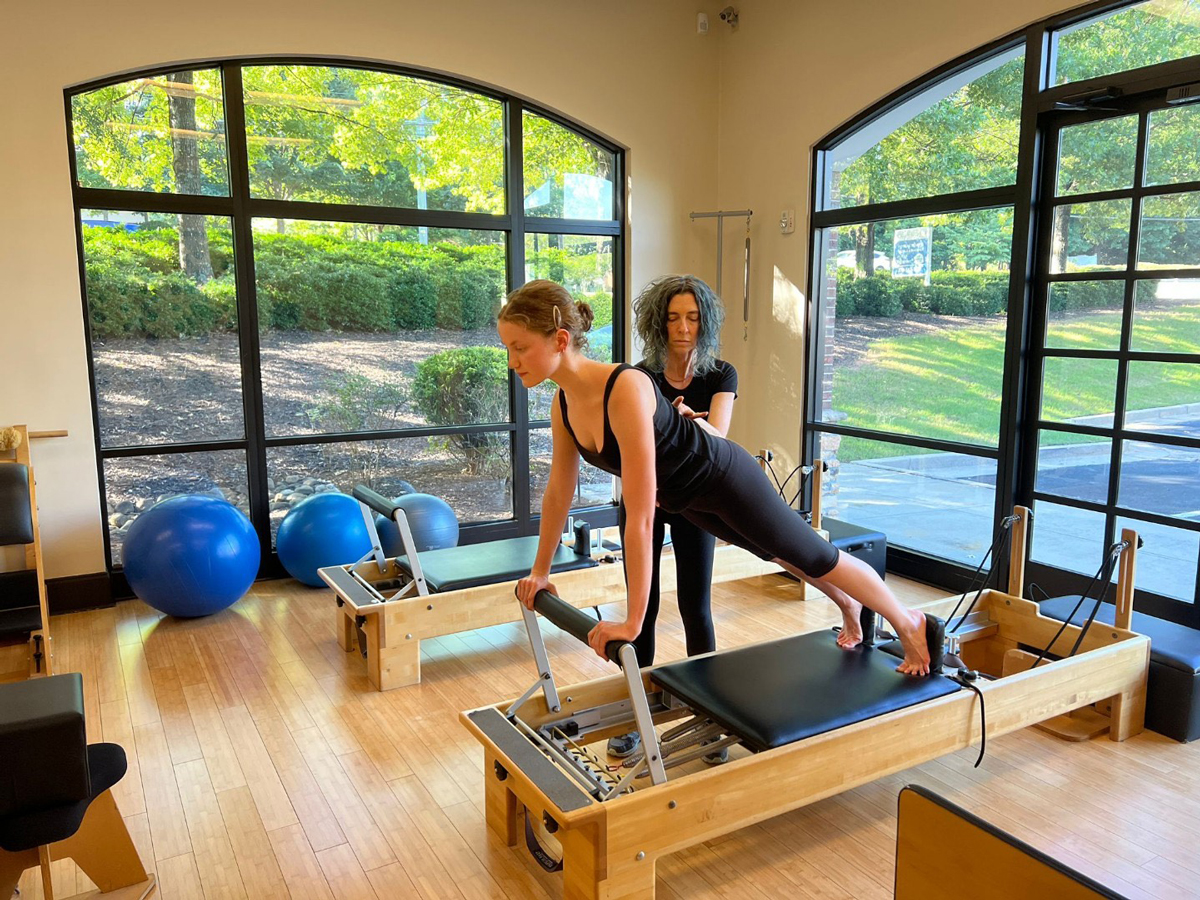
“Pilates is a low-impact exercise method that focuses on core strength, stability, flexibility, posture, alignment, and precise movement,” says Daphne Kelman, a Pilates instructor at Body-N-Balance in Johns Creek, who has been teaching for 25 years. “It can benefit overall fitness and rehabilitation.” Her clients come to her because Pilates uses controlled movements, versus high-impact, high-energy exercises, which can lead to injury more easily. “Pilates is a sustainable and functional path to feeling stronger and more mobile,” she says. “My clients say they feel stronger, have less fatigue, and are more aware of their bodies.”
Alexa Idama, the founder of Peachtree Pilates, has been teaching Pilates for 8 years and has been in the industry for over 20. She explains that there are two different schools of Pilates today; classical and contemporary. In classical Pilates, the teacher is following the work of Joseph Pilates. “I consider classical Pilates [any studio] that has the classical pieces of equipment like Cadillacs [a large frame used for full-body work], reformers [ a resistance-based spring-loaded carriage], and chairs [a spring-loaded pedal apparatus],” she says. “Just because a studio has reformers doesn’t mean it’s classical.” Contemporary Pilates is “a mix of aerobics, bar, and physical therapy with a little bit of Pilates inspiration,” she says.
Lagree, a type of high-intensity, low-impact exercise done on a Megaformer, is not the same as Pilates, says Idama. Neither is mat Pilates, which often gets lumped into these types of workouts. “Mat Pilates is part of the system,” she says. “If you understand the clinical work, you can have a good impact, but unfortunately, what we’re seeing is mostly aerobics on the mat [in a mat class].”
Ready to try it out? Here, a select list of Pilates and Pilates-inspired studios around Atlanta.
Classical Pilates can be done at studios such as Peche Pilates in Buckhead, The Studio Pilates in Druid Hills and the Upper Westside, The Daily Pilates in Milton, Vinings, and more, Kinfolk Pilates on the Upper Westside, Club Pilates (multiple locations), and more. Most studios allow teachers to drive the workout how they see fit utilizing Joseph Pilates’ exercises and the 10 pieces of equipment in his repertoire, such as the Cadillac, tower and reformer.
Grant Street Studio, Reformed Atlanta, and Body-N-Balance offer Gyrotonic sessions, which are not considered Pilates but rather a complementary exercise. Pilates focuses on linear movements that are slow and controlled; Gyrotonic uses circular movements and breath coordination to create fluid movements. Both aim to strengthen, improve balance, and help with mobility. You’ll sometimes find Gyrotonic towers at Pilates studios.
Lagree often gets lumped in with Pilates, but it’s a different style of exercise that blends strength training with Pilates-based foundational exercises that use a different machine. There are only three Lagree studios in Atlanta: Third Eye Tribe downtown, and PACE and Sculpthouse in Buckhead.
There are many Lagree-inspired studios, such as Stellar Bodies (Buckhead and Upper Westside), Solidcore (Avalon, Perimeter, Peachtree Corners, and more), Sculpted Body in East Cobb, and BodyRok in Midtown and Roswell. Each has a different set of principles and exercises.