


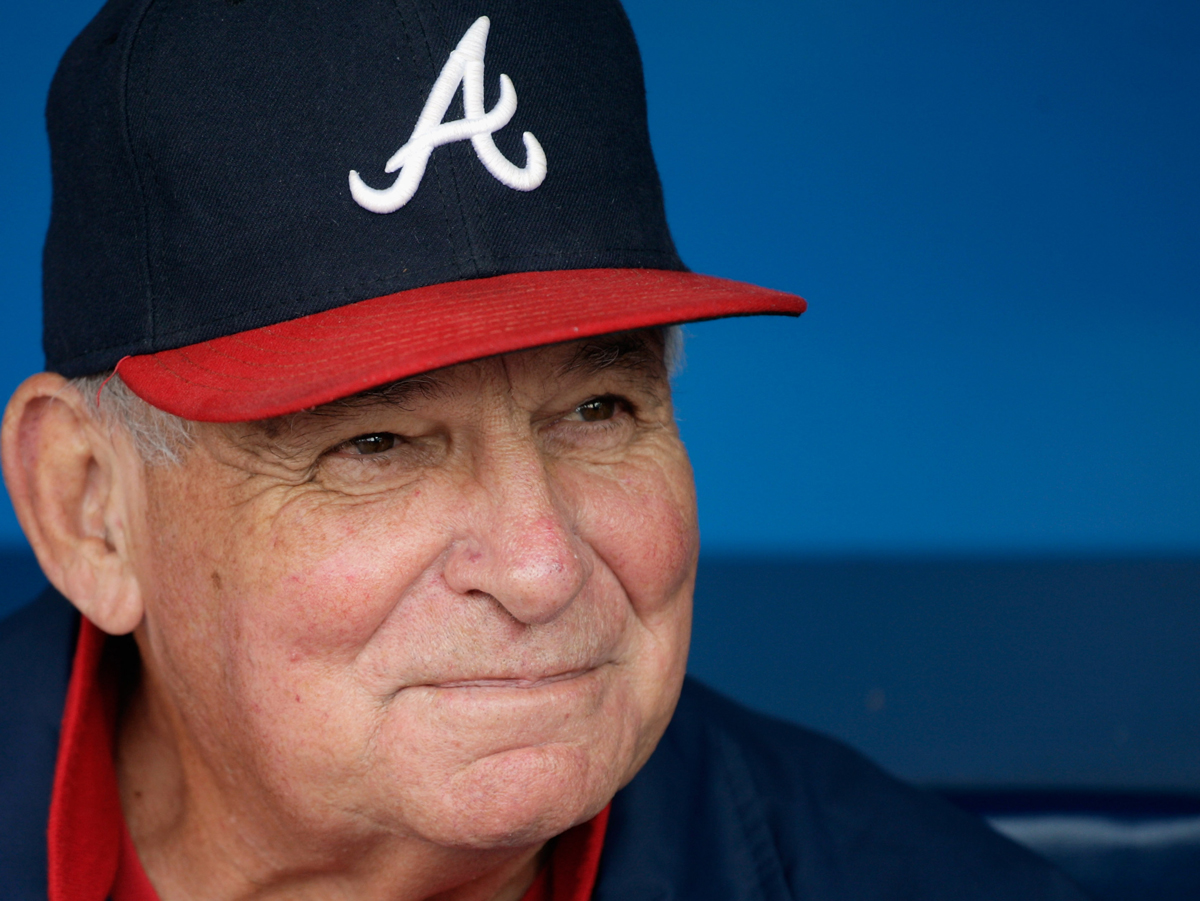
Photograph by Jamie Squire/Getty Images
Despite all the great stars who played for the Atlanta Braves over the years, in many ways their defining figure didn’t pitch or hit. Instead, he managed the team, glowering from the top step of the dugout in his familiar No. 6 jersey and baseball spikes.
Bobby Cox was the Braves for many people, a leader who not only oversaw win after win on the field but plucked talented youngsters from all over and molded them, on and off the diamond, into one of the most successful teams and eras any franchise has ever assembled.
Cox died on May 9 at age 84. (No official cause has been released.) He suffered a major stroke in 2019. Further heart-related complications slowed Cox in recent years, and he was unable to attend the All-Star Game at Truist Park last summer, though he was there in August for a celebration of the 30th anniversary of the 1995 championship squad.
The Braves released a statement reading, in part, “We are overcome with emotion on the passing of Bobby Cox, our treasured skipper . . . Bobby was a favorite among all in the baseball community, especially those who played for him. His wealth of knowledge on player development and the intricacies of in managing the game were rewarded with the sport’s ultimate prize in 2014—enshrinement into the Baseball Hall of Fame.”
Commissioner Rob Manfred also acknowledged Cox’s passing, saying “As manager of the Braves, his clubs became an October fixture, representing consistency, professionalism, and championship-caliber baseball for an entire generation of fans.”
You are probably familiar with his achievements. Under Cox, the Braves won a World Series, five pennants, and 16 division titles, including every one between 1991 and 2005 (not counting the strike-shortened season in 1994). He is fourth on the all-time win list, with 2,504 victories in his career, 2,149 of those with Atlanta. Four Manager of the Year Awards. Six of his teams won 100 or more games in a season over his 29-year career as manager.
“For sustained success, no team of the modern era can match it,” says broadcaster and baseball historian Bob Costas, who often covered Cox and the Braves during those years.
Mostly, Cox is revered as a nonpareil teacher of the game and of what it took, on the field and off, to be a major leaguer, as the hundreds and hundreds of players who thrived under his tutelage will attest.
His smiling face and friendly disposition after his retirement stood in stark contrast to the intense fire he displayed in the dugout. Cox famously was ejected from games more often than any other manager in history, 158 of them, plus several more postseason contests. While many of those were deserved, Cox always was one to protect his players, and took the fall on many an occasion to save the player from himself. “I generally don’t go onto the field that much,” Cox once explained. “90 percent of the time it’s because my player is upset.”
“He was fighting for his team,” Costas says. “The guys appreciated that, even as they hid their faces while laughing at Bobby’s histrionics.”

Photograph by Rick Stewart/Getty Images
Cox was born in Tulsa but grew up in California, in the San Joaquin Valley. While he will forever be associated with the Braves, Cox had deep ties with the New York Yankees, having played the 1968 and 1969 seasons, mostly at third base, for the team. Like many highly successful managers, Cox wasn’t a great major league player, hitting just .225 with nine home runs in the bigs.
But the contacts he made with the Bronx Bombers served him well, as Cox got a gig managing in their farm system as he learned the game in a whole new light. The first title Cox won as a manager came in the AA Eastern League with a Yankees affiliate. He later won an International League title with the AAA Syracuse Chiefs and was first-base coach with the 1977 Yankees, winning a memorable World Series that fall.
That success got him the head Atlanta job in 1978. He took over for Dave Bristol, who had led the Braves to consecutive last-place finishes in the National League West. Upon arrival Cox handed down a half-dozen rules that would always be the standard for his teams:
- No beards.
- No uniform pants covering the shoe tops.
- Dress code.
- Mind the curfew.
- Be on time.
- Play hard at all times.
Cox would later bend a bit on the beards, but until his last game as manager, players who failed to run out ground balls or jogged after fly balls found themselves pulled off the field and at the receiving end of a tirade about playing the game the right way.
“But he never embarrassed them,” says Costas, “and if they got a tongue-lashing, the respect the players had for Bobby meant they knew they probably deserved it.”
Cox didn’t have much success in his first go-round with the Braves, though he made the bold decision to move slugging catcher Dale Murphy, whose throwing issues were costing the team, to centerfield, where Murphy thrived on his way to two MVP Awards and 398 home runs. Cox was nonetheless fired by the late Ted Turner after the 1981 season.
He landed in Toronto, where Cox won a Manager of the Year Award in 1985 (he is one of just two managers to win the award in both leagues). But he remained true to Atlanta, as they say, and continued to live in Marietta even while plying his trade north of the border. So when Turner, who regretted firing Cox, offered Bobby the general manager job in 1986, he leapt at it, wanting to be close to the home he shared with his second wife, Pam, and their children.
Cox’s managerial exploits have outstripped his GM accomplishments, though under his front office guidance the Braves drafted or acquired many of the players who would become the foundation of their 90’s dynasty—Chipper Jones, John Smoltz, Tom Glavine, David Justice. But on the field, the Braves were still grim, going through a succession of managers before Cox identified the problem—he should be the field boss. He turned over the GM role to John Schuerholz, and went back to managing the Braves, his first, best destiny.
Immediately, the Braves surged, with Cox earning the 1991 Manager of the Year Award for taking the club from worst to first. Atlanta made it all the way to Game Seven of the World Series, where they were defeated by Minnesota. That became a lasting legacy of Cox’s teams—great regular season results but ultimate disappointment in the postseason.
There was one exception—that lone, glorious redemptive Fall Classic of 1995, when the Braves at last won it all, knocking off Cleveland in a memorable 1-0 shutout by Glavine, the sole run coming on Justice’s home run, in Game Six to win the only championship of Cox’s career.
“‘The team of the ‘90s has its championship!’ was my call on NBC,” Costas recalls, “and at the moment, it was true.”
But then came the crushing losses to the Yankees, Cox’s former club, in the 1996 and 1999 World Series. The former in particular hurt, as the Braves were much the better team and stormed out to a 2-0 lead, clubbing the Yanks twice in New York before losing the next four and the Series. He also lost a Series to his other former employer, the Blue Jays, in 1992.
Mostly, the Braves found ways to lose decisive playoff games in excruciating fashion, when the randomness of a short series played havoc with the machine the Braves had built in order to cruise to division title after division title. Five of Bobby’s teams won 100+ games only to fall short of the World Series, much less a championship. As such, there was always a hint of “yeah, but . . . ” attached to discussions of Cox and his winning legacy.

Photograph by Elsa/Getty Images
Cox was the essence of a “player’s manager,” but he was swift to pare his teams of talented players who didn’t toe the line or found themselves in the spotlight too often, such as Deion Sanders, John Rocker, and Kenny Lofton. His ballpark demeanor could be often described as grouchy, his temper flaring up when his standards were not met, be they by a player who failed to hustle or a reporter who asked a dumb question.
But he wasn’t an angry or bitter man—in no way did he resemble Billy Martin or John McGraw, whose record for ejections Cox shattered. Away from the white lines he was always approachable and chatty. “He was classy in the sense that he treated people well no matter what,” says Costas, “and not based on what they could do for him. He knew my name and treated me with kindness and respect even when I was a 22-year old—who looked 15—in Syracuse covering the Chiefs.”
Cox was diplomatic when the occasion called for it, a necessity when working for the tempestuous Turner in Atlanta and George Steinbrenner in New York. And many of his former players, most of whom revere him, told of Cox’s willingness to dole out money when they had fallen on hard times.
As Smoltz said after Cox was enshrined in Cooperstown, “A small part of Bobby Cox changes you as a baseball player. Twenty years with the man changes your life.”