
Home 2025

Archives

Review: Cafe Momentum Atlanta’s fine dining gives its interns a second chance

0

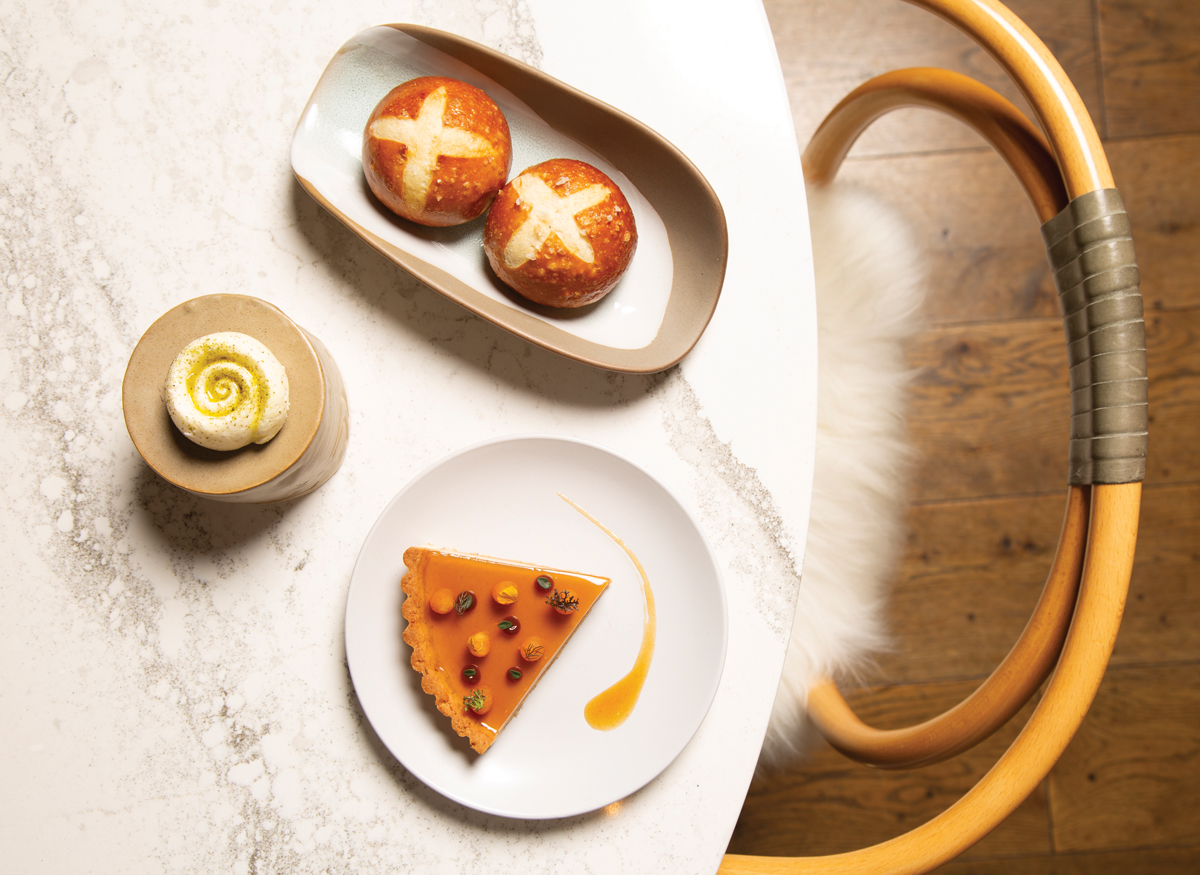
Chef Josh Lee and his intern crewEating out is a largely self-serving exercise: You pick a place, order what pleases, imbibe a bit, soak up time with a dining companion, and go on your merry way. Instead, Cafe Momentum Atlanta, which opened downtown in March, puts investing in Atlanta’s youth at the forefront of dining out, while also delivering a memorable meal.

The Atlanta outpost is the nonprofit organization’s third, following ones in Dallas and Pittsburgh. Founded in 2015 by Dallas-based chef Chad Houser, its mission is to transform the lives of teens in the juvenile justice system with life skills, employment opportunities, and education. I visited the Dallas location several years ago and eagerly anticipated the opening in my hometown.

The cafe’s motto, emblazoned in big letters on the dining room wall, is “Eat. Drink. Change Lives.” As I found over a couple of visits this spring, eating at Cafe Momentum is not entirely altruistic. As it happens, the food is top-notch, with James Beard Award–nominated chef Josh Lee (co-owner of Soul: Food & Culture in Krog Street Market with chef Todd Richards) leading the kitchen.

Here’s how it works: Young people (ages 15-19) who are exiting the juvenile justice system are hired as paid interns. On staff, they learn the ropes of serving tables and work all of the stations in the kitchen while receiving education, financial literacy training, and mental health counseling through the attached community services center.

The environment is upscale but not showy, with a dining room flanked by a bustling open kitchen and set with blond wood tables and channel-back booths in camel-hued leather. The Philip Shutze–designed 200 Peachtree Street building was built in 1927 (some Atlantans will remember when it was Macy’s before becoming the Southern Exchange Ballrooms), but this 110-seat space is thoroughly modern, as is the food itself.

The deviled egg “experience” comes with egg halves surrounded by mounds of pimento cheese, pickled onions, trout roe, and smoked, pulled venison brisket. It’s a choose-your-own adventure opportunity to see what flavor combinations you like best (for me, it was a little of everything piled on top). For something heartier, the Cheshire Farm smoked pork belly is a study in contrasts. Salty pork plays beautifully with sweet-tart green-apple puree and dehydrated strawberries.

A word to the wise: Don’t sleep on the cabbage wedge as an alternative to a more pedestrian salad. The cruciferous veggie is steamed until it’s tender, pan-seared for just the right amount of caramelization, and then roasted. It comes topped with velvety onion cream, charred red pepper, and salty-crisp pork lardons. It’s big enough to share, but you may not want to. The flavors are nuanced enough to turn an avowed cabbage-hater like me into a fan.

fried chicken, risotto, and sea bass
Chef Josh Lee and his intern crew turn out masterful takes on fried chicken, risotto, and sea bass.

Photograph by Ben Rollins

Brined, smoked fried chicken is a signature across Momentum locations, and this one hits the spot. Juicy meat is coated in a thick seasoned crust, and silky mashed potatoes and tangy braised greens offer textural counterpoints. A fluffy biscuit sits atop the whole presentation for a feat of culinary architecture (the small retail area at the front sells biscuit mix if you want seconds to make at home).

The brown butter–poached sea bass is a beauty in a pool of dashi broth, served with a seared pearl onion and wilted spinach. The flavors are delicate and floral, a light menu addition among heavier entrees. Similarly complex, the spring pea risotto comes studded with caramelized local mushrooms and herbs, infused with cashew cream, and topped with curly pea shoots and umami-rich shaved black truffles. It tastes like spring on a plate, though I might have liked a slightly creamier texture with a smidge more liquid.

For me, the real surprise favorite was simply called a “dry-aged sirloin” on the menu. It’s so much more than that. Georgia-raised American Wagyu steak is crowned with creamy thyme-rosemary compound butter and paired with tender, crisp potato pave (I dare you to count the multitude of paper-thin layers). With a texture that renders a knife almost unnecessary, this sirloin would stand tall next to any local steakhouse’s version.

Pastry chef Antonée Pryce’s work stands out in a version of strawberry shortcake. A generous portion of grilled pound cake is topped with Prosecco-macerated strawberries and fluffy whipped cream. Another winner? The chocolate cake with a blood orange glaze has just the right amount of bitterness to balance the sweetness.

the bar’s smoked old fashioned
Equally commanding: the bar’s smoked old fashioned.

Photograph by Ben Rollins

Here, the beverage program is streamlined by design. Because the interns are underage, the restaurant has a dedicated bartender with three rotating specialty cocktails, five beers, and a handful of wines by the bottle, which are offered at close to retail prices. For example, a bottle of the Hess Shirtail Creek Chardonnay is $22, a bargain by Atlanta restaurant standards.

The downtown location is tricky. The $12 valet can be hit or miss (on one rainy evening, it took 20 minutes to retrieve our car), and the area is often congested with pedestrians. But the spot is less about the guests’ convenience than it is about access for the team of interns, almost all of whom use public transportation to get to work.

You might need to remind a server of something, but any service slipups are easily eclipsed by the eager-to-please attitude of the staff. If you invite conversation, you may even get to hear a bit about someone’s story. On one visit, our server, Reggie, told us what a difference Cafe Momentum has made for him. “For the first time in my life, I have hope,” he said.

Bottom line: The opportunity to be a small part of those kinds of stories alone is worth the visit.

This article appears in our August 2025 issue.

Review: Acclaimed chef Jason Liang’s new Taiwanese restaurant Lucky Star shines bright

0

a bowl of Pho from Lucky Star RestaurantAfter a string of accomplished Japanese restaurants, chef Jason Liang takes a sharp turn with his latest project, Lucky Star. Here, he trades in sushi for Taiwanese food, with all its bold, deeply comforting flavors. It is a homecoming of sorts as Liang, who was born in South Carolina, was raised in Taiwan. His new restaurant, which quietly opened last fall inside an office building in the Star Metals complex on Howell Mill Road, is unexpected and overdue—especially from someone with Liang’s culinary chops.

Liang is now a Michelin-starred chef, a James Beard nominee, and one of Atlanta’s most prolific restaurateurs, along with his wife, ChingYao Wang. Their restaurant group includes Cuddlefish, Momonoki, Brush Sushi, and O by Brush. But Lucky Star is their first non-Japanese concept and my hands-down favorite. Liang runs the restaurant with a tight team that includes beverage director Kirk Gibson and Wang on pastry. The result is a stylish Taiwanese bar-cafe that is fast becoming one of the more interesting places to eat and drink in the city. It’s also versatile, serving breakfast, lunch, and dinner.

The inside of Lucky Star

With smart design pops, including the curved mirror you can’t help but take a selfie in, the restaurant’s cosmopolitan flourishes evoke Tokyo or Taipei—a testament to the stylish sophistication of Liang and Wang, both of whom are worth a follow on social media. Their sense of what makes something cool is evident in this small but mighty dining space. The room is anchored by a long bar that dominates the room, with moody lighting and a DJ-curated playlist that lends a nightclub feel to the restaurant. The place somehow seems intimate, even though it lacks a wall between the restaurant and the building’s hallway.

The food here is filtered through the lens of a chef who’s spent the better part of a decade refining his sushi skills and jumping on global culinary trends before most in the city. The balance between nostalgia for Taiwan and craftsmanship is where Lucky Star succeeds. The menu is stacked with dishes that make you want every single thing, so plan on multiple visits. Liang considers most of his dishes authentic to what you would find anywhere in Taipei. However, given the sexy setting, his masterful touch and finesse add polish, making even a dish of noodles elegant.

The Murder Point oyster omelet, made with Murder Point oysters, shrimp, Taiwanese bok choy, bean sprouts, soft-cooked eggs, and rice paper, is a standout. It’s crisp on the bottom, soft inside, and doused in a rich, chili-miso gravy that’s well-balanced and comforting. The use of rice paper in place of traditional sweet potato starch makes for a less slippery texture. Another highlight is the Beef Shank Scallion Pancake Wrap, which is made with a duck fat scallion pancake, braised beef, cucumber, cilantro, and finished with garlic soy and chili sauce, both made in-house. The dish, which is cut into sushi-style rolls, is a keeper. It kind of tastes like perfect bites of Peking duck.

Big bowls of beef noodle soup (choose from thin or thick noodles made in the kitchen) are super soothing, with a rich broth but only a wink of anise. The order comes with beef chili oil in a tincture bottle with a dropper and a dish of chili paste you can add to your soup. The Sausage in Sausage, a Taiwanese night-market staple, layers sweet pork sausage inside a chewy glutinous sticky rice sausage, cleverly wrapped in rice paper, with pickled cucumber and garlic soy. It’s a loud, fatty, deeply satisfying dish that’s messy but worth it.

Other plates, like the Lu Rou Fan (soy-braised pork belly over rice) and Fly’s Head (a garlicky stir-fry of minced pork, garlic chives, tofu, and fermented black beans), are straightforward, comforting, and perfectly seasoned. There’s an excellent shiitake mushroom version of the Fly’s Head that’s not as spicy but just as soulful. The food leans slightly sweet, reflecting Liang’s southern Taiwanese roots, but there’s enough acid and heat to keep things lively. The ume tomato salad with dried plum seasoning was the only dish I tried that didn’t work. The flavors competed too much to be a success, and the plum made the tomato taste almost like saccharin.

Wang is a talented pastry chef, and at Lucky Star you’ll find an assortment of pastries, such as a chocolate yuzu croissant heated to order and egg custard tarts. But the showstopper of the meal is her pineapple cake ice cream, a riff on a Taiwanese classic. The sour and sweet pineapple cake sits in a cardboard tub submerged in salted vanilla ice cream. Each bite had my table audibly wowed and surprised at the seemingly humble dish.

Unfortunately, service hasn’t quite caught up to the kitchen and bar’s ambition. Dishes and drinks can sometimes take too long to reach the table. The dining room staff is warm and knowledgeable, but they’re still learning how to manage the flow of the busy room.

a margarita from Lucky Star's bar
Bold flavors, sleek design, and margarita magic come together at Lucky Star.

Photograph by Martha Williams

The bar, however, is in full stride. Gibson has created one of the more compelling cocktail menus in the city. The drinks change monthly and are built with food in mind. The margarita-inspired Little Lantern is stellar. The coffee selections are also ambitious, just as they are at sister cafe, Momonoki, which leans more Japanese. Lucky Star’s beverage program includes seasonal drinks and zero-proof cocktails, such as a recent iced matcha with butterfly pea flower and marshmallow cream, which was whimsical and perfectly sweetened.

Lucky Star’s location doesn’t invite foot traffic unless you know it is there. The flow of customers has been inconsistent, especially during the week, which is a known challenge for restaurants on this stretch of Howell Mill Road. Liang says business dropped after its initial buzz, and the team has responded with a new brunch menu, including Taiwanese rice rolls that look like burritos, sweet-salty French toast, and sandos (Japanese-style sandwiches on soft white bread). More events are planned, including DJ sets, as is a possible cocktail omakase with small bites.

This article appears in our July 2025 issue.

Review: Tiger Sun pushes the boundaries of an immersive cocktail and dining experience

0
sauce being poured onto a dumpling at a Tiger Sun table
Dramatic broth pours

Photograph by Martha Williams

People who live in Atlanta and consume related social media know the phrase “Atlanta is not a real place.” For the uninitiated, it’s an umbrella slogan that refers to the magnetic but disorienting energy here—an unpredictability unique to us. That’s the feeling you get when you step into Tiger Sun, a converted bus turned omakase-style cocktail bar behind Muchacho on the Beltline.

Tiger Sun is one of Atlanta’s toughest reservations to secure, but it’s not due to exclusivity. With 18 seats on the refurbished vintage tour bus and only two seatings from Wednesday to Sunday, the bar is one of the most coveted spots in Atlanta. Reservations are made during biweekly drops, and they go so fast that receiving a confirmation for the cocktail omakase can feel like winning a medal. (If you miss out, don’t stress. I’ve grabbed last-minute cancellations easily on Resy.)

Tiger Sun offers something unexpected in a city known for its creative spirit. It’s not just another bar or restaurant; it’s an immersive cocktail and dining happening that pushes the boundaries of what I have come to expect from a night out in Atlanta.

a glowing drink sits atop a tiger sun table
Glowing drinks

Photograph by Martha Williams

Each season reveals a new theme. At the time of this writing, it’s Karate Kid. I enter Tiger Sun’s “dojo,” which draws martial arts inspiration from the 1980s film. The bus is fully committed to the motif: A Bruce Lee poster, a large tiger head, furry sheepskin seats, and music by The Who all add to the setting, creating a surreal world—one where anything can happen just steps from Memorial Drive. There’s even orange shag carpet and windows converted to neon lights that glow red and orange. The lights cycle through other colors when the servers ask you to take a “caviar bump” with them—for an additional fee. “When the lights go down, the vibes go up,” says one of the hosts as she turns down the lights.

The vibes are vibing at Tiger Sun, and I feel transported on the moody bus, which is an approximation of the bus I imagine when listening to Frankie Smith’s 1981 bop, the “Double Dutch Bus.” The bus rocks when the all-female staff shakes cocktails to order or when someone steps on with a platter of courses from the nearby Muchacho kitchen.

Joe Schafer, Electric Hospitality’s vice president of culinary operations and formerly of Bacchanalia, oversees food pairings, and Ranger Station’s McKenzie Nelson brings her award-winning mixology skills. The duo’s collaboration is a win-win as plates and beverages all seem carefully crafted to complement one another.

a bartender shakes a cocktail behind the Tiger Sun bar
Rattling cocktail shakers

Photograph by Martha Williams

Each table gets two different menus with four rounds of dishes and cocktails with names inspired by the movie. This means each person’s experience is distinct, but tables can always share sips and bites. Keeping with the Karate Kid theme, this season’s menus are “Wax On” and “Wax Off.” There are even joke menu items such as “Private lessons at the Tree of Life Dojo”—market price, of course. One criticism is that there is little room for dietary restrictions, per the website, so this is not the place for those with such concerns.

The food is exceptionally executed overall, with some minor mistakes I noted over two visits. My favorite dish was the birria potsticker, filled with pulled beef birria. The hot broth is poured over the monster dumpling, adding an element of theater to the meal and enhancing the deep, savory flavors.

The birria contrasts with the boozy Sweep the Leg, a mix of mezcal, ponzu, Thai basil, barley, shochu, lime, and orange shrub. Drink creations push the boundaries of what one would expect, and pack so much flavor in tiny glasses. Cream cheese–washed gin paired with mezcal in the Fish and Karate also gets a playful pop from cucumber vermouth. It arrives with a sweet crab bite on top of a fried rectangle of crispy rice that was a little greasy.

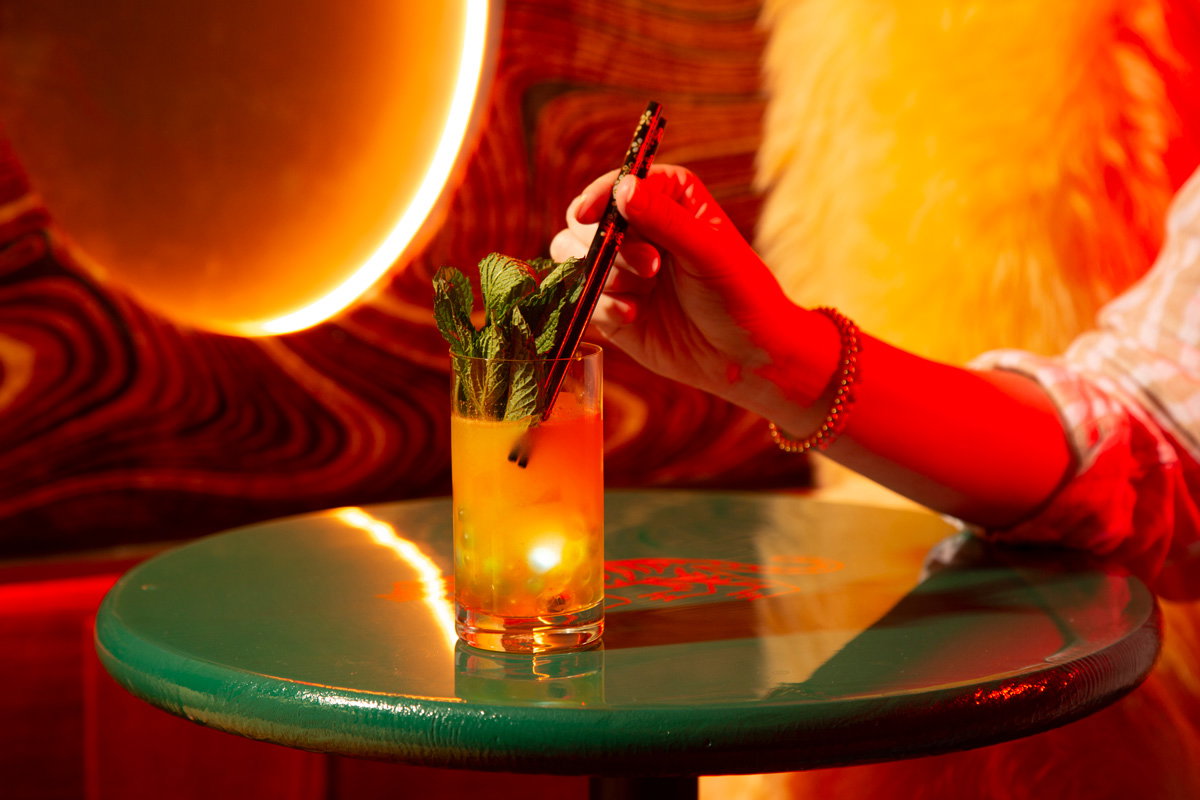
Some drinks go even further, providing a visual wow, like cocktails that light up, casting an ethereal glow as they hit the table. One illuminated cocktail, the Beginner’s Luck, arrives with chopsticks so you can fish for boba, which is meant to pay homage to the scene in which the film’s main character, Daniel, struggles to catch a fly with chopsticks.

a cocktail drink has a pouf of cotton candy as garnish
Poufs of cotton candy

Photograph by Martha Williams

The gochujang and green Chartreuse-infused drink is incredibly strong, but appropriately so, as it comes with slightly oversalted but crispy fried chicken. Tiger Sun’s answer to a French 75, the Banzai, is made with plum wine, green Sichuan vodka, lychee, gin, and yuzu. It’s effervescent on the tongue and delightfully topped with a cloud of vanilla cotton candy. It was illuminated by a tiny light immersed in the base of the Nick and Nora glass.

I went twice to experience both menus, and Tiger Sun was a fun addition to my predictable routine. I recommend this singular omakase immersion to any cocktail-loving Atlantan who is looking for something different and wants to chill in close quarters with new friends. While a night at Tiger Sun is $75 per person, the price is more than fair when you consider how much you get during the four-course tasting menu. I thought I’d be ready for a second round of food—or what I call a “Hobbit meal” (since Hobbits eat up to seven meals a day), but I was satiated after my final bite of a crumbly shortbread topped with crispy pork cracklings.

Everything here is crafted with intention. Tiger Sun isn’t the beginning of a night out. This is the night out. Still, hungrier guests can opt for “extra kicks”—themed additions that let you personalize your indulgence further—such as caviar bumps and assorted yakitori skewers of char-gilled Wagyu beef and maitake mushrooms. There is also a long list of spirits, filed under “Trophy Ceremony” on the menu, if you want more booze. But the evening’s sips are so strong that a ride-share service is recommended.

What’s cool about Tiger Sun is that it will continue to change with rotating themes (next up: Pulp Fiction), which means you can go once every season for a different menu. In a city like Atlanta, where the strange and unique are celebrated, Tiger Sun is a reminder that even in a surreal town, there’s still room for innovation and a little escape.

This article appears in our June 2025 issue.

Review: While waiting for his pizzeria to open next door, Anthony Spina is excelling at Small Fry

0
falafel burger between crispy buns
Falafel burger

Photograph by Martha Williams

The vestiges of Anthony Spina’s Italian American childhood, spent largely in New Jersey, are all over the 25-year-old chef’s first restaurant. That would be Small Fry, a tiny slip of a room at Atlanta Dairies on Memorial Drive, where Spina makes magic by embellishing deep-fried foods with Italian touches.

Behold Spina’s vodka parm sandwich: Never before have I seen a breaded chicken cutlet smothered with so much sauce, pesto, and cheese. It’s criminally good. Consider his impeccably fried polenta sticks, intended to be dipped in warm sugo, a sauce made from Sclafani “Jersey Fresh” tomatoes. (Holy moly.) Now to the fries: Small, indeed, these potatoes are thin, crispy shoestring-style ringlets, tossed with beef tallow and seasoned, unbashfully, with salt and herbs. The takeaway on Spina: Baby, he was born to fry.

Spina moved to Atlanta from Red Bank, New Jersey, when he was 13. The third of five kids, he helped his dad, Anthony Spina Sr., in the kitchen of O4W Pizza, where the square, crackly bottomed grandma pie became a virtual overnight sensation. “I got thrown into the fire immediately,” he says of his childhood immersion into the family business. During the pandemic, he went solo with Spina Pizza, a pop-up offering Neapolitan-style pies. A brick-and-mortar version of Spina Pizza is in the works, in collaboration with Spina’s partners, Duane Kulers (Pollo Primo) and Omar Ferrer (El Malo). It will sit side by side with Small Fry.

For now, Spina has proved himself to be the primo fry guy of Southeast Atlanta.

One might surmise that his affinity for fried seafood is related to childhood memories of the Jersey Shore. (I did—wrongly.) In fact, he told me, it was on his first trip to Italy, in 2022, that he came full circle with his Mediterranean heritage. In Venice, he saw seaside strollers spearing fishy fried morsels out of paper cones with toothpicks. Spina’s version of the classic fritto misto—tail-on shrimp, calamari, cherry peppers, lemon slices, and polenta planks—is one of many reasons I feel such big love for Small Fry.

Spina, whose Instagram handle is @dirtyjerseyy, favors T-shirts over chef whites. When he needs to let off steam, he might grab the joystick of the video game Mortal Kombat, which stands in one corner of the restaurant. His playlist is loaded with old-school hip-hop (Jadakiss), West Coast rap (Cali Life Style), classic ’70s rock (38 Special), and swing music (Thee Sinseers).

Likewise catholic in his food-and-drink taste, he invites pop-up buddies like Coffee Was Black and Ruki’s Kitchen (an Ethiopian food vendor) to work alongside him at Saturday brunch. Atlanta pastry star Claudia Martinez keeps treats under the cake dome interesting, and Small Fry lures concertgoers wandering out of The Eastern, Atlanta Dairies’ live music venue, with such late-night specials as bacalaitos (salt-cod fritters), tostones, and mojitos. (For the record, Spina’s mother is Puerto Rican.)

Yet the main draw is the all-day menu of sandwiches and baskets; a few salads and appetizers; and delicious, original cocktails by Caleb Grubb, the general manager and beverage director. Grubb coaxes delicate flavors from bright ingredients. He likes to switch things up, but you can depend on his Royale Flush (a frozen drink of tequila, cachaca, cassis, lime, cherry bark, and vanilla) or the Chu-Hai (lemongrass shochu, plum brandy, and sake—with lemon, ginger, and tonic). Or perhaps you just want a glass of wine or beer: The list is concise and appropriate.

Icy, gradient drink named the "Royale Flush Cocktail"
Royale Flush cocktail

Photograph by Martha Williams

Voluptuous and messy, the aforementioned vodka parm sandwich is like the girl who couldn’t decide what accessory to wear so she wore them all (luscious tomato sauce, squishy burrata, nutty pistachio pesto, and Parmesan). It’s so rich it may make you feel drunk. A little less showy but no less tasty, the fishcake sandwich plays like a fancy, over-the-top Filet-O-Fish. To make it, the chef presses Atlantic cod, prawn, and scallops into a patty and dresses it with American cheese, tartar sauce, chili crisp and, for an upcharge, Siberian caviar. No sturgeon eggs for me, but I couldn’t have loved it more.

The falafel burger was a textural delight: crispy chickpea balls and crunchy pickled cabbage, moistened with tzatziki and toum (garlic sauce). Next visit, I might order some falafel a la carte so I can investigate it further—which is to say, drag it through the zingy tzatziki and pop it into my mouth. (Incidentally, there are six dipping condiments, including honey mustard and tartar; personally, I think the chili mayo makes everything better.)

Fritto misto in a cone shaped container with a "small fry" sticker
Fritto misto

Photograph by Martha Williams

Consider pairing the wedge salad with the fritto misto, perhaps with a dry martini. The chilled salad and the warm, salty, crunchy fried bits taste like they belong together. The humble iceberg gives Italian glam with heady gorgonzola instead of the traditional blue; pepperoni crumbles instead of bacon; and a lovely green goddess–like dressing instead of the pedestrian blue cheese. The fritto misto, for its part, has more surprises than a box of Cracker Jacks: fried lemon slices, crispy bites of sweet shallot, and textbook polenta sticks.

After four visits and one takeout order, I’d say the kitchen’s command of fish and chicken cookery is often stellar but not infallible. On one visit, with Spina apparently not on deck, the breading of the fish, shrimp, and chicken seemed a bit more panko-y than usual—not a misstep but less satisfying than I’d grown accustomed to.

One crazy-good fried item, which involved no breading at all, was the Ripper (aka fried hot dog), so named because the skin sometimes bursts while cooking. Served on a masterfully toasted and buttered bun over a bed of fries, it was a superb frankfurter, all the better with the addition of chili and cheese. This Jersey-style weenie didn’t just give a Varsity dog a run for its money—it beat it by a Peachtree mile.

Should you have a hankering for something sweet, make it the rice krispy treats or the cannoli. Filled with pistachio-cherry or chocolate-chip cream, the cannoli may be on the dainty side, but they are made with so much love, who cares? “That’s one thing I’m always going to have, no matter what restaurant I open,” Spina says. “I could open a Chinese restaurant—I’m having cannoli there.”

This article appears in our May 2025 issue.

Review: Delbar in Buckhead shines with Persian nostalgia

0
The main dining room at Delbar
Inspired by the owner’s childhood in Iran, Delbar Buckhead glimmers with luxuriant touches and evocative flavors.

Photograph by Martha Williams

The restaurant space in One Buckhead Plaza, at the corner of Peachtree and West Paces Ferry Roads, has always been prime real estate. It has been everything from Nava under Kevin Rathbun to Ford Fry’s King + Duke. Now, it’s Delbar, under Fares Kargar’s hospitality company Nooshe Jan Group. Nooshe Jan is a Farsi phrase meaning “May it feed your soul.” It isn’t just a name; it’s a promise.

Following the success of two other Delbar locations in Inman Park and Alpharetta, Delbar finally opened in Buckhead in November 2024. Anticipation was high after the restaurant’s other Buckhead space faltered due to lease negotiations. Kargar says he is up to the challenge. “This project has been a dream to work on,” he says. “This is one of the most famous buildings in Atlanta—a jewel.”

People have a clear vision when they’re working on their dream.

With each Delbar, Kargar wants to transport you to the places he loved growing up in Iran. Since Delbar Buckhead is a freestanding space, unlike the other Delbars, Kargar had more control over creating the vibe. Incorporating elements of Iranian design was a priority. The restaurant employed Iranian designers and artisans to create the elegant warmth of the space, which is divided by carved screens and abundant potted plants.

Sharbat e Khiyar, a cocktail made with coconut, mint, and cucumber

The bar’s pink Moroccan tiles—very of the moment—glow like rose quartz. It’s the perfect place to start the night with cocktails, which have fun names, such as Saudi Money and the smokey rum- and mezcal-based Magic Carpet infused with baharat, a spice blend that includes coriander, cumin, and cinnamon. Even nonalcoholic drinks, like the Sharbat e Khiyar—made with coconut, mint, and cucumber—are incredibly balanced and never too sweet.

The service can feel like a hug from a distant relative—well-meaning but occasionally awkward. The staff, though eager to please, range from servers with intimate knowledge of the menu to those who stumble over dish pronunciations. Kargar acknowledges the challenge. “Servers are hard to find when it comes to cuisines like ours,” he says. “You have to teach them a whole new language (Farsi), what polo (rice) means . . . That’s just the start of the training.”

When the dishes arrive, they stun. Kargar is a storyteller who is in love with Middle Eastern food, and he draws influences from many places. The food at Delbar is primarily Persian, with Turkish, Lebanese, and Iraqi elements. He also says it’s sometimes hard to attribute exactly where a dish is from since many cuisines have similar food. “You really can’t tell where each dish comes from because it will start a war in the Middle East,” he says with a laugh. “Everybody invented falafel.”

Two dishes at Delbar

A dish at Delbar

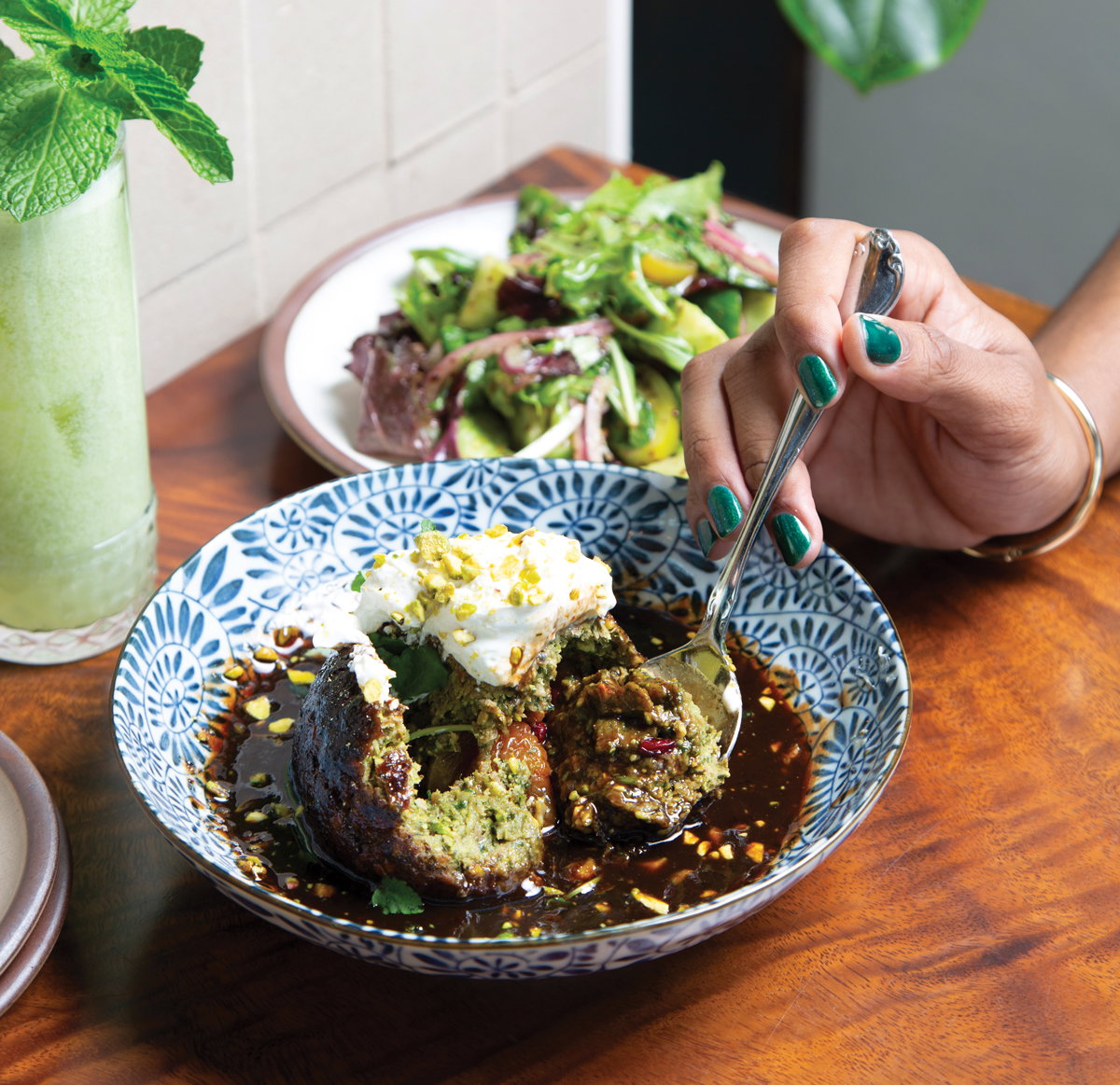
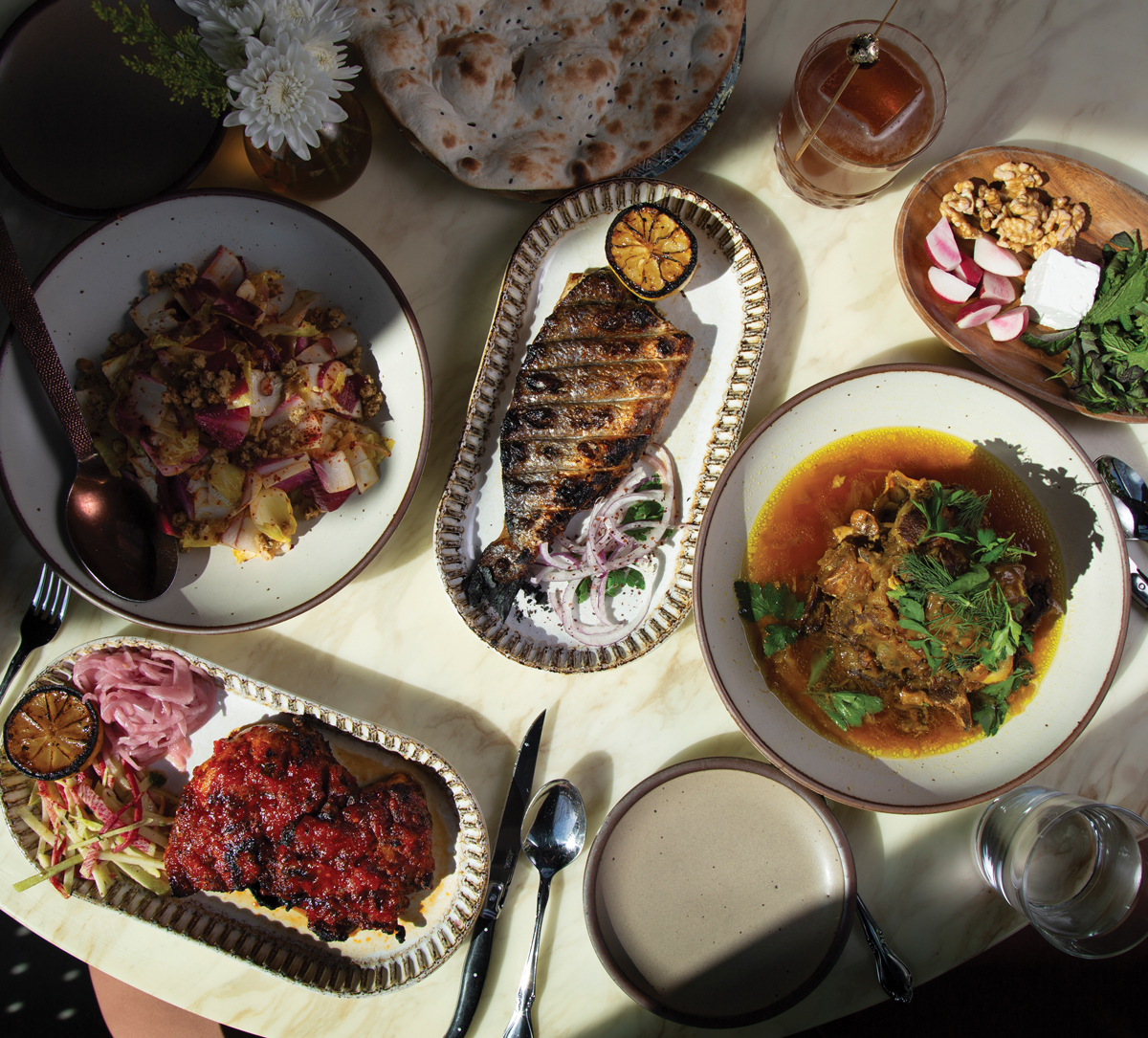
Like many people, when I dine out, I want food I cannot replicate at home. Eating at Delbar is always such a treat. You can easily feast on grilled lamb kabobs, the restaurant’s peerless tahdig (rice with a crispy top), and labneh (strained yogurt) dip, but the menu urges you to dig deeper to discover treasures. Take the seemingly simple meatball, the kofta Tabrizi. The grapefruit-sized ground lamb and beef meatball has a core studded with dried dates, pistachios, and pomegranate that spills out of its center like strawberry doughnut filling when split open with a fork. It’s covered with lemon yogurt and pomegranate syrup. The delightful interplay of the sweet, savory, and tart ingredients showcases the depth and complexity of Persian cuisine. The dish is full of personality.

“I’m a huge flavor guy,” says Kargar. “I like a punch of flavor. If a dish doesn’t have a big flavor, it’s not my kind of dish.” Even the salads manage to elevate ingredients I have had many times before. One example is a red and green endive lettuce salad with orange and grapefruit segments and candied walnuts. A puckery dressing of preserved lemon vinaigrette and Aleppo pepper turns the combination on its head.

When you ask, Kargar provides an origin story for each dish. Most are based on nostalgia for something a relative cooked. The whole branzino stuffed with walnuts, pomegranate, and herbs stands out with such a story. It’s a dish his mother used to make him in Iran, but this is his version. “The branzino stuffing takes six hours to cook,” Kargar says. “It’s a very time-consuming dish, and the entire cooking process is borderline between burning the stuff and making it perfect.”

A table of food at Delbar

The stuffing fills the split fish, which is then grilled over the restaurant’s open fire. I can’t say I have ever had better branzino. The flavor combination is so unexpected, but harmonious. The tang of the pomegranate and the richness of the walnuts paired with the ethereal, flaky fish is a combination I have recalled many times since that evening.

Ordering grilled chicken seems like a waste when more interesting-sounding dishes like braised lamb neck are on the menu, but the honey harissa chicken is special. The chicken thighs glazed with the sweet heat of the honey harissa glaze are transformed by the heat of the fire as their edges crisp. The accompanying kohlrabi pear slaw and pickled onions counteract the spiciness and sweetness of the chicken with welcomed acidity. I kept returning for more, even though the excellent lamb neck sat beside it.

Desserts are equally interesting and over the top, if you have any room left after the sesame-studded flatbread rounds (as big as pizzas) that stream endlessly out of the kitchen. The baklava ice cream sandwich is beautiful, too, in its composition of flavors and presentation. Vanilla ice cream is sandwiched between layered phyllo pastry and covered with crushed rose petals, walnuts, and pistachios.

Overall, Delbar Buckhead shines like the glossy pomegranate seeds that crown many of its dishes. The food is superb, and Kargar’s passion is undeniable. If the restaurant addresses the service issues, it has all the ingredients to be the jewel that fulfills Kargar’s big dreams and nourishes the soul.

This article appears in our April 2025 issue.

Review: Il Premio brings a winning combination of steaks and classic Italian pasta to Old Fourth Ward

0

A waiter holding two dishes

Atlanta is a steakhouse town. It has plenty of them—between 100 and 150, depending on how you define steakhouses and Atlanta. As a result, such restaurants find differentiating themselves challenging, and newcomer Il Premio faces that obstacle head-on. Few steakhouses are near its location at the newly minted Forth Hotel in the Old Fourth Ward near Ponce City Market, so it has an immediate edge.

Il Premio, whose name translates to “prize,” draws its inspiration from the Palio di Siena, Italy’s most famous horse race in the Tuscan town of Siena. The walls of the ground-floor restaurant, covered in thoughtfully curated equestrian-themed art, and the rich fabrics, such as mustard velvet seating, make the space look like a swanky Italian polo club. Its menu is also Italian-leaning, and you can expect to find sections for crudi and secondi. Chef John Adamson previously led kitchens at the health-forward True Food Kitchen and steakhouses Marcel and American Cut (the latter closed in 2022).

“We are trying to differentiate,” Adamson said over the phone. “A lot of the steakhouses are not super seasonal or driven by the produce aspect of it, so that’s something that we’re trying to incorporate, because what do you think about Italian food? Everything is seasonal and hyperlocal.”

Adamson also took inspiration from Italy when he designed the menu sections. “It was hard incorporating all of these steakhouse aspects with Italian because we still wanted an amazing pasta program,” the chef said. “I didn’t want to be a seafood tower–type steakhouse. If you eat the seafood tower, you’re probably not gonna have room to enjoy the pasta. Everything is kind of built in a way that you can enjoy something from every section.”

So, instead of a chilled seafood tower, Adamson features crudi: fresh starters centered around raw fish. One of my favorites was a swirl of impeccable Mediterranean sea bass decorated with cucumber slices, a pop of brightness from Finger Lime pearls (the citrus fruit has an interior like caviar), and a whisper of brine from its real caviar crown.

The beef tartare is one of the most elegant steak tartare preparations I’ve recently encountered. Its combination of mustard dressing and the umami of black (aged) garlic is a powerhouse on the palate, and its precious plating resembling a flower was almost too pretty to break apart.

The two salads on the menu are a fresh and vibrant stop before indulging in the pasta and meat. My one criticism is that the amount of radicchio in the restaurant’s namesake salad needed tempering as its bitterness overwhelmed the balance on the plate. The same could be said for sides that showed promise but had far too many flavors and ingredients that overwhelmed my taste buds or didn’t come together, such as the eggplant, which felt too rustic and sloppy. Sides, notably, are the Achilles’ heel for many Atlanta steakhouses. I advise any steakhouse to favor simplicity over innovation and use fewer ingredients. There is nothing wrong with a well-executed baked potato or sauteed spinach.

Wagyu beef tartare and a bit of bread, and a spread of bistecca alla Fiorentina, pastas, and broccolini.
Serve it forth, starting with Wagyu beef tartare and a bit of bread, then a spread of bistecca alla Fiorentina, pastas, and broccolini.

Photograph by Martha Williams

As the restaurant is Italian-inspired, the pasta program features handmade versions of classic dishes. Adamson’s takes on tagliolini with ragu Bolognese and bucatini all’Amatriciana are faultless in execution, perfectly balancing indulgence and opulence. The pasta dishes, flavorful and rich, are a nice course to share on the way to the main event: the steak.

The menu has a delicious filet and New York strip, and many show-off orders. For larger parties, one such showstopper is the 41-ounce bistecca alla Fiorentina, a porterhouse steak that became popular in Florence. It is one of the most expensive cuts on the menu and one of the best to eat. The bone-in steak was cooked to our specified medium rare, presented beautifully sliced on a cutting board, and imbued with smokiness.

The open kitchen, with its impressive wood-fired grill and adjustable grates, is a focal point. This grill provides the intense flavors and char that give the steaks at Il Premio their signature taste. It’s also fun to watch the chefs and cooks at work.

The bomboloni, an Italian-style doughnut filled with a vanilla bean Chantilly cream, is a perfect finish to the meal. Warm and light, it is not overly sweet but provides the tiniest sweet indulgence after a rich meal. Get to the restaurant early to drink at the hotel’s rooftop terrace, Moonlight, which has jaw-dropping, expansive views of Atlanta.

Or you can cozy up in the restaurant’s bar, where rich tapestries and fabrics make for a comforting space. I was especially enchanted with the Il Premio martini service, which arrives with the remainder of the olive oil–washed (infused) Belvedere vodka, Fords gin, Acqua Di Cedro, and dry vermouth in a small, chilled sidecar glass.

What makes me want to return to Il Premio, aside from its food quality, is the service. My first visit of many to the restaurant was accidental when I decided to slip in after a nearby event where they served more booze than food. Even though it was Il Premio’s opening night, the hospitality was some of the best I have experienced in Atlanta in 20 years. Service is the first thing I mention whenever I talk about the restaurant.

Adamson and the higher-ups took a trip to New York last April for inspiration. “I probably ate at 20 restaurants in three days. It was like breakfast, lunch, second lunch, dinner, second dinner,” Adamson said. “We compiled notes on 20 of those restaurants, and then we went around the city here and did the same.” In other words, they did their research, and that also extends to pricing.

For a high-priced steakhouse, Il Premio’s pricing is competitive. Adamson says they audited local steakhouse prices before opening and chose prices to provide the best value while maintaining quality. You can ball out if you want to, as there are three types of caviar on the menu. But it’s also easy to share a few courses here and be satiated without taking out a second mortgage. I cannot always say this for the rest of the steakhouses in this town. Il Premio offers a distinct twist from the American or French-leaning steakhouses we’ve come to know and love. It’s a prize, indeed.

This article appears in our March 2025 issue.

At Avize Modern Alpine, chef Karl Gorline reaches new heights with a refined menu

0
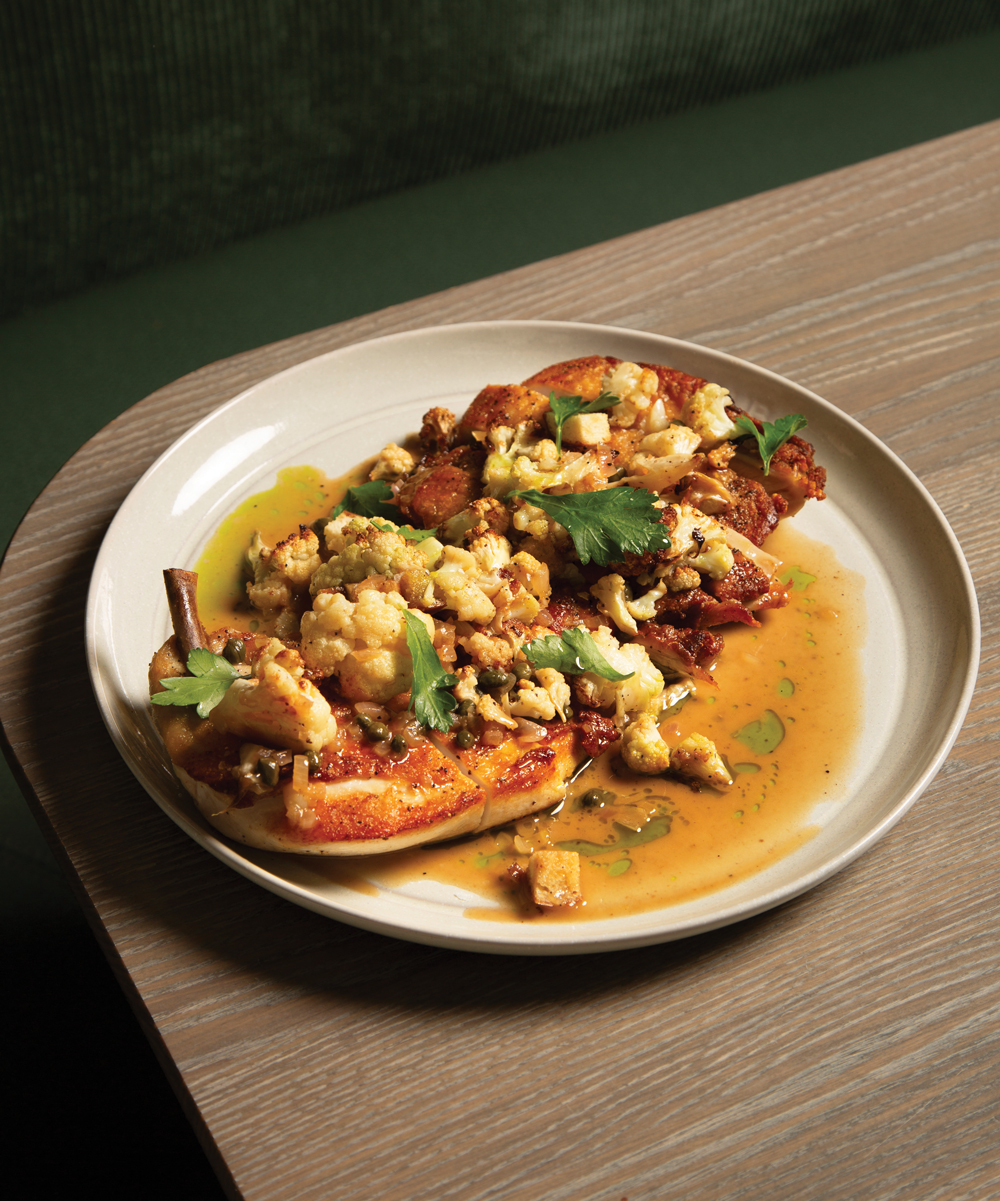
Grenobloise (rustic chicken with browned butter, cauliflower, capers, lemon, and croutons)

Photograph by Martha Williams

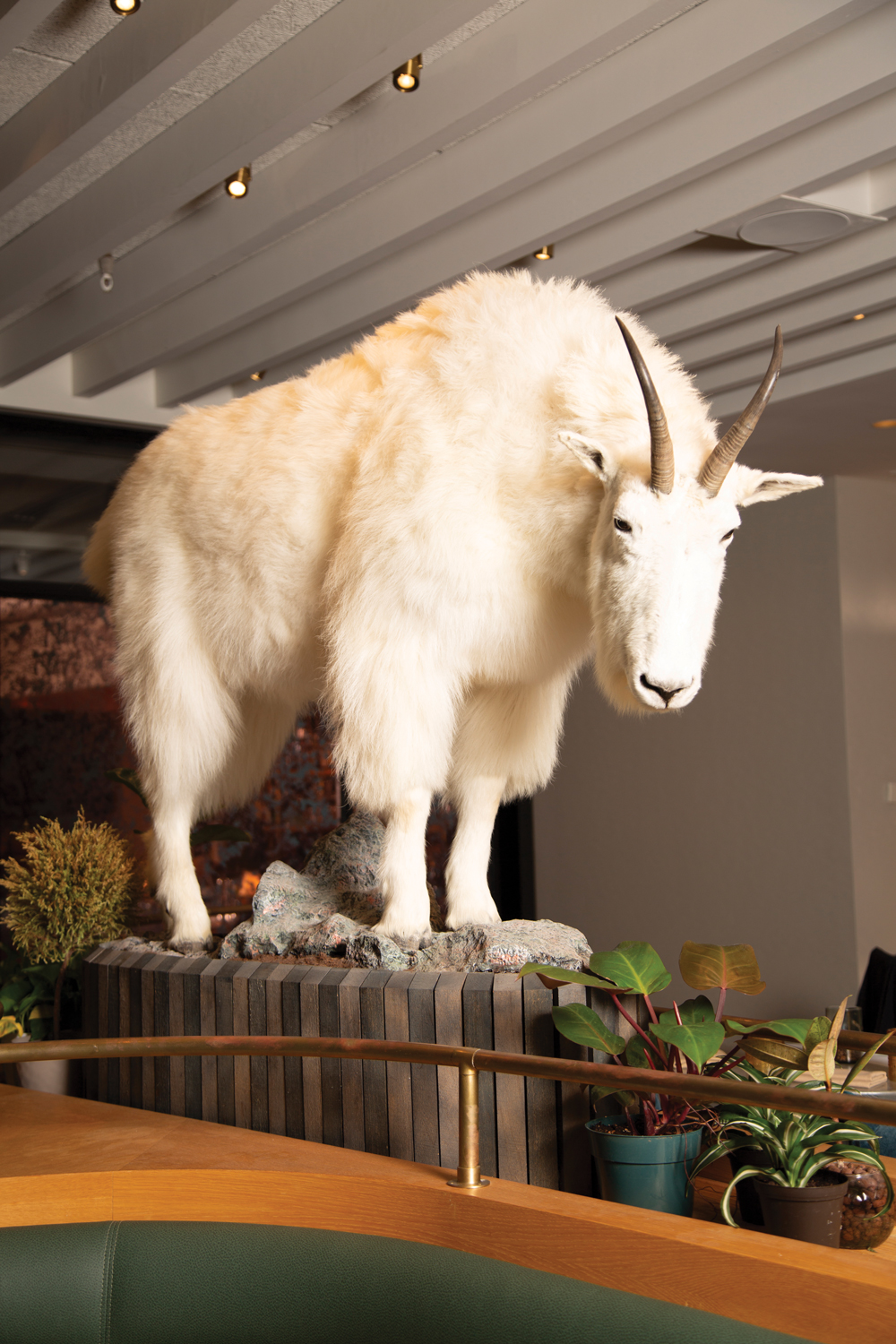
It’s a long trek from the grassy slopes and rocky ridges of the Swiss Alps to the concrete labyrinth of West Midtown. Just ask Truffles. The rugged, white mountain goat who once climbed the snowy peaks of Europe’s famous summits is now, in his taxidermic retirement, presiding over the dining room at Avize Modern Alpine, just down the block from Miller Union.

Like his sturdy mascot, Avize’s chef-owner, Karl Gorline, a Mississippi native and New Orleans and Atlanta restaurant veteran, knows the obstacles and occasional missteps that are part of a steady ascent. Finally at the helm of his own place, a few years shy of 40, he has reached a monumental peak in his career, following turns at revered Restaurant August in New Orleans and Watershed, Atlas, and The Woodall in Atlanta—not to mention Food Network’s Chopped

While partly a nod to his heritage—his grandparents left the Bavarian region of Germany to travel by steamer to the United States—Gorline’s latest culinary direction is mostly a way to explore all the great food of the Alpine region. To recap for the geographically challenged, that’s an area defined by breathtaking vistas of vineyards, winding hiking trails near dairy farms, and a majestic mountain range spanning eight countries. Of those, it’s most often associated with France, Italy, Switzerland, and Austria. 

“We’re looking at the culture and traditions, and we’re interpreting Southern food and our ingredients and our farmers and our culture through their lens,” Gorline says. 

A taxidermic white mountain goat

Photograph by Martha Williams

In his newly redesigned space, formerly Nick’s Westside, Gorline opted for an open kitchen, which adds a buzzy energy, as does the music mix of pop, R&B, and dance tracks—just loud enough to counteract a potentially stuffy fine-dining atmosphere. 

A huge black-and-white photo of the Alps encircled by clouds helps set the scene. The main room is charming, with fabrics in deep blues and teals, ash and honey-colored wood tones, marble tabletops, antiqued brass trim, and white wainscoting. Crisp navy-and-white gingham adds a cheerful pop to chairs paired with tables along a long banquette (whoever added the lumbar pillows, you’re a genius). 

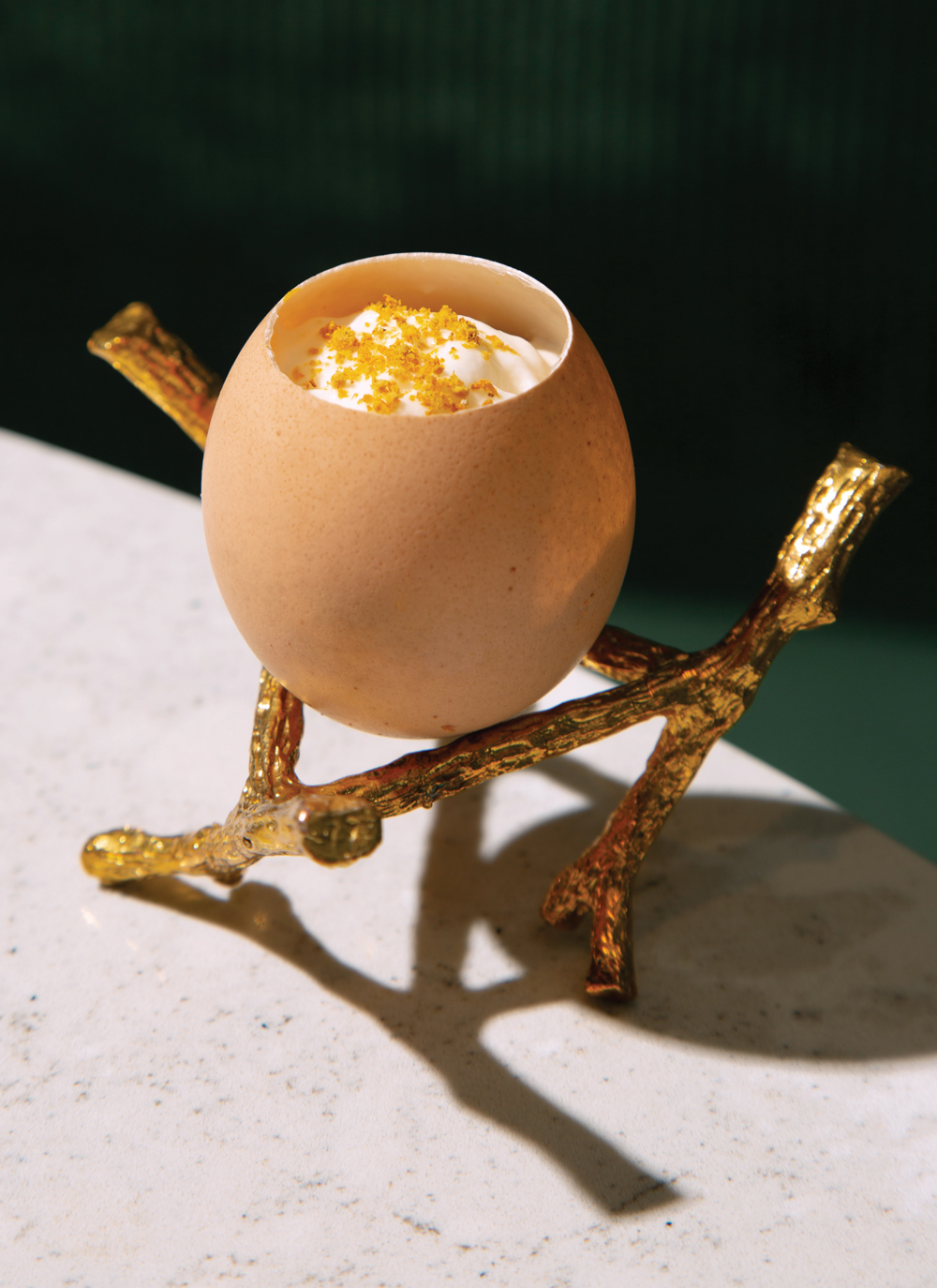
But don’t be fooled by the casual vibe and cozy chalet-chic decor; fine dining lies ahead. Any doubts you have will be gone by the time the amuse-bouche arrives. Gorline’s take on the famous Arpege egg arrives on a golden twig stand. His interpretation of the Parisian classic has butternut squash custard, pine, and yeast. It’s a lot more complex than that, but this is the chef’s simplest breakdown. It doesn’t take away from the “wow” factor. 

Appetizers


Peruse the menu (including wine-pairing suggestions), which lists selections from “The Farm. The Forest. The Sea,” as you sip on a signature cocktail. We suggest the Old Man of the Woods, a rye tippler with hints of maple and pine. To quote our server, it’s an old-fashioned, but the bartender “Alpined it up.” The drink is served with its own decanter and poured over an emerald-cut ice cube handmade by bar manager Jason Swaringen—his nakiri knife always at the ready. Another excellent mood enhancer is the Alpine Swizzle. Basically a tiki drink served in a stein, it’s a potent mix of navy rum, allspice, pineapple, and chartreuse vegetal liqueur. 

The staff is relentlessly diligent about noting ingredients (vegetables, herbs, grains such as buckwheat and rye) from the restaurant’s 700-acre farm north of Bremen, Georgia. “Chef Karl” is equally dutiful about acknowledging other Georgia growers the restaurant relies on for sourcing, including Love Is Love and Pearson farms, as well local purveyors, such as Rusty Bowers of Pine Street Market (for bacon ends and pieces). 

While the menu is seasonal, a handful of core dishes stay put. Among them: a dandelion greens salad with a knockout truffle vinaigrette and Satsuma oranges; the hay-smoked duck breast; the exquisite, fermented carrot Bolognese; the poulet Grenobloise (rustic chicken with browned butter, cauliflower, capers, lemon, and croutons); and the must-have flammkuchen (an Alsatian flatbread with fromage blanc, onions, and bacon).


The dessert options are few, and after some intense dishes, we wished for something a tad less challenging. Is a little chocolate too much to ask for? But if you’re all in until the end, go with juniper- and pine-tip ice cream with oolong milk tea foam and fennel pollen. It’s utterly unlike anything we’ve tried before, light and cleansing, and represents the complexity and unique flavors that make Avize remarkable. The ice cream goes nicely with a pour of Vermouth de Chambery Blanc over ice.

A drink in a wood cup holder

Another lovely way to finish is with Avize’s spin on an espresso martini: The Espresso Piemonte features agave vodka, espresso, fortified wine, and a topping of Comte cheese foam with a dusting of mint powder. 

Cofounder and beverage director Taurean Philpott, a native of Bermuda, is within earshot of any questions and is quick to share a suggestion or expand on the wines, bubblies, and botanical liqueurs from the Alps. It’s another example of the staff’s easygoing graciousness and eagerness to inform—an homage to both Alpine and Southern hospitality.

This article appears in our February 2025 issue.

Restaurant Natalie Bianca brings “New Southern” cooking with Mexican influences to Cascade Heights

0

Dishes and wine at Natalie BiancaNamed after a cherished friend of the owner, Natalie Bianca joins a cluster of culinary gems nestled in Cascade Heights, near the Cascade Springs Nature Preserve and the Adams Park neighborhood.

You might have driven down the area’s main thoroughfare, Cascade Road, bound for nearby hiking trails or big-box stores off I-285. But for many Atlantans, the historic Cascade Heights neighborhood remains relatively unexplored, including its dining scene. Thankfully, like most secrets, word gets out.

When seasoned restaurateur Jamshad “Jaamy” Zarnegar heard there was an opportunity to open a new spot in the neighborhood’s space on Cascade formerly home to restaurants Serenidad and La Panarda, he was intrigued but hesitant. In his late 60s, Zarnegar says he had no intention of opening another restaurant. Now settled in Midtown, the former manager and co-owner of the critically acclaimed Last Resort Grill in Athens was impressed with Cascade Heights’ burgeoning culinary status. And, to his surprise, as he became more familiar with the area, he realized it was only a mile from where his longtime bestie, Natalie Bianca Coward, had grown up.

Owner “Jaamy” Zarnegar (left) and co-owner Courtney Rucker
Owner “Jaamy” Zarnegar (left) and co-owner Courtney Rucker curate good times and a value-driven wine list by the glass.

Photograph by Martha Williams

This new opportunity felt like kismet and a way to honor his friend, who had passed away from a heart attack just a couple of years before. “We met in a nightclub—Backstreet, to be exact—at 3 a.m.,” says Zarnegar. “I was just standing there having a drink, and this woman walked up and started talking. We hit it off and began what became a lifelong friendship.”

From party days to work life and tougher times, which included caring for ailing parents, these two, along with their friend Kitty Dare Ethridge, stuck together. Zarnegar named a restaurant for that departed friend as well: the Mediterranean-inspired Kitty Dare in Inman Park. He has fond memories of both women, especially in their younger years. “We spent many nights in the basement of Natalie’s father’s house—her sanctuary—getting ready for a night out.”

Decor at Natalie BiancaNatalie Bianca, the restaurant, opened last September in good company, surrounded by several noteworthy eateries within shouting distance: Cafe Bartique, Aiskrimu Ice Cream Bar, Barrio ATL, and Oreatha’s at the Point from chef Deborah VanTrece.
Natalie Bianca stands out among them. The exterior is painted a super-sunny yellow and has a small front patio and large street-facing windows. Inside, the open dining room, with its dozen or so tables, includes an inviting bar along one wall. The room is a touch romantic, featuring stone tiles, wood accents, dark and light rattan pendants, mounted ceramic plates with Mexican floral motifs, votive candles, and colorful, beaded hobnail glassware.

In the back hangs a portrait of a woman with a warm, wide smile and a mischievous glint in her eyes. Our server confirms she is the one and only Natalie Bianca Coward. “I hear she was quite the diva back in the day,” the server offers before sharing top picks from the cocktail list.

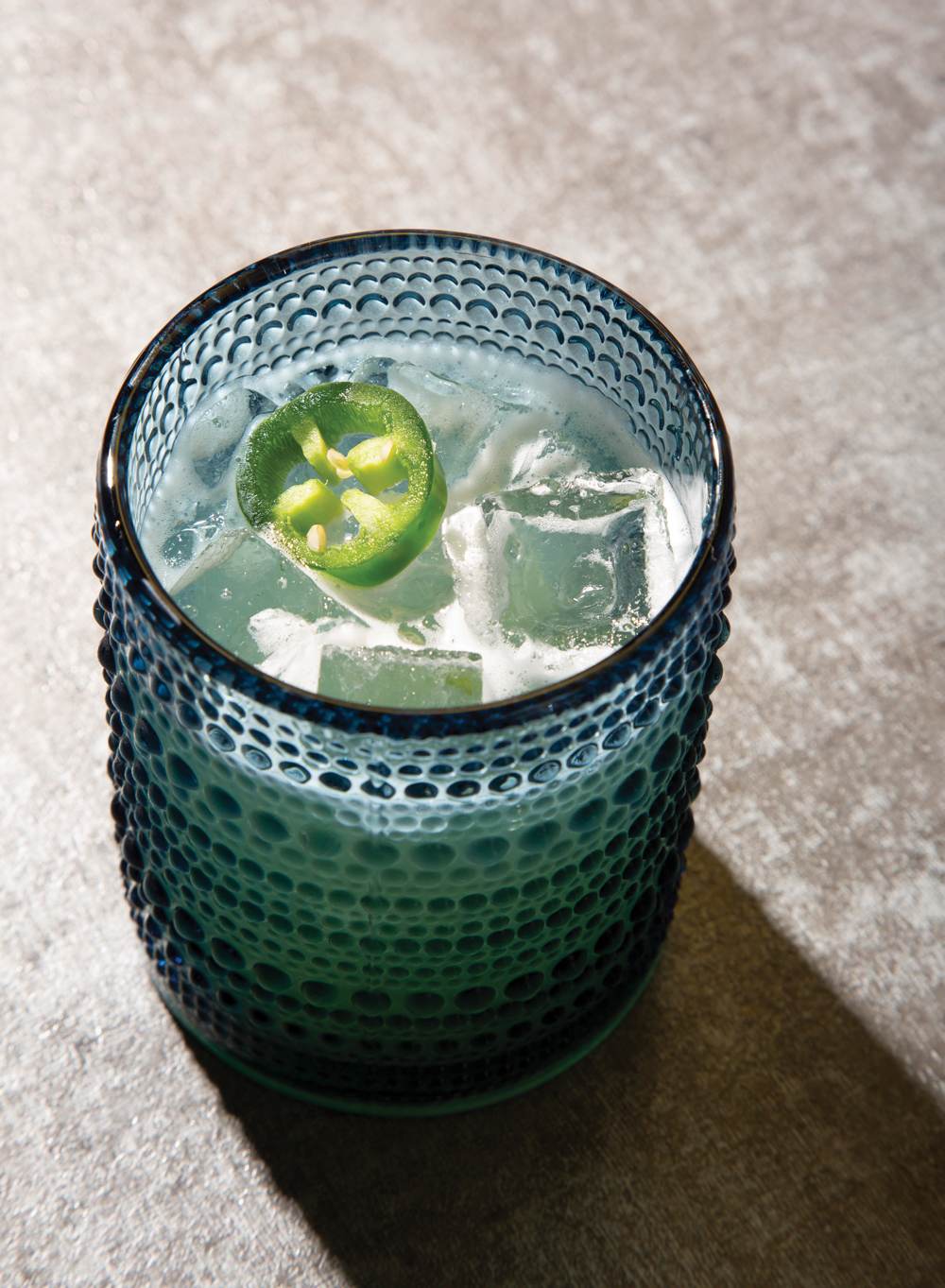
I start with the Jules, a spicy margarita on the rocks with a jalapeño-slice garnish. Sassy, it’s right up my alley. My dining companion begins with the For Marti, an espresso martini that went down so smooth he had to order another. The menu, described as New Southern with Mexican flavors, has several options—from small and big plates to burgers and sandwiches, chimichanga and quesadilla dishes, a vegan plate, and more.

A spicy margarita cocktail with a jalapeno slice at Natalie Bianca
Spicy margarita

Photograph by Martha Williams

Among the small plates are fried green tomatoes with a creamy sweet onion and bacon sauce; crab cakes with roasted caper aioli; and black bean crepes served over tomato sauce and topped with dill sour cream. Salads include a lovely Caesar with fried capers, parmesan, and sourdough croutons, and a colorful “harvest” salad with house-made dressings, including Green Goddess. Entrees lean toward familiar and comforting, with satisfying selections such as short ribs on mashed potatoes with green beans; salmon on creamy Southern grits with roasted garlic cream sauce; Natalie’s shrimp pasta; and Bruno’s steak, a skirt steak marinated in Mexican herbs and spices.

Shrimp pasta with a salad and glass of wine
Shrimp pasta

Photograph by Martha Williams

For dessert, there’s a chocolate walnut pie that Zarnegar insists on making himself; the recipe is from the now-shuttered Southern Lights Bistro in Greensboro, North Carolina, an influential stepping stone in his early culinary career. The kitchen crew, led by two Superica alums, handles the rest, including the knockout churros. Served in a silver cup, the cinnamon-coated, frites-length pieces are warm and crunchy and come with chocolate sauce and whipped cream for dunking.

The restaurant hosts wine dinners and plans to start Sunday brunch in January, but Zarnegar admits they struggle to fill the dining room during the week. It’s a familiar story lately, especially for newcomers. But this is exactly the kind of place Atlanta needs more of: relaxed, inclusive spaces where you can drop in for an after-work drink or bite at the bar or settle into a cozy dining room that works for a date night, a weeknight respite, or small celebrations. It’s worthy of your support. Bring your friends—especially the divas.

This article appears in our January 2025 issue.

Austin’s at Serenbe summons spirits past

0
Wagyu New York strip with sweet potato confit

Photograph by Martha Williams

In 1967, a progressive Episcopal priest named Austin Ford converted a Peoplestown Victorian with a lurid reputation into the community-building institution known as Emmaus House. The neighborhood may have been rough, but the bachelor minister’s upstairs lair was stocked with antiques, leather-bound books, fine china, and art. At Father Austin’s legendary Christmas Eve soirees, champagne flowed, and caviar was mandatory.

Though the cultured and convivial DeKalb County native died in 2018, at 89, he is remembered still as a tireless social advocate, flock tender, garden keeper, and epicurean. Thanks to his friendship with Serenbe founders Steve and Marie Nygren and their three daughters, this bourbon-loving bon vivant now has a namesake watering hole and restaurant at the bucolic 20-year-old South Fulton community.

The patron saint of Austin’s Cocktailery & Kitchen may have been an Anglophile with impeccable diction, but Serenbe’s newest food-and-drink establishment is hardly buttoned up. Push through the formidable front door—standing 11 feet tall and weighing 1,000 pounds, it recalls the portal of a European cathedral, albeit a very modern one—and you arrive at the inner sanctum: a speakeasy-like room with curvy, green-tufted banquettes and a jaw-droppingly long bar. With every detail, it’s evident this isn’t Steve Nygren’s first time at the rodeo. He’s created 41 restaurants to date, if you count the 5 at Serenbe and the 36 that made up his influential Peasant Restaurants brand (1972–1994).

A playground for Serenbe dwellers and destination diners alike, Austin’s looks for reasons to party: oyster happy hours, Saturday jazz. It offers cutely named original cocktails (the Frankly, My Dear, the Absinthe Minded) and a heady list of classics (Tom Collins, gimlet). Nearly everything touched by co-chefs Jesse Sherwood (previously at The Hill at Serenbe) and Tyler Braun (Staplehouse) demonstrates dazzling technique, from their elevated bar snacks to their dinner entrees. In particular, their vegetables shine, which is only right and proper, since Serenbe is wrapped in farmland.

The Crystal Negroni
The Crystal Negroni

Photograph by Martha Williams

For me, Austin’s really clicks as a place for drinks and nibbles, followed by larger courses if you’re still hungry. I adored the snack tray of fried olives, thin housemade potato chips seasoned with malt vinegar powder, and nuggets of cheese dappled with spice or olive oil and sea salt. I’m all in on the luscious, lobster-studded Japanese egg custard (chawanmushi) and the salmon: rare fish marinated with citrus and fermented chiles, mounted on compressed disks of crispy rice and showered with chives.

I was less taken with the beef tartare—an unconventional treatment in which the meat is dressed with salsa verde and spooned on finger-sized rectangles of toasted hash browns. Seemingly a riff on box sushi (substituting spuds for rice), it’s an interesting way to fashion tartare as a preassembled cocktail nosh, though purists may not be so amused.

How grand not to have to pore over tireless tasting notes about oysters from east and west. Austin’s single choice was elegant and on the money: tiny but mighty gems, freshly plucked from the beds of Alabama’s Murder Point farm. Slurp them with a glass of Muscadet.

Beverage director Cedar Meyers

Photograph by Martha Williams

Austin’s bills itself as a Jazz Age hideaway, and beverage director Cedar Meyers plays along coyly with the period-referencing Tropic of Cancer (a vodka, pineapple, lime, and vanilla syrup shout-out to Henry Miller’s scandalous novel) and the Fever Dream (a gin and St-Germain number with Grand Poppy amaro—“poppy” as in the flower, Meyers told me, right before I sipped one). The best drinks we sampled were the Crystal Negroni (a ginny, sweetly botanical Lillet- and limoncello-spiked slapper with a hint of bergamot) and the modern classic Naked and Famous (equal parts mezcal, Aperol, yellow chartreuse, and lime).

Those in want of more substantial dishes won’t be slighted. We were enraptured with a Saturday special of Wagyu New York strip from Kentucky, all pink, juicy, and charred, with grilled broccolini, confit sweet potatoes, and Georgia pecans. Who cares that the snapper was a little monochromatic? Within that pure whiteness lay pure buttery comfort.

The chefs’ imagination hardly freezes up when it comes to fall and winter veggies. Witness a humble wedge of cabbage—tender, black with char, and coddled in a Taleggio foam dotted with basil oil—and a sense-awakening porridge of rice, beets, goat cheese, walnuts, and zingy basil and lemon. Both splendid.

So what would Father Austin think of this posthumous tribute from the Nygren family? I suspect he’d sip a Front Porch Swing (built with bourbon, of course) and give the joint his blessing.

This article appears in our December 2024 issue.

Review: Gene’s BBQ offers a Viet-Cajun twist in East Lake

0
Brisket, mac and cheese, beet salad, creamed esquites, and brussels sprouts.

Photograph by Martha Williams

The east side of Atlanta is a tough place to open up a barbecue spot. Sgt. Wyatt’s Country BBQ in Kirkwood is a family barbecue haven with divine pork; Georgia Boy BBQ (in the former Anna’s location in Kirkwood) serves up some of the best wings I’ve had; Fox Bros. is a stone’s throw away on DeKalb Avenue; Daddy D’z BBQ Joynt on Memorial Drive has some of the best plates and sides you can get in town. The area is crowded with staples of the game, but a competitor might argue it’s the place to be, a battleground of sorts in which to carve out their barbecue crown.

Gene’s BBQ opened in late July in the East Lake neighborhood, in the same building as Poor Hendrix and Mix’d Up Burger. Avery Cottrell started Gene’s as a pop-up at places such as Kimball House and Poor Hendrix, before he partnered with John Ward of Victory Brands and the owners of Kimball House to open up a permanent location. Cottrell has flooded his debut restaurant with creativity. Named after his orange and white cat, whose cartoon face is plastered on the website, Gene’s offers Cottrell’s take on Viet-Cajun and Texas-style barbecue, all set at a Flora-Bama party in Pensacola.

When I walked in on a Friday night in September, I started to feel like Friday. I was hit with a disco ball reflecting Christmas lights strung across the ceiling and the bar. A 20-foot red alligator hanging from the ceiling, neon signs, a retro jukebox, sidewalk newspaper boxes, and more folk-art decor that Cottrell, Ward, and Matt Christison (of Kimball House) collected over five years make the space feel like it’s been lived in for that long. At the counter, I reveled in the festivities, and ordered a Genesicle, a zero-proof frozen coconut-cream cocktail (I opted to add rum for an extra charge) with orange and vanilla flavors that hits in a place like this. The drink menu is expansive, with a mix of sophisticated and simple, fun frozen drinks, classic cocktails, wine, and cheap beer. The spacious interior has four-tops, booths with red banquettes, and a few large round tables for the family.

A red alligator floats overhead

Photograph by Martha Williams

I took a seat outside on the covered patio, where there are half a dozen tables with colorful oilcloth table covers. My view was a sight to behold—a four-door, hot-pink smoker from Primitive Pits (based in Cumming) that serves up brisket, pork, chicken, and ribs. As I sat, Genesicle in hand, Cottrell’s vision felt ambitious but effective.

After I’d ordered, an attentive and quick staff delivered the food in paper boats on trays. Every meat plate comes with flour tortillas—as is the custom in South Texas—and pickled vegetables, for a choose-your-own-barbecue-adventure. I ordered the sliced brisket, which was smoked tender, but lacked the bold, complex spice that you might find in Texas. The plate made up for it. I built a bulging brisket taco with pickles, pickled red onions, mint, and cilantro, dousing it all with Boss Saus, a sweet barbecue sauce with red chili flakes for the right kick. And they don’t skimp on the tortillas, serving you four of them, warm, for the journey.

The ultimate test of barbecue for myself and my bank account is the pulled pork sandwich. At any barbecue joint in Georgia, this is the cheapest entree on the menu and likely the most ordered. Gene’s version costs $14, with a choice of one side, which, in this economy, satisfies. The pulled pork came on a sesame seed bun with slaw-topped meat doused in Smokin’ Wet Sauce, a vinegar-based barbecue sauce too hot to call Carolina. The meat itself left something to be desired; the pork was mushy, without much bark to the bite, even as the slaw and sauce gave the sandwich the boldness it needed.

Where Gene’s really shone was in the Viet-Cajun side of the menu. The summer menu had smoked-mushroom tacos, topped with pickled fennel, toum (garlic sauce), and pomegranate—a staple of Vietnamese cuisine—packed with a complex and rich flavor. The mushrooms were crispy and succulent, leaving my girlfriend and me with “taco hand,” a phrase we coined for a great and dripping taco. Marinated Cajun crab claws come in a tangy chili-vinegar sauce. The cucumber salad was fresh and topped with mint and cilantro; fish sauce vinegar packed umami into each crisp bite. Gene’s wings come Hooters- or Daytona-style, with a grilled, crunchy finish to the smoked chicken. I devoured the fish sauce caramel wings (you can also get Buffalo or lemon pepper), which were sweet and sour and paired well with jalapeño ranch.

Banana pudding
Banana pudding

Photograph by Martha Williams

For dessert, I opted for the banana pudding with two vanilla wafers and a Biscoff cookie set in the middle. The sweet custard was rich and creamy, and before long, it disappeared in front of me. I also got the most infamous menu item—the Mountain Dew Jell-O shot—and, pleasantly, it tasted exactly as the soda does in the can.

As with any debut, Cottrell’s hopes and dreams fill Gene’s, and his ambition pays off with a vibrant atmosphere that’s infectious. While the barbecue can improve, it stands out among the east side of Atlanta’s crowd, with its unique Viet-Cajun flair that gives the food an intensity that will bring me back. That, and the fact that I can bank on a Flora-Bama party every time I step through the door.

This article appears in our November 2024 issue.

Follow Us

69,386FansLike
144,836FollowersFollow
493,480FollowersFollow

NEWSLETTERS