
Home 2024

Archives

Review: Two Fish Myanmar is reborn in a new Clarkston location

Review: Two Fish Myanmar is reborn in a new Clarkston location
Nan gyi thoke, and the milky dessert, shwe yin aye.

Photograph by Andrew Thomas Lee

In a social setting, I never tell people what I do for a living. “I am a writer,” I say vaguely, or, at most, “I am a food writer.” I know from experience that if I tell the truth—I am the dining critic for Atlanta magazine—people will interrogate me (“What’s your favorite restaurant?”) and immediately contradict me in an effort to show me that their opinion is as good as mine.

One line of inquiry I don’t mind is the one about my favorite cuisine. French, of course, but only in France. Ditto Italian. But the food I could eat every day in Atlanta is Asian: Korean, Vietnamese, Japanese, and all forms of Chinese. Of all Asian cuisine, the culinary tradition that fascinates and delights me always has barely made an appearance here. I have loved Burmese food since I first encountered it at the famous Burma Superstar in Oakland, California.

Burma is now officially called Myanmar, a name given to it by the ruling military group while suppressing a pro-democracy uprising in 1989. Still, many people, within and outside Myanmar, continue to use the term Burmese to describe the traditions and foodways. My passion for a culture that uses fermented tea leaves in its salads and makes tofu out of yellow split peas knows no bounds. In Atlanta, we have had a few obscure, mostly short-lived Burmese places in eastern DeKalb County. After the closing of the terrific Royal Myanmar Cuisine in an especially desolate strip mall, we had quite the dry spell.

Luckily for the few who made the trek to Clarkston and looked for a small house abutting the expressway, two Burmese refugees who came to Atlanta via Malaysia started cooking and serving brilliant meals out of their home in 2020. I became a devotee of Two Fish Myanmar and started going at least once a week to sit at the kitchen counter or the lone picnic table in the shadow of a big oak tree.

Yapar Shel; his wife, Roi San; and their two daughters finally have the brick-and-mortar restaurant they have been dreaming of. Clarkston Market, a new development whose tenants are mostly refugee businesses and refugee services, is as unusual as it is attractively designed. A church is the anchor tenant, a setup that means a lot to Christian convert Shel, whose family resettlement was sponsored by the International Rescue Committee. The very name of the restaurant is a biblical reference to Jesus Christ feeding multitudes with “five loaves and two fish.”

I can’t say that I love the contemporary Christian music playing nonstop in Two Fish Myanmar’s minuscule modern dining room, but I am charmed by details such as flowered Kleenex boxes used as napkin holders, and baskets on the wall that still have their price stickers. As in the past, everything comes plated on Styrofoam, and you’d better get used to it, especially as your meal will be dirt cheap.

On a recent trip to Portland, I was lucky enough to score an Uber driver from North Myanmar. I learned a lot from our conversation about the more than 100 ethnic groups there (he was Kachin), most with their own language and culture. At Two Fish Myanmar, San, a Northerner, specializes in noodles and meat salads flavored with ginger. Shel—who grew up near Naypyidaw, the capital city, closer to the center of the country—is more of a grill man, in charge of items such as the street-style pork skewers. Chinese, Indian, Thai, and Malay influences are obvious on a menu where dishes feature hidden slivers of bird’s-eye chiles, pungent dried fish, and much more that is crunchy, sweet, and sour. Mohinga, a catfish soup with crispy split-chickpea fritters, hard-boiled eggs, and fresh cilantro, which is the national dish of Myanmar, is an excellent introduction to the textural and visual wonders of this unique food culture.

Review: Two Fish Myanmar is reborn in a new Clarkston location
Burmese marionettes (yoke thé)

Photograph by Andrew Thomas Lee

Nan gyi thoke, assertively seasoned tubular rice noodles tossed with ground chicken, chili powder, and fish sauce and garnished with hard-boiled eggs and cilantro—a Burmese spaghetti, if you will—is a big favorite of mine. The salads are revelatory. Their tea leaf salad uses fermented tea leaves mixed with cabbage, tomato, roasted peanuts, sesame seeds, fried yellow split peas, fried garlic, and dried shrimp. If you are allergic to peanuts, better stay away, for they are everywhere. With the exception of the steamed fish with lime and the whole spicy ma la fish, the dishes are cheap, $7 to $10 for a generous portion, often with a clear chicken broth on the side. Go ahead and order the chicken biryani, the shrimp sauteed with broad wheat noodles, and any of the curries. I guarantee that you will be impressed.

You get to retrieve your colorful milk-based desserts from the upright cooler displaying some to-go meals (in Styrofoam, of course). All are ravishing, with bright green pandan “noodles,” various jellies, grated coconut, sago pearls, etc., vying for your attention. Best of all, Shel prepares the falooda (iced sweetened milk, rose syrup, tapioca pearls, basil seeds, grass jelly, egg pudding, peanuts, raisins, sliced almonds, and a scoop of vanilla ice cream) behind the counter.

I have seen huge pots coming out of the kitchen, evidence that the couple still caters birthdays, weddings, and funerals at their beloved church. They could do the same for your backyard party! Once you taste Burmese food, you may become as obsessed as I am with its mysteries and seductive notes.

This article appears in our October 2024 issue.

Review: Beloved Italian restaurant Nino’s adds on without losing its nostalgic charm

Review: Beloved Italian restaurant Nino's adds on without losing its nostalgic charm

In the mid-1970s, young people in Atlanta didn’t eat in restaurants. Some of the 20-somethings may have gone to fill their bellies at places like Ma Hull’s Boarding House, and every so often, they had to play dress-up and follow their parents to one of the traditional establishments the older generations patronized. There was no culinary scene. On “Eyetalian” night, it was mostly Nino’s on Cheshire Bridge Road or its archrival Alfredo’s, almost next door. A Parisian who came to Atlanta via New York, I hated both restaurants with all my heart.

At Nino’s, the shuffling waiters, heavy pasta dishes, and veal parmigiana in no way resembled what I was familiar with from Rome or Florence. The restaurant, established in 1968 by Genoa-born Nino Laporete, an opera buff who liked to give impromptu performances in his dining room, didn’t seem to me worthy of its reputation. I warmed up to the restaurant after a change in ownership in the early 1980s, when Antonio Noviello, who hails from the Amalfi Coast, took over. I still wasn’t a super fan of a menu too conservative for my taste. But put in the proper context, when Atlanta was falling in love with showboating restaurants started by powerful hospitality groups, an old-fashioned family-run restaurant promising an intimate experience became something valued. I wasn’t the only one who thought so.

Review: Beloved Italian restaurant Nino's adds on without losing its nostalgic charm
Running Nino’s is a family affair for Alessandra Noviello Hayes and her husband Micah Hayes.

Photograph by Martha Williams

Longtime customers still show up regularly in the unassuming building facing a street previously known for its louche scene. Newly built apartments and legit eateries have changed the face of Cheshire Bridge Road, long celebrated for places such as Nakato, Taqueria del Sol, and Ethiopian restaurants. Nearby, Daily Chew (and before it closed in August, The Buttery) attracts a classy clientele and increase traffic. In the spring I dined in the low-lit main dining room with a longtime friend. We ordered clams oreganata (mainly breadcrumbs), lasagna (now firm but creamy), veal saltimbocca buried in sauce, and a delicious half portion of porcini fettuccine—the latter now an off-menu item that the kitchen makes on request. I recognized one of the veteran servers doing slow laps in the dining room where younger types provide a fast-paced style of service one would be hard pressed to describe as soulful and involved. We skipped dessert and talked about how low the prices used to be, our quest for a nostalgic atmosphere and food connecting us to the past.

There have been changes at Nino’s over the years—new floors, better wine glasses, upscale place settings—but the most obvious and transformative is the recent expansion of the restaurant following its acquisition of the hair salon next door. Noviello, who seemed to be an immutable feature, retired, leaving Nino’s in the capable hands of his middle daughter, Alessandra, and her husband Micah Hayes. “My father is still a partner,” Alessandra told me. “I have to write him a check every month.” But while he still comes by to make himself a strong cup of espresso, he now spends a good amount of time traveling with his wife.

The addition, named Dopo Lavoro, allows the dynamic younger generation to follow their dreams. The old, crowded bar has now been replaced with a larger one in this open, new space, which also serves as an extension of the dining room, now offering lunch and brunch. The light-filled and airy room feels vastly different from the rest of the dark restaurant with its romantic intimacy. The main features of the new room—plump, high-backed butter-yellow banquettes, a wealth of black-and-white family photographs in gold frames hung on stark white walls, and traditional blue-and-white tiles topping both the tables and the bar—are in a style commonly found throughout contemporary Italy. For the design, Alessandra collaborated with her sister, Gabriela Eisenhart.

“People who see me at the door can tell I am not Italian,” Micah jokes, a reference to his being a Black man. He met his wife when they were both teenagers (about three years before he ever worked a shift at the restaurant), and Micah was a customer, while she worked at the maitre d’ stand. After spending years working at the restaurant, he now does pretty much everything needed at Nino’s, from trimming the bushes and clipping the herbs to spending a fair amount of time in the kitchen. He influences the cooking, freshening up the pasta dishes (“We now use real bechamel in our lasagna,” he boasts) and baking the desserts. Charismatic and smart, Micah knows that every detail, including cleanliness and optics, communicates the quality of an establishment. He, his wife, and their three children regularly go to Italy in pursuit of pleasurable and instructive experiences.

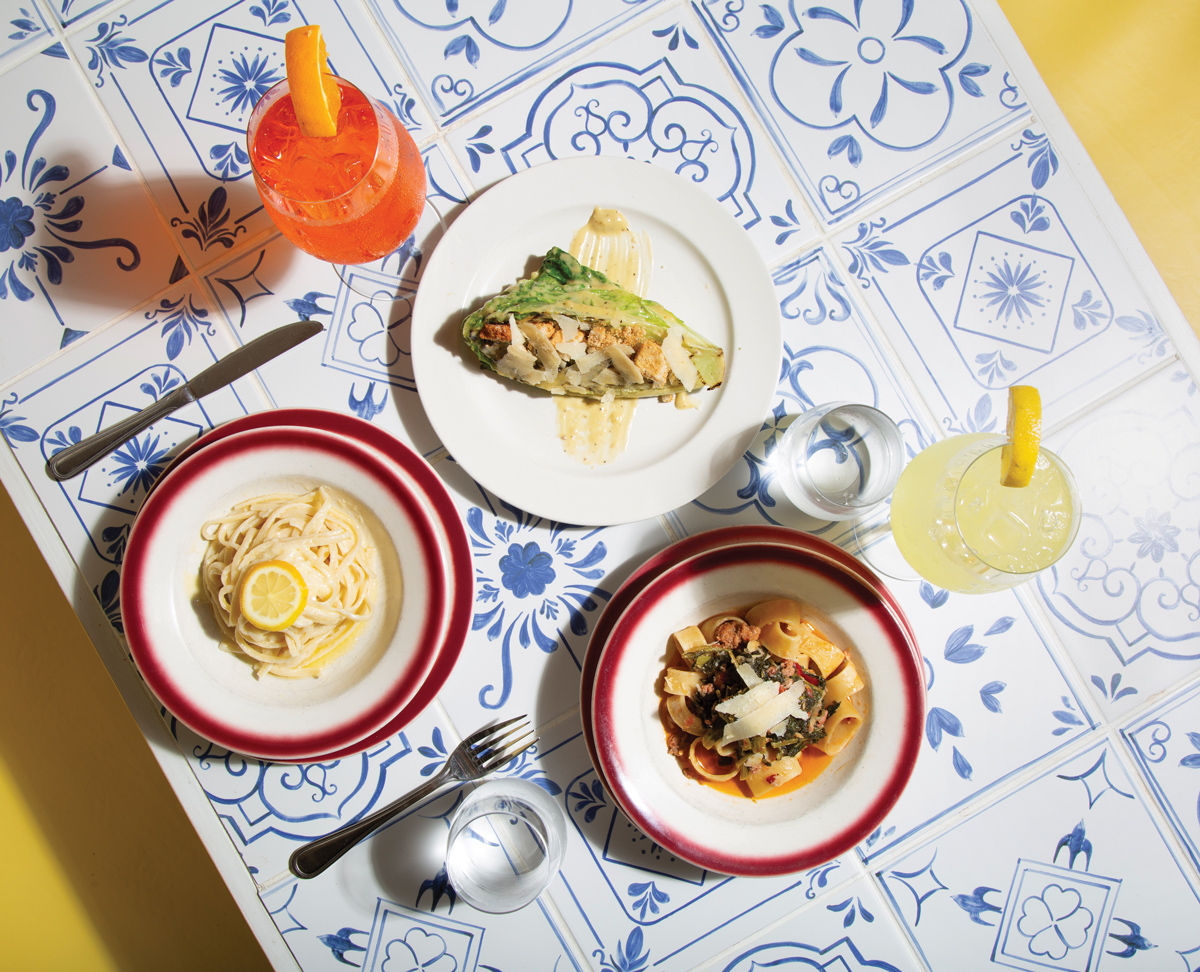
My lunch in the bright new room, followed by an illuminating conversation with Micah, gave me faith in a concept he described to me as his baby. New salads (especially a grilled romaine in the style of an iceberg wedge but with Caesar accoutrements and an anchovy-rich sauce); new sandwiches such as the anchovies and arugula Alici on baguette wrapped in butcher paper; new perfectly cooked pasta (linguine with lemon cream and zest, an Amalfi specialty; tubular calamarata with rapini and ground Italian sausage dressed with fresh herbs and garlic) followed by a flourless torta Caprese reminiscent of a dense and not too sweet chocolate cheesecake all won me and my lunch date over.

Italian wines by the glass and refreshing spritzes up the ante. In addition to dinner seven days a week, Nino’s now serves lunch Monday to Thursday and brunch on Sunday. A place rightly known as an institution is rare enough in Atlanta, but one that knows how and when to bring in new pizazz without compromising its values is almost unheard of and worthy of our respect.

This article appears in our September 2024 issue.

Review: An elegant new space for Michelin-starred Lazy Betty

Lazy Betty Review
A steady hand places the finishing touches on the duck plate at Lazy Betty.

Photograph by Martha Williams

In the competitive world of extreme fine dining, chefs think of themselves first and foremost as innovators. How many ways can they astonish us with their technical brilliance, their hunt for the rarest ingredients, the most unusual presentations? Only cities where big spenders live or travel can support restaurants where virtuosity is its own goal. New York, San Francisco, Chicago, Philadelphia, and, more recently, Atlanta can afford to go head to head with flashy tasting menus at shocking prices. The rest of the world doesn’t care, or watches it on TV.

I often wonder how I would feel about what is often called tweezer cuisine if I were a big guy with a fat wallet and a reasonable appetite. Would I want to stay seated for three hours, munching on minuscule leaves and tiny flowers deposited on slivers of protein with the help of precision instruments?

Tweezers of all shapes and dimensions are hard at work in the kitchen of Lazy Betty, where Ron Hsu and his team, including longtime friend and collaborator Aaron Phillips, bend over plates you and I are meant to revere for their daring and often abstract congregations of miniaturized ingredients.

My first thought about the recently relocated Lazy Betty, now at the former location of Empire State South at the intersection of 10th Street and Peachtree Street, was Well, this is the end of the courtyard! Who is going to spend $300 or more per person looking at a bocce court? The entrance to the restaurant has been moved around the corner, to the cruelly lit lobby of the office building above. Entering the completely transformed dining room, a vision in smooth, light-caramel wood dividers, repositioned bar, and raw-wood tabletops, I realized how casual Hugh Acheson’s previous concept had been. No clatter and clang emerge from the two smaller dining rooms off the main, now splendid, one. A kind of voluptuous calm reigns supreme.

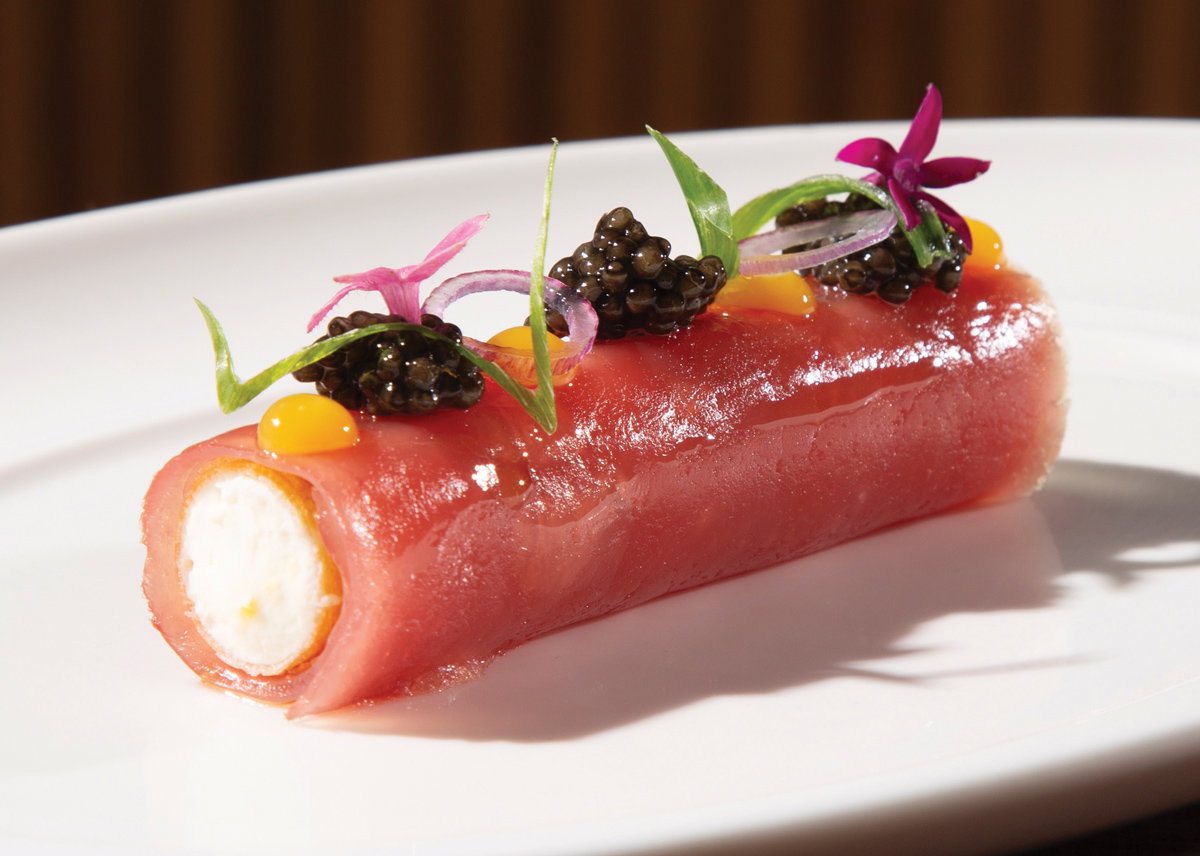
Lazy BettyMoving from DeKalb Avenue to Midtown is an excellent business decision for an ambitious chef with a new Michelin star and all that it entails in terms of target audience. The number of dishes on the tasting menu has increased (seven courses now, plus all kinds of supplements, amuses, and mignardises), and so have the prices ($225, beverages excluded). I love the new menu (be prepared for slight seasonal changes) and its intentional progression from recognizable to unfamiliar. It begins with a bread service consisting of citrusy buns and deliciously laminated biscuits with a borderline distressing bright-red hibiscus butter, followed by a shadow box where tiny savories are nestled in a diorama including foraged moss and pine needles. The first course, a fat cigar of raw bluefin tuna with an evanescent, crisp sheet of brik pastry on the bottom, lemon crème fraiche in the middle, and caviar on top, is one of Hsu’s best creations. Thereafter, one enters into a fussier world, where a delicate, multilayered terrine alternating foie gras and cherry is plated with a few leaves of radicchio and poached endive, a fingertip of roasted ruby beet, a showy oat tuile, minute dots of yogurt meringue, and more.

I gravitate toward the slightly larger and less complicated mini-entrees, such as a duck plate with a slim cut of crisp-tender breast, a bit of leg confit stuffed into a vol-au-vent, foie gras, caramelized miso, and carefully poured rivulets of blackberry gastrique. My favorite, a butter-poached Icelandic cod the size of a hefty scallop, surrounded by peeled and divided fava beans, green tomato caviar, and country ham broth poured from a small pitcher, makes sense to me.

Hsu explained that he works with the best part of his ingredient (say, the tip of the tip of a white asparagus shoot), but I was often lost in a world where, without my waiter’s explanations, I would have missed the ramp-stuffed morels, barely visible onion and fava flowers, or ringlets of this and tendrils of that.

The pastry kitchen, headed by Gus Castro, is exceptional. A citrusy granita with coconut foam is genius as a palate cleanser; an intense domed raspberry mousse, then refined petits fours with relatable, progressive flavors, followed by a few mignardises, revive taste buds fatigued by the previous plethora of garnishes.

For a less committed experience, one could sit at the bar or in the lounge and order a la carte. Other than the caviar service, none of these far-from-casual dishes (for example, cured kampachi with pineapple consomme, chili peppers, finger limes, pomegranate, and mint, or a brioche doughnut with whipped foie gras and raspberry coulis) are on the menu served in the dining rooms. One can get away with a glass of champagne and a few oysters, or an intriguing bourbon cocktail, an Attitude Adjustment, with real smoke trapped in a glass topped with a jaunty cork cap.

I am a big fan of Ron Hsu. Personally, he is relaxed and hospitable. Like his most famous previous boss, the sensational Eric Ripert of Manhattan’s Le Bernardin, he is French-trained and obsessive. I believe in him as a madly talented chef whose attitude toward food should perhaps prioritize intensity of taste over artistic prowess.

This issue appears in our August 2024 issue.

Review: Gourmet sandwiches at The Little Hippo hit all the right flavors

Review: Gourmet sandwiches at The Little Hippo hit all the right flavors
The meatball sandwich, served only on Mondays

Photography by Martha Williams

The first time I went to Jamie and Aaron Russell’s outdoor sandwich restaurant, on the main drag in Avondale Estates, was shortly after it opened in December 2023. It was love at first sight. At that time it was called The Velvet Hippo, named after their silky and sturdy pit bull mix rescue. The place was simply perfect: a great space with Astroturf, surrounded by amenities such as overhead fans and heaters, landscaping, and enclosed toilets. Beyond the creature comforts were the distinctive sandwiches, sides, and cocktails. By February, Meatball Monday had been added (yay!), and the name had been changed to The Little Hippo (okay).

Unfortunately for the youngish couple, a lounge in Durham, North Carolina, had already federally registered the name. One crucial step in starting a new business of any kind is making sure that no one else owns the name you are considering. If a restaurant is called The Real Something Something, you can be sure that there has been a dispute or lawsuit over copyright infringement. But The Little Hippo works for me, both as a name and as a concept.

Gourmet sandwich shops are a significant trend across America (Bunk and the more recent Sammich in Portland, Oregon; Turkey and the Wolf in New Orleans; and the gorgeous but pricey Bona Fide Deluxe—opened in February 2023 by the hipsters at Banshee—near the Edgewood–Candler Park MARTA station). Meanwhile, there are already plenty of great sandwiches in Atlanta—the hot pastrami on rye at the General Muir, the unbelievably cheap egg banh mi at Lee’s Bakery, the spiedie (alas, temporarily retired) at Ticonderoga Club, the Israeli falafel pita at Rina—but nothing iconic. New Orleans has the muffuletta and the po’ boy, Philadelphia the cheesesteak and the roast pork, New York the mile-high deli meats on rye, and Maine the lobster roll.

What many people don’t know about the Russells is that Aaron used to work for Günter Seeger at The Dining Room at the Ritz-Carlton Buckhead, and that he became the official pastry chef of Seeger’s on West Paces Ferry Road. He was nominated for a national James Beard Award. After the unfortunate closure of the high-end Seeger’s, Aaron became co-chef at the much-beloved (now-defunct) Chocolate Bar in downtown Decatur. Many, myself included, still pine for that magic caramel popcorn, which brought in orders even from heavyweight local corporations. I also crave his homemade Rice Krispie treats, made with brown butter, at his and his wife’s Poor Hendrix in East Atlanta. Jamie left her career in academia to run the dining room of Poor Hendrix, one of the true jewels in town. The young couple excels at keeping their places casual, with menus that are short, sweet, and affordable given the high quality of both ingredients and preparation.

A friend of the Russells owned a lot where a dilapidated shed once sat, just past the Tudor stretch. Per the City of Avondale Estates, he was able to raze the building if he rebuilt in the same spot. Rebuilt it was, using cheap siding, and the Russells rented it. The cooler is in the backyard, and ordering takes place at a tiny counter.

I forgive the restaurant for its bizarre hours (just like Poor Hendrix, it’s open Mondays but closed Tuesdays and Wednesdays). I am not crazy about people bringing their dogs to The Little Hippo, oblivious to the fact that their pet may disgrace the Astroturf or bite a fellow canine. But I adore the sandwiches, on soft potato rolls dotted with sesame seeds or classic hoagie buns. My favorite is the Vietnamese-style fried fish, with all the accoutrements of a banh mi jammed into a soft roll. The lamb burger is actually a merguez, a spicy North African lamb sausage, sticking out at both ends in what is a magical, aggressively tasty combination. The hoagies are great, too, with fillings such as Italian meatballs (Monday only), fried mortadella, or Italian charcuterie. Vegetarians get a pita with beets, tahini, and cucumbers. I am also appreciative that none are of a size that could dislocate my jaw. The menu contains more than sandwiches: a phenomenal ginger carrot soup, a divine potato salad included with your order, cocktails such as the Negroni Spritz and a passionate “Marg” that’s strong on the silver tequila and the Tajín spice. I don’t typically need a dessert after a sandwich, but only a fool would fail to order the fudgy chocolate brownie.

Dogs—Little Hippo not included—gambol around. There are children, old folks, and pretty much anyone who understands that fun awaits under a sky that could be blue or gray, in a place where the food doesn’t cost the now-usual arm and leg.

This article appears in our June 2024 issue.

Review: Breaker Breaker turns the BeltLine into a boardwalk

Breaker Breaker Review
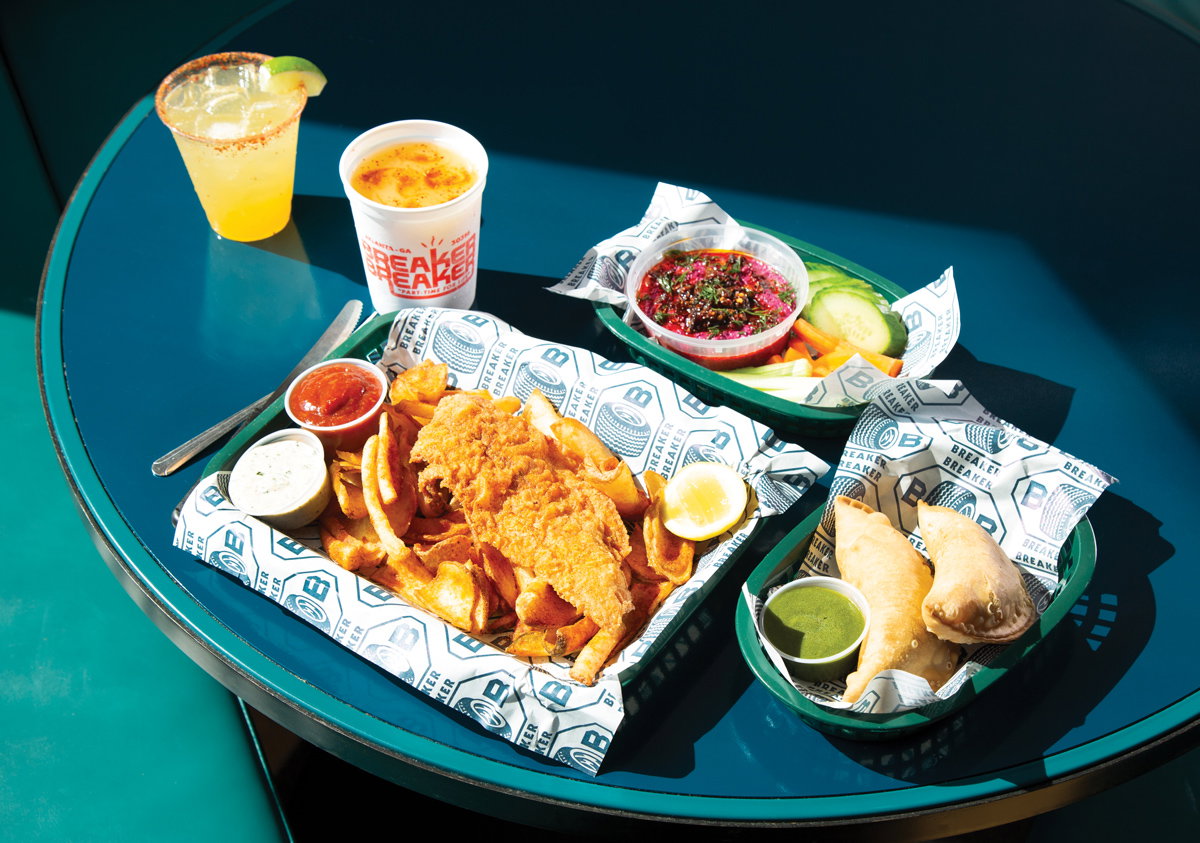
Breaker Breaker’s fried Gulf Fish with fries, empanadas, and roasted beet dip

Photograph by Martha Williams

Fifteen years ago, when I first met Alex Brounstein in the Sweet Auburn Curb Market, where he had just opened his first Grindhouse Killer Burgers, I felt that everything I knew about restaurants was about to change. He doesn’t like it much that I call him the first hipster restaurateur I met (“I wasn’t that cool,” he demurs). But the way he brought together popular culture and novel food ideas in an unorthodox setting thoroughly rattled me.

Everything about Grindhouse was fun. Did we like the burgers more because they had fresh Southwestern peppers and interesting sauces, or because we could slouch at the counter and watch cult movies on the wall? Both! A former lawyer who put away his suits to embrace a less serious way of life, Brounstein was challenging us to quit being so stuffy. We accepted the challenge, and a movement was born.

Brounstein’s new concept, the wildly clever and relaxed Breaker Breaker (921 Wylie Street Southeast), opened late last summer on the BeltLine. It takes full advantage of an unusually uncrowded and narrow stretch, once the home of the historic Stein Steel in Reynoldstown, where giant metal beams were turned into ceiling joists.

The BeltLine turns sharply at Wylie Street, and Brounstein wanted to call the restaurant “Point Break” for the 1990s surfer movie. After his partners vetoed that, Matthew McConaughey appeared to Brounstein in a dream and suggested “Breaker Breaker.” Good, he thought. If they say it twice, they’ll remember it.

What I especially love about Breaker Breaker—besides the fried-fish platters with thick tartar sauce, the fun sandwiches, and the cocktails—is the location. Unlike most of the places constructed closer to Krog Street, there is nothing conventional about the architecture. It consists of linear-stacked concrete blocks, with a huge metal roof original to Stein Steel floating on top. Nicknamed by Brounstein “The World’s Most Expensive Umbrella,” the iconic feature extends to protect a gigantic patio, reminiscent of those along the Gulf Coast beaches of Florida.

The inside of the restaurant has cozy diner vibes, but the best seats are outside or at the bar. All around you, people are having fun. Kids play by the big yellow crane and the other leftover machinery. Their young parents watch them with tall, not-too-sweet, sippable frozen cocktails in hand and fat grouper sandwiches in front of them. Eager bicyclists dismount and lock their wheels, while intowners arrive from a neighborhood where parking isn’t yet a nightmare.

Being fun doesn’t mean that the restaurant isn’t serious about its food. The chef, Maximilian Hines, comes from the now-closed Lawrence, and some of his ideas—always run by Brounstein and his usual manager, now partner, Johnny Farrow—reflect his experience in the world of fine dining. Take Hines’s dips, for example. The fresh, earthy flavor of a chunky beet dip topped with fresh dill—served with raw veggies, but easily recruited to enhance the supermoist hush puppies presented with spiced honey butter—quickly earns enthusiastic approval. Ditto the smoked-fish dip with pickled chilies. There are fun little fried enoki mushrooms atop fried calamari. The fries, shaped like neither sticks nor wedges nor curls, seem to have fallen from a big peeler that respects the irregular form of a potato.

Everything is easily shared: charbroiled oysters with lemon wedges, empanadas generously filled with chicken étouffée with salsa verde on the side, peel-and-eat shrimp, platters of fried fish with fries and Cajun slaw, a Dockside Poutine where crab plays hide-and-seek among the cheese curds. The sandwiches—shrimp po’ boy with slaw, mushroom chopped cheese, properly fried or grilled chicken—hold plenty of appeal. The kids menu offers a mini fish platter and a grilled cheese sandwich. There are no burgers, of course, considering how close Breaker Breaker is to Grindhouse. But there are vegan crab cakes and a bevy of other enticing options.

Everything is easy to execute in an uncommonly narrow kitchen. The only two desserts—ice cream sandwiches (firmly pressed cookies bracketing banana or vanilla ice cream) and refreshingly sour individual Key lime pies—are easy to grab and serve.

Much thought has gone into the beverage menu. Wine boxes; inexpensive lagers; cocktails such as the Mucho Nada (White Claw mango vodka, mango puree, Tajín rim) and spicy Vaya con Dios (habanero tequila, passion fruit liqueur, lime juice)—all are quickly made and lend themselves to repeat orders. As of press time, a rooftop lounge, “Florida Man,” is set to open in late March. [Editor’s note: It’s now set to open in May.]

Unlike the easily replicated Grindhouse, Breaker Breaker is more of a singular concept relying on a unique location. Never before had I thought of the BeltLine as a city boardwalk. But I can see it now, thanks to a team with a real understanding of what makes us happy, and enough chutzpah to generate it.

This article appears in our May 2024 issue.

Review: Southern National is an adventure in haute Southern cuisine

Southern National Review
Duane Nutter

Photograph by Martha Williams

My heart always beats faster in a restaurant when I see something I have never seen before. It isn’t as if I’ve never spotted a chef expediting his own food at the kitchen pass, checking that everything on each plate is how and where it should be, moving a little sprig of greenery by a sixteenth of an inch or calling for his crew to redo an entire dish. But a chef, let alone one who is the size of a giant, standing in the dining room at a long table and quietly fixing all that needs fixing in plain view of his customers is pretty much new to me.

Southern National opened this summer in trendy Summerhill, where it joins Little Bear, Talat Market, and other influential independent establishments. The restaurant announces itself from the get-go as an ambitious showcase. As a young Black chef fresh out of culinary school on the West Coast, Duane Nutter was a disciple of Darryl Evans, Atlanta’s most famous Black chef of the 1980s and 1990s, who hired him for what is now the Four Seasons. Nutter then toiled in the kitchens of Villa Christina and other local restaurants. In 2008, the city and its many visitors became familiar with him and current business partner Reginald Washington, also Black, when Nutter became executive chef at One Flew South in Concourse E of Hartsfield-Jackson Atlanta International Airport. Born in Louisiana, raised in Seattle, Nutter broke all the rules when he put fancy sushi, elevated Southern cuisine, and craft cocktails on the menu of an airport restaurant.

Nutter and Washington departed Atlanta in 2016 to start a restaurant they called Southern National in Mobile, Alabama, Washington’s hometown. The place attracted a lot of attention, down to making the short list of finalists for a regional James Beard Restaurant Award, but eventually closed. Now relocated to Atlanta, the restaurant cuts an even more cosmopolitan figure.

There is something of the showman in Nutter, who has done stand-up comedy and improv on and off throughout his career. Speaking in a voice surprisingly gentle for a man of his size, he refers to Southern National as “a compilation of [his] greatest hits.” Asked about his style, he answers, “I cook my life,” with a blend of innocence and pride. He thinks nothing of depositing shiny black mussels, shiitake mushrooms, and bacon in a thicket of glossy Southern greens or plating tradition-breaking berbere-spiced fried boneless chicken thighs on tender maque choux.

Southern National Review
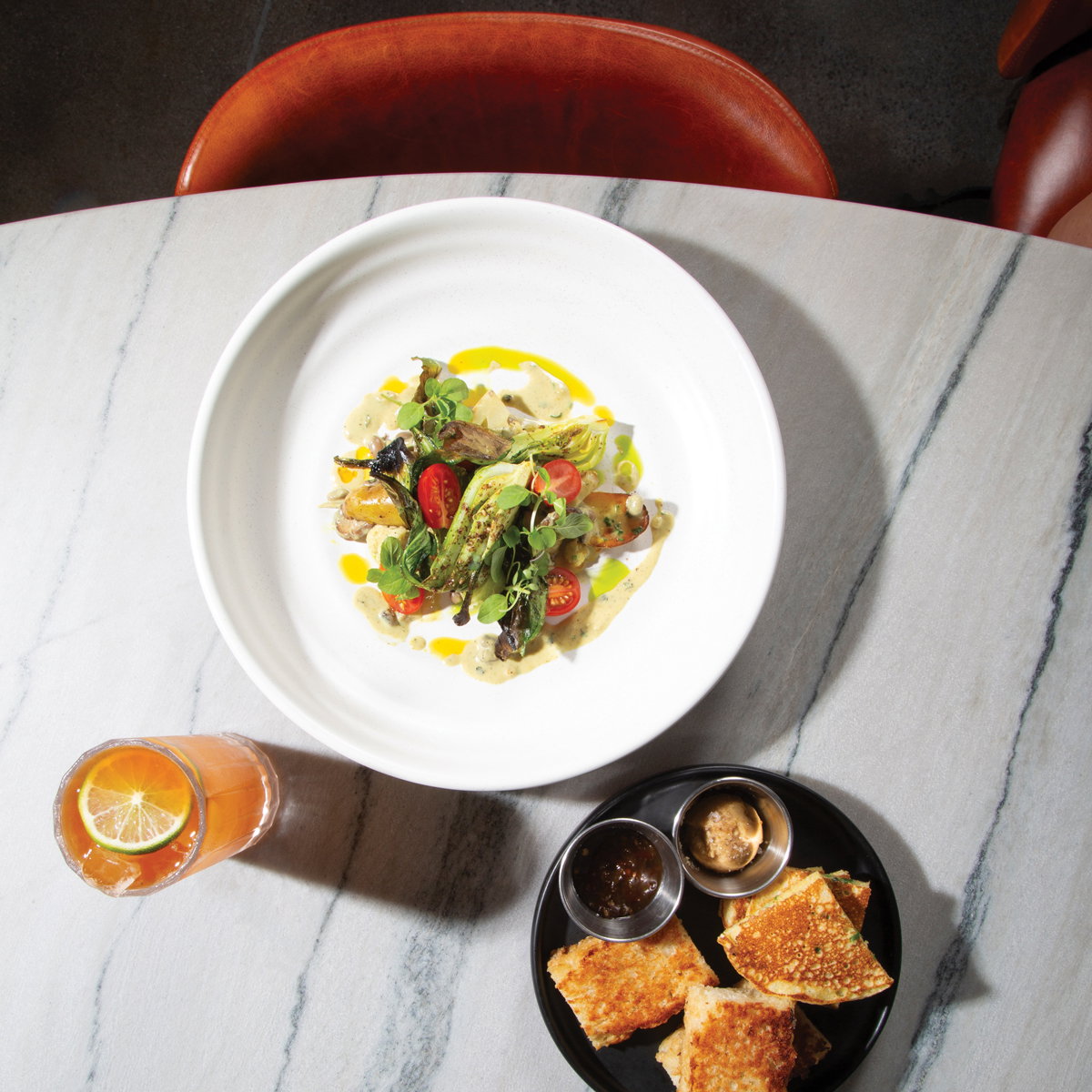
Vegetable plate spiced with za’atar, bread plate, and On the Nose cocktail

Photograph by Martha Williams

The bread service—all-around-crisp sheet-pan biscuits with pepper jelly and jalapeño johnnycakes with cane sugar syrup butter—lets you know that you are in a South that is evolving beyond tradition. A smoked-turkey-and-corn soup with big-pearl couscous and bright green Southern chimichurri sauce, a perky salad of grilled okra and shishito peppers, and an exuberant vegetable plate spiced with za’atar win you over instantaneously thanks to their originality. But there is more: a frequent special of pimento cheese set with pickled goodies against a giant bouquet of homemade crackers, grilled pork chop rubbed with coffee in red wine mustard sauce, sassy baked rigatoni with “lamb burger helper.” Complex and exciting, a finely textured, boozy pecan Old Fashioned float feels like a cocktail and a dessert in one.

The opulent bar mixes clean, well-balanced concoctions such as the Coconut Negroni, the Punch Royal (cognac, champagne, pineapple juice, and lemon), the Prado (blanco tequila, lime, maraschino, egg white, and a fancy cherry impaled on a stick), and the On the Nose (bourbon, lime, ginger soda, with a little dark rum on the top), all created by Greg Best and Paul Calvert, the stars behind Ticonderoga Club, who have cooperated with Southern National since its Mobile days. There is a lot to love about a wine list that roams from Spain’s Basque region to Italy’s Puglia with well-priced, timely selections. The usual suave, calculated neutrality of Smith Hanes’s decor, art by renowned Black artists, and the educated but unobtrusive servers in fancy aprons allow the food to shine in all its colorful glory.

You won’t regret entering Nutter’s world. Instead of looking over his shoulder at what others are doing, he has fun on a path of his own. His head is full of ideas about how to celebrate the South without resorting to cliches. Aesthetically and emotionally satisfying, Southern National tells you that Atlanta is a global city that is changing for the better.

This article appears in our November 2023 issue.

Review: Larakin is a good thing in a small package

Review: Larakin is a good thing in a small package
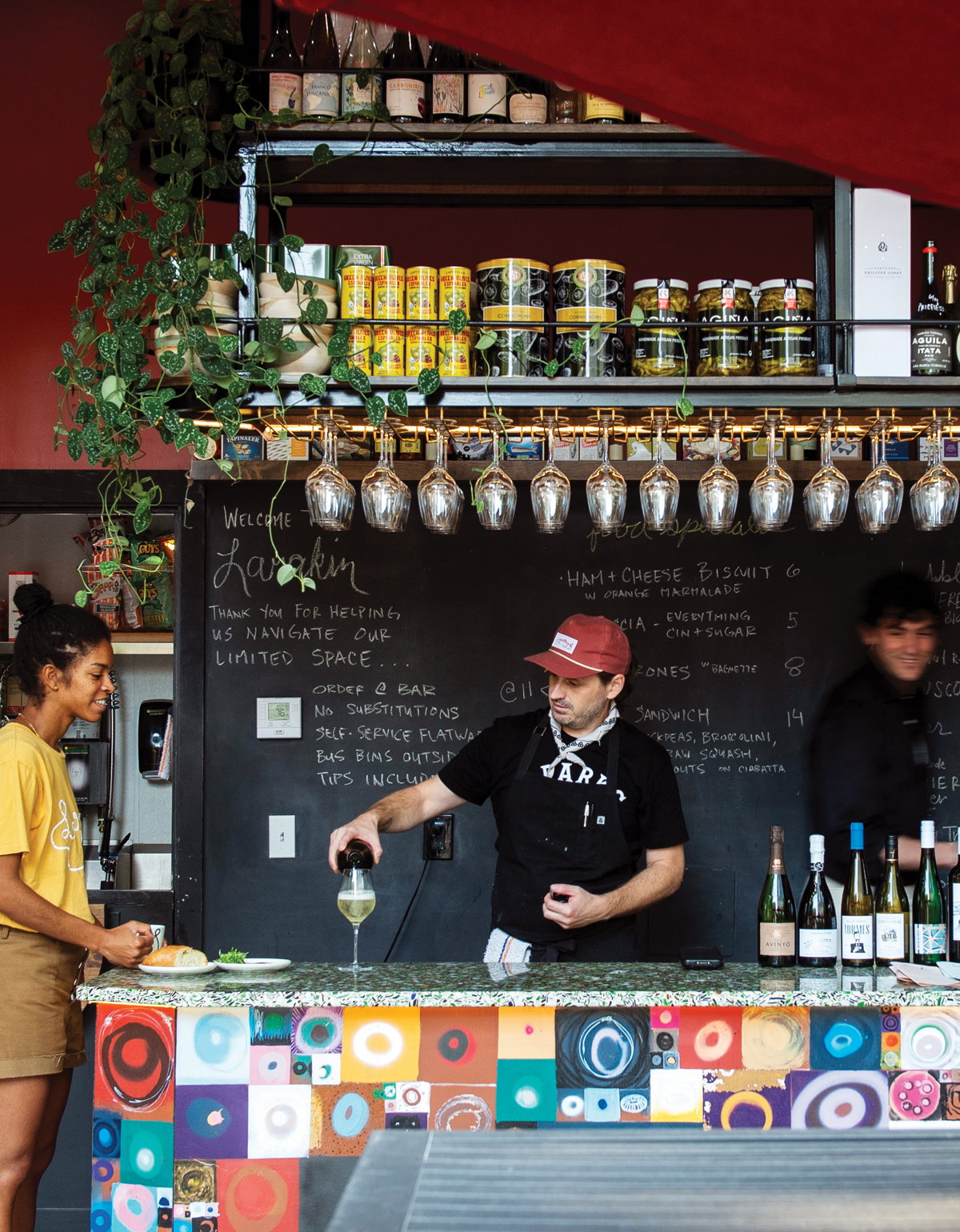
Open from morning till night, tiny, charming Larakin specializes in coffee drinks, natural wines, tinned fish, elegant Euro-inspired bites—and serious fun.

Photograph by Caroline C. Kilgore

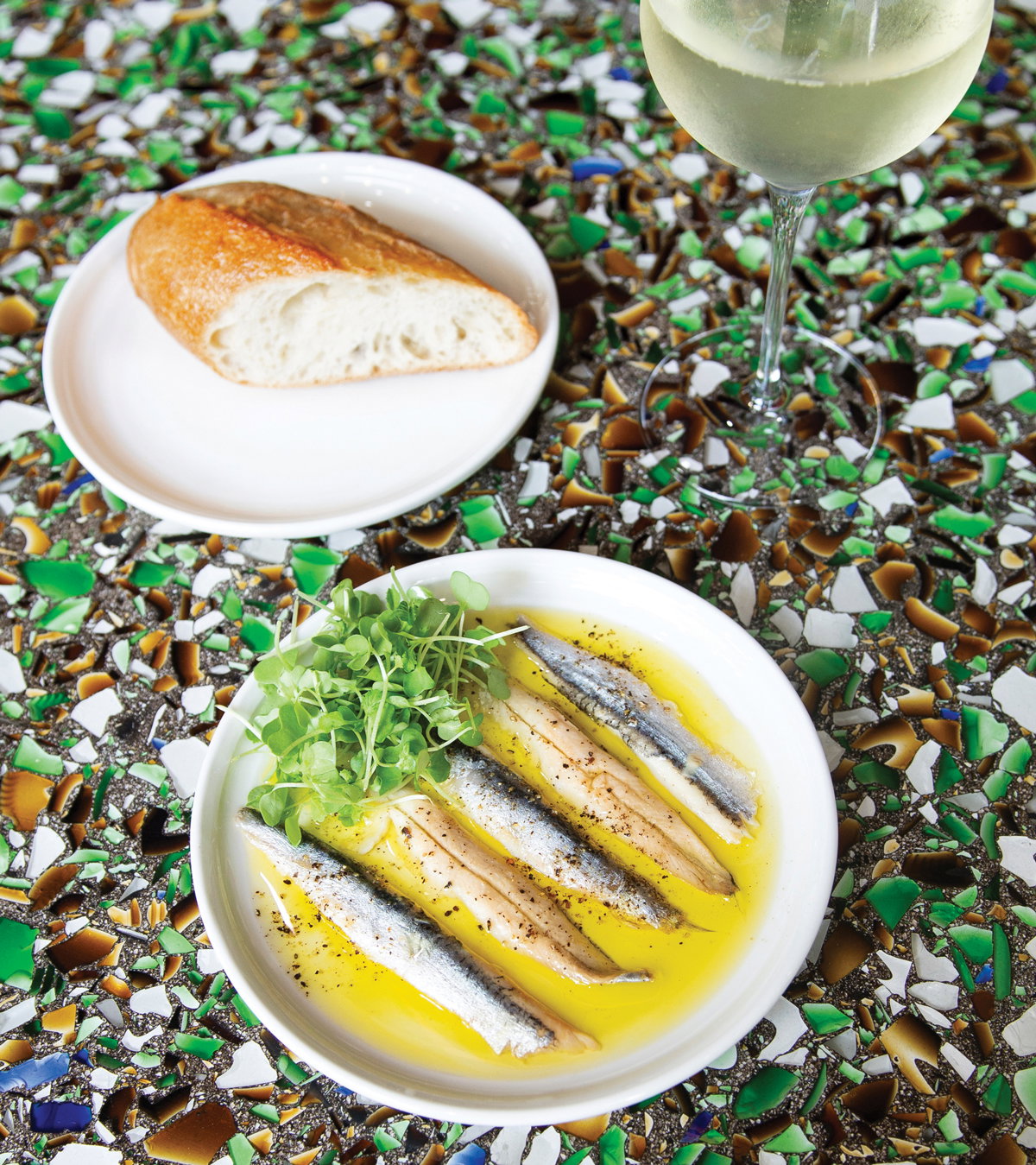
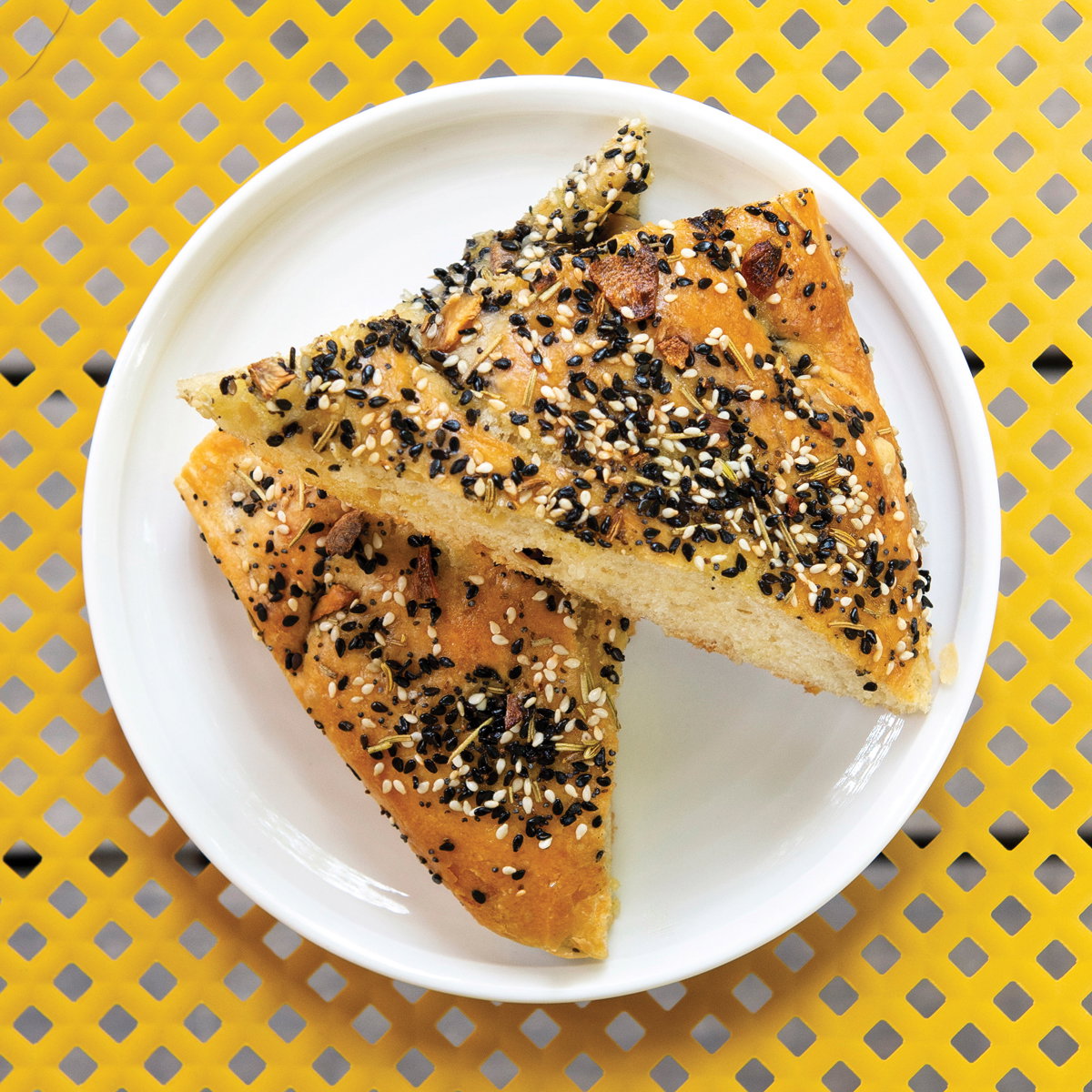
The words adorable and European are never far from my mind when I walk into Larakin, the coffee shop and wine bar that opened late last year almost within sight of Piedmont Park. I climb a few opulent steps engraved with the names of the drinks that wait within—coffee, wine, latte—and suddenly I am in another culture. A wonderfully comfortable patio extends a warm welcome to whoever seeks easy, relaxed sustenance: a perfect hot biscuit, a tasty sandwich on freshly baked focaccia, or a glass of Spanish wine and a plate of white anchovies marinated in lemon and extra-virgin olive oil.

The narrow indoor space offers no seating, but plenty of incentive to down a cortado while standing at the counter; at six by four feet, the kitchen has less room than some walk-in closets. Though the package is tiny, the message is important: One can serve splendid coffee and wine and even some good food out of a small space, if one has the will and talent. The face beaming out of the kitchen/closet belongs to Jordan Chambers, a perpetually curious Missouri native who went to culinary school in Atlanta, and whom locals may remember as the co-owner of Emory Village’s Steady Hand Pour House, which closed in 2013.

Review: Larakin is a good thing in a small packageLarakin (or larrikin) is an Australian expression that can denote a mischievous or rowdy youth or, more generally, someone who knows how to have a good time, conveying something like joie de vivre does in France. Chambers was inspired by a trip down under to adopt it for his new business. The cafe’s treasures start in the morning with a simple breakfast sandwich, filled with a buttermilk frittata baked in a cast-iron pan with Cabot white cheddar, thinly sliced red onion, and chopped guindilla peppers. It’s served on a brioche roll, to which you may want to add a dash of Ding’s Magic Hot Sauce, a local product made by a friend of Chambers’s. Although he hadn’t been to France until recently, Chambers also endeared himself to me by standing up for the famous jambon beurre, a sandwich in which butter, rather than cheese, complements slices of mild Parisian ham. Alas, though, customers had other ideas, and Larakin has switched to a (still delicious) proper ham-and-cheese sandwich.

At Steady Hand, Chambers was an early adopter of made-to-order cups of pour-over coffee; he’s been serving Intelligentsia beans since 2007, and in his new place he eschews syrups, flavors, and even sugar. But he’s no longer just a coffee nerd of uncommon gifts: Chambers has emerged as a wine geek to be taken seriously. I and many others had to wait a solid six months, the amount of time it took to get a full beer and wine license, for his vision to be fulfilled. Now, though, he’s able to pair his glorious conservas—imported tinned seafood such as razor clams, sardines, scallops, branzino, mussels, and small mackerels, packed in fruity olive oil by artisanal European facilities—with compatible wines. (See page 33 for more.) Tinned-fish plates are served with guindilla peppers, cornichons, lemon, and focaccia or chips. Pizzas and focaccias change constantly depending on what’s around: Combos such as tomato, spicy onion, basil, and microgreens, and feta, basil, and Calabrian chilis, have been big hits, and look out for the occasional refreshing gazpacho as well.

Review: Larakin is a good thing in a small packageLarakin approaches wine the way it does coffee: no additives or stabilizers, minimal sugars and sulfites, small production. The list changes frequently, and the blackboard chalks up selections by the glass that may include a sparkling Gramona III Lustros Brut Nature, a skin-contact Casal de Ventozela Contatto, even a Txurrut Basque Vermut or an El Maestro Sierra Oloroso 15-year sherry. Beer and sangria haven’t been forgotten, nor has the imperative to make things fun: Hosting events like Sunday-afternoon music parties with resident DJ Indiana Robbins, Larakin is a gift to its neighborhood in countless ways. It deserves a place on your radar.

This article appears in our October 2023 issue.

Review: The new Holeman & Finch has less offal, but is still pretty good

0
Holeman & Finch Public House Review
The Lady Edison 36-month ham plate, right, is a little slice of hog heaven—and part of a broadly meaty menu at Holeman & Finch, which finally reopened this year in Midtown’s Colony Square.

Photograph by Martha Williams

Fifteen years ago, a somewhat hidden South Buckhead gastropub became a local and national sensation, based on an approach to food and drink that made it one of the coolest culinary kids in town. But yesterday’s Holeman & Finch is not today’s Holeman & Finch.

You’ll still find the cool kids inside the new space at Colony Square, as I did on a recent visit. It happened to be the day Michelin announced it was bringing its famous restaurant guide to Atlanta, for better or worse; conversations about what the news could mean for the city’s restaurants could be heard down the bar as I ordered my first cocktail, the spritzy, gin-based Ribbons. Balancing dry vermouth with apricot and amaro, it was a good enough aperitif, though my favorite was ultimately the Crescent Wing, served in a coupe and reminiscent of a Paper Plane. Tangy, with an earthy depth from Madeira, the drink seemed aesthetically and spiritually connected to the classic cool that H&F appears eager to re-create in its new digs.

The decor leans into the clubby appeal of the original—a retro, industrial-funk hangout that closed in 2020, and whose planned move to Midtown was delayed by the pandemic. That vibe felt more organic further up Peachtree Street than in the almost-hip corporate courtyard of Colony Square. But that doesn’t mean the new look is a miss; the mix of warm wood against cold metal, just barely reflecting the dim lighting, does a decent job of mimicking the original H&F’s edgy Gen-X/Millennial experience. Hanging hams flanking the open kitchen, and unique art pieces in each dining booth, prove the vibe was capable of travel, at least partially. But in reality, the OG Holeman & Finch will never be duplicated, for several reasons. (Another: the fact that spirits master Greg Best—a partner at the original H&F, where he played a key role in bringing craft cocktail culture to Atlanta—now makes his drinks at Ticonderoga Club and Southern National.)

Opened by Linton and Gina Hopkins in 2008—when Buckhead was still figuring itself out after pushing out Black partygoers and blaming Ray Lewis—Holeman & Finch caught lightning in a bottle. Other, stuffier Buckhead restaurant institutions were becoming as dated as the wilted lawyers who held court in their private back rooms, likely formulating early plans for Buckhead City. Then, along came this strange little spot across from the Hopkinses’ fine dining place, Restaurant Eugene. Rather than steaks and lobster, it served what we were told was one of America’s best burgers, taught ATL how and why to drink Fernet Branca, and specialized in whole-animal cuisine. Hell, it even had a “Parts” menu.

The new H&F briefly had a “Parts” menu, too, during its soft opening. It included veal brains. Today, Gina and Linton, along with their son/manager Linton II, have wisely pared down the menu to parts more known. The solid roasted bone marrow remains, but we’re no longer in an area of town where youthful blue bloods relish in proving their street cred by eating offal. In Midtown, veal brains don’t make sense.

Smartly, the Midtown menu—now divided into oysters, cheese, charcuterie, and “small plates” that range from chicken livers to carbonara alla chitarra—is easier to digest. The Lady Edison 36-month ham plate, at a very reasonable $12, is a sweet and salty spread of sliced hog heaven that I paired with chevre at the bartender’s suggestion. But it’s the more approachable dishes—red snapper meuniere with new potatoes and wide-cut collards, roast chicken with tomatoes, parsley, and thick croutons in vinaigrette and natural jus—that shine. My advice: For added veggies, go for the simple lettuce and herb salad, or the Woodland Gardens bok choy in hot sauce and sherried shrimp butter, over the tasteless kilt greens in bacon fat.

Holeman & Finch Public House ReviewI steered clear of the classic menu items that made Holeman & Finch such a revered brand in Atlanta, like the beloved Crunchy Gentleman sandwich and the famous cheeseburger (which is almost $10 cheaper at Ponce City Market). I do regret not having the option to taste Linton’s Sapelo Island red peas, which weren’t on the (frequently changing) menu when I visited. Still, it’s good to see the Hopkinses’ scrappy, highly celebrated rock-and-roller restaurant come back from the uncertainties of Covid. Filling in the final pieces of its former self will take time, but this stylish reminder of Atlanta’s indie dining origins—executed well enough, if perhaps less imaginatively—remains sufficiently gutsy to justify a repeat visit.

This article appears in our September 2023 issue.

Review: Omakase, y’all! Taking stock of Atlanta’s latest fancy sushi spots

Review: Omakase, y'all! Taking stock of Atlanta's latest fancy sushi spots
A tasting of three different grades of Hokkaido uni, or sea urchin at Omakase Table

Photograph by Martha Williams

I liked eating in Japanese restaurants better before the omakase frenzy took hold. Yes, it could be stressful to tell trusted chefs that you wanted to give them carte blanche: “Omakase,” you whispered (the phrase means something like “I leave it up to you”), and maybe a number between $100 and $200. The chefs then reached deep into their inventory to create menus reflecting the availability of products and their seasonality. When you grew satiated, you said, “I have had enough,” and that was it. Receiving every piece of sushi one at a time from the chef’s hand, you felt superior to the masses eating big platters nearby.

In recent years, though, omakase around these parts has morphed into something more like a prix fixe dinner, featuring a tasting menu with sometimes as many as 22 courses. Practically speaking, the formula makes economic sense. It requires a smaller staff and a smaller battery of cooking equipment than a conventional restaurant; the dining room is usually compact and features a single counter. Atlanta now has at least three dedicated omakase restaurants, all within striking distance from one another on or near Howell Mill Road. More are on the way.

I’ve already told you, in a December 2022 review, what I think of Mujo: It is the epitome of fine dining ($225, beverages excluded) and a fascinating showcase for the traditional Edomae style of sushi, which features cured fish that’s had time to relax and deepen in flavor. Let me add a few others for your consideration.

I had many delightful dinners at Sushi Hayakawa: For 15 years, the restaurant was a staple—and a famously difficult reservation—on Buford Highway, where its chef, Atsushi “Art” Hayakawa, was a jovial dude from Hokkaido who had the best salmon caviar in town. It relocated recently to the Star Metals development and streamlined its name to, simply, Hayakawa. The reformulated restaurant features a severe dining room with a long, austere counter, with the chef working at a distance from his customers and wearing a microphone. The dishes I remember best from the costly meal ($315, beverage and service excluded) are the clear soup with pearly scallops, the simmered conger eel with sansho pepper, the remarkable bluefin tuna, and the spicy pollack roe over rice cooked with dashi broth and green tea. The meal included too much rice for my comfort, but the quality otherwise never faltered.

Review: Omakase, y'all! Taking stock of Atlanta's latest fancy sushi spots
Ethereal tamago at Omakase Table

Photograph by Martha Williams

Leonard Yu’s Omakase Table ($235 before tax and gratuity) will save you money because it doesn’t have a liquor license and you can drink what you bring without a corkage fee. Yu, who is from Indonesia, rose to fame through his pop-ups at Brush Sushi Izakaya. As at other omakase restaurants, dinner starts with a series of tiny appetizers known as otsumami—a few pearls of lustrous caviar, a bite of monkfish liver. As the main event got underway, I particularly loved watching the chef arranging precious pieces of seafood atop carefully shaped fingers of rice—almost as if he were a potter—and working on the temperature and texture of items such as a rare cherry blossom trout, a wondrous sharkskin sole topped with a bit of its own fin, an unusually shaped cockle, a delicate splendid alfonsino, a quickly poached striped imperial prawn. Young assistants stood by to explain the nature and provenance of a female squid that appears only in the spring, or an almost crunchy amberjack warmed by pressing binchotan (Japanese charcoal) on its surface. Yu impresses connoisseurs with his ethereal tamago, a Japanese omelet flavored here with sweet shrimp; it’s a dish that normally does very little for me but was the revelation of the meal.

Editor’s note: When this article went to press for our August 2023 issue, it included Jason Liang’s Cuddlefish. However, Cuddlefish closed in late July. As this article was not published online until late August, we have removed Cuddlefish from the digital version.

This article appears in our August 2023 issue.

Review: This Poncey-Highland restaurant is the best of the wurst

The Best Sandwich Shop/Wurst Beer Hall
Hearty sandwiches

Photograph by Martha Williams

Not long ago, on the same morning that I reluctantly forked over $2.17 for a small pouch of M&M’s at my regular gas station, I paid $7 for a cortado and an excellent breakfast sandwich—eggs and bacon on a soft sesame-seed roll. How could such a thing be? In any event, I have since returned almost daily to the Best Sandwich Shop and the Wurst Beer Hall, chef Shaun Doty’s new restaurant combo in the former Moe’s space on Ponce de Leon Avenue.

An Oklahoma native who once worked at the Ritz-Carlton Buckhead and has opened restaurants including the Federal and Bantam + Biddy, Doty has gotten this spot up and running with the help of vice president of operations (and life partner) Natalie Samples. He’s already doing remarkably well with a concept that seems pretty brilliant to me—“bringing the North to the South”—and a commitment to both quality and affordability that feels increasingly rare these days. As any New Yorker can tell you, one can still get a cheap egg sandwich and a cup of coffee on every corner of the city, courtesy of an old-fashioned food cart or a diner. In Atlanta, it’s impossible.

The Best Sandwich Shop/Wurst Beer Hall
Cortado

Photograph by Martha Williams

Well—nearly. Nowadays for breakfast, I head to Best Sandwich, where the basic egg-and-cheddar option goes for $3.50; there’s also fresh orange juice and halfway decent hash browns. By noon the menu grows to include daily soups (matzo ball, tomato) and a lot more sandwiches. The latter are divided between hot (e.g., the Farmers Daughter, with seared Halloumi and roast peppers, and the Immortal, a meatball sub with San Marzano tomato sauce and mozzarella from Capella Cheese) and cold (the Sunset Blvd, with turkey, bacon, and avocado), and all are easy to enjoy in the cozy, tiny dining room.

An even bigger draw: the beer hall, which occupies the other, larger part of the building and pours Bavarian lagers by the liter and half liter. (The sandwich shop closes at 3; the beer hall opens at 5.) The Wurst Beer Hall specializes in hearty fare: currywurst and french fries, smoked pork chop with brown butter and sour cherries, and fish and chips, with sides like braised red cabbage and an unusual Ukrainian beet salad with kidney beans. Yes, you can order crowd-pleasers like chicken wings and humongous pretzels with cheese sauce—but I prefer bangers and mash or, if I can gather enough people, the giant sampler platter of four sausages, served with sauerkraut and German mustard. (Doty’s economizing extends to the dinner hour as well: He doesn’t buy the sausage from some local hotshot monetizing his meat trimmings, but rather from Patak Meat Products, an Austell-based old-world butcher that has truly mastered the trade.)

The Best Sandwich Shop/Wurst Beer Hall
Pork knuckle confit

Photograph by Martha Williams

The Friday and Saturday special? A monumental pig knuckle, simmered in duck fat for 12 hours and served with kraut, pickles, and country bread, that the chef himself may be willing to carve tableside. Skip the Aperol spritz (good advice for any beer hall) and glory in the thoughtful selection of brews—mostly lagers, including my favorite, Ayinger Pils—and homey dining room, with several TV screens that may have a soccer game on. There’s outdoor patio seating too—a bona fide beer garden.

This article appears in our July 2023 issue.

Follow Us

69,386FansLike
144,836FollowersFollow
493,480FollowersFollow

NEWSLETTERS