

Home 2014

Archives

How it feels to patrol the toughest neighborhoods

By now know that in the spring, these blog posts are chock full of festivals. And this one is no exception. But if you’re suffering from festival fatigue, this pre-holiday weekend has a lot of quirky activities, from dogs on a catwalk, to a quest for the greatest laugh, to ballerinas causing a ruckus. – See more at: http://www.atlantamagazine.com/agenda/2014/05/15/atlanta-events-may-15-16-17-18#sthash.ShfxOYsa.dpuf

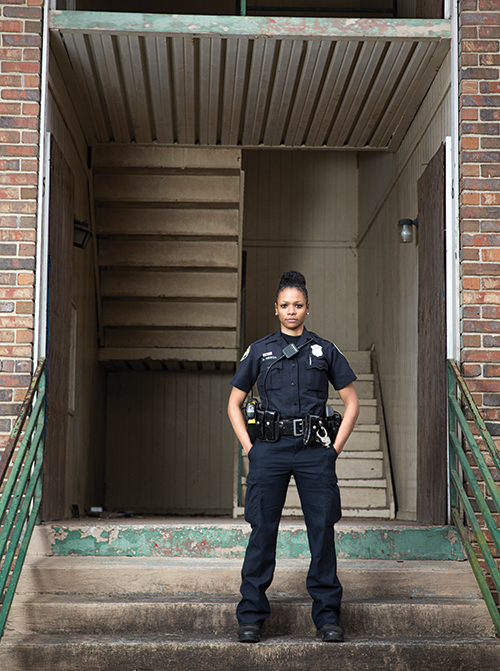
Photograph by Fernando Decillis

Ashley Gibson, 25, Atlanta Police Department Officer, Zone 3

A family dispute is flaring in a cramped kitchen in southeast Atlanta when Ashley Gibson arrives. Gibson is five foot three, with pearl earrings and pink-painted fingernails, her hair swept into a high bun that recalls her cheerleading years. Despite her slight stature, Gibson doesn’t flinch. The Gwinnett County native graduated the police academy two years ago and requested to work Atlanta Police Department’s Zone 3, a rectangular swath of generally tough neighborhoods stretching from Downtown to near the airport. Over the course of a dreary afternoon, Gibson, nicknamed “Smiley” for her sunny disposition, investigates an attempted burglary, races to assist officers at a high school brawl, sternly advises a pedestrian to pull up his pants, and tells one bozo on a four-wheeler to take it home. In the kitchen, Gibson settles everybody down and persuades one unruly teen to dole out apologies and hugs. The boy’s mother praises Gibson: “Girl, you good!”

I wanted to come here. I figured, I’m a big girl, I might as well start with a big department, where you can get good experience.

I don’t come out here judging people. Everyone has a story. You never know somebody’s struggle.

Couple weeks ago, I arrested a twelve-year-old for two felonies. She brought 4.7 grams of weed to school and tried to sell it. I was sad for her. She’s so young. They don’t realize your record follows you.

From what I hear, they used to call Zone 3 “the war zone.” It was a little more intense than it is now. Some zones are prettier than others. This isn’t the pretty Downtown area of Atlanta. Crime happens.

There are scenarios where you might encounter a subject that has a gun or knife on them. I wouldn’t say it’s an everyday occurrence. I’ve never had to pull my gun out. In some situations, if you can talk to people, that can get you a long way, that verbal judo.

Sometimes, being a female officer, people automatically underestimate you. That’s just a fact of life. To be honest, the females are the ones that give you a harder time than the males. I can’t say specifically why. People say, “You’re a police officer?” People are so quick to say that, but they can’t explain it, you know? What’s a female cop supposed to look like?

My dad wishes I would have gone into criminology instead of policing, but he still supports it. My mom tries to not let me know she worries. You have your own family, but here, in the work environment, in the zone, especially on [evening] watch, those officers really do become your brothers and your sisters. I truly believe that.

I ultimately want to be a homicide detective. I’ve always had that goal, ever since I was little. I know it’s kind of weird, especially for a girl. Homicide’s different, but I still view it as helping people in need.

This article originally appeared in our May 2014 issue.
How it feels to send someone to prison

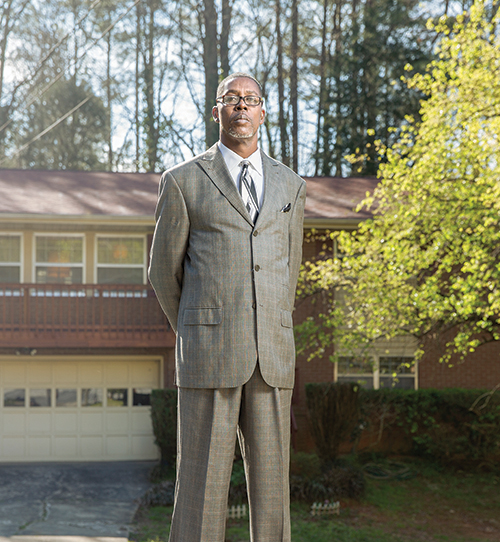
James Bodiford, 64, Chief Judge of Cobb Superior Court

Thirty-seven years ago, at age twenty-seven, James Bodiford quit a job selling magazines to attend law school. In 1985 he was appointed chief magistrate judge of Cobb County, and in 1994 he was elected to Superior Court. Bodiford has presided over some of the region’s most prominent trials, including Fred Tokars, who was convicted of masterminding the murder of his wife; Lynn Turner, the so-called anti­freeze serial murderer; and Brian Nichols, the Fulton County Courthouse shooter. But as he approaches retirement this year, Bodiford says his decisions in non-capital cases will stay with him the most.

Some people think that sentencing a convicted murderer is the hardest. It’s not. It’s easy. Because in Georgia, murder gets a life imprisonment. If a jury convicts someone of murder, I know what I must do.

But on most offenses I have discretion, and I value that discretion. It weighs on me. Now, if you have a fourth-time convicted felon, then you’re not really thinking too much about that individual—if his life is lost here on Earth, that’s the way it is. But often you see a young person who has just made a mistake. As a judge, you have his or her complete life in front of you—even if you aren’t sentencing them to life in prison. They have parents, just like you did. Sometimes they are parents, like you are. They have friends, fellow church members, folks that believe in them. And you know that your sentence—be it two or five or twenty years—is going to have a huge impact not only on the convict but on the community.

And in the toughest cases, there may not even have been criminal intent. One case: A young woman was with her family in a van on their way home from a jewelry store, where she had taken her parents to show them the engagement ring her fiance had picked out. Meanwhile, in the oncoming lanes, two young men were drag racing when one of the drivers lost control, veered across the line, and crashed into the van. The daughter was killed. All I can do, as a judge, is punish those responsible and hand out a sentence. I try always to balance the victims and the harm the crime has caused the community against the criminal. In this case, the criminals were young, with no criminal records. They were educated, had family and community support. There was no alcohol involved. They didn’t mean to kill anyone. But they did. And did they show remorse? Accountability for their actions? Well, they chose to go to trial, which is absolutely their right. Rather than admitting guilt and saying they’re sorry, they decided to take their chances. A jury found the young men guilty of vehicular homicide. I gave them the median of seven years. Was it the right decision? Was I too harsh? Too lenient? Hard to say. I don’t regret it. I’ve run into people to whom I’ve given a second chance who shake my hand and thank me for helping them turn their lives around. I’ve seen others I let slide for small offenses right back in my courtroom for more serious crimes. I don’t have a crystal ball. As for these two young motorists: It’s been years since their release dates, and I haven’t seen them.

This article originally appeared in our May 2014 issue.

How it feels to shoot an intruder

Photograph by Fernando Decillis

Eugene Thomas, 55, Retired Security Guard and U.S. Army Veteran, East Point

A gunshot rang out the morning of December 31 last year, and it’s been echoing in Eugene Thomas’s mind ever since. Thomas and his fiancee, Gayle Ikeman, live on a cul-de-sac in a sleepy neighborhood. Police and firefighters have honored the couple for their volunteer work with neighborhood youth, including the back-to-school barbecues they’ve organized and paid for themselves. The local kids call them “uncle” and “auntie.” So Thomas knew the young man smashing through his back door with a shovel that morning could not be from the neighborhood. Alone at the time, the former soldier and personal security officer retrieved his 9mm handgun and fired once at the stranger, whom police later identified as Natavius Willingham, twenty-one. In the wake of the shooting, Thomas became the type of steadfast homeowner cheered by gun advocates. But for Thomas, life since hasn’t been so simple.


I grew up a good old country boy. Daddy used to take us hunting. We always had a gun or something around the house. I’ve always kept one around, just in case.

I still had on my pajamas and my robe. As I’m pouring my glass of orange juice, the doorbell rang. I’m thinking it’s probably a solicitor or somebody. I peeked out the peephole. I didn’t recognize the person or the vehicle.

I went downstairs, where we have a little living area. I’m like, What in the devil’s going on? That ain’t no tree falling. That sounds like somebody’s breaking in. I grabbed our handgun, and as I’m coming up the steps, heart racing, he’d begun to bust out the den’s double sliding doors with the shovel. As I get to the top of the steps, he literally had busted through. I just fired one time to stop the threat. I wasn’t trying to kill the young man, but he wasn’t going to come any farther, either. I heard him make a screaming noise, and he went around the side of the house.

I was trying to call police, trying to dial Gayle at work. I couldn’t really get the numbers right. Then I calmed down enough to call 911.

After all the dust settles, if you have any type of heart, you’re going to feel some remorse. Every time I walk up these stairs, I think of him. Every morning I go get the newspaper, I think of him, because he collapsed and died right out there in the driveway.

You know, I have children around the age of this young man. I’m not a natural-born killer. I’ve been around buddies at the bar, drinking, saying, “Oh, man, I’ll kill you.” It’s just a figure of speech. But when it actually happens, it’s a whole different animal. It eats at you.

I used to be a very relaxed sleeper. Now it seems like the devil keeps trying to replay that scenario in my head. I just get up and read the Bible. I feel like I’m still in that react mode. I’m still very edgy.

Through this terrible incident, I just felt the need to go to church and pray. I gave my testimony, and I can’t explain what happened. I had no intention of joining the church, but a little voice spoke to me: The time is now. You’re not promised tomorrow. I just went weeping like a baby. From that day, my life has really, really changed.

I pray for this young man’s family and ask the Lord to have mercy on his soul. But at the same time, if I had to do it all over again, I wouldn’t change a thing.

This article originally appeared in our May 2014 issue.

How it feels to survive a shooting

Bryan C. Ryser, 60, U.S. Navy Veteran and Hunting Club President, Loganville

On a hot day in 2008, on a street of middle-class homes in Gwinnett County, Bryan Ryser was putting his lawn mower away when his neighbor, Charles Quinn, shot him in the back. Other neighbors had nicknamed the schizophrenic Quinn “Wi-Fi” because he berated them for sending messages to his brain via cell phone. He was known to mow his lawn without starting the mower. Three months before, Quinn had been arrested on simple battery and criminal trespass charges for attacking a seventeen-year-old girl in the neighborhood. And now Quinn was charging at his neighbor with a handgun. What happened over the next few moments—before Quinn inexplicably retreated to his home and killed himself—would strip Ryser of his cherished hobbies: snow skiing, ice hockey, scuba diving, playing his guitar.

The first shot shattered my acetabulum, blew my hip apart. The only way I can describe the impact is if someone came up behind you with a bat and knocked you to your knees. For whatever reason, I knew I’d been shot. Probably within three to five seconds, you feel it. The bullet wound itself was just like a searing, white-hot poker rammed through you. It’s just an indescribable heat.

I turned on my knees and said, “You need to stop now.” Put my hand up, and he blew my thumb off. I thought, I’m dead now. I started crawling to the back door, and he was just walking behind me, shooting me. Two more times [in the shoulder and lower back]. I was scared to death.

I was lying there, making my peace, praying to have my family taken care of, and he stood over me. I could see his foot. I thought, Just don’t breathe, don’t do anything, just pray that he walks off. It was dead calm. Wasn’t a car, an airplane, a bird, a dog. Then I heard the fifth shot [attempt, but it was] a misfire. That probably would have been the finish-off shot.

I didn’t hear him leave. He never spoke, never said a word. He didn’t have an expression on his face—just a deadpan, glazed stare. Whatever he saw, I don’t think it was me. He didn’t look at me like a human to a human.
I started crawling for my life [around the house, to the kitchen]. I laid there, made my 911 call. They showed up in force. Two Gwinnett firefighters, William Jennings and Phillip Kleck, strapped me to a board and got me out before the scene was secure. They saved my life.

[At Grady Memorial Hospital] there was a female doctor; I wish I knew her name. She put her face in mine, almost nose-to-nose, and she said, “We’re going to save your life now.” I started crying. I was like, “Thank you!” Then I was out.

Total of eight [surgeries], including three on the hip. I’ve had acupuncture, every kind of therapy. Too much medication. I don’t just jump out of bed in the morning.

There’s stuff you can measure—leg flexion and those sorts of things. But the immeasurable things are probably the worst. I’ve lost trust. I pull up at a QuikTrip and I stop, look all around the parking lot. Someone slams the door behind me, it raises the hair on my neck. I don’t sit with my back to the window, or to the door. No, no, no. It sounds kind of crazy, but that’s just the way it is. This isn’t like television; I’m not okay next week.

People say, “You know how lucky you are?” I’m not lucky; I’m fortunate. There’s a big difference. No matter where I am, Walmart or whatever, people ask, “How are you?” I say, “Fantastic!” And I say it loud enough for everybody to hear.

This article originally appeared in our May 2014 issue.
If crime rates are so low, why am I so worried?

I’m driving home, just 150 yards from my house, when I see a white Chevy Tahoe in my driveway. According to social media and local news blogs, it’s the car a crew of burglars has been using for about a week to break into homes all around us—Oakhurst, Kirkwood, East Lake. The fifteen seconds it takes to get to my driveway are time enough for the following to occur:

• To feel my heart rate skyrocket.
• To say, “Oh, s–t.”
• To answer, “Nothing,” when my three-year-old daughter asks me what I just said.
• To see that the Tahoe is actually in my neighbor’s driveway.
• To see the Tahoe has a Florida tag, not the Georgia tag seen on the suspect vehicle.
• To remember my neighbors have out-of-town guests staying with them.
• To feel like a schmuck.

This is my brain on social media.

Neighbors had posted a BOLO (that’s “be on the lookout”) to Facebook, Twitter, local blogs, and my neighborhood Yahoo Group about a Burglarmobile. I had “liked” and retweeted the posts. My mind drifted into a state somewhere between vigilance and paranoia, hence my reaction when I saw one of the bestselling cars in America (in the most popular color!) appear in my neighbor’s driveway. When the Tahoe in question was eventually found and an alleged ringleader arrested, crime-related social media posts ceased. My resting heart rate returned to normal . . . until, of course, the next BOLO.

There is one factor notably absent in my hypervigilance: the actual prevalence of crime. I moved to Decatur in 2007. Since then, property crime and violent crime have dropped significantly. In 2007, 732 property crimes and 202 violent crimes were reported inside the city limits. Last year there were 690 and 128, respectively. In other words, the overall number of crimes has dropped more than 12 percent. When you consider Decatur’s population has grown by roughly 1 percent per year since 2007, the per capita crime rate is dropping even faster. And while there are ups and downs by year and by neighborhood, violent and property crimes have been trending down for years.

Collectively, metro Atlantans are safer today than we’ve ever been, but the ambient level of fear of crime, as expressed in the number of conversations we have about crime (and my blood pressure), remains stubbornly and perhaps irrationally high.

Are Mark Zuckerberg, et al., to blame for this apparent gap between the low rate of actual crime and high rate of anxiety about crime? Actually, yes. Social media is an amazingly powerful megaphone and echo chamber of neighborhood-level worries. Fifteen years ago you had to talk to your neighbors to hear about their fears. Today fear notifications are pushed to our smartphones. Instead of giving us a clearer picture of crime, this up-to-the-second stream of information is distorting our view. A Pew survey released in December shows 56 percent of Americans think gun crime is worse than it was twenty years ago. In fact, the gun homicide rate in the U.S. declined 49 percent from 1993 to 2010. The fear virus was already being transmitted through news at 11, so it makes sense that it’s being transmitted even more effectively through digital media platforms that exist to make thoughts and sentiments “go viral.”

Even if you had the yogic self-control required to remain unmoved by the impassioned worries of your neighbors, it wouldn’t be a good idea. There’s nothing wrong with being nudged to remember to lock your doors, remove your easily resold valuables from plain view, or call 911 when you see a car that matches the description of the one that’s been looting your neighbors’ houses. But if there’s a way to follow the steady stream of local social media chatter without going a little bonkers, it’s probably by taking a minute to consider the big picture. Crime rates may not be this low forever, so let’s try to enjoy it.

This article originally appeared in our May 2014 issue.

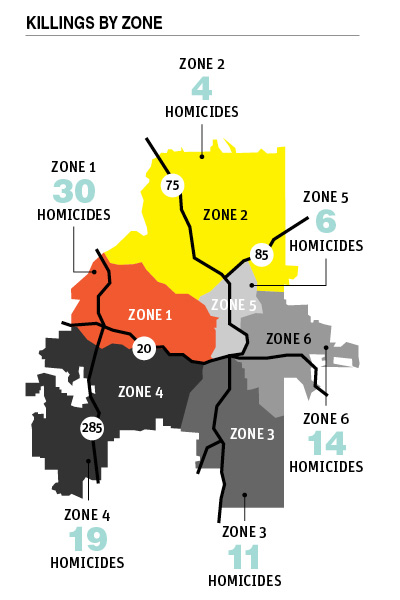
The Homicide Report

Just how safe is Atlanta? 
Here is a list of the most dangerous big cities (over 200,000 in population) compiled by Law Street Media. The analysis, released last November, compared cities according to their rates of violent crime in 2012—murder, rape, robbery, and aggravated assault. Data came from the FBI’s Uniform Crime Reports.

1.  Detroit
2.  Oakland
3.  St. Louis
4.   Memphis
5.   Stockton, California
6.   Birmingham
7.   Baltimore
8.   Cleveland
9.   Atlanta
10.  Milwaukee

Law Street Media released an update to its list in February, using FBI stats from the first half of 2013. Compared with the same period in 2012, violent crime in Atlanta was down 9.75 percent, thanks to drops in rapes, murders, and aggravated assaults. Robberies, however, were up 11.23 percent in the first six months of 2013, compared with the year before. In 1960, when the city’s population was 487,000, the homicide rate was low. Rates peaked in 1990 (reflecting national trends), when population had dropped to 394,000. Today, homicides are falling and the population is increasing (444,000 in 2012). 


From the police reports 
> In early May,
a couple was returning home after eating at a fast-food restaurant. “Several black males exited a vehicle on Lowe Street and approached them with guns drawn. They robbed the victims outside, and then ordered the victims into the house. As they entered the house, the male victim began to fight with the robbers. One of the robbers fired his weapon several times.” The man died of the gunshot wounds.

> According to eyewitnesses, on Sunday, December 1, Marilyn Taylor-Redding was walking down Gartrell Street in the Old Fourth Ward when Alex Mason, who was in his silver PT Cruiser, revved the engine, “put the vehicle in drive, jumped the curb, and ran Ms. Taylor-Redding over, causing her death.” Neighbors grabbed Mason and held him until police arrived.

> Officers arrived at Magic City, a club on Forsyth Street, to find two men shot right after “a large fight between 20 to 30 people occurred inside the club. After the fight, a large group of people were escorted outside of Magic City. The two victims exited the club at this time and proceeded to their vehicle. They began to drive off when someone suddenly fired into the driver-side window, striking both.” 


By the numbers
65

Number of 2013’s 84 cases in which a suspect had been charged by the year’s end.   
10
Number of homicides in November 2013, the month with the highest number. The lowest: March, with three.   
84
The age of the oldest victim, who was stabbed to death by her husband in an attempted murder-suicide. 
1/1/2013 
Date of the year’s first homicide. Jared Billings was shot and killed on New Year’s Day. The last homicide of the year was the death of Amin Bouchelaghem, who was killed December 30.

The most lawless year in Atlanta’s history

In August 1844, a New Englander by the name of Jonathan Norcross opened a sawmill at the corner of Decatur and Pratt streets; powered by a blind and ancient horse, it was the first manufacturing operation in Marthasville, the little town sprouting around the terminus of the Western and Atlantic railway.

Norcross had one big customer: the new Georgia Railroad. His mill churned out crossties, and he gave away scrap slabs of wood to poor mill workers. The cluster of cabins and shanties built using these remnants was soon known as Slabtown. Norcross ran the mill for one year, then moved on to new ventures, eventually opening his own store. Bonding with his fellow merchants and aspiring civic leaders, Norcross joined the movement to obtain a city charter and to change Marthasville’s name; Atlanta was the ultimate choice. Perhaps because of his upbringing as the son of a minister, Norcross wanted to set a moral tone for the fast-growing city.

This would not be easy. While the popular image of antebellum Atlanta is one of Southern charm and gracious manners, the railroad town had more in common with the Wild West. By 1850, the city of 2,500 was home to forty saloons. Criminals clustered in Slabtown and nearby Murrel’s Row, a stretch of Decatur Street where the primary enterprises were cockfighting and “groggery.” Even more notorious was Snake Nation, an enclave of log cabins and wood huts along old Whitehall Road (now Peters Street). It reportedly earned its nickname from snake oil peddlers, but was home to far more unsavory characters.

The battle between Atlanta’s merchant and railroad class and the Snake Nation toughs raged during the 1851 mayoral election. The first group founded the Moral Party, with Norcross as its candidate. Snake
Nation was loyal to the Free and Rowdy Party, which fielded a onetime city councilman and lawyer, who added a veneer of respectability. The Rowdies canvassed in saloons, winning support by picking up bar tabs. Norcross campaigned with more traditional public forums and wholesome handouts: apples and candy.

After winning the election, Mayor Norcross was saddled with an extra job—running police court. The Moral Party was eager to round up the Rowdies and throw them in Atlanta’s new jail, which replaced a log stockade so shoddily built that prison breaks were routine: Inmates either burrowed through its dirt floor or used brute force to simply topple the whole thing over. In the most audacious escape, friends of inmates came at night and lifted the stockade off the ground so the prisoners inside could crawl out. The new prison, constructed with a cement floor and prisoner-retaining frame structure, was escape-proof.

A few days into his mayoral term, Norcross held police court. First on the docket: a Rowdy accused of street fighting. Norcross issued a guilty verdict, levied a fine, and called for the next case.

Not so fast, said the sentenced man. He stood up and waved a “wicked-looking bowie knife,” threatening to butcher everyone in the court. Norcross grabbed his chair and brandished it like a lion tamer. The man with the knife slipped away in the chaos.

The next night, Rowdy Party members ventured to Decatur and came back hauling the city’s cannon—an artifact of the War of 1812. Decaturites fired the cannon to celebrate holidays, but the Rowdies had another idea in mind. They set up the cannon in the middle of the street, pointed it directly at Norcross’s store, and fired. Loaded with sand and gravel, the cannon caused a lot of mess but little damage. The Rowdies left a note: Resign, or the next shot will be serious.

For several weeks, Norcross and the city police arrested and imprisoned residents of Snake Nation and Rowdy Party ringleaders. When the jail filled, they put prisoners under house arrest.

Late one night, Moral Party faithful and deputized Atlantans swept into Snake Nation. Disguised under hoods, they entered houses and bars, whipping men and capturing women. The men were chased to the outskirts of town and the women loaded onto wagons and dropped off in Decatur. The “white cap” citizens’ brigade then made its way through Snake Nation and Slabtown, setting buildings on fire. In Slabtown, every house built from scraps of lumber that Norcross gave away burned to the ground; all of Snake Nation was destroyed.

The Slabtown area rebuilt quickly; Decatur Street remained Atlanta’s epicenter of drunk and disorderly goings-on into the early 1900s. But it would be years before anything was constructed on the ashes of Snake Nation. Eventually, just as Norcross had decades earlier, another merchant came to town. That man, Daniel Castleberry, opened a shop at the intersection of Peters and Fair streets, and in what would become a longstanding Atlanta tradition, the former Snake Nation was rebranded as Castleberry Hill.

This article originally appeared in our May 2014 issue.

Where guns go to die

0

The Atlanta field office of the federal Bureau of Alcohol, Tobacco, Firearms, and Explosives seized more than 900 firearms last fiscal year. Some end up in museums, while others are repurposed for use by law enforcement. But most of them are destroyed. The ATF outsources the destruction of firearms but oversees it carefully. The cache of weaponry pictured here was rendered forever unusable by a blowtorch. Other weapons are fed into metal shredders. Second Amendment fans: Do not mourn these weapons. In 2012, according to the ATF, U.S. manufacturers churned out more than 8.5 million guns—a record year. Georgia’s contribution to the national arsenal was substantial: 135,951 pistols, fourteen revolvers, 7,742 rifles, and 883 weapons the ATF classifies as “miscellaneous.”

Photographs by Greg Miller

This article originally appeared in our May 2014 issue.

How it feels to be a crime-fighting superhero

“The Crimson Fist,” 27, Volunteer Crusader, Castleberry Hill

On a cold, dark night, the Crimson Fist gulped an energy drink and marched into the bowels of Atlanta—the Gulch—where he dodged screaming freight trains, prowled the weeds for stolen property, and searched under bridges for homeless men he knows by name. A typical night, basically. Raised on X-Men comics and superhero flicks in Gwinnett County, this homespun vigilante dons a red mask and carries pepper spray and a stun gun to patrol Castleberry Hill three nights a week. Sometimes joined by his sidekick (and wife), Metadata, he’s been foot-patrolling the city since 2006, using Atlanta police crime data to chart his courses. He’s contributed to the arrests of a couple dozen ne’er-do-wells, from vehicle larcenists to Nelson Street dope pushers.

I didn’t have costumes when I first started. I just decided to go Downtown and do it. I got off the train and started walking. About two years in, I came across my first crime. I was walking just north of Woodruff Park and heard breaking glass. There was a kid leaning in the window of a car. At the time, I didn’t have a very good mind-set about what it was to be a superhero. I only knew what I’d seen Batman do, and I was going to do that. I went over and pulled the kid out of the car, and I just started hitting him. I hit him more than I should have. I said, “Don’t ever let me catch you out here again,” and he ran off. I literally had his blood on my hands, and I realized that I didn’t help anybody that night. The name, the costume, all of that is a reminder: That kid’s blood is always going to be on my hands.

I’m on really good terms with most of the beat cops around here, to the point if they’re looking for a suspicious person and they spot me, they say, “Look out for this.” I feel like when you see somebody who needs help, you have to help them. It might not end well for you, but you have to help them.

If I have to get in a fight, I’ll fight really dirty. My [martial arts instructor] taught me to kick them in the dick, gouge their eyes, bite their face—whatever you have to do to win. It takes a very particular kind of crazy to really stick with this.

I work with kids a lot, and I’d like to be a role model for them. I’d like them to say to themselves, What would Crimson Fist do? Everyone has a part to play making their city or their neighborhood a better place. I feel like this is mine.

This article originally appeared in our May 2014 issue.

How it feels to be burglarized

Nicole Guerrero, 41, Personal Stylist, East Atlanta

Nicole Guerrero and her husband moved to East Atlanta in February 2012. It didn’t take long before they were initiated into a club where no one wants to be a member.

It seemed like a rite of passage almost, the first time we were broken into in East Atlanta. We had moved there in February of 2012, and that June, while I was out with friends after work, my husband came home to see that someone had come in through the back window and stolen a TV and a computer.

We weren’t using our alarm at the time, so we took it as a lesson learned. We didn’t make any changes in the house, except to start using the alarm system religiously. But it didn’t impact our daily comings and goings.

The second break-in happened in September of 2013. That was a bigger deal for us. We were sitting at a restaurant, getting some pizza, when the alarm company called. The front door had been kicked in, and our dog was missing. And they had taken quite a bit more stuff this go-round: both TVs, the computer we had just replaced, a camera.

We took the day off and plastered the entire area with flyers about our lost dog, a dalmatian and pit bull mix. We’d get a call and drop everything to go look for her, but we couldn’t find her. Our neighborhood really came together to help us. We spent three days looking. On the last day, at 7 p.m., we were just emotionally and physically drained, and we got a call that she’d just come out of the woods. People were out, pointing and saying, “She went that way,” and a guy in a truck said he’d seen her and drove my husband to go catch her. We were so glad to get her home, safe.

With this second break-in, I was angry. Angry because of the stuff, sure—it was financially a bigger loss—but all of that could be replaced. For me it was the fear of not being able to leave my house. I felt like I was being forced to spend money on additional security measures, and I didn’t feel like I could even go out to dinner or leave for a few hours on a Sunday. When we did go out, we were constantly watching the feed from our security cameras on our phones. It was this fear of leaving the house and wondering what we were going to come home to.

The police reports have been pretty grim in the area. It makes you fearful, but we’re feeling a little better as time goes on. I’m not going to lie and say we haven’t thought about moving. But about 90 percent of the time we love our home, our neighborhood, and the access it provides. So we’re here, and committed. But it’s still very frustrating.

I went to a court hearing for a suspect in some robberies in Decatur, just to show community support and to see the process. I wanted to help send a message that we’re watching. We’re paying attention. This is our neighborhood, our community. We’re done, and we’re over it.

This article originally appeared in our May 2014 issue.

Follow Us

69,386FansLike
144,836FollowersFollow
493,480FollowersFollow

NEWSLETTERS